1. THE EARTH’S CRUST.
A) The earth’s structure.
 The Earth is a rocky, almost spherical planet divided into three concentric
layers:
① The core consists of the inner core and
the outer core (molten materials).
② The mantle is made up of materials
such as molten rock or magma.
③ The crust is a layer of solid rock
such as basalt or granite. The outer
part of the crust is the lithosphere.
 The Earth’s temperature increases with depth.
 The activity inside the Earth can be seen on the Earth’s crust, because this
produces different types of relief.
B) Oceans and continents:
 71% of the Earth’s surface is covered by water.
 29% or the Earth’s surface is the dry land of the continents.
 Continents: are very large land masses surrounded by oceans and seas.
• Asia
• America
• Africa
• Antarctica
• Europe
• Oceania.
 Oceans: are vast masses of saltwater that are connected to each other.
• Pacific Ocean (largest and deeptest).
• Atlantic Ocean (2nd largest).
• Indian Ocean.
• Southern Ocean (frozen so much of the year).
• Artic Ocean (mainly frozen, the smallest).
2. WHAT IS THE EARTH’S RELIEF?
Relief: Consisting of all the features, such as the mountains and
valleys,
which make the terrain so varied (watch the vocabulary
presentation!!!)
a) Continental relief:
 Mountains
(mountain ranges)
 Valleys
 Plains
 Plateaus
 Basins
b) Coastal relief:
 Cliffs
 Beaches
 Peninsula
 Isthmus
 Cape
 Island
 Gulf
 Bay
c) Ocean floor ’ s
relief:
 Continentel shelf
 Continental slope
 Abyssal plains
 Mid-ocean ridges
 Ocean trenches
3. INTERNAL FORCES OF RELIEF.
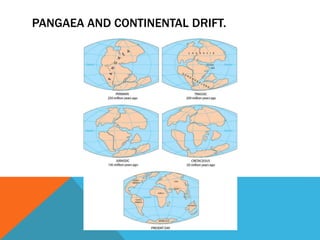
 THEORY OF CONTINENTAL DRIFT:
 Many million years ago there was only a single super-continent, called
Pangaea, which broke up into fragments to make the continents we have
today.
 Look at the coasts of the current continents, we can see that they seem
to match like an enormous jigsaw.
PANGAEA AND CONTINENTAL DRIFT.
 TECTONIC PLATES:
 The Earth’s crust is not just one big piece of rock. It is divided into smaller pieces of
crust called tectonic plates.
 The plates move because the mantle underneath them is moving, but they only
move very slowly.
 The places where the plates meet are called plate boundaries or plate margins.
WHAT HAPPENS WHEN THE PLATES MOVE?
 FAULTS AND FOLDS:
 Below the surface of the Earth, gases and compressed materials put
pressure on the crust. They can deform it or make it crack. They are
called INTERNAL FORCES.
 The Earth’s surface ondulates or fractures by the pressure from molten
materials in the mantle.
 When Earth’s surface ondulates FOLDS are created.
 When the surface is extremely ridig FAULTS are
created, and one block rise while the other sink.
 Fold:
• When two plates move towards each other the Earth’s surface is forced
upwards or folded.
• This happens very slowly.
 Faults:
• When the plates againts each other, pressure can build up. Sometimes
this causes the rock to split, making a fault in the rock.
• On one side of the fault, the ground rises, and on the other side it falls.
 VOLCANOES:
• A volcano is an openning in the surface of the Earth through which very hot
material (magma) comes out.
• When magma comes out of a volcano, it is called lava.
• Volcanic cones are the result of lava accumulating outside the opening.
• Volcanoes are generally found on the edge os tectonic plates because this is
the weakest part of the Earth’s crust.
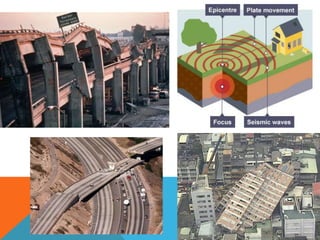
 EARTHQUAKES:
• Sometimes the increase in pressure at a plate boundary can cause a release
of energy that makes the ground shake. This is called a earthquake.
• The point in the ground where the earthquake starts is called the focus or
hypocentre.
• Shock waves or seismic waves are vibrations that spread out from the focus.
• The epicentre is the point on the Earth’s surface above the focus.
• We measure the strength of an earthquake using the Richter Scale.
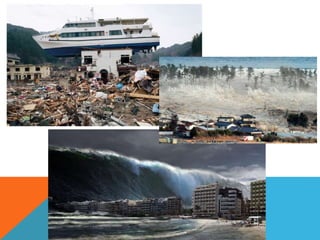
 TSUNAMIS:
• If earthquakes and volcanic eruptions happen in or near the sea, they can
displace sea water, and this causes a tsunami.
• A tsunami is a series of enormous waves.
• It can cause a lot of damage to coastal areas.
• TEDeD lesson:https://ed.ted.com/lessons/how-tsunamis-work-alex-
gendler#watch
Remember: the earth’s crust
 It is thicker where it forms the continents and thinner where the oceans cover
it.
 The crust is not smooth, there are features of land relief (mountains, valleys,
basins or depressions and plains) on land and under the sea.
 The Earth’s relief is constantly changing because of internal and external
forces.
HOW DOES RELIEF CHANGE?
o The Earth’ relief is shaped by its internal forces: pressures (the
movement of tectonic plates: folds and faults), volcanoes and
earthquakes.
o Relief is also shaped by external agents on the Earth’s surface
(external forces): water, wind, changes of temperature and living
things (human action).
o All of these external agents modify relief by three processes:
 Erosion: materials, such as rocks and soil, are broken up and moved
around by external agents.
 Transportation: these materials are then transported by seas, rivers,
ice or wind.
 Deposition: eroded rocks, sand and mud are deposited in low areas
where the sediments acumulate.
EXTERNAL FORCES OF RELIEF
o Water: plays a very important role in erosion, transport and deposition (rivers,
seas and oceans, rain water and ground water).
EXTERNAL FORCES OF RELIEF
o Wind: (aeolian erosion)
 Is when wind erodes and transports rocks and sand.
 It often occurs in dry climates, sucha as deserts, because there is little
vegetation to protect the soil.
o Changes of temperature:
 In deserts or mountainous areas it is much hotter during the day than at
night-time.
 Water sometimes enter the cracks in rocks. It may break the rocks if it
freezes and expands.
o Living things:
 Vegetation or animals.
 Human action: through activities such as agriculture, deforestaion or mining.
Roads or reservoirs are man-made features of the Earth’s relief.

Unit2.theearth'srelief

  • 2.
    1. THE EARTH’SCRUST. A) The earth’s structure.  The Earth is a rocky, almost spherical planet divided into three concentric layers: ① The core consists of the inner core and the outer core (molten materials). ② The mantle is made up of materials such as molten rock or magma. ③ The crust is a layer of solid rock such as basalt or granite. The outer part of the crust is the lithosphere.  The Earth’s temperature increases with depth.  The activity inside the Earth can be seen on the Earth’s crust, because this produces different types of relief.
  • 3.
    B) Oceans andcontinents:  71% of the Earth’s surface is covered by water.  29% or the Earth’s surface is the dry land of the continents.  Continents: are very large land masses surrounded by oceans and seas. • Asia • America • Africa • Antarctica • Europe • Oceania.  Oceans: are vast masses of saltwater that are connected to each other. • Pacific Ocean (largest and deeptest). • Atlantic Ocean (2nd largest). • Indian Ocean. • Southern Ocean (frozen so much of the year). • Artic Ocean (mainly frozen, the smallest).
  • 7.
    2. WHAT ISTHE EARTH’S RELIEF? Relief: Consisting of all the features, such as the mountains and valleys, which make the terrain so varied (watch the vocabulary presentation!!!) a) Continental relief:  Mountains (mountain ranges)  Valleys  Plains  Plateaus  Basins b) Coastal relief:  Cliffs  Beaches  Peninsula  Isthmus  Cape  Island  Gulf  Bay c) Ocean floor ’ s relief:  Continentel shelf  Continental slope  Abyssal plains  Mid-ocean ridges  Ocean trenches
  • 8.
    3. INTERNAL FORCESOF RELIEF.  THEORY OF CONTINENTAL DRIFT:  Many million years ago there was only a single super-continent, called Pangaea, which broke up into fragments to make the continents we have today.  Look at the coasts of the current continents, we can see that they seem to match like an enormous jigsaw.
  • 9.
  • 10.
     TECTONIC PLATES: The Earth’s crust is not just one big piece of rock. It is divided into smaller pieces of crust called tectonic plates.  The plates move because the mantle underneath them is moving, but they only move very slowly.  The places where the plates meet are called plate boundaries or plate margins.
  • 11.
    WHAT HAPPENS WHENTHE PLATES MOVE?  FAULTS AND FOLDS:  Below the surface of the Earth, gases and compressed materials put pressure on the crust. They can deform it or make it crack. They are called INTERNAL FORCES.  The Earth’s surface ondulates or fractures by the pressure from molten materials in the mantle.  When Earth’s surface ondulates FOLDS are created.  When the surface is extremely ridig FAULTS are created, and one block rise while the other sink.
  • 12.
     Fold: • Whentwo plates move towards each other the Earth’s surface is forced upwards or folded. • This happens very slowly.
  • 13.
     Faults: • Whenthe plates againts each other, pressure can build up. Sometimes this causes the rock to split, making a fault in the rock. • On one side of the fault, the ground rises, and on the other side it falls.
  • 14.
     VOLCANOES: • Avolcano is an openning in the surface of the Earth through which very hot material (magma) comes out. • When magma comes out of a volcano, it is called lava. • Volcanic cones are the result of lava accumulating outside the opening. • Volcanoes are generally found on the edge os tectonic plates because this is the weakest part of the Earth’s crust.
  • 16.
     EARTHQUAKES: • Sometimesthe increase in pressure at a plate boundary can cause a release of energy that makes the ground shake. This is called a earthquake. • The point in the ground where the earthquake starts is called the focus or hypocentre. • Shock waves or seismic waves are vibrations that spread out from the focus. • The epicentre is the point on the Earth’s surface above the focus. • We measure the strength of an earthquake using the Richter Scale.
  • 18.
     TSUNAMIS: • Ifearthquakes and volcanic eruptions happen in or near the sea, they can displace sea water, and this causes a tsunami. • A tsunami is a series of enormous waves. • It can cause a lot of damage to coastal areas. • TEDeD lesson:https://ed.ted.com/lessons/how-tsunamis-work-alex- gendler#watch
  • 20.
    Remember: the earth’scrust  It is thicker where it forms the continents and thinner where the oceans cover it.  The crust is not smooth, there are features of land relief (mountains, valleys, basins or depressions and plains) on land and under the sea.  The Earth’s relief is constantly changing because of internal and external forces.
  • 21.
    HOW DOES RELIEFCHANGE? o The Earth’ relief is shaped by its internal forces: pressures (the movement of tectonic plates: folds and faults), volcanoes and earthquakes. o Relief is also shaped by external agents on the Earth’s surface (external forces): water, wind, changes of temperature and living things (human action). o All of these external agents modify relief by three processes:  Erosion: materials, such as rocks and soil, are broken up and moved around by external agents.  Transportation: these materials are then transported by seas, rivers, ice or wind.  Deposition: eroded rocks, sand and mud are deposited in low areas where the sediments acumulate.
  • 22.
    EXTERNAL FORCES OFRELIEF o Water: plays a very important role in erosion, transport and deposition (rivers, seas and oceans, rain water and ground water).
  • 23.
    EXTERNAL FORCES OFRELIEF o Wind: (aeolian erosion)  Is when wind erodes and transports rocks and sand.  It often occurs in dry climates, sucha as deserts, because there is little vegetation to protect the soil. o Changes of temperature:  In deserts or mountainous areas it is much hotter during the day than at night-time.  Water sometimes enter the cracks in rocks. It may break the rocks if it freezes and expands. o Living things:  Vegetation or animals.  Human action: through activities such as agriculture, deforestaion or mining. Roads or reservoirs are man-made features of the Earth’s relief.