MESOPOTAMIA AND EGYPT
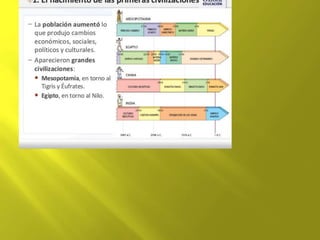
1. THE BIRTH OF THE FIRST CIVILISATIONS
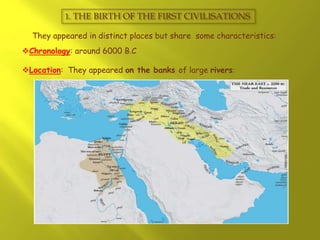
They appeared in distinct places but share some characteristics:
Chronology: around 6000 B.C
Location: They appeared on the banks of large rivers:
They developed irrigation techniques that took advantage
of the rivers´ water abundant harvest population growth
the villages became cities
They created a strong political power and hierarchical societies:
- New skills emerged, e.g gold and silver smithing new social groups.
Each group had a different status ( some people were more important than
others)
- The government and public administration were created to organise the city
- Kings or pharaohs ( divine) and priests had the power and decided the laws.
- Society began to pay taxes
- WRITING appeared around 3500 B.C . It was used for administration
and commerce BEGINNING OF HISTORY
2. MESOPOTAMIA : natural environment and history
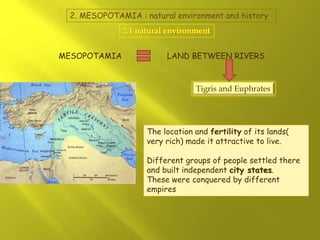
MESOPOTAMIA LAND BETWEEN RIVERS
Tigris and Euphrates
The location and fertility of its lands(
very rich) made it attractive to live.
Different groups of people settled there
and built independent city states.
These were conquered by different
empires
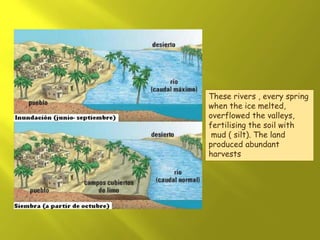
These rivers , every spring
when the ice melted,
overflowed the valleys,
fertilising the soil with
mud ( silt). The land
produced abundant
harvests
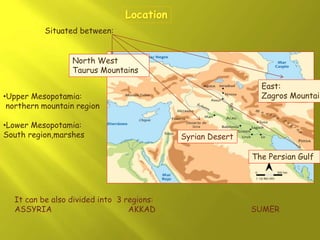
Situated between:
•Upper Mesopotamia:
northern mountain region
•Lower Mesopotamia:
South region,marshes
It can be also divided into 3 regions:
ASSYRIA AKKAD SUMER
North West
Taurus Mountains
East:
Zagros Mountain
The Persian Gulf
Syrian Desert
2.2 THE HISTORY OF MESOPOTAMIA
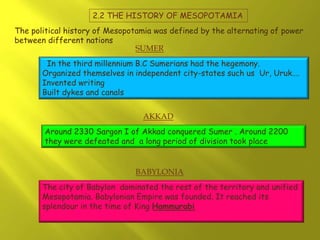
The political history of Mesopotamia was defined by the alternating of power
between different nations:
In the third millennium B.C Sumerians had the hegemony.
Organized themselves in independent city-states such us Ur, Uruk….
Invented writing
Built dykes and canals
Around 2330 Sargon I of Akkad conquered Sumer . Around 2200
they were defeated and a long period of division took place
The city of Babylon dominated the rest of the territory and unified
Mesopotamia. Babylonian Empire was founded. It reached its
splendour in the time of King Hammurabi
SUMER
AKKAD
BABYLONIA
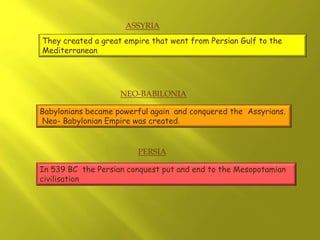
In 539 BC the Persian conquest put and end to the Mesopotamian
civilisation
They created a great empire that went from Persian Gulf to the
Mediterranean
Babylonians became powerful again and conquered the Assyrians.
Neo- Babylonian Empire was created.
ASSYRIA
NEO-BABILONIA
PERSIA
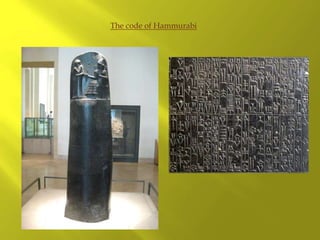
The code of Hammurabi
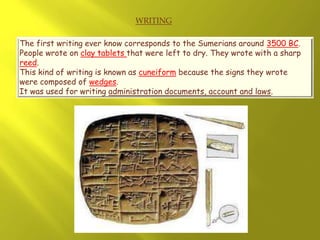
WRITING
The first writing ever know corresponds to the Sumerians around 3500 BC.
People wrote on clay tablets that were left to dry. They wrote with a sharp
reed.
This kind of writing is known as cuneiform because the signs they wrote
were composed of wedges.
It was used for writing administration documents, account and laws.
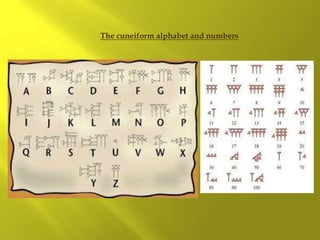
The cuneiform alphabet and numbers
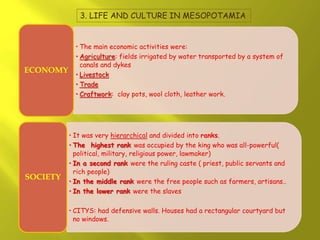
3. LIFE AND CULTURE IN MESOPOTAMIA
• The main economic activities were:
• Agriculture: fields irrigated by water transported by a system of
canals and dykes
• Livestock
• Trade
• Craftwork: clay pots, wool cloth, leather work.
ECONOMY
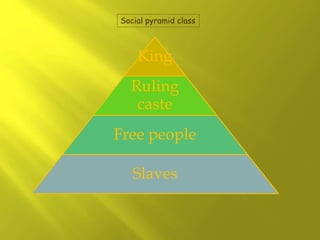
• It was very hierarchical and divided into ranks.
• The highest rank was occupied by the king who was all-powerful(
political, military, religious power, lawmaker)
• In a second rank were the ruling caste ( priest, public servants and
rich people)
• In the middle rank were the free people such as farmers, artisans..
• In the lower rank were the slaves
• CITYS: had defensive walls. Houses had a rectangular courtyard but
no windows.
SOCIETY
Imagen anaya pag 104
King
Ruling
caste
Free people
Slaves
Social pyramid class
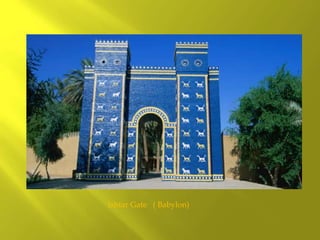
Ishtar Gate ( Babylon)
• Mesopotamians were polytheistic( several gods)
• Gods were human-shaped but were immortal.
• They also believed in life after death.
• Temples were the houses of the gods
RELIGION
• There were libraries.
• Arts: epic of Gilgamesh, The code of Hammurabi.
• They made advances in sciences: maths, astronomy,
medicine…
ARTS
and
SCIENCES
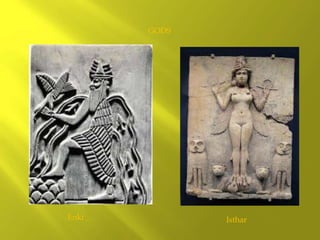
Enki Isthar
GODS
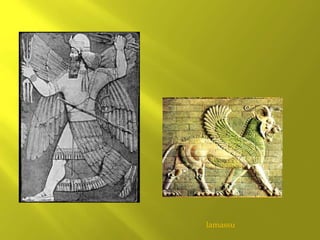
lamassu
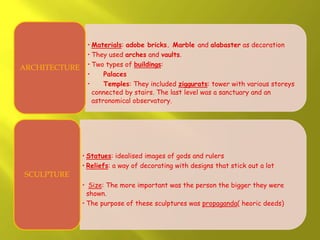
• Materials: adobe bricks. Marble and alabaster as decoration
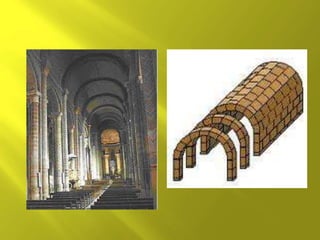
• They used arches and vaults.
• Two types of buildings:
• Palaces
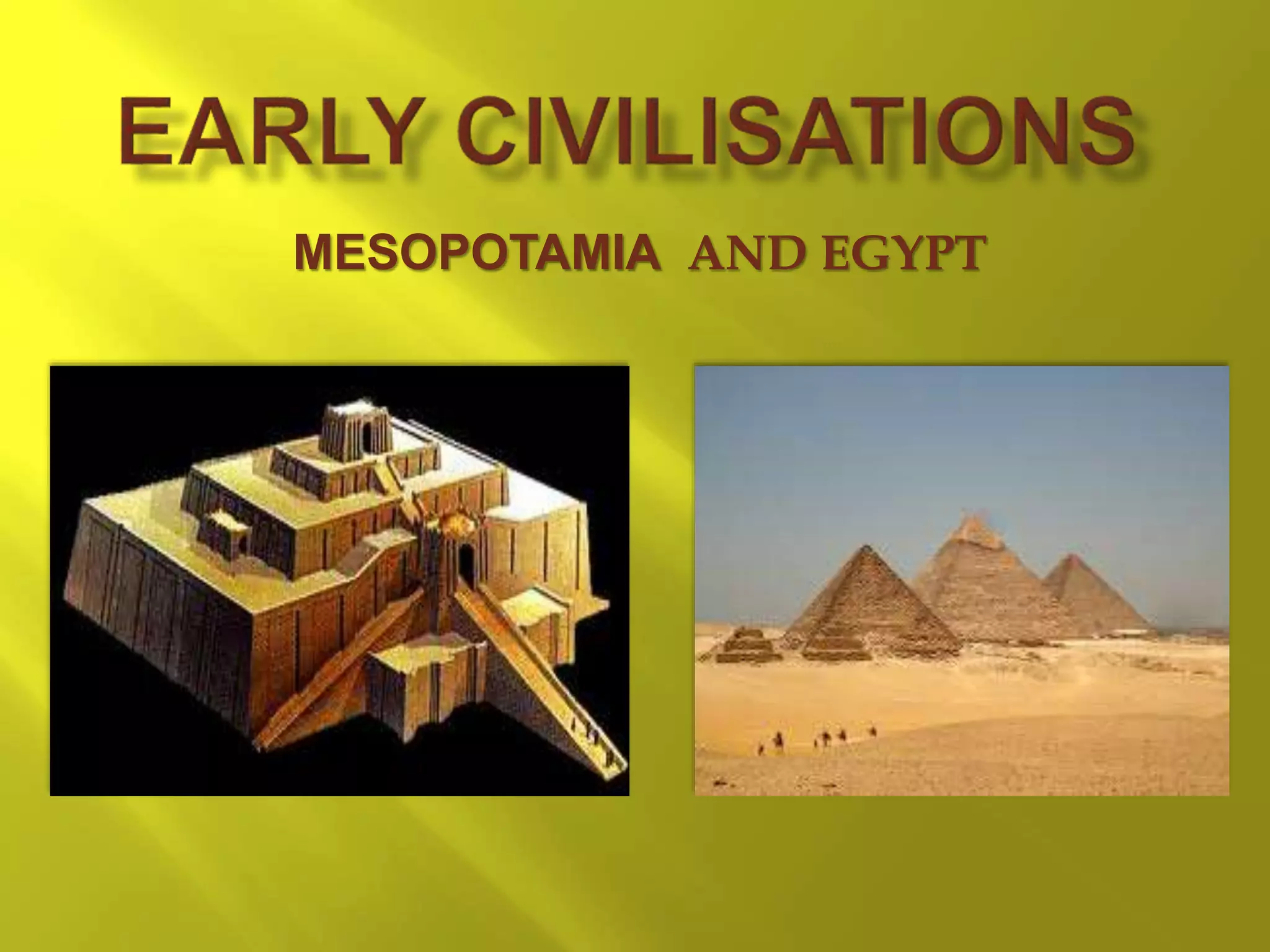
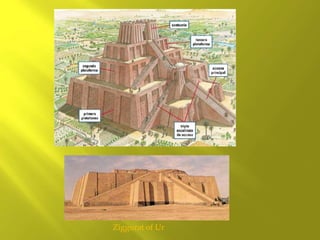
• Temples: They included ziggurats: tower with various storeys
connected by stairs. The last level was a sanctuary and an
astronomical observatory.
ARCHITECTURE
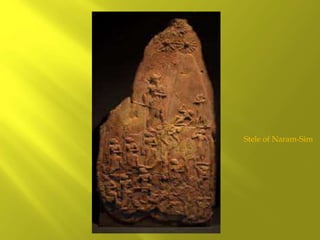
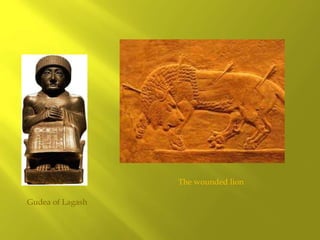
• Statues: idealised images of gods and rulers
• Reliefs: a way of decorating with designs that stick out a lot
• Size: The more important was the person the bigger they were
shown.
• The purpose of these sculptures was propaganda( heoric deeds)
SCULPTURE
Ziggurat of Ur
Stele of Naram-Sim
The wounded lion
Gudea of Lagash
Early civilisations
Early civilisations
Early civilisations

Early civilisations

  • 1.
  • 2.
    1. THE BIRTHOF THE FIRST CIVILISATIONS They appeared in distinct places but share some characteristics: Chronology: around 6000 B.C Location: They appeared on the banks of large rivers:
  • 3.
    They developed irrigationtechniques that took advantage of the rivers´ water abundant harvest population growth the villages became cities They created a strong political power and hierarchical societies: - New skills emerged, e.g gold and silver smithing new social groups. Each group had a different status ( some people were more important than others) - The government and public administration were created to organise the city - Kings or pharaohs ( divine) and priests had the power and decided the laws. - Society began to pay taxes - WRITING appeared around 3500 B.C . It was used for administration and commerce BEGINNING OF HISTORY
  • 4.
    2. MESOPOTAMIA :natural environment and history MESOPOTAMIA LAND BETWEEN RIVERS Tigris and Euphrates The location and fertility of its lands( very rich) made it attractive to live. Different groups of people settled there and built independent city states. These were conquered by different empires
  • 5.
    These rivers ,every spring when the ice melted, overflowed the valleys, fertilising the soil with mud ( silt). The land produced abundant harvests
  • 6.
    Situated between: •Upper Mesopotamia: northernmountain region •Lower Mesopotamia: South region,marshes It can be also divided into 3 regions: ASSYRIA AKKAD SUMER North West Taurus Mountains East: Zagros Mountain The Persian Gulf Syrian Desert
  • 7.
    2.2 THE HISTORYOF MESOPOTAMIA The political history of Mesopotamia was defined by the alternating of power between different nations: In the third millennium B.C Sumerians had the hegemony. Organized themselves in independent city-states such us Ur, Uruk…. Invented writing Built dykes and canals Around 2330 Sargon I of Akkad conquered Sumer . Around 2200 they were defeated and a long period of division took place The city of Babylon dominated the rest of the territory and unified Mesopotamia. Babylonian Empire was founded. It reached its splendour in the time of King Hammurabi SUMER AKKAD BABYLONIA
  • 8.
    In 539 BCthe Persian conquest put and end to the Mesopotamian civilisation They created a great empire that went from Persian Gulf to the Mediterranean Babylonians became powerful again and conquered the Assyrians. Neo- Babylonian Empire was created. ASSYRIA NEO-BABILONIA PERSIA
  • 9.
    The code ofHammurabi
  • 10.
    WRITING The first writingever know corresponds to the Sumerians around 3500 BC. People wrote on clay tablets that were left to dry. They wrote with a sharp reed. This kind of writing is known as cuneiform because the signs they wrote were composed of wedges. It was used for writing administration documents, account and laws.
  • 11.
  • 12.
    3. LIFE ANDCULTURE IN MESOPOTAMIA • The main economic activities were: • Agriculture: fields irrigated by water transported by a system of canals and dykes • Livestock • Trade • Craftwork: clay pots, wool cloth, leather work. ECONOMY • It was very hierarchical and divided into ranks. • The highest rank was occupied by the king who was all-powerful( political, military, religious power, lawmaker) • In a second rank were the ruling caste ( priest, public servants and rich people) • In the middle rank were the free people such as farmers, artisans.. • In the lower rank were the slaves • CITYS: had defensive walls. Houses had a rectangular courtyard but no windows. SOCIETY
  • 13.
    Imagen anaya pag104 King Ruling caste Free people Slaves Social pyramid class
  • 14.
    Ishtar Gate (Babylon)
  • 15.
    • Mesopotamians werepolytheistic( several gods) • Gods were human-shaped but were immortal. • They also believed in life after death. • Temples were the houses of the gods RELIGION • There were libraries. • Arts: epic of Gilgamesh, The code of Hammurabi. • They made advances in sciences: maths, astronomy, medicine… ARTS and SCIENCES
  • 16.
  • 17.
  • 18.
    • Materials: adobebricks. Marble and alabaster as decoration • They used arches and vaults. • Two types of buildings: • Palaces • Temples: They included ziggurats: tower with various storeys connected by stairs. The last level was a sanctuary and an astronomical observatory. ARCHITECTURE • Statues: idealised images of gods and rulers • Reliefs: a way of decorating with designs that stick out a lot • Size: The more important was the person the bigger they were shown. • The purpose of these sculptures was propaganda( heoric deeds) SCULPTURE
  • 19.
  • 20.
  • 21.