Unit3PassiveVoiceGrammar Notes
Examples of Passive
Examples of Passive
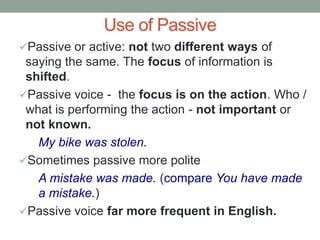
Use of PassivePassive or active: not two differentways of saying the same. The focus of information is shifted.
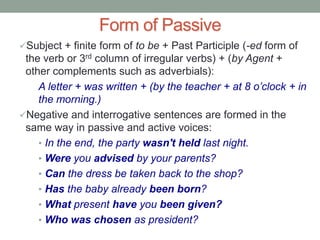
Passive voice -  the focus is on the action. Who / what is performing the action - notimportant or notknown.My bike was stolen.Sometimes passive more polite A mistake was made.(compare You have made a mistake.)Passive voice far more frequent in English.Form of PassiveSubject + finite form of to be + Past Participle (-ed form of the verb or 3rd column of irregular verbs) + (by Agent + other complements such as adverbials):A letter + was written + (by the teacher + at 8 o’clock + in the morning.)Negative and interrogative sentences are formed in the same way in passive and active voices:
In the end, the party wasn't held last night.
Were you advised by your parents?
Can the dress be taken back to the shop?
Has the baby already beenborn?
What present have you been given?
Who was chosen as president?  Rewritingactive sentences in passivevoiceIntransitive active clauses don’t have passive counterpart: happen, die, sleep, exist, go, come, occur, arrive, have, live…We live in Murcia. (Murcia is lived by us.)The finite form of the verb is changed (to be + Past Participle). To be has the same tense in the passive sentence as the verb in the active sentence.
He sold his car last week. (Past simple tense)
His car wassold last week. (Past simple tense)
The object of the active sentence becomes the subject of the passive sentence:
He sold his car last week.
His car was sold last week. 
Rewritingactive sentences in passivevoiceSome active verbs are ditransitive(an Oi referring to people and an Od referring to things). In passive voice one of the two objects becomes the subject, the other one remains an object.
Which object to transform into a subject depends on what you want to put the focus on. For drilling purposes, it is customary to use the first one:

Bridges2 unit03-cw-passive-10-11

  • 1.
  • 2.
  • 3.
  • 4.
    Use of PassivePassiveor active: not two differentways of saying the same. The focus of information is shifted.
  • 5.
    Passive voice - the focus is on the action. Who / what is performing the action - notimportant or notknown.My bike was stolen.Sometimes passive more polite A mistake was made.(compare You have made a mistake.)Passive voice far more frequent in English.Form of PassiveSubject + finite form of to be + Past Participle (-ed form of the verb or 3rd column of irregular verbs) + (by Agent + other complements such as adverbials):A letter + was written + (by the teacher + at 8 o’clock + in the morning.)Negative and interrogative sentences are formed in the same way in passive and active voices:
  • 6.
    In the end,the party wasn't held last night.
  • 7.
    Were you advisedby your parents?
  • 8.
    Can the dressbe taken back to the shop?
  • 9.
    Has the babyalready beenborn?
  • 10.
    What present haveyou been given?
  • 11.
    Who was chosenas president?  Rewritingactive sentences in passivevoiceIntransitive active clauses don’t have passive counterpart: happen, die, sleep, exist, go, come, occur, arrive, have, live…We live in Murcia. (Murcia is lived by us.)The finite form of the verb is changed (to be + Past Participle). To be has the same tense in the passive sentence as the verb in the active sentence.
  • 12.
    He sold hiscar last week. (Past simple tense)
  • 13.
    His car wassoldlast week. (Past simple tense)
  • 14.
    The object ofthe active sentence becomes the subject of the passive sentence:
  • 15.
    He sold hiscar last week.
  • 16.
    His car wassold last week. 
  • 17.
    Rewritingactive sentences inpassivevoiceSome active verbs are ditransitive(an Oi referring to people and an Od referring to things). In passive voice one of the two objects becomes the subject, the other one remains an object.
  • 18.
    Which object totransform into a subject depends on what you want to put the focus on. For drilling purposes, it is customary to use the first one: