
Edited by: Karla
Romero
What did it do?
•It ate cheese.
The cheese was eaten.
My bike was stolen.
In the example above, the focus is on the fact that
my bike was stolen. I do not know, however, who
did it.
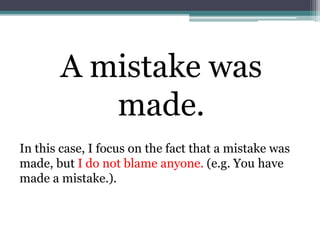
A mistake was
made.
In this case, I focus on the fact that a mistake was
made, but I do not blame anyone. (e.g. You have
made a mistake.).
What is the Passive
• Verbs are also said to be either active or
passive in voice.
• In the active voice, the subject and verb
relationship is straightforward: the subject is a
be-er or a do-er and the verb moves the
sentence along.
• In the passive voice, the subject of the
sentence is neither a do-er or a be-er, but is
acted upon by some other agent or by
something unnamed.
Use of Passive
• Passive voice is used when the focus is on the
action. It is not important or not known,
however, who or what is performing the action.
• We use the passive when:
▫ we want to make the active object more
important
▫ we do not know the active subject
Form of Passive
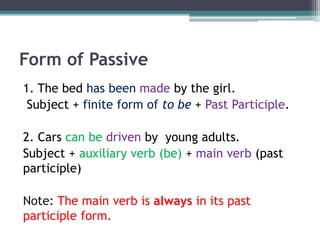
1. The bed has been made by the girl.
Subject + finite form of to be + Past Participle.
2. Cars can be driven by young adults.
Subject + auxiliary verb (be) + main verb (past
participle)
Note: The main verb is always in its past
participle form.
Changing into passive
• When rewriting active sentences in passive
voice, note the following:
1. the object of the active sentence becomes the
subject of the passive sentence
2. the finite form of the verb is changed (to be +
past participle)
3. the subject of the active sentence becomes the
object of the passive sentence (or is dropped)
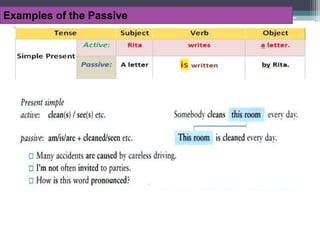
Examples of the Passive
This tense is confusing because the verb "be" appears twice. This
example uses the verb "tell" as the main verb: tell / told / told
Singular Plural
I am being told We are being told
You are being told You are being told
He is being told
She is being told They are being told
It is being told
The Present Continuous, Passive Voice
S + (be) + being + past participle
Examples of the Passive
The Passive Present Progressive:
The book is being read by the boy.
Pancakes are being made in the kitchen.
Flowers are being grown in this garden.
This tense is confusing because the verb "be" appears twice. This example uses the
verb "teach" as the main verb: teach / taught / taught
Singular Plural
I was being taught We were being taught
You were being taught You were being taught
He was being taught
She was being taught They were being taught
It was being taught
* This is similar to the causative form which we will look at in Lesson 15, Green Level.
The Past Continuous, Passive Voice
S + (be: was or were) + being + past participle
Examples of the Passive
The Passive Past Progressive:
The book was being read by the boy.
Pancakes were being made in the kitchen.
Flowers were being grown in this garden.
Passive Voice Slides

Passive Voice Slides

  • 1.
  • 2.
    What did itdo? •It ate cheese.
  • 3.
  • 8.
    My bike wasstolen. In the example above, the focus is on the fact that my bike was stolen. I do not know, however, who did it.
  • 9.
    A mistake was made. Inthis case, I focus on the fact that a mistake was made, but I do not blame anyone. (e.g. You have made a mistake.).
  • 10.
    What is thePassive • Verbs are also said to be either active or passive in voice. • In the active voice, the subject and verb relationship is straightforward: the subject is a be-er or a do-er and the verb moves the sentence along. • In the passive voice, the subject of the sentence is neither a do-er or a be-er, but is acted upon by some other agent or by something unnamed.
  • 11.
    Use of Passive •Passive voice is used when the focus is on the action. It is not important or not known, however, who or what is performing the action. • We use the passive when: ▫ we want to make the active object more important ▫ we do not know the active subject
  • 13.
    Form of Passive 1.The bed has been made by the girl. Subject + finite form of to be + Past Participle. 2. Cars can be driven by young adults. Subject + auxiliary verb (be) + main verb (past participle) Note: The main verb is always in its past participle form.
  • 14.
  • 15.
    Changing into passive •When rewriting active sentences in passive voice, note the following: 1. the object of the active sentence becomes the subject of the passive sentence 2. the finite form of the verb is changed (to be + past participle) 3. the subject of the active sentence becomes the object of the passive sentence (or is dropped)
  • 17.
  • 18.
  • 19.
  • 20.
  • 21.
  • 23.
    This tense isconfusing because the verb "be" appears twice. This example uses the verb "tell" as the main verb: tell / told / told Singular Plural I am being told We are being told You are being told You are being told He is being told She is being told They are being told It is being told The Present Continuous, Passive Voice S + (be) + being + past participle Examples of the Passive
  • 24.
    Examples of thePassive The Passive Present Progressive: The book is being read by the boy. Pancakes are being made in the kitchen. Flowers are being grown in this garden.
  • 25.
    This tense isconfusing because the verb "be" appears twice. This example uses the verb "teach" as the main verb: teach / taught / taught Singular Plural I was being taught We were being taught You were being taught You were being taught He was being taught She was being taught They were being taught It was being taught * This is similar to the causative form which we will look at in Lesson 15, Green Level. The Past Continuous, Passive Voice S + (be: was or were) + being + past participle Examples of the Passive
  • 26.
    Examples of thePassive The Passive Past Progressive: The book was being read by the boy. Pancakes were being made in the kitchen. Flowers were being grown in this garden.