O R C U T T A C A D E M Y H I G H S C H O O L
C O R E C O N N E C T I O N S A L G E B R A 1
Chapter 4
Systems
4-8 to 4-19
4-8. Approximately f = 58 + 7a, where f
is the final exam score (in percent) and
a is the AP score; about 79%
4-9. See below:
a) no solution
b) x = 13
4-10. (−1, 3)
4-11. Cadel is correct because he
followed the exponent rules. Jorge is
incorrect; the problem only contains
multiplication, so there are not two
terms and the Distributive Property
cannot be used. Lauren did not follow
the exponent rules.
4-12. See below:
a) 3y(y − 4) = 3 𝑦2
− 12y
b) (3y + 5)(y − 4) = 3 𝑦2
− 7y − 20
4-13. No; 2 is a prime number and it is
even.
4-14. If x = the length, 2(x) + 2(3x −
1) = 30 width is 4 in., length is 11 in.
4-15. Lakeisha, Samantha, Carly,
Barbara, and Kendra
4-16. She combined terms from
opposite sides of the equation.
Instead, line 4 should read 2x = 14, so
x = 7 is the solution.
4-17. This statement is sometimes
true. It is true when x = 0, but
otherwise it is false because the
Distributive Property states that a(b
+ c) = ab + ac. Students can also
justify this with a diagram of algebra
tiles.
4-18. y = 1/2x + 5/2
4-19. See below:
a) 6𝑥2
− x − 2
b) 6 𝑥3
− 𝑥2
− 12x − 5
4-25 to 4-30
4-25. See below:
a) t – 4; 2(t – 4)
b) 150 – c
c) 14.95c + 39.99v
4-26. If Nina has n nickels, then
5n + 9 + 5(2n) = 84, and n = 5
nickels.
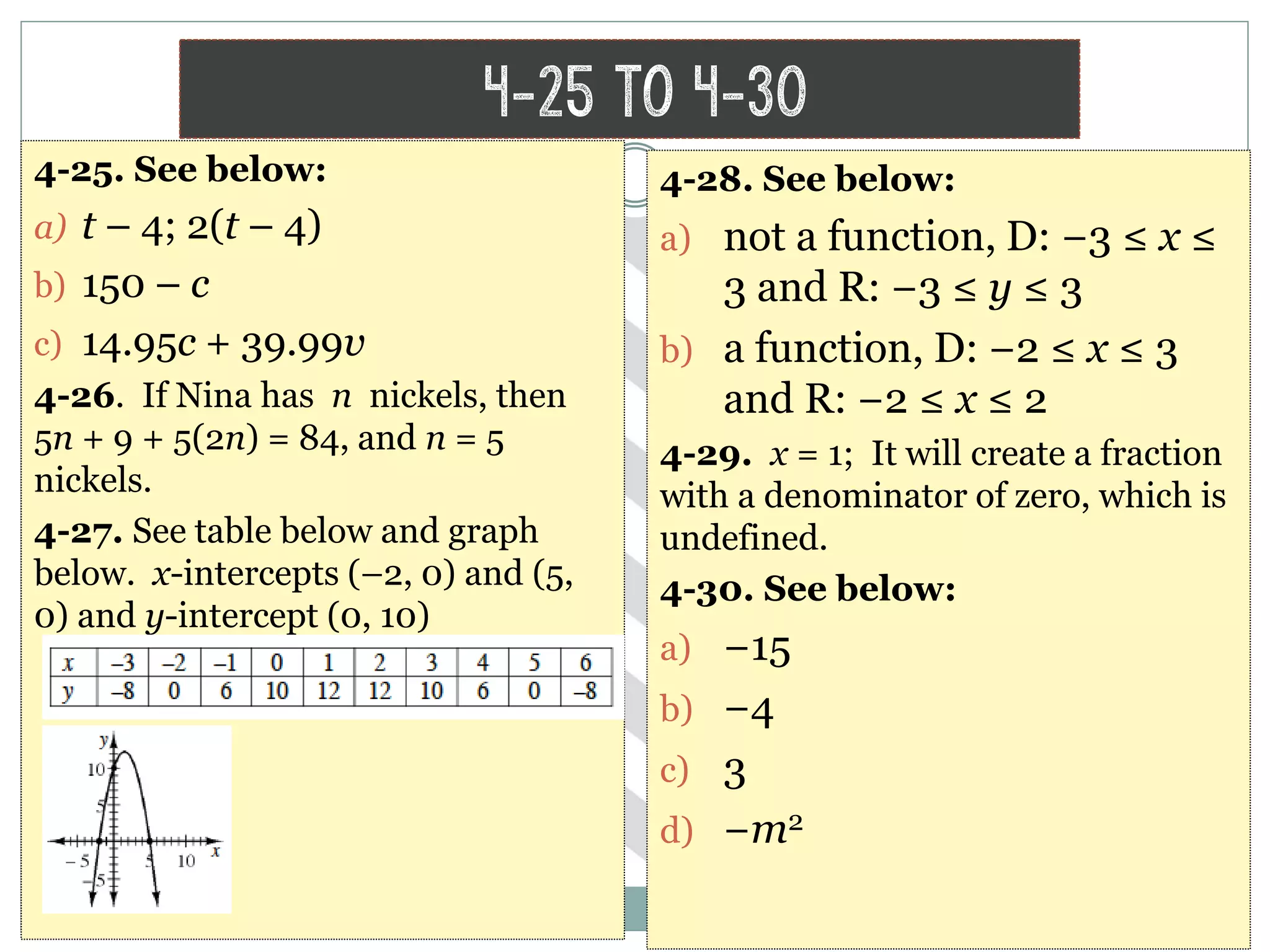
4-27. See table below and graph
below. x-intercepts (–2, 0) and (5,
0) and y-intercept (0, 10)
4-28. See below:
a) not a function, D: −3 ≤ x ≤
3 and R: −3 ≤ y ≤ 3
b) a function, D: −2 ≤ x ≤ 3
and R: −2 ≤ x ≤ 2
4-29. x = 1; It will create a fraction
with a denominator of zero, which is
undefined.
4-30. See below:
a) −15
b) −4
c) 3
d) −m2
4-36 to 4-41
4-36. A very strong positive non-linear
association with no apparent outliers.
4-37. See below:
a) a = 0
b) m = −2
c) x = 10
d) t = 2
4-38. See below:
a) ii
b) 4 touchdowns and 9 field goals
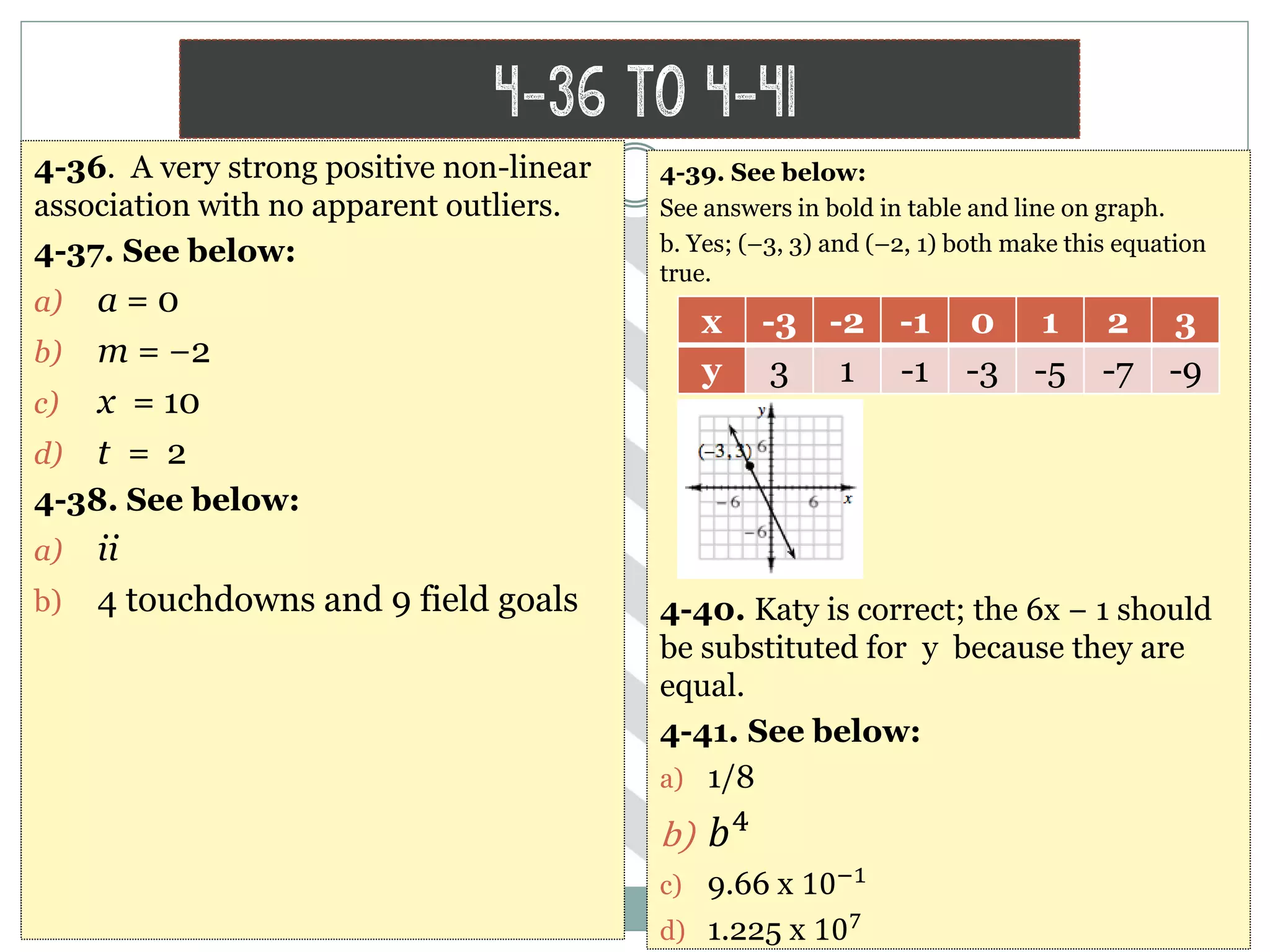
4-39. See below:
See answers in bold in table and line on graph.
b. Yes; (–3, 3) and (–2, 1) both make this equation
true.
4-40. Katy is correct; the 6x − 1 should
be substituted for y because they are
equal.
4-41. See below:
a) 1/8
b) 𝑏4
c) 9.66 x 10⁻¹
d) 1.225 x 10⁷
x -3 -2 -1 0 1 2 3
y 3 1 -1 -3 -5 -7 -9
4-49 to 4-54
4-49. Yes; each point
makes the equation
true.
4-50. See below:
a) (3, 5)
4-51. See below:
a) h = 2c − 3
b) 3h + 1.5c = 201
c) 28 corndogs
were sold.
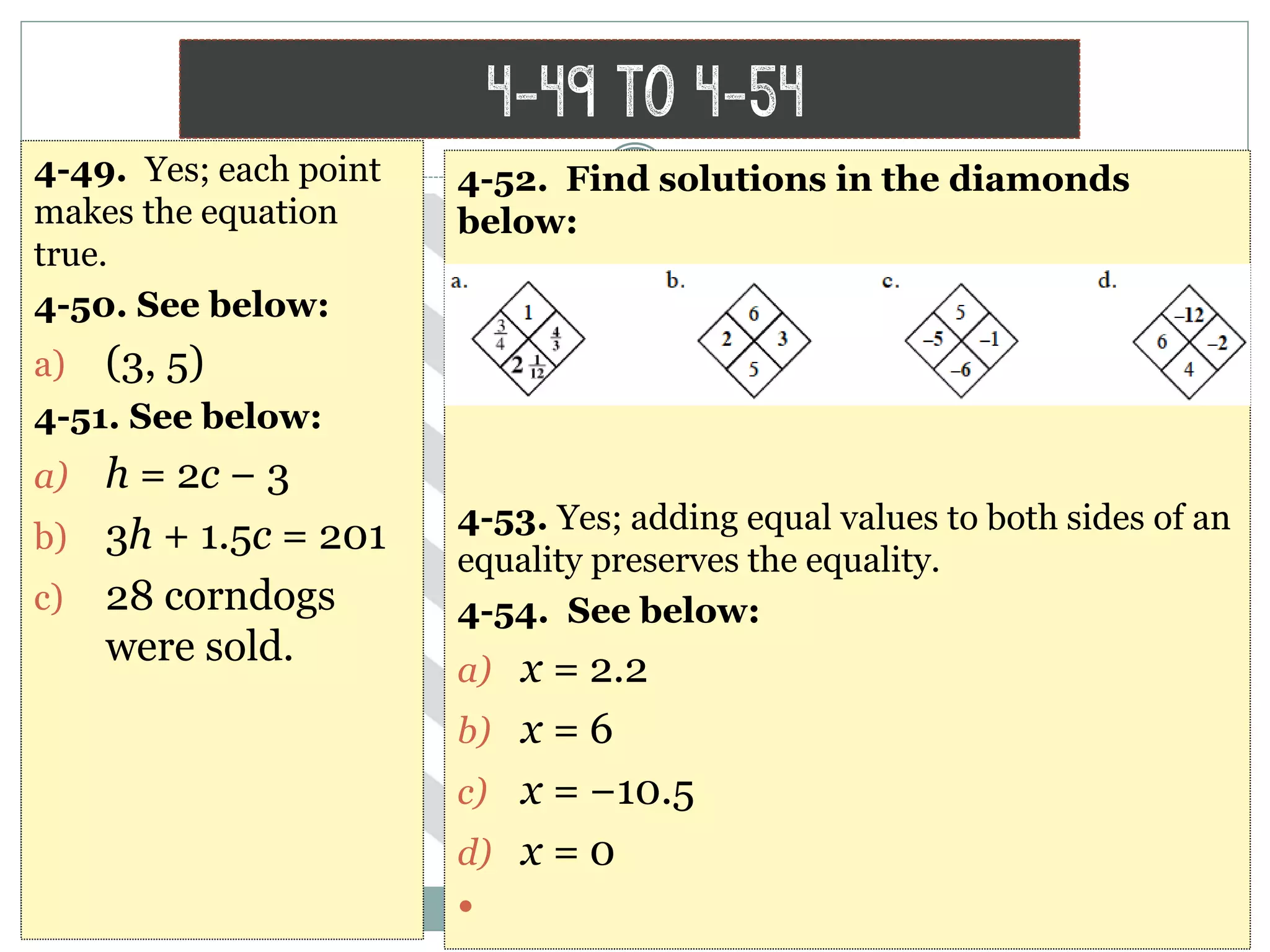
4-52. Find solutions in the diamonds
below:
4-53. Yes; adding equal values to both sides of an
equality preserves the equality.
4-54. See below:
a) x = 2.2
b) x = 6
c) x = −10.5
d) x = 0

4-60 to 4-65
4-63. $36.88
4-64. See below:
a) x2 − 3x − 10
b) y2 + 5xy + 6x2
c) −3xy + 3y2 +
8x − 8y
d) x2 −9y2
4-65. See below:
a) Moderately strong
negative linear
association with
no apparent
outliers.
b) About 25 mpg
4-60. See below:
a) (–5, 1)
b) (3, 1)
c) no solution
4-61. See below:
a) There are infinite solutions.
b) The two lines coincide.
c) Since the two lines coincide, they will have an
infinite number of points of intersection. Thus,
the system has infinite solutions.
4-62. See below:
a) Let p represent the number of pizza slices
and b represent the number of burritos
sold. Then 2.50p + 3b = 358 and p = 2b − 20.
b) 82 pizza slices were sold.
4-71 to 4-76
4-74. They are both correct. The
lines coincide.
4-75. y = 2x + 5, 105 tiles
4-76. See below:
a) b = y −mx
b) x =
𝑦−𝑏
𝑚
c) t =
𝐼
𝑝𝑟
d) t =
𝐴−𝑝
𝑝𝑟
4-71. See below:
a) (3, 1)
b) (0, 4)
c) (10, 2)
d) (–4, 5)
4-72. These lines coincide. There
are infinite points of intersection.
4-73. See below:
a) x = 4 or x = –4
b) x = 7.9 or x = –1.5
c) x = –
5
6
or x = –2
1
6
d) x = –1
1
7
or x = –
6
7
4-81 to 4-86
 4-81. See below:
a) (0,
1
3
)
b) (−6, 2)
c) no solution
d) (11, −5)
 4-82. 2n = p and n + p = 168; 56
nectarines are needed.
 4-83. See below:
a) Yes, because these expressions are
equal.
b) 5(3y) + y = 32, y = 2, x = 3.5
 4-84. See below:
a) −127
b) 10
c) −4
d) −24
 4-85. See below:
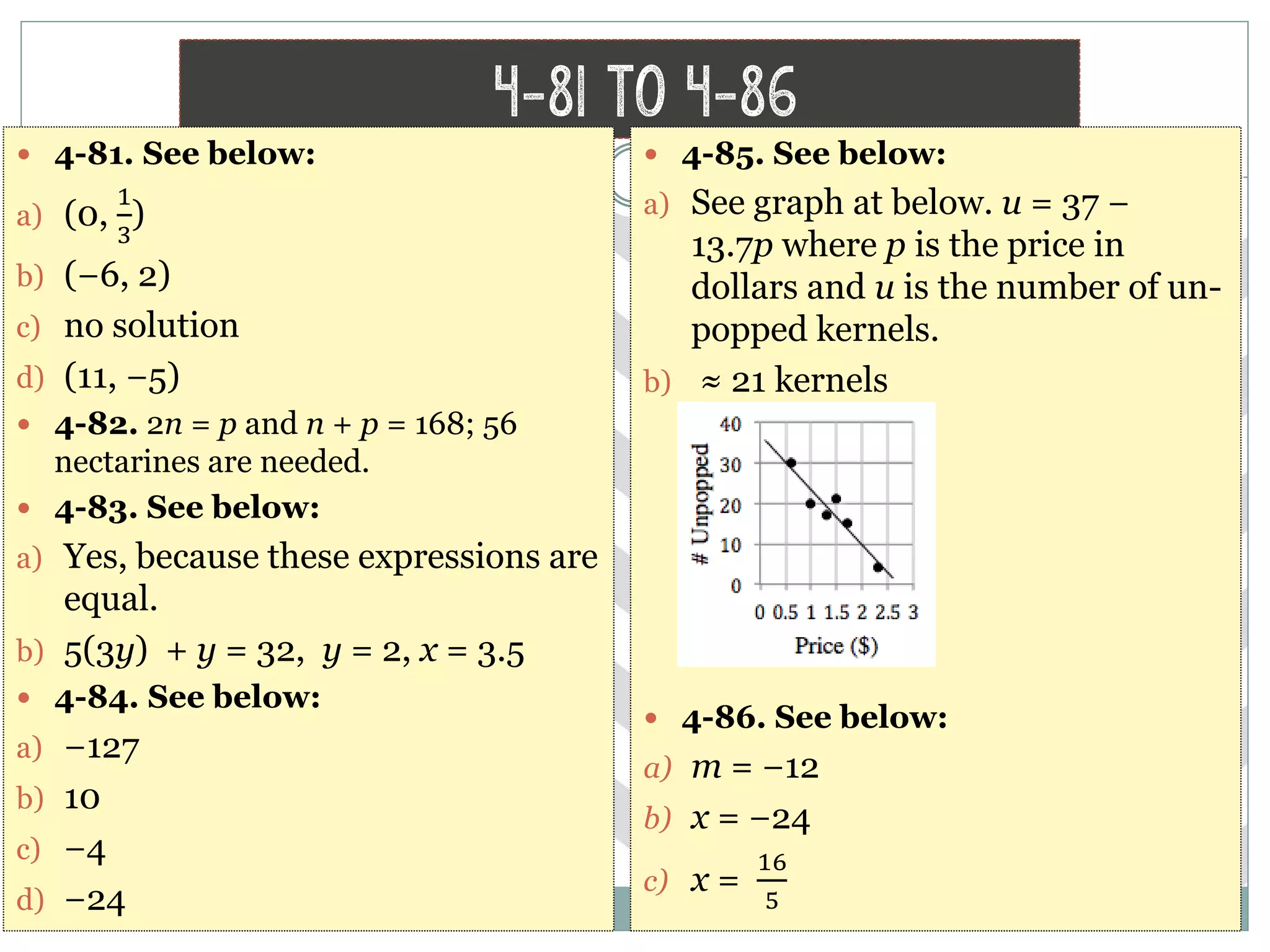
a) See graph at below. u = 37 −
13.7p where p is the price in
dollars and u is the number of un-
popped kernels.
b) ≈ 21 kernels
 4-86. See below:
a) m = −12
b) x = −24
c) x =
16
5

CCA Chapter 4 HW Answers

  • 1.
    O R CU T T A C A D E M Y H I G H S C H O O L C O R E C O N N E C T I O N S A L G E B R A 1 Chapter 4 Systems
  • 2.
    4-8 to 4-19 4-8.Approximately f = 58 + 7a, where f is the final exam score (in percent) and a is the AP score; about 79% 4-9. See below: a) no solution b) x = 13 4-10. (−1, 3) 4-11. Cadel is correct because he followed the exponent rules. Jorge is incorrect; the problem only contains multiplication, so there are not two terms and the Distributive Property cannot be used. Lauren did not follow the exponent rules. 4-12. See below: a) 3y(y − 4) = 3 𝑦2 − 12y b) (3y + 5)(y − 4) = 3 𝑦2 − 7y − 20 4-13. No; 2 is a prime number and it is even. 4-14. If x = the length, 2(x) + 2(3x − 1) = 30 width is 4 in., length is 11 in. 4-15. Lakeisha, Samantha, Carly, Barbara, and Kendra 4-16. She combined terms from opposite sides of the equation. Instead, line 4 should read 2x = 14, so x = 7 is the solution. 4-17. This statement is sometimes true. It is true when x = 0, but otherwise it is false because the Distributive Property states that a(b + c) = ab + ac. Students can also justify this with a diagram of algebra tiles. 4-18. y = 1/2x + 5/2 4-19. See below: a) 6𝑥2 − x − 2 b) 6 𝑥3 − 𝑥2 − 12x − 5
  • 3.
    4-25 to 4-30 4-25.See below: a) t – 4; 2(t – 4) b) 150 – c c) 14.95c + 39.99v 4-26. If Nina has n nickels, then 5n + 9 + 5(2n) = 84, and n = 5 nickels. 4-27. See table below and graph below. x-intercepts (–2, 0) and (5, 0) and y-intercept (0, 10) 4-28. See below: a) not a function, D: −3 ≤ x ≤ 3 and R: −3 ≤ y ≤ 3 b) a function, D: −2 ≤ x ≤ 3 and R: −2 ≤ x ≤ 2 4-29. x = 1; It will create a fraction with a denominator of zero, which is undefined. 4-30. See below: a) −15 b) −4 c) 3 d) −m2
  • 4.
    4-36 to 4-41 4-36.A very strong positive non-linear association with no apparent outliers. 4-37. See below: a) a = 0 b) m = −2 c) x = 10 d) t = 2 4-38. See below: a) ii b) 4 touchdowns and 9 field goals 4-39. See below: See answers in bold in table and line on graph. b. Yes; (–3, 3) and (–2, 1) both make this equation true. 4-40. Katy is correct; the 6x − 1 should be substituted for y because they are equal. 4-41. See below: a) 1/8 b) 𝑏4 c) 9.66 x 10⁻¹ d) 1.225 x 10⁷ x -3 -2 -1 0 1 2 3 y 3 1 -1 -3 -5 -7 -9
  • 5.
    4-49 to 4-54 4-49.Yes; each point makes the equation true. 4-50. See below: a) (3, 5) 4-51. See below: a) h = 2c − 3 b) 3h + 1.5c = 201 c) 28 corndogs were sold. 4-52. Find solutions in the diamonds below: 4-53. Yes; adding equal values to both sides of an equality preserves the equality. 4-54. See below: a) x = 2.2 b) x = 6 c) x = −10.5 d) x = 0 
  • 6.
    4-60 to 4-65 4-63.$36.88 4-64. See below: a) x2 − 3x − 10 b) y2 + 5xy + 6x2 c) −3xy + 3y2 + 8x − 8y d) x2 −9y2 4-65. See below: a) Moderately strong negative linear association with no apparent outliers. b) About 25 mpg 4-60. See below: a) (–5, 1) b) (3, 1) c) no solution 4-61. See below: a) There are infinite solutions. b) The two lines coincide. c) Since the two lines coincide, they will have an infinite number of points of intersection. Thus, the system has infinite solutions. 4-62. See below: a) Let p represent the number of pizza slices and b represent the number of burritos sold. Then 2.50p + 3b = 358 and p = 2b − 20. b) 82 pizza slices were sold.
  • 7.
    4-71 to 4-76 4-74.They are both correct. The lines coincide. 4-75. y = 2x + 5, 105 tiles 4-76. See below: a) b = y −mx b) x = 𝑦−𝑏 𝑚 c) t = 𝐼 𝑝𝑟 d) t = 𝐴−𝑝 𝑝𝑟 4-71. See below: a) (3, 1) b) (0, 4) c) (10, 2) d) (–4, 5) 4-72. These lines coincide. There are infinite points of intersection. 4-73. See below: a) x = 4 or x = –4 b) x = 7.9 or x = –1.5 c) x = – 5 6 or x = –2 1 6 d) x = –1 1 7 or x = – 6 7
  • 8.
    4-81 to 4-86 4-81. See below: a) (0, 1 3 ) b) (−6, 2) c) no solution d) (11, −5)  4-82. 2n = p and n + p = 168; 56 nectarines are needed.  4-83. See below: a) Yes, because these expressions are equal. b) 5(3y) + y = 32, y = 2, x = 3.5  4-84. See below: a) −127 b) 10 c) −4 d) −24  4-85. See below: a) See graph at below. u = 37 − 13.7p where p is the price in dollars and u is the number of un- popped kernels. b) ≈ 21 kernels  4-86. See below: a) m = −12 b) x = −24 c) x = 16 5