Phonological Processes of the
     Connected Speech
         By Betancourt y Galiffa (2009).
INTRODUCTION


      Nowadays, we live in a society where English Language has become one of the most
spoken languages in the whole world. Due to this, it is considered as a universal language
since it is used in different academic and occupational areas. Also, it is taken into account
as a very important language to be learnt by many people in order to communicate in
specific situations or areas such as: business, education, tourism and so on. In this way, it is
understood the relevancy that has the education in the teaching of a new language.

      The learning of a new language implies to learn its grammatical and phonological
rules, for this reason, this didactic guide will help you to understand whole about the
phonological processes of the connected speech.

      Here, you will find information about concept, uses and importance of the
phonological processes in the learning-teaching process of a new language.
OBJECTIVES OF THE DYDACTIC GUIDE


              To analyze the definition, importance and application of the phonological
processes for real situations in order to get an effective oral communication in the English
Language.
              To acquire all kinds of information related to the phonological processes for
the comprehension of information in the English language.
PHONOLOGICAL PROCESSES OF THE CONNECTED SPEECH
                          Part I, defining Phonology and Phonetics.


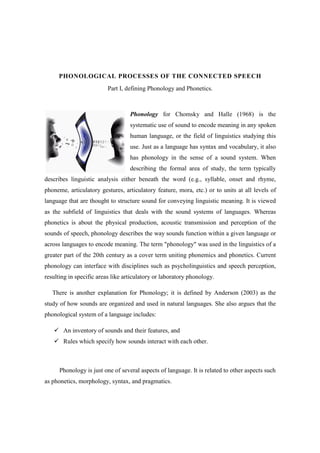
                                   Phonology for Chomsky and Halle (1968) is the
                                   systematic use of sound to encode meaning in any spoken
                                   human language, or the field of linguistics studying this
                                   use. Just as a language has syntax and vocabulary, it also
                                   has phonology in the sense of a sound system. When
                                   describing the formal area of study, the term typically
describes linguistic analysis either beneath the word (e.g., syllable, onset and rhyme,
phoneme, articulatory gestures, articulatory feature, mora, etc.) or to units at all levels of
language that are thought to structure sound for conveying linguistic meaning. It is viewed
as the subfield of linguistics that deals with the sound systems of languages. Whereas
phonetics is about the physical production, acoustic transmission and perception of the
sounds of speech, phonology describes the way sounds function within a given language or
across languages to encode meaning. The term "phonology" was used in the linguistics of a
greater part of the 20th century as a cover term uniting phonemics and phonetics. Current
phonology can interface with disciplines such as psycholinguistics and speech perception,
resulting in specific areas like articulatory or laboratory phonology.

   There is another explanation for Phonology; it is defined by Anderson (2003) as the
study of how sounds are organized and used in natural languages. She also argues that the
phonological system of a language includes:

       An inventory of sounds and their features, and
       Rules which specify how sounds interact with each other.


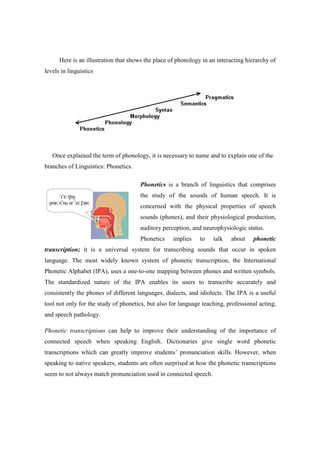
      Phonology is just one of several aspects of language. It is related to other aspects such
as phonetics, morphology, syntax, and pragmatics.
Here is an illustration that shows the place of phonology in an interacting hierarchy of
levels in linguistics


   Once explained the term of phonology, it is necessary to name and to explain one of the
branches of Linguistics: Phonetics.

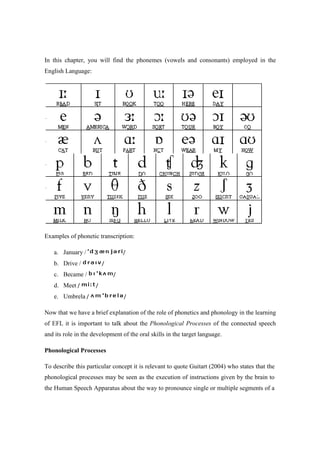
                                      Phonetics is a branch of linguistics that comprises
                                      the study of the sounds of human speech. It is
                                      concerned with the physical properties of speech
                                      sounds (phones), and their physiological production,
                                      auditory perception, and neurophysiologic status.
                                      Phonetics     implies    to   talk   about     phonetic
transcription; it is a universal system for transcribing sounds that occur in spoken
language. The most widely known system of phonetic transcription, the International
Phonetic Alphabet (IPA), uses a one-to-one mapping between phones and written symbols.
The standardized nature of the IPA enables its users to transcribe accurately and
consistently the phones of different languages, dialects, and idiolects. The IPA is a useful
tool not only for the study of phonetics, but also for language teaching, professional acting,
and speech pathology.

Phonetic transcriptions can help to improve their understanding of the importance of
connected speech when speaking English. Dictionaries give single word phonetic
transcriptions which can greatly improve students’ pronunciation skills. However, when
speaking to native speakers, students are often surprised at how the phonetic transcriptions
seem to not always match pronunciation used in connected speech.
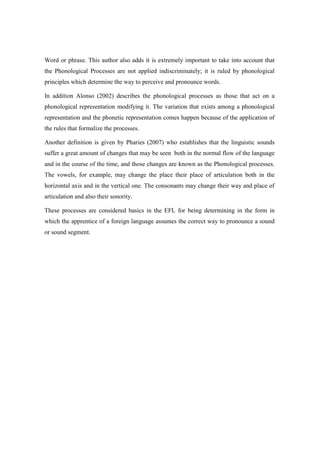
In this chapter, you will find the phonemes (vowels and consonants) employed in the
English Language:


Examples of phonetic transcription:

   a. January /                  /
   b. Drive /            /
   c. Became /               /
   d. Meet /         /
   e. Umbrela /                  /

Now that we have a brief explanation of the role of phonetics and phonology in the learning
of EFL it is important to talk about the Phonological Processes of the connected speech
and its role in the development of the oral skills in the target language.

Phonological Processes

To describe this particular concept it is relevant to quote Guitart (2004) who states that the
phonological processes may be seen as the execution of instructions given by the brain to
the Human Speech Apparatus about the way to pronounce single or multiple segments of a
Word or phrase. This author also adds it is extremely important to take into account that
the Phonological Processes are not applied indiscriminately; it is ruled by phonological
principles which determine the way to perceive and pronounce words.

In addition Alonso (2002) describes the phonological processes as those that act on a
phonological representation modifying it. The variation that exists among a phonological
representation and the phonetic representation comes happen because of the application of
the rules that formalize the processes.

Another definition is given by Pharies (2007) who establishes that the linguistic sounds
suffer a great amount of changes that may be seen both in the normal flow of the language
and in the course of the time, and those changes are known as the Phonological processes.
The vowels, for example, may change the place their place of articulation both in the
horizontal axis and in the vertical one. The consonants may change their way and place of
articulation and also their sonority.

These processes are considered basics in the EFL for being determining in the form in
which the apprentice of a foreign language assumes the correct way to pronounce a sound
or sound segment.

Guia Didactica Uno

  • 1.
    Phonological Processes ofthe Connected Speech By Betancourt y Galiffa (2009).
  • 2.
    INTRODUCTION Nowadays, we live in a society where English Language has become one of the most spoken languages in the whole world. Due to this, it is considered as a universal language since it is used in different academic and occupational areas. Also, it is taken into account as a very important language to be learnt by many people in order to communicate in specific situations or areas such as: business, education, tourism and so on. In this way, it is understood the relevancy that has the education in the teaching of a new language. The learning of a new language implies to learn its grammatical and phonological rules, for this reason, this didactic guide will help you to understand whole about the phonological processes of the connected speech. Here, you will find information about concept, uses and importance of the phonological processes in the learning-teaching process of a new language.
  • 3.
    OBJECTIVES OF THEDYDACTIC GUIDE To analyze the definition, importance and application of the phonological processes for real situations in order to get an effective oral communication in the English Language. To acquire all kinds of information related to the phonological processes for the comprehension of information in the English language.
  • 4.
    PHONOLOGICAL PROCESSES OFTHE CONNECTED SPEECH Part I, defining Phonology and Phonetics. Phonology for Chomsky and Halle (1968) is the systematic use of sound to encode meaning in any spoken human language, or the field of linguistics studying this use. Just as a language has syntax and vocabulary, it also has phonology in the sense of a sound system. When describing the formal area of study, the term typically describes linguistic analysis either beneath the word (e.g., syllable, onset and rhyme, phoneme, articulatory gestures, articulatory feature, mora, etc.) or to units at all levels of language that are thought to structure sound for conveying linguistic meaning. It is viewed as the subfield of linguistics that deals with the sound systems of languages. Whereas phonetics is about the physical production, acoustic transmission and perception of the sounds of speech, phonology describes the way sounds function within a given language or across languages to encode meaning. The term "phonology" was used in the linguistics of a greater part of the 20th century as a cover term uniting phonemics and phonetics. Current phonology can interface with disciplines such as psycholinguistics and speech perception, resulting in specific areas like articulatory or laboratory phonology. There is another explanation for Phonology; it is defined by Anderson (2003) as the study of how sounds are organized and used in natural languages. She also argues that the phonological system of a language includes: An inventory of sounds and their features, and Rules which specify how sounds interact with each other. Phonology is just one of several aspects of language. It is related to other aspects such as phonetics, morphology, syntax, and pragmatics.
  • 5.
    Here is anillustration that shows the place of phonology in an interacting hierarchy of levels in linguistics Once explained the term of phonology, it is necessary to name and to explain one of the branches of Linguistics: Phonetics. Phonetics is a branch of linguistics that comprises the study of the sounds of human speech. It is concerned with the physical properties of speech sounds (phones), and their physiological production, auditory perception, and neurophysiologic status. Phonetics implies to talk about phonetic transcription; it is a universal system for transcribing sounds that occur in spoken language. The most widely known system of phonetic transcription, the International Phonetic Alphabet (IPA), uses a one-to-one mapping between phones and written symbols. The standardized nature of the IPA enables its users to transcribe accurately and consistently the phones of different languages, dialects, and idiolects. The IPA is a useful tool not only for the study of phonetics, but also for language teaching, professional acting, and speech pathology. Phonetic transcriptions can help to improve their understanding of the importance of connected speech when speaking English. Dictionaries give single word phonetic transcriptions which can greatly improve students’ pronunciation skills. However, when speaking to native speakers, students are often surprised at how the phonetic transcriptions seem to not always match pronunciation used in connected speech.
  • 6.
    In this chapter,you will find the phonemes (vowels and consonants) employed in the English Language: Examples of phonetic transcription: a. January / / b. Drive / / c. Became / / d. Meet / / e. Umbrela / / Now that we have a brief explanation of the role of phonetics and phonology in the learning of EFL it is important to talk about the Phonological Processes of the connected speech and its role in the development of the oral skills in the target language. Phonological Processes To describe this particular concept it is relevant to quote Guitart (2004) who states that the phonological processes may be seen as the execution of instructions given by the brain to the Human Speech Apparatus about the way to pronounce single or multiple segments of a
  • 7.
    Word or phrase.This author also adds it is extremely important to take into account that the Phonological Processes are not applied indiscriminately; it is ruled by phonological principles which determine the way to perceive and pronounce words. In addition Alonso (2002) describes the phonological processes as those that act on a phonological representation modifying it. The variation that exists among a phonological representation and the phonetic representation comes happen because of the application of the rules that formalize the processes. Another definition is given by Pharies (2007) who establishes that the linguistic sounds suffer a great amount of changes that may be seen both in the normal flow of the language and in the course of the time, and those changes are known as the Phonological processes. The vowels, for example, may change the place their place of articulation both in the horizontal axis and in the vertical one. The consonants may change their way and place of articulation and also their sonority. These processes are considered basics in the EFL for being determining in the form in which the apprentice of a foreign language assumes the correct way to pronounce a sound or sound segment.