Section 6.1 Development of the Modern
Periodic Table
• Trace the development of the periodic table.
• Identify key features of the periodic table.
atomic number: the number of protons in an atom
The periodic table evolved over
time as scientists discovered more
useful ways to compare and
organize the elements.
Development of the Periodic Table
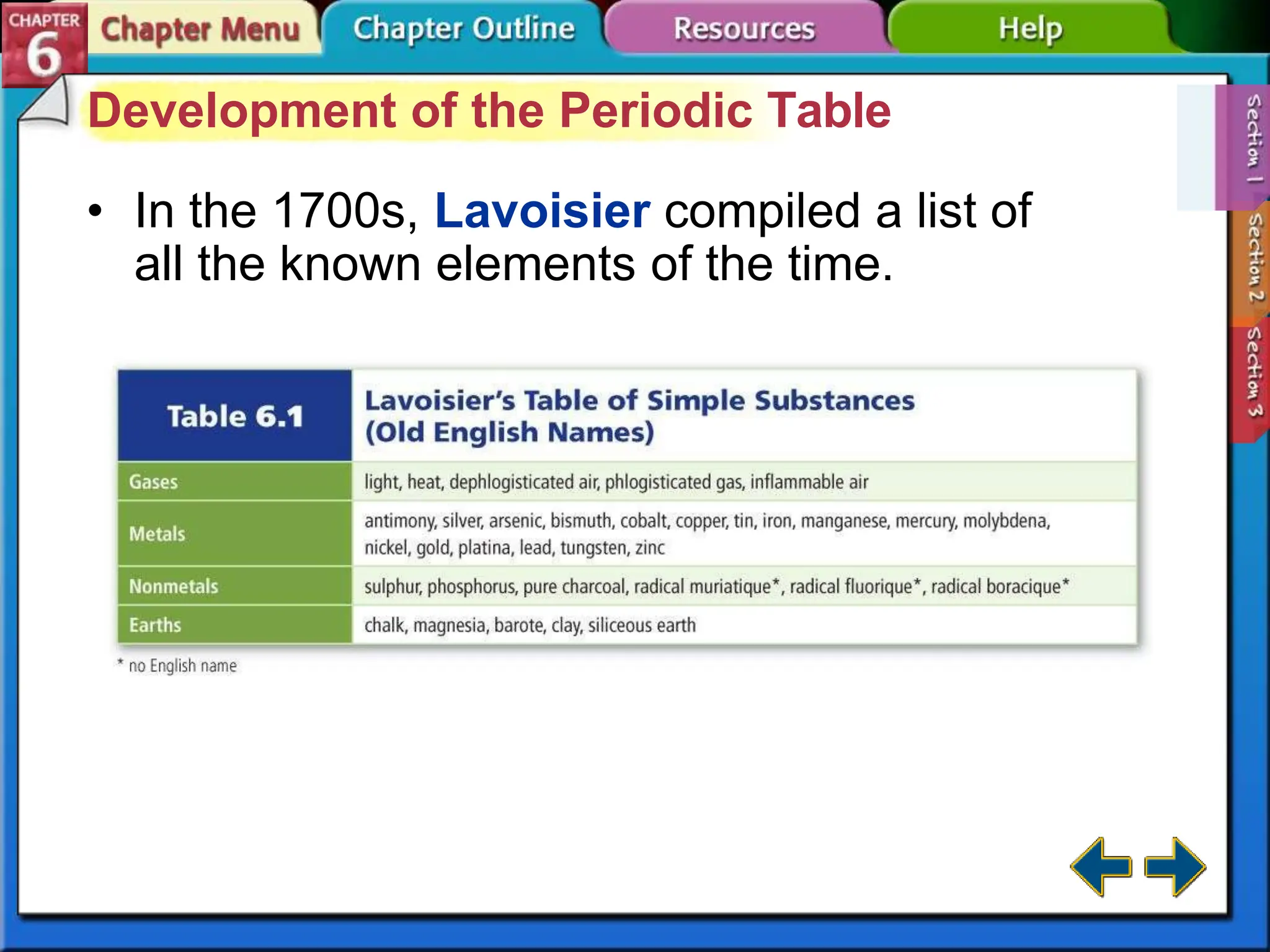
• In the 1700s, Lavoisier compiled a list of
all the known elements of the time.
Development of the Periodic Table (cont.)
• The 1800s brought large amounts of
information and scientists needed a way to
organize knowledge about elements.
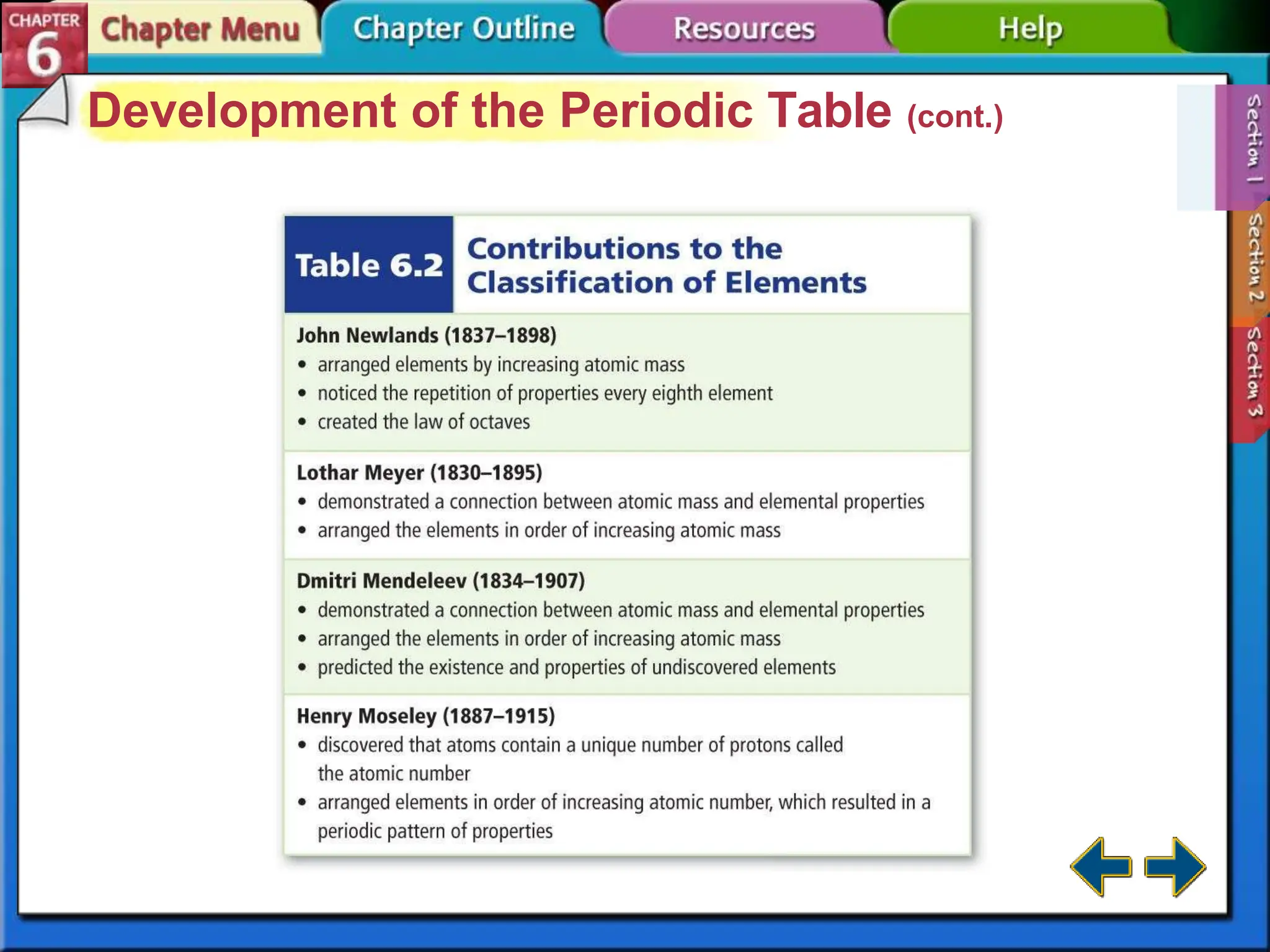
• John Newlands proposed an arrangement
where elements were ordered by increasing
atomic mass.
Development of the Periodic Table (cont.)
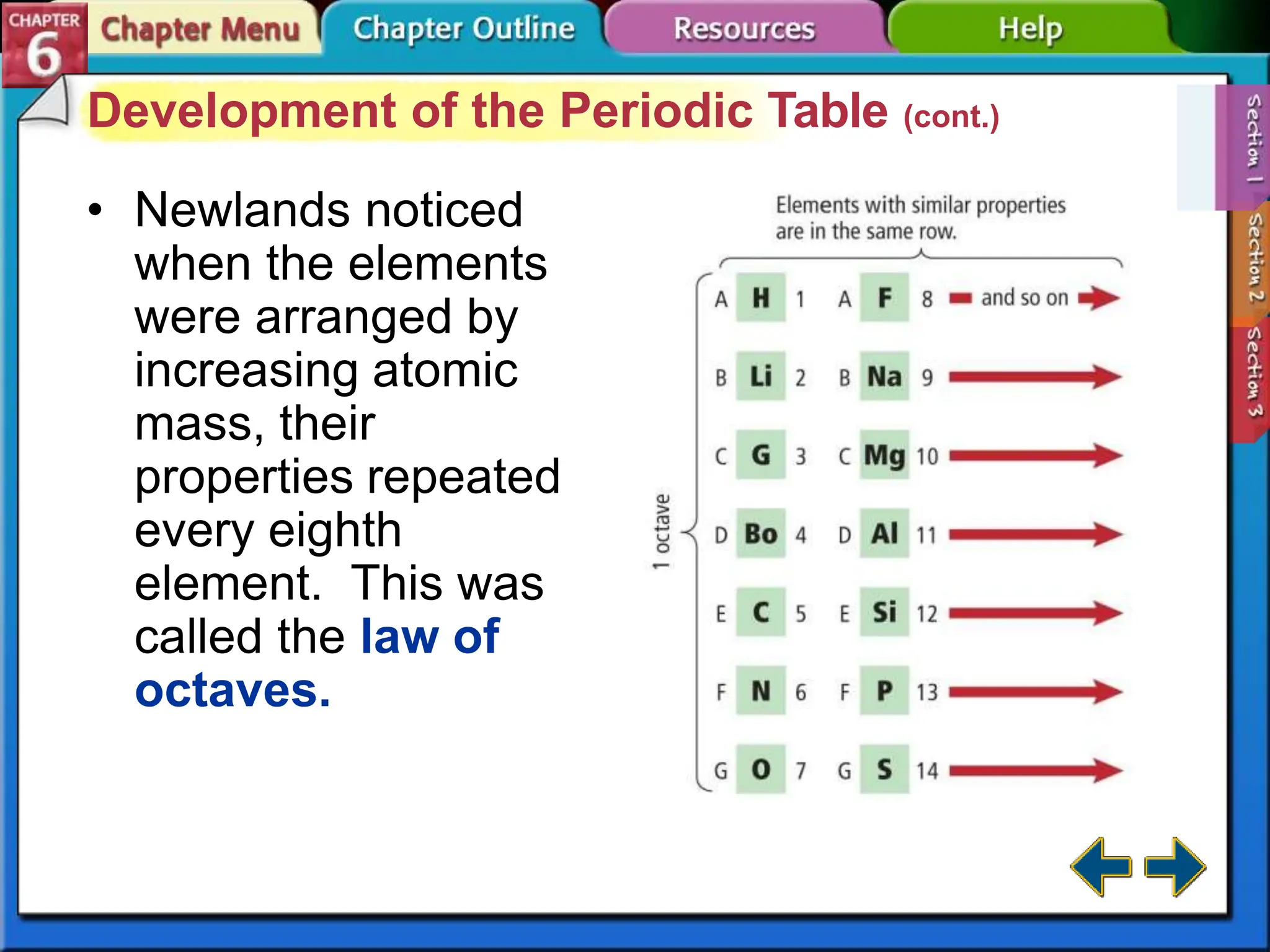
• Newlands noticed
when the elements
were arranged by
increasing atomic
mass, their
properties repeated
every eighth
element. This was
called the law of
octaves.
Development of the Periodic Table (cont.)
• Meyer and Mendeleev both demonstrated
a connection between atomic mass and
elemental properties.
• When creating his periodic table, Mendeleev
left blank spaces for elements that had not
yet been discovered.
• Using periodic properties of the other
elements, he correctly predicted the
properties of scandium, gallium, and
germanium.
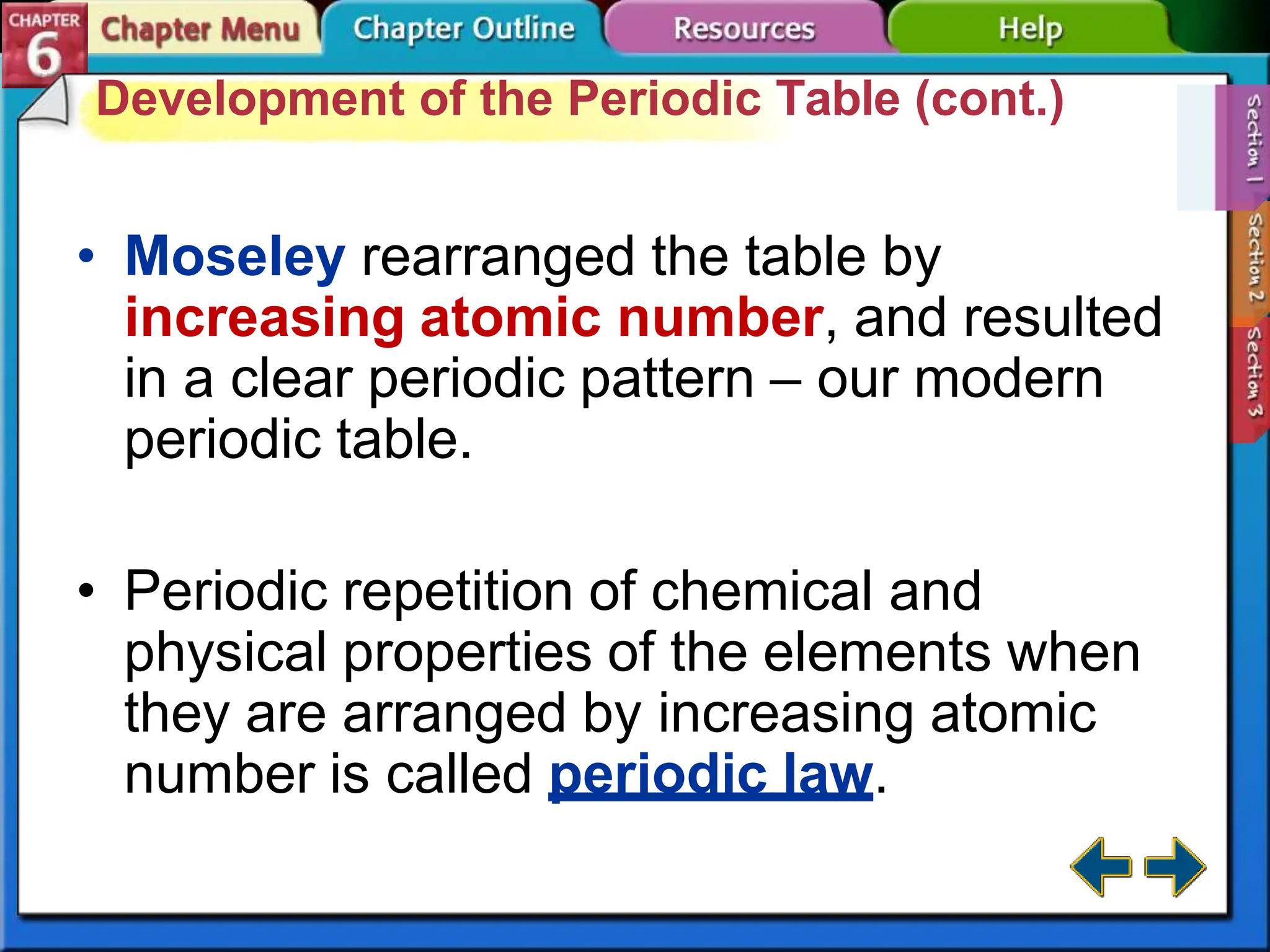
• Moseley rearranged the table by
increasing atomic number, and resulted
in a clear periodic pattern – our modern
periodic table.
• Periodic repetition of chemical and
physical properties of the elements when
they are arranged by increasing atomic
number is called periodic law.
Development of the Periodic Table (cont.)
The Modern Periodic Table
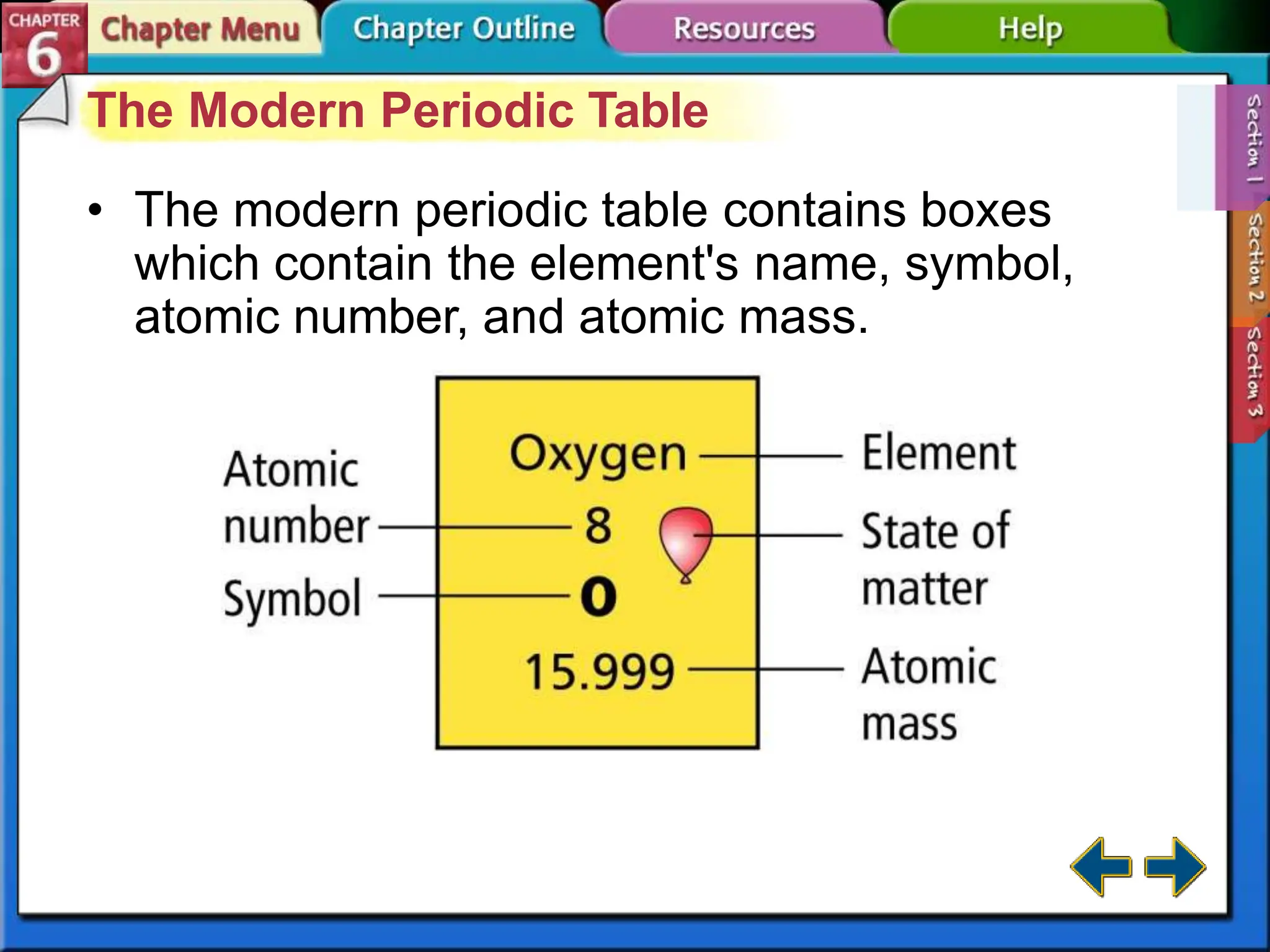
• The modern periodic table contains boxes
which contain the element's name, symbol,
atomic number, and atomic mass.
The Modern Periodic Table (cont.)
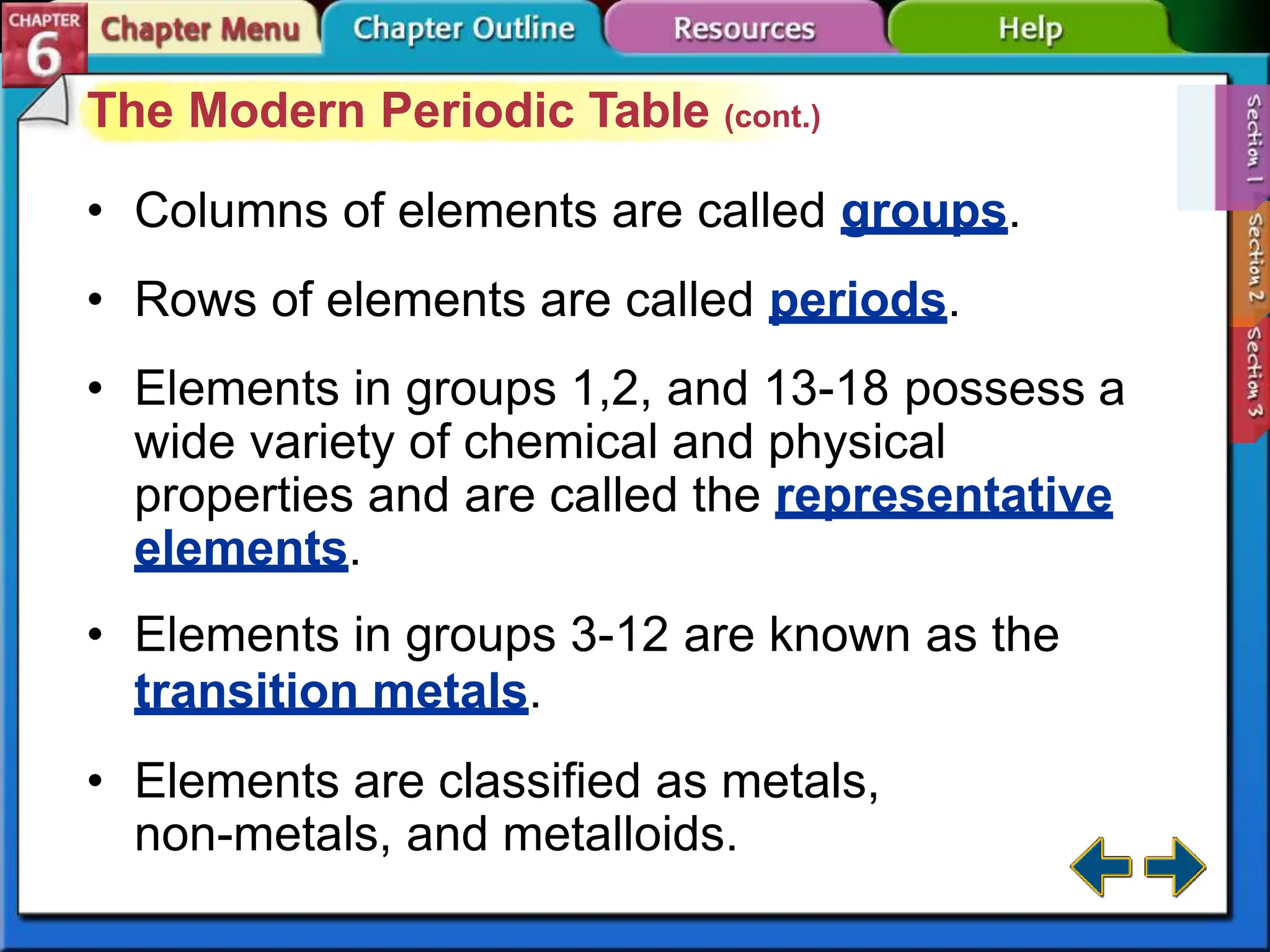
• Columns of elements are called groups.
• Rows of elements are called periods.
• Elements in groups 1,2, and 13-18 possess a
wide variety of chemical and physical
properties and are called the representative
elements.
• Elements in groups 3-12 are known as the
transition metals.
• Elements are classified as metals,
non-metals, and metalloids.
Metals
• Metals are elements that are generally shiny
when smooth and clean, solid at room
temperature, good conductors of heat and
electricity, malleable, and ductile.
• Alkali metals are all the elements in group 1
except hydrogen, and are very reactive.
• Alkaline earth metals are in group 2, and
are also highly reactive.
Metals (cont.)
• The transition elements are divided into
transition metals and inner transition
metals.
• The two sets of inner transition metals are
called the lanthanide series and actinide
series and are located at the bottom of the
periodic table.
Nonmetals
• Non-metals are elements that are
generally gases or brittle, dull-looking
solids, and poor conductors of heat and
electricity.
• Group 17 is composed of highly reactive
elements called halogens.
• Group 18 gases are extremely unreactive and
commonly called noble gases.
Metalloids
• Metalloids have physical and chemical
properties of both metals and non-metals,
such as silicon and germanium.
• The metalloids form a staircase that
separates the metals from the nonmetals,
with the exception of aluminum which is a
metal.
The Modern Periodic Table
0% 0% 0% 0%
Section 6.1 Assessment
What is a row of elements on the periodic
table called?
A. octave
B. period
C. group
D. transition
0% 0% 0% 0%
Section 6.1 Assessment
What is silicon an example of?
A. metal
B. non-metal
C. inner transition metal
D. metalloid

chemistry matter and changes the periodic table

  • 2.
    Section 6.1 Developmentof the Modern Periodic Table • Trace the development of the periodic table. • Identify key features of the periodic table. atomic number: the number of protons in an atom The periodic table evolved over time as scientists discovered more useful ways to compare and organize the elements.
  • 3.
    Development of thePeriodic Table • In the 1700s, Lavoisier compiled a list of all the known elements of the time.
  • 4.
    Development of thePeriodic Table (cont.) • The 1800s brought large amounts of information and scientists needed a way to organize knowledge about elements. • John Newlands proposed an arrangement where elements were ordered by increasing atomic mass.
  • 5.
    Development of thePeriodic Table (cont.) • Newlands noticed when the elements were arranged by increasing atomic mass, their properties repeated every eighth element. This was called the law of octaves.
  • 6.
    Development of thePeriodic Table (cont.) • Meyer and Mendeleev both demonstrated a connection between atomic mass and elemental properties. • When creating his periodic table, Mendeleev left blank spaces for elements that had not yet been discovered. • Using periodic properties of the other elements, he correctly predicted the properties of scandium, gallium, and germanium.
  • 7.
    • Moseley rearrangedthe table by increasing atomic number, and resulted in a clear periodic pattern – our modern periodic table. • Periodic repetition of chemical and physical properties of the elements when they are arranged by increasing atomic number is called periodic law. Development of the Periodic Table (cont.)
  • 8.
    Development of thePeriodic Table (cont.)
  • 9.
    The Modern PeriodicTable • The modern periodic table contains boxes which contain the element's name, symbol, atomic number, and atomic mass.
  • 10.
    The Modern PeriodicTable (cont.) • Columns of elements are called groups. • Rows of elements are called periods. • Elements in groups 1,2, and 13-18 possess a wide variety of chemical and physical properties and are called the representative elements. • Elements in groups 3-12 are known as the transition metals. • Elements are classified as metals, non-metals, and metalloids.
  • 11.
    Metals • Metals areelements that are generally shiny when smooth and clean, solid at room temperature, good conductors of heat and electricity, malleable, and ductile. • Alkali metals are all the elements in group 1 except hydrogen, and are very reactive. • Alkaline earth metals are in group 2, and are also highly reactive.
  • 12.
    Metals (cont.) • Thetransition elements are divided into transition metals and inner transition metals. • The two sets of inner transition metals are called the lanthanide series and actinide series and are located at the bottom of the periodic table.
  • 13.
    Nonmetals • Non-metals areelements that are generally gases or brittle, dull-looking solids, and poor conductors of heat and electricity. • Group 17 is composed of highly reactive elements called halogens. • Group 18 gases are extremely unreactive and commonly called noble gases.
  • 14.
    Metalloids • Metalloids havephysical and chemical properties of both metals and non-metals, such as silicon and germanium. • The metalloids form a staircase that separates the metals from the nonmetals, with the exception of aluminum which is a metal.
  • 15.
  • 16.
    0% 0% 0%0% Section 6.1 Assessment What is a row of elements on the periodic table called? A. octave B. period C. group D. transition
  • 17.
    0% 0% 0%0% Section 6.1 Assessment What is silicon an example of? A. metal B. non-metal C. inner transition metal D. metalloid