The Periodic TablePhysical ScienceChapter 5
Arranging the ElementsPhysical ScienceChapter 5.1
Objectives:Describe how Mendeleev arranged elements in the first periodic table.Explain how elements are arranged in the modern periodic table.Comparemetals, nonmetals, and metalloids based on their properties and on their location in the periodic table.Describethe difference between a period and a group.
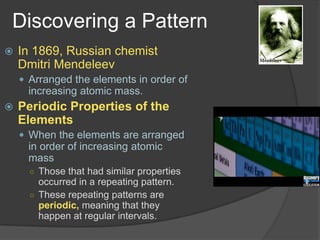
Discovering a PatternIn 1869, Russian chemist Dmitri MendeleevArranged the elements in order of increasing atomic mass.Periodic Properties of the ElementsWhen the elements are arranged in order of increasing atomic massThose that had similar properties occurred in a repeating pattern.These repeating patterns are periodic,meaning that they happen at regular intervals.
Predicting Properties of Missing ElementsMendeleev’s arrangement had gaps in its pattern.Mendeleev predicted that elements yet to be found would fill these gaps.He also predicted the properties of the missing elements.By 1886, all of the gaps had been filled and Mendeleev’s predictions were right.
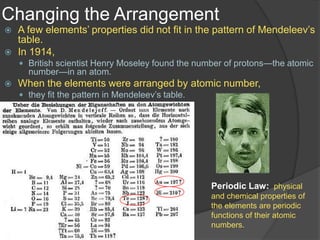
Changing the ArrangementA few elements’ properties did not fit in the pattern of Mendeleev’s table.In 1914,British scientist Henry Moseley found the number of protons—the atomic number—in an atom.When the elements were arranged by atomic number,they fit the pattern in Mendeleev’s table.Periodic Law:  physical and chemical properties of the elements are periodic functions of their atomic numbers.
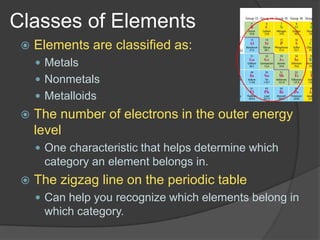
Classes of ElementsElements are classified as:MetalsNonmetalsMetalloidsThe number of electrons in the outer energy levelOne characteristic that helps determine which category an element belongs in.The zigzag line on the periodic tableCan help you recognize which elements belong in which category.
Metals:Found to the left of the zigzag line.Atoms of most metals have few electrons in their outer energy level.All metals areShinyDuctileMalleableGood conductors of electric current and thermal energy.
NonmetalsFound to the right of the zigzag line.Atoms of most nonmetals have an almost complete set of electrons in their outer energy level.Nonmetals are:Not shinyNot ductile, or malleablePoor conductors of electric current and thermal energy.
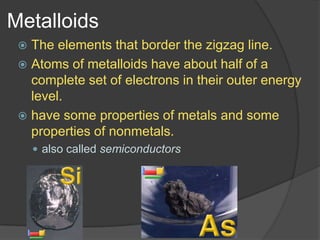
MetalloidsThe elements that border the zigzag line.Atoms of metalloids have about half of a complete set of electrons in their outer energy level.have some properties of metals and some properties of nonmetals.also called semiconductors
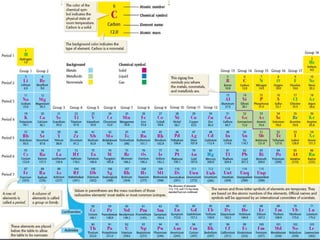
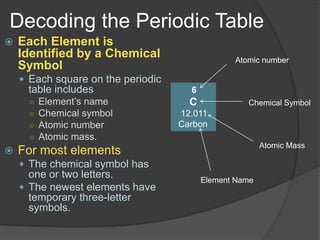
Decoding the Periodic TableEach Element is Identified by a Chemical SymbolEach square on the periodic table includesElement’s nameChemical symbolAtomic numberAtomic mass.For most elementsThe chemical symbol has one or two letters.The newest elements have temporary three-letter symbols.Atomic number6C12.011 CarbonChemical SymbolAtomic MassElement Name
Horizontal rows Are Called PeriodsThe chemical and physical properties of elements in a row follow a repeating pattern as you move across the period.Vertical columns Are Called GroupsElements in the same group often have similar chemical and physical properties.PeriodGroup

Physical Science 5.1 : Arranging the Elements

  • 1.
  • 2.
  • 3.
    Objectives:Describe how Mendeleevarranged elements in the first periodic table.Explain how elements are arranged in the modern periodic table.Comparemetals, nonmetals, and metalloids based on their properties and on their location in the periodic table.Describethe difference between a period and a group.
  • 4.
    Discovering a PatternIn1869, Russian chemist Dmitri MendeleevArranged the elements in order of increasing atomic mass.Periodic Properties of the ElementsWhen the elements are arranged in order of increasing atomic massThose that had similar properties occurred in a repeating pattern.These repeating patterns are periodic,meaning that they happen at regular intervals.
  • 5.
    Predicting Properties ofMissing ElementsMendeleev’s arrangement had gaps in its pattern.Mendeleev predicted that elements yet to be found would fill these gaps.He also predicted the properties of the missing elements.By 1886, all of the gaps had been filled and Mendeleev’s predictions were right.
  • 6.
    Changing the ArrangementAfew elements’ properties did not fit in the pattern of Mendeleev’s table.In 1914,British scientist Henry Moseley found the number of protons—the atomic number—in an atom.When the elements were arranged by atomic number,they fit the pattern in Mendeleev’s table.Periodic Law: physical and chemical properties of the elements are periodic functions of their atomic numbers.
  • 8.
    Classes of ElementsElementsare classified as:MetalsNonmetalsMetalloidsThe number of electrons in the outer energy levelOne characteristic that helps determine which category an element belongs in.The zigzag line on the periodic tableCan help you recognize which elements belong in which category.
  • 9.
    Metals:Found to theleft of the zigzag line.Atoms of most metals have few electrons in their outer energy level.All metals areShinyDuctileMalleableGood conductors of electric current and thermal energy.
  • 10.
    NonmetalsFound to theright of the zigzag line.Atoms of most nonmetals have an almost complete set of electrons in their outer energy level.Nonmetals are:Not shinyNot ductile, or malleablePoor conductors of electric current and thermal energy.
  • 11.
    MetalloidsThe elements thatborder the zigzag line.Atoms of metalloids have about half of a complete set of electrons in their outer energy level.have some properties of metals and some properties of nonmetals.also called semiconductors
  • 12.
    Decoding the PeriodicTableEach Element is Identified by a Chemical SymbolEach square on the periodic table includesElement’s nameChemical symbolAtomic numberAtomic mass.For most elementsThe chemical symbol has one or two letters.The newest elements have temporary three-letter symbols.Atomic number6C12.011 CarbonChemical SymbolAtomic MassElement Name
  • 13.
    Horizontal rows AreCalled PeriodsThe chemical and physical properties of elements in a row follow a repeating pattern as you move across the period.Vertical columns Are Called GroupsElements in the same group often have similar chemical and physical properties.PeriodGroup