Unit I:
Introduction to Corporate
Social Responsibility
 Person going from one side of the canyon to the
other… a lot of clouds like fog. The point is going
from one way of doing business to another is
very tough. There’s a lot uncertainty. It takes a
lot of skill, but we have to lift ourselves beyond
that, above the fog, and that’s not going to be a
simple exercise. CSR is about seeing the forest,
the fog, and seeing how we can get on the other
side, and how we can be well-equipped for doing
that. So probably we need to develop additional
skills, knowledge, and understanding.”
Message
“The message is that whatever we do today will
have an impact on future generations. It’s not
just my kids or your kids or somebody else’s.
It’s future generations. We should not hope that
the walls we build to protect ourselves will be tall
enough to protect our children. Only with very
conscious effort we can make the world for them
a better place to live…even if we address our
most selfish needs we have to address the needs
of the next generation. That’s what CSR is
about.”
Reference Books
 Corporate Social Responsibility
- C.V. Baxi
 Corporate Social Responsibility
- Jayant Bhattacharya
Definition of Corporate Social
Responsibility
“CSR is about how companies manage the
business processes to produce an overall
positive impact on society.”
Definition
“Achieving commercial success in ways
that honour ethical values and respect
people, communities, and the natural
environment”
Definitions: Practice
WBCSD (World Business Council for
Sustainable Development)
“The continuing commitment by business to
behave ethically and contribute to
sustainable economic development while
improving the quality of life of the workforce
and their families as well as of the local
community and society.”
Definitions: Concept
Philip Kotler & Nancy Lee (2005)
“a commitment to improve community
well-being through discretionary business
practices and contributions of corporate
resources”.
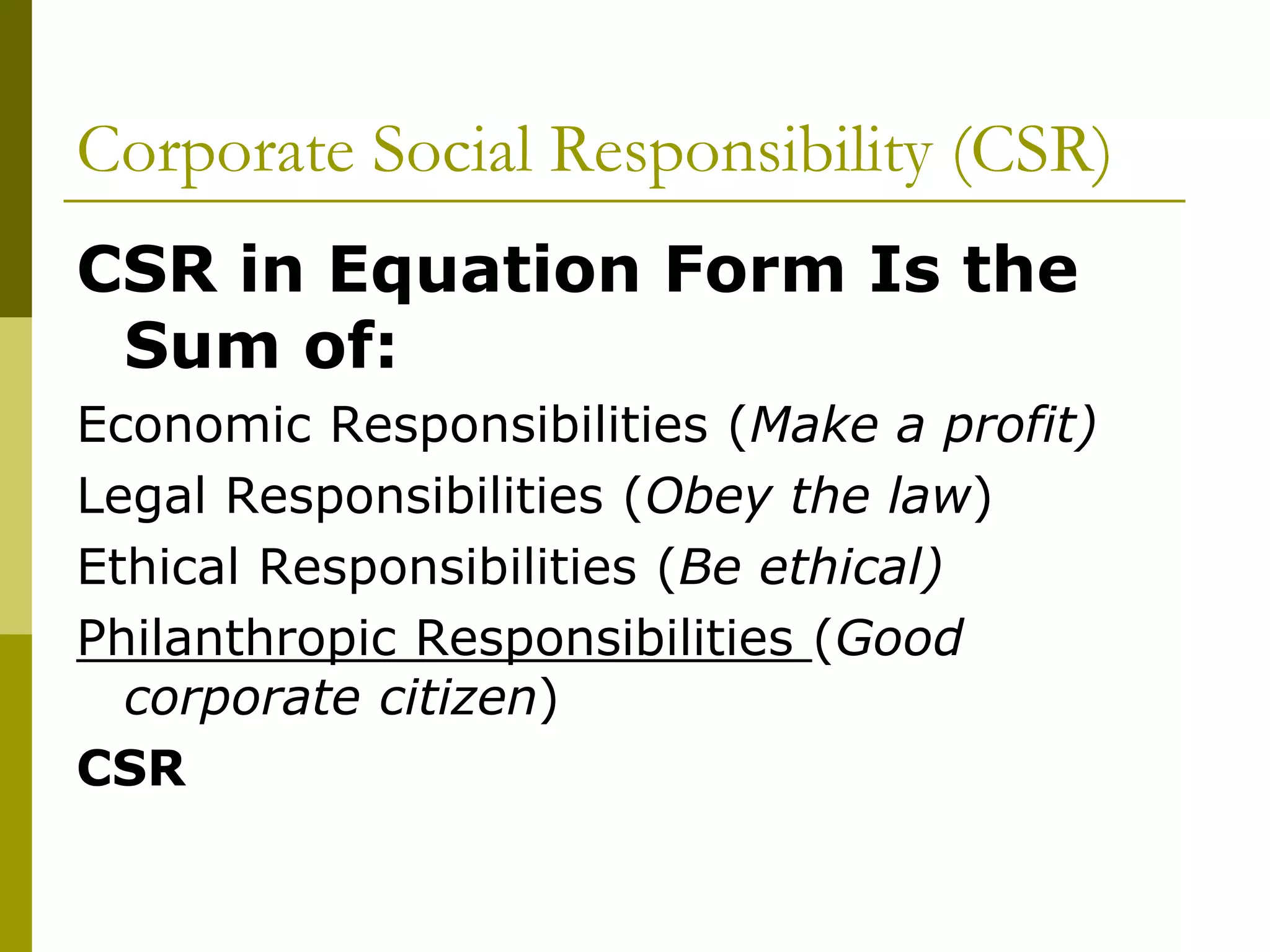
Corporate Social Responsibility (CSR)
CSR in Equation Form Is the
Sum of:
Economic Responsibilities (Make a profit)
Legal Responsibilities (Obey the law)
Ethical Responsibilities (Be ethical)
Philanthropic Responsibilities (Good
corporate citizen)
CSR
Historical Perspective
From the 1950’s to the present the
concept of CSR has gained considerable
acceptance and the meaning has been
broadened to include additional
components
Corporate Social Responsibility (CSR)
Evolving Viewpoints
 CSR considers the impact of the
company’s actions on society (Bauer)
 CSR requires decision makers to take
actions that protect and improve the
welfare of society as a whole along with
their own interests (Davis and Blomstrom
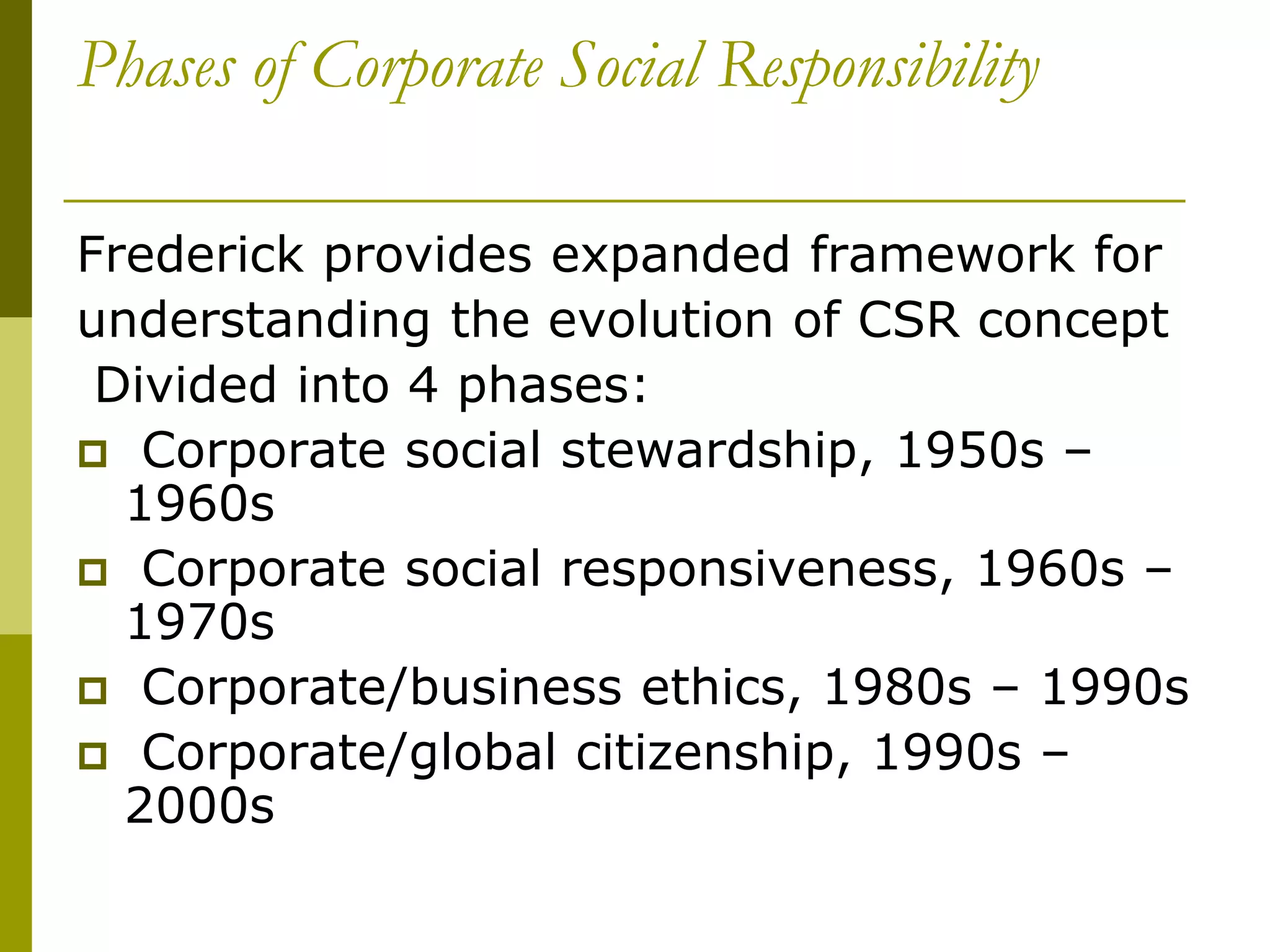
Phases of Corporate Social Responsibility
Frederick provides expanded framework for
understanding the evolution of CSR concept
Divided into 4 phases:
 Corporate social stewardship, 1950s –
1960s
 Corporate social responsiveness, 1960s –
1970s
 Corporate/business ethics, 1980s – 1990s
 Corporate/global citizenship, 1990s –
2000s
Drivers of CSR
 The shrinking role of government
 Demands for greater disclosure
 Growing investor pressure
 Competitive markets
Benefits of CSR…
 Strengthened brand positioning.
 Enhanced corporate image.
 Increased ability to attract, motivate, and retain
employees.
 Increased sales and market share.
 Increased appeal to investors and financial
analysts.
CSR also known as
 Sustainable Development
 Corporate Citizenship
 Triple Bottom Line
 Business Ethics
 Sustainable Business Practices
CSR EXAMPLES
 IBM UK - Reinventing Education Partnership
programme Interactions and sharing of
knowledge through a web-based technology - the
“Learning Village” software. Culture of openness
and sharing of good practice
 AVON - a partnership with Breakthrough Breast
Cancer, and its Breast Cancer Crusade has raised
over 10 million pounds since its launch 12 years
ago
 TOI’s Lead India campaign, campaign for
contribution towards educating the poor
Companies in trouble
 Dasani mineral water (part of Coca-Cola).
 Coke’s sale was banned as the result of
tests, including those by the Indian
government, which found high
concentrations of pesticides.
 Communities in India , around Coca-Cola's
bottling operations are facing severe
shortages of water as a result of the cola
major sucking huge amounts of water from
the common groundwater source.
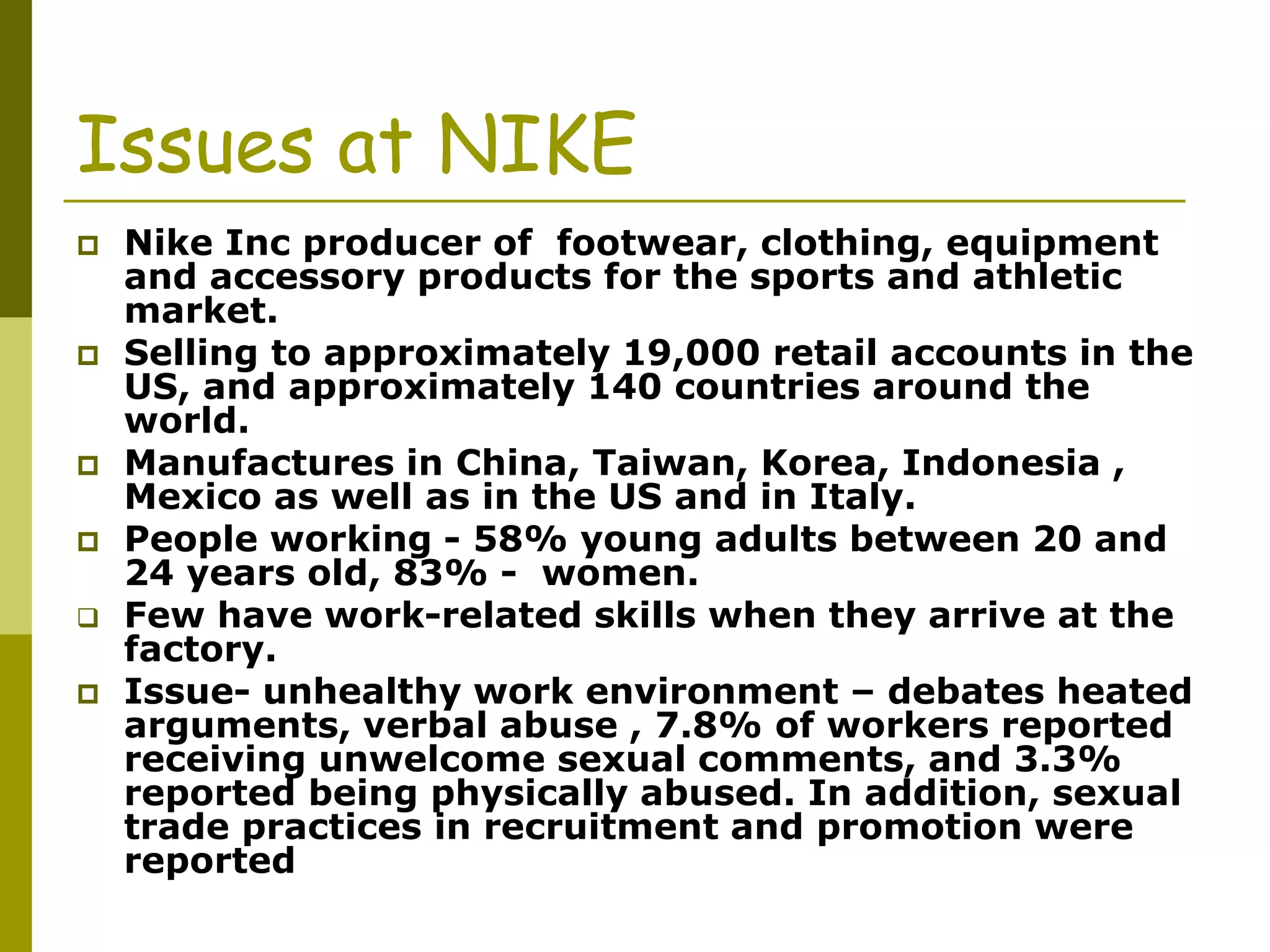
Issues at NIKE
 Nike Inc producer of footwear, clothing, equipment
and accessory products for the sports and athletic
market.
 Selling to approximately 19,000 retail accounts in the
US, and approximately 140 countries around the
world.
 Manufactures in China, Taiwan, Korea, Indonesia ,
Mexico as well as in the US and in Italy.
 People working - 58% young adults between 20 and
24 years old, 83% - women.
 Few have work-related skills when they arrive at the
factory.
 Issue- unhealthy work environment – debates heated
arguments, verbal abuse , 7.8% of workers reported
receiving unwelcome sexual comments, and 3.3%
reported being physically abused. In addition, sexual
trade practices in recruitment and promotion were
reported
Private Sector Perspective
“Corporate Social Responsibility is not a
cosmetic; it must be rooted in our values.
It must make a difference to the way we
do our business.”
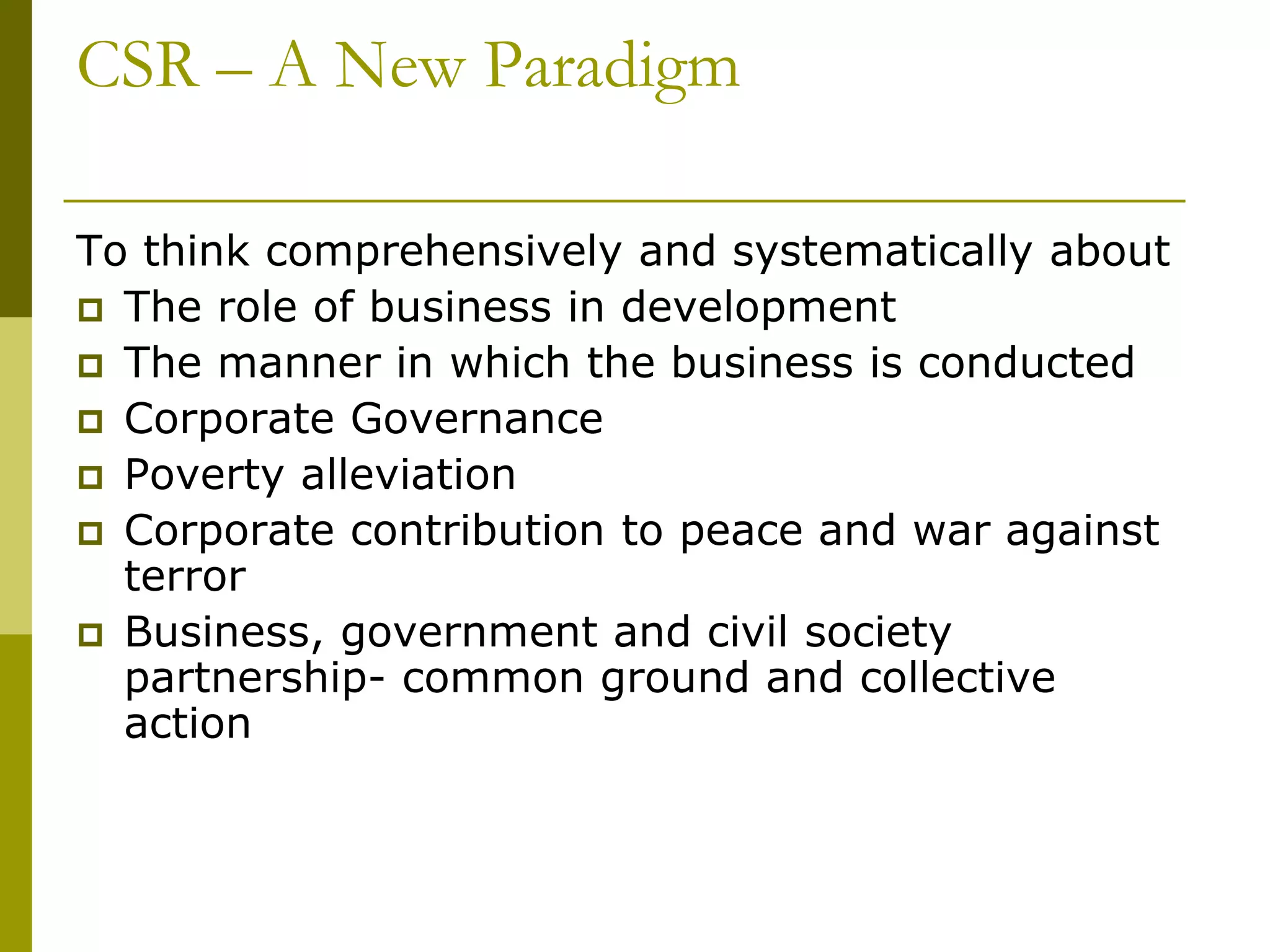
CSR – A New Paradigm
To think comprehensively and systematically about
 The role of business in development
 The manner in which the business is conducted
 Corporate Governance
 Poverty alleviation
 Corporate contribution to peace and war against
terror
 Business, government and civil society
partnership- common ground and collective
action
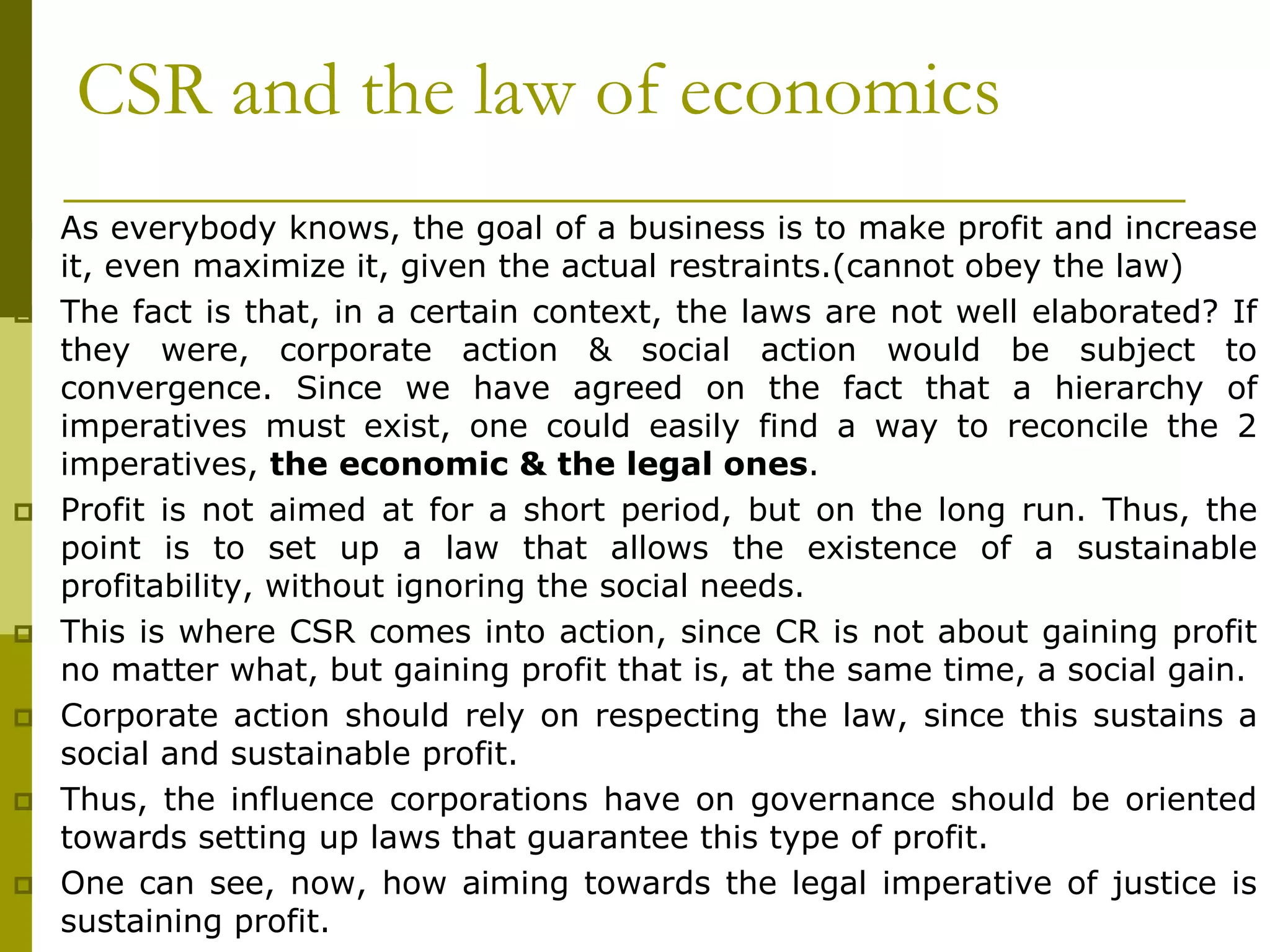
CSR and the law of economics
 As everybody knows, the goal of a business is to make profit and increase
it, even maximize it, given the actual restraints.(cannot obey the law)
 The fact is that, in a certain context, the laws are not well elaborated? If
they were, corporate action & social action would be subject to
convergence. Since we have agreed on the fact that a hierarchy of
imperatives must exist, one could easily find a way to reconcile the 2
imperatives, the economic & the legal ones.
 Profit is not aimed at for a short period, but on the long run. Thus, the
point is to set up a law that allows the existence of a sustainable
profitability, without ignoring the social needs.
 This is where CSR comes into action, since CR is not about gaining profit
no matter what, but gaining profit that is, at the same time, a social gain.
 Corporate action should rely on respecting the law, since this sustains a
social and sustainable profit.
 Thus, the influence corporations have on governance should be oriented
towards setting up laws that guarantee this type of profit.
 One can see, now, how aiming towards the legal imperative of justice is
sustaining profit.
CSR and the law of economics
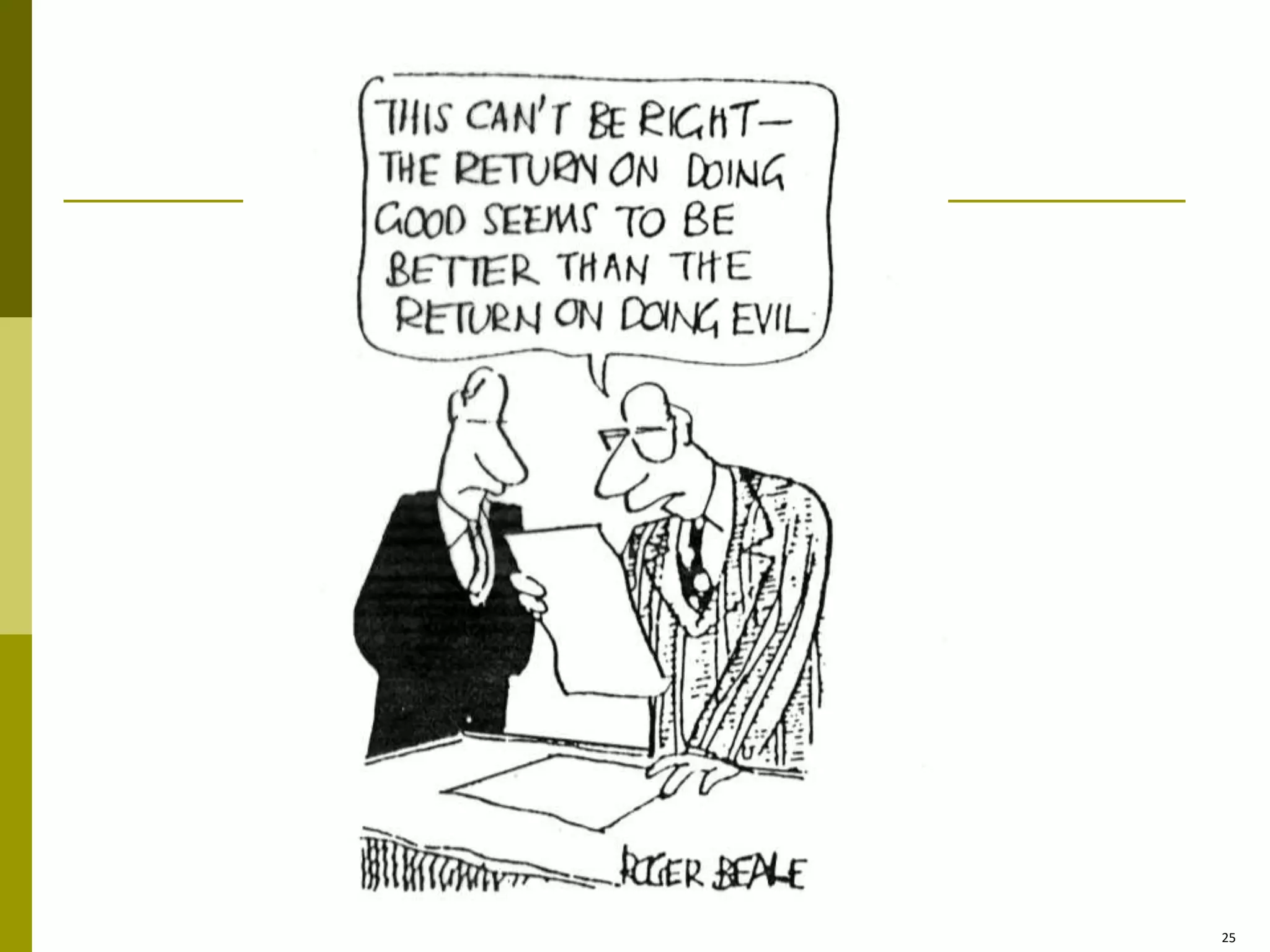
 Aiming towards good is profitable on the long run. Corporate
action is aimed towards a good that has a social relevance and is a
bit different from what many people take as good.
 In short, the idea is not to help the poor, but to make them help
themselves. Corporate action cannot be reduced to the mere act of
being kind to a poor person.
 This is why CSR is a new type of morality, a social inserted one.
Furthermore, being good does not mean giving up competition.
Being fair to competitors does not rule out profit.
 The point is that what stirs corporate action is the desire to
improve own activity, not to weaken the activity of the
competitors.
 Besides, one should never forget that being fair contributes to
setting up a friendly business environment
 And, last but not least, both society and other businesses benefit
from an act of goodness of some business. This is how moral
imperative sustains profit
25
CSR and Social Legitimacy
 "The social responsibility of business
encompasses the economic, legal, ethical and
discretionary expectations that a society has of
organizations at a given point in time.“
 “A concept whereby companies integrate social
and environmental concerns in their business
operations and in their interaction with their
stakeholders on a voluntary basis".
 Legitimacy focuses on whether the value system
of an organisation is consistent with the value
system of society, and whether the objective of
organisations is to meet social expectations
CSR and social legitimacy
 Legitimacy theory, provides a sight that the
interrelationship between an organisation &
related social expectations is just a reality of
social life.
 Acc to this theory, the continued existence of an
organisation is estb both by market strength &
social expectations, & hence an understanding
of the broader concerns of the public articulated
in community expectations becomes a essential
prerequisite for an organisation’s survival.
 The theory focuses on the supposition that an
organisation must keep its social position by
responding to society’s requirements & giving
society what it wants.
The evolving role of stakeholders
 •Shareholder - the purpose of the corporation is to
promote shareholder value
 •Stakeholder - the purpose of the corporation is to serve a
wider range of interests
 Good corporate governance helps... to ensure that
corporations take into account the interests that of a wide
range of constituencies, as well as of the communities
within which they operate, and that their boards are
accountable to the company and the shareholders. This, in
turn, helps to assure that corporations operate for the
benefit of society as a whole.
 Employees: There is widespread agreement that they are a prime
stakeholder
 Shareholders: Some would say that shareholders are the first
stakeholder
 Management: Controversial, but some believe that managers are
stakeholders
 Creditors: Creditors rights are often protected under contract and
backed by collateral so they are seldom treated as “owners” as the
shareholders are.
 Trade unions: Some argue that this group is redundant with the
employee group
 Customers: Most stakeholder models include customers
 Suppliers: Often considered a stakeholder
 The local community: Broader definitions of stakeholders widen
the concept to include responsibilities to local communities and,
more generally, civil society
 Future generations: Sustainable development --those who will
one day be reliant upon the physical environment-- as a
stakeholder group
 Stakeholders and shareholders agree that
effective corporate governance requires the
following principles:
 Transparency: Full disclosure of financial and
non-financial information
 Accountability: Ensuring that magt is
effectively overseen (and, where necessary,
replaced) by appointing an independent &
competent governing body
 Fairness: Equitable treatment of investors
 Responsibility: Ensuring the corporation
fulfills its proper role in society
The evolving role of stakeholders
 Employee participation in corporate governance systems can be
found in many countries and corporations throughout the world.
Examples include:
 Right to consultation - where employees must be consulted on
certain mgt decisions. This right increases transparency of mgt
decisions & allows employee opinion to reorganize the
asymmetry of information between management & the market
 Duties of board members to consider stakeholder
interests. This right reinforces accountability by protecting
stakeholders
 Right to nominate/vote for supervisory board members.
In many cases employee participation on the board is mandated.
This right creates a check & balance system between
management & the supervisory board, which in turn creates the
perception of greater fairness
 Compensation/privatization programs that make employees
shareholders, thereby empowering employees to elect the
supervisory board, which, in turn holds management responsible
Dynamics of reform: what is needed?
 Champions: The reform process needs champions-a stakeholder group
that is deeply interested in the long term health of the company and has
an undeniable right to speak out to management on improving the
corporation. Employee shareholders are ideally positioned because:
 •they have additional knowledge of the corporation
 •they rely upon the corporation for their own prosperity through
employment
 Incentives: The reform process needs to provide incentives for change.
Improvements in corporate governance standards could benefit employee
shareholders:
 •improving long term prospective health of company, safeguarding jobs
 •they stand to gain as shareholders if the corporation increases in value
 Rules: The reform process must also be governed by clear rules. But this
is not all. Rules must be enforced.
 Enforcement-Institutions which can enforce corporate governance rules
must also be supported in the reform process
The Iron Law
 The Law of Long-Run Self-Interest, or the
Iron Law of Social Responsibility:
 “In the long run, those who do not use
power in a manner that society considers
responsible will tend to lose it.”
 Social responsibility should involve
consideration for the environment and other
issues of public welfare as applicable to
specific corporate activities.
 The rule was introduced in response to
Davis's observation that people in business
tend to be more concerned with profit &
immediate economic interests than they are
with anything else. He claimed that they
should seek to resolve any issues caused by
their practices as well.
33
The Principle of Public
Responsibility
 The firm is said to have three levels of involvement:
 Primary involvement: Doing the firm’s basic tasks or
missions.
 Secondary involvement: Fixing the unintended by products
of the primary level, such as cleaning up pollution.
 Tertiary involvement: Everything else, such as making
speeches at business school graduations.
 interaction with the local community;
 level of support for community projects;
 level of support for developing countries;
 health and safety record;
 training, employment and education programs; and
 environmental performance.
34
Moral & Economic Arguments for CSR
 Arguments in favour of CSR:
 1. Protect the interests of stakeholders:
 Labour force is united into unions which demand protection of their rights
from business enterprises. To get the support of workers, it has become
necessary for organisations to discharge responsibility towards their
employees.
 Caveat emptor (‘let the buyer beware’), no more holds true. Consumer
today is the kingpin around whom all marketing activities revolve.
Consumer does not buy what is offered to him. He buys what he wants.
Firms that fail to satisfy consumer needs will close down sooner or later.
Besides, there are consumer redressal cells to protect consumers against
anti-consumer activities. Consumer sovereignty has, thus, forced firms to
assume social responsiveness towards them.
 Firms that assume social responsibilities may suffer losses in the short-
run but fulfilling social obligations is beneficial for long-run survival of the
firms. The short-term costs are, therefore, investments for long-run
profitability.
 2. Long-run survival:
 Business organisations are powerful institutions of the society.
Their acceptance by the society will be denied if they ignore social
problems. To avoid self-destruction in the long-run, business
enterprises assume social responsibility.
 3. Self-enlightenment:
 With increase in the level of education and understanding of
businesses that they are the creations of society, they are
motivated to work for the cause of social good. Managers create
public expectations by voluntarily setting and following standards
of moral and social responsibility.
 They ensure paying taxes to the Government, dividends to
shareholders, fair wages to workers, quality goods to consumers
and so on. Rather than legislative interference being the cause of
social responsibility, firms assume social responsibility on their
own.
 4. Resources:
 Business organisations have enormous resources which can be
partly used for solving social problems. Businesses are the creation
of society and must work in the best interest of society, both
economically and socially.
5. Avoids government regulation:
 Non-conformance to social norms may attract legislative restrictions. Government
directly influences the organisations through regulations that dictate what they
should do and what not. Various agencies monitor business activities.
 For example, Central Pollution Control Board takes care of issues related to
environmental pollution, Securities and Exchange Board of India considers issues
related to investor protection, Employees State Insurance Corporation promotes
issues related to employees’ health etc. Organisations that violate these regulations
are levied fines and penalties. To avoid such interventions, organisations have risen
to the cause of social concerns.
 6. Professionalisation:
 Management is moving towards professionalism which is contributing to social
orientation of business. Increasing professionalism is causing managers to have
formal management education and qualifications. Managers specialise in planning,
organising, leading and controlling through their knowledge and subscribe to the
code of ethics established by a recognised body.
 The ethics of profession bind managers to social values and growing concern for
society. Thus, there is increasing awareness of social responsibility. To grow in the
environment of dynamism and challenge, business concern does not decide
whether or not to discharge social responsibilities but decides how much social
responsibility to discharge. A good business anticipates developments and acts in
accordance with the currently conceived social responsibilities to achieve the future
targets.

Unit 1. Introduction to Corporate Social Responsibility.ppt

  • 1.
    Unit I: Introduction toCorporate Social Responsibility
  • 3.
     Person goingfrom one side of the canyon to the other… a lot of clouds like fog. The point is going from one way of doing business to another is very tough. There’s a lot uncertainty. It takes a lot of skill, but we have to lift ourselves beyond that, above the fog, and that’s not going to be a simple exercise. CSR is about seeing the forest, the fog, and seeing how we can get on the other side, and how we can be well-equipped for doing that. So probably we need to develop additional skills, knowledge, and understanding.”
  • 5.
    Message “The message isthat whatever we do today will have an impact on future generations. It’s not just my kids or your kids or somebody else’s. It’s future generations. We should not hope that the walls we build to protect ourselves will be tall enough to protect our children. Only with very conscious effort we can make the world for them a better place to live…even if we address our most selfish needs we have to address the needs of the next generation. That’s what CSR is about.”
  • 6.
    Reference Books  CorporateSocial Responsibility - C.V. Baxi  Corporate Social Responsibility - Jayant Bhattacharya
  • 7.
    Definition of CorporateSocial Responsibility “CSR is about how companies manage the business processes to produce an overall positive impact on society.”
  • 8.
    Definition “Achieving commercial successin ways that honour ethical values and respect people, communities, and the natural environment”
  • 9.
    Definitions: Practice WBCSD (WorldBusiness Council for Sustainable Development) “The continuing commitment by business to behave ethically and contribute to sustainable economic development while improving the quality of life of the workforce and their families as well as of the local community and society.”
  • 10.
    Definitions: Concept Philip Kotler& Nancy Lee (2005) “a commitment to improve community well-being through discretionary business practices and contributions of corporate resources”.
  • 11.
    Corporate Social Responsibility(CSR) CSR in Equation Form Is the Sum of: Economic Responsibilities (Make a profit) Legal Responsibilities (Obey the law) Ethical Responsibilities (Be ethical) Philanthropic Responsibilities (Good corporate citizen) CSR
  • 12.
    Historical Perspective From the1950’s to the present the concept of CSR has gained considerable acceptance and the meaning has been broadened to include additional components
  • 13.
    Corporate Social Responsibility(CSR) Evolving Viewpoints  CSR considers the impact of the company’s actions on society (Bauer)  CSR requires decision makers to take actions that protect and improve the welfare of society as a whole along with their own interests (Davis and Blomstrom
  • 14.
    Phases of CorporateSocial Responsibility Frederick provides expanded framework for understanding the evolution of CSR concept Divided into 4 phases:  Corporate social stewardship, 1950s – 1960s  Corporate social responsiveness, 1960s – 1970s  Corporate/business ethics, 1980s – 1990s  Corporate/global citizenship, 1990s – 2000s
  • 15.
    Drivers of CSR The shrinking role of government  Demands for greater disclosure  Growing investor pressure  Competitive markets
  • 16.
    Benefits of CSR… Strengthened brand positioning.  Enhanced corporate image.  Increased ability to attract, motivate, and retain employees.  Increased sales and market share.  Increased appeal to investors and financial analysts.
  • 17.
    CSR also knownas  Sustainable Development  Corporate Citizenship  Triple Bottom Line  Business Ethics  Sustainable Business Practices
  • 18.
    CSR EXAMPLES  IBMUK - Reinventing Education Partnership programme Interactions and sharing of knowledge through a web-based technology - the “Learning Village” software. Culture of openness and sharing of good practice  AVON - a partnership with Breakthrough Breast Cancer, and its Breast Cancer Crusade has raised over 10 million pounds since its launch 12 years ago  TOI’s Lead India campaign, campaign for contribution towards educating the poor
  • 19.
    Companies in trouble Dasani mineral water (part of Coca-Cola).  Coke’s sale was banned as the result of tests, including those by the Indian government, which found high concentrations of pesticides.  Communities in India , around Coca-Cola's bottling operations are facing severe shortages of water as a result of the cola major sucking huge amounts of water from the common groundwater source.
  • 20.
    Issues at NIKE Nike Inc producer of footwear, clothing, equipment and accessory products for the sports and athletic market.  Selling to approximately 19,000 retail accounts in the US, and approximately 140 countries around the world.  Manufactures in China, Taiwan, Korea, Indonesia , Mexico as well as in the US and in Italy.  People working - 58% young adults between 20 and 24 years old, 83% - women.  Few have work-related skills when they arrive at the factory.  Issue- unhealthy work environment – debates heated arguments, verbal abuse , 7.8% of workers reported receiving unwelcome sexual comments, and 3.3% reported being physically abused. In addition, sexual trade practices in recruitment and promotion were reported
  • 21.
    Private Sector Perspective “CorporateSocial Responsibility is not a cosmetic; it must be rooted in our values. It must make a difference to the way we do our business.”
  • 22.
    CSR – ANew Paradigm To think comprehensively and systematically about  The role of business in development  The manner in which the business is conducted  Corporate Governance  Poverty alleviation  Corporate contribution to peace and war against terror  Business, government and civil society partnership- common ground and collective action
  • 23.
    CSR and thelaw of economics  As everybody knows, the goal of a business is to make profit and increase it, even maximize it, given the actual restraints.(cannot obey the law)  The fact is that, in a certain context, the laws are not well elaborated? If they were, corporate action & social action would be subject to convergence. Since we have agreed on the fact that a hierarchy of imperatives must exist, one could easily find a way to reconcile the 2 imperatives, the economic & the legal ones.  Profit is not aimed at for a short period, but on the long run. Thus, the point is to set up a law that allows the existence of a sustainable profitability, without ignoring the social needs.  This is where CSR comes into action, since CR is not about gaining profit no matter what, but gaining profit that is, at the same time, a social gain.  Corporate action should rely on respecting the law, since this sustains a social and sustainable profit.  Thus, the influence corporations have on governance should be oriented towards setting up laws that guarantee this type of profit.  One can see, now, how aiming towards the legal imperative of justice is sustaining profit.
  • 24.
    CSR and thelaw of economics  Aiming towards good is profitable on the long run. Corporate action is aimed towards a good that has a social relevance and is a bit different from what many people take as good.  In short, the idea is not to help the poor, but to make them help themselves. Corporate action cannot be reduced to the mere act of being kind to a poor person.  This is why CSR is a new type of morality, a social inserted one. Furthermore, being good does not mean giving up competition. Being fair to competitors does not rule out profit.  The point is that what stirs corporate action is the desire to improve own activity, not to weaken the activity of the competitors.  Besides, one should never forget that being fair contributes to setting up a friendly business environment  And, last but not least, both society and other businesses benefit from an act of goodness of some business. This is how moral imperative sustains profit
  • 25.
  • 26.
    CSR and SocialLegitimacy  "The social responsibility of business encompasses the economic, legal, ethical and discretionary expectations that a society has of organizations at a given point in time.“  “A concept whereby companies integrate social and environmental concerns in their business operations and in their interaction with their stakeholders on a voluntary basis".  Legitimacy focuses on whether the value system of an organisation is consistent with the value system of society, and whether the objective of organisations is to meet social expectations
  • 27.
    CSR and sociallegitimacy  Legitimacy theory, provides a sight that the interrelationship between an organisation & related social expectations is just a reality of social life.  Acc to this theory, the continued existence of an organisation is estb both by market strength & social expectations, & hence an understanding of the broader concerns of the public articulated in community expectations becomes a essential prerequisite for an organisation’s survival.  The theory focuses on the supposition that an organisation must keep its social position by responding to society’s requirements & giving society what it wants.
  • 28.
    The evolving roleof stakeholders  •Shareholder - the purpose of the corporation is to promote shareholder value  •Stakeholder - the purpose of the corporation is to serve a wider range of interests  Good corporate governance helps... to ensure that corporations take into account the interests that of a wide range of constituencies, as well as of the communities within which they operate, and that their boards are accountable to the company and the shareholders. This, in turn, helps to assure that corporations operate for the benefit of society as a whole.
  • 29.
     Employees: Thereis widespread agreement that they are a prime stakeholder  Shareholders: Some would say that shareholders are the first stakeholder  Management: Controversial, but some believe that managers are stakeholders  Creditors: Creditors rights are often protected under contract and backed by collateral so they are seldom treated as “owners” as the shareholders are.  Trade unions: Some argue that this group is redundant with the employee group  Customers: Most stakeholder models include customers  Suppliers: Often considered a stakeholder  The local community: Broader definitions of stakeholders widen the concept to include responsibilities to local communities and, more generally, civil society  Future generations: Sustainable development --those who will one day be reliant upon the physical environment-- as a stakeholder group
  • 30.
     Stakeholders andshareholders agree that effective corporate governance requires the following principles:  Transparency: Full disclosure of financial and non-financial information  Accountability: Ensuring that magt is effectively overseen (and, where necessary, replaced) by appointing an independent & competent governing body  Fairness: Equitable treatment of investors  Responsibility: Ensuring the corporation fulfills its proper role in society The evolving role of stakeholders
  • 31.
     Employee participationin corporate governance systems can be found in many countries and corporations throughout the world. Examples include:  Right to consultation - where employees must be consulted on certain mgt decisions. This right increases transparency of mgt decisions & allows employee opinion to reorganize the asymmetry of information between management & the market  Duties of board members to consider stakeholder interests. This right reinforces accountability by protecting stakeholders  Right to nominate/vote for supervisory board members. In many cases employee participation on the board is mandated. This right creates a check & balance system between management & the supervisory board, which in turn creates the perception of greater fairness  Compensation/privatization programs that make employees shareholders, thereby empowering employees to elect the supervisory board, which, in turn holds management responsible
  • 32.
    Dynamics of reform:what is needed?  Champions: The reform process needs champions-a stakeholder group that is deeply interested in the long term health of the company and has an undeniable right to speak out to management on improving the corporation. Employee shareholders are ideally positioned because:  •they have additional knowledge of the corporation  •they rely upon the corporation for their own prosperity through employment  Incentives: The reform process needs to provide incentives for change. Improvements in corporate governance standards could benefit employee shareholders:  •improving long term prospective health of company, safeguarding jobs  •they stand to gain as shareholders if the corporation increases in value  Rules: The reform process must also be governed by clear rules. But this is not all. Rules must be enforced.  Enforcement-Institutions which can enforce corporate governance rules must also be supported in the reform process
  • 33.
    The Iron Law The Law of Long-Run Self-Interest, or the Iron Law of Social Responsibility:  “In the long run, those who do not use power in a manner that society considers responsible will tend to lose it.”  Social responsibility should involve consideration for the environment and other issues of public welfare as applicable to specific corporate activities.  The rule was introduced in response to Davis's observation that people in business tend to be more concerned with profit & immediate economic interests than they are with anything else. He claimed that they should seek to resolve any issues caused by their practices as well. 33
  • 34.
    The Principle ofPublic Responsibility  The firm is said to have three levels of involvement:  Primary involvement: Doing the firm’s basic tasks or missions.  Secondary involvement: Fixing the unintended by products of the primary level, such as cleaning up pollution.  Tertiary involvement: Everything else, such as making speeches at business school graduations.  interaction with the local community;  level of support for community projects;  level of support for developing countries;  health and safety record;  training, employment and education programs; and  environmental performance. 34
  • 35.
    Moral & EconomicArguments for CSR  Arguments in favour of CSR:  1. Protect the interests of stakeholders:  Labour force is united into unions which demand protection of their rights from business enterprises. To get the support of workers, it has become necessary for organisations to discharge responsibility towards their employees.  Caveat emptor (‘let the buyer beware’), no more holds true. Consumer today is the kingpin around whom all marketing activities revolve. Consumer does not buy what is offered to him. He buys what he wants. Firms that fail to satisfy consumer needs will close down sooner or later. Besides, there are consumer redressal cells to protect consumers against anti-consumer activities. Consumer sovereignty has, thus, forced firms to assume social responsiveness towards them.  Firms that assume social responsibilities may suffer losses in the short- run but fulfilling social obligations is beneficial for long-run survival of the firms. The short-term costs are, therefore, investments for long-run profitability.
  • 36.
     2. Long-runsurvival:  Business organisations are powerful institutions of the society. Their acceptance by the society will be denied if they ignore social problems. To avoid self-destruction in the long-run, business enterprises assume social responsibility.  3. Self-enlightenment:  With increase in the level of education and understanding of businesses that they are the creations of society, they are motivated to work for the cause of social good. Managers create public expectations by voluntarily setting and following standards of moral and social responsibility.  They ensure paying taxes to the Government, dividends to shareholders, fair wages to workers, quality goods to consumers and so on. Rather than legislative interference being the cause of social responsibility, firms assume social responsibility on their own.  4. Resources:  Business organisations have enormous resources which can be partly used for solving social problems. Businesses are the creation of society and must work in the best interest of society, both economically and socially.
  • 37.
    5. Avoids governmentregulation:  Non-conformance to social norms may attract legislative restrictions. Government directly influences the organisations through regulations that dictate what they should do and what not. Various agencies monitor business activities.  For example, Central Pollution Control Board takes care of issues related to environmental pollution, Securities and Exchange Board of India considers issues related to investor protection, Employees State Insurance Corporation promotes issues related to employees’ health etc. Organisations that violate these regulations are levied fines and penalties. To avoid such interventions, organisations have risen to the cause of social concerns.  6. Professionalisation:  Management is moving towards professionalism which is contributing to social orientation of business. Increasing professionalism is causing managers to have formal management education and qualifications. Managers specialise in planning, organising, leading and controlling through their knowledge and subscribe to the code of ethics established by a recognised body.  The ethics of profession bind managers to social values and growing concern for society. Thus, there is increasing awareness of social responsibility. To grow in the environment of dynamism and challenge, business concern does not decide whether or not to discharge social responsibilities but decides how much social responsibility to discharge. A good business anticipates developments and acts in accordance with the currently conceived social responsibilities to achieve the future targets.