ORGANISATION CHALLENGES  IN MANAGING BUSINESS  IN THE NEW MILLENNIA  (21 ST  CENTURY)
MANAGEMENT CHALLENGES IN THE NEW MILLENNIA (21 ST  CENTURY) Impact of Globalization   - leads to strategic challenges of mixed cultures and languages in the business environment. Managing Across Borders   – the ability of an organisation to survive and succeed in the 21 st  century transnational workforce and borderless business environment. Challenges in  managing  enterprise-wide  production environments. Revolution of Information Technology   – supported by a new world infrastructure of data communications and telecommunications i.e. use of internet, wireless, e-commerce as part of management tools and easing of technology transfer. Security Issues   with wide usage of internet platform in business transactions. Increasing demand for   knowledge-worker  in the knowledge driven organizations.
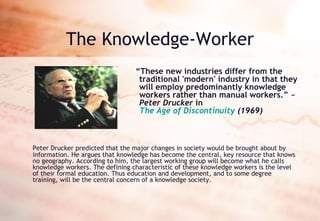
The Knowledge-Worker “ These new industries differ from the traditional 'modern' industry in that they will employ predominantly knowledge workers rather than manual workers.” ~  Peter Drucker  in  The Age of Discontinuity  (1969) Peter Drucker predicted that the major changes in society would be brought about by information. He argues that knowledge has become the central, key resource that knows no geography. According to him, the largest working group will become what he calls knowledge workers. The defining characteristic of these knowledge workers is the level of their formal education. Thus education and development, and to some degree training, will be the central concern of a knowledge society.
The Key to Organisation Survival & Prospering in the 21 st  Century Corporate Strategy   - Organizations must have a structure that help to unleash the power of their professionals and to capture the opportunities of today's economy.  Ethical Issues   – Understanding the new ethical issues emerged from changes in the social and political landscape and from the development of new technologies.  Social Responsibility   – The issues of privacy and confidentially, accessibility to technology issues, property right and ownership issues, freedom of speech…etc Global Challenges   – impact of globalisation and cross-border work culture. Ecological Issues   – Oil exploitation and land rights, food security, mining in Africa, climate vulnerability and ecotourism.  Workforce Diversity   - Cultural Awareness/Acceptance (i.e. Ethnic Minorities, Multilingualism, Individual Differences)
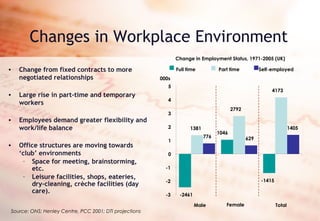
Changes in Workplace Environment Change from fixed contracts to more negotiated relationships Large rise in part-time and temporary workers Employees demand greater flexibility and work/life balance Office structures are moving towards ‘club’ environments  Space for meeting, brainstorming, etc. Leisure facilities, shops, eateries, dry-cleaning, crèche facilities (day care). Source: ONS; Henley Centre, PCC 2001; DTI projections Change in Employment Status, 1971-2005 (UK) -2461 1046 -1415 1381 2792 4173 776 629 1405 -3 -2 -1 0 1 2 3 4 5 Male Female Total Full time Part time Self-employed 000s
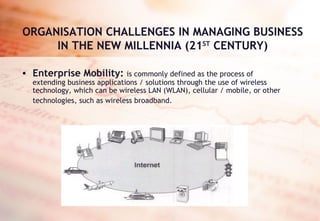
ORGANISATION CHALLENGES IN MANAGING BUSINESS IN THE NEW MILLENNIA (21 ST  CENTURY) Enterprise Mobility:   is commonly defined as the process of extending business applications / solutions through the use of wireless technology, which can be wireless LAN (WLAN), cellular / mobile, or other technologies, such as wireless broadband.
ORGANISATION CHALLENGES IN MANAGING BUSINESS IN THE NEW MILLENNIA (21 ST  CENTURY) Maintain and contribute to a sustainable socioeconomic environment:   recycle waste and control pollution in the physical environment.  Importance of "human capital “:   to   create an   organisations which support the workers in their cooperative endeavors.   Improve organisation management (leadership) :   Eliminating internal competition, alignment of measurement and reward systems, training and empowering employees to act on the scene and communicate critical problems without delay and to get rapid organisational response.
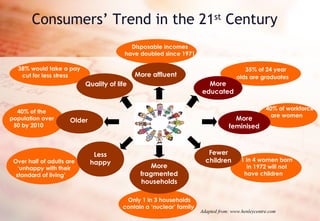
Consumers’ Trend in the 21 st  Century More affluent More educated Quality of life More feminised Older More fragmented households Less happy Fewer children 1 in 4 women born in 1972 will not have children  40% of the population over 50 by 2010  Disposable incomes have doubled since 1971  Only 1 in 3 households contain a ‘nuclear’ family  35% of 24 year olds are graduates  40% of workforce are women  Over half of adults are ‘unhappy with their standard of living’  38% would take a pay cut for less stress  Adapted from: www.henleycentre.com
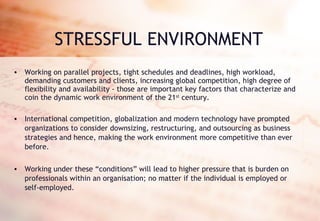
STRESSFUL ENVIRONMENT Working on parallel projects, tight schedules and deadlines, high workload, demanding customers and clients, increasing global competition, high degree of flexibility and availability - those are important key factors that characterize and coin the dynamic work environment of the 21 st  century. International competition, globalization and modern technology have prompted organizations to consider downsizing, restructuring, and outsourcing as business strategies and hence, making the work environment more competitive than ever before.  Working under these “conditions” will lead to higher pressure that is burden on professionals within an organisation; no matter if the individual is employed or self-employed.
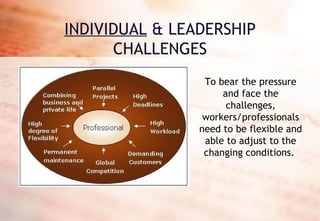
INDIVIDUAL  & LEADERSHIP CHALLENGES To bear the pressure and face the challenges, workers/professionals need to be flexible and able to adjust to the changing conditions.
INDIVIDUAL &  LEADERSHIP  CHALLENGES Generational leadership   - managing an older workforce, as well as the digital generation  Sustainability   - protecting today's environment and addressing consumers' needs  Virtual leadership   - leading an internet-based environment   The  developing world   - responding to a changing economy  Diversity   - leading a workforce comprising ethnic minorities, mature workers, etc  Globalisation   - managing an extended workforce, and social responsibility.
Implication to HR & Challenges in 21 st  Century HR must understand the cultures around the world and think of itself and operate as a business globally. With the unemployment rate standing at 4.1%, "the type of worker being sought in the new millennium are more skilled or higher educated than in the past. The pool of such people is running dry. Putting together programs that help employees find the right balance between home and work. Using best practices to create an environment that attracts people and makes them want to stay.  Effective handling of company downsizing and retrenched workers. Technology, as well as the change in the traditional workweek and how jobs are defined, will combine to give employees more autonomy over when they work. Dealing with a diverse workforce and will find a way to direct these workers toward a common purpose.  Change of workplace to ‘club’ environment requires HR professionals to have extra skills in determining the design and layout of offices and meeting areas.
SUMMARY New and faster technology, redefined values, and shifting customer demands are changing the way businesses operate in the twenty-first century.  The delivery of goods, services, and spare parts will be done by e-commerce organizations.  In the majority of developed countries, the population is aging. Human resources is being transformed from a specialized, stand-alone function to a broad, corporate competency. HR policies and program initiatives will have to be responsive to market conditions and global business structures. Importance of Global Leadership in the 21 st  century

21st Century Business Challenges

  • 1.
    ORGANISATION CHALLENGES IN MANAGING BUSINESS IN THE NEW MILLENNIA (21 ST CENTURY)
  • 2.
    MANAGEMENT CHALLENGES INTHE NEW MILLENNIA (21 ST CENTURY) Impact of Globalization - leads to strategic challenges of mixed cultures and languages in the business environment. Managing Across Borders – the ability of an organisation to survive and succeed in the 21 st century transnational workforce and borderless business environment. Challenges in managing enterprise-wide production environments. Revolution of Information Technology – supported by a new world infrastructure of data communications and telecommunications i.e. use of internet, wireless, e-commerce as part of management tools and easing of technology transfer. Security Issues with wide usage of internet platform in business transactions. Increasing demand for knowledge-worker in the knowledge driven organizations.
  • 3.
    The Knowledge-Worker “These new industries differ from the traditional 'modern' industry in that they will employ predominantly knowledge workers rather than manual workers.” ~ Peter Drucker in The Age of Discontinuity (1969) Peter Drucker predicted that the major changes in society would be brought about by information. He argues that knowledge has become the central, key resource that knows no geography. According to him, the largest working group will become what he calls knowledge workers. The defining characteristic of these knowledge workers is the level of their formal education. Thus education and development, and to some degree training, will be the central concern of a knowledge society.
  • 4.
    The Key toOrganisation Survival & Prospering in the 21 st Century Corporate Strategy - Organizations must have a structure that help to unleash the power of their professionals and to capture the opportunities of today's economy. Ethical Issues – Understanding the new ethical issues emerged from changes in the social and political landscape and from the development of new technologies. Social Responsibility – The issues of privacy and confidentially, accessibility to technology issues, property right and ownership issues, freedom of speech…etc Global Challenges – impact of globalisation and cross-border work culture. Ecological Issues – Oil exploitation and land rights, food security, mining in Africa, climate vulnerability and ecotourism. Workforce Diversity - Cultural Awareness/Acceptance (i.e. Ethnic Minorities, Multilingualism, Individual Differences)
  • 5.
    Changes in WorkplaceEnvironment Change from fixed contracts to more negotiated relationships Large rise in part-time and temporary workers Employees demand greater flexibility and work/life balance Office structures are moving towards ‘club’ environments Space for meeting, brainstorming, etc. Leisure facilities, shops, eateries, dry-cleaning, crèche facilities (day care). Source: ONS; Henley Centre, PCC 2001; DTI projections Change in Employment Status, 1971-2005 (UK) -2461 1046 -1415 1381 2792 4173 776 629 1405 -3 -2 -1 0 1 2 3 4 5 Male Female Total Full time Part time Self-employed 000s
  • 6.
    ORGANISATION CHALLENGES INMANAGING BUSINESS IN THE NEW MILLENNIA (21 ST CENTURY) Enterprise Mobility: is commonly defined as the process of extending business applications / solutions through the use of wireless technology, which can be wireless LAN (WLAN), cellular / mobile, or other technologies, such as wireless broadband.
  • 7.
    ORGANISATION CHALLENGES INMANAGING BUSINESS IN THE NEW MILLENNIA (21 ST CENTURY) Maintain and contribute to a sustainable socioeconomic environment: recycle waste and control pollution in the physical environment. Importance of "human capital “: to create an organisations which support the workers in their cooperative endeavors. Improve organisation management (leadership) : Eliminating internal competition, alignment of measurement and reward systems, training and empowering employees to act on the scene and communicate critical problems without delay and to get rapid organisational response.
  • 8.
    Consumers’ Trend inthe 21 st Century More affluent More educated Quality of life More feminised Older More fragmented households Less happy Fewer children 1 in 4 women born in 1972 will not have children 40% of the population over 50 by 2010 Disposable incomes have doubled since 1971 Only 1 in 3 households contain a ‘nuclear’ family 35% of 24 year olds are graduates 40% of workforce are women Over half of adults are ‘unhappy with their standard of living’ 38% would take a pay cut for less stress Adapted from: www.henleycentre.com
  • 9.
    STRESSFUL ENVIRONMENT Workingon parallel projects, tight schedules and deadlines, high workload, demanding customers and clients, increasing global competition, high degree of flexibility and availability - those are important key factors that characterize and coin the dynamic work environment of the 21 st century. International competition, globalization and modern technology have prompted organizations to consider downsizing, restructuring, and outsourcing as business strategies and hence, making the work environment more competitive than ever before. Working under these “conditions” will lead to higher pressure that is burden on professionals within an organisation; no matter if the individual is employed or self-employed.
  • 10.
    INDIVIDUAL &LEADERSHIP CHALLENGES To bear the pressure and face the challenges, workers/professionals need to be flexible and able to adjust to the changing conditions.
  • 11.
    INDIVIDUAL & LEADERSHIP CHALLENGES Generational leadership - managing an older workforce, as well as the digital generation Sustainability - protecting today's environment and addressing consumers' needs Virtual leadership - leading an internet-based environment The developing world - responding to a changing economy Diversity - leading a workforce comprising ethnic minorities, mature workers, etc Globalisation - managing an extended workforce, and social responsibility.
  • 12.
    Implication to HR& Challenges in 21 st Century HR must understand the cultures around the world and think of itself and operate as a business globally. With the unemployment rate standing at 4.1%, "the type of worker being sought in the new millennium are more skilled or higher educated than in the past. The pool of such people is running dry. Putting together programs that help employees find the right balance between home and work. Using best practices to create an environment that attracts people and makes them want to stay. Effective handling of company downsizing and retrenched workers. Technology, as well as the change in the traditional workweek and how jobs are defined, will combine to give employees more autonomy over when they work. Dealing with a diverse workforce and will find a way to direct these workers toward a common purpose. Change of workplace to ‘club’ environment requires HR professionals to have extra skills in determining the design and layout of offices and meeting areas.
  • 13.
    SUMMARY New andfaster technology, redefined values, and shifting customer demands are changing the way businesses operate in the twenty-first century. The delivery of goods, services, and spare parts will be done by e-commerce organizations. In the majority of developed countries, the population is aging. Human resources is being transformed from a specialized, stand-alone function to a broad, corporate competency. HR policies and program initiatives will have to be responsive to market conditions and global business structures. Importance of Global Leadership in the 21 st century

Editor's Notes

  • #2 In Management Challenges for the 21st Century (Classic Drucker Collection) By Peter F. Drucker Drucker sees the period we're living in as one of "PROFOUND TRANSITION--and the changes are more radical perhaps than even those that ushered in the 'Second Industrial Revolution' in the middle of the 19th century, or the structural changes triggered by the Great Depression and the Second World War". In the midst of all this change, he contends, there are five social and political certainties that will shape business strategy in the not-too-distant future: the collapsing birthrate in the developed world; shifts in distribution of disposable income; a redefinition of corporate performance; global competitiveness; and the growing incongruence between economic and political reality. Drucker then looks at requirements for leadership ("One cannot manage change. One can only be ahead of it"), the characteristics of the "new information revolution" (one should focus on the meaning of information, not the technology that collects it), productivity of the knowledge worker (unlike manual workers, knowledge workers must be seen as capital assets, not costs), and finally the responsibilities that knowledge workers must assume in managing themselves and their careers.