1
The Meaning Of An Ethical Culture
i
The Meaning Of An Ethical Culture
• Ethical culture is centered on keeping promises and honoring
commitments (Vaux, n.d.)
• Personal integrity, moral and ethical relationships are the
cornerstones of your business (Schwartz, 2010)
• An ethical workplace supports a positive reputation and improved
morale (Frost, n.d.)
2
The Meaning Of An Ethical Culture (cont.)
• Moral principles that have been set to govern
workplace behavior
• A good moral character has been well developed within
the organization
3
Maintaining An Ethical Culture
4
ii
Maintaining An Ethical Culture
• Constant monitoring and corrective measures must be in place
• Ethics education and compliance program enforcement and
discipline (Snell, 2010)
• Policies, management actions, resources, and reporting (Frost,
n.d.)
Written policies establish employee expectations
Senior leadership sets the tone
Having resources help your employees to function properly
A reporting system allows warning of possible violations
5
Maintaining An Ethical Culture (cont.)
• Maintaining the values of the organization is everyone’s responsibility (SCU,
2015)
• Get the message out, educate, make aware and you will maintain which will
result in compliance (Pitt, 2015)
6
The Role Culture Plays In Business Ethics
7
iii
The Role Culture Plays In Business Ethics
• It’s about responsibility (Brimmer, 2007)
• Neither luxury or an option
• Shared core values – honesty, respect, responsibility, fairness, and compassion
• Common language – communicate readily and comfortably
• Commitment from above – ethics meaningless without senior leaders walking the talk
• Moral courage – no fear of reprisal should be felt (Brimmer, 2007)
8
The Role Culture Plays In Business Ethics
(cont.)
• Organizational culture encourages ethical conduct and compliance
• A positive culture of integrity is the foundation for effective ethics and
compliance
• Mind the gap between management’s perception and how the organization
views its culture (Deloitte Risk Editor, 2015)
9
10
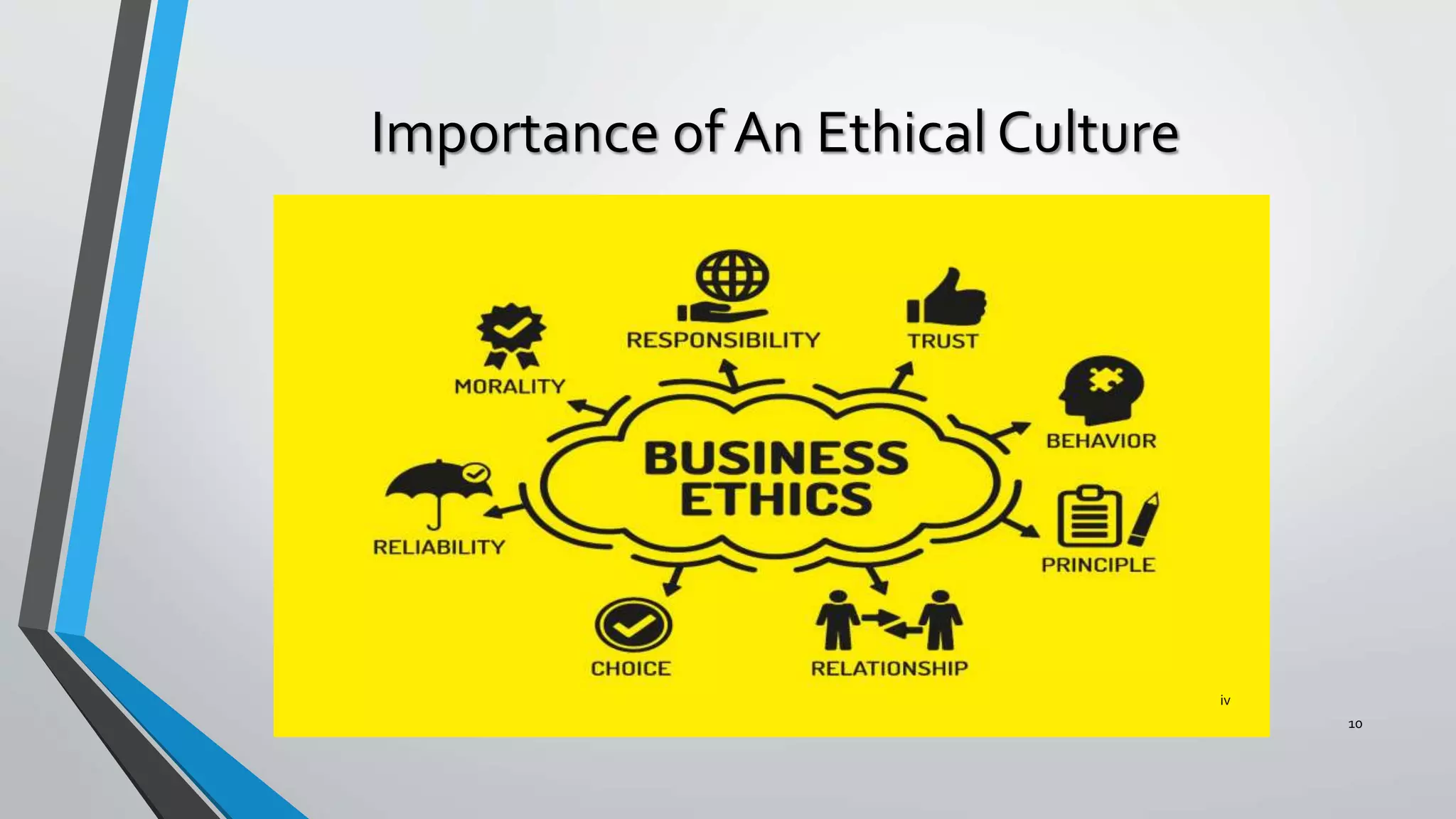
Importance of An Ethical Culture
iv
Importance of An Ethical Culture
• Positive corporate culture, consumer confidence, and reduced financial
liabilities (Leonard, 2018)
• Credibility created with consumers
• Creates management credibility with employees
11
Importance of An Ethical Culture (cont.)
• Asset protection – employees won’t do things like use printer for personal use
• Productivity – employees work better, more accomplished
• Teamwork – employees build better peer relationships
• Public image – perception is crucial
• Decision-making – accountability, responsibility (Russell, 2015)
12
13
Recommended Methods
v
Recommended Methods
• Model desired behavior – from leaders
• Clear and concise verbiage – what is and what is not allowed
• Skill building, right tools, and problem solving – training, workshops
• Reinforce the right behavior – praise the right actions
• Corrective feedback – providing proper critique (Plante, 2015)
14
Recommended Methods (cont.)
Value Attitude Ethical Behavior
Wisdom and Knowledge Experience promotes wisdom that converts to knowledge Use knowledge to solve problems ethically, do what is right
Self-Control
Self-control means managing reactions to situations and
temptations
Put personal motivations aside, act with objectivity, do what
is right
Justice
Just and fair behavior is a driver for ethical behavior; use the
“Golden Rule”
Establish agreed upon criteria, administer fairly to all
Transcendence
Belief in a power/source outside oneself reduces self-serving
actions, increases humility
Put others interests above self interests
Love and Kindness
Treat people with kindness will increase the reservoir of affection
and love
Recognize and encourage others for their contributions
Courage and Integrity
Ethics requires courage to do the right things without regard to
personal consequences
Make decisions based on the facts
15
(Kern, 2003)
Brimmer, S. (2007). The role of ethics in 21st century organizations. Retrieved https://www.regent.edu/acad/global/publications/lao/issue_11/brimmer.htm
Deloitte Risk Editor, (2015). Corporate culture: The center of strong ethics and compliance. Retrieved from
http://deloitte.wsj.com/riskandcompliance/2015/01/20/corporate-culture-the-center-of-strong-ethics-and-compliance/
Frost, S. (n.d.). How a company develops & maintains an ethical environment. Retrieved from http://smallbusiness.chron.com/company-develops-
maintains-ethical-environment-37312.html
Kern, C.D. (2003). Creating and sustaining an ethical workplace culture. Retrieved from https://gbr.pepperdine.edu/2010/08/creating-and-sustaining-an-
ethical-workplace-culture/
Leonard, K. (2018). The importance of ethics in organizations. Retrieved from http://smallbusiness.chron.com/importance-ethics-organizations-20925.html
Pitt, V. (2015, March 6). Sugaring the pill. Legal Week, 12-14. Retrieved from
https://libraryresources.columbiasouthern.edu/login?url=http://search.proquest.com.libraryresources.columbiasouthern.edu/docview/1662390832?acco
untid=33337
References
16
Plante, T.G. (2015). Six ways to create a culture of ethics in any organization. Retrieved from https://www.psychologytoday.com/us/blog/do-the-right-
thing/201507/six-ways-create-culture-ethics-in-any-organization
Russel, A. (2015). The benefits & importance of ethics in the workplace. Retrieved from https://www.linkedin.com/pulse/benefits-importance-ethics-
workplace-larry-ventimiglio
Schwartz, A. (2010). Being ethical in an unethical industry. Contractor Magazine, 57(11), 30-67. Retrieved from
http://web.b.ebscohost.com.libraryresources.columbiasouthern.edu/ehost/detail/detail?vid=6&sid=e23d793b-5753-48fc-9adb-
a67c0eec1c47%40sessionmgr120&bdata=JnNpdGU9ZWhvc3QtbGl2ZSZzY29wZT1zaXRl#AN=55715117&db=bth
SCU. (2015). Maintaining and improving the ethical culture of a business organization. Retrieved from https://www.scu.edu/ethics/focus-areas/business-
ethics/resources/maintaining-and-improving-the-ethical-culture-of/
Snell, R. (2010). Being Nice to People is Not Always the Nice Thing to Do. Journal Of Health Care Compliance, 12(6), 27-30. Retrieved from
http://web.b.ebscohost.com.libraryresources.columbiasouthern.edu/ehost/detail/detail?vid=3&sid=e23d793b-5753-48fc-9adb-
a67c0eec1c47%40sessionmgr120&bdata=JnNpdGU9ZWhvc3QtbGl2ZSZzY29wZT1zaXRl#db=bth&AN=56469399
Vaux, R. (n.d.) Ethical business culture. Retrieved from http://smallbusiness.chron.com/ethical-business-culture-19425.html
References (cont.)
17
Graphics References
i. https://www.nonprofitnext.nhnonprofits.org/landing/operations
ii. https://americantesol.com/blogger/american-tesol-webinar-10-professional-development-
tips-for-english-language-teaching/
iii. http://www.thebusinesstrends.net/the-importance-of-business-ethics/
iv. https://www.chuckgallagher.com/2016/08/23/influencing-ethical-behavior-4-levers-that-
create-an-ethical-culture/
v. http://clipground.com/people-using-tools-clipart.html
18

Ethical culture

  • 1.
    1 The Meaning OfAn Ethical Culture i
  • 2.
    The Meaning OfAn Ethical Culture • Ethical culture is centered on keeping promises and honoring commitments (Vaux, n.d.) • Personal integrity, moral and ethical relationships are the cornerstones of your business (Schwartz, 2010) • An ethical workplace supports a positive reputation and improved morale (Frost, n.d.) 2
  • 3.
    The Meaning OfAn Ethical Culture (cont.) • Moral principles that have been set to govern workplace behavior • A good moral character has been well developed within the organization 3
  • 4.
  • 5.
    Maintaining An EthicalCulture • Constant monitoring and corrective measures must be in place • Ethics education and compliance program enforcement and discipline (Snell, 2010) • Policies, management actions, resources, and reporting (Frost, n.d.) Written policies establish employee expectations Senior leadership sets the tone Having resources help your employees to function properly A reporting system allows warning of possible violations 5
  • 6.
    Maintaining An EthicalCulture (cont.) • Maintaining the values of the organization is everyone’s responsibility (SCU, 2015) • Get the message out, educate, make aware and you will maintain which will result in compliance (Pitt, 2015) 6
  • 7.
    The Role CulturePlays In Business Ethics 7 iii
  • 8.
    The Role CulturePlays In Business Ethics • It’s about responsibility (Brimmer, 2007) • Neither luxury or an option • Shared core values – honesty, respect, responsibility, fairness, and compassion • Common language – communicate readily and comfortably • Commitment from above – ethics meaningless without senior leaders walking the talk • Moral courage – no fear of reprisal should be felt (Brimmer, 2007) 8
  • 9.
    The Role CulturePlays In Business Ethics (cont.) • Organizational culture encourages ethical conduct and compliance • A positive culture of integrity is the foundation for effective ethics and compliance • Mind the gap between management’s perception and how the organization views its culture (Deloitte Risk Editor, 2015) 9
  • 10.
    10 Importance of AnEthical Culture iv
  • 11.
    Importance of AnEthical Culture • Positive corporate culture, consumer confidence, and reduced financial liabilities (Leonard, 2018) • Credibility created with consumers • Creates management credibility with employees 11
  • 12.
    Importance of AnEthical Culture (cont.) • Asset protection – employees won’t do things like use printer for personal use • Productivity – employees work better, more accomplished • Teamwork – employees build better peer relationships • Public image – perception is crucial • Decision-making – accountability, responsibility (Russell, 2015) 12
  • 13.
  • 14.
    Recommended Methods • Modeldesired behavior – from leaders • Clear and concise verbiage – what is and what is not allowed • Skill building, right tools, and problem solving – training, workshops • Reinforce the right behavior – praise the right actions • Corrective feedback – providing proper critique (Plante, 2015) 14
  • 15.
    Recommended Methods (cont.) ValueAttitude Ethical Behavior Wisdom and Knowledge Experience promotes wisdom that converts to knowledge Use knowledge to solve problems ethically, do what is right Self-Control Self-control means managing reactions to situations and temptations Put personal motivations aside, act with objectivity, do what is right Justice Just and fair behavior is a driver for ethical behavior; use the “Golden Rule” Establish agreed upon criteria, administer fairly to all Transcendence Belief in a power/source outside oneself reduces self-serving actions, increases humility Put others interests above self interests Love and Kindness Treat people with kindness will increase the reservoir of affection and love Recognize and encourage others for their contributions Courage and Integrity Ethics requires courage to do the right things without regard to personal consequences Make decisions based on the facts 15 (Kern, 2003)
  • 16.
    Brimmer, S. (2007).The role of ethics in 21st century organizations. Retrieved https://www.regent.edu/acad/global/publications/lao/issue_11/brimmer.htm Deloitte Risk Editor, (2015). Corporate culture: The center of strong ethics and compliance. Retrieved from http://deloitte.wsj.com/riskandcompliance/2015/01/20/corporate-culture-the-center-of-strong-ethics-and-compliance/ Frost, S. (n.d.). How a company develops & maintains an ethical environment. Retrieved from http://smallbusiness.chron.com/company-develops- maintains-ethical-environment-37312.html Kern, C.D. (2003). Creating and sustaining an ethical workplace culture. Retrieved from https://gbr.pepperdine.edu/2010/08/creating-and-sustaining-an- ethical-workplace-culture/ Leonard, K. (2018). The importance of ethics in organizations. Retrieved from http://smallbusiness.chron.com/importance-ethics-organizations-20925.html Pitt, V. (2015, March 6). Sugaring the pill. Legal Week, 12-14. Retrieved from https://libraryresources.columbiasouthern.edu/login?url=http://search.proquest.com.libraryresources.columbiasouthern.edu/docview/1662390832?acco untid=33337 References 16
  • 17.
    Plante, T.G. (2015).Six ways to create a culture of ethics in any organization. Retrieved from https://www.psychologytoday.com/us/blog/do-the-right- thing/201507/six-ways-create-culture-ethics-in-any-organization Russel, A. (2015). The benefits & importance of ethics in the workplace. Retrieved from https://www.linkedin.com/pulse/benefits-importance-ethics- workplace-larry-ventimiglio Schwartz, A. (2010). Being ethical in an unethical industry. Contractor Magazine, 57(11), 30-67. Retrieved from http://web.b.ebscohost.com.libraryresources.columbiasouthern.edu/ehost/detail/detail?vid=6&sid=e23d793b-5753-48fc-9adb- a67c0eec1c47%40sessionmgr120&bdata=JnNpdGU9ZWhvc3QtbGl2ZSZzY29wZT1zaXRl#AN=55715117&db=bth SCU. (2015). Maintaining and improving the ethical culture of a business organization. Retrieved from https://www.scu.edu/ethics/focus-areas/business- ethics/resources/maintaining-and-improving-the-ethical-culture-of/ Snell, R. (2010). Being Nice to People is Not Always the Nice Thing to Do. Journal Of Health Care Compliance, 12(6), 27-30. Retrieved from http://web.b.ebscohost.com.libraryresources.columbiasouthern.edu/ehost/detail/detail?vid=3&sid=e23d793b-5753-48fc-9adb- a67c0eec1c47%40sessionmgr120&bdata=JnNpdGU9ZWhvc3QtbGl2ZSZzY29wZT1zaXRl#db=bth&AN=56469399 Vaux, R. (n.d.) Ethical business culture. Retrieved from http://smallbusiness.chron.com/ethical-business-culture-19425.html References (cont.) 17
  • 18.
    Graphics References i. https://www.nonprofitnext.nhnonprofits.org/landing/operations ii.https://americantesol.com/blogger/american-tesol-webinar-10-professional-development- tips-for-english-language-teaching/ iii. http://www.thebusinesstrends.net/the-importance-of-business-ethics/ iv. https://www.chuckgallagher.com/2016/08/23/influencing-ethical-behavior-4-levers-that- create-an-ethical-culture/ v. http://clipground.com/people-using-tools-clipart.html 18

Editor's Notes

  • #3 Having a good ethical culture means everyone within the organization has the moral fortitude to do what’s right, and it starts with the owner and/or CEO. If he or she does not set the proper standard then there will be ethical unrest within the company. Improved employee morale and a positive reputation are the byproducts of a good ethical culture.
  • #4 Basically, good moral character is seen throughout the company.
  • #6 Having an ethics compliance in writing is one thing but it must be properly enforced and constantly monitored to ensure compliance. Do not act like an ‘ethics police force’ or having a dictatorship mentality, that will only cause personnel to harbor resentment.
  • #7 Everyone places a role in maintaining a positive ethical culture, regardless of position within the workplace. Each person is responsible in doing what is right for the customer and for the business.
  • #9 Organizations should see ethics to be a social duty to which they should be committed to. Creating a values-based culture is necessary in todays economy. Employees need to feel safe in discussing sensitive issues.
  • #10 The company should have the right mindset from the beginning. It’s better to be proactive than to have to be reactive. Establish cultural assessments using employee surveys.
  • #12 Organizational leaderships should encourage ethical activity that enhances a positive environment. The public will see the evidence of a good ethical culture which could lead to consumer loyalty, not to mention a possible increase in a positive public opinion and sales.
  • #13 Treat employees with dignity and instill in them a sense of pride for your company. Ethics helps align the values of the business with your employees values. The public will learn to respect the business when they witness good ethics within the company. Business decisions should be made with transparency and by doing what is right for the greater good, not personal gain.
  • #15 Senior leaders must walk the talk, be the example, and set the proper standard. Put the expectations in easy to understand terminology, into what we in the military call ‘breaking it down Barney style’. By proper training organizations can develop the right ethical skill set into its personnel. Ongoing training is key to keeping ethical behavior in employees minds. When an employee does something right, you praise in public and reprimand in private.
  • #16 What is the value? Where is it learned? Normally you would think that these were instilled in a person throughout his childhood to adulthood. But where some areas may be lacking, they are skills that can be learned later on. However, it must come from those with the knowledge and experience to pass on the good traits to others.