Background
A definition of consumer behaviour –
  …the decision process and physical activity individuals
    engage in when evaluating, acquiring, using, or
    disposing of goods and services.
CB is a subset of Human Behaviour
Behavioral Sciences have studied Human Behaviour
….contd
 BS disciplines which have greatly contributed to our understanding of
  consumers are :
    Psychology : study of the behaviour and mental processes of
     individuals
    Sociology : study of the collective behaviour of people in groups
    Social psychology : study of how individuals influence and are
     influenced by groups
    Economics : study of people’s production, exchange, and
     consumption of goods and services
    Anthropology : study of people in relation to their cultural and
     racial heritage
Why Study Consumer Behaviour
CB affects, directly and significantly, decisions
Decisions in the market place have other effects, in turn !
Micro perspective : understanding consumers for the
 purpose of enabling a co to accomplish its objectives; eg
 the need of advertising managers / product designers to
 understand the consumer
Societal perspective : macro or aggregate level; collective
 behaviour of consumers; eg western world and
 automobile tptn – cars, highway systems/services, petro
 prods, where many live and how daily life is run (shop,
 eating, entertainment)
Foundations of Consumer
Behaviour (2 h)
Customer oriented marketing
  ..the need for studying consumer behaviour emanates from the
  demands of customer oriented marketing

 According to Marketing Experts –
  ‘Successful marketing requires that companies fully connect with their
  customers. Adopting a holistic marketing orientation means
  understanding consumers – gaining a 360-degree view of both their
  daily lives and the changes that occur during their lifetimes. Gaining a
  thorough, in-depth consumer understanding helps to ensure that the
  right products are marketed to the right consumers in the right way
Customer Oriented Marketing

Consumers’ needs and wants, co objectives,
 integrated strategy
Mkt-opportunity analysis, eg fitness centres/ eqpt
Target-mkt selection, eg deodorant soap Irish
 Spring captured 15% mkt share – Col Palm
 identified unique group thru segmentation
Mktg-mix determination, eg expensive watches
Influences on Buying Behaviour
Cultural factors
Social factors
Personal factors
Consumer Buying & Consumption
Process
Making a purchase with little or no influence from
 others
Purchase involving joint decision
Purchasing for someone else
Purchase situation may involve at least one person in
 each such role, or a single individual can take on
 several roles
Focus on actual buyer useful – decisions…..
Consumer Buying & Consumption
Process (….contd)
Classification of roles
Initiator – individual who determines that some need or
 want is not being met and authorizes a purchase to rectify
 the situation
Influencer – person who by word or action, intentional or
 unintentional, influences the purchase decision, actual
 purchase, and/or the use of the product or service
Buyer – individual actually making the purchase
 transaction
User – person most directly involved in the consumption
 or use of the purchase
(…..contd)
Consumer behaviour involves
A mental decision process
Physical activity
Actual act of purchase is just one stage in a series of
 mental and physical activities that occur during this phase
Some of these activities preceded the actual buying, while
 others follow it
Consumption system – who, how, when, where….
All these factors capable of influencing the adoption of
 products or services
(….contd)
Primary psychological processes involved are
Motivation
Perception
Learning
Memory
  We shall study these in details as we go along….
Consumer Decision Making Models
 External environmental variables influencing behaviour – culture,
  subculture, social class, social group, family, personal influences
 Individual determinants of behaviour – learning / memory,
  personality/ self-concept, attitudes, motivation/ involvement
 Consumer’s decision process – problem recognition, information
  search (internal & external), info processing, evaluating, purchase
  process, post-purchase behaviour
 Level of Consumer Involvement
 Decision Heuristics and Biases
 Mental Accounting
Consumer Decision Model
 The Consumer Decision Model (also known as the Engel-Blackwell-
  Miniard Model) - originally developed in 1968 by Engel, Kollat, and
  Blackwell and has gone through numerous revisions
 many of the elements of the model are similar to those presented in the
  Theory of Buyer Behaviour (Howard AND Sheth 1969), however the
  structure of presentation and relationship between the variables differs
  somewhat
 model is structured around a seven point decision process: need
  recognition followed by a search of information both internally and
  externally, the evaluation of alternatives, purchase, post purchase
  reflection and finally, divestment.
 These decisions are influenced by two main factors.
    Firstly stimuli is received and processed by the consumer in conjunction with
     memories of previous experiences, and
    secondly, external variables in the form of either environmental influences or
     individual differences. The environmental influences identified include:
     Culture; social class; personal influence; family and situation. While the
     individual influences include: consumer resource; motivation and
     involvement; knowledge; attitudes; personality; values and lifestyle
     (Blackwell,Miniard et al. 2001).
Researching the Consumer
Exploratory research – consumer feedback, focus
 groups; primary objective is hyothesis
 formulation, ie forming a conjectural statement
 about the relationship between tow or more
 variables
Conclusive research – builds upon exploratory
 research; main objectives are to describe
 consumer behaviour and to offer explanations for
 its causes; also, behaviour forecast and methods of
 influencing it can be determined
Market segmentation
Demographics
Age – stage in life cycle : people buy different
 goods and svcs over a lifetime
Gender – differing needs, preferences
Occupation – influences consumption patterns;
 eg factory worker’s outfit vs co director’s apparel,
 software engineer vs construction engineer
Education – fashions mindset, shapes choice
 process and preferences, can catalyse income
Economic Status
Buying behaviour vis-à-vis buy-not-buy or
 product choice greatly affected by economic
 circumstances
Income : level, stability, time pattern – personal
 income, disposable income, discretionary income
The problem with specification of ‘necessities’
 and the usefulness of the concept of subjective
 discretionary income (SDI)
Needs and Motivation
Needs and motivation related to demographics
 and economic logic
Different stages of life produce varying needs –
 say, progression from toys to walking stick;
 similarly motivation – amusement to functionality
Economic circumstances form the logic of one
 man’s luxury being seen by another as necessity
Level of Involvement and
Decision Making Type
Involvement defined in terms of the level of
 engagement and active processing undertaken by
 the consumer in responding to a marketing
 stimulus
  Is related to consumer’s values and self-concept, which
   influence the degree of personal importance ascribed to
   a product or situation
  Can vary across individuals and different situations
  Is related to some form of arousal
Involvement is characterised by – intensity or
 degree of arousal and directional influence
(….contd)
 Dimensions of involvement
    Antecedents : person, stimulus/object, situations – a persons
     needs, values, interests, etc and closeness of the product (or
     stimulus) to these, in relation to the use (situational context) of
     the product – govern involvement
 Properties of involvement
    Intensity : degree > high or low, ie how much a consumer will
     invest in decision making for purchase
    Direction : focus or target < strong influence of antecedents; eg
     women and perfume, men and cars
    Persistence : length of time consumer remains engaged; eg bird
     watchers, sport fishing, auto enthusiasts
(….contd)
 High involvement decision making
 Low involvement decision making
 Flowing from the above :
    Central route (to processing) in which cognition and extensive
     critical evaluation leads to attitude formation followed by
     behaviour
    Peripheral route, in which cognition, at low attention, continues
     with weak brand knowledge and interest, without developing
     strong attitude about any of the specific brands; thus mere
     familiarity or association with non-central cues, like good shop
     ambience or salesperson, leads to decision
 Marketing strategies are tailored to account for these
Psychographics
 Personality
    A set of distinguishing human psychological traits that lead to
     relatively consistent and enduring responses to environmental
     stimuli
    Traits such as self-confidence, dominance, autonomy, deference,
     sociability, defensiveness, and adaptability
    Major Personality Theories
      Psychoanalytic Personality Theory – id, ego, superego; the
        reality principle, defence mechanisms (repression, projection,
        identification, reaction formation)
      Social Theories
      Trait and Factor Theories
    Can be a useful variable in analyzing consumer brand choices
(….contd)
  Brands also have personalities, and consumers are likely
    to choose brands whose personalities match their own
Brand personality : the specific mix of human traits that
 may be attributed to a particular brand; eg one such
 identification
  sincerity (down-to-earth, honest, cheerful)
  Excitement (daring, spirited)
  Competence (reliable, intelligent)
  Sophistication (upper-class and charming)
  Ruggedness (outdoor-type and tough)
       Ruggedness – Levis, competence – BBC, LH
Lifestyle
A person’s pattern of living as expressed in activities,
 interests, and opinions
Lifestyle portrays the ‘whole person’ interacting with his
 or her environment
Broadly, two segments : money-constrained (Wal-Mart’s
 target thru low prices bringing high sales) or time-
 constrained (breakfast on feet – bagels rather than cereals)
Lifestyle segmentation further into brand-user, product-
 user, situation segmentation…..
AIO (activity, interest, opinion) analysis
Self-concept
Self-image > a person’s perception of himself which
 includes his physical being, other characteristics such as
 strength, honesty, and good humour in relation to others,
 and even extending to include certain possessions and his
 creations
How one views oneself – actual self-concept
How one would like to view oneself – ideal self-concept
How one thinks others see one – others’ self-concept
Affects publicly consumed products as compared to
 privately consumed goods; congruence with actual or ideal
 self-concept
Interpersonal Factors
Culture
 Culture refers to the cumulative deposit of knowledge, experience, beliefs,
  values, attitudes, meanings, hierarchies, religion, notions of time, roles, spatial
  relations, concepts of the universe, and material objects and possessions
  acquired by a group of people in the course of generations through individual
  and group striving.
 Culture is a collective programming of the mind that distinguishes the
  members of one group or category of people from another
 Culture consists of material and non-material components :
    Material culture: consists of all the physical substances that have been
      changed and used by people, such as tools, automobiles, roads, and farms;
      in the context of markets and CB, artifacts of material culture would
      include all the products and services which are produced and consumed,
      eg Big Bazaar, Spencers
    Non-material culture: includes the words people use, the ideas, customs,
      and beliefs they share, and the habits they pursue; eg the way in which
      consumers shop in supermarkets, our desire for newer and better
      products, and our responses to the word “sale”
Culture (….contd)
Significance of culture lies in –
 The understanding of the extent to which people are
   more than just chemistry, physiology, or a set of
   biological drives and instincts
 Thus, although all customers may be biologically
   similar, their views of the world, what they value, and
   how they act differ according to their cultural
   backgrounds
Culture & Marketing Decisions
Culture influences consumers – historically
 acknowledged
All activities people engage in are culturally
 determined
All purchases of goods are made either to provide
 physical comfort or to implement the activities
 that make up the life of a culture
…..an understanding of culture enables the
 marketer to interpret the reaction of consumers to
 alternative marketing strategies.
(….contd)
 Culture manifests through –
    National character
    Differences in subcultures such as blacks, Jews, and Hispanics in America,
     and regional population groups in India
    Silent language of gesture, posture, food and drink preferences, and other
     nonverbal clues to behaviour
    Symbols in society; semiotics – how signs function within a culture ie
     anything that conveys a meaning : advertising uses this to invest products
     with meaning for a culture whose dominant focus is consumption
    Taboos, or prohibitions in a culture, relating to various things such as the
     use of particular colours, phrases, or symbols
    Ritualised activities in which people participate at home, work, or play,
     both as individuals and as members of a group. Such behaviour occurs in a
     fixed episodic sequence, and tends to be repeated over time
Cultural Manifestations
Cultural meaning can be communicated by
 consumer goods
Commonly observed consumption rituals
   Morning tea/coffee, newspaper, TV/radio news, weather, traffic
   Shower and grooming : items used
   Dresses for work : as appropriate
   Drives : car model
   En route visits temple, posts a b’day card
   Business meetings / lunch
   En route home takes in a movie, beverage
   Home for dinner over TV, then bed
(….contd)
These activities are associated with various types of
 rituals : media, household, grooming, religious, gift-
 sending, business, eating,entertainment / recreation,
 bedtime
Observe how rituals involve aspects of consumer
 behaviour processes in obtaining goods and services,
 exchanging them, or using and disposing of them
Characteristics of Culture
Culture(s) is / (are)
Invented : ideological system (ideas, beliefs, values, and
 ways of reasoning in defining what is desirable or not),
 technological system, organisational system
Learned
Socially shared
Similar but different
Gratifying and persistent
Adaptive
Organised and integrated
Prescriptive
Cultural Values
Can be defined as
  A widely held belief or sentiment that some activities,
   relationships, feelings, or goals are important to the
   community’s identity or well-being
  Or
  Centrally held and enduring beliefs that guide actions
   and judgments across specific situations and beyond
   immediate goals to more ultimate end-states of
   existence
(….contd)
Values produce inclinations to respond t specific
 stimuli in standard ways
A specific behaviour is expected to either help or
 hinder the attainment of some value or group of
 values
Consumers then, are motivated to engage in
 behaviours designed to enhance the achievement
 of certain values and to avoid those behaviours
 perceived to hinder the attainkent of certain value
 states
Values vs attitudes
(….contd)
 Values are culturally determined
 Values are learned from social interaction, largely from our families
  and friends in settings such as schools and other places of aggregation
 Values strongly influence consumer hehaviour; even though specific
  situations may dictate slightly different actions, overall there is much
  similarity in consumer behaviour within a given culture, such as in
  tastes, methods of shopping, etc
 A marketer must understand society’s basic value structure so that
  strategy decisions are consistent with ingrained cultural patterns
 Much easier to harmonize with the culture than to attempt to change
  fundamental cultural values
Core Cultural Values
 Individualism – interrelated with ideas such as freedom, democracy,
  nationalism, and patriotism; founded on a belief in the dignity, worth,
  and goodness of the individual
 Equality
 Activity
 Progress and achievement
 Efficiency and practicality
 Mastery over the environment
 Religious and moral orientation
 Humanitarianism
 Youthfulness
 Materialism
 Social interaction and conformity
Values and Consumer
Behaviour
Culture is a strong force in the consumer’s milieu
 affecting his or her choice of behaviour
Marketers have long recognised the importance of
 appealing to consumers’ values in marketing
Values guide actions, attitudes, and judgments
Illustrative Listing of Indian
Contrasts
  INDIAN VALUES                                    NON-INDIAN VALUES
  Leaders are the servants                         Leaders are the masters
  Cooperation                                      Competition
  Group Emphasis                                   Individual Emphasis
  Passive                                          Assertive
  Informal Courtesy                                Formal Politeness
  Patient                                          Impatient
  Sharing                                          Saving
  Time - Constant                                  Time - Fleeting
  Respect for Age                                  Respect for Youth
  Harmony with Nature                              Conquest over Nature
  Religion = Way of Life . . . Sacramental,        Religion = Segment of Life . . . Intellectual,
  Symbolic                                         Gnostic
  Non-verbal                                       Verbal
  Extended Family                                  Nuclear Family
  Tradition                                        Novelty
  No Eye-to-eye Contact                            Eye-to-eye Contact
  Holistic Problem Solving . . . Vision of Total   Analytical Problem Solving . . . Piece by Piece
  Happiness = Spiritual Harmony                    Happiness = Wealth Accumulation
Implications of Cultural Change
for the marketer
Values are dynamic, not static or fixed
Cultural change may happen gradually, as an
 evolution, or rapidly; the latter places more stress
 on the system
Marketers need
  to understand that cultures do change and
  to appreciate the implications this may have for
    consumer behaviour
            e.g. frozen foods
Cultural Change & Marketing Strategies
What the consumer wants, expects, associates
Will affect product planning, pricing, distribution
 channels, promotion
Increasing importance of market segmentation
  Knowledge of consumer value orientations provides a
   measurable set of variables, related to needs, which
   gives the marketer deeper insight
  Growing diversity of individual tastes, abetted by
   increasing incomes and the concept of pleasure
  Finer segmentation of the market on the basis of value
   profiles
Cross-cultural Understanding of
Consumer Behaviour
 Global outlook
 Cultural differences among international and regional markets,
  influence consumer behaviour
 Time
 Thought and communication process
 Personal space
 Materialism and achievement
 Family roles
 Religion
 Competitiveness and individuality
 Social behaviour
                      e.g. Goodyear : found consumers make three key decisions when buying tyres –
  outlet, brand, and price – and the sequence of their pairing critical; identified four groups for global
  marketing purposes : quality buyers, value buyers, price buyers, and commodity buyers. While
  segment sizes vary from country to country, the elements in each segment’s profile remain largely
  the same; the extent to which these elements vary determines how Goodyear must customise its
  marketing programs
Decision areas for the
International Marketer
Elements of CB analysis in a cross-cultural setting
  Determine underlying values and their rate of change;
   what are more strongly held
  Evaluate the product concept as it relates to this culture
   : does it harmonize with current and evolving values;
   what changes; positive values; satisfies what needs
  Determine characteristic decision-making process
  Determine appropriate promotion methods
  Determine appropriate distribution channels
  Determine appropriate pricing approaches
Market Segments
As in domestic, successful marketing in
 international also requires mkt segmentation
Illustrative case of one survey identifying across
 14 countries, five distinct global segments with
 shared attitudes, values, actual purchasing
 patterns:
  Strivers
  Achievers
  Pressureds
  Adapters
  Traditionals
  But their consumption pattern can be distinct
Marketing Strategies
Across boundaries-cultures, separate marketing
 mixes and programs may be needed
  Product considerations : home appliances use in
   Germany vs Spain – 128 : 54
  Promotion considerations
  Distribution channel considerations
  Pricing considerations
Indian Culture & Changes
 Cultural values in India are good health, education, respect for age and
  seniority. But in our culture today, time scarcity is a growing problem,
  which implies a change in meals. Some changes in our culture:

 1.Convenience: as more and more women are joining the work force
  there is an increasing demand for products that help lighten and relieve
  the daily household chores, and make life more convenient. This is
  reflected in the soaring sale of Washing machines, microwaves,
  Pressure cookers, Mixer grinders, food processors, frozen food etc.

 2.Education: People in our society today wish to acquire relevant
  education and skills that would help improve their career prospects. This
  is evident from the fact that so many professional, career oriented
  educational centers are coming up, and still they cannot seem to meet
  the demand. As a specific instance count the number of institutions
  offering courses and training in computers that has opened in your city.
(….contd)
 3. Physical appearance: Today, physical fitness, good health and smart
  appearance are on premium today. Slimming centers and beauty parlours
  are mushrooming in all major cities of the country. Cosmetics for both
  women and men are being sold in increasing numbers. Even exclusive
  shops are retailing designer clothes.

 4.Materialism: There is a very definite shift in the people’s cultural value
  from spiritualism towards materialism. We are spending more money than
  ever before on acquiring products such as air-conditioners, cars CD players
  etc, which adds to our physical comfort as well as status.
Subcultures
Culture - consists of basic behavioural patterns which
 exist in a society
However, all segments of a society may not have the same
 cultural patterns
Within the heterogeneous national society more
 homogeneous subgroups can be distinguished
These groups are subcultures – having values, customs,
 traditions, and other ways of behaving that are peculiar to
 a particular group within a culture, eg students,
 academics, professional sportspersons, musicians, etc
Individuals may be members of more than one subculture;
 thus marketers must identify the most relevant sub…..
Sub-cultural Segmentation
Marketers also segment overall societies into smaller
 subgroups (subcultures).
A subculture consists of people who have the same
 ethnic origin or customs or behaviors.
Sub-cultural divisions are based on various socio-cultural
 and demographic variables such as nationality, religion,
 geographic locality, race, age, and gender
CB in the sub-cultural context explores marketing
 opportunities created by specific sub-groups within
 society
Two Broad Subcultures
Ethnic – normally minority group of a society;
 identification based on what a person is when
 born; descend from common forbears; tend to
 reside in the same area, distinct from other
 groups, over generations; marry within; share a
 common sense of peoplehood (kindredness)
Commonly, three ethnic types – race, nationality,
 religion
Two Broad Subcultures
   (….contd)
Age
 youth subculture
 olders subculture
Youth Subculture
 Money to spend – discretionary almost entirely
 Primary purchaser product patterns – clothes, music,
  entertainment, travel, cosmetics, fashion accessories, electronic items
  (including games)
 Style, colour, make, model
 Emergence of brand loyalties; may be long lasting
 Shopping behaviour – rely more on personal sources for information
  on high value products and on media for others
 At the product evaluation stage, price (….discounts) and brand
  perceived as important
 Promoting to youth – all media; gimmicky ads, use of celebrities,
  sports themes, humour
Olders Subculture
Product p – brand, demand guarantees and
 warrantees, less experimenting unless recommended
Shopping behaviour – near homes, store loyalty
 particularly with high income and high value, value
 for money
Promoting – all media; quality, comfort,
 independence
MajorIndian Sub-cultural
Categories
Categories                               Examples
Nationality                             original nationality : indian, nepali,
                                        bangladeshi, pakistani ancestral pride is
   manifestedin CB termsby their consumption of ethnic foods, travel to
   the homeland, purchase of ethnic cultural
   artefacts, art, music

Religion                                hinduism, islam, buddhism,
                                        jainism, christianity (140
                                        different organised religious subcultures
                                        symbolic and ritualistic products
Geographical regions                    NorthIndian, SouthIndian,
                                        North Eastern, Western, Eastern, etc many
  languages, food                       habits, clothing, etc
Race                                    Aryan (high consumption/ experimental/
  flamboyant), Dravidian (conservative/ subtle/ non-experimental), Mongoloid (fashion
  conscious/ trendy/ techno-inclined)
Age                                      appreciate different music, movie, lit, clothing
                                        between generations
(….contd)
Gender                        Traditionally society assigns certain traits to males
   and females
   ‡Males: aggressiveness, competitiveness, providers
   ‡Females: gentleness, talkativeness, neatness, nurturers
   ‡Within every society certain products are either male or female eg.Cigars,
   pants, ties-males and colognes, hair dryers, hair sprays-females
  internet use: Males seek out investments, free software, discovery;females-
               reference materials, online books, medical information
    Men are likely to purchase more on the internet than women because of the
                      latter’s concern with privacy and security
Occupation                             govt, business, professional, exec
Social class                           upper, middle, lower
Social Class
A group consisting of a number of people who have
 approximately equal positions in a society
Positions may be achieved or ascribed/ inherited
Opportunity may exist for upward or downward
 movement to other classes
Basic Characteristics of Social
Class
 Social class exhibit status – linked to status ie one’s rank in the social
  system, as perceived by other members of society
    Symbols of status – the need for prestige and how products satisfy
      this; the attributes of such products
       Blurring of symbolism – technology, mass marketing,
         functionality, upward shift of products
 S c are multidimensional – not determined solely by one criterion; mix
  of occupation, income, heredity
 S c are hierarchical – vertical order
 S c restrict behaviour – stay within a class due common traits
 S c are homogeneous – similar attitudes, activities, interests, and
  other behaviour patterns – thus similar media, purchases, shopping
  locations; which marketers can take advantage of thru suitable mktg
  mixes
 S c are dynamic – closed and open systems; if latter, people can move
  up or down thru achievements
Social Class categorisation
Upper, middle, lower
Upper-upper, lower-upper, upper-middle, lower-
 middle, upper-lower, lower-lower
Problems in measurement : based on an average
 of the person’s position ignoring inconsistencies
 like high income-low education; assumed to be
 stable ignoring mobility; ignores reference group
 effects from other classes; examines usually only
 the adult male wage earner in the family
Role of social class in
segmenting markets
S c and income related to lifestyle patterns
S c and income related to consumer behaviour patterns –
 product purchase patterns : shopping habits, store
 preferences, and media usage
S c may not often be a relevant basis ie segmentation by
 other criteria, eg age / gender, more appropriate
For undifferentiated products benefits may be less
S c segmtn is usually more effective when used in
 conjunction with addl variables eg life-cycle stage, ethnic
 group
Social Class and Consumer
Behaviour
Products and services consumed
Shopping behaviour
Promotional response patterns
Price-related behaviour
Reference Groups & Opinion Leaders
 Group – consists of people who have a sense of relatedness as a
  result of interaction with each other
 Or
    Two or more individuals who share a set of norms, values, or
     beliefs and have certain implicitly or explicitly defined
     relationships to one another such that their behaviours are
     interdependent
 Classification of groups by
    Content or function
    Degree of personal involvement : primary and secondary
    Degree of organisation : formal and informal
 Group properties – status, norms, role, socialisation, power
Reference Groups
Reference groups are those an individual uses (ie
 refers to) in determining his judgments, beliefs, and
 behaviour OR one whose presumed perspectives or
 values are being used by an individual as the basis of
 her/his current behaviours – use as guide for
 behaviour in a specific situation
Types of Reference Groups
Membership
Nonmembership
  Anticipatory aspirational group
  Symbolic aspirational group
       Positive versus negative
Influence on consumers group properties (ref. Sl. 59)
Reasons for reference-group
influence
Informational benefits
Utilitarian benefits
Value-expressive benefits- +ive / -ive may come into
 play
Comparative influence
Variability of reference-group
influence on consumers
 Variability among products – conspicuousness; seen or identified by
  others; influence on prod purchase or choice of brand; publicly /
  privately consumed luxury / necessity : impact on prod / brand
 Variability among group – urge to conform : group cohesiveness;
  proximity to grp members; indiv’s relationship; similarity to grp
  characteristics, outlook, values
 Variability among individuals – personality; social character;
  demographic
 Variability by type of influence – type of product and relevance of the
  influence in terms of informational, utilitarian, value-expressive
 Variability by situation – nature of the consumer situation and the
  reference influence connect : patronage of retail stores, home
  maintenance services, etc
Opinion Leaders
People who are able to exert personal influence
 on others, in a given situation
Ability to influence others through verbal
 communication, as others seek advice and info
Can influence +ively or –ively
Consumers tend to be influenced by those with
 whom they identify
O L present in every group and each status level,
 but may be more functional at higher income /
 status level
Characteristics of Opinion
Leaders
 Long-term involvement with the product category – enduring
  involvement
 Enhanced knowledge about the product, leading to opinion leadership
 Tends to be product specific
 Functionss through communications and observations
 Usually within the same social-class, but viewed as of higher status
 Tend to be more gregarious and willingness to act differently
 Greater exposure to mass media, relevant to their interest
 Expertise and sociability
 Tend to be older in age, particularly in eastern world, eg India,
  Indonesia, Korea – value maturity
Situations
High involvement product purchase – seek info and advice
Low involvement purchase – less likely to seek direct
 opinion; but may observe others group members, esp
 those viewed as leaders
Stimulating opinion leadership – marketers can advertise
 with endorsement of health related products by doctors
Generate communications concerning a product by
 sending samples to potential and influential customers –
 cosmetics to beauty clinics; salesmen and retailers can
 encourage current customers to pass on to others by
 word-of-mouth
Market mavens – neighbourhood expert
Family
A type of small group
Often predominant in its influence over consumer
 behaviour
Primary group (characterised by intimate, face-to-face
 interaction)
Reference group (with members referring to certain family
 values, norms, and standards in their behaviour)
Strongly bonded group, functioning as an economic unit,
 earning and spending money
Thus individual and collective consumption priorities,
 decide on products and brands, where to buy, how to use
 to further family members’ goals
Moulded often by the family they grew up in
FLC
Bachelor stage
Newly married couples
Full Nest I
Full Nest II
Full Nest III
Empty Nest I
Empty Nest II
Solitary Survivor I
Solitary Survivor II
Income and needs vary with change in the FLC stages
- buying behaviour will differ accordingly
Non-traditional FLC
Some of the stages identified :
Bachelor I
Young couple : female head; married/ unmarried; no
  kids
Full Nest I : female head; md / unmd; kid<6
Single Parent I / II
Delayed full nest : female head 35-64; youngest child
  6 or +
Family Decision-making
When two or more members are involved as opposed
 to individual decisions
How money is to be spent
Role structure (instrumental and expressive; initiator,
 influencer / opinion leader, info gatherer, decision
 maker, purchaser); power structure (patriarch,
 matriarch, equalit); resolve conflict
(….contd)
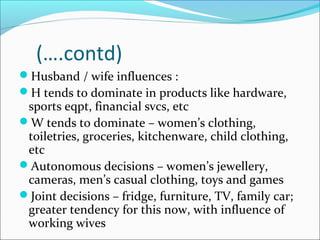
Husband / wife influences :
H tends to dominate in products like hardware,
 sports eqpt, financial svcs, etc
W tends to dominate – women’s clothing,
 toiletries, groceries, kitchenware, child clothing,
 etc
Autonomous decisions – women’s jewellery,
 cameras, men’s casual clothing, toys and games
Joint decisions – fridge, furniture, TV, family car;
 greater tendency for this now, with influence of
 working wives
(….contd)
Implications for marketers depending on who
 decides :
  Media selection
  Advt msge target
  Requirement of separate ad campaigns
Education, occupation, and income of hus/
 wife shapes who tends to decide; the better
 person does so
Increasing influence of children
  Perceived knowledge of prod, importance to them,
   more purchasing power
  The effects of authoritarian parents, neglecting,
   democratic, permissive
Interpersonal Factors and
Symbolic Consumption
As recognized since long, consumption serving to signal
 social status, group membership, or self-esteem is a
 socially contingent activity
The corresponding expenditures are motivated mainly by
 the symbolic value they have for transmitting the signal
This presupposes some form of social coordination on
 what are valid, approved symbols
Unlike consumption not serving signaling purposes, the
 technological characteristics of the goods and services
 consumed may be secondary that counts is their socially
 agreed capacity to function as a symbol
Consumption central to meaningful practice of
 daily life
Consumption choices not only from product’s
 utilities, but also symbolic meanings
Not only to create and sustain self, but also to
 locate in society
The latter may also enslave us in the illusive
 world of consumption
Environmental Factors
Product offerings and
innovations
Product exists in an environment
The nature of the physical product and service
 features are influenced by consumer behaviour
  What size, shape, and features should the prod have
  How should it be packaged
  What aspects of service are most important to
   consumers
  What types of warranties and service programs should
   be provided
  What types of accessories and associated products
   should be offered
(….contd)
 Consumers’ attempts to directly evaluate physical prod attributes –
  intrinsic cues
 Difficulty in distinguishing between different prod offerings on the
  basis of direct attributes, eg taste of colas
 May be able to discriminate between brands, but not be able to
  determine whether these differences are important in predicting
  which brand will provide greater satisfaction, eg best grade of
  waterproofing, adhesives, carpeting, paint, etc
 Use of extrinsic cues : consumer’s experience, how cues are encoded
  (wrapper saying ‘freshly packed’, ‘hygienically sealed’); not encoded
  meaningfully (chemical names); additional inferential beliefs or
  interpretations (by association)
Product offerings-new
 New-product innovation is an essential element of market dynamics
 Among various definitions – ‘an innovation is a product, service, attribute, or
  idea that consumers within a mkt segment perceive as new and that has an
  effect on existing consumption patterns
 Continuous innovns – least disrupting to established consumption patterns;
  prod alteration only, eg fluoride toothpaste, salt in toothpaste, auto model
  variants
 Dynamically continuous innovns – more disrupting, but usually not altering
  estbld patterns; new prod or alteration, eg wall TV, mobile phone with qwert
  key pad
 Discontinuous innovns – new prod with new behaviour patterns, eg genset to
  inverters, pc to laptop, swipe card tech
 Some offerings and innovations influence how, when, where, why, or whether
  we acquire products
Mkt segmentation and segment consumer behaviour
 lead to importance of how consumers perceive the
 marketer’s prod
Cause for product positioning
Positioning on : prod features, benefits, usage (or
 situation, eg Campbell’s soup, Gatorade), user
 (Johnson baby oil), competition
Delivering product
The place variable involves consideration of where and
 how to offer products and services for sale
Also concerned with the mechanisms for transferring
 goods and their ownership to consumers
What type of retails outlet
Retail outlets – location and number
Logistics of supplying retailers
How much control necessary over channels
What image and clientele should the retailer seek to
 cultivate
The When
The time dimension :
  when do consumers buy – seasonality, occasions,
   demographics;
  also working hours, free time, 24 hours necessity;
  purchase time – existing and new prods;
  in-shop browsing and decision-making time
Value ….or, price
Marketers must make decisions regarding the
 prices to charge for the company’s products or
 services and any modification to those prices
These will determine the revenues the firm will
 generate
How price-aware are consumers in the prod
 category
Price sensitivity among brands
What reduction needed to encourage buying
 during new intros and promotions
What discount size for cash, seasonality, etc
Letting the consumer know
Promotion to communicate aspects of firm and its
 offerings – goals and methods
Methods of promos and specific sits
Most effective means for gaining attention
Methods which best convey intended msge
Advt repeat - periodicity
Public Policy Issues
 Comparative advertising – compare the co’s brand directly with competitor’s;
  present prod info on which consumers can base purchase decisions;
  encourages competition & can lead to lowering of prices (Pepsi-Coke)
    Consumers dislike comp ads : due lacking in reliability and usefulness
    Confuse consumers and foster –ve attitudes
 CB and govtl decision making
    Govt services : govt provision of public svcs can benefit significantly from
     an understanding of the consumers; eg public tptn – metro vs car (address
     long lines, last mile issues, crowding and behaviour)
    Govt & other agencies for consumer protection : regulating business
     practices to protect consumers’ interest and welfare; also designed to
     influence certain consumer actions directly; protection against claims not
     substantiated by research (food supplements, toothpastes); anti-smoking
     campaigns
Consumerism – activities of govt, business, and
 independent orgns that are designed to protect
 the rights of consumers
Why :
  Disillusionment with the system
  Performance gap
  Consumer info gap
  Advertising content
  Impersonal and unresponsive mktg institutions
  Intrusions of privacy
Consumer’s Fundamental
Rights
Right to safety
Right to be informed
Right to choose
Right to be heard
Safety
Unsafe product and physical injury
Drug controller : medicines and allied prods
Certification authorities : RTOs, DGCA, Municipality
 (elevators)
ISI, AGMARK, etc
Information
Deception : capacity to deceive – puffery to
 deception; claim-fact discrepancy; claim-fact
 interaction
Corrective advtg
Affirmative disclosure
Availability of sufficient info – unit pricing,
 nutritional labeling, dating, information overload
Choice
Consumers must have choice to benefit from market
 forces interplay
A different take – consumers should be given not
 what they want, but what is ‘best’ for them
Too much choice may confuse and lead to unsuitable
 choice
Hearing and redressal
Consumer inputs as a means of setting govt policies
 and complaints directed to businesses – the facility
 and response
Restitution
Punishment
Environmental Concerns
Right to a clean environment
Concern about potential environmental damage
 caused by consumer products and packaging
Companies trying to protect the environment –
 majority consumers for it
Change in shopping and lifestyle to help protect
 the environment
Consumer mindset changing – willingness to pay
 extra for the environment – yet not enough in
 ratio; a challenge
Privacy
Consumer information collected, merged, and
 exchanged through computer and communication
 technologies has become a tool of power
Concern over threats to privacy
Public still willing to give personal info when
 convinced about the need and fairplay
Consumer privacy protection policies
Social and ethical issues
 Good businesses have responded to this responsibility :
    Thru varied constitution of their Board of Directors, emphasis
      on ethics, and use of social performance disclosures (social
      audits)
 Marketing as the most visible activity of an orgn thus has the onus
  of developing useful products, fair pricing of prods and svcs, and
  promoting them in an accurate manner
 What should be considered ethical : the relevance of an ethical
  base
    Relative standards : utilitarianism, intuitionism
    Absolute standards

Consumer responsibilities : obligation – choose wisely,
  keep informed, put safety first, help protect the
  environment
Marketer response to
consumer issues
Understanding the issues – heed the consumer voice
 and complaints
Designing a consumer response system –
 understanding what consumers experience,
 establishing a consumer advisory board, listening to
 consumers and responding effectively, estblng a corp
 consumer affairs/ svcs unit, educating consumers
Information Receipt,
Processing, and Outcomes
Stimulus, Exposure, and Attention

Stimulus serves as the raw material to be
 processed
Internally produced stimulus like hunger pangs,
 and stimuli which impinge upon the five senses of
 taste, touch, smell, vision, and hearing
A stimulus is not in isolation, but of a larger
 stimulus situation consisting of many stimuli
(….contd)
Acquisition process enables consumers to confront certain
 stimuli in their environment and begin to process them
Exposure, a part of the acquisition process, has two major
 categories :
  Active search : to seek out specific types of stimuli, eg
    nutritional content per serving of a baby food;
    influenced by this factor under conscious control;
    internal, external
  Passive reception : consumers confront stimuli in the
    process of living their daily lives; exposure to advts (TV,
    magazines), news reports, info as by-product of
    shopping activities; advtsr tries to counter zapping by
    chameleon advt
Sensation
  Awareness threshold
  Differential threshold; Weber’s Law
Attention : allocation of processing capacity to
 stimuli
  Voluntary and involuntary – former enables filtering,
   the latter helps keep in touch with environment
  Characteristics – can attend to a limited number of
   items at any time, many stimuli require attention to be
   processed while some do not, can be allocated to
   stimuli on a rapid basis
How consumers allocate their attention – mainly
 affect involuntary attention :
  Selective attention : stimulus factor – colour, novelty
   and contrast, size and position, humour,
  Selective attention : individual factors – attention span,
   adaptation, perceptual vigilance and defence
Encoding & Decoding of
Message Processing
Encoding – a highly individualised process that is
 used to derive personal meaning from stimulus
 experiences
Subsequent actions and thoughts based on
 interpretations derived from stimuli rather than
 on the actual stimuli themselves
Processing the sensations (from the stimulus) –
 individual ability, knowledge and experience
  Feature analysis
  synthesis stage
  catergorisation
Opportunity – situation, time, aids
Motivation or willingness – inclination, incentive to
 engage
Depth of processing – degree of effort consumer
 expends in developing meaning from the stimulus
Perception
Perception is the way in which an individual gathers,
 processes, and interprets information from the
 environment.
Perception is the process of making sense out of an
 experience – the imputing of meaning to experience
Factors ImpactingPerception
Internal:
 Sensory Abilities
 Comprehension Skills
 Memory Capacity
 Needs
 Experience/Knowledge
 Involvement
 Confidence
 Pre-dispositions
 (Attitudes, Beliefs, Mood)
External:
 Stimulus(I) Characteristics:
 Motion, Intensity, Shape,
 Format, Color, Contrast,
 Location, Size
 Competing Stimuli
 Setting Characteristics
Selective perception
The various elements of selective perception are:
 selective exposure
 selective attention
 selective comprehension
 selective retention
Selective comprehension
Selective comprehension:
 This stage involves interpreting discrepant
 information so that it is consistent with beliefs and
 attitudes
Perception
The process by which an individual uses
 information to create a meaningful picture of
 the world by
selecting,
organizing
interpreting
Perception is important because people
 selectively perceive what they want and it
 affects how people see risks in a purchase.
Selective Perception

 Filtering
 exposure,
 comprehension, and
 retention
    in the human brain’s attempt to organize and interpret information.
 Selective exposure
    Consumers can pay attention to messages that are consistent with
     their own attitudes and beliefs
    Consumers can ignore messages that are inconsistent.
 Selective comprehension
 Involves interpreting (distorting?) information so that it is
    consistent with a person's attitudes and beliefs.
Selective retention
   Consumers do not remember all the information they see,
    read, or hear.
Subliminal perception
   Consumers see or hear messages without being aware of
    them.
   This is a hotly debated issue with more popular appeal than
    scientific support.
   Research suggests that such messages have limited effects on
    behavior
Perceived Risk
 Anxieties felt
 Consumes cannot anticipate the outcomes of a purchase
 Believe that there may be negative consequences.
 Marketers try to reduce a consumer's perceived risk and
  encourage purchases by strategies such as providing
    Free trial of a product
    Securing endorsements from influential people
    Providing warranties and guarantees.
Learning
Those behaviors that result from repeated
 experience and thinking.

             Behavioral Learning

The process of developing automatic
 responses to a situation built up through
 repeated exposure to it.
Four variables central to how consumers
           learn from repeated experience are:

Drive - a need that moves an individual to action
Cue - a stimulus or symbol perceived by consumers
Response - the action taken by a consumer to satisfy the
 drive
Reinforcement - the reward
   Employed in conjunction with the methods of learning
    connections :
       Classical conditioning
       Instrumental conditioning
Marketers use two concepts from behavioral learning
                         theory:
Stimulus generalization - occurs when a response
 elicited by one stimulus (cue) is generalized to
 another
   using the same brand name for different products is an
    application of this concept
       Brand extension aspects play on this and marketers frequently
        use this to advantage (reference should be made vis-à-vis brand
        management)
Stimulus discrimination - refers to a person's ability
 to perceive differences in stimuli
   the advertising for Hayward X000 beers is an example of this
    concept
Cognitive learning
Involves making connections between two or
 more ideas
Or, simply observing the outcomes of others’
 behaviors and adjusting one's accordingly
Brand loyalty
Is a favorable attitude and consistent
 purchase of a single brand over time
Brand loyalty differs across cultures,
 countries, etc
Beliefs and Attitudes
Attitude Formation
                                                               Attitude
 A learned predisposition to respond to an object or class of
  objects in a consistently favorable or unfavorable way.
 Shaped by our values and beliefs, which are learned.
 Values
    personally or socially preferable modes of conduct or states of
     existence that are enduring.
 Beliefs
    consumer's subjective perception of how well a product or brand
     performs on different attributes.
Degree of learning
    Rate, wearout, maintain, extinction, recovery, recall
Memory and Retrieval
Experience has shown that all that consumers have
 ‘learned’ is not always readily retrievable – eg brand
 names, shelf location, etc may be recalled easily, but
 other details not so
Structure of memory and its operation is relevant to
 divine consumer behaviour
Memory Systems -
characteristics
Structure of memory and its operation :
Multiple store approach – sensory, short-term, long-term
   Sensory : fraction of a second, all perceived by sensors,
     direct representation of reality, forgetting by decay
     (size, shape, colour – used heavily by advtsrs)
   Short-term : < 1 min, limit 7 items approx, indirect
     (thru chunking), decay (tele nos.)
   Long-term : many years, unlimited store, indirect
     (clustering via meaningfulness), forget due interference
     (new phone models and features)
Levels of processing – treatment of stimuli how rigorous
Activation model – stimuli activating only an appropriate
  section of memory; spreading activation (eg sports-car
  attributes extending to info on other sports-cars)
Retrieval of information
Accessing information in long-term memory and
 activating it into consciousness
Correlated with other material from s-t memory
 and processed into meaningful package for use
Influences :
  Extent of original learning
  Goal of original learning
  Contextual relevance
Advertising applications
Advtg msge with unique aspects – long term impact on
 memory
Order in which material is presented – beginning and end
 most remembered
Msges that encourage immdte rehearsal – remembered
 (eg tele no., address)
Chunked – more processing and better retention (7 items)
Amount of info transferred to long term memory is a
 function of time avble for processing
Cue-dependent – eg babbling mountain brook for healthy
 water
Meaningfulness of individual – better retained
Methods
Visual material
Interactive imagery
Showing mistakes
Incomplete msges
Mnemonic techniques (jingles, numbers, melodic
 patterns)
“Habit strength" - said to develop as a function of
 practice
Habits were depicted as stimulus-response
 connections based on reward
Responses (rather than perceptions or expectancies)
 participate in habit formation, the process is gradual,
 and reward is an essential condition
Adoption & Diffusion of Innovation
 Any idea, practice, or material artifact perceived to be new by the
  relevant adopting unit
    Continuous, dynamically continuous, discontinuous
 Adoption – acceptance and continued use of a product or brand by an
  individual
 Adoption process – awareness, comprehension, attitude, legitimation,
  trial, adoption
 Some consumers pass thru the adoption process early in the product’s
  life or it could be later
 Relevant for marketers : early stages of the adoption process, mass
  media appear most effective in creating awareness; later stages :
  personal sources of info, so effective personal selling and word-of-
  mouth communications at these points
Diffusion Process
The nature of the process by which innovations
 spread
Diffusion process refers to a group phenomenon (as
 against the indiv phenomenon for adoption),
 indicating how an innovation spreads among
 consumers
Trickle-down, trickle-across, subcultural group’s
 propagation, leadership
(….contd)
Innovators, early adopters, early majority, late
 majority, laggards
Factors influencing rate of diffusion – relative
 advantage, compatibility, complexity, trailability,
 observability, cost
Marketing implications – from product design to
 packaging, distribution and selling, to promotion
Purchase, Consumption, &
Post-purchase
Problem Recognition(awareness of need)--difference
 between the desired state and the actual condition. Deficit
 in assortment of products. Hunger--Food. Hunger
 stimulates your need to eat.
 Can be stimulated by the marketer through product
 information--did not know you were deficient? See a
 commercial for a new pair of shoes, stimulates your
 recognition that you need a new pair of shoes.
Problem Recognition
Marketers develop products and services to help
 consumers solve problems
Marketers also attempt to help consumers anticipate
 and recognise problems ….. sometimes well in
 advance of their occurrence
Process of Problem Recognition
 Consumers must become aware of the problem through information
  processing arising as a result of internal or external stimuli
 This leads to motivating consumers; then arousal and activation to
  engage in some goal directed activity ie purchase decision-making
 This response action for solution finding depends on the
    magnitude of the discrepancy between the current state and the desired or
     ideal, and / or
    the importance of the problem for the concerned consumer
 Any time the desired state is perceived as being greater than or less
  than the actual state, a problem exists
 Important to appreciate that it is actually the consumer’s perception
  of the actual state that stimulates problem recognition and not some
  ‘objective’ reality
 Relative importance also is a critical concept in several purchase
  decisions because almost all consumers have budget or time
  constraints
Types of Consumer Problems
Immediacy of problem solution is a relevant aspect in
  determining
   How soon solution is needed
   Length of time involved in decision-making
   Intensity of decision effort
Routine – those where the difference between actual
  and desired states is expected to be felt and would call
  for immediate solution
Emergency – unexpected and need immdte solution
Planning – expected in the future, but immdte solution
  not called for
Evolving – unexpected and there is no need for an
  immdte solution
Activating Problem Recognition
Influencing the desired state
Influencing perceptions of the actual state
Influencing the timing of problem recognition
Utilising problem-recognition information
  Analyzing purchase-intention categories
  Analyzing conversion of purchase intentions
Types of Decisions
The myriad decision options of today’s market place
 may be summed up in five main types :
  What to buy
  How much to buy
  Where to buy
  When to buy
  How to buy
(….contd)
Routine Problem Solving or Nominal Decision-
  Making
Limited Problem Solving or Limited Decision-Making
Extensive Problem Solving or Extended Decision-
  Making
All are related to the level of involvement
Information Search
 Knowledge obtained about product / services, or facts related to
  these, thru mental as well as physical information-seeking and
  processing activities which one engages in to facilitate decision
  making regarding some goal-object in the marketplace
 After problem recognition, the natural progress is to information
  search
 Forms of search :
    Prepurchase search
    Ongoing search
    Internal search
    External search
Types and Sources of
Information
Types :
  Info about existence and availability of products and
   service offerings
  Info useful in forming evaluative criteria
  Info on properties and characteristics of alternatives
Sources :
  Marketer dominated sources
  Consumer sources
  Neutral sources
(….contd)
The amount of external search that consumers
 engage in varies considerably across individuals
 and different purchase situations
Influences on external-search behaviour :
  Market conditions
  Buying strategies
  Individual factors
  Situational factors
  Perceived risk
     Influencing situations
     Types of risk
Evaluation Process
Evaluation involves those activities undertaken by
 the consumer to appraise carefully, o the basis of
 certain criteria, alternative solutions to market-
 related problems
The search process determines what the
 alternatives are, and in the evaluation process
 they are compared so that the consumer is ready
 to make a decision
Criteria
 The standards and specifications the consumer uses in evaluating
  products and brands
 Definition of the preferred product/brand features that consumer
  seeks in a purchase and may be either objective or subjective in nature
 Evaluative criteria may vary from one consumer to another, as also
  product to product
 Criteria evaluated by consumer are likely to differ in their importance,
  usually with one or two criteria being more important than others
 Types :
    Salient
    Determinant
    Critical
  The marketer should be careful in assuming that a certain feature
  ranked as most important by consumers is actually determinant
(….contd)
 Reducing the range of alternatives
 Evaluating alternatives
    CPB (choice by processing brands)
    CPA (choice by processing attributes)
    Though CPB strategy seems to be common, research also indicates
     that consumers in early stages of the decision process use a CPA
     strategy, switching to a brand-processing approach in later stages
    Consumers may use noncompensatory or compensatory processes as
     decision rules in evaluating product-alternative attributes
 Noncompensatory decision rules
    Disjunctive rule : setting minimum stds and selecting one for
     eliminating
    Conjunctive rule : setting minimum level of acceptability for each
     criterion
    Lexicographic rule : assessment on criteria in order of importance
     priority
    Sequential elimination rule : establish acceptable performance
     minima for each evaluative criterion and then proceed to evaluate
     each brand and eliminate any not measuring up to these minima
Decision rules (….contd)
Compensatory decision rule - consumers allow
 perceived favourable ratings or brand evaluative
 criteria to offset unfavourable evaluations
Consumers tend to initially use rules enabling easy
 reduction of alternatives, and then use more rigorous
 one to assess the remaining brands for a final decision
Important for Marketer
Determine sources of information
Determining source influence
Determining which criteria are used by consumers
Determining the relative importance of criteria used by
 consumers
Determining consumers’ evaluations of brand criteria
 performance
Determining consumers’ cue usage
Influencing consumers’ evaluation
   Altering cue characteristics
   Altering information value

  However, criteria that fly in the face of consumers’
   common-sense perceptions find difficulty in acceptance
Choice Making and Purchase
Decision
Why do people shop ?
  Personal motive
  Social motive
Except for a very small percentage, the vast majority
 of sales takes place in stores
Choosing an outlet or a store is critical step in
 purchase, and hinges upon various factors
Choice of Outlet
Determinants
Store location – intercity, intracity, interstore
 choices
Store design and physical facilities
Merchandise (and image)
Advertising and sales promotion
Personnel
Customer services
Clientele
In-store purchasing behaviour
Merchandising techniques
  Store layout and traffic patterns
  Point-of-purchase media
  Product shelving : shelf height, shelf space, price
   awareness, promotional pricing, discount coupons
  Packaging
  Brand choice : among known brands, between known
   brands and local/private brands
  Personal selling effects : buyer-seller dyad
Non-store Purchasing
Direct marketing
 TV home shopping networks
 Mail order
 Internet
 Door to door selling
Shopping convenience most important motivator
Subject to risk of buying factor
Purchasing Patterns
Two important patterns
  The extent to which consumers develop repeat
   purchasing patterns : nature of brand loyalty, effect of
   out of stock conditions
  The extent to which purchases are unplanned : impulse
   purchasing – pure impulse, suggestion impulse,
   reminder impulse, planned impulse
Paying for the Purchase
Store checkouts should be easy
Acceptance of a variety of credit and debit cards
Smooth cash transaction
Depending on the store layout/system, easy bagging
Consumption and Post-consumption
behaviour
The post-purchase phase – product installation and/or
 use; decisions on products or services related to the item
 purchased
Product set-up and use :
   Providing information and assistance
   Understanding the user’s consumption system
   Decisions about warranties

Related products and services
   Buyers’ interests in related items
Post-purchase Evaluation
 Consumer satisfaction/ dissatisfaction – disconfirmation of
  expectations : positive and negative; can be related to instrumental
  performance and symbolic performance
 Consumer complaint behaviour
 Post-purchase dissonance : will motivate the person to reduce it; will
  avoid situations that produce more dissonance
 Consumer’s dissonance : probability and magnitude can be related to
  –
    Degree of irrevocability of decision
    Importance of decision to consumer
    Difficulty of choosing among alternatives
    Individual’s tendency to experience anxiety
Dissonance Reduction
Changing product evaluations – increase desirability of the
 purchased item
Seeking new information – to confirm the wisdom of their
 choice; may be through devaluing alternatives
Changing attitudes – decrease importance of the purchase
 decision
Marketing implications for the marketer’s action :
  Confirming expectations
  Inducing attitude change
  Reinforcing buyers
Product Disposition
Disposition alternatives and determinants
Disposition choice can be influenced by :
  Psychological characteristics of decision maker
  Factors intrinsic to the product
  Situational factors extrinsic to the product
Alternatives for disposing of (routinely) :
  Get rid of it permanently – trash it, give it away, trade
   it, sell it
  Get rid of it temporarily – rent or loan it
  Keep - for use, new use, or store
(….contd)
Marketing implications
  Public policy effects of disposition, eg environment
  Marketing strategy factors (to facilitate disposing of by
   consumer
     Disposing of to raise funds for new purchase
     Disposing of to create space for new

     Forecasting of replacement buys

     Identification of reasons for disposing of may enable marketer to
      gain knowledge of why consumer wants replacement
Indian Consuming Classes
Snapshot
 300 million odd middle class - the Real consumers - is catching the
  attention of the world
 Estimated over 600 million effective consumers by 2015; India is
  bound to emerge as one of the largest consumer markets of the world
 About one-third of households in India can afford white goods, such
  as washing machines, refrigerators and air conditioners.
 However, consumers are price-conscious, and demand for many white
  goods is restrained by long replacement cycles in urban areas.
(….contd)
India has around 192 million households, as per India's
 Marketing Whitebook by Business World
Of these only a little over six million are 'affluent' – that is,
 with household income in excess of INR 215, 000.
Another 75 million households are in the category of 'well
 off' immediately below the affluent, earning between INR
 45,000 and INR 215,000.
This is a sizable proportion which offers excellent
 opportunity for organized retailers to serve.
Consumer Profile
One of the key reasons for increased consumption is the
 impressive growth of the middle class.
Around 70 per cent of the total households in India reside
 in the rural areas.
The total number of rural household estimated to rise
 from 135 million to 162 million in the period 2001 to 2015.
 This presents the largest potential market in the world.
According to the study conducted by NCAER :
  the number of `lower middle income' group in rural
    areas is almost double as compared to the urban areas,
    having a large consuming class with 41% of the Indian
    middle class and 58% of the total disposable income
Potential
 The Indian rural market has been growing at 3-4% per annum, adding
  more than 1 million new consumers every year and now accounts for
  close to 50% of the volume consumption of fast-moving consumer
  goods (FMCG) in India
 Some projections forecast the market size of the fast moving
  consumer goods sector at around US$ 23.25 billion
 As a result, it is becoming an important market place for fast moving
  consumer goods as well as consumer durables.
 Interestingly, there were nearly 75 mn households (33% of the total)
  with an income of more than US$3,000 in 2009. These "well-off"
  households already owned relatively expensive consumer durables,
  such as air conditioners and refrigerators.
Age & Income Research
India – a young nation
   550 mn+ under the age of 20 by 2015
   In the age group of 15-19 years, above average growth in urban and
    rural areas
   Population in the age group of 0-14 years is 65%
   Today brand identification is a major factor in motivating purchase
    by youngsters
    (Ernst & Young)
Income classes
   70 mn+ earn Rs. 8,00,000+ ($18,000) a year – number to rise to 140
    mn by 2011
    (no authentication survey results published yet)
India's Income classes
 The following offers a good picture, even though the data pertains to
  the period 1990-00 - 2005-06

  RICH (annual income > US$ 4,700)
  * Own cars, PCs
  3million households
  6milliion households

  CONSUMING (US$ 1000-4700)
  * Have bulk of banded consumer goods, 70% of 2-wheelers,
  refrigerators, washing machines
  55million
  75million
(….contd)
 CLIMBERS (US$500-1000)
  * Have atleast one major durable (mixer, sewing machine/tv)
  66million
  78million

  ASPIRANTS (US$350-500)
  * Have bicycles, radios and fans
  32million
  33million

  DESTITUTES (Less than US$350)
  * Not buying
  24million
  17million


  Source: The Great Indian Retail Story 2006, Ernst & Young.
Consumer Behavior
 Availability of lifestyle spending options is increasing for Indian
  consumers and inducing higher spends on "status acquisition“
 Traditionally, Indian consumer is cautious about debts. In recent
  past, this attitude has changed radically and in recent year's credit
  is no more a feared entity.
 Indian consumer buying behavior to a large extent has a western
  influence. Foreign brands have gained wide consumer acceptance
  in India and they are much more open for experimentation.
 Beauty parlors in cities, eateries, designer wear, watches, hi-tech
  products are a few instances which reflect these changes.
 Purchasing priorities in India also influence the level of sales of
  individual products.
 Penetration data bear this out: televisions in use in 2006, a
  particularly high sales year till then, were estimated at 95 per
  1,000 populations, far higher than the level for white goods. This
  reflects the growing demand for entertainment in India.
(….contd)
 The emergence of a larger middle and upper middle classes and the
  substantial increase in their disposable income has changed the
  nature of shopping in India from need based to lifestyle dictated
 The self-employed segment has replaced the employed salaried
  segment as the mainstream market, thus resulting in an increasing
  consumption of productivity goods, especially mobile phones and 2 -
  4 wheeler vehicles
 There is also an easier acceptance of luxury and an increased
  willingness to experiment with the mainstream fashion, resulting in
  an increased willingness towards disposability and casting out from
  apparels to cars to mobile phones to consumer durables
        (Ernst & Young report)
The (Indian) Millenium Woman
Well-wired – uses all market offerings (of superior quality
 generally); lives in cities and larger towns
Serial mom – reasonably high consuming, but with a
 touch of traditionalism; lives in South India and some in
 West
Golden oldies – traditional; lives mostly in Northern India
 followed by East
Devoted caretaker – mainly family care; lives in Southern
 India, followed by East, West, and smaller towns
Consumer Spending
The rate of growth of spending on discretionary items
 (unlike basic necessities like food) has been growing at
 an average of 9 per cent per year in recent years
A nation of savers, India, has now altered into a nation of
 spenders.
An estimate suggests that an average Indian spends
 40% of his monthly salary on food and grocery and 8%
 on personal care products. (KSA Technopak's Consumer
 Outlook report)
Urban-Rural divide in Spending (%)
     Category         Rural   Urban
     Entertainment    33      67
     Consumer         44      56
     Services
     Durables         50      50
     Misc. Consumer   57      43
     Goods
     Clothing &       61      39
     Footwear
     Food             64      36
Indian Growth Prospect Estimates
 Average household disposable income growth in the 20 year band
  range of 2005 to 2025 projected as :
    All India : 5.3%; Urban : 5.8%; Rural : 3.6%
 Upward shift in income classes projections :
        (%- due rounding off, may not total to 100)        (McKinsey
  report)
       Category      2005 (Est)    2015          2025
                                   (Forecast)    (Forecast)


       Globals       0            1             2
       (rich)
       Strivers      1            1             9
       Seekers       4            19            32
       Aspirers      41           43            36
       Deprived      54           35            22
Indian Consumer – evolution
brief
 Income growth
 Affordability growth
 Rural India looks beyond agriculture
 Rise of the self-employed
 Elevation of women as partners in family progress
 Preference for ‘real value’ products and services
 Increased demand for entertainment
 Comfortable with :
    Borrowing (funds)
    Acquiring luxuries
    Technology
   (also refer to relevant slides under Culture section, for other regional
     and grouping characteristics)
Salient Regional India Segments
The North – West skew
 Mumbai and Delhi account for :
    28 million people (almost equal to the population of Canada)
    60% of all domestic traffic
    70% of all Indian travellers going abroad
    At No.7, the Mumbai-Delhi air corridor is amongst world’s 10
     busiest
    Roughly half the country’s ‘super rich’ families (annual income >
     Rs 10 million) live in Mumbai and Delhi
    Mumbai, Delhi, and Bengaluru are 3 cities among 24 rated as
     Rising Urban Global Stars
 Further market centres of cognizance : Ahmedabad, Chennai,
  Hyderabad, Kolkata, Pune

Iipm consumer behaviour full

  • 2.
    Background A definition ofconsumer behaviour – …the decision process and physical activity individuals engage in when evaluating, acquiring, using, or disposing of goods and services. CB is a subset of Human Behaviour Behavioral Sciences have studied Human Behaviour
  • 3.
    ….contd  BS disciplineswhich have greatly contributed to our understanding of consumers are :  Psychology : study of the behaviour and mental processes of individuals  Sociology : study of the collective behaviour of people in groups  Social psychology : study of how individuals influence and are influenced by groups  Economics : study of people’s production, exchange, and consumption of goods and services  Anthropology : study of people in relation to their cultural and racial heritage
  • 4.
    Why Study ConsumerBehaviour CB affects, directly and significantly, decisions Decisions in the market place have other effects, in turn ! Micro perspective : understanding consumers for the purpose of enabling a co to accomplish its objectives; eg the need of advertising managers / product designers to understand the consumer Societal perspective : macro or aggregate level; collective behaviour of consumers; eg western world and automobile tptn – cars, highway systems/services, petro prods, where many live and how daily life is run (shop, eating, entertainment)
  • 5.
    Foundations of Consumer Behaviour(2 h) Customer oriented marketing ..the need for studying consumer behaviour emanates from the demands of customer oriented marketing  According to Marketing Experts – ‘Successful marketing requires that companies fully connect with their customers. Adopting a holistic marketing orientation means understanding consumers – gaining a 360-degree view of both their daily lives and the changes that occur during their lifetimes. Gaining a thorough, in-depth consumer understanding helps to ensure that the right products are marketed to the right consumers in the right way
  • 6.
    Customer Oriented Marketing Consumers’needs and wants, co objectives, integrated strategy Mkt-opportunity analysis, eg fitness centres/ eqpt Target-mkt selection, eg deodorant soap Irish Spring captured 15% mkt share – Col Palm identified unique group thru segmentation Mktg-mix determination, eg expensive watches
  • 7.
    Influences on BuyingBehaviour Cultural factors Social factors Personal factors
  • 8.
    Consumer Buying &Consumption Process Making a purchase with little or no influence from others Purchase involving joint decision Purchasing for someone else Purchase situation may involve at least one person in each such role, or a single individual can take on several roles Focus on actual buyer useful – decisions…..
  • 9.
    Consumer Buying &Consumption Process (….contd) Classification of roles Initiator – individual who determines that some need or want is not being met and authorizes a purchase to rectify the situation Influencer – person who by word or action, intentional or unintentional, influences the purchase decision, actual purchase, and/or the use of the product or service Buyer – individual actually making the purchase transaction User – person most directly involved in the consumption or use of the purchase
  • 10.
    (…..contd) Consumer behaviour involves Amental decision process Physical activity Actual act of purchase is just one stage in a series of mental and physical activities that occur during this phase Some of these activities preceded the actual buying, while others follow it Consumption system – who, how, when, where…. All these factors capable of influencing the adoption of products or services
  • 11.
    (….contd) Primary psychological processesinvolved are Motivation Perception Learning Memory We shall study these in details as we go along….
  • 12.
    Consumer Decision MakingModels  External environmental variables influencing behaviour – culture, subculture, social class, social group, family, personal influences  Individual determinants of behaviour – learning / memory, personality/ self-concept, attitudes, motivation/ involvement  Consumer’s decision process – problem recognition, information search (internal & external), info processing, evaluating, purchase process, post-purchase behaviour  Level of Consumer Involvement  Decision Heuristics and Biases  Mental Accounting
  • 13.
    Consumer Decision Model The Consumer Decision Model (also known as the Engel-Blackwell- Miniard Model) - originally developed in 1968 by Engel, Kollat, and Blackwell and has gone through numerous revisions  many of the elements of the model are similar to those presented in the Theory of Buyer Behaviour (Howard AND Sheth 1969), however the structure of presentation and relationship between the variables differs somewhat  model is structured around a seven point decision process: need recognition followed by a search of information both internally and externally, the evaluation of alternatives, purchase, post purchase reflection and finally, divestment.  These decisions are influenced by two main factors.  Firstly stimuli is received and processed by the consumer in conjunction with memories of previous experiences, and  secondly, external variables in the form of either environmental influences or individual differences. The environmental influences identified include: Culture; social class; personal influence; family and situation. While the individual influences include: consumer resource; motivation and involvement; knowledge; attitudes; personality; values and lifestyle (Blackwell,Miniard et al. 2001).
  • 14.
    Researching the Consumer Exploratoryresearch – consumer feedback, focus groups; primary objective is hyothesis formulation, ie forming a conjectural statement about the relationship between tow or more variables Conclusive research – builds upon exploratory research; main objectives are to describe consumer behaviour and to offer explanations for its causes; also, behaviour forecast and methods of influencing it can be determined Market segmentation
  • 16.
    Demographics Age – stagein life cycle : people buy different goods and svcs over a lifetime Gender – differing needs, preferences Occupation – influences consumption patterns; eg factory worker’s outfit vs co director’s apparel, software engineer vs construction engineer Education – fashions mindset, shapes choice process and preferences, can catalyse income
  • 17.
    Economic Status Buying behaviourvis-à-vis buy-not-buy or product choice greatly affected by economic circumstances Income : level, stability, time pattern – personal income, disposable income, discretionary income The problem with specification of ‘necessities’ and the usefulness of the concept of subjective discretionary income (SDI)
  • 18.
    Needs and Motivation Needsand motivation related to demographics and economic logic Different stages of life produce varying needs – say, progression from toys to walking stick; similarly motivation – amusement to functionality Economic circumstances form the logic of one man’s luxury being seen by another as necessity
  • 19.
    Level of Involvementand Decision Making Type Involvement defined in terms of the level of engagement and active processing undertaken by the consumer in responding to a marketing stimulus Is related to consumer’s values and self-concept, which influence the degree of personal importance ascribed to a product or situation Can vary across individuals and different situations Is related to some form of arousal Involvement is characterised by – intensity or degree of arousal and directional influence
  • 20.
    (….contd)  Dimensions ofinvolvement  Antecedents : person, stimulus/object, situations – a persons needs, values, interests, etc and closeness of the product (or stimulus) to these, in relation to the use (situational context) of the product – govern involvement  Properties of involvement  Intensity : degree > high or low, ie how much a consumer will invest in decision making for purchase  Direction : focus or target < strong influence of antecedents; eg women and perfume, men and cars  Persistence : length of time consumer remains engaged; eg bird watchers, sport fishing, auto enthusiasts
  • 21.
    (….contd)  High involvementdecision making  Low involvement decision making  Flowing from the above :  Central route (to processing) in which cognition and extensive critical evaluation leads to attitude formation followed by behaviour  Peripheral route, in which cognition, at low attention, continues with weak brand knowledge and interest, without developing strong attitude about any of the specific brands; thus mere familiarity or association with non-central cues, like good shop ambience or salesperson, leads to decision  Marketing strategies are tailored to account for these
  • 22.
    Psychographics  Personality  A set of distinguishing human psychological traits that lead to relatively consistent and enduring responses to environmental stimuli  Traits such as self-confidence, dominance, autonomy, deference, sociability, defensiveness, and adaptability  Major Personality Theories  Psychoanalytic Personality Theory – id, ego, superego; the reality principle, defence mechanisms (repression, projection, identification, reaction formation)  Social Theories  Trait and Factor Theories  Can be a useful variable in analyzing consumer brand choices
  • 23.
    (….contd) Brandsalso have personalities, and consumers are likely to choose brands whose personalities match their own Brand personality : the specific mix of human traits that may be attributed to a particular brand; eg one such identification sincerity (down-to-earth, honest, cheerful) Excitement (daring, spirited) Competence (reliable, intelligent) Sophistication (upper-class and charming) Ruggedness (outdoor-type and tough)  Ruggedness – Levis, competence – BBC, LH
  • 24.
    Lifestyle A person’s patternof living as expressed in activities, interests, and opinions Lifestyle portrays the ‘whole person’ interacting with his or her environment Broadly, two segments : money-constrained (Wal-Mart’s target thru low prices bringing high sales) or time- constrained (breakfast on feet – bagels rather than cereals) Lifestyle segmentation further into brand-user, product- user, situation segmentation….. AIO (activity, interest, opinion) analysis
  • 25.
    Self-concept Self-image > aperson’s perception of himself which includes his physical being, other characteristics such as strength, honesty, and good humour in relation to others, and even extending to include certain possessions and his creations How one views oneself – actual self-concept How one would like to view oneself – ideal self-concept How one thinks others see one – others’ self-concept Affects publicly consumed products as compared to privately consumed goods; congruence with actual or ideal self-concept
  • 26.
    Interpersonal Factors Culture  Culturerefers to the cumulative deposit of knowledge, experience, beliefs, values, attitudes, meanings, hierarchies, religion, notions of time, roles, spatial relations, concepts of the universe, and material objects and possessions acquired by a group of people in the course of generations through individual and group striving.  Culture is a collective programming of the mind that distinguishes the members of one group or category of people from another  Culture consists of material and non-material components :  Material culture: consists of all the physical substances that have been changed and used by people, such as tools, automobiles, roads, and farms; in the context of markets and CB, artifacts of material culture would include all the products and services which are produced and consumed, eg Big Bazaar, Spencers  Non-material culture: includes the words people use, the ideas, customs, and beliefs they share, and the habits they pursue; eg the way in which consumers shop in supermarkets, our desire for newer and better products, and our responses to the word “sale”
  • 27.
    Culture (….contd) Significance ofculture lies in – The understanding of the extent to which people are more than just chemistry, physiology, or a set of biological drives and instincts Thus, although all customers may be biologically similar, their views of the world, what they value, and how they act differ according to their cultural backgrounds
  • 28.
    Culture & MarketingDecisions Culture influences consumers – historically acknowledged All activities people engage in are culturally determined All purchases of goods are made either to provide physical comfort or to implement the activities that make up the life of a culture …..an understanding of culture enables the marketer to interpret the reaction of consumers to alternative marketing strategies.
  • 29.
    (….contd)  Culture manifeststhrough –  National character  Differences in subcultures such as blacks, Jews, and Hispanics in America, and regional population groups in India  Silent language of gesture, posture, food and drink preferences, and other nonverbal clues to behaviour  Symbols in society; semiotics – how signs function within a culture ie anything that conveys a meaning : advertising uses this to invest products with meaning for a culture whose dominant focus is consumption  Taboos, or prohibitions in a culture, relating to various things such as the use of particular colours, phrases, or symbols  Ritualised activities in which people participate at home, work, or play, both as individuals and as members of a group. Such behaviour occurs in a fixed episodic sequence, and tends to be repeated over time
  • 30.
    Cultural Manifestations Cultural meaningcan be communicated by consumer goods Commonly observed consumption rituals  Morning tea/coffee, newspaper, TV/radio news, weather, traffic  Shower and grooming : items used  Dresses for work : as appropriate  Drives : car model  En route visits temple, posts a b’day card  Business meetings / lunch  En route home takes in a movie, beverage  Home for dinner over TV, then bed
  • 31.
    (….contd) These activities areassociated with various types of rituals : media, household, grooming, religious, gift- sending, business, eating,entertainment / recreation, bedtime Observe how rituals involve aspects of consumer behaviour processes in obtaining goods and services, exchanging them, or using and disposing of them
  • 32.
    Characteristics of Culture Culture(s)is / (are) Invented : ideological system (ideas, beliefs, values, and ways of reasoning in defining what is desirable or not), technological system, organisational system Learned Socially shared Similar but different Gratifying and persistent Adaptive Organised and integrated Prescriptive
  • 33.
    Cultural Values Can bedefined as A widely held belief or sentiment that some activities, relationships, feelings, or goals are important to the community’s identity or well-being Or Centrally held and enduring beliefs that guide actions and judgments across specific situations and beyond immediate goals to more ultimate end-states of existence
  • 34.
    (….contd) Values produce inclinationsto respond t specific stimuli in standard ways A specific behaviour is expected to either help or hinder the attainment of some value or group of values Consumers then, are motivated to engage in behaviours designed to enhance the achievement of certain values and to avoid those behaviours perceived to hinder the attainkent of certain value states Values vs attitudes
  • 35.
    (….contd)  Values areculturally determined  Values are learned from social interaction, largely from our families and friends in settings such as schools and other places of aggregation  Values strongly influence consumer hehaviour; even though specific situations may dictate slightly different actions, overall there is much similarity in consumer behaviour within a given culture, such as in tastes, methods of shopping, etc  A marketer must understand society’s basic value structure so that strategy decisions are consistent with ingrained cultural patterns  Much easier to harmonize with the culture than to attempt to change fundamental cultural values
  • 36.
    Core Cultural Values Individualism – interrelated with ideas such as freedom, democracy, nationalism, and patriotism; founded on a belief in the dignity, worth, and goodness of the individual  Equality  Activity  Progress and achievement  Efficiency and practicality  Mastery over the environment  Religious and moral orientation  Humanitarianism  Youthfulness  Materialism  Social interaction and conformity
  • 37.
    Values and Consumer Behaviour Cultureis a strong force in the consumer’s milieu affecting his or her choice of behaviour Marketers have long recognised the importance of appealing to consumers’ values in marketing Values guide actions, attitudes, and judgments
  • 38.
    Illustrative Listing ofIndian Contrasts INDIAN VALUES NON-INDIAN VALUES Leaders are the servants Leaders are the masters Cooperation Competition Group Emphasis Individual Emphasis Passive Assertive Informal Courtesy Formal Politeness Patient Impatient Sharing Saving Time - Constant Time - Fleeting Respect for Age Respect for Youth Harmony with Nature Conquest over Nature Religion = Way of Life . . . Sacramental, Religion = Segment of Life . . . Intellectual, Symbolic Gnostic Non-verbal Verbal Extended Family Nuclear Family Tradition Novelty No Eye-to-eye Contact Eye-to-eye Contact Holistic Problem Solving . . . Vision of Total Analytical Problem Solving . . . Piece by Piece Happiness = Spiritual Harmony Happiness = Wealth Accumulation
  • 39.
    Implications of CulturalChange for the marketer Values are dynamic, not static or fixed Cultural change may happen gradually, as an evolution, or rapidly; the latter places more stress on the system Marketers need to understand that cultures do change and to appreciate the implications this may have for consumer behaviour e.g. frozen foods
  • 40.
    Cultural Change &Marketing Strategies What the consumer wants, expects, associates Will affect product planning, pricing, distribution channels, promotion Increasing importance of market segmentation Knowledge of consumer value orientations provides a measurable set of variables, related to needs, which gives the marketer deeper insight Growing diversity of individual tastes, abetted by increasing incomes and the concept of pleasure Finer segmentation of the market on the basis of value profiles
  • 41.
    Cross-cultural Understanding of ConsumerBehaviour  Global outlook  Cultural differences among international and regional markets, influence consumer behaviour  Time  Thought and communication process  Personal space  Materialism and achievement  Family roles  Religion  Competitiveness and individuality  Social behaviour e.g. Goodyear : found consumers make three key decisions when buying tyres – outlet, brand, and price – and the sequence of their pairing critical; identified four groups for global marketing purposes : quality buyers, value buyers, price buyers, and commodity buyers. While segment sizes vary from country to country, the elements in each segment’s profile remain largely the same; the extent to which these elements vary determines how Goodyear must customise its marketing programs
  • 42.
    Decision areas forthe International Marketer Elements of CB analysis in a cross-cultural setting Determine underlying values and their rate of change; what are more strongly held Evaluate the product concept as it relates to this culture : does it harmonize with current and evolving values; what changes; positive values; satisfies what needs Determine characteristic decision-making process Determine appropriate promotion methods Determine appropriate distribution channels Determine appropriate pricing approaches
  • 43.
    Market Segments As indomestic, successful marketing in international also requires mkt segmentation Illustrative case of one survey identifying across 14 countries, five distinct global segments with shared attitudes, values, actual purchasing patterns: Strivers Achievers Pressureds Adapters Traditionals But their consumption pattern can be distinct
  • 44.
    Marketing Strategies Across boundaries-cultures,separate marketing mixes and programs may be needed Product considerations : home appliances use in Germany vs Spain – 128 : 54 Promotion considerations Distribution channel considerations Pricing considerations
  • 45.
    Indian Culture &Changes  Cultural values in India are good health, education, respect for age and seniority. But in our culture today, time scarcity is a growing problem, which implies a change in meals. Some changes in our culture:  1.Convenience: as more and more women are joining the work force there is an increasing demand for products that help lighten and relieve the daily household chores, and make life more convenient. This is reflected in the soaring sale of Washing machines, microwaves, Pressure cookers, Mixer grinders, food processors, frozen food etc.  2.Education: People in our society today wish to acquire relevant education and skills that would help improve their career prospects. This is evident from the fact that so many professional, career oriented educational centers are coming up, and still they cannot seem to meet the demand. As a specific instance count the number of institutions offering courses and training in computers that has opened in your city.
  • 46.
    (….contd)  3. Physical appearance:Today, physical fitness, good health and smart appearance are on premium today. Slimming centers and beauty parlours are mushrooming in all major cities of the country. Cosmetics for both women and men are being sold in increasing numbers. Even exclusive shops are retailing designer clothes.  4.Materialism: There is a very definite shift in the people’s cultural value from spiritualism towards materialism. We are spending more money than ever before on acquiring products such as air-conditioners, cars CD players etc, which adds to our physical comfort as well as status.
  • 47.
    Subcultures Culture - consistsof basic behavioural patterns which exist in a society However, all segments of a society may not have the same cultural patterns Within the heterogeneous national society more homogeneous subgroups can be distinguished These groups are subcultures – having values, customs, traditions, and other ways of behaving that are peculiar to a particular group within a culture, eg students, academics, professional sportspersons, musicians, etc Individuals may be members of more than one subculture; thus marketers must identify the most relevant sub…..
  • 48.
    Sub-cultural Segmentation Marketers alsosegment overall societies into smaller subgroups (subcultures). A subculture consists of people who have the same ethnic origin or customs or behaviors. Sub-cultural divisions are based on various socio-cultural and demographic variables such as nationality, religion, geographic locality, race, age, and gender CB in the sub-cultural context explores marketing opportunities created by specific sub-groups within society
  • 49.
    Two Broad Subcultures Ethnic– normally minority group of a society; identification based on what a person is when born; descend from common forbears; tend to reside in the same area, distinct from other groups, over generations; marry within; share a common sense of peoplehood (kindredness) Commonly, three ethnic types – race, nationality, religion
  • 50.
    Two Broad Subcultures (….contd) Age youth subculture olders subculture
  • 51.
    Youth Subculture  Moneyto spend – discretionary almost entirely  Primary purchaser product patterns – clothes, music, entertainment, travel, cosmetics, fashion accessories, electronic items (including games)  Style, colour, make, model  Emergence of brand loyalties; may be long lasting  Shopping behaviour – rely more on personal sources for information on high value products and on media for others  At the product evaluation stage, price (….discounts) and brand perceived as important  Promoting to youth – all media; gimmicky ads, use of celebrities, sports themes, humour
  • 52.
    Olders Subculture Product p– brand, demand guarantees and warrantees, less experimenting unless recommended Shopping behaviour – near homes, store loyalty particularly with high income and high value, value for money Promoting – all media; quality, comfort, independence
  • 53.
    MajorIndian Sub-cultural Categories Categories Examples Nationality original nationality : indian, nepali, bangladeshi, pakistani ancestral pride is manifestedin CB termsby their consumption of ethnic foods, travel to the homeland, purchase of ethnic cultural artefacts, art, music Religion hinduism, islam, buddhism, jainism, christianity (140 different organised religious subcultures symbolic and ritualistic products Geographical regions NorthIndian, SouthIndian, North Eastern, Western, Eastern, etc many languages, food habits, clothing, etc Race Aryan (high consumption/ experimental/ flamboyant), Dravidian (conservative/ subtle/ non-experimental), Mongoloid (fashion conscious/ trendy/ techno-inclined) Age appreciate different music, movie, lit, clothing between generations
  • 54.
    (….contd) Gender Traditionally society assigns certain traits to males and females ‡Males: aggressiveness, competitiveness, providers ‡Females: gentleness, talkativeness, neatness, nurturers ‡Within every society certain products are either male or female eg.Cigars, pants, ties-males and colognes, hair dryers, hair sprays-females internet use: Males seek out investments, free software, discovery;females- reference materials, online books, medical information Men are likely to purchase more on the internet than women because of the latter’s concern with privacy and security Occupation govt, business, professional, exec Social class upper, middle, lower
  • 55.
    Social Class A groupconsisting of a number of people who have approximately equal positions in a society Positions may be achieved or ascribed/ inherited Opportunity may exist for upward or downward movement to other classes
  • 56.
    Basic Characteristics ofSocial Class  Social class exhibit status – linked to status ie one’s rank in the social system, as perceived by other members of society  Symbols of status – the need for prestige and how products satisfy this; the attributes of such products  Blurring of symbolism – technology, mass marketing, functionality, upward shift of products  S c are multidimensional – not determined solely by one criterion; mix of occupation, income, heredity  S c are hierarchical – vertical order  S c restrict behaviour – stay within a class due common traits  S c are homogeneous – similar attitudes, activities, interests, and other behaviour patterns – thus similar media, purchases, shopping locations; which marketers can take advantage of thru suitable mktg mixes  S c are dynamic – closed and open systems; if latter, people can move up or down thru achievements
  • 57.
    Social Class categorisation Upper,middle, lower Upper-upper, lower-upper, upper-middle, lower- middle, upper-lower, lower-lower Problems in measurement : based on an average of the person’s position ignoring inconsistencies like high income-low education; assumed to be stable ignoring mobility; ignores reference group effects from other classes; examines usually only the adult male wage earner in the family
  • 58.
    Role of socialclass in segmenting markets S c and income related to lifestyle patterns S c and income related to consumer behaviour patterns – product purchase patterns : shopping habits, store preferences, and media usage S c may not often be a relevant basis ie segmentation by other criteria, eg age / gender, more appropriate For undifferentiated products benefits may be less S c segmtn is usually more effective when used in conjunction with addl variables eg life-cycle stage, ethnic group
  • 59.
    Social Class andConsumer Behaviour Products and services consumed Shopping behaviour Promotional response patterns Price-related behaviour
  • 60.
    Reference Groups &Opinion Leaders  Group – consists of people who have a sense of relatedness as a result of interaction with each other  Or  Two or more individuals who share a set of norms, values, or beliefs and have certain implicitly or explicitly defined relationships to one another such that their behaviours are interdependent  Classification of groups by  Content or function  Degree of personal involvement : primary and secondary  Degree of organisation : formal and informal  Group properties – status, norms, role, socialisation, power
  • 61.
    Reference Groups Reference groupsare those an individual uses (ie refers to) in determining his judgments, beliefs, and behaviour OR one whose presumed perspectives or values are being used by an individual as the basis of her/his current behaviours – use as guide for behaviour in a specific situation
  • 62.
    Types of ReferenceGroups Membership Nonmembership Anticipatory aspirational group Symbolic aspirational group  Positive versus negative Influence on consumers group properties (ref. Sl. 59)
  • 63.
    Reasons for reference-group influence Informationalbenefits Utilitarian benefits Value-expressive benefits- +ive / -ive may come into play Comparative influence
  • 64.
    Variability of reference-group influenceon consumers  Variability among products – conspicuousness; seen or identified by others; influence on prod purchase or choice of brand; publicly / privately consumed luxury / necessity : impact on prod / brand  Variability among group – urge to conform : group cohesiveness; proximity to grp members; indiv’s relationship; similarity to grp characteristics, outlook, values  Variability among individuals – personality; social character; demographic  Variability by type of influence – type of product and relevance of the influence in terms of informational, utilitarian, value-expressive  Variability by situation – nature of the consumer situation and the reference influence connect : patronage of retail stores, home maintenance services, etc
  • 65.
    Opinion Leaders People whoare able to exert personal influence on others, in a given situation Ability to influence others through verbal communication, as others seek advice and info Can influence +ively or –ively Consumers tend to be influenced by those with whom they identify O L present in every group and each status level, but may be more functional at higher income / status level
  • 66.
    Characteristics of Opinion Leaders Long-term involvement with the product category – enduring involvement  Enhanced knowledge about the product, leading to opinion leadership  Tends to be product specific  Functionss through communications and observations  Usually within the same social-class, but viewed as of higher status  Tend to be more gregarious and willingness to act differently  Greater exposure to mass media, relevant to their interest  Expertise and sociability  Tend to be older in age, particularly in eastern world, eg India, Indonesia, Korea – value maturity
  • 67.
    Situations High involvement productpurchase – seek info and advice Low involvement purchase – less likely to seek direct opinion; but may observe others group members, esp those viewed as leaders Stimulating opinion leadership – marketers can advertise with endorsement of health related products by doctors Generate communications concerning a product by sending samples to potential and influential customers – cosmetics to beauty clinics; salesmen and retailers can encourage current customers to pass on to others by word-of-mouth Market mavens – neighbourhood expert
  • 68.
    Family A type ofsmall group Often predominant in its influence over consumer behaviour Primary group (characterised by intimate, face-to-face interaction) Reference group (with members referring to certain family values, norms, and standards in their behaviour) Strongly bonded group, functioning as an economic unit, earning and spending money Thus individual and collective consumption priorities, decide on products and brands, where to buy, how to use to further family members’ goals Moulded often by the family they grew up in
  • 69.
    FLC Bachelor stage Newly marriedcouples Full Nest I Full Nest II Full Nest III Empty Nest I Empty Nest II Solitary Survivor I Solitary Survivor II Income and needs vary with change in the FLC stages - buying behaviour will differ accordingly
  • 70.
    Non-traditional FLC Some ofthe stages identified : Bachelor I Young couple : female head; married/ unmarried; no kids Full Nest I : female head; md / unmd; kid<6 Single Parent I / II Delayed full nest : female head 35-64; youngest child 6 or +
  • 71.
    Family Decision-making When twoor more members are involved as opposed to individual decisions How money is to be spent Role structure (instrumental and expressive; initiator, influencer / opinion leader, info gatherer, decision maker, purchaser); power structure (patriarch, matriarch, equalit); resolve conflict
  • 72.
    (….contd) Husband / wifeinfluences : H tends to dominate in products like hardware, sports eqpt, financial svcs, etc W tends to dominate – women’s clothing, toiletries, groceries, kitchenware, child clothing, etc Autonomous decisions – women’s jewellery, cameras, men’s casual clothing, toys and games Joint decisions – fridge, furniture, TV, family car; greater tendency for this now, with influence of working wives
  • 73.
    (….contd) Implications for marketersdepending on who decides : Media selection Advt msge target Requirement of separate ad campaigns Education, occupation, and income of hus/ wife shapes who tends to decide; the better person does so Increasing influence of children Perceived knowledge of prod, importance to them, more purchasing power The effects of authoritarian parents, neglecting, democratic, permissive
  • 74.
    Interpersonal Factors and SymbolicConsumption As recognized since long, consumption serving to signal social status, group membership, or self-esteem is a socially contingent activity The corresponding expenditures are motivated mainly by the symbolic value they have for transmitting the signal This presupposes some form of social coordination on what are valid, approved symbols Unlike consumption not serving signaling purposes, the technological characteristics of the goods and services consumed may be secondary that counts is their socially agreed capacity to function as a symbol
  • 75.
    Consumption central tomeaningful practice of daily life Consumption choices not only from product’s utilities, but also symbolic meanings Not only to create and sustain self, but also to locate in society The latter may also enslave us in the illusive world of consumption
  • 76.
    Environmental Factors Product offeringsand innovations Product exists in an environment The nature of the physical product and service features are influenced by consumer behaviour What size, shape, and features should the prod have How should it be packaged What aspects of service are most important to consumers What types of warranties and service programs should be provided What types of accessories and associated products should be offered
  • 77.
    (….contd)  Consumers’ attemptsto directly evaluate physical prod attributes – intrinsic cues  Difficulty in distinguishing between different prod offerings on the basis of direct attributes, eg taste of colas  May be able to discriminate between brands, but not be able to determine whether these differences are important in predicting which brand will provide greater satisfaction, eg best grade of waterproofing, adhesives, carpeting, paint, etc  Use of extrinsic cues : consumer’s experience, how cues are encoded (wrapper saying ‘freshly packed’, ‘hygienically sealed’); not encoded meaningfully (chemical names); additional inferential beliefs or interpretations (by association)
  • 78.
    Product offerings-new  New-productinnovation is an essential element of market dynamics  Among various definitions – ‘an innovation is a product, service, attribute, or idea that consumers within a mkt segment perceive as new and that has an effect on existing consumption patterns  Continuous innovns – least disrupting to established consumption patterns; prod alteration only, eg fluoride toothpaste, salt in toothpaste, auto model variants  Dynamically continuous innovns – more disrupting, but usually not altering estbld patterns; new prod or alteration, eg wall TV, mobile phone with qwert key pad  Discontinuous innovns – new prod with new behaviour patterns, eg genset to inverters, pc to laptop, swipe card tech  Some offerings and innovations influence how, when, where, why, or whether we acquire products
  • 79.
    Mkt segmentation andsegment consumer behaviour lead to importance of how consumers perceive the marketer’s prod Cause for product positioning Positioning on : prod features, benefits, usage (or situation, eg Campbell’s soup, Gatorade), user (Johnson baby oil), competition
  • 80.
    Delivering product The placevariable involves consideration of where and how to offer products and services for sale Also concerned with the mechanisms for transferring goods and their ownership to consumers What type of retails outlet Retail outlets – location and number Logistics of supplying retailers How much control necessary over channels What image and clientele should the retailer seek to cultivate
  • 81.
    The When The timedimension : when do consumers buy – seasonality, occasions, demographics; also working hours, free time, 24 hours necessity; purchase time – existing and new prods; in-shop browsing and decision-making time
  • 82.
    Value ….or, price Marketersmust make decisions regarding the prices to charge for the company’s products or services and any modification to those prices These will determine the revenues the firm will generate How price-aware are consumers in the prod category Price sensitivity among brands What reduction needed to encourage buying during new intros and promotions What discount size for cash, seasonality, etc
  • 83.
    Letting the consumerknow Promotion to communicate aspects of firm and its offerings – goals and methods Methods of promos and specific sits Most effective means for gaining attention Methods which best convey intended msge Advt repeat - periodicity
  • 84.
    Public Policy Issues Comparative advertising – compare the co’s brand directly with competitor’s; present prod info on which consumers can base purchase decisions; encourages competition & can lead to lowering of prices (Pepsi-Coke)  Consumers dislike comp ads : due lacking in reliability and usefulness  Confuse consumers and foster –ve attitudes  CB and govtl decision making  Govt services : govt provision of public svcs can benefit significantly from an understanding of the consumers; eg public tptn – metro vs car (address long lines, last mile issues, crowding and behaviour)  Govt & other agencies for consumer protection : regulating business practices to protect consumers’ interest and welfare; also designed to influence certain consumer actions directly; protection against claims not substantiated by research (food supplements, toothpastes); anti-smoking campaigns
  • 85.
    Consumerism – activitiesof govt, business, and independent orgns that are designed to protect the rights of consumers Why : Disillusionment with the system Performance gap Consumer info gap Advertising content Impersonal and unresponsive mktg institutions Intrusions of privacy
  • 86.
    Consumer’s Fundamental Rights Right tosafety Right to be informed Right to choose Right to be heard
  • 87.
    Safety Unsafe product andphysical injury Drug controller : medicines and allied prods Certification authorities : RTOs, DGCA, Municipality (elevators) ISI, AGMARK, etc
  • 88.
    Information Deception : capacityto deceive – puffery to deception; claim-fact discrepancy; claim-fact interaction Corrective advtg Affirmative disclosure Availability of sufficient info – unit pricing, nutritional labeling, dating, information overload
  • 89.
    Choice Consumers must havechoice to benefit from market forces interplay A different take – consumers should be given not what they want, but what is ‘best’ for them Too much choice may confuse and lead to unsuitable choice
  • 90.
    Hearing and redressal Consumerinputs as a means of setting govt policies and complaints directed to businesses – the facility and response Restitution Punishment
  • 91.
    Environmental Concerns Right toa clean environment Concern about potential environmental damage caused by consumer products and packaging Companies trying to protect the environment – majority consumers for it Change in shopping and lifestyle to help protect the environment Consumer mindset changing – willingness to pay extra for the environment – yet not enough in ratio; a challenge
  • 92.
    Privacy Consumer information collected,merged, and exchanged through computer and communication technologies has become a tool of power Concern over threats to privacy Public still willing to give personal info when convinced about the need and fairplay Consumer privacy protection policies
  • 93.
    Social and ethicalissues  Good businesses have responded to this responsibility :  Thru varied constitution of their Board of Directors, emphasis on ethics, and use of social performance disclosures (social audits)  Marketing as the most visible activity of an orgn thus has the onus of developing useful products, fair pricing of prods and svcs, and promoting them in an accurate manner  What should be considered ethical : the relevance of an ethical base  Relative standards : utilitarianism, intuitionism  Absolute standards Consumer responsibilities : obligation – choose wisely, keep informed, put safety first, help protect the environment
  • 94.
    Marketer response to consumerissues Understanding the issues – heed the consumer voice and complaints Designing a consumer response system – understanding what consumers experience, establishing a consumer advisory board, listening to consumers and responding effectively, estblng a corp consumer affairs/ svcs unit, educating consumers
  • 95.
  • 96.
    Stimulus, Exposure, andAttention Stimulus serves as the raw material to be processed Internally produced stimulus like hunger pangs, and stimuli which impinge upon the five senses of taste, touch, smell, vision, and hearing A stimulus is not in isolation, but of a larger stimulus situation consisting of many stimuli
  • 97.
    (….contd) Acquisition process enablesconsumers to confront certain stimuli in their environment and begin to process them Exposure, a part of the acquisition process, has two major categories : Active search : to seek out specific types of stimuli, eg nutritional content per serving of a baby food; influenced by this factor under conscious control; internal, external Passive reception : consumers confront stimuli in the process of living their daily lives; exposure to advts (TV, magazines), news reports, info as by-product of shopping activities; advtsr tries to counter zapping by chameleon advt
  • 98.
    Sensation Awarenessthreshold Differential threshold; Weber’s Law Attention : allocation of processing capacity to stimuli Voluntary and involuntary – former enables filtering, the latter helps keep in touch with environment Characteristics – can attend to a limited number of items at any time, many stimuli require attention to be processed while some do not, can be allocated to stimuli on a rapid basis
  • 99.
    How consumers allocatetheir attention – mainly affect involuntary attention : Selective attention : stimulus factor – colour, novelty and contrast, size and position, humour, Selective attention : individual factors – attention span, adaptation, perceptual vigilance and defence
  • 100.
    Encoding & Decodingof Message Processing Encoding – a highly individualised process that is used to derive personal meaning from stimulus experiences Subsequent actions and thoughts based on interpretations derived from stimuli rather than on the actual stimuli themselves Processing the sensations (from the stimulus) – individual ability, knowledge and experience Feature analysis synthesis stage catergorisation
  • 101.
    Opportunity – situation,time, aids Motivation or willingness – inclination, incentive to engage Depth of processing – degree of effort consumer expends in developing meaning from the stimulus
  • 102.
    Perception Perception is theway in which an individual gathers, processes, and interprets information from the environment. Perception is the process of making sense out of an experience – the imputing of meaning to experience
  • 103.
    Factors ImpactingPerception Internal: SensoryAbilities Comprehension Skills Memory Capacity Needs Experience/Knowledge Involvement Confidence Pre-dispositions (Attitudes, Beliefs, Mood)
  • 104.
    External: Stimulus(I) Characteristics: Motion, Intensity, Shape, Format, Color, Contrast, Location, Size Competing Stimuli Setting Characteristics
  • 105.
    Selective perception The variouselements of selective perception are: selective exposure selective attention selective comprehension selective retention
  • 106.
    Selective comprehension Selective comprehension: This stage involves interpreting discrepant information so that it is consistent with beliefs and attitudes
  • 107.
    Perception The process bywhich an individual uses information to create a meaningful picture of the world by selecting, organizing interpreting Perception is important because people selectively perceive what they want and it affects how people see risks in a purchase.
  • 108.
    Selective Perception  Filtering exposure,  comprehension, and  retention  in the human brain’s attempt to organize and interpret information.  Selective exposure  Consumers can pay attention to messages that are consistent with their own attitudes and beliefs  Consumers can ignore messages that are inconsistent.  Selective comprehension
  • 109.
     Involves interpreting(distorting?) information so that it is consistent with a person's attitudes and beliefs. Selective retention  Consumers do not remember all the information they see, read, or hear. Subliminal perception  Consumers see or hear messages without being aware of them.  This is a hotly debated issue with more popular appeal than scientific support.  Research suggests that such messages have limited effects on behavior
  • 110.
    Perceived Risk  Anxietiesfelt  Consumes cannot anticipate the outcomes of a purchase  Believe that there may be negative consequences.  Marketers try to reduce a consumer's perceived risk and encourage purchases by strategies such as providing  Free trial of a product  Securing endorsements from influential people  Providing warranties and guarantees.
  • 111.
    Learning Those behaviors thatresult from repeated experience and thinking. Behavioral Learning The process of developing automatic responses to a situation built up through repeated exposure to it.
  • 112.
    Four variables centralto how consumers learn from repeated experience are: Drive - a need that moves an individual to action Cue - a stimulus or symbol perceived by consumers Response - the action taken by a consumer to satisfy the drive Reinforcement - the reward  Employed in conjunction with the methods of learning connections :  Classical conditioning  Instrumental conditioning
  • 113.
    Marketers use twoconcepts from behavioral learning theory: Stimulus generalization - occurs when a response elicited by one stimulus (cue) is generalized to another  using the same brand name for different products is an application of this concept  Brand extension aspects play on this and marketers frequently use this to advantage (reference should be made vis-à-vis brand management) Stimulus discrimination - refers to a person's ability to perceive differences in stimuli  the advertising for Hayward X000 beers is an example of this concept
  • 114.
    Cognitive learning Involves makingconnections between two or more ideas Or, simply observing the outcomes of others’ behaviors and adjusting one's accordingly Brand loyalty Is a favorable attitude and consistent purchase of a single brand over time Brand loyalty differs across cultures, countries, etc
  • 115.
    Beliefs and Attitudes AttitudeFormation  Attitude  A learned predisposition to respond to an object or class of objects in a consistently favorable or unfavorable way.  Shaped by our values and beliefs, which are learned.  Values  personally or socially preferable modes of conduct or states of existence that are enduring.  Beliefs  consumer's subjective perception of how well a product or brand performs on different attributes. Degree of learning  Rate, wearout, maintain, extinction, recovery, recall
  • 116.
    Memory and Retrieval Experiencehas shown that all that consumers have ‘learned’ is not always readily retrievable – eg brand names, shelf location, etc may be recalled easily, but other details not so Structure of memory and its operation is relevant to divine consumer behaviour
  • 117.
    Memory Systems - characteristics Structureof memory and its operation : Multiple store approach – sensory, short-term, long-term Sensory : fraction of a second, all perceived by sensors, direct representation of reality, forgetting by decay (size, shape, colour – used heavily by advtsrs) Short-term : < 1 min, limit 7 items approx, indirect (thru chunking), decay (tele nos.) Long-term : many years, unlimited store, indirect (clustering via meaningfulness), forget due interference (new phone models and features) Levels of processing – treatment of stimuli how rigorous Activation model – stimuli activating only an appropriate section of memory; spreading activation (eg sports-car attributes extending to info on other sports-cars)
  • 118.
    Retrieval of information Accessinginformation in long-term memory and activating it into consciousness Correlated with other material from s-t memory and processed into meaningful package for use Influences : Extent of original learning Goal of original learning Contextual relevance
  • 119.
    Advertising applications Advtg msgewith unique aspects – long term impact on memory Order in which material is presented – beginning and end most remembered Msges that encourage immdte rehearsal – remembered (eg tele no., address) Chunked – more processing and better retention (7 items) Amount of info transferred to long term memory is a function of time avble for processing Cue-dependent – eg babbling mountain brook for healthy water Meaningfulness of individual – better retained
  • 120.
    Methods Visual material Interactive imagery Showingmistakes Incomplete msges Mnemonic techniques (jingles, numbers, melodic patterns)
  • 121.
    “Habit strength" -said to develop as a function of practice Habits were depicted as stimulus-response connections based on reward Responses (rather than perceptions or expectancies) participate in habit formation, the process is gradual, and reward is an essential condition
  • 122.
    Adoption & Diffusionof Innovation  Any idea, practice, or material artifact perceived to be new by the relevant adopting unit  Continuous, dynamically continuous, discontinuous  Adoption – acceptance and continued use of a product or brand by an individual  Adoption process – awareness, comprehension, attitude, legitimation, trial, adoption  Some consumers pass thru the adoption process early in the product’s life or it could be later  Relevant for marketers : early stages of the adoption process, mass media appear most effective in creating awareness; later stages : personal sources of info, so effective personal selling and word-of- mouth communications at these points
  • 123.
    Diffusion Process The natureof the process by which innovations spread Diffusion process refers to a group phenomenon (as against the indiv phenomenon for adoption), indicating how an innovation spreads among consumers Trickle-down, trickle-across, subcultural group’s propagation, leadership
  • 124.
    (….contd) Innovators, early adopters,early majority, late majority, laggards Factors influencing rate of diffusion – relative advantage, compatibility, complexity, trailability, observability, cost Marketing implications – from product design to packaging, distribution and selling, to promotion
  • 125.
    Purchase, Consumption, & Post-purchase ProblemRecognition(awareness of need)--difference between the desired state and the actual condition. Deficit in assortment of products. Hunger--Food. Hunger stimulates your need to eat. Can be stimulated by the marketer through product information--did not know you were deficient? See a commercial for a new pair of shoes, stimulates your recognition that you need a new pair of shoes.
  • 126.
    Problem Recognition Marketers developproducts and services to help consumers solve problems Marketers also attempt to help consumers anticipate and recognise problems ….. sometimes well in advance of their occurrence
  • 127.
    Process of ProblemRecognition  Consumers must become aware of the problem through information processing arising as a result of internal or external stimuli  This leads to motivating consumers; then arousal and activation to engage in some goal directed activity ie purchase decision-making  This response action for solution finding depends on the  magnitude of the discrepancy between the current state and the desired or ideal, and / or  the importance of the problem for the concerned consumer  Any time the desired state is perceived as being greater than or less than the actual state, a problem exists  Important to appreciate that it is actually the consumer’s perception of the actual state that stimulates problem recognition and not some ‘objective’ reality  Relative importance also is a critical concept in several purchase decisions because almost all consumers have budget or time constraints
  • 128.
    Types of ConsumerProblems Immediacy of problem solution is a relevant aspect in determining How soon solution is needed Length of time involved in decision-making Intensity of decision effort Routine – those where the difference between actual and desired states is expected to be felt and would call for immediate solution Emergency – unexpected and need immdte solution Planning – expected in the future, but immdte solution not called for Evolving – unexpected and there is no need for an immdte solution
  • 129.
    Activating Problem Recognition Influencingthe desired state Influencing perceptions of the actual state Influencing the timing of problem recognition Utilising problem-recognition information Analyzing purchase-intention categories Analyzing conversion of purchase intentions
  • 130.
    Types of Decisions Themyriad decision options of today’s market place may be summed up in five main types : What to buy How much to buy Where to buy When to buy How to buy
  • 131.
    (….contd) Routine Problem Solvingor Nominal Decision- Making Limited Problem Solving or Limited Decision-Making Extensive Problem Solving or Extended Decision- Making All are related to the level of involvement
  • 132.
    Information Search  Knowledgeobtained about product / services, or facts related to these, thru mental as well as physical information-seeking and processing activities which one engages in to facilitate decision making regarding some goal-object in the marketplace  After problem recognition, the natural progress is to information search  Forms of search :  Prepurchase search  Ongoing search  Internal search  External search
  • 133.
    Types and Sourcesof Information Types : Info about existence and availability of products and service offerings Info useful in forming evaluative criteria Info on properties and characteristics of alternatives Sources : Marketer dominated sources Consumer sources Neutral sources
  • 134.
    (….contd) The amount ofexternal search that consumers engage in varies considerably across individuals and different purchase situations Influences on external-search behaviour : Market conditions Buying strategies Individual factors Situational factors Perceived risk  Influencing situations  Types of risk
  • 135.
    Evaluation Process Evaluation involvesthose activities undertaken by the consumer to appraise carefully, o the basis of certain criteria, alternative solutions to market- related problems The search process determines what the alternatives are, and in the evaluation process they are compared so that the consumer is ready to make a decision
  • 136.
    Criteria  The standardsand specifications the consumer uses in evaluating products and brands  Definition of the preferred product/brand features that consumer seeks in a purchase and may be either objective or subjective in nature  Evaluative criteria may vary from one consumer to another, as also product to product  Criteria evaluated by consumer are likely to differ in their importance, usually with one or two criteria being more important than others  Types :  Salient  Determinant  Critical The marketer should be careful in assuming that a certain feature ranked as most important by consumers is actually determinant
  • 137.
    (….contd)  Reducing therange of alternatives  Evaluating alternatives  CPB (choice by processing brands)  CPA (choice by processing attributes)  Though CPB strategy seems to be common, research also indicates that consumers in early stages of the decision process use a CPA strategy, switching to a brand-processing approach in later stages  Consumers may use noncompensatory or compensatory processes as decision rules in evaluating product-alternative attributes  Noncompensatory decision rules  Disjunctive rule : setting minimum stds and selecting one for eliminating  Conjunctive rule : setting minimum level of acceptability for each criterion  Lexicographic rule : assessment on criteria in order of importance priority  Sequential elimination rule : establish acceptable performance minima for each evaluative criterion and then proceed to evaluate each brand and eliminate any not measuring up to these minima
  • 138.
    Decision rules (….contd) Compensatorydecision rule - consumers allow perceived favourable ratings or brand evaluative criteria to offset unfavourable evaluations Consumers tend to initially use rules enabling easy reduction of alternatives, and then use more rigorous one to assess the remaining brands for a final decision
  • 139.
    Important for Marketer Determinesources of information Determining source influence Determining which criteria are used by consumers Determining the relative importance of criteria used by consumers Determining consumers’ evaluations of brand criteria performance Determining consumers’ cue usage Influencing consumers’ evaluation  Altering cue characteristics  Altering information value However, criteria that fly in the face of consumers’ common-sense perceptions find difficulty in acceptance
  • 140.
    Choice Making andPurchase Decision Why do people shop ? Personal motive Social motive Except for a very small percentage, the vast majority of sales takes place in stores Choosing an outlet or a store is critical step in purchase, and hinges upon various factors
  • 141.
    Choice of Outlet Determinants Storelocation – intercity, intracity, interstore choices Store design and physical facilities Merchandise (and image) Advertising and sales promotion Personnel Customer services Clientele
  • 142.
    In-store purchasing behaviour Merchandisingtechniques Store layout and traffic patterns Point-of-purchase media Product shelving : shelf height, shelf space, price awareness, promotional pricing, discount coupons Packaging Brand choice : among known brands, between known brands and local/private brands Personal selling effects : buyer-seller dyad
  • 143.
    Non-store Purchasing Direct marketing TV home shopping networks Mail order Internet Door to door selling Shopping convenience most important motivator Subject to risk of buying factor
  • 144.
    Purchasing Patterns Two importantpatterns The extent to which consumers develop repeat purchasing patterns : nature of brand loyalty, effect of out of stock conditions The extent to which purchases are unplanned : impulse purchasing – pure impulse, suggestion impulse, reminder impulse, planned impulse
  • 145.
    Paying for thePurchase Store checkouts should be easy Acceptance of a variety of credit and debit cards Smooth cash transaction Depending on the store layout/system, easy bagging
  • 146.
    Consumption and Post-consumption behaviour Thepost-purchase phase – product installation and/or use; decisions on products or services related to the item purchased Product set-up and use :  Providing information and assistance  Understanding the user’s consumption system  Decisions about warranties Related products and services  Buyers’ interests in related items
  • 147.
    Post-purchase Evaluation  Consumersatisfaction/ dissatisfaction – disconfirmation of expectations : positive and negative; can be related to instrumental performance and symbolic performance  Consumer complaint behaviour  Post-purchase dissonance : will motivate the person to reduce it; will avoid situations that produce more dissonance  Consumer’s dissonance : probability and magnitude can be related to –  Degree of irrevocability of decision  Importance of decision to consumer  Difficulty of choosing among alternatives  Individual’s tendency to experience anxiety
  • 148.
    Dissonance Reduction Changing productevaluations – increase desirability of the purchased item Seeking new information – to confirm the wisdom of their choice; may be through devaluing alternatives Changing attitudes – decrease importance of the purchase decision Marketing implications for the marketer’s action : Confirming expectations Inducing attitude change Reinforcing buyers
  • 149.
    Product Disposition Disposition alternativesand determinants Disposition choice can be influenced by : Psychological characteristics of decision maker Factors intrinsic to the product Situational factors extrinsic to the product Alternatives for disposing of (routinely) : Get rid of it permanently – trash it, give it away, trade it, sell it Get rid of it temporarily – rent or loan it Keep - for use, new use, or store
  • 150.
    (….contd) Marketing implications Public policy effects of disposition, eg environment Marketing strategy factors (to facilitate disposing of by consumer  Disposing of to raise funds for new purchase  Disposing of to create space for new  Forecasting of replacement buys  Identification of reasons for disposing of may enable marketer to gain knowledge of why consumer wants replacement
  • 151.
    Indian Consuming Classes Snapshot 300 million odd middle class - the Real consumers - is catching the attention of the world  Estimated over 600 million effective consumers by 2015; India is bound to emerge as one of the largest consumer markets of the world  About one-third of households in India can afford white goods, such as washing machines, refrigerators and air conditioners.  However, consumers are price-conscious, and demand for many white goods is restrained by long replacement cycles in urban areas.
  • 152.
    (….contd) India has around192 million households, as per India's Marketing Whitebook by Business World Of these only a little over six million are 'affluent' – that is, with household income in excess of INR 215, 000. Another 75 million households are in the category of 'well off' immediately below the affluent, earning between INR 45,000 and INR 215,000. This is a sizable proportion which offers excellent opportunity for organized retailers to serve.
  • 153.
    Consumer Profile One ofthe key reasons for increased consumption is the impressive growth of the middle class. Around 70 per cent of the total households in India reside in the rural areas. The total number of rural household estimated to rise from 135 million to 162 million in the period 2001 to 2015. This presents the largest potential market in the world. According to the study conducted by NCAER : the number of `lower middle income' group in rural areas is almost double as compared to the urban areas, having a large consuming class with 41% of the Indian middle class and 58% of the total disposable income
  • 154.
    Potential  The Indianrural market has been growing at 3-4% per annum, adding more than 1 million new consumers every year and now accounts for close to 50% of the volume consumption of fast-moving consumer goods (FMCG) in India  Some projections forecast the market size of the fast moving consumer goods sector at around US$ 23.25 billion  As a result, it is becoming an important market place for fast moving consumer goods as well as consumer durables.  Interestingly, there were nearly 75 mn households (33% of the total) with an income of more than US$3,000 in 2009. These "well-off" households already owned relatively expensive consumer durables, such as air conditioners and refrigerators.
  • 155.
    Age & IncomeResearch India – a young nation  550 mn+ under the age of 20 by 2015  In the age group of 15-19 years, above average growth in urban and rural areas  Population in the age group of 0-14 years is 65%  Today brand identification is a major factor in motivating purchase by youngsters (Ernst & Young) Income classes  70 mn+ earn Rs. 8,00,000+ ($18,000) a year – number to rise to 140 mn by 2011 (no authentication survey results published yet)
  • 156.
    India's Income classes The following offers a good picture, even though the data pertains to the period 1990-00 - 2005-06 RICH (annual income > US$ 4,700) * Own cars, PCs 3million households 6milliion households CONSUMING (US$ 1000-4700) * Have bulk of banded consumer goods, 70% of 2-wheelers, refrigerators, washing machines 55million 75million
  • 157.
    (….contd)  CLIMBERS (US$500-1000) * Have atleast one major durable (mixer, sewing machine/tv) 66million 78million ASPIRANTS (US$350-500) * Have bicycles, radios and fans 32million 33million DESTITUTES (Less than US$350) * Not buying 24million 17million Source: The Great Indian Retail Story 2006, Ernst & Young.
  • 158.
    Consumer Behavior  Availabilityof lifestyle spending options is increasing for Indian consumers and inducing higher spends on "status acquisition“  Traditionally, Indian consumer is cautious about debts. In recent past, this attitude has changed radically and in recent year's credit is no more a feared entity.  Indian consumer buying behavior to a large extent has a western influence. Foreign brands have gained wide consumer acceptance in India and they are much more open for experimentation.  Beauty parlors in cities, eateries, designer wear, watches, hi-tech products are a few instances which reflect these changes.  Purchasing priorities in India also influence the level of sales of individual products.  Penetration data bear this out: televisions in use in 2006, a particularly high sales year till then, were estimated at 95 per 1,000 populations, far higher than the level for white goods. This reflects the growing demand for entertainment in India.
  • 159.
    (….contd)  The emergenceof a larger middle and upper middle classes and the substantial increase in their disposable income has changed the nature of shopping in India from need based to lifestyle dictated  The self-employed segment has replaced the employed salaried segment as the mainstream market, thus resulting in an increasing consumption of productivity goods, especially mobile phones and 2 - 4 wheeler vehicles  There is also an easier acceptance of luxury and an increased willingness to experiment with the mainstream fashion, resulting in an increased willingness towards disposability and casting out from apparels to cars to mobile phones to consumer durables (Ernst & Young report)
  • 160.
    The (Indian) MilleniumWoman Well-wired – uses all market offerings (of superior quality generally); lives in cities and larger towns Serial mom – reasonably high consuming, but with a touch of traditionalism; lives in South India and some in West Golden oldies – traditional; lives mostly in Northern India followed by East Devoted caretaker – mainly family care; lives in Southern India, followed by East, West, and smaller towns
  • 161.
    Consumer Spending The rateof growth of spending on discretionary items (unlike basic necessities like food) has been growing at an average of 9 per cent per year in recent years A nation of savers, India, has now altered into a nation of spenders. An estimate suggests that an average Indian spends 40% of his monthly salary on food and grocery and 8% on personal care products. (KSA Technopak's Consumer Outlook report)
  • 162.
    Urban-Rural divide inSpending (%) Category Rural Urban Entertainment 33 67 Consumer 44 56 Services Durables 50 50 Misc. Consumer 57 43 Goods Clothing & 61 39 Footwear Food 64 36
  • 163.
    Indian Growth ProspectEstimates Average household disposable income growth in the 20 year band range of 2005 to 2025 projected as :  All India : 5.3%; Urban : 5.8%; Rural : 3.6%  Upward shift in income classes projections : (%- due rounding off, may not total to 100) (McKinsey report) Category 2005 (Est) 2015 2025 (Forecast) (Forecast) Globals 0 1 2 (rich) Strivers 1 1 9 Seekers 4 19 32 Aspirers 41 43 36 Deprived 54 35 22
  • 164.
    Indian Consumer –evolution brief  Income growth  Affordability growth  Rural India looks beyond agriculture  Rise of the self-employed  Elevation of women as partners in family progress  Preference for ‘real value’ products and services  Increased demand for entertainment  Comfortable with :  Borrowing (funds)  Acquiring luxuries  Technology (also refer to relevant slides under Culture section, for other regional and grouping characteristics)
  • 165.
    Salient Regional IndiaSegments The North – West skew  Mumbai and Delhi account for :  28 million people (almost equal to the population of Canada)  60% of all domestic traffic  70% of all Indian travellers going abroad  At No.7, the Mumbai-Delhi air corridor is amongst world’s 10 busiest  Roughly half the country’s ‘super rich’ families (annual income > Rs 10 million) live in Mumbai and Delhi  Mumbai, Delhi, and Bengaluru are 3 cities among 24 rated as Rising Urban Global Stars  Further market centres of cognizance : Ahmedabad, Chennai, Hyderabad, Kolkata, Pune