UNIT1 PRODUCT
PROF. MAHUA MUKHERJEE
PRODUCT AND PRICING MANAGEMENT
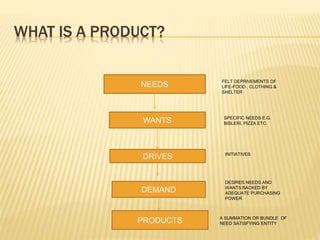
WHAT IS A PRODUCT?
NEEDS
WANTS
DRIVES
DEMAND
PRODUCTS
FELT DEPRIVEMENTS OF
LIFE-FOOD , CLOTHING &
SHELTER
SPECIFIC NEEDS E.G.
BISLERI, PIZZA ETC.
INITIATIVES
DESIRES NEEDS AND
WANTS BACKED BY
ADEQUATE PURCHASING
POWER
A SUMMATION OR BUNDLE OF
NEED SATISFYING ENTITY
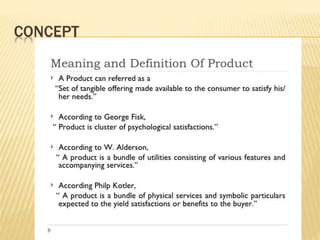
CONCEPT
PRODUCT LIFE CYCLE
 The product life cycle is an important
concept in marketing. It describes the stages
a product goes through from when it was
first thought of until it finally is removed from
the market. Not all products reach this final
stage. Some continue to grow and others
rise and fall.
 The Product Life Cycle.
 A new product progresses through a
sequence of stages from introduction to
growth, maturity, and decline. This sequence
is known as the product life cycle
 It is associated with changes in the
marketing situation, thus impacting the
marketing strategy and the marketing mix.
 Philip Kotler :”The product life cycle is an attempt to
recognize distinct stages in sales history of the product.”
 Product life cycle is the historical study of (sales of) the
product. It includes when it was introduced; when it was
getting rapid acceptance; when it was on the peak of its
position; when it started falling from the peak; and when it
disappeared. Product passes through certain stages
during its life span.
 In fact, no product is capable to satisfy needs and wants
of consumers for an unlimited period of time. As such, its
sales and profits are subject to differ over time. The life of
product can be determined by its capacity to meet market
expectations. It lasts or exists as long as it satisfies its
users.
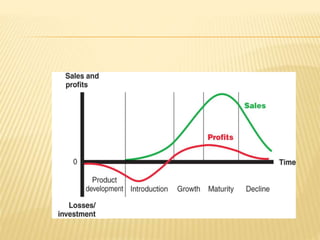
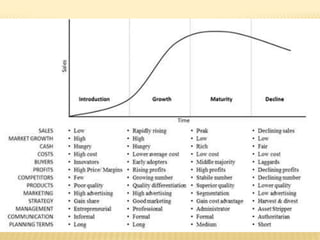
STAGES OF PRODUCT LIFE CYCLE:
Product life cycle comprises of four
steps/stages. Each stage of product life cycle
can be characterized in terms of at least four
aspects – sales volume, amount of profits,
level of promotional efforts and expenses,
and degree of competition. Each stage
demands the unique marketing strategy. Let
us briefly describe each of the stages of the
PLC :
INTRODUCTION STAGE:
 Introduction stage starts when a new product is, for
the very first time, made available for purchase.
Consumers are not aware of product, or they may not
have general opinion and experience regarding
product. Moreover, a new product has to face the
existing products. So, the sales remain limited.
 In the very initial stage, there is loss or negligible
profit. During this period, the direct competition is
almost absent. Company has not mastered
production and selling problems. Price is normally
high to recover/offset costs of development,
production, and marketing with minimum sales. So,
sales rise at gradually.
CHARACTERISTICS OF INTRODUCTION STAGE INCLUDE:
(i) Huge selling and promotional costs are
required to increase awareness of customers.
(ii) Price is kept high to recover high development,
production, and marketing costs.
(iii) Marketer has to tackle technical and
production problems.
(iv) Sale is low and increasing at a lower rate.
(v) There is loss or negligible profit.
(vi) There is no competition
GROWTH STAGE:
 This is the stage of a rapid market acceptance. Due to
increased awareness, the product gets positive response
from market. This stage is marked by a rapid climb in
sales. Sales rise at the increasing rate. Profits follow the
sales. Seller shifts his promotional attempts from “try-my-
brand” to “buy-my-brand.”
 Company tries to develop effective distribution network.
Here, the most of production and marketing problems are
mastered. Due to rise in profits, competitors are
attracted. At a right time, price may be reduced to attract
the price-sensitive buyers.
 Company continues, even increases, its selling and
promotional efforts to educate and convince the market
and meet competition. At the end of growth stage, sales
start increasing at decelerated rate, consequently, profits
starts to decline.
CHARACTERISTICS OF GROWTH STAGE INCLUDE:
(i) Sales increase rapidly (or at increasing rate) as a
result of consumer acceptance of the products.
(ii) Company can earn maximum profits.
(iii) Competitors enter the market due to attractive
profits.
(iv) Price is reduced to attract more consumers.
(v) Distribution network is widened and improved.
(vi) Necessary primary changes are made in product to
remove defects.
(vii) Company enters the new segments and new
channels are selected.
MATURITY STAGE:
This stage is marked with slow down of sales
growth. Sales continue to rise but at
decreasing rate. Competitors have entered
the market and existing products face
severe competition. Sales curve is pushed
downward. It is just like an inverse “U.”
During this stage, for certain period of time,
sales remain stable. This level is called the
Saturation. Profits also decline. Normally,
this stage lasts longer and marketers face
formidable challenges.
CHARACTERISTICS OF MATURITY STAGE INCLUDE:
i. Sales increase at decreasing rate.
ii. Profits start to decline.
iii. Marginal competitors leave the market.
iv. Customer retention is given more emphasis.
v. Product, market, and marketing mix
modifications are undertaken.
DECLINE STAGE:
 This is the last stage of product life cycle. Here,
sales start declining rapidly. Profits also start
erasing. There is a minimum profit or even a little
loss. Advertising and selling expenses are
reduced to realize some profits. This stage is faced
by only those who survived in maturity stage.
 Most products obsolete as new products enter
the market. All products have to face the stage
earlier or later. New products start their own life
cycle and replace old ones. A number of
competitors withdraw from the market. Those
who remain in the market prefer to drop smaller
segments, make minor changes in products, and
continue selling the products in profitable
segments and channels.
 Here, logic has its own role. Management
continues with the same product with
expectation that sales improve when economy
improves; marketing strategy is revised
expecting that competitors will leave the
market; or product is improved to attract new
market segments.
 However, unless a strong reason exists, it is
costly and risky to continue with the same
products. Later on it is difficult of manage
selling and promotional efforts. Marketer must
check every possibility before dropping the
product completely.
CHARACTERISTICS OF DECLINE STAGE INCLUDE:
i. Sales fall rapidly.
ii. Profits fall more rapidly than sales.
iii. Product modification is adopted.
iv. Gradually, the company prefers to shift
resources to new products.
v. Most of sellers withdraw from the market.
vi. Promotional expenses are reduced to
realize a little profit.
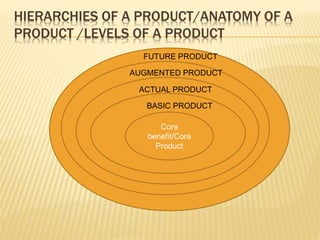
HIERARCHIES OF A PRODUCT/ANATOMY OF A
PRODUCT /LEVELS OF A PRODUCT
POAU
BASI
Core
benefit/Core
Product
BASIC PRODUCT
ACTUAL PRODUCT
AUGMENTED PRODUCT
FUTURE PRODUCT
CORE PRODUCT/ CORE BENEFIT
 The fundamental or the basic benefit or the
attribute for which the customer buys the
product is called its core benefit.
 For example:
1. The buyer of a washing machine actually
buys cleanliness of clothes.
2. A customer in an hotel pays fundamentally
for rest and sleep.
BASIC PRODUCT
At this level, the marketer turns the core benefit
into a basic product.Thus a washing machine
includes features such as care for clothes,
conviniencein washing, manageable size ,
durability of the machine etc. apart from core
benefit.
EXPECTED PRODUCT/ACTUAL PRODUCT
 Over and above the basic product the
customers expect some additional attributes or
benefits when they buy the product.
 Adding benefits over a basic product, gives birth
to expected product or the actual product.
 For example-
Customers buy washing machines also expect
lesser noise at the time of its operation, minimum
vibration, different modes for different types of
clothes(woolen, delicate, cotton etc. ),they look for
fully automatic, semi automatic etc.
AUGMENTED PRODUCT
 As inter firm rivalry increases the marketers try
to find out some benefits or attributes that go
beyond the normal expectations of customers
but can add some value to the product offer.
 These value enhancements results in
augmented products.
 For example in case of washing machines
options of hot, cold and warm water are present
or quick normal and strong wash options etc.
 In developed or developing countries
competition takes place in product
augmentation level, but in less developed or
under developed countries it is mainly at the
expected level, like in India some companies
offer same product at different levels- like
some models in lower price range and some
models in higher price range.
POTENTIAL PRODUCT
 When manufacturers add future compatibility to
products we get this level of potential product.
 Benefits are added not only to satisfy them but to
provide delight or surprise them.
Example-
1. for washing machines smart diagnosis where the
executives can solve many problems by hearing the
sound of the machine over phone
2. Censor enabled doors
3. Smart phone connected geasers
4. Wi-fi enabled printers.
PRODUCT MANAGEMENT & PRODUCT LIFE CYCLE

PRODUCT MANAGEMENT & PRODUCT LIFE CYCLE

  • 1.
    UNIT1 PRODUCT PROF. MAHUAMUKHERJEE PRODUCT AND PRICING MANAGEMENT
  • 2.
    WHAT IS APRODUCT? NEEDS WANTS DRIVES DEMAND PRODUCTS FELT DEPRIVEMENTS OF LIFE-FOOD , CLOTHING & SHELTER SPECIFIC NEEDS E.G. BISLERI, PIZZA ETC. INITIATIVES DESIRES NEEDS AND WANTS BACKED BY ADEQUATE PURCHASING POWER A SUMMATION OR BUNDLE OF NEED SATISFYING ENTITY
  • 3.
  • 4.
    PRODUCT LIFE CYCLE The product life cycle is an important concept in marketing. It describes the stages a product goes through from when it was first thought of until it finally is removed from the market. Not all products reach this final stage. Some continue to grow and others rise and fall.
  • 5.
     The ProductLife Cycle.  A new product progresses through a sequence of stages from introduction to growth, maturity, and decline. This sequence is known as the product life cycle  It is associated with changes in the marketing situation, thus impacting the marketing strategy and the marketing mix.
  • 6.
     Philip Kotler:”The product life cycle is an attempt to recognize distinct stages in sales history of the product.”  Product life cycle is the historical study of (sales of) the product. It includes when it was introduced; when it was getting rapid acceptance; when it was on the peak of its position; when it started falling from the peak; and when it disappeared. Product passes through certain stages during its life span.  In fact, no product is capable to satisfy needs and wants of consumers for an unlimited period of time. As such, its sales and profits are subject to differ over time. The life of product can be determined by its capacity to meet market expectations. It lasts or exists as long as it satisfies its users.
  • 9.
    STAGES OF PRODUCTLIFE CYCLE: Product life cycle comprises of four steps/stages. Each stage of product life cycle can be characterized in terms of at least four aspects – sales volume, amount of profits, level of promotional efforts and expenses, and degree of competition. Each stage demands the unique marketing strategy. Let us briefly describe each of the stages of the PLC :
  • 10.
    INTRODUCTION STAGE:  Introductionstage starts when a new product is, for the very first time, made available for purchase. Consumers are not aware of product, or they may not have general opinion and experience regarding product. Moreover, a new product has to face the existing products. So, the sales remain limited.  In the very initial stage, there is loss or negligible profit. During this period, the direct competition is almost absent. Company has not mastered production and selling problems. Price is normally high to recover/offset costs of development, production, and marketing with minimum sales. So, sales rise at gradually.
  • 11.
    CHARACTERISTICS OF INTRODUCTIONSTAGE INCLUDE: (i) Huge selling and promotional costs are required to increase awareness of customers. (ii) Price is kept high to recover high development, production, and marketing costs. (iii) Marketer has to tackle technical and production problems. (iv) Sale is low and increasing at a lower rate. (v) There is loss or negligible profit. (vi) There is no competition
  • 12.
    GROWTH STAGE:  Thisis the stage of a rapid market acceptance. Due to increased awareness, the product gets positive response from market. This stage is marked by a rapid climb in sales. Sales rise at the increasing rate. Profits follow the sales. Seller shifts his promotional attempts from “try-my- brand” to “buy-my-brand.”  Company tries to develop effective distribution network. Here, the most of production and marketing problems are mastered. Due to rise in profits, competitors are attracted. At a right time, price may be reduced to attract the price-sensitive buyers.  Company continues, even increases, its selling and promotional efforts to educate and convince the market and meet competition. At the end of growth stage, sales start increasing at decelerated rate, consequently, profits starts to decline.
  • 13.
    CHARACTERISTICS OF GROWTHSTAGE INCLUDE: (i) Sales increase rapidly (or at increasing rate) as a result of consumer acceptance of the products. (ii) Company can earn maximum profits. (iii) Competitors enter the market due to attractive profits. (iv) Price is reduced to attract more consumers. (v) Distribution network is widened and improved. (vi) Necessary primary changes are made in product to remove defects. (vii) Company enters the new segments and new channels are selected.
  • 14.
    MATURITY STAGE: This stageis marked with slow down of sales growth. Sales continue to rise but at decreasing rate. Competitors have entered the market and existing products face severe competition. Sales curve is pushed downward. It is just like an inverse “U.” During this stage, for certain period of time, sales remain stable. This level is called the Saturation. Profits also decline. Normally, this stage lasts longer and marketers face formidable challenges.
  • 15.
    CHARACTERISTICS OF MATURITYSTAGE INCLUDE: i. Sales increase at decreasing rate. ii. Profits start to decline. iii. Marginal competitors leave the market. iv. Customer retention is given more emphasis. v. Product, market, and marketing mix modifications are undertaken.
  • 16.
    DECLINE STAGE:  Thisis the last stage of product life cycle. Here, sales start declining rapidly. Profits also start erasing. There is a minimum profit or even a little loss. Advertising and selling expenses are reduced to realize some profits. This stage is faced by only those who survived in maturity stage.  Most products obsolete as new products enter the market. All products have to face the stage earlier or later. New products start their own life cycle and replace old ones. A number of competitors withdraw from the market. Those who remain in the market prefer to drop smaller segments, make minor changes in products, and continue selling the products in profitable segments and channels.
  • 17.
     Here, logichas its own role. Management continues with the same product with expectation that sales improve when economy improves; marketing strategy is revised expecting that competitors will leave the market; or product is improved to attract new market segments.  However, unless a strong reason exists, it is costly and risky to continue with the same products. Later on it is difficult of manage selling and promotional efforts. Marketer must check every possibility before dropping the product completely.
  • 18.
    CHARACTERISTICS OF DECLINESTAGE INCLUDE: i. Sales fall rapidly. ii. Profits fall more rapidly than sales. iii. Product modification is adopted. iv. Gradually, the company prefers to shift resources to new products. v. Most of sellers withdraw from the market. vi. Promotional expenses are reduced to realize a little profit.
  • 19.
    HIERARCHIES OF APRODUCT/ANATOMY OF A PRODUCT /LEVELS OF A PRODUCT POAU BASI Core benefit/Core Product BASIC PRODUCT ACTUAL PRODUCT AUGMENTED PRODUCT FUTURE PRODUCT
  • 20.
    CORE PRODUCT/ COREBENEFIT  The fundamental or the basic benefit or the attribute for which the customer buys the product is called its core benefit.  For example: 1. The buyer of a washing machine actually buys cleanliness of clothes. 2. A customer in an hotel pays fundamentally for rest and sleep.
  • 21.
    BASIC PRODUCT At thislevel, the marketer turns the core benefit into a basic product.Thus a washing machine includes features such as care for clothes, conviniencein washing, manageable size , durability of the machine etc. apart from core benefit.
  • 22.
    EXPECTED PRODUCT/ACTUAL PRODUCT Over and above the basic product the customers expect some additional attributes or benefits when they buy the product.  Adding benefits over a basic product, gives birth to expected product or the actual product.  For example- Customers buy washing machines also expect lesser noise at the time of its operation, minimum vibration, different modes for different types of clothes(woolen, delicate, cotton etc. ),they look for fully automatic, semi automatic etc.
  • 23.
    AUGMENTED PRODUCT  Asinter firm rivalry increases the marketers try to find out some benefits or attributes that go beyond the normal expectations of customers but can add some value to the product offer.  These value enhancements results in augmented products.  For example in case of washing machines options of hot, cold and warm water are present or quick normal and strong wash options etc.
  • 24.
     In developedor developing countries competition takes place in product augmentation level, but in less developed or under developed countries it is mainly at the expected level, like in India some companies offer same product at different levels- like some models in lower price range and some models in higher price range.
  • 25.
    POTENTIAL PRODUCT  Whenmanufacturers add future compatibility to products we get this level of potential product.  Benefits are added not only to satisfy them but to provide delight or surprise them. Example- 1. for washing machines smart diagnosis where the executives can solve many problems by hearing the sound of the machine over phone 2. Censor enabled doors 3. Smart phone connected geasers 4. Wi-fi enabled printers.