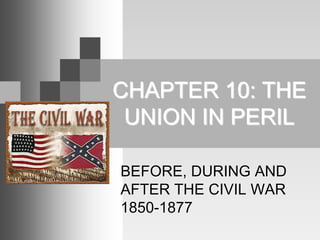
CHAPTER 10: THE
UNION IN PERIL
BEFORE, DURING AND
AFTER THE CIVIL WAR
1850-1877
THE DIVISIVE POLITICS OF
SLAVERY
• Over the centuries, the
Northern and Southern
sections of the United
States had developed
into two very different
cultural and economic
regions
• There were also
differences in geography
and climate, as well as
religious differences
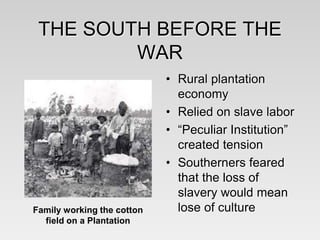
THE SOUTH BEFORE THE
WAR
• Rural plantation
economy
• Relied on slave labor
• “Peculiar Institution”
created tension
• Southerners feared
that the loss of
slavery would mean
lose of cultureFamily working the cotton
field on a Plantation
THE NORTH BEFORE THE
WAR• The North had a
more diverse
economy
• Industry flourished
• Openly opposed
slavery in the
South and the new
territories
• More urbanized
than South
BOSTON HARBOR
Wilmot Proviso
Example of SECTIONALISM in the country
• Northern sponsored bill in 1846; David Wilmot, (D)PA
• Stipulated that slavery be prohibited in any territory acquired
from Mexico. CA.UT.NM
• Passed House (Northern Majority); failed Senate.
Was the Missouri Compromise unconstitutional?
North View South View
Northerners cite “elastic clause”
Missouri Compromise gave
Congress control over legislation
regarding slavery in the territories.
John Calhoun: slaves were
property by the 5th amendment;
property rights protected by could
carry their slave anywhere.
constitution; slaveholders
California Statehood
• California Gold Rush
• Population boom let
CA skip territorial
status and apply
directly for
statehood.
• Slave State or Free
State?
• CA would upset the
“Balance of Power”
between the sections
Compromise of 1850
Henry Clay
Great Compromiser
1. California enters the union as a free state
2. In the rest of the Mexican cession
territory “popular sovereignty” would
decide.
3. $10 Million to Settle border dispute
between TX & NM
4. End of the slave trade (not slavery) in
Washington DC
5. Stronger Fugitive Slave Law.
History Alive USH 8-5, Activity 2.1, Slide G
Fugitive Slave Act
• Federal Crime to help runaway slaves
• Officials could arrest runaways in areas where slavery
banned.
• Federal Marshalls could organize posses.
• no trial by jury for fugitives
• fugitives could not testify on their own behalf
• fugitives returned to slavery on testimony of claimants
• court-appointed commissioners paid $10 if rule for claimant;
$5 if rule for fugitive
• Hiding a runaway—6 months in jail and $1000 fine.
Leads to the Underground RR—19 trips
Harriet (Moses) Tubman
History Alive USH 8-5, Activity 2.1, Slide H
Harriet
Beecher
Stowe
1811 -
1896So this is the lady who
started the Civil War.
-- Abraham Lincoln
Uncle Tom’s
Cabin
1852
• Sold 300,000
copies in the
first year.
• 2 million in a
decade!
Kansas-Nebraska Act,
1854
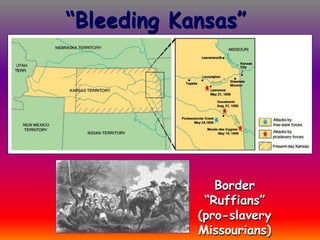
“Bleeding Kansas”
Border
“Ruffians”
(pro-slavery
Missourians)
Sumner Brooks Affair
Comparing the Compromises
1852
Election
Results
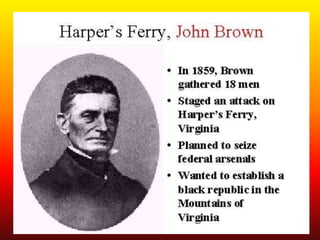
John Brown: Madman, Hero
or Martyr?
Dred Scott v.
Sanford, 1857
Dred Scott decision (1857)
• DS was taken from Mo. To Wi. (free terr.)
• DS sued for his freedom
U.S. Supreme Court:
– Dominated by Southerners
– Chief Justice Taney (South Carolina)
• 1. DS cannot sue – not a citizen
• 2. Residence in Wisconsin does not grant
freedom
– Still “property”
• 3. Mo. Compromise unconstitutional
• Reactions of North and South???
The Lincoln-Douglas
(Illinois Senate)
Debates, 1858
A House divided
against itself,
cannot stand.
1860
Presidential
Election
√ Abraham
Lincoln
Republican
John Bell
Constitutional
Union
Stephen A. Douglas
Northern Democrat
John C. Breckinridge
Southern Democrat
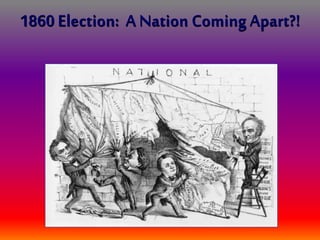
1860 Election: A Nation Coming Apart?!
1860
Election
Results
Summary

Union in peril

  • 1.
    CHAPTER 10: THE UNIONIN PERIL BEFORE, DURING AND AFTER THE CIVIL WAR 1850-1877
  • 2.
    THE DIVISIVE POLITICSOF SLAVERY • Over the centuries, the Northern and Southern sections of the United States had developed into two very different cultural and economic regions • There were also differences in geography and climate, as well as religious differences
  • 3.
    THE SOUTH BEFORETHE WAR • Rural plantation economy • Relied on slave labor • “Peculiar Institution” created tension • Southerners feared that the loss of slavery would mean lose of cultureFamily working the cotton field on a Plantation
  • 4.
    THE NORTH BEFORETHE WAR• The North had a more diverse economy • Industry flourished • Openly opposed slavery in the South and the new territories • More urbanized than South BOSTON HARBOR
  • 5.
    Wilmot Proviso Example ofSECTIONALISM in the country • Northern sponsored bill in 1846; David Wilmot, (D)PA • Stipulated that slavery be prohibited in any territory acquired from Mexico. CA.UT.NM • Passed House (Northern Majority); failed Senate. Was the Missouri Compromise unconstitutional? North View South View Northerners cite “elastic clause” Missouri Compromise gave Congress control over legislation regarding slavery in the territories. John Calhoun: slaves were property by the 5th amendment; property rights protected by could carry their slave anywhere. constitution; slaveholders
  • 6.
    California Statehood • CaliforniaGold Rush • Population boom let CA skip territorial status and apply directly for statehood. • Slave State or Free State? • CA would upset the “Balance of Power” between the sections
  • 7.
    Compromise of 1850 HenryClay Great Compromiser 1. California enters the union as a free state 2. In the rest of the Mexican cession territory “popular sovereignty” would decide. 3. $10 Million to Settle border dispute between TX & NM 4. End of the slave trade (not slavery) in Washington DC 5. Stronger Fugitive Slave Law.
  • 8.
    History Alive USH8-5, Activity 2.1, Slide G
  • 9.
    Fugitive Slave Act •Federal Crime to help runaway slaves • Officials could arrest runaways in areas where slavery banned. • Federal Marshalls could organize posses. • no trial by jury for fugitives • fugitives could not testify on their own behalf • fugitives returned to slavery on testimony of claimants • court-appointed commissioners paid $10 if rule for claimant; $5 if rule for fugitive • Hiding a runaway—6 months in jail and $1000 fine. Leads to the Underground RR—19 trips Harriet (Moses) Tubman
  • 10.
    History Alive USH8-5, Activity 2.1, Slide H
  • 11.
    Harriet Beecher Stowe 1811 - 1896So thisis the lady who started the Civil War. -- Abraham Lincoln
  • 12.
    Uncle Tom’s Cabin 1852 • Sold300,000 copies in the first year. • 2 million in a decade!
  • 14.
  • 15.
  • 18.
  • 19.
  • 20.
  • 21.
    John Brown: Madman,Hero or Martyr?
  • 22.
  • 23.
    Dred Scott decision(1857) • DS was taken from Mo. To Wi. (free terr.) • DS sued for his freedom U.S. Supreme Court: – Dominated by Southerners – Chief Justice Taney (South Carolina) • 1. DS cannot sue – not a citizen • 2. Residence in Wisconsin does not grant freedom – Still “property” • 3. Mo. Compromise unconstitutional • Reactions of North and South???
  • 24.
    The Lincoln-Douglas (Illinois Senate) Debates,1858 A House divided against itself, cannot stand.
  • 26.
    1860 Presidential Election √ Abraham Lincoln Republican John Bell Constitutional Union StephenA. Douglas Northern Democrat John C. Breckinridge Southern Democrat
  • 27.
    1860 Election: ANation Coming Apart?!
  • 28.
  • 29.