Immigration
Ch 15.1 & 2
New ImmigrantsNew Immigrants
 immigrants had come from northern Europe
since before the American Revolution
– United Kingdom (England, Scotland, & Irish)
– Germany
– Scandinavia (Sweden, Norway, & Finland)
 fewer immigrants came from these countries
– they already had industrialized countries
New ImmigrantsNew Immigrants
southern & eastern Europe
eastern Mediterranean
much of these areas controlled by
– Russian Empire
– Austro-Hungarian Empire
– Ottoman (Turkish) Empire
New ImmigrantsNew Immigrants
 reasons for leaving:
– overpopulation
– lack of jobs
– mistreatment by government
 America offered:
– jobs
– opportunity
– freedom
Crossing the OceanCrossing the Ocean
 steamships were safer & faster
 steamships didn’t have to worry about winds
 steamships could operate on any schedule
 cheap passage available
– single men could come to America for a few
months or years & go home
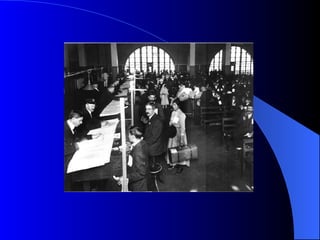
Ellis Island: Gate to AmericaEllis Island: Gate to America
 1886: Statue of
Liberty in New York
Harbor
 1892: Ellis Island
opened as
immigration center
 What happened at
Ellis Island?
Medical CheckupsMedical Checkups
checked for diseases & other health
impairments
depending on the disease, an
immigrant could be
– turned away
– kept on the island until improvement
ProcessingProcessing
inspectors might ask immigrants:
– Name?
– Occupation?
– Who paid your fare?
– Can you read & write?
– How much money do you have?
– Have you ever been in prison or the
poorhouse?
– Where are you going?
Name ChangesName Changes
 during this processing,
names often changed
 names that were
difficult to pronounce or
spell were changed
 American-sounding
names
Immigrants SettledImmigrants Settled
settled where there was work
– mines
– mills
– factories
beginning of 1900s half of all
immigrants settled in four states
– New York, Pennsylvania, Massachusetts,
& Illinois
Immigrants SettledImmigrants Settled
most immigrants ended up where
relatives were located
– many immigrants had relatives in America
pay their way
most immigrants ended up doing similar
jobs to what their relatives did
Living conditions in USLiving conditions in US
For the poor—
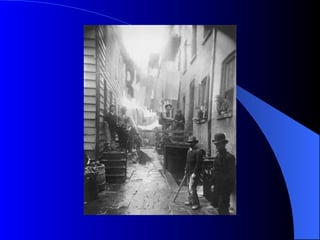
– TENEMENT buildings
– Overcrowded, dark, unventilated apartments
– 10-12 family members living in a 1-2 BR apt
– Disease spread quickly, no windows
– High rent for small space
Working conditions
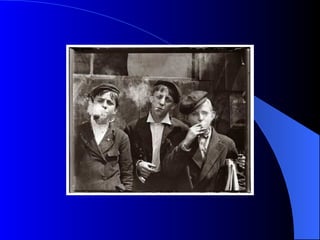
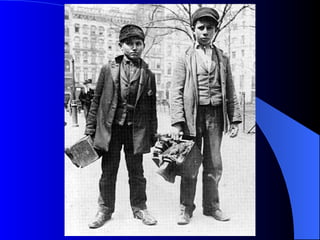
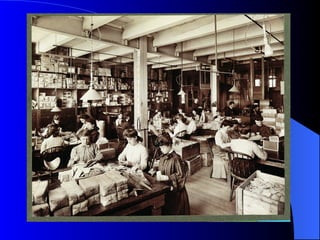
-Many women and children worked to support the family
-“Newsies” was about the plight of child newspaper boys
-Poorly lit, not properly ventilated factories
-long hours
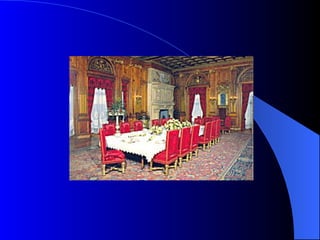
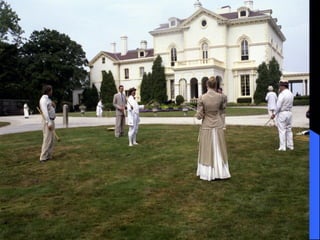
Meanwhile…the rich lived well!
-Houses that looked like castles
-Factory owners
-Fashionable
Vanderbilt estate
Carnegie Mansion
Rockefeller mansion

Us immigration

  • 1.
  • 2.
    New ImmigrantsNew Immigrants immigrants had come from northern Europe since before the American Revolution – United Kingdom (England, Scotland, & Irish) – Germany – Scandinavia (Sweden, Norway, & Finland)  fewer immigrants came from these countries – they already had industrialized countries
  • 3.
    New ImmigrantsNew Immigrants southern& eastern Europe eastern Mediterranean much of these areas controlled by – Russian Empire – Austro-Hungarian Empire – Ottoman (Turkish) Empire
  • 5.
    New ImmigrantsNew Immigrants reasons for leaving: – overpopulation – lack of jobs – mistreatment by government  America offered: – jobs – opportunity – freedom
  • 8.
    Crossing the OceanCrossingthe Ocean  steamships were safer & faster  steamships didn’t have to worry about winds  steamships could operate on any schedule  cheap passage available – single men could come to America for a few months or years & go home
  • 10.
    Ellis Island: Gateto AmericaEllis Island: Gate to America  1886: Statue of Liberty in New York Harbor  1892: Ellis Island opened as immigration center  What happened at Ellis Island?
  • 12.
    Medical CheckupsMedical Checkups checkedfor diseases & other health impairments depending on the disease, an immigrant could be – turned away – kept on the island until improvement
  • 15.
    ProcessingProcessing inspectors might askimmigrants: – Name? – Occupation? – Who paid your fare? – Can you read & write? – How much money do you have? – Have you ever been in prison or the poorhouse? – Where are you going?
  • 18.
    Name ChangesName Changes during this processing, names often changed  names that were difficult to pronounce or spell were changed  American-sounding names
  • 19.
    Immigrants SettledImmigrants Settled settledwhere there was work – mines – mills – factories beginning of 1900s half of all immigrants settled in four states – New York, Pennsylvania, Massachusetts, & Illinois
  • 20.
    Immigrants SettledImmigrants Settled mostimmigrants ended up where relatives were located – many immigrants had relatives in America pay their way most immigrants ended up doing similar jobs to what their relatives did
  • 21.
    Living conditions inUSLiving conditions in US For the poor— – TENEMENT buildings – Overcrowded, dark, unventilated apartments – 10-12 family members living in a 1-2 BR apt – Disease spread quickly, no windows – High rent for small space
  • 26.
    Working conditions -Many womenand children worked to support the family -“Newsies” was about the plight of child newspaper boys -Poorly lit, not properly ventilated factories -long hours
  • 31.
    Meanwhile…the rich livedwell! -Houses that looked like castles -Factory owners -Fashionable
  • 32.
  • 36.
  • 37.

Editor's Notes

  • #5 http://webpages.csus.edu/~ettinger/
  • #7 http://www.english.illinois.edu/maps/poets/a_f/angel/gallery.htm
  • #8 http://www.paulgassfamily.com/section2/ii3/ii3_002.htm
  • #10 http://www.english.illinois.edu/maps/poets/a_f/angel/gallery.htm
  • #12 http://teachers.henrico.k12.va.us/tuckahoems/gorman_g/literarymagazine/indimm.html
  • #14 http://www.lhncbc.nlm.nih.gov/apdb/phsHistory/EllisIsland/ThePHS.htm
  • #15 http://www.wright.edu/cgi-bin/cm/news.cgi?action=news_item&id=1159&print=Y
  • #17 http://www.usatoday.com/news/nation/2008-09-23-ellis-island_N.htm
  • #18 http://housecallsinthegardenstate.com/
  • #23 New York tenements http://images.encarta.msn.com/xrefmedia/sharemed/targets/images/pho/t628/T628873A.jpg
  • #24 NY tenements c1900-1910 http://www.flickr.com/photos/41321274@N00/392222073/
  • #25 One of Four Pedlars Who Slept in the Cellar of 11 Ludlow Street Rear c. 1892 http://masters-of-photography.com/R/riis/riis_pedlar_full.html
  • #26 Bandit's Roost, 59 1/2 Mulberry Street c. 1888 http://masters-of-photography.com/R/riis/riis_bandits_roost_full.html
  • #28 Newsies http://retrothing.typepad.com/photos/uncategorized/2007/08/08/newsies.jpg
  • #29 Bootblacks http://www.latinamericanstudies.org/immigration/italian-bootblacks-1910.jpg
  • #33 Frederick William Vanderbilt’s bedroom in Vanderbilt Mansion http://www.hvnet.com/houses/vanderbilt/
  • #34 Vanderbilt Mansion, finished in August 1898, Hyde Park NY Cornelius Vanderbilt, railroad and shipping tycoon http://www.nps.gov/history/nr/TwHP/wwwlps/lessons/78vanderbilt/78visual2.htm GW Vanderbilt II Biltmore Estate, Asheville, NC built 1888-1895
  • #35 Vanderbilt Mansion Dining Room, Hyde Park, NY http://www.tias.com/cgi-bin/item.fcgi?itemKey=1923149496&store=%2Fstores%2Ftyrem&catId=new-york