Growth of Industry & InventionGrowth of Industry & Invention
Industrial RevolutionIndustrial Revolution
Occurs in Great Britain & shifts to America.Occurs in Great Britain & shifts to America.
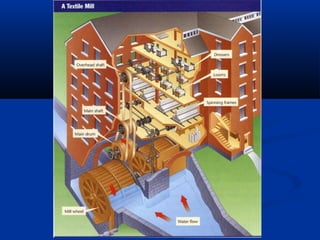
The Industrial Revolution was a Soc. & Eco.The Industrial Revolution was a Soc. & Eco.
Reorganization that took place as machines replacedReorganization that took place as machines replaced
hand tools & large scale factory production tookhand tools & large scale factory production took
placeplace
 Examples;Examples;
 Ford=CarsFord=Cars
 Dell=ComputersDell=Computers
 Samuel SlaterSamuel Slater’s Factory=thread’s Factory=thread
The Industrial NorthThe Industrial North
 New England IndustrializesNew England Industrializes
 Primary source of income after the war wasPrimary source of income after the war was
international tradeinternational trade
 Industrial Rev causes New England to shift to Production.Industrial Rev causes New England to shift to Production.
 Lowell Mill-Lowell Mill- Young women flock to town to work inYoung women flock to town to work in
factoriesfactories
 Strict rules were put in place; long hrsStrict rules were put in place; long hrs 12-16hrs/day, curfew, social12-16hrs/day, curfew, social
Economy of the early 1800sEconomy of the early 1800s
 Northern economyNorthern economy
 Based on farming and industryBased on farming and industry
 Mills, factories, mining, shipping, tradeMills, factories, mining, shipping, trade
 John DeereJohn Deere’s plow & Cyrus McCormick’s reaper in 1830s’s plow & Cyrus McCormick’s reaper in 1830s
 Rural and Urban areas (city and country)Rural and Urban areas (city and country)
 Rise of factories leads to city growthRise of factories leads to city growth
 Tenements in citiesTenements in cities
 Poor living conditionsPoor living conditions
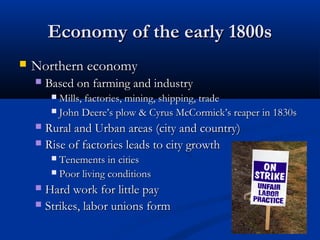
 Hard work for little payHard work for little pay
 Strikes, labor unions formStrikes, labor unions form
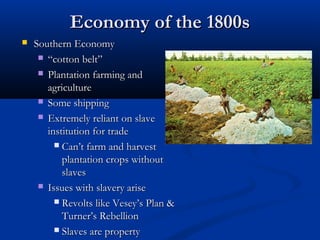
Economy of the 1800sEconomy of the 1800s
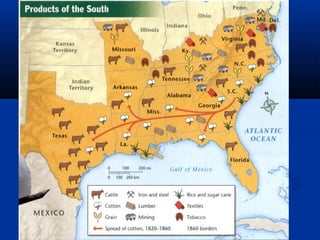
 Southern EconomySouthern Economy
 ““cotton belt”cotton belt”
 Plantation farming andPlantation farming and
agricultureagriculture
 Some shippingSome shipping
 Extremely reliant on slaveExtremely reliant on slave
institution for tradeinstitution for trade
 CanCan’t farm and harvest’t farm and harvest
plantation crops withoutplantation crops without
slavesslaves
 Issues with slavery ariseIssues with slavery arise
 Revolts like VeseyRevolts like Vesey’s Plan &’s Plan &
Turner’s RebellionTurner’s Rebellion
 Slaves are propertySlaves are property
Inventions & InnovationsInventions & Innovations
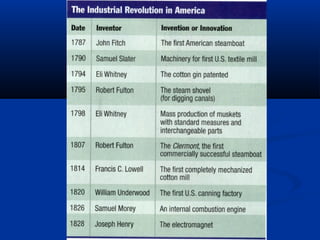
 1700s in Britain, Industrial Revolution1700s in Britain, Industrial Revolution
beginsbegins
 US steals plans of British textile millsUS steals plans of British textile mills
 1790 Rhode Island houses the first US1790 Rhode Island houses the first US
textile milltextile mill
 By 1840 over 240 mills operatingBy 1840 over 240 mills operating
 Eli Whitney leads campaign forEli Whitney leads campaign for
necessity ofnecessity of ‘interchangeable parts’‘interchangeable parts’
 Changes the machinery of theChanges the machinery of the
countrycountry
Eli WhitneyEli Whitney
 WhitneyWhitney’s invention of the cotton gin set south’s invention of the cotton gin set south
on a separate course.on a separate course.
 Cotton easy to grow, but hard to cleanCotton easy to grow, but hard to clean
 Invention of cotton gin-> can clean cotton faster-Invention of cotton gin-> can clean cotton faster-
>South needs more slaves to pick cotton.>South needs more slaves to pick cotton.
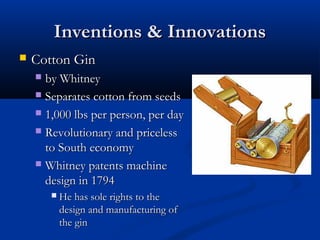
Inventions & InnovationsInventions & Innovations
 Cotton GinCotton Gin
 by Whitneyby Whitney
 Separates cotton from seedsSeparates cotton from seeds
 1,000 lbs per person, per day1,000 lbs per person, per day
 Revolutionary and pricelessRevolutionary and priceless
to South economyto South economy
 Whitney patents machineWhitney patents machine
design in 1794design in 1794
 He has sole rights to theHe has sole rights to the
design and manufacturing ofdesign and manufacturing of
the ginthe gin
Slavery on the InclineSlavery on the Incline
 During the American Rev. slave trade declined.During the American Rev. slave trade declined.
 After the war of 1812 slave trade increasedAfter the war of 1812 slave trade increased
 The amount of slaves owned directly correlates withThe amount of slaves owned directly correlates with
the amount of cotton produced.the amount of cotton produced.
Henry ClayHenry Clay’s American System’s American System
 North & South developed different economiesNorth & South developed different economies
 Congress/Pres./Clay want to unify the USCongress/Pres./Clay want to unify the US
GoalGoal’s of American System’s of American System
 Goal 1- Unite Regional EconomiesGoal 1- Unite Regional Economies
 Goal 2- Create Strong stable US economyGoal 2- Create Strong stable US economy
 Goal 3- Make the US self-sufficientGoal 3- Make the US self-sufficient
 Why is this important?Why is this important?
3 Major Parts of the American3 Major Parts of the American
SystemSystem
 I. Develop transportation systems & otherI. Develop transportation systems & other
internal improvementsinternal improvements
 II. Establish Protective TariffII. Establish Protective Tariff
 III. Resurrect the national bank- influenceIII. Resurrect the national bank- influence
reduced under Jefferson.reduced under Jefferson.
How would it Unite the Country?How would it Unite the Country?
 North produces manufactured goods that farmers from the S. &North produces manufactured goods that farmers from the S. &
W. would buy.W. would buy.
 The S. & W. would produce the grain, meat, & cotton needed inThe S. & W. would produce the grain, meat, & cotton needed in
the N.the N.
 A nationally accepted currency & improved transportationA nationally accepted currency & improved transportation
network would facilitate the exchange of goodsnetwork would facilitate the exchange of goods
 America would no longer be economically dependent on BritainAmerica would no longer be economically dependent on Britain
& other European Nations.& other European Nations.
Tariff of 1816Tariff of 1816 & what caused it?& what caused it?
 B/c British goods stockpiled during War ofB/c British goods stockpiled during War of
1812-> price dropped->sold cheaper than1812-> price dropped->sold cheaper than
American goodsAmerican goods
 Placing a tariff on imports would increase thePlacing a tariff on imports would increase the
cost of foreign goods->eliminates pricecost of foreign goods->eliminates price
advantageadvantage
Tariff cont.Tariff cont.
 The revenue earned from tariff would be usedThe revenue earned from tariff would be used
for internal improvementsfor internal improvements
 Roads, canals, etc.Roads, canals, etc.
 Northerners loved the ideaNortherners loved the idea
 b/c more pple would buy American goodsb/c more pple would buy American goods
 Southerners hated the ideaSoutherners hated the idea
 b/c it increase price of goods.b/c it increase price of goods.
Innovations & InventionsInnovations & Inventions
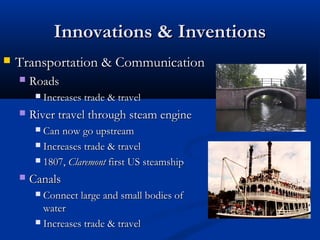
 Transportation & CommunicationTransportation & Communication
 RoadsRoads
 Increases trade & travelIncreases trade & travel
 River travel through steam engineRiver travel through steam engine
 Can now go upstreamCan now go upstream
 Increases trade & travelIncreases trade & travel
 1807,1807, ClaremontClaremont first US steamshipfirst US steamship
 CanalsCanals
 Connect large and small bodies ofConnect large and small bodies of
waterwater
 Increases trade & travelIncreases trade & travel
Inventions & InnovationsInventions & Innovations
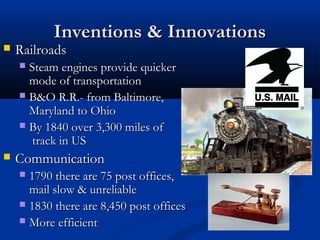
 RailroadsRailroads
 Steam engines provide quickerSteam engines provide quicker
mode of transportationmode of transportation
 B&O R.R.- from Baltimore,B&O R.R.- from Baltimore,
Maryland to OhioMaryland to Ohio
 By 1840 over 3,300 miles ofBy 1840 over 3,300 miles of
track in UStrack in US
 CommunicationCommunication
 1790 there are 75 post offices,1790 there are 75 post offices,
mail slow & unreliablemail slow & unreliable
 1830 there are 8,450 post offices1830 there are 8,450 post offices
 More efficientMore efficient
Ch 7 industry and change

Ch 7 industry and change

  • 1.
    Growth of Industry& InventionGrowth of Industry & Invention
  • 2.
    Industrial RevolutionIndustrial Revolution Occursin Great Britain & shifts to America.Occurs in Great Britain & shifts to America. The Industrial Revolution was a Soc. & Eco.The Industrial Revolution was a Soc. & Eco. Reorganization that took place as machines replacedReorganization that took place as machines replaced hand tools & large scale factory production tookhand tools & large scale factory production took placeplace  Examples;Examples;  Ford=CarsFord=Cars  Dell=ComputersDell=Computers  Samuel SlaterSamuel Slater’s Factory=thread’s Factory=thread
  • 3.
    The Industrial NorthTheIndustrial North  New England IndustrializesNew England Industrializes  Primary source of income after the war wasPrimary source of income after the war was international tradeinternational trade  Industrial Rev causes New England to shift to Production.Industrial Rev causes New England to shift to Production.  Lowell Mill-Lowell Mill- Young women flock to town to work inYoung women flock to town to work in factoriesfactories  Strict rules were put in place; long hrsStrict rules were put in place; long hrs 12-16hrs/day, curfew, social12-16hrs/day, curfew, social
  • 4.
    Economy of theearly 1800sEconomy of the early 1800s  Northern economyNorthern economy  Based on farming and industryBased on farming and industry  Mills, factories, mining, shipping, tradeMills, factories, mining, shipping, trade  John DeereJohn Deere’s plow & Cyrus McCormick’s reaper in 1830s’s plow & Cyrus McCormick’s reaper in 1830s  Rural and Urban areas (city and country)Rural and Urban areas (city and country)  Rise of factories leads to city growthRise of factories leads to city growth  Tenements in citiesTenements in cities  Poor living conditionsPoor living conditions  Hard work for little payHard work for little pay  Strikes, labor unions formStrikes, labor unions form
  • 6.
    Economy of the1800sEconomy of the 1800s  Southern EconomySouthern Economy  ““cotton belt”cotton belt”  Plantation farming andPlantation farming and agricultureagriculture  Some shippingSome shipping  Extremely reliant on slaveExtremely reliant on slave institution for tradeinstitution for trade  CanCan’t farm and harvest’t farm and harvest plantation crops withoutplantation crops without slavesslaves  Issues with slavery ariseIssues with slavery arise  Revolts like VeseyRevolts like Vesey’s Plan &’s Plan & Turner’s RebellionTurner’s Rebellion  Slaves are propertySlaves are property
  • 7.
    Inventions & InnovationsInventions& Innovations  1700s in Britain, Industrial Revolution1700s in Britain, Industrial Revolution beginsbegins  US steals plans of British textile millsUS steals plans of British textile mills  1790 Rhode Island houses the first US1790 Rhode Island houses the first US textile milltextile mill  By 1840 over 240 mills operatingBy 1840 over 240 mills operating  Eli Whitney leads campaign forEli Whitney leads campaign for necessity ofnecessity of ‘interchangeable parts’‘interchangeable parts’  Changes the machinery of theChanges the machinery of the countrycountry
  • 8.
    Eli WhitneyEli Whitney WhitneyWhitney’s invention of the cotton gin set south’s invention of the cotton gin set south on a separate course.on a separate course.  Cotton easy to grow, but hard to cleanCotton easy to grow, but hard to clean  Invention of cotton gin-> can clean cotton faster-Invention of cotton gin-> can clean cotton faster- >South needs more slaves to pick cotton.>South needs more slaves to pick cotton.
  • 9.
    Inventions & InnovationsInventions& Innovations  Cotton GinCotton Gin  by Whitneyby Whitney  Separates cotton from seedsSeparates cotton from seeds  1,000 lbs per person, per day1,000 lbs per person, per day  Revolutionary and pricelessRevolutionary and priceless to South economyto South economy  Whitney patents machineWhitney patents machine design in 1794design in 1794  He has sole rights to theHe has sole rights to the design and manufacturing ofdesign and manufacturing of the ginthe gin
  • 10.
    Slavery on theInclineSlavery on the Incline  During the American Rev. slave trade declined.During the American Rev. slave trade declined.  After the war of 1812 slave trade increasedAfter the war of 1812 slave trade increased  The amount of slaves owned directly correlates withThe amount of slaves owned directly correlates with the amount of cotton produced.the amount of cotton produced.
  • 11.
    Henry ClayHenry Clay’sAmerican System’s American System  North & South developed different economiesNorth & South developed different economies  Congress/Pres./Clay want to unify the USCongress/Pres./Clay want to unify the US
  • 12.
    GoalGoal’s of AmericanSystem’s of American System  Goal 1- Unite Regional EconomiesGoal 1- Unite Regional Economies  Goal 2- Create Strong stable US economyGoal 2- Create Strong stable US economy  Goal 3- Make the US self-sufficientGoal 3- Make the US self-sufficient  Why is this important?Why is this important?
  • 13.
    3 Major Partsof the American3 Major Parts of the American SystemSystem  I. Develop transportation systems & otherI. Develop transportation systems & other internal improvementsinternal improvements  II. Establish Protective TariffII. Establish Protective Tariff  III. Resurrect the national bank- influenceIII. Resurrect the national bank- influence reduced under Jefferson.reduced under Jefferson.
  • 14.
    How would itUnite the Country?How would it Unite the Country?  North produces manufactured goods that farmers from the S. &North produces manufactured goods that farmers from the S. & W. would buy.W. would buy.  The S. & W. would produce the grain, meat, & cotton needed inThe S. & W. would produce the grain, meat, & cotton needed in the N.the N.  A nationally accepted currency & improved transportationA nationally accepted currency & improved transportation network would facilitate the exchange of goodsnetwork would facilitate the exchange of goods  America would no longer be economically dependent on BritainAmerica would no longer be economically dependent on Britain & other European Nations.& other European Nations.
  • 15.
    Tariff of 1816Tariffof 1816 & what caused it?& what caused it?  B/c British goods stockpiled during War ofB/c British goods stockpiled during War of 1812-> price dropped->sold cheaper than1812-> price dropped->sold cheaper than American goodsAmerican goods  Placing a tariff on imports would increase thePlacing a tariff on imports would increase the cost of foreign goods->eliminates pricecost of foreign goods->eliminates price advantageadvantage
  • 16.
    Tariff cont.Tariff cont. The revenue earned from tariff would be usedThe revenue earned from tariff would be used for internal improvementsfor internal improvements  Roads, canals, etc.Roads, canals, etc.  Northerners loved the ideaNortherners loved the idea  b/c more pple would buy American goodsb/c more pple would buy American goods  Southerners hated the ideaSoutherners hated the idea  b/c it increase price of goods.b/c it increase price of goods.
  • 17.
    Innovations & InventionsInnovations& Inventions  Transportation & CommunicationTransportation & Communication  RoadsRoads  Increases trade & travelIncreases trade & travel  River travel through steam engineRiver travel through steam engine  Can now go upstreamCan now go upstream  Increases trade & travelIncreases trade & travel  1807,1807, ClaremontClaremont first US steamshipfirst US steamship  CanalsCanals  Connect large and small bodies ofConnect large and small bodies of waterwater  Increases trade & travelIncreases trade & travel
  • 18.
    Inventions & InnovationsInventions& Innovations  RailroadsRailroads  Steam engines provide quickerSteam engines provide quicker mode of transportationmode of transportation  B&O R.R.- from Baltimore,B&O R.R.- from Baltimore, Maryland to OhioMaryland to Ohio  By 1840 over 3,300 miles ofBy 1840 over 3,300 miles of track in UStrack in US  CommunicationCommunication  1790 there are 75 post offices,1790 there are 75 post offices, mail slow & unreliablemail slow & unreliable  1830 there are 8,450 post offices1830 there are 8,450 post offices  More efficientMore efficient