LIFE IN THE NEW NATION
Cultural Changes
• American scholars & artists contribute to culture
– Noah Webster- dictionary & spelling book
– Mercy Otis Warren-patriotic plays like History of
the American Revolution
– Benjamin Rush-books on chemistry &
medicine, belief that mental disease was not
demonic affliction
– Benjamin Banneker-surveyor of Washington
D.C., mathmatics, inventor, writer, astronomer
– Charles Willson Peale-artist, founds
1st museum in US
Cultural Changes
– Phyllis Wheatley-poetry Poems on
Various Subjects Religious and Moral
• Republican virtues promoted
– Self-reliance, hard work, frugality,
harmony, sacrificing individual
needs for society
• Education- schools add
departments to help girls become
“republican women”
Social Changes• Population growth
– 1780- 13 states, 2.7 million people
– 1830-24 states, 12 million people
– Population doubles every 20 years
– Not due to immigration of
Europeans or Africans
– 90% of growth due to increase in
birth
– 1800-1850 average woman has 5
children
– Median age in 1820 is 17 years old
(1/2 population was under age 17)
Social Changes
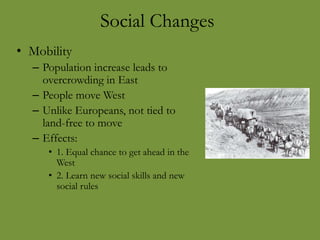
• Mobility
– Population increase leads to
overcrowding in East
– People move West
– Unlike Europeans, not tied to
land-free to move
– Effects:
• 1. Equal chance to get ahead in the
West
• 2. Learn new social skills and new
social rules
Social Changes
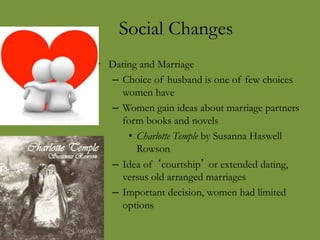
• Dating and Marriage
– Choice of husband is one of few choices
women have
– Women gain ideas about marriage partners
form books and novels
• Charlotte Temple by Susanna Haswell
Rowson
– Idea of ‘courtship’ or extended dating,
versus old arranged marriages
– Important decision, women had limited
options
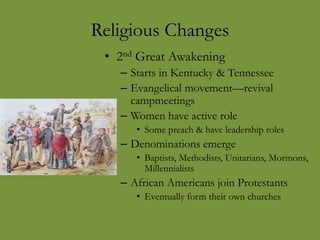
Religious Changes
• 2nd Great Awakening
– Starts in Kentucky & Tennessee
– Evangelical movement—revival
campmeetings
– Women have active role
• Some preach & have leadership roles
– Denominations emerge
• Baptists, Methodists, Unitarians, Mormons,
Millennialists
– African Americans join Protestants
• Eventually form their own churches
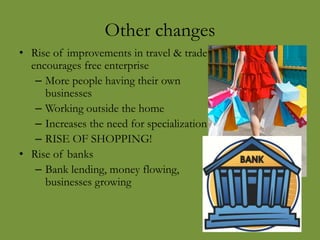
Other changes
• Rise of improvements in travel & trade
encourages free enterprise
– More people having their own
businesses
– Working outside the home
– Increases the need for specialization
– RISE OF SHOPPING!
• Rise of banks
– Bank lending, money flowing,
businesses growing
Ch 8.1 cultural change

Ch 8.1 cultural change

  • 1.
    LIFE IN THENEW NATION
  • 2.
    Cultural Changes • Americanscholars & artists contribute to culture – Noah Webster- dictionary & spelling book – Mercy Otis Warren-patriotic plays like History of the American Revolution – Benjamin Rush-books on chemistry & medicine, belief that mental disease was not demonic affliction – Benjamin Banneker-surveyor of Washington D.C., mathmatics, inventor, writer, astronomer – Charles Willson Peale-artist, founds 1st museum in US
  • 3.
    Cultural Changes – PhyllisWheatley-poetry Poems on Various Subjects Religious and Moral • Republican virtues promoted – Self-reliance, hard work, frugality, harmony, sacrificing individual needs for society • Education- schools add departments to help girls become “republican women”
  • 4.
    Social Changes• Populationgrowth – 1780- 13 states, 2.7 million people – 1830-24 states, 12 million people – Population doubles every 20 years – Not due to immigration of Europeans or Africans – 90% of growth due to increase in birth – 1800-1850 average woman has 5 children – Median age in 1820 is 17 years old (1/2 population was under age 17)
  • 5.
    Social Changes • Mobility –Population increase leads to overcrowding in East – People move West – Unlike Europeans, not tied to land-free to move – Effects: • 1. Equal chance to get ahead in the West • 2. Learn new social skills and new social rules
  • 6.
    Social Changes • Datingand Marriage – Choice of husband is one of few choices women have – Women gain ideas about marriage partners form books and novels • Charlotte Temple by Susanna Haswell Rowson – Idea of ‘courtship’ or extended dating, versus old arranged marriages – Important decision, women had limited options
  • 7.
    Religious Changes • 2ndGreat Awakening – Starts in Kentucky & Tennessee – Evangelical movement—revival campmeetings – Women have active role • Some preach & have leadership roles – Denominations emerge • Baptists, Methodists, Unitarians, Mormons, Millennialists – African Americans join Protestants • Eventually form their own churches
  • 8.
    Other changes • Riseof improvements in travel & trade encourages free enterprise – More people having their own businesses – Working outside the home – Increases the need for specialization – RISE OF SHOPPING! • Rise of banks – Bank lending, money flowing, businesses growing