THEMATIC MAPPING TECHNIQUES
WHAT IS A FLOW-LINE MAP?
• Flow maps are a type of thematic map used in
cartography to show the movement of objects between
different areas.
• These types of maps can show things like:
• the movement of goods across space
• the number of animal species in a specific migration pattern
• traffic volume and stream flow
THE USE OF LINES
• They can also show both qualitative and quantitative
data.
• Flow maps usually represent the movement of goods,
weather phenomena, people and other living things
with line symbols of different widths.
• The use of lines on a flow map is similar to the use of
graduated symbols on other types of thematic maps.
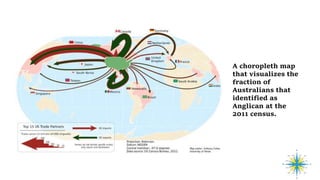
A choropleth map
that visualizes the
fraction of
Australians that
identified as
Anglican at the
2011 census.
THE USE OF FLOW-LINE MAPS
• When properly designed, flow maps are beneficial
because they allow cartographers, GIS analysts and
map users alike to easily see the differences in
magnitude of a wide variety of items across space with
very little map clutter.
• This allows businesses to see where the majority of
their products are going, commuters to see traffic
patterns, and meteorologists to see wind patterns.
TYPES OF FLOW-MAPS
There are three basic categories for the maps:
• Radial
• Network
• Distributive
Radial flow maps show relationships between one source and
many destinations and use separate lines radiating out from a
starting point to show movement.
Network flow maps show the quantity of flow over an existing
network. These types of flow maps most frequently show
transportation and communication networks.
Distributive flow maps are maps that show relationships
between a single source and many destinations like a radial flow
map.
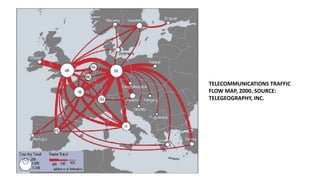
TELECOMMUNICATIONS TRAFFIC
FLOW MAP, 2000. SOURCE:
TELEGEOGRAPHY, INC.
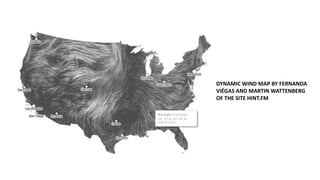
DYNAMIC WIND MAP BY FERNANDA
VIÉGAS AND MARTIN WATTENBERG
OF THE SITE HINT.FM
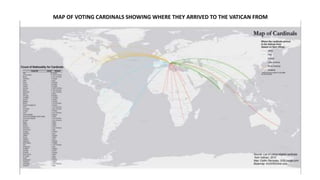
MAP OF VOTING CARDINALS SHOWING WHERE THEY ARRIVED TO THE VATICAN FROM
HOW TO INTERPRET A FLOW-LINE MAP
1. Identify the geographic feature or phenomena being
mapped.
2. Verify the value of each line or arrow used on the map.
This can be done by reading the map’s legend.
3. Identify the scale of the administrative regions shown on
the map (does the map show suburbs, census areas, states
or countries?).
4. Describe the direction and magnitude of the various
movements of the geographic phenomena between
different areas of the map.
STEPS TO CONSTRUCT A FLOW-LINE MAP
1. Obtain a base map of the region you wish to show.
2. Examine the data to determine how thick each flow line
will need to be, to accurately communicate the magnitude
of each flow. For example, 1mm of line thickness could
represent 100 data units.
3. Plot your data by drawing lines or arrows on the base map
according to your predetermined scale. Position the tail of
each flow line at the place of origin and add to it an
arrowhead pointing to its destination.
4. Construct a key or legend to show the line scale, and the
meaning of any symbols or shading used.

GEOGRAPHIC SKILLS: FLOW-LINE MAPS

  • 1.
  • 2.
    WHAT IS AFLOW-LINE MAP? • Flow maps are a type of thematic map used in cartography to show the movement of objects between different areas. • These types of maps can show things like: • the movement of goods across space • the number of animal species in a specific migration pattern • traffic volume and stream flow
  • 3.
    THE USE OFLINES • They can also show both qualitative and quantitative data. • Flow maps usually represent the movement of goods, weather phenomena, people and other living things with line symbols of different widths. • The use of lines on a flow map is similar to the use of graduated symbols on other types of thematic maps.
  • 4.
    A choropleth map thatvisualizes the fraction of Australians that identified as Anglican at the 2011 census.
  • 5.
    THE USE OFFLOW-LINE MAPS • When properly designed, flow maps are beneficial because they allow cartographers, GIS analysts and map users alike to easily see the differences in magnitude of a wide variety of items across space with very little map clutter. • This allows businesses to see where the majority of their products are going, commuters to see traffic patterns, and meteorologists to see wind patterns.
  • 6.
    TYPES OF FLOW-MAPS Thereare three basic categories for the maps: • Radial • Network • Distributive Radial flow maps show relationships between one source and many destinations and use separate lines radiating out from a starting point to show movement. Network flow maps show the quantity of flow over an existing network. These types of flow maps most frequently show transportation and communication networks. Distributive flow maps are maps that show relationships between a single source and many destinations like a radial flow map.
  • 7.
    TELECOMMUNICATIONS TRAFFIC FLOW MAP,2000. SOURCE: TELEGEOGRAPHY, INC.
  • 8.
    DYNAMIC WIND MAPBY FERNANDA VIÉGAS AND MARTIN WATTENBERG OF THE SITE HINT.FM
  • 9.
    MAP OF VOTINGCARDINALS SHOWING WHERE THEY ARRIVED TO THE VATICAN FROM
  • 10.
    HOW TO INTERPRETA FLOW-LINE MAP 1. Identify the geographic feature or phenomena being mapped. 2. Verify the value of each line or arrow used on the map. This can be done by reading the map’s legend. 3. Identify the scale of the administrative regions shown on the map (does the map show suburbs, census areas, states or countries?). 4. Describe the direction and magnitude of the various movements of the geographic phenomena between different areas of the map.
  • 11.
    STEPS TO CONSTRUCTA FLOW-LINE MAP 1. Obtain a base map of the region you wish to show. 2. Examine the data to determine how thick each flow line will need to be, to accurately communicate the magnitude of each flow. For example, 1mm of line thickness could represent 100 data units. 3. Plot your data by drawing lines or arrows on the base map according to your predetermined scale. Position the tail of each flow line at the place of origin and add to it an arrowhead pointing to its destination. 4. Construct a key or legend to show the line scale, and the meaning of any symbols or shading used.