Mapping PMBOK®	to	Agile
Based on PMBOK® Guide—Fifth	Edition
By	www.itedge.org
1
About us
IT	Edge is	a	consulting	firm	based	in	Oslo,	Norway.	It	was	founded	in	
2010	by	Didier	Soriano	along	with	a	team	of	senior	IT	professionals.
Our	team	is	backed	by	industry	certifications	in PMP,	PMI-ACP, CSM,	
CSPO, PMI-PBA	, Six	Sigma	black	belt,	CSSGB,	ISTQB, TOGAF, CGEIT,	
CRISC, ITIL	etc.
We	provide	a	suite	of	professional	training	and	consulting	services	in	
Agile,	Scrum,	Lean,	Design	thinking,	Kanban,	DevOps	and	Project	
Management. We	specialize	in	providing	IT	solutionsaround	our	
expertise.
The	company	consistently	applies	Agile	principles	to	itself,	
by improving	it's service	catalogues	to	include	the	latest	
trends, thereby	making	the	courses	relevant	and	easier	to	understand.
Please	visit	us	at	www.itedge.org.
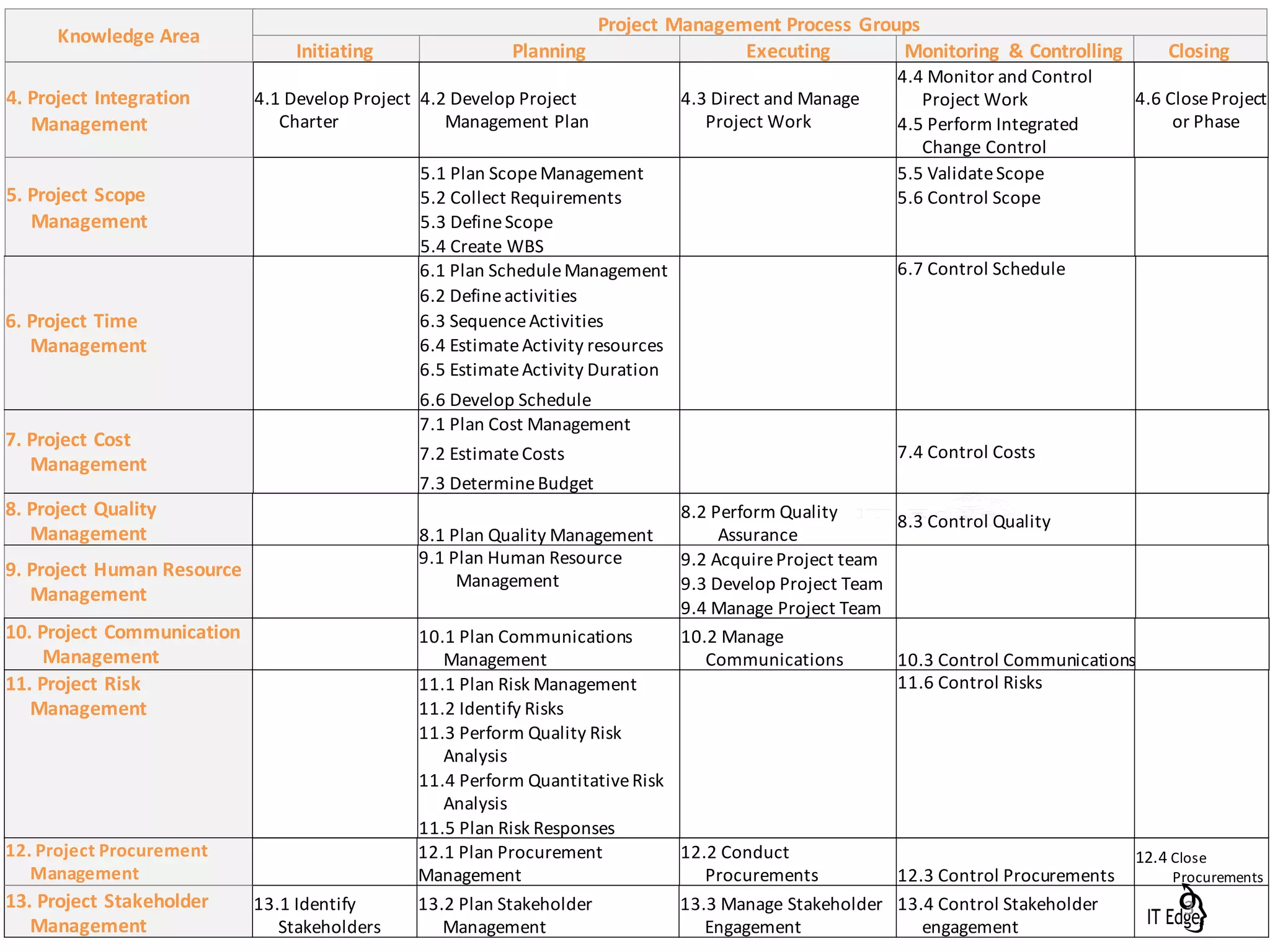
Knowledge	Area
Project	Management	Process	Groups
Initiating Planning Executing Monitoring	 &	Controlling Closing
4.	Project	Integration	
Management
4.1	Develop	Project	
Charter
4.2	Develop	Project	
Management	Plan
4.3	Direct	and	Manage	
Project	Work
4.4	Monitor	and	Control	
Project	Work 4.6	Close	Project	
or	Phase4.5	Perform	Integrated	
Change	Control
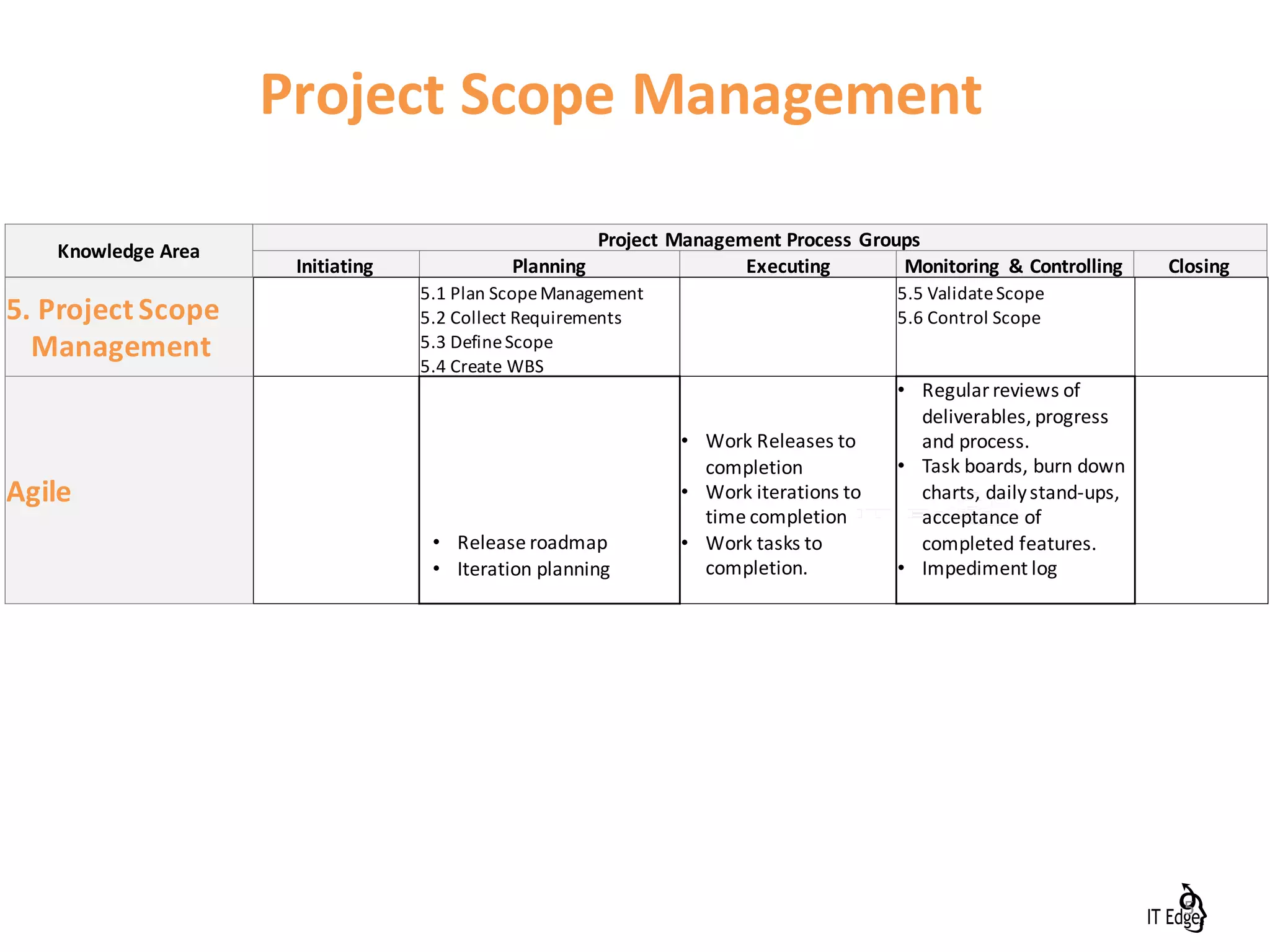
5.	Project	Scope	
Management
5.1	Plan	Scope	Management 5.5	Validate	Scope
5.2	Collect	Requirements 5.6	Control	Scope
5.3	Define	Scope
5.4	Create	WBS
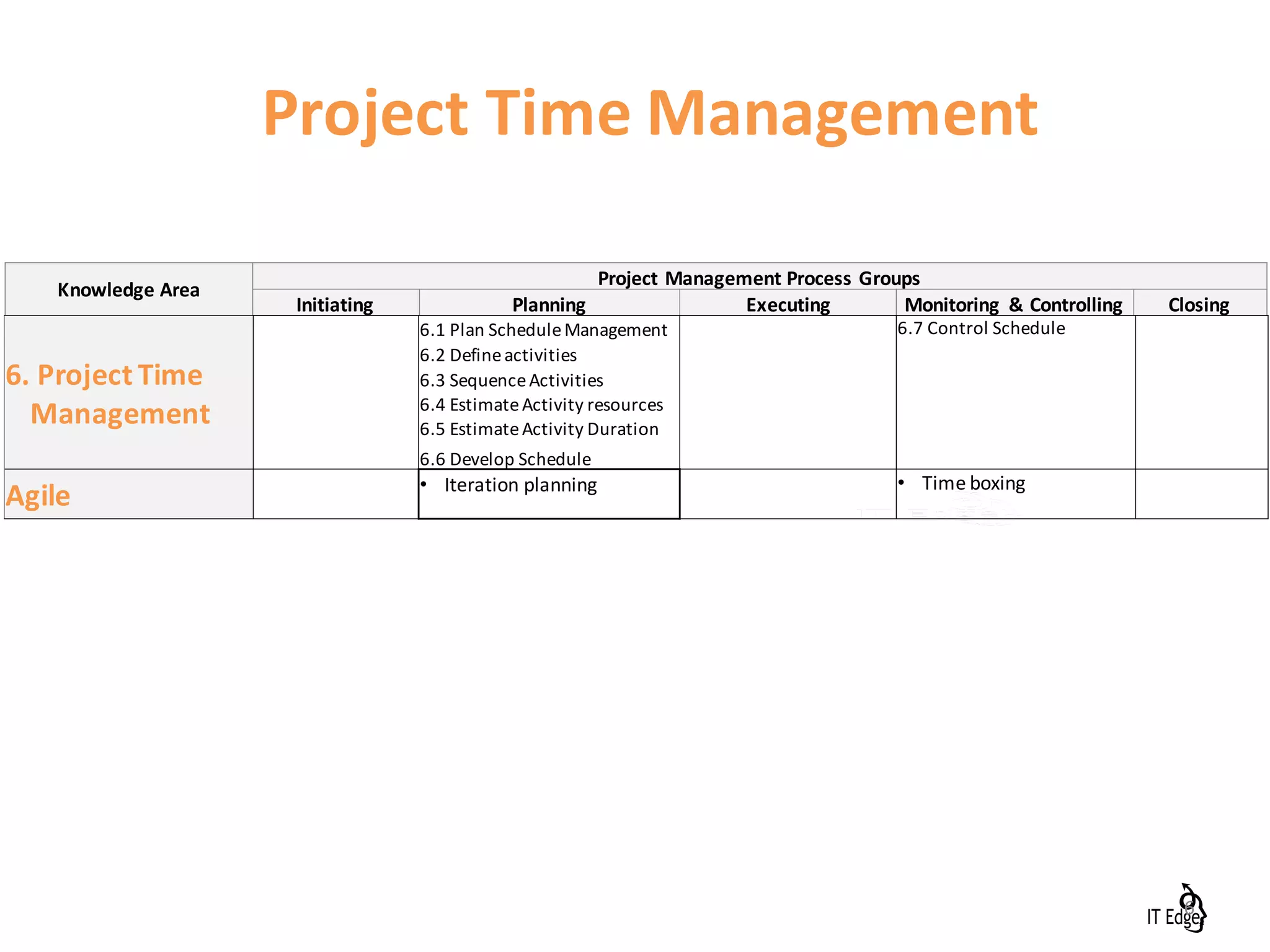
6.	Project	Time	
Management
6.1	Plan	Schedule	Management 6.7	Control	Schedule
6.2	Define	activities
6.3	Sequence	Activities
6.4	Estimate	Activity	resources
6.5	Estimate	Activity	Duration
6.6	Develop	Schedule
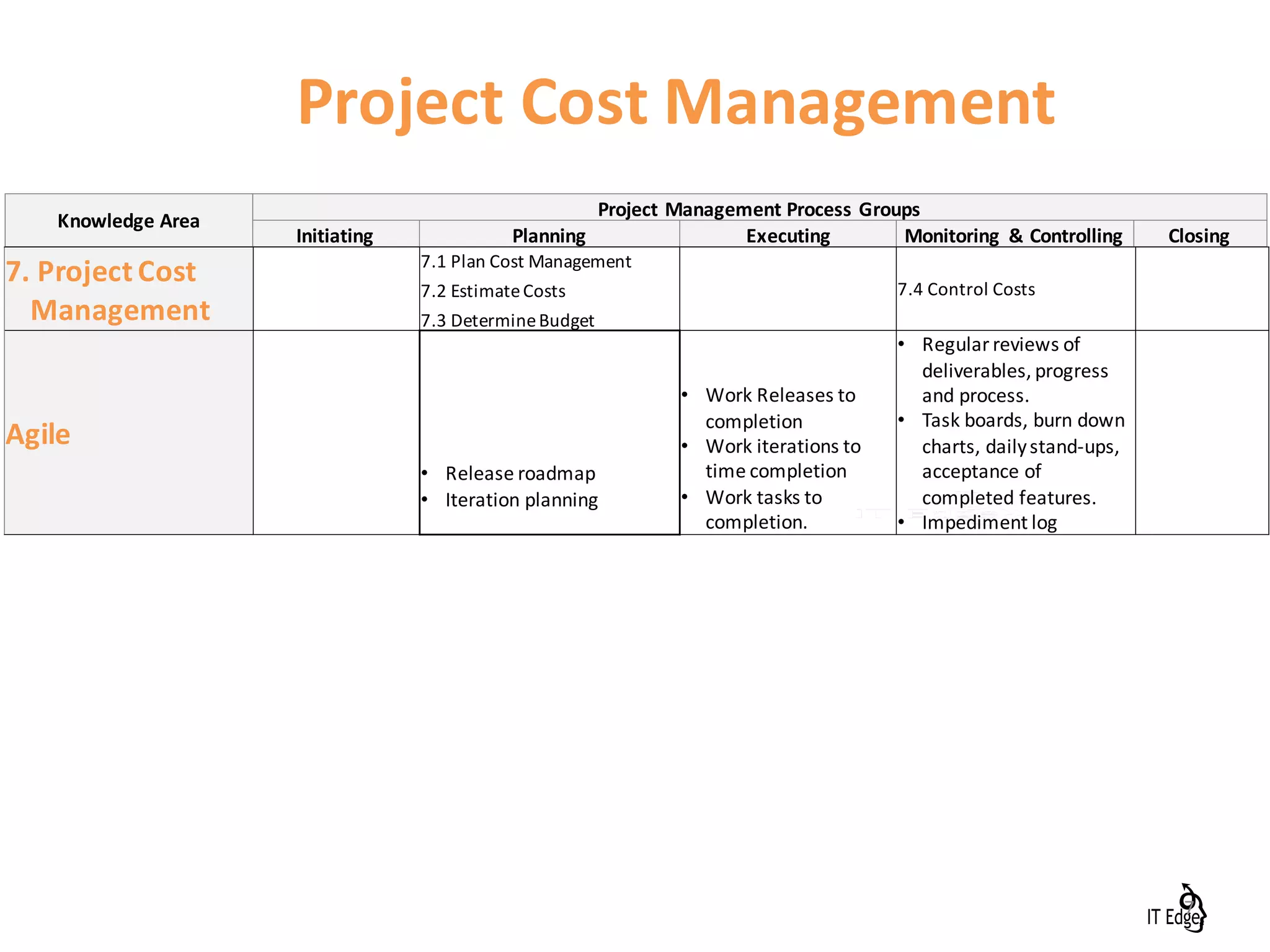
7.	Project	Cost	
Management
7.1	Plan	Cost	Management
7.4	Control	Costs7.2	Estimate	Costs
7.3	Determine	Budget
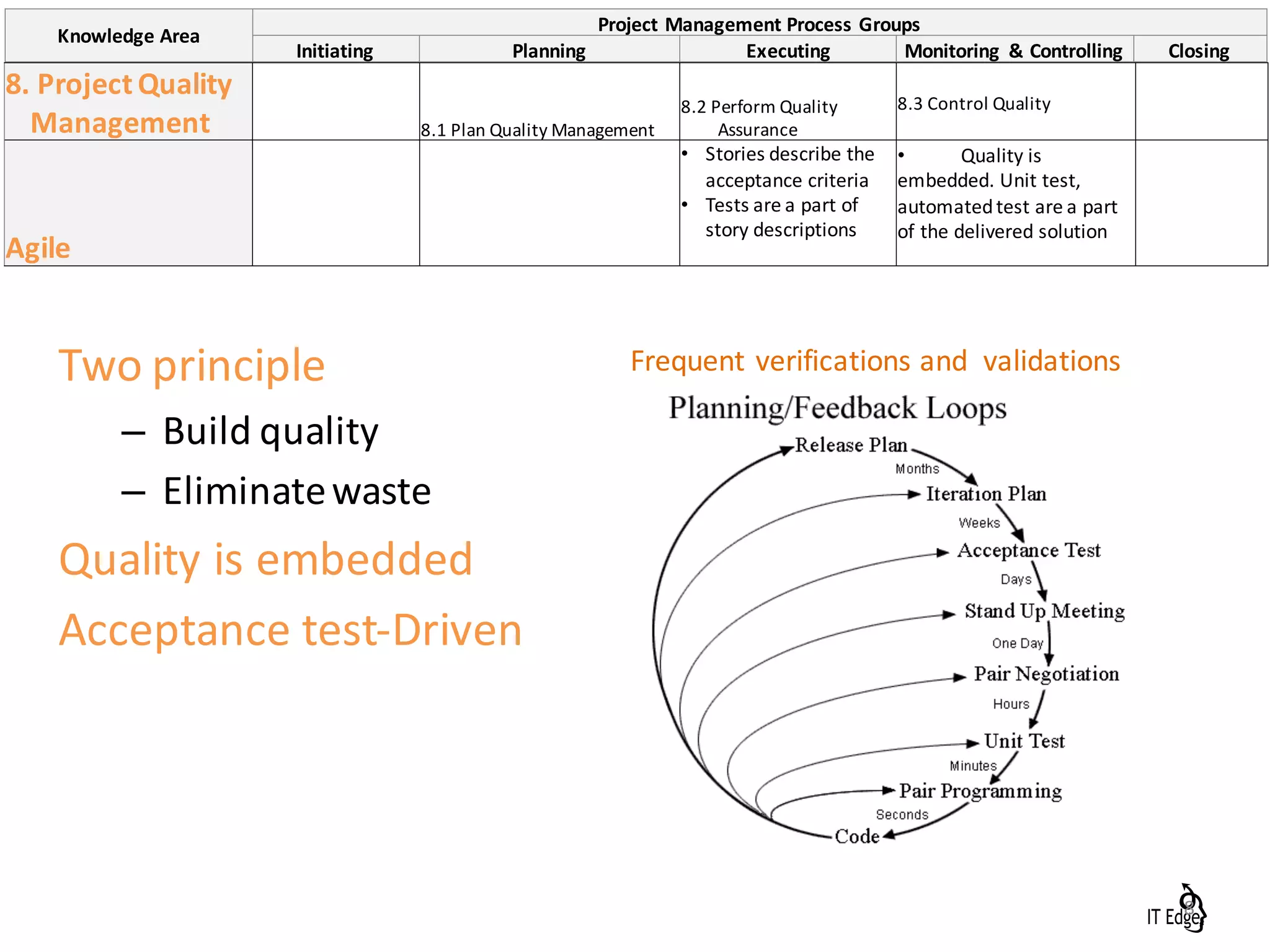
8.	Project	Quality	
Management 8.1	Plan	Quality	Management
8.2	Perform	Quality	
Assurance
8.3	Control	Quality
9.	Project	Human	Resource	
Management
9.1	Plan	Human	Resource	
Management
9.2	Acquire	Project	team
9.3	Develop	Project	Team
9.4	Manage	Project	Team
10.	Project	Communication	
Management
10.1	Plan	Communications	
Management
10.2	Manage	
Communications 10.3	Control	Communications
11.	Project	Risk	
Management
11.1	Plan	Risk	Management 11.6	Control	Risks
11.2	Identify	Risks
11.3	Perform	Quality	Risk	
Analysis
11.4	Perform	Quantitative	Risk	
Analysis
11.5	Plan	Risk	Responses
12.	Project	Procurement	
Management
12.1	Plan	Procurement	
Management
12.2	Conduct	
Procurements 12.3	Control	Procurements
12.4	Close	
Procurements
13.	Project	Stakeholder	
Management
13.1	Identify	
Stakeholders
13.2	Plan	Stakeholder	
Management
13.3	Manage	Stakeholder	
Engagement
13.4	Control	Stakeholder	
engagement
3
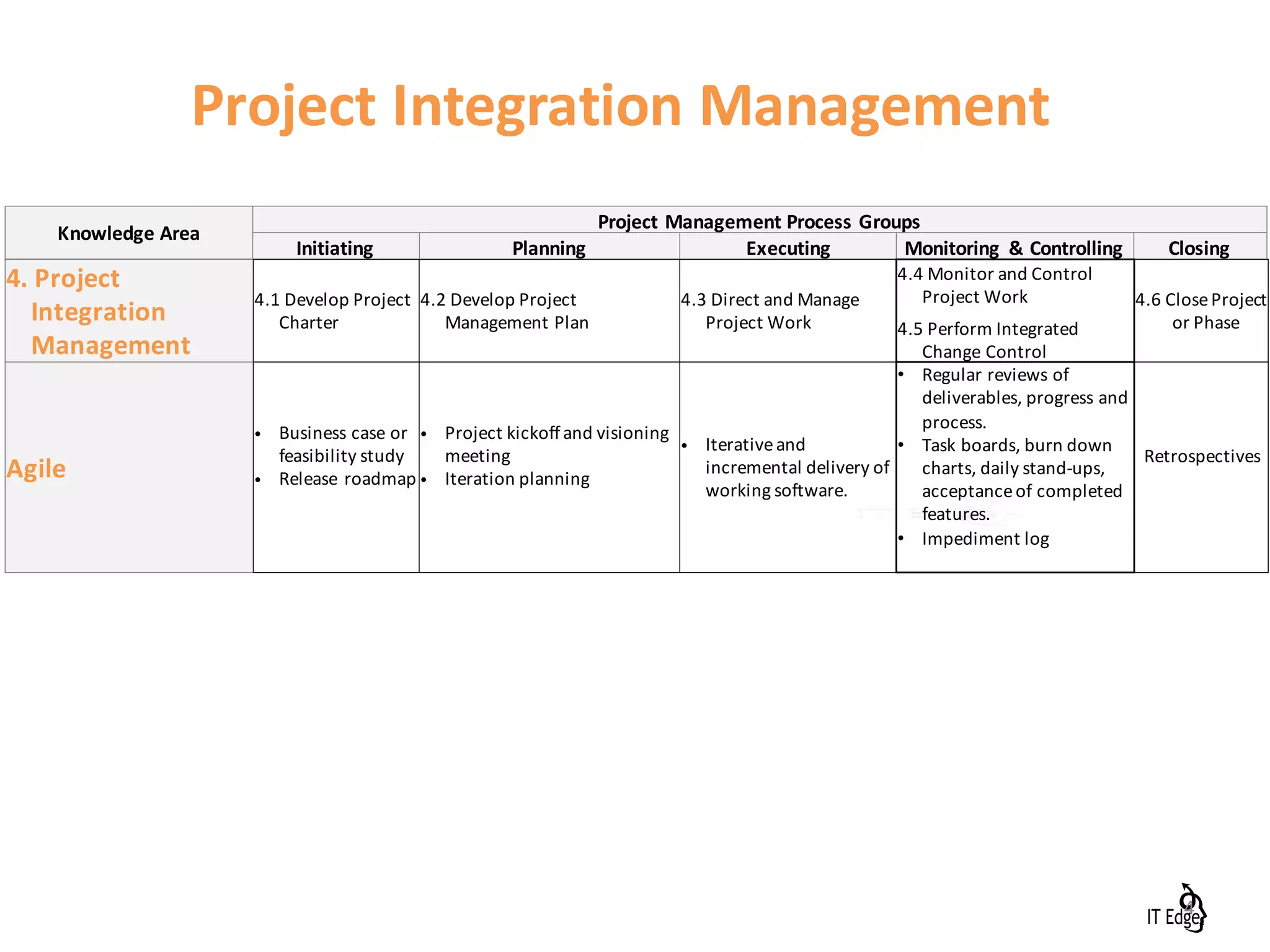
Knowledge	Area
Project	Management	Process	Groups
Initiating Planning Executing Monitoring	 &	Controlling Closing
4.	Project	
Integration	
Management
4.1	Develop	Project	
Charter
4.2	Develop	Project	
Management	Plan
4.3	Direct	and	Manage	
Project	Work
4.4	Monitor	and	Control	
Project	Work 4.6	Close	Project	
or	Phase4.5	Perform	Integrated	
Change	Control
Agile
• Business	case	or	
feasibility	study	
• Release	roadmap
• Project	kickoff	and	visioning	
meeting
• Iteration	planning
• Iterative	and	
incremental	delivery	of	
working	software.
• Regular	reviews	of	
deliverables,	progress	and	
process.
• Task	boards,	burn	down	
charts,	daily	stand-ups,	
acceptance	of	completed	
features.
• Impediment	log
Retrospectives
Project	Integration	Management
4
Knowledge	Area
Project	Management	Process	Groups
Initiating Planning Executing Monitoring	 &	Controlling Closing
5.	Project	Scope	
Management
5.1	Plan	Scope	Management 5.5	Validate	Scope
5.2	Collect	Requirements 5.6	Control	Scope
5.3	Define	Scope
5.4	Create	WBS
Agile
• Release	roadmap
• Iteration	planning
• Work	Releases	to	
completion
• Work	iterations	to	
time	completion
• Work	tasks	to	
completion.	
• Regular	reviews	of	
deliverables,	progress	
and	process.
• Task	boards,	burn	down	
charts,	daily	stand-ups,	
acceptance	of	
completed	features.
• Impediment	log
Project	Scope	Management
5
Knowledge	Area
Project	Management	Process	Groups
Initiating Planning Executing Monitoring	 &	Controlling Closing
6.	Project	Time	
Management
6.1	Plan	Schedule	Management 6.7	Control	Schedule
6.2	Define	activities
6.3	Sequence	Activities
6.4	Estimate	Activity	resources
6.5	Estimate	Activity	Duration
6.6	Develop	Schedule
Agile • Iteration	planning • Time	boxing
Project	Time	Management
6
Knowledge	Area
Project	Management	Process	Groups
Initiating Planning Executing Monitoring	 &	Controlling Closing
7.	Project	Cost	
Management
7.1	Plan	Cost	Management
7.4	Control	Costs7.2	Estimate	Costs
7.3	Determine	Budget
Agile
• Release	roadmap
• Iteration	planning
• Work	Releases	to	
completion
• Work	iterations	to	
time	completion
• Work	tasks	to	
completion.	
• Regular	reviews	of	
deliverables,	progress	
and	process.
• Task	boards,	burn	down	
charts,	daily	stand-ups,	
acceptance	of	
completed	features.
• Impediment	log
Project	Cost	Management
7
Two	principle
– Build	quality
– Eliminate	waste
Quality	is	embedded	
Acceptance	test-Driven
8
Frequent	verifications	and		validations
Knowledge	Area
Project	Management	Process	Groups
Initiating Planning Executing Monitoring	 &	Controlling Closing
8.	Project	Quality	
Management 8.1	Plan	Quality	Management
8.2	Perform	Quality	
Assurance
8.3	Control	Quality
Agile
• Stories	describe	the	
acceptance	criteria	
• Tests	are	a	part	of	
story	descriptions
• Quality	is	
embedded.	Unit	test,	
automated	test	are	a	part	
of	the	delivered	solution
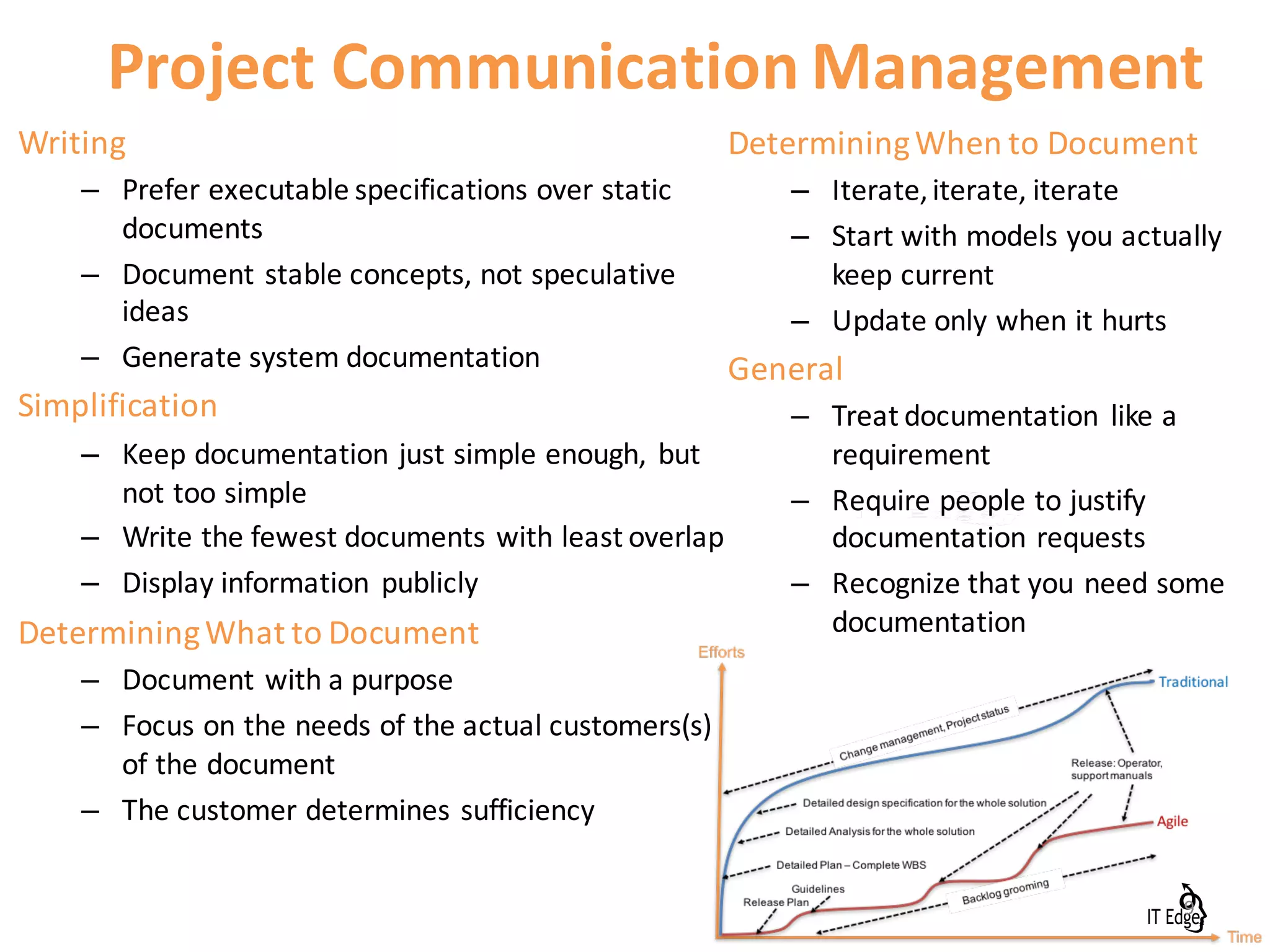
Writing
– Prefer	executable	specifications	over	static	
documents
– Document	stable	concepts,	not	speculative	
ideas
– Generate	system	documentation
Simplification
– Keep	documentation	just	simple	enough,	 but	
not	too	simple
– Write	the	fewest	documents	with	least	overlap
– Display	information	 publicly
Determining	What	to	Document
– Document	with	a	purpose
– Focus	on	the	needs	of	the	actual	customers(s)	
of	the	document
– The	customer	determines	sufficiency
Determining	When	to	Document
– Iterate,	iterate,	iterate
– Start	with	models	you	actually	
keep	current
– Update	only	when	it	hurts
General
– Treat	documentation	 like	a	
requirement
– Require	people	to	justify	
documentation	requests
– Recognize	that	you	need	some	
documentation
9
Project	Communication	Management
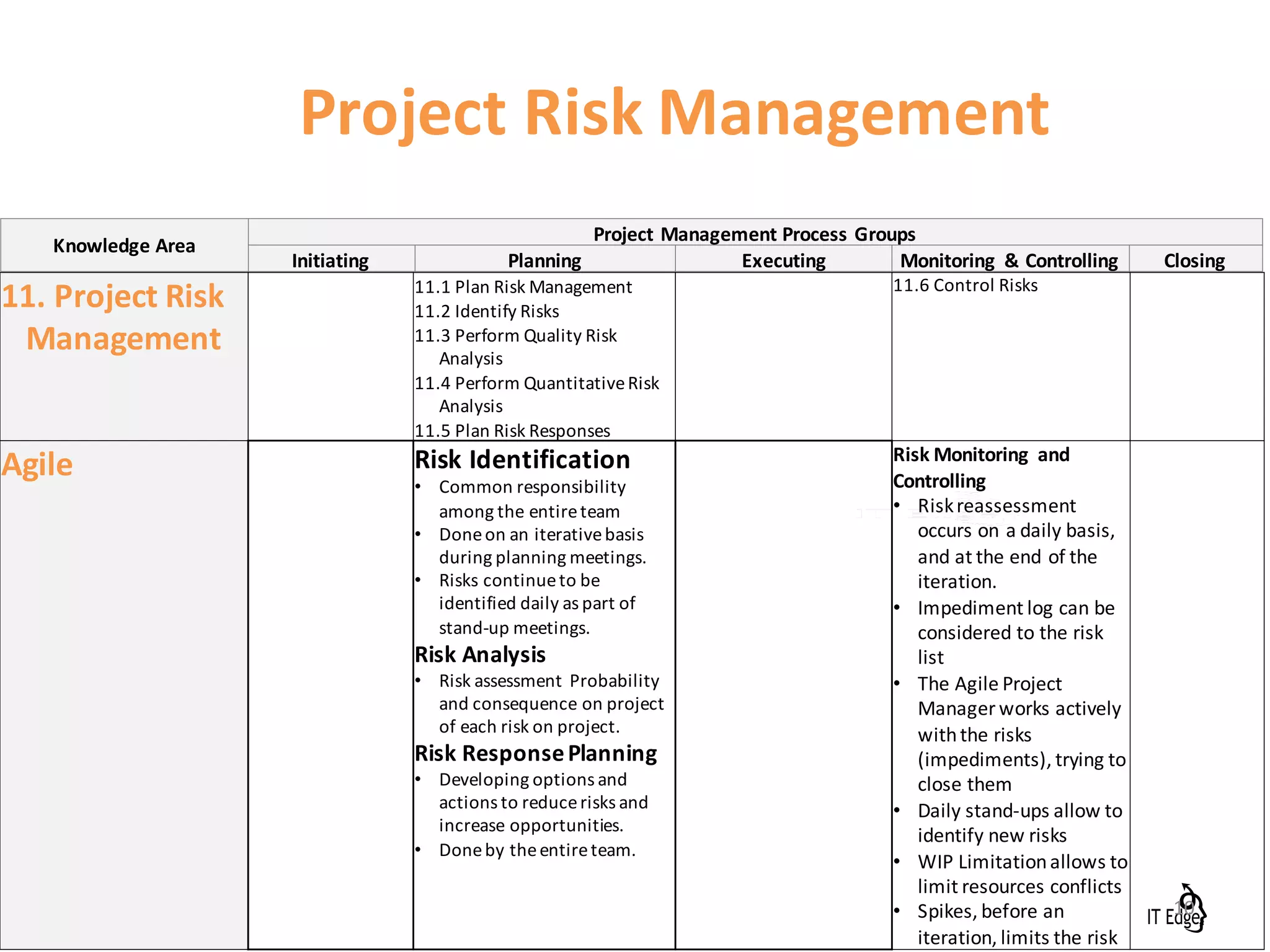
Knowledge	Area
Project	Management	Process	Groups
Initiating Planning Executing Monitoring	 &	Controlling Closing
11.	Project	Risk	
Management
11.1	Plan	Risk	Management 11.6	Control	Risks
11.2	Identify	Risks
11.3	Perform	Quality	Risk	
Analysis
11.4	Perform	Quantitative	Risk	
Analysis
11.5	Plan	Risk	Responses
Agile Risk	Identification
• Common	responsibility	
among	the	entire	team
• Done	on	an	iterative	basis	
during	planning	meetings.	
• Risks	continue	to	be	
identified	daily	as	part	of	
stand-up	meetings.
Risk	Analysis
• Risk	assessment	Probability	
and	consequence	on	project	
of	each	risk	on	project.	
Risk	Response	Planning
• Developing	options	and	
actions	to	reduce	risks	and	
increase	opportunities.
• Done	by	the	entire	team.
Risk	Monitoring	 and	
Controlling
• Risk	reassessment	
occurs	on	a	daily	basis,	
and	at	the	end	of	the	
iteration.
• Impediment	log	can	be	
considered	to	the	risk	
list
• The	Agile	Project	
Manager	works	actively	
with	the	risks	
(impediments),	trying	to	
close	them
• Daily	stand-ups	allow	to	
identify	new	risks
• WIP	Limitation	allows	to	
limit	resources	conflicts
• Spikes,	before	an	
iteration,	limits	the	risk
Project	Risk	Management
10
References
11

Mapping PMBOK® to Agile

  • 1.
    Mapping PMBOK® to Agile Based onPMBOK® Guide—Fifth Edition By www.itedge.org 1
  • 2.
    About us IT Edge is a consulting firm based in Oslo, Norway. It was founded in 2010 by Didier Soriano along with a team of senior IT professionals. Our team is backed by industry certifications inPMP, PMI-ACP, CSM, CSPO, PMI-PBA , Six Sigma black belt, CSSGB, ISTQB, TOGAF, CGEIT, CRISC, ITIL etc. We provide a suite of professional training and consulting services in Agile, Scrum, Lean, Design thinking, Kanban, DevOps and Project Management. We specialize in providing IT solutionsaround our expertise. The company consistently applies Agile principles to itself, by improving it's service catalogues to include the latest trends, thereby making the courses relevant and easier to understand. Please visit us at www.itedge.org.
  • 3.
    Knowledge Area Project Management Process Groups Initiating Planning ExecutingMonitoring & Controlling Closing 4. Project Integration Management 4.1 Develop Project Charter 4.2 Develop Project Management Plan 4.3 Direct and Manage Project Work 4.4 Monitor and Control Project Work 4.6 Close Project or Phase4.5 Perform Integrated Change Control 5. Project Scope Management 5.1 Plan Scope Management 5.5 Validate Scope 5.2 Collect Requirements 5.6 Control Scope 5.3 Define Scope 5.4 Create WBS 6. Project Time Management 6.1 Plan Schedule Management 6.7 Control Schedule 6.2 Define activities 6.3 Sequence Activities 6.4 Estimate Activity resources 6.5 Estimate Activity Duration 6.6 Develop Schedule 7. Project Cost Management 7.1 Plan Cost Management 7.4 Control Costs7.2 Estimate Costs 7.3 Determine Budget 8. Project Quality Management 8.1 Plan Quality Management 8.2 Perform Quality Assurance 8.3 Control Quality 9. Project Human Resource Management 9.1 Plan Human Resource Management 9.2 Acquire Project team 9.3 Develop Project Team 9.4 Manage Project Team 10. Project Communication Management 10.1 Plan Communications Management 10.2 Manage Communications 10.3 Control Communications 11. Project Risk Management 11.1 Plan Risk Management 11.6 Control Risks 11.2 Identify Risks 11.3 Perform Quality Risk Analysis 11.4 Perform Quantitative Risk Analysis 11.5 Plan Risk Responses 12. Project Procurement Management 12.1 Plan Procurement Management 12.2 Conduct Procurements 12.3 Control Procurements 12.4 Close Procurements 13. Project Stakeholder Management 13.1 Identify Stakeholders 13.2 Plan Stakeholder Management 13.3 Manage Stakeholder Engagement 13.4 Control Stakeholder engagement 3
  • 4.
    Knowledge Area Project Management Process Groups Initiating Planning ExecutingMonitoring & Controlling Closing 4. Project Integration Management 4.1 Develop Project Charter 4.2 Develop Project Management Plan 4.3 Direct and Manage Project Work 4.4 Monitor and Control Project Work 4.6 Close Project or Phase4.5 Perform Integrated Change Control Agile • Business case or feasibility study • Release roadmap • Project kickoff and visioning meeting • Iteration planning • Iterative and incremental delivery of working software. • Regular reviews of deliverables, progress and process. • Task boards, burn down charts, daily stand-ups, acceptance of completed features. • Impediment log Retrospectives Project Integration Management 4
  • 5.
    Knowledge Area Project Management Process Groups Initiating Planning ExecutingMonitoring & Controlling Closing 5. Project Scope Management 5.1 Plan Scope Management 5.5 Validate Scope 5.2 Collect Requirements 5.6 Control Scope 5.3 Define Scope 5.4 Create WBS Agile • Release roadmap • Iteration planning • Work Releases to completion • Work iterations to time completion • Work tasks to completion. • Regular reviews of deliverables, progress and process. • Task boards, burn down charts, daily stand-ups, acceptance of completed features. • Impediment log Project Scope Management 5
  • 6.
    Knowledge Area Project Management Process Groups Initiating Planning ExecutingMonitoring & Controlling Closing 6. Project Time Management 6.1 Plan Schedule Management 6.7 Control Schedule 6.2 Define activities 6.3 Sequence Activities 6.4 Estimate Activity resources 6.5 Estimate Activity Duration 6.6 Develop Schedule Agile • Iteration planning • Time boxing Project Time Management 6
  • 7.
    Knowledge Area Project Management Process Groups Initiating Planning ExecutingMonitoring & Controlling Closing 7. Project Cost Management 7.1 Plan Cost Management 7.4 Control Costs7.2 Estimate Costs 7.3 Determine Budget Agile • Release roadmap • Iteration planning • Work Releases to completion • Work iterations to time completion • Work tasks to completion. • Regular reviews of deliverables, progress and process. • Task boards, burn down charts, daily stand-ups, acceptance of completed features. • Impediment log Project Cost Management 7
  • 8.
    Two principle – Build quality – Eliminate waste Quality is embedded Acceptance test-Driven 8 Frequent verifications and validations Knowledge Area Project Management Process Groups InitiatingPlanning Executing Monitoring & Controlling Closing 8. Project Quality Management 8.1 Plan Quality Management 8.2 Perform Quality Assurance 8.3 Control Quality Agile • Stories describe the acceptance criteria • Tests are a part of story descriptions • Quality is embedded. Unit test, automated test are a part of the delivered solution
  • 9.
    Writing – Prefer executable specifications over static documents – Document stable concepts, not speculative ideas –Generate system documentation Simplification – Keep documentation just simple enough, but not too simple – Write the fewest documents with least overlap – Display information publicly Determining What to Document – Document with a purpose – Focus on the needs of the actual customers(s) of the document – The customer determines sufficiency Determining When to Document – Iterate, iterate, iterate – Start with models you actually keep current – Update only when it hurts General – Treat documentation like a requirement – Require people to justify documentation requests – Recognize that you need some documentation 9 Project Communication Management
  • 10.
    Knowledge Area Project Management Process Groups Initiating Planning ExecutingMonitoring & Controlling Closing 11. Project Risk Management 11.1 Plan Risk Management 11.6 Control Risks 11.2 Identify Risks 11.3 Perform Quality Risk Analysis 11.4 Perform Quantitative Risk Analysis 11.5 Plan Risk Responses Agile Risk Identification • Common responsibility among the entire team • Done on an iterative basis during planning meetings. • Risks continue to be identified daily as part of stand-up meetings. Risk Analysis • Risk assessment Probability and consequence on project of each risk on project. Risk Response Planning • Developing options and actions to reduce risks and increase opportunities. • Done by the entire team. Risk Monitoring and Controlling • Risk reassessment occurs on a daily basis, and at the end of the iteration. • Impediment log can be considered to the risk list • The Agile Project Manager works actively with the risks (impediments), trying to close them • Daily stand-ups allow to identify new risks • WIP Limitation allows to limit resources conflicts • Spikes, before an iteration, limits the risk Project Risk Management 10
  • 11.