1 
ASHA PHILIP. MSc
2 
PREFACE 
I t is common belief that mathematics is a 
dull and difficult subject. It has been dreaded by many 
children. The problem lies in the traditional way the 
subject is treated and taught. It has, in fact, the potential to 
be enjoyed and appreciated the way music and paintings 
are appreciated. 
Mathematics forms an integral part of everyday 
life. We have to teach it with freshness and variety to 
make it meaningfully applicable to life. This is a humble 
attempt at it. This text book is designed to meet the 
everyday requirements of students at school and the 
general readers of mathematics. I humbly dedicate this 
book to all students and teachers. 
Suggestions for improvement are welcome. 
The author.
3 
CONTENTS 
1. Quadrilateral 
2. Rectangle 
3. Rhombus 
4. Square 
5. Parallelogram 
6. Trapezium 
7. Reference
4 
QUADRILATERALS 
1.1 INTRODUCTION 
In Euclidean plane geometry, 
a quadrilateral is a polygon with four sides (or edges) and four 
vertices or corners. Sometimes, the term quadrangle is used, by 
analogy withtriangle, and sometimes tetragon for consistency 
with pentagon (5-sided), hexagon (6-sided) and so on. 
The origin of the word "quadrilateral" is the two Latin 
words quadri, a variant of four, and latus, meaning "side". 
Quadrilaterals are simple (not self-intersecting) 
or complex (self-intersecting), also called crossed. Simple 
quadrilaterals are either convex or concave. 
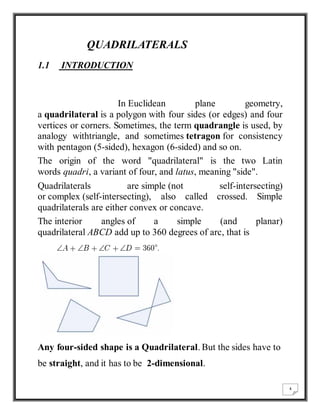
The interior angles of a simple (and planar) 
quadrilateral ABCD add up to 360 degrees of arc, that is 
Any four-sided shape is a Quadrilateral. But the sides have to 
be straight, and it has to be 2-dimensional.
5 
1. 2 PROPERTIES 
 Four sides (edges) 
 Four vertices (corners) 
 The interior angles add up to 360 degrees: 
1. 3 TYPES OF QUADRILATERAL 
 Rectangle 
 Rhombus 
 Square 
 Parallelogram 
 Trapezium
6 
2. RECTANGLE 
2.1 DEFINITION 
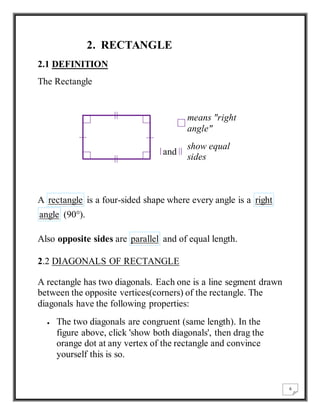
The Rectangle 
means "right 
angle" 
and 
show equal 
sides 
A rectangle is a four-sided shape where every angle is a right 
angle (90°). 
Also opposite sides are parallel and of equal length. 
2.2 DIAGONALS OF RECTANGLE 
A rectangle has two diagonals. Each one is a line segment drawn 
between the opposite vertices(corners) of the rectangle. The 
diagonals have the following properties: 
 The two diagonals are congruent (same length). In the 
figure above, click 'show both diagonals', then drag the 
orange dot at any vertex of the rectangle and convince 
yourself this is so.
7 
 Each diagonal bisects the other. In other words, the point 
where the diagonals intersect(cross), divides each diagonal 
into two equal parts 
 Each diagonal divides the rectangle into two congruent 
right triangles. Because the triangles are congruent, they 
have the same area, and each triangle has half the area of 
the rectangle 
2.3 MEASUREMENTS 
Area of a rectangle = length * breadth. 
Perimeter of a rectangle =2( l + b) 
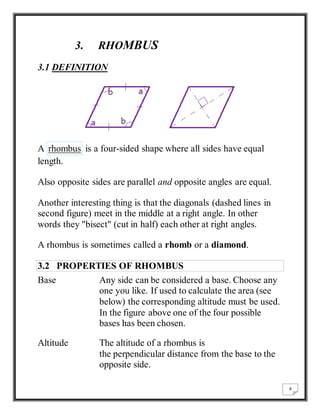
d the length of the diagonal if we know the width and height of 
the rectangle. 
Then, 
where: 
w is the width of the rectangle 
h is the height of the rectangle
8 
3. RHOMBUS 
3.1 DEFINITION 
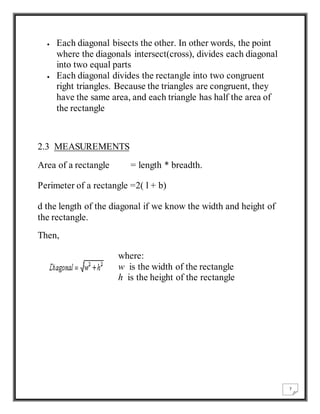
A rhombus is a four-sided shape where all sides have equal 
length. 
Also opposite sides are parallel and opposite angles are equal. 
Another interesting thing is that the diagonals (dashed lines in 
second figure) meet in the middle at a right angle. In other 
words they "bisect" (cut in half) each other at right angles. 
A rhombus is sometimes called a rhomb or a diamond. 
3.2 PROPERTIES OF RHOMBUS 
Base Any side can be considered a base. Choose any 
one you like. If used to calculate the area (see 
below) the corresponding altitude must be used. 
In the figure above one of the four possible 
bases has been chosen. 
Altitude The altitude of a rhombus is 
the perpendicular distance from the base to the 
opposite side.
9 
3.2 MEASUREMENTS 
Area There are several ways to find the area of a 
rhombus. The most common is (base × altitude). 
Area of a rhombus = 
푑1푑2 
2 
; where 푑1 , 푑2 are 
the diagonals of the rhombus. 
Perimeter Distance around the rhombus. The sum of its 
side lengths.
10 
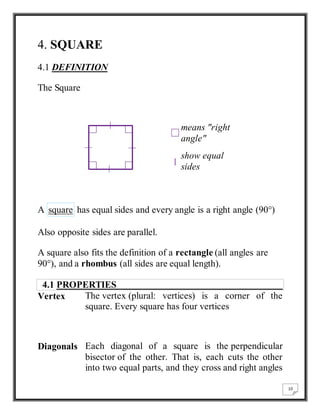
4. SQUARE 
4.1 DEFINITION 
The Square 
means "right 
angle" 
show equal 
sides 
A square has equal sides and every angle is a right angle (90°) 
Also opposite sides are parallel. 
A square also fits the definition of a rectangle (all angles are 
90°), and a rhombus (all sides are equal length). 
4.1 PROPERTIES 
Vertex The vertex (plural: vertices) is a corner of the 
square. Every square has four vertices 
Diagonals Each diagonal of a square is the perpendicular 
bisector of the other. That is, each cuts the other 
into two equal parts, and they cross and right angles
11 
(90°). 
The length of each diagonal is 
s√2 
where s is the length of any one side. 
4 . 2 MEASUREMENTS. 
Area: Like most quadrilaterals, the area is the length of 
one side times the perpendicular height. So in a 
square this is simply: 
area = s2 
where s is the length of one side.. 
Perimeter: The distance around the square. All four sides are by 
definition the same length, so the perimeter is four 
times the length of one side, or: 
perimeter = 4s 
where s is the length of one side
12 
5. PARALLELOGRAM 
5.1 DEFINITION 
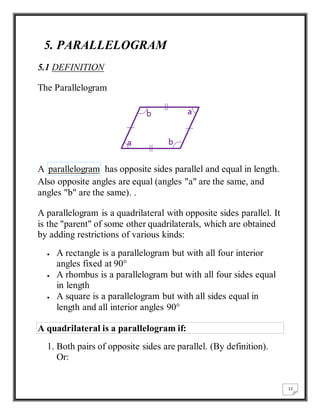
The Parallelogram 
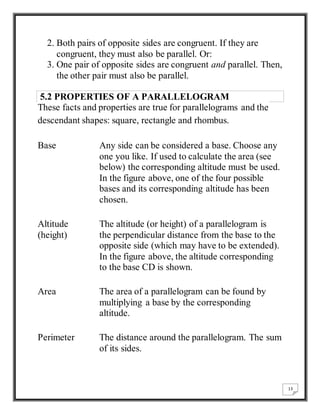
A parallelogram has opposite sides parallel and equal in length. 
Also opposite angles are equal (angles "a" are the same, and 
angles "b" are the same). . 
A parallelogram is a quadrilateral with opposite sides parallel. It 
is the "parent" of some other quadrilaterals, which are obtained 
by adding restrictions of various kinds: 
 A rectangle is a parallelogram but with all four interior 
angles fixed at 90° 
 A rhombus is a parallelogram but with all four sides equal 
in length 
 A square is a parallelogram but with all sides equal in 
length and all interior angles 90° 
A quadrilateral is a parallelogram if: 
1. Both pairs of opposite sides are parallel. (By definition). 
Or:
13 
2. Both pairs of opposite sides are congruent. If they are 
congruent, they must also be parallel. Or: 
3. One pair of opposite sides are congruent and parallel. Then, 
the other pair must also be parallel. 
5.2 PROPERTIES OF A PARALLELOGRAM 
These facts and properties are true for parallelograms and the 
descendant shapes: square, rectangle and rhombus. 
Base Any side can be considered a base. Choose any 
one you like. If used to calculate the area (see 
below) the corresponding altitude must be used. 
In the figure above, one of the four possible 
bases and its corresponding altitude has been 
chosen. 
Altitude 
(height) 
The altitude (or height) of a parallelogram is 
the perpendicular distance from the base to the 
opposite side (which may have to be extended). 
In the figure above, the altitude corresponding 
to the base CD is shown. 
Area The area of a parallelogram can be found by 
multiplying a base by the corresponding 
altitude. 
Perimeter The distance around the parallelogram. The sum 
of its sides.
14 
Opposite sides Opposite sides are congruent (equal in length) 
and parallel. As you reshape the parallelogram 
at the top of the page, note how the opposite 
sides are always the same length. 
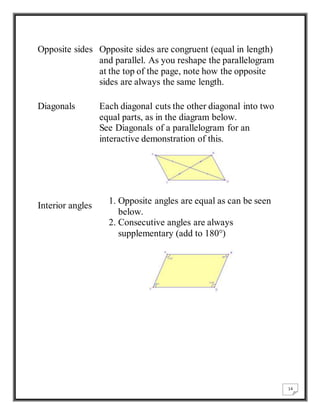
Diagonals Each diagonal cuts the other diagonal into two 
equal parts, as in the diagram below. 
See Diagonals of a parallelogram for an 
interactive demonstration of this. 
Interior angles 
1. Opposite angles are equal as can be seen 
below. 
2. Consecutive angles are always 
supplementary (add to 180°)
15 
6. TRAPEZIUM 
6.1 DEFENITION 
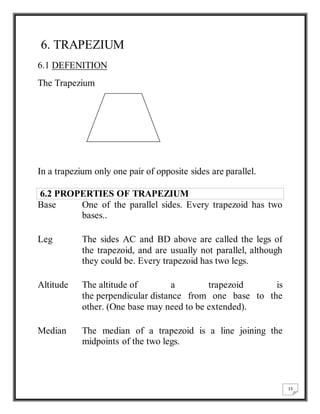
The Trapezium 
In a trapezium only one pair of opposite sides are parallel. 
6.2 PROPERTIES OF TRAPEZIUM 
Base One of the parallel sides. Every trapezoid has two 
bases.. 
Leg The sides AC and BD above are called the legs of 
the trapezoid, and are usually not parallel, although 
they could be. Every trapezoid has two legs. 
Altitude The altitude of a trapezoid is 
the perpendicular distance from one base to the 
other. (One base may need to be extended). 
Median The median of a trapezoid is a line joining the 
midpoints of the two legs.
16 
6.3 MEASUREMENTS 
Area The usual way to calculate the area is the average 
base length times altitude. 
Perimeter The distance a round the trapezoid. The sum of its 
side lengths. 
REFERENCE: 
1) https://www.google.co.in/search?q=G&oq=g&aqs=chr 
ome.0.69i59j69i60j69i59j69i60l3.1419j0j7&sourceid= 
chrome&es_sm=93&ie=UTF-8#q=quadrilatelas 
2) https://www.google.co.in/search?q=geometrical+figur 
es 
&oq=geometrical+figures&aqs=chrome..69i57.8179j0 
j9&sourceid=chrome&es_sm=93&ie=UTF-8

Quadrilaterals

  • 1.
  • 2.
    2 PREFACE It is common belief that mathematics is a dull and difficult subject. It has been dreaded by many children. The problem lies in the traditional way the subject is treated and taught. It has, in fact, the potential to be enjoyed and appreciated the way music and paintings are appreciated. Mathematics forms an integral part of everyday life. We have to teach it with freshness and variety to make it meaningfully applicable to life. This is a humble attempt at it. This text book is designed to meet the everyday requirements of students at school and the general readers of mathematics. I humbly dedicate this book to all students and teachers. Suggestions for improvement are welcome. The author.
  • 3.
    3 CONTENTS 1.Quadrilateral 2. Rectangle 3. Rhombus 4. Square 5. Parallelogram 6. Trapezium 7. Reference
  • 4.
    4 QUADRILATERALS 1.1INTRODUCTION In Euclidean plane geometry, a quadrilateral is a polygon with four sides (or edges) and four vertices or corners. Sometimes, the term quadrangle is used, by analogy withtriangle, and sometimes tetragon for consistency with pentagon (5-sided), hexagon (6-sided) and so on. The origin of the word "quadrilateral" is the two Latin words quadri, a variant of four, and latus, meaning "side". Quadrilaterals are simple (not self-intersecting) or complex (self-intersecting), also called crossed. Simple quadrilaterals are either convex or concave. The interior angles of a simple (and planar) quadrilateral ABCD add up to 360 degrees of arc, that is Any four-sided shape is a Quadrilateral. But the sides have to be straight, and it has to be 2-dimensional.
  • 5.
    5 1. 2PROPERTIES  Four sides (edges)  Four vertices (corners)  The interior angles add up to 360 degrees: 1. 3 TYPES OF QUADRILATERAL  Rectangle  Rhombus  Square  Parallelogram  Trapezium
  • 6.
    6 2. RECTANGLE 2.1 DEFINITION The Rectangle means "right angle" and show equal sides A rectangle is a four-sided shape where every angle is a right angle (90°). Also opposite sides are parallel and of equal length. 2.2 DIAGONALS OF RECTANGLE A rectangle has two diagonals. Each one is a line segment drawn between the opposite vertices(corners) of the rectangle. The diagonals have the following properties:  The two diagonals are congruent (same length). In the figure above, click 'show both diagonals', then drag the orange dot at any vertex of the rectangle and convince yourself this is so.
  • 7.
    7  Eachdiagonal bisects the other. In other words, the point where the diagonals intersect(cross), divides each diagonal into two equal parts  Each diagonal divides the rectangle into two congruent right triangles. Because the triangles are congruent, they have the same area, and each triangle has half the area of the rectangle 2.3 MEASUREMENTS Area of a rectangle = length * breadth. Perimeter of a rectangle =2( l + b) d the length of the diagonal if we know the width and height of the rectangle. Then, where: w is the width of the rectangle h is the height of the rectangle
  • 8.
    8 3. RHOMBUS 3.1 DEFINITION A rhombus is a four-sided shape where all sides have equal length. Also opposite sides are parallel and opposite angles are equal. Another interesting thing is that the diagonals (dashed lines in second figure) meet in the middle at a right angle. In other words they "bisect" (cut in half) each other at right angles. A rhombus is sometimes called a rhomb or a diamond. 3.2 PROPERTIES OF RHOMBUS Base Any side can be considered a base. Choose any one you like. If used to calculate the area (see below) the corresponding altitude must be used. In the figure above one of the four possible bases has been chosen. Altitude The altitude of a rhombus is the perpendicular distance from the base to the opposite side.
  • 9.
    9 3.2 MEASUREMENTS Area There are several ways to find the area of a rhombus. The most common is (base × altitude). Area of a rhombus = 푑1푑2 2 ; where 푑1 , 푑2 are the diagonals of the rhombus. Perimeter Distance around the rhombus. The sum of its side lengths.
  • 10.
    10 4. SQUARE 4.1 DEFINITION The Square means "right angle" show equal sides A square has equal sides and every angle is a right angle (90°) Also opposite sides are parallel. A square also fits the definition of a rectangle (all angles are 90°), and a rhombus (all sides are equal length). 4.1 PROPERTIES Vertex The vertex (plural: vertices) is a corner of the square. Every square has four vertices Diagonals Each diagonal of a square is the perpendicular bisector of the other. That is, each cuts the other into two equal parts, and they cross and right angles
  • 11.
    11 (90°). Thelength of each diagonal is s√2 where s is the length of any one side. 4 . 2 MEASUREMENTS. Area: Like most quadrilaterals, the area is the length of one side times the perpendicular height. So in a square this is simply: area = s2 where s is the length of one side.. Perimeter: The distance around the square. All four sides are by definition the same length, so the perimeter is four times the length of one side, or: perimeter = 4s where s is the length of one side
  • 12.
    12 5. PARALLELOGRAM 5.1 DEFINITION The Parallelogram A parallelogram has opposite sides parallel and equal in length. Also opposite angles are equal (angles "a" are the same, and angles "b" are the same). . A parallelogram is a quadrilateral with opposite sides parallel. It is the "parent" of some other quadrilaterals, which are obtained by adding restrictions of various kinds:  A rectangle is a parallelogram but with all four interior angles fixed at 90°  A rhombus is a parallelogram but with all four sides equal in length  A square is a parallelogram but with all sides equal in length and all interior angles 90° A quadrilateral is a parallelogram if: 1. Both pairs of opposite sides are parallel. (By definition). Or:
  • 13.
    13 2. Bothpairs of opposite sides are congruent. If they are congruent, they must also be parallel. Or: 3. One pair of opposite sides are congruent and parallel. Then, the other pair must also be parallel. 5.2 PROPERTIES OF A PARALLELOGRAM These facts and properties are true for parallelograms and the descendant shapes: square, rectangle and rhombus. Base Any side can be considered a base. Choose any one you like. If used to calculate the area (see below) the corresponding altitude must be used. In the figure above, one of the four possible bases and its corresponding altitude has been chosen. Altitude (height) The altitude (or height) of a parallelogram is the perpendicular distance from the base to the opposite side (which may have to be extended). In the figure above, the altitude corresponding to the base CD is shown. Area The area of a parallelogram can be found by multiplying a base by the corresponding altitude. Perimeter The distance around the parallelogram. The sum of its sides.
  • 14.
    14 Opposite sidesOpposite sides are congruent (equal in length) and parallel. As you reshape the parallelogram at the top of the page, note how the opposite sides are always the same length. Diagonals Each diagonal cuts the other diagonal into two equal parts, as in the diagram below. See Diagonals of a parallelogram for an interactive demonstration of this. Interior angles 1. Opposite angles are equal as can be seen below. 2. Consecutive angles are always supplementary (add to 180°)
  • 15.
    15 6. TRAPEZIUM 6.1 DEFENITION The Trapezium In a trapezium only one pair of opposite sides are parallel. 6.2 PROPERTIES OF TRAPEZIUM Base One of the parallel sides. Every trapezoid has two bases.. Leg The sides AC and BD above are called the legs of the trapezoid, and are usually not parallel, although they could be. Every trapezoid has two legs. Altitude The altitude of a trapezoid is the perpendicular distance from one base to the other. (One base may need to be extended). Median The median of a trapezoid is a line joining the midpoints of the two legs.
  • 16.
    16 6.3 MEASUREMENTS Area The usual way to calculate the area is the average base length times altitude. Perimeter The distance a round the trapezoid. The sum of its side lengths. REFERENCE: 1) https://www.google.co.in/search?q=G&oq=g&aqs=chr ome.0.69i59j69i60j69i59j69i60l3.1419j0j7&sourceid= chrome&es_sm=93&ie=UTF-8#q=quadrilatelas 2) https://www.google.co.in/search?q=geometrical+figur es &oq=geometrical+figures&aqs=chrome..69i57.8179j0 j9&sourceid=chrome&es_sm=93&ie=UTF-8