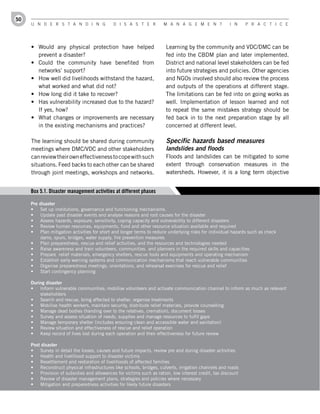
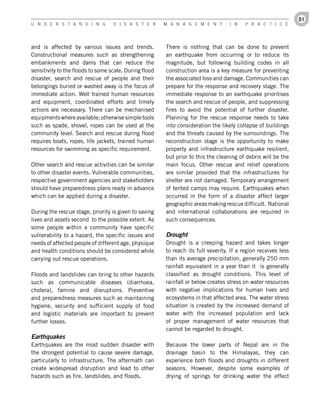
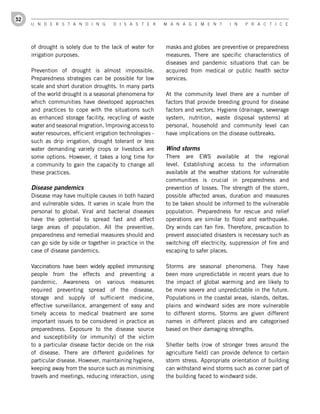
Understanding Disaster Management
                 in Practice
with reference to Nepal
Understanding Disaster Management
                 in Practice
with reference to Nepal
© Practical Action, 2010


Citation: Practical Action. 2010. Understanding Disaster Management in Practice: with reference to
Nepal. Kathmandu, Nepal: Practical Action


ISBN: 978-9937-8135-8-7


Study Team:
Dinanath Bhandari
Yuwan Malakar
Ben Murphy


No use of this publication may be made for resale or other commercial purpose without prior permission
of the copyright holder.

This publication has been produced with the assistance of the UKaid from the Department for International
Development (DFID). The contents of this publication are the sole responsibility of the author/s and can
in no way be taken to reflect the views of Practical Action and DFID.
Preface


Nepal, along with three quarters of human population occupying a quarter of the global landmass is
facing unprecedented disaster risks. People are being exposed to more frequent and severe hazards
becoming vulnerable to the impact of natural physical phenomena and less able to cope. While hazards
may be increasing in frequency and severity, their impacts are exacerbated by a series of dynamic
processes including population growth, increasing levels of poverty and marginalisation, environmental
degradation, poor planning and preparedness and the impacts of climate change.

Disasters damage natural and physical resources on which people’s livelihoods depend. While different
hazards have specific effects, the ultimate impact of each hazard on resource and poor people is mostly
to disrupt or destroy their livelihoods. Small farmers, artisans and fishermen are affected both through
the loss of assets and the loss of employment opportunities. Prevailing poverty, characterised by low
level of awareness, limited resources, including access to skills and knowledge, limit livelihood options.
These constraints limit opportunities to build resilience. The vulnerability of the poor is predicted to
increase in the future under pressure from increasing human population, environmental degradation,
unsustainable socio economic practices and the adverse impacts of climate change. Currently two
thirds of disasters are estimated to be meteorologically induced. Climate change is likely to increase the
frequency and severity of such disasters.

Disaster management in the past has focused on the aftermath of sudden onset large scale events such
as earthquakes, volcanic eruptions, floods or tsunamis. Yet more deaths, accumulated losses and greater
suffering is caused by slow onset and creeping hazards such as drought, disease, invasive species and
the degradation of natural resources. The cumulative effect of a succession of several small adverse
events can devastate the lives and livelihoods of poor people; frequently driving them from subsistence
to a state of total destitution.

Disasters affect poor countries and poor people the most. According to UNDP, 24 out of 49 least
developed countries face high levels of disaster risks. Nepal is no exception. Not only are the people of
poor countries worst affected by disasters, they also lack the capacity to deal with the consequences of a
disastrous event. Lack of capacity to deal with the aftermath of a major disaster developing countries are
in the mercy of external humanitarian aid. This exacerbates the situation which is often characterised
by food shortages, civil unrest and furthermore creates dependency. Despite irrefutable evidence that
mitigation activities can reduce the negative impacts of disasters, developing countries are reluctant
to spend money to limit the impacts of an event that might only occur some time in the future time or
not.
Linking DRR approaches to development can overcome this dichotomy. DRR and development must
be coherent. Disasters put development at risk if development continues without considering future
disaster risks. Hazards turn into disasters where there is a low level of physical and social development.
For example floods may happen because of the absence of necessary flood management or counter
disaster infrastructure such as embankments and drainage channels. In some cases poorly planned
infrastructure development can itself be the cause of disasters such as outburst of dams and collapse
of mines.

Although external efforts are necessarily driven by the disasters they seek to prevent, local communities
should be the major drivers of DRR strategies. They are at the forefront and the first to suffer and
respond. Each community should be aware of the hazards they are exposed to, recognise the potential
risks and plan interventions to reduce the risk of hazard impacts turning into disasters. DRR should be
an integral part of development processes to reduce potential losses and ensure that development gains
are sustainable at all levels – local, national and regional.

This book is written by Dinanath Bhandari, DRR Project Manager and Yuwan Malakar, DRR Project
Officer, Practical Action and Ben Murphy, Practical Action UK. The authors benefited from the guidance
and support of Pieter Van Den Ende, International Project Manager and Gehendra Gurung, Nepal Team
Leader, Reducing Vulnerability Programme.

The achievements described in this publication are a tribute to the hard work and dedication of Practical
Action staff, the members of MADE and SAHAMATI, numerous local government officials and other
collaborators and the hard working communities. It is hoped that the improvements in the communities’
lives will inspire other like minded organisations to adopt a livelihood centered approach to disaster
management.

Lastly, thanks to Upendra Shrestha, Fundraising and Communications Manager for his assistance and
Shradha Giri, Communications Officer from Practical Action for rigorously working on language and
structure of the book and bringing physically to this shape.

Achyut Luitel
Country Director
Contents


Foreword ............................................................................................................................................vii

ACroNymS.............................................................................................................................................ix

Chapter 1 Introduction
1. Concern about disaster ........................................................................................................... 2
2. The role of disaster management ............................................................................................. 3
3. Terms used in disaster management ........................................................................................ 3
4. Organisation of this book ........................................................................................................ 9

Chapter 2 Factors of disasters Nepal Profile
1. Geology and topography ....................................................................................................... 13
2. Weather and climate ............................................................................................................ 13
3. Ecosystems ......................................................................................................................... 14
4. Human factors .................................................................................................................... 18

Chapter 3 Practical Approaches to disaster management
1. Disaster management approaches ......................................................................................... 22
2. Disaster management and development ................................................................................. 23
3. Reducing vulnerability.......................................................................................................... 24
4. Community Based Disaster Management (CBDM) ................................................................... 26
5. Livelihood strategies and disaster management....................................................................... 28
6. Conclusion: communities prepared for disasters...................................................................... 30

Chapter 4 Practical methods for CBdm Planning
1. Vulnerability assessment of VDCs, municipalities and their priority ranking ............................... 33
2. Selection of VDC/municipality for community based disaster management planning ................... 33
3. The disaster management planning of selected VDCs/municipalities ......................................... 34
4. Stakeholder consultation and plan verification ........................................................................ 40
5. Approval of plan and implementation..................................................................................... 41

Chapter 5 Implementation of CBdm Plans
1. Pre disaster phase ............................................................................................................... 45
2. During disaster phase........................................................................................................... 47
3. Post disaster ....................................................................................................................... 48
Chapter 6 Integrating drr and development into Policy and Practice
1. The need for national level planning ...................................................................................... 56
2. National and international policies looking to the local ............................................................ 58
3. Building up from the community level - using the local development plans ............................... 61

Chapter 7 Climate Change and drr
1. What is climate change ........................................................................................................ 64
2. Climate change in Nepal ...................................................................................................... 64
3. Climate change and disasters................................................................................................ 66
4. Dealing with climate change: DRR and development approaches .............................................. 68

Chapter 8 Conclusions ................................................................................................................73

references ............................................................................................................................. 76

Box
1.2   Successful DRR .................................................................................................................. 7
1.3   Effects and impacts of a disaster: Gig Tso GLOF .................................................................... 8
3.1   Indigenous knowledge and practices ................................................................................... 25
3.2   Agricultural livelihood capitals ........................................................................................... 28
3.3   Natural resource management to strengthen livelihoods ........................................................ 30
4.1   Negligence to smaller issues may cost high ......................................................................... 40
5.1   Disaster management activities at different phases .............................................................. 50
7.1   Nepal’s climate scenario .................................................................................................... 65
7.2   Integrated watershed management: a no regret option to CCA and DRR.................................. 70

Table
1.1 Natural hazards are biophysical phenomena and generally fall into the
     following categories............................................................................................................. 4
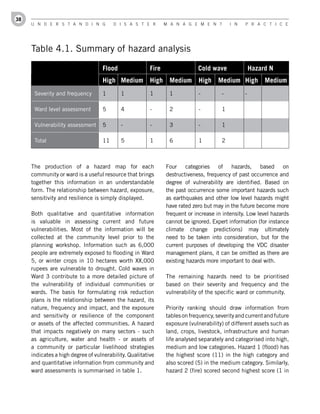
4.1 Summary of hazard analysis ............................................................................................... 38
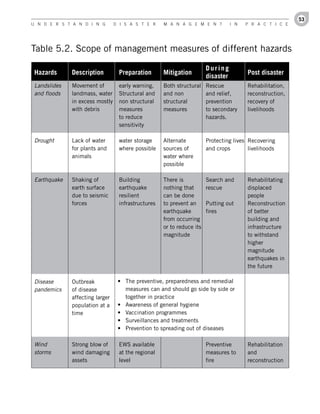
5.2 Scope of management measures of different hazards............................................................ 53

Figure
4.1 CBDRM planning process at local level ............................................................................... 32
5.1 Disaster management cycle................................................................................................ 45
5.2 Early Warning System for disaster risk management ............................................................. 46
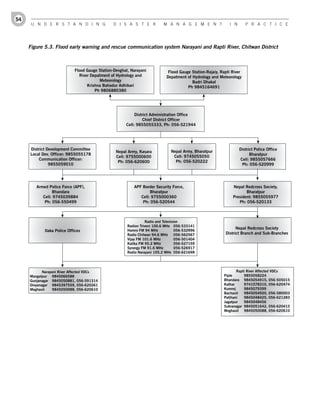
5.3 Flood early warning and rescue communication system Narayani and
     Rapti River, Chitwan District .............................................................................................. 54
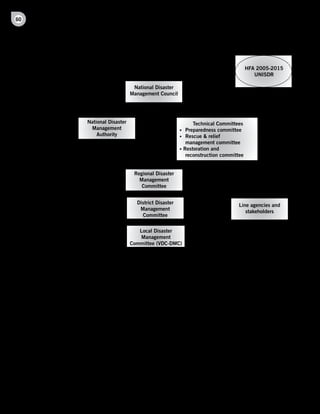
6.1 Disaster and development institutions at the local level within Nepal ..................................... 60
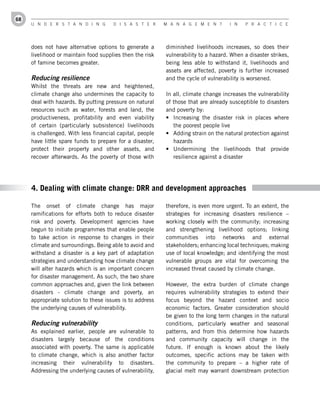
7.1 Annual precipitation trend across Nepal (1976-2005) .......................................................... 66
Foreword


Disaster Risk Reduction (DRR) strategies must be included in all development processes as the recognition
of negative impact of hazards disbars attainment of Millennium Development Goals (MDGs). While the
Hyogo1 Framework for Action (HFA) places DRR firmly in the centre of development activities, a focus
on national level and technical solutions with little recognition of existing local capacities has resulted
in minimal progress on the implementation of DRR actions at the local level. (Global Assessment Report
2009, Views from the Front-line Report).
Work done in the past by Practical Action and other NGOs with poor communities demonstrate that
communities are not passive victims waiting for disasters to strike, but rather have the capacity to
build their resilience to disasters. By adopting a holistic approach, focusing on people’s livelihoods,
their assets and the environment on which they depend, communities can adopt appropriate strategies
that dramatically reduce the impact of disasters. Building on local knowledge, resources and with
appropriate support even the poorest deprived communities are able to engage in activities that increase
their resilience to prevailing future hazards.

In January 2007 Practical Action Nepal Office joined Bangladesh, Sri Lanka, Peru and Zimbabwe in the
implementation of the DFID CHF funded project entitled “Livelihood Centred Approaches to Disaster
Management.” The project focuses on the roles and linkages between poor communities and district and
national institutions in relation to both disaster management and development.

The project has two main components:
•	 Community level activities which reduce the impact of particular hazards by increasing livelihood
   opportunities, increasing resilience, reducing vulnerability, while fostering preparedness to deal with
   the hazard and its aftermath.
•	 Advocacy and capacity building to link community based experiences with district and national level
   institutions. Community based experiences and best practices are documented and used to demonstrate
   the validity of the livelihoods approach to disaster management to government institutions.


1
    www.unisdr.org. Summary of the Hyogo Framework for Action 2005-2015:
    “Building the Resilience of Nations and Communities to Disasters”.
Ultimately, the project aims to influence development and disaster preparedness and mitigation processes
to adopt a livelihood centered approach to disaster management.

This book documents lessons learned during the implementation of the project in Nepal. It describes the
prevailing physical, institutional and socio economic context and details of activities and interventions.
It describes how participatory hazard and vulnerability analysis leads to the development of community
development plans while accounting prevalent future risks. Improved and diversified livelihood strategies,
including the adoption of new income generating opportunities have increased incomes, food security,
better health and resilience of targeted communities while reducing their exposure to prevailing future
hazards. The aftermath of project implementation reveals that a livelihood centered approach reduces
both poverty and vulnerability.

Evidence in increased resilience of communities that have adopted livelihood centered approach has
a positive impact on local development processes. Collaborating with existing community and local
government structures has resulted in the mainstreaming of DRR into poverty reduction in two districts
–Chitwan and Nawalparasi. Both Practical Action and the concerned district authorities have approached
the national level policy makers to replicate the process in other vulnerable districts of Nepal.

Pieter Van Den Ende
Acronyms


CBDM      Community Based Disaster Management
CBO       Community Based Organisation
CBS       Central Bureau of Statistics
CRA       Community Risk Analysis
DADO      District Agriculture Development Office
DDC       District Development Committee
DDRC      District Disaster Rescue Committee
DFID      Department for International Development
DHM       Department of Hydrology and Meteorology
DMC       Disaster Management Committee
DRR       Disaster Risk Reduction
GHG       Greenhouse Gas
GLOF      Glacier Lake Outburst Flood
HFA       Hyogo Framework for Action
ICIMOD    International Centre for Integrated Mountain Development
IFRC      International Federation of Red Cross and Red Crescent Societies
I/NGO     International/Non Governmental Organisation
IPCC      Intergovernmental Panel on Climate Change
LDC       Least Developed Country
MDG       Millennium Development Goal
MLD       Ministry for Local Development
MOHA      Ministry of Home Affairs
NSDRM     National Strategy for Disaster Risk Management
PVA       Participatory Vulnerability Analysis
UNDP      United Nations Development Programme
UNFCCC    United Nations Framework Convention on Climate Change
UN/ISDR   United Nations/ International Strategy for Disaster Reduction
V2R       Vulnerability to Resilience
VDC       Village Development Committee
1
U n d e r s t a n d i n g   d i s a s t e r   M a n a g e M e n t   i n   P r a c t i c e


                                                 c ha pt e r


                                Introduction
                                                        1
2
    U n d e r s t a n d i n g          d i s a s t e r      M a n a g e M e n t         i n   P r a c t i c e


    1. Concern about disaster

    A disaster is an adverse situation that overwhelms      of urbanisation, economic and territorial
    the capacity of those in the vicinity to protect        development, and ecosystem decline’ (ibid).
    their lives and livelihoods, and in most instances
    requires external help in dealing with the losses.      Alongside its prevalence of various hazards, Nepal
    Disasters arise from hazards, and, crucially, it is     has many of the characteristics that increase disaster
    the impact on human life that distinguishes the         impacts - high local level vulnerability associated
    former from the latter. With its uniquely varied        with poverty levels, depleted natural resources,
    geology, topography and climate, Nepal is very          fragile land and infrastructure; and increasing
    familiar with a range and frequency of hazards          intensive risk as urbanisation rises in some areas.
    and, unfortunately, its population has experienced      Nepal experiences high floods once to twice a
    the drastic consequences when these hazards             decade with increasing trend in the recent decades
    manifest into disasters. In many regions of Nepal,      and counts perhaps highest losses. However, losses
    the threat of disaster is a persistent concern.         from drought, fire and disease outbreak are more
                                                            frequent and cause greater economic loss although
    Globally, nearly all hazards carry a higher risk        less information is documented.
    of culminating in a disaster, a fact that reveals
    the inseparable human influences in disaster            Between 1971 and 2007 about 133,000
    creation. Between 1970 and 2007, the United             people were affected annually and 9350 houses
    Nations recorded that the highest death tolls and       destroyed. During the last 24 years epidemics
    economic losses occurred in more concentrated           claimed over 10,000 lives followed by flash flood
    geographic areas, evidence that the worst               that took 6584 lives. At least 4013 people were
    impacts are felt where exposure and vulnerability       killed by landslide and floods between 1993 and
    to hazards are intensified within smaller but more      2007. According to the Ministry of Information,
    populated areas (ISDR, 2009). At the same time,         there has been annual average loss worth of
    vast areas experienced more frequent low intensity      NPR 1, 208,000,000 for every last decade. Many
    losses (typically from weather events) which,           casualties do not come into the national reporting
    whilst claiming fewer fatalities, persistently effect   due to remoteness and other unforeseen reasons.
    more people, livelihoods, local infrastructure and      Since 1993, landslides and floods have become
    property (ibid). The increase in the impacts from       almost annual disastrous events in the country.
    low-intensity events is associated with better
    reporting of losses and new problems linked to          Fortunately, disasters are not inevitable, even
    climate change, but primarily it indicates ‘locally     where there is a high rate of hazards. With better
    specific increases in exposure, vulnerability           support, a disaster can be completely averted or
    and hazard in the context of broader processes          its impacts reduced to limit loss and disruption.
3
U n d e r s t a n d i n g         d i s a s t e r      M a n a g e M e n t        i n   P r a c t i c e


2. The role of disaster management

Ultimately, disaster management aims to reduce         programmes plan for the whole disaster process
the impact of disasters. The ways of achieving this    including a range of activities at different stages
have varied and evolved over time. The earliest        of disaster management. The strategies include
and still predominate approach is for agencies to      risk reduction such as hazard, exposure and
provide relief to those affected once a disaster has   sensitivity reduction, impact reduction, and
happened. Rescue assistance, medical support,          capacity building for resilience addressing not
food and water supply are vital for saving lives       only the impacts but the factors that turn a
which prevent further harm. However, responding        hazard into a disaster. Poverty is well understood
to a disaster can only do so much, and a level of      to significantly increase the disaster impact,
loss is almost inevitable before a rescue operation    a fact that is observable in nearly all events
can even arrive. As well as wasting precious time,     around the world as it is the poorest that are
relying on external support is not desirable for       the most affected each time. This leads to the
communities at risk of a disaster, particularly as     view that disasters are a symptom of incomplete,
they often have a capacity to deal with a disaster     inappropriate or inequitable development. As
already.                                               a development organisation that specialises in
                                                       working with communities to develop technologies
More recent approaches, such as that followed          to alleviate poverty, Practical Action aims to break
by Practical Action, take a more holistic view         the cycle that makes people in poverty particularly
and seek to reduce the risk of a disaster. Rather      susceptible to disasters and disasters particularly
than waiting to respond, disaster management           detrimental to poverty.


3. Terms used in disaster management

Disaster management has developed a discourse          mechanism of the people in that          vicinity is
that helps to conceptualise the whole process of       overwhelmed.
a disaster, covering the contributors, categorising
the implications, and explaining solutions. A brief    Hazards manifest in different forms determined
explanation of some terms useful for understanding     by their origins broadly classified into two groups:
and applying this book is given below.                 natural hazards and man made or technological
                                                       hazards. The dynamics involved measures the
Hazard                                                 two as either slow or rapid onset. However, the
A hazard is an event, or its potential, that           distinction in both categories is not clear cut.
threatens to cause damage and disruption for           Hazards can originate from a single source or
a particular area at a certain time threatening        a combination, and can gradually emerge in a
lives, livelihoods, property, infrastructure and       sequential pattern of slow and fast phases such
the natural environment, as well as normal socio       as land degradation, glacier lake formation which
economic operations. An important distinction to       are slow to a point and then generate disastrous
note is that, whilst hazards act as catalysts for      results such as landslide due to land degradation
disasters, it is not inevitable that one should lead   in the hills, glacier lakes are also slow in the
to the other. Disasters only occur if the coping       formation but at certain point they exceed the
4
    U n d e r s t a n d i n g       d i s a s t e r     M a n a g e M e n t        i n   P r a c t i c e


    dam capacity and outburst. On the other hand,        and generating flood afterwards and drought
    one hazard can invite another hazard or disaster     enhancing forest fire. Following example helps
    risk for example famine could invite conflicts,      to understand role of natural or human factors
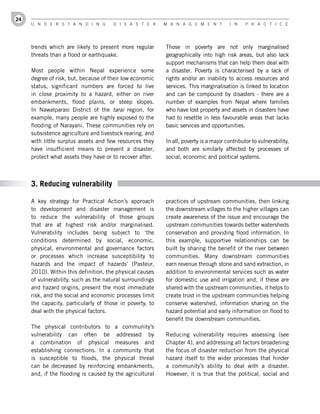
    robbery; landslide damming river temporarily         associated to a particular hazard.

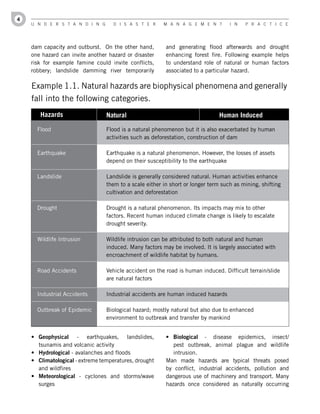
    Example 1.1. Natural hazards are biophysical phenomena and generally
    fall into the following categories.
       Hazards                   Natural                                      Human Induced

      Flood                      Flood is a natural phenomenon but it is also exacerbated by human
                                 activities such as deforestation, construction of dam

      Earthquake                 Earthquake is a natural phenomenon. However, the losses of assets
                                 depend on their susceptibility to the earthquake

      Landslide                  Landslide is generally considered natural. Human activities enhance
                                 them to a scale either in short or longer term such as mining, shifting
                                 cultivation and deforestation

      Drought                    Drought is a natural phenomenon. Its impacts may mix to other
                                 factors. Recent human induced climate change is likely to escalate
                                 drought severity.

      Wildlife Intrusion         Wildlife intrusion can be attributed to both natural and human
                                 induced. Many factors may be involved. It is largely associated with
                                 encroachment of wildlife habitat by humans.

      Road Accidents             Vehicle accident on the road is human induced. Difficult terrain/slide
                                 are natural factors

      Industrial Accidents       Industrial accidents are human induced hazards

      Outbreak of Epidemic       Biological hazard; mostly natural but also due to enhanced
                                 environment to outbreak and transfer by mankind


    •	 Geophysical - earthquakes, landslides,            •	 Biological - disease epidemics, insect/
       tsunamis and volcanic activity                       pest outbreak, animal plague and wildlife
    •	 Hydrological - avalanches and floods                 intrusion.
    •	 Climatological - extreme temperatures, drought    Man made hazards are typical threats posed
       and wildfires                                     by conflict, industrial accidents, pollution and
    •	 Meteorological - cyclones and storms/wave         dangerous use of machinery and transport. Many
       surges                                            hazards once considered as naturally occurring
5
U n d e r s t a n d i n g            d i s a s t e r       M a n a g e M e n t         i n    P r a c t i c e


are now identified as a result of human induced            terms of frequency and intensity as well. Extreme
environmental changes. For example, an increase            weather events are relevant example.
in the threat from flooding is linked to the escalating
rate of deforestation in watershed areas, and the          Sensitivity
risk famine is often considered to be a human              Sensitivity measures the likelihood of being
induced hazard. That there is no clear boundary            affected by a hazard and is an indicator to how well
between natural and man made origins (except for           protected or capacitated to defend those exposed to
events such as earthquakes and volcanoes) is due to        a hazard are? An elephant is less sensitive to a tiger
human reliance on the natural environment. Whilst          than a deer as the former has stronger defending
the hazards are undesirable, their source may be           capacity in general. A community at the bank of
essential to human life: a river provides water for        river is exposed to flooding but their sensitivity will
agricultural irrigation and livestock production, but      be low if the embankment is reinforced. A house
extreme and unmanageable floods pose a threat to           with a lightening rod is less sensitive to being
these practices as well as lives and property.             struck by lightning during a thunderstorm. The
                                                           risk associated with exposure can be reduced by
Understanding the dynamics of a hazard is                  decreasing sensitivity, yet the exposure itself still
essential for assessing the potential threat to a          remains: a mouth mask may reduce a person’s
community and determining which risk reduction             sensitivity to flu but their exposure remains when
measures to follow. Slow onset or creeping                 in close contact with someone carrying the virus.
hazards are protracted events such as drought,             A house away from the river bank may still be
desertification, and some forms of pollution which         sensitive to flooding but its low exposure (or say
gradually increase to their full potential. Rapid          zero exposure) makes it less vulnerable to flood.
onset hazards, such as, road accidents, industrial         However, in some cases exposure and sensitivity
accidents, flash floods, earthquakes, landslides,          come together confusing to segregate. Sensitivity
storms, and volcanoes occur faster, reach their            and defending capacity are opposite properties
disaster potential sooner, and move quickly                to each other whereas exposure and sensitivity
in spreading in terms of physical movement                 contribute in the similar way to vulnerability.
damaging and affecting areas.
                                                           Vulnerability
Exposure                                                   Vulnerability is a core concept in both DRR
Exposure is a gauge of the potential threat and            and poverty reduction work. Broadly, it is used
defined by physical proximity to, as well as, the extent   to understand a group’s overall susceptibility to
of interaction with a hazard. If individuals and their     any negative consequences that will throw them
properties are close to a river bank, their exposure       deeper in poverty or even tip them into destitution.
to flooding is higher than those further away or on        DRR considers the wide aspect of vulnerability
higher ground. In the context of slow onset hazards,       but also contains a specific assessment in relation
the duration of exposure also determines the scale         to disaster risk. Being vulnerable to a disaster is
of risk. For example, the longer a community suffers       considered to be the ‘diminished capacity of an
from drought it increases the potential for stress and     individual or a group to anticipate, cope with,
losses. In some hazards such as diseases it is both        resist and recover from the impact of a natural or
physical distance and interaction such as in the case      man made hazard’ (IFRC, nd).
of exposure to HIV. In the case of hazards where
exposure is uncertain or its probability is the same       The physical aspects of a hazard, and a group’s
across the area and assets, exposure is measured in        relationship to them, determines a proportion of
6
    U n d e r s t a n d i n g                     d i s a s t e r             M a n a g e M e n t         i n    P r a c t i c e


    vulnerability - individuals or their properties are                        adversely affected or lost and is dynamic with
    not classed as susceptible to a disaster if they                           respect to development, trends, governance,
    are not exposed to a hazard, and vulnerability                             environmental changes etc
    can be reduced by decreasing sensitivity. Even
    for individuals or families exposed equally to the                         Disaster risk2
    same hazard, variances in sensitivity can alter the                        Disaster risk refers to the probability that harmful
    level of vulnerability.                                                    consequences or expected losses will result from
                                                                               a hazard event. It can also be described as the
    As such vulnerability can be expressed as the                              probability of a disaster. Risk is measured by
    relationship between hazard, exposure and                                  assessing a hazard’s characteristics such as the
    capacity:                                                                  likelihood and magnitude of its occurrence and
                                                                               the corresponding vulnerability level of those
    In this relationship vulnerability can be reduced                          expected to be affected:
    either by limiting the hazard potential, decreasing
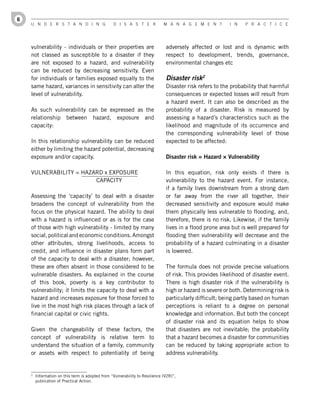
    exposure and/or capacity.                                                  Disaster	risk	=	Hazard	×	Vulnerability

    VULNERABILITY = HAZARD x EXPOSURE                                          In this equation, risk only exists if there is
                        CAPACITY                                               vulnerability to the hazard event. For instance,
                                                                               if a family lives downstream from a strong dam
    Assessing the ‘capacity’ to deal with a disaster                           or far away from the river all together, their
    broadens the concept of vulnerability from the                             decreased sensitivity and exposure would make
    focus on the physical hazard. The ability to deal                          them physically less vulnerable to flooding, and,
    with a hazard is influenced or as is for the case                          therefore, there is no risk. Likewise, if the family
    of those with high vulnerability - limited by many                         lives in a flood prone area but is well prepared for
    social, political and economic conditions. Amongst                         flooding then vulnerability will decrease and the
    other attributes, strong livelihoods, access to                            probability of a hazard culminating in a disaster
    credit, and influence in disaster plans form part                          is lowered.
    of the capacity to deal with a disaster; however,
    these are often absent in those considered to be                           The formula does not provide precise valuations
    vulnerable disasters. As explained in the course                           of risk. This provides likelihood of disaster event.
    of this book, poverty is a key contributor to                              There is high disaster risk if the vulnerability is
    vulnerability; it limits the capacity to deal with a                       high or hazard is severe or both. Determining risk is
    hazard and increases exposure for those forced to                          particularly difficult; being partly based on human
    live in the most high risk places through a lack of                        perceptions is reliant to a degree on personal
    financial capital or civic rights.                                         knowledge and information. But both the concept
                                                                               of disaster risk and its equation helps to show
    Given the changeability of these factors, the                              that disasters are not inevitable; the probability
    concept of vulnerability is relative term to                               that a hazard becomes a disaster for communities
    understand the situation of a family, community                            can be reduced by taking appropriate action to
    or assets with respect to potentiality of being                            address vulnerability.


    2
        Information on this term is adopted from “Vulnerability to Resilience (V2R)”,
        publication of Practical Action.
7
U n d e r s t a n d i n g               d i s a s t e r          M a n a g e M e n t              i n     P r a c t i c e


   Example 1.2. Successful DRR

In some countries, disaster risk is successfully lowered. Japan experiences frequent earthquakes which proved disastrous
in the past, but now, as a result of appropriate technologies, widespread awareness raising, preparedness and institutional
response mechanisms, they are less likely to result in serious losses or disruptions. Even when affected, the majority of
people are able to cope and recover as a result of having insurance cover and secure jobs. Similarly, Australia has suffered six
years of severe drought and, though farmers experienced reduced harvests, the drought has not resulted in widespread death
or drastic food shortages. Farmers have been able to adapt to changing circumstances, many have diversified to different
livelihoods, and government support is available to help people cope.


Effect
When a disaster occurs, its effects are the                       risk, the impacts are more detrimental to those
immediate consequences, most often estimated                      already struggling. Financial losses, damages
immediately or calculated to the extent of                        to property and disruptions to work patterns
possible through some sort of enumerations by                     are much more harmful to groups that rely on
the direct near term losses and the coverage of                   subsistence livelihoods. Damages to the natural
a disaster. Figures and information on deaths,                    environment are often insufficiently covered in
injuries, and property losses calculate the effects.              impact assessments, yet these add to the scale
In reference to disasters, the terms ‘effect’ and                 and duration of the effects on smallholder farmers
‘impact’ are often used interchangeably; however,                 who depend on natural resources.
effect explicitly refers to the initial consequences
directly resulting from the force of the hazard                   Due to their limited access to the services,
event. The example in example 1.3 clarifies the                   impacts for the poor appear less on the national
distinction where first paragraph describes effects               database systems. The society is always more or
and the second impacts                                            less dynamic and impacts are both qualitative
                                                                  and quantitative in nature. So, there are problems
Impact                                                            measuring the actual total impacts.
The impact is the sum of all effects imposed
by a disaster, a total of the short and long term                 Mitigation
results including the indirect consequences.                      Mitigation in disaster management is the
Impact indicators cover a broad range of areas,                   reduction of disaster effects and impacts. The
from those directly concerned with humans                         UNISDR (2009) defines the term as ‘structural
(death toll, livelihood losses and psychological                  and non structural measures undertaken to
impacts) to the socio economic, cultural, physical                limit the adverse impact of natural hazards,
(infrastructure and landscape) and environmental                  environmental degradation and technological
consequences.                                                     hazards’. Mitigation is an important component
                                                                  in aspects of the disaster management cycle (see
The impact of one disaster varies for different                   Chapter 5). All activities carried out before a
sections of a population, and even certain groups                 disaster are considered as mitigating the potential
within communities. It is often the poorest                       for severe impacts; those during mitigate the loss
and most vulnerable people that experience                        and further losses; and the post disaster work is an
the greatest impact from a disaster because,                      important opportunity for reducing the potential
aside from facing a higher exposure to disaster                   from future disasters.
8
    U n d e r s t a n d i n g                 d i s a s t e r          M a n a g e M e n t               i n     P r a c t i c e


    Example 1.3. Effects and impacts of a disaster: Gig Tso GLOF

    In 1985 a glacier lake, Dig Tsho in Mt. Everest region burst and a glacier lake outburst flood (GLOF) flooded Bhote Koshi
    River. The GLOF destroyed the Namche hydropower project that was built at the cost of US$ 1.5 million approximately. Many
    agriculture fields along the banks of Bhote Koshi and down the confluence, along Dhud Koshi River were destroyed. In some
    villages such as Ghat in Chaurikharka, 5 houses and a monastery were destroyed. 14 suspended bridges across the Dhudh
    Koshi and Bhote Koshi Rivers were destroyed. Long distances of foot trail along the river banks were crumbled down in many
    places that cut off communication and transport for a long time. Some livestock were reported killed though actual data is
    not available. No human death or injury was reported as it happened during the daytime and people escaped the risky zones.
    The effect spread down to 90 kms in the downstream destroying foot trails, foot bridges, agriculture lands, forests and other
    properties.

    This warranted relocation of the Namche hydropower project site in Thame village and it took some more years to get
    electricity supply in the Khumbu region. The damage was irreparable as the destroyed bridges were replaced by temporary
    crossing which only worked during winter and dry seasons. In monsoon seasons the temporary crossings were often washed
    away by the increased water level in the river and required reconstruction year after another. Construction of longer span and
    higher free board suspended bridges were initiated some years later but took years to complete. During the reconstruction,
    longer span and high free board bridges required as stream banks were washed away and river bed rose due to debris
    deposition that required greater costs. Restoration of vegetation damaged by the GLOF took many years in the downstream
    and it is still in the recovering phase in the upper reaches (even after 20 years) as ecologically it takes longer, particularly in
    its sub alpine and alpine region. Some villagers hailing from Ghat area had to relocate their houses higher up in the terraces.
    In many stretches, foot trails had to be modified to change their alignments from the original one. Tourism is main source
    of income in the region but the number of tourists visiting the area remained below average from the usual statistics as
    infrastructures were damaged.


    Resilience
    Resilience is the ability to cope or endure a                       these actions themselves, or can draw upon local
    stress, the opposite of vulnerability. A resilient                  support to deal with a disaster as independent
    community is equipped with certain capacities                       from external assistance as possible. However,
    which can be employed in anticipation during                        the most comprehensive state of resilience is
    and before a disaster strikes:                                      determined by wider factors, such as the degree
    •	 Absorb stresses or destructive forces through                    to which the whole social system is capable of
       resistance or adaptation                                         learning from past disasters, its ability to improve
    •	 Manage or maintain certain basic functions                       risk reduction measures, and its willingness to
       (such as clean water supply or market systems)                   address the vulnerability of the poorest.
       and structures during disastrous events
    •	 Recover or ‘bounce back’ after an event                          Resilience to disasters requires constant vigilance,
                                                                        particularly in hazard prone areas like Nepal. It
    Strategies for increasing resilience capacities                     is not an end state as such, but the approach
    start with being able to foresee a potentially                      described in this book aims for communities to
    threatening event and progress to the ability                       reach a level of resilience whereby they have the
    to take action to prevent, protect, or respond                      ability, using their own means, to take action and,
    appropriately when they do occur. Resilient                         ultimately, reduce both the disaster risk and the
    communities are able to implement the majority of                   underlying causes of their vulnerability.
9
U n d e r s t a n d i n g           d i s a s t e r      M a n a g e M e n t        i n    P r a c t i c e


4. Organisation of this book

This book charts the approach to DRR and poverty         chapter five explains the whole disaster cycle and
alleviation followed by Practical Action. It aims to     identifies and precautionary steps that should be
be informative of the relationship between disasters     implemented at each stage.
and poverty and makes suggestion on the basis of
the project work with Nepali communities. Those          Chapter six describes ways to link local level plans
with a particular interest in Nepal will find that its   with higher level process and disaster practitioners
focus - starting with the Nepal profile in chapter       as well as government organisations will find it
two illuminates the physical and human features          useful for understanding how communities can
of the country, yet the approach described is            benefit from inclusion in national and international
applicable anywhere if tailored to the context. Given    policies.
Nepal’s situation, it is highly relevant for multiple
hazard contexts. Chapter three outlines the logical      Chapter seven explains the impact of climate
progression from disaster and poverty focus to a         change for those that are already susceptible
vulnerability approach, and explains why working         to disasters and draws upon Practical Action’s
with communities is important to the imperative.         experience in dealing with this new threat to
                                                         outline ways in which this extra burden for
The practical planning processes outlined in             those in poverty can be averted. Finally, the
chapter four are the initial steps for reducing          book acknowledges that neither disasters nor
vulnerability. The explanation of the community          vulnerability are static processes but evolving
selection process, vulnerability assessments and         challenges that require constant learning and
plan formation make it a valuable resource for           improvement to approaches. The book hopes to
local, regional and national planners and policy         give the reader a key lesson i.e. by working together
makers, disaster practitioners and organisations         with communities it is possible to simultaneously
hoping to work with community knowledge at               reduce the losses, distress and disruptions caused
the local level. Putting these plans into practice,      by disaster and alleviate poverty.
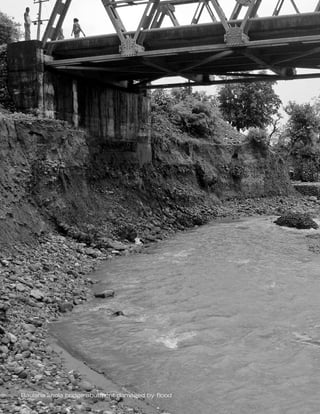
Baulaha khola bridge abutment damaged by flood
11
U n d e r s t a n d i n g   d i s a s t e r   M a n a g e M e n t   i n   P r a c t i c e


                                                 c ha pt e r


        Factors of Disasters-
                                                        2
               Nepal Profile
12
     U n d e r s t a n d i n g          d i s a s t e r       M a n a g e M e n t        i n   P r a c t i c e


     Nepal has experienced many disasters in the past,        flooding destroys acres of agricultural land and a
     a product of its unique natural features combining       particularly bad flood in 2001 washed away 120
     with local, regional and global conditions. These        houses in Ghailaghari in Jagatpur VDC and over
     factors give Nepal a prevalence of natural hazards       500 people were affected. Wind spreads the seeds
     which present a constant threat to large population      and spores of many important species such as
     and occasionally lead to various catastrophic            Bombax ceiba and Alstonia scholaris to rejuvenate
     events. The most common disasters are flooding           the local biodiversity, but storm winds can damage
     which can occur relatively frequently, perhaps           property, natural resources and even claim lives in
     only on a minor scale and may be confined to             less protected communities.
     certain regions or communities. Drought i.e.
     shortage of water for irrigation occurs almost           Disasters, therefore, are inextricably linked to the
     annually which often induces fire hazard. Fire           human context. Nepal has a population of over
     causes greater loss in the forest and biodiversity       27 million (2009 projection). About 30 per cent
     but the impact of drought and fire losses are            of that figure lives below the poverty level and the
     poorly represented in the national information           majority of the population are considered to be
     system as the government fails to prevent such           particularly at risk of a hazard because of location
     hazards. Nepal also experiences extraordinary            and/or socioeconomic factors. Human activities
     natural events such as earthquakes (Nepal stands         are also a major contributor to the likelihood and
     11th as the most at risk country in the world)           extent of a disaster; people have to engage with
     and flooding from glacial lake outbursts, which,         the natural environment on a daily basis and can
     although less common, happen on a greater                aggravate the natural conditions in ways that lead
     magnitude and affect a larger number of people.          to extreme events. The problem is more acute in
     According to the disaster loss record maintained         Nepal, where the topography is highly pronounced,
     by Ministry of Home Affairs, at least 1000 people        socio economic activities are linked closely to the
     are killed each year due to different disasters in       natural environment, and disturbances in one
     Nepal, not to mention the non fatal victims and          region can easily lead to consequent effects in
     the high costs associated with recovery.                 other areas - destructive practices like slash and
                                                              burn agriculture in the upstream areas increases
     Yet most of Nepal’s naturally occurring hazards cannot   risk of flood downstream. Understanding the
     be isolated and treated separately from the other        process involved in a disaster event requires
     processes they relate to. Except for earthquakes,        analysing hazards at the locality, linking them to
     the source of a hazard can be an essential resource      wider driving factors, and assessing the human
     for communities, and can only become disastrous          interaction. This chapter profiles the features of
     when they occur on a scale that adversely affects        Nepal as the origins of natural hazards, providing
     those in the vicinity. The river Rapti, for example,     an account of the geology and topography, climate
     is an important source of water, surface irrigation,     and ecological conditions that interact with human
     and many ecological services in Chitwan, but its         activities and have proved disastrous in the past.
13
U n d e r s t a n d i n g               d i s a s t e r        M a n a g e M e n t           i n    P r a c t i c e


1. Geology and topography

The topography of an area is formed by the relief and          enhances hazard severity. The physical landscape plays
terrain of the earth’s surface, producing various structures   a part in shaping the weather for an area and also the
from mountains ranges to plains planes, valleys to             context for the type of ecosystems that can flourish
cliffs. These features are a major factor contributing to      and the options for socio economic activities. Whilst
disasters, determining the characteristics of a hazard -       playing such a primary role in disasters, it is impossible
its origin, extent and severity. Strong geology - where        to change the physical landscapes of an area. However,
the earth’s surface is made up of stable rocks and can         DRR measures are possible by understanding the
withstand shocks and stresses - can provide a defence          nature of these regions and how they contribute to both
to hazards but weak geology, on the other hand,                vulnerability and resilience.


2. Weather and climate

Weather is the day-to-day conditions of                        the implementation of activities to reduce the
temperature and precipitation for a particular                 impacts. Knowing that high rainfall is expected
region and expressed in indicators such as                     in three days, a community can make decision to
sunshine, cloud, wind, rainfall, cold and                      secure property and livelihoods.
warmth. Weather conditions are generated by the
interaction between the earth’s surface and the                Average atmospheric conditions over significantly
density of temperature and moisture elements in                longer periods (20-30 years) are referred to as the
the atmosphere. As the most dynamic aspect of                  climate. Different climatic regions are associated
the atmosphere, weather is temporary and can                   with different areas of the world classified into
change variously within a day, however sustained               tropical, dry, moderate, continental and polar – yet
weather patterns for a region are associated                   Nepal is unique as it is one of the few countries
with particular seasons – such as the winter or                to experience the greatest range of climate zones
monsoon period which are longer term (months)                  within a comparatively small geographic area (see
expression of typical conditions.                              chapter 7). For a particular region, the climate
                                                               is considered as being more or less permanent,
The weather is a vital input for many livelihood               although recently this has been challenged
practices, particularly those involved in crop                 by the onset of climatic change. Changes in
based agriculture, yet adverse conditions can                  climatic conditions can heighten or increase the
be hazardous. Storms, cold and heat waves,                     likelihood of extreme weather events or contribute
heavy rain, hail and snow fall are weather events              to other hazards by speeding biodiversity loss,
that create stresses and can lead to disasters.                desertification, and disease and insect outbreaks.
Accurate weather forecasting is a key tool for                 Further explanation of the link between climate
disaster management as it provides a signal for                change and disaster is provided in the chapter 7.
14
     U n d e r s t a n d i n g         d i s a s t e r      M a n a g e M e n t        i n   P r a c t i c e


     3. Ecosystems
     An ecosystem is an intricate network of living         endemic species. It also harbours a lake covering
     organisms such as plants, animals and bacteria,        10.8 sq km at an altitude of 2990 m above sea
     interacting with and within a physical environment.    level (HMGN/MFSC, 2002). At similar altitude
     They may be any scale of living community from a       (900 to 1500 meter) south of Annapurna range
     small puddle to a whole planet but, for the purposes   in central Nepal (Kaski District) harbours Schima-
     of disaster management and development, focus          Castanopsis forests whereas in other areas Pinus
     is given to the processes that are involved in         roxburghii is common. South of the range is green
     sustaining human life. Principally, ecosystems         and productive as it receives more rainfall. On
     provide humans with food, water and energy, but        the other hand, north of it (Mustang and Manang
     they are also utilised for livelihoods, particularly   Districts) are dry at the similar altitude and
     those based on agricultural, and fulfilling needs      harbours dry sub alpine and alpine vegetation.
     beyond subsistence living.                             In single hill too, south facing slopes are covered
                                                            by Pinus roxburghii and north facing slopes are
     Not all aspects of an ecosystem are beneficial for     covered by Schima-Castanopsis vegetations at the
     humans and if a careful balance in the interactions    same altitude because south facing slopes are
     between living organisms is not maintained there       more exposed to solar radiation and thus drier.
     is the potential for a disaster. Whilst animals and    In general, eastern Nepal receives more rainfall
     wildlife help rejuvenate the ecosystem, excessive      and Ilam-Dhankuta area is appropriate for tea and
     population rises in one species can lead to decline    cardamom whereas western Nepal is less potential
     in another. Human encroachment into the habitat        for these crops. Instead, Jumla and Dolpa areas in
     of wild animal often leads to conflicts and danger     the west are potential for apple production.
     for both sides. Many insects are useful for cross
     pollination of plants, but Nepal has several crops     Appropriate management of ecosystems helps
     eating species, like locust, white flies, brown        reduce disaster risks. Appropriate utilisation
     plant hopper, that destroy yields and an outbreak      of ecosystem services provides inputs to DRR
     of these varieties may result in food scarcity and     of vulnerable livelihood assets. Collection of
     famine. Human diseases, such as flu viruses, can       fallen leaves and dry matter from forests and
     also be spread by vectors, passing on bacteria with    establishing firebreak lines provides input to
     the potential to affect large populations within a     agriculture in the form of manure and fuel wood
     few weeks.                                             for household energy later and reduces fire risk in
                                                            the forest. Conservation of watersheds improves
     Nepal is home to 118 ecosystems, 75 vegetation         water availability and reduces soil erosion. Small
     types and at least 35 forest types, and, because       actions on the ground generate bigger results in the
     of its diverse topography and climate there are        ecosystems. Such information about ecosystem
     marked differences in ecosystems within short          function should be considered in the development
     distances. For example, the Rara National Park         and DRR initiatives for which awareness of
     (106 sq km) in the mid western hills harbours 16       community and stakeholders is important.
15
U n d e r s t a n d i n g          d i s a s t e r      M a n a g e M e n t       i n   P r a c t i c e


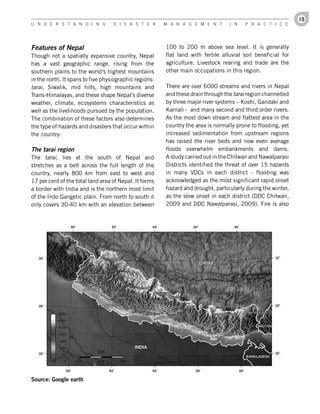
Features of Nepal                                       100 to 200 m above sea level. It is generally
Though not a spatially expansive country, Nepal         flat land with fertile alluvial soil beneficial for
has a vast geographic range, rising from the            agriculture. Livestock rearing and trade are the
southern plains to the world’s highest mountains        other main occupations in this region.
in the north. It spans to five physiographic regions:
tarai, Siwalik, mid hills, high mountains and           There are over 6000 streams and rivers in Nepal
Trans-Himalayas, and these shape Nepal’s diverse        and these drain through the tarai region channelled
weather, climate, ecosystems characteristics as         by three major river systems – Koshi, Gandaki and
well as the livelihoods pursued by the population.      Karnali - and many second and third order rivers.
The combination of these factors also determines        As the most down stream and flattest area in the
the type of hazards and disasters that occur within     country the area is normally prone to flooding, yet
the country:                                            increased sedimentation from upstream regions
                                                        has raised the river beds and now even average
The tarai region                                        floods overwhelm embankments and dams.
The tarai, lies at the south of Nepal and               A study carried out in the Chitwan and Nawalparasi
stretches as a belt across the full length of the       Districts identified the threat of over 15 hazards
country, nearly 800 km from east to west and            in many VDCs in each district - flooding was
17 per cent of the total land area of Nepal. It forms   acknowledged as the most significant rapid onset
a border with India and is the northern most limit      hazard and drought, particularly during the winter,
of the Indo Gangetic plain. From north to south it      as the slow onset in each district (DDC Chitwan,
only covers 30-40 km with an elevation between          2009 and DDC Nawalparasi, 2009). Fire is also


Source:	Google	earth
16
     U n d e r s t a n d i n g           d i s a s t e r      M a n a g e M e n t         i n   P r a c t i c e


     equally important hazard in the tarai and damages        The Siwalik has weak topography making it
     forests and houses in particular.                        sensitive to soil erosion and unsuitable for
                                                              agriculture. However, the hills are experiencing
     The population is increasing in the tarai at a           a rise in inhabitants due to population pressure
     faster rate in the last 3-4 decades. In 1961, the        in the tarai and migration from the upper
     population in Chitwan District stood at 67,882,          hills. Agriculture and livestock keeping are
     it had reached 183,644 by 1971 and in 2001 it            the main occupation of the inhabitant. These
     stood at 470,713 (CBS, 2003). The population             unsustainable socio economic activities have
     was projected to increase over 625,000 in 2009           led to a faster degradation of ecosystems. The
     (CBS, 2007). This trend is fuelled by migration          region is already highly prone to landslides; mass
     from the hills and mountains as living conditions        wasting and debris flow add significant amounts
     worsen in hills and mountains and people want to         of sediment load into the major rivers that
     live in emerging new cities in the plains. The tarai     cause problems downstream. Climate change
     has become a more attractive option for relocation       is also likely to exacerbate the problems in the
     after successful malaria eradication programme           Siwalik, with subsequent problems in the tarai
     by the government and settlement initiatives in          where vulnerability to sediment deposition, land
     the tarai region.                                        scouring and inundation has already increased in
                                                              recent decades.
     The Siwalik region
     Commonly known as the Churiya, the Siwalik are           The hill region
     the foot hills that rise abruptly from the tarai. Here   After the Siwalik, the middle mountain range,
     the elevation ranges from 700 to 1,500 m above           or Mahabharat, extends the length of Nepal,
     sea level. Extending west to east, it lies north of      intersected only by antecedent rivers such as the
     the tarai except at Chitwan and Dang where it            Koshi, Gandaki, Karnali and Mahakali. It makes up
     touches the southern border, creating the inner          68 per cent of Nepal’s total land area. Its altitude
     tarai or dun valleys. The Siwalik is discontinued        ranges from 1500 to 3000 m above sea level and
     near Koilabas and Butwal as the Mahabharat               in some places reaches 4000 m making it the first
     range adjoins the tarai.                                 great barrier to the monsoon winds. The slopes of
                                                              the Mahabharat are steep and sparsely cultivated,
     The Siwalik Hills are composed of poorly                 with settlements in the hill slope. There are few
     consolidated coarse sediments which allow                valleys in the middle hill but these are the site of
     rainwater infiltration to recharge the tarai. Many       some increasingly urbanised cities.
     seasonal streams, active during monsoons, also
     originate in Siwalik and flow south to the tarai. For    Due to the steep topography, the region is vulnerable
     the past decades, these have widened at a faster         to landslides and flooding, particularly during the
     rate. Any disturbance to this range during the           monsoon season, and these are exacerbated by
     monsoon season (between June and September)              poor land use practices. Agriculture is the mainstay
     heightens flood hazards in both the Siwalik and          for majority of population and cropping takes place
     tarai zones, whilst in the winter and pre monsoon        in the hill terraces and flood plains of rivers in the
     seasons water shortage is a major problem. Drought       valleys. Degradation has decreased productivity and
     has increased in frequency over the recent years due     the resultant pressure on natural resources has led
     to various issues such as dwindling underground          to desertification in some districts. The situation is
     aquifers and increased resource exploitation.            likely to increase famine events, spread diarrhoeal
17
U n d e r s t a n d i n g           d i s a s t e r      M a n a g e M e n t         i n   P r a c t i c e


diseases and create further environmental stresses.      (GLOF in the short run and less water availability
In addition, erratic patterns of rainfall, storms,       in the long run), a potential source of disasters
hail, forest fire and drought are increasing hazards     for millions of people in the South Asia region. At
and likely to get worse with the further advance of      least 20 glacier lakes are identified as being at risk
climate change.                                          of breaking out of their moraine dams according
                                                         to a study by the ICIMOD (Mool et al, 2001).
Outward migration from the mid hills is increasing,      Water shortages during dry periods in particular
generally to the tarai and the urban area within         will affect irrigation, hydropower, ground water
the hill region. The population is increasing in         recharge and ecosystems in downstream areas of
cities, such as Kathmandu and Pokhara.                   Nepal. The Himalayan range is also vulnerable to
                                                         avalanches and rock fall.
The high mountain range
This range, consisting of some of the highest peaks      The Trans-Himalayan region
in the world, runs at Nepal’s northern frontier to the   The land north of the high Himalayas is part of
China. In west Nepal it extends to part of Tibetan       the Tibetan plateau and described as the Trans-
plateau and covers 15 per cent of the total land         Himalayan region. This region mainly covers
area. The mountains serve as the ultimate barrier        the areas west of the Kaligandaki basin and the
to the monsoon rains which drop the highest              districts of Manang, Mustang, Dolpo and Humla.
precipitation on its southern slopes. Lumle on the
southern slopes of Annapurna Range receives over         As the monsoon rain is blocked by the high
5400 mm while Mustang to the north of it only            mountains, the Trans-Himalayan region is known
receives around 250 mm per year.                         as a rain shadow area with an annual precipitation
                                                         of less than 250 ml. Due to its higher altitude
Much of the region is covered with snow providing        the region is very cold, yet changes in its climate
the source of perennial rivers that serve millions       have seen the temperature rise in recent years
of people in Nepal, India and Bangladesh. There          based on 30 year weather data between 1976 and
are over 2323 glaciers in Nepal alone (Mool et           2005 (Practical Action, 2009). Adverse effects
al, 2001). The population in the high mountain           on the ecosystem and livestock and agriculture
range itself is small, with people engaged in            livelihoods are likely to arise due to climate
livestock raising, agriculture, wool preparation,        induced desertification in the region.
seasonal trading and seasonal migration for
livelihood generation. The area is also famous           Strong wind and drought are major stresses in the
for mountaineering, nature based and adventure           region and small scale earthquakes are almost
tourism. However, as the Himalayas are the               annual events.
youngest and most fragile mountains, they
are sensitive to human disturbances, climatic            Many hazards have extended across the
variability and changing weather.                        physiographic regions. A destructive earthquake
                                                         in 1933 damaged Kathmandu and other areas of
The glaciers in the Himalayas are believed to be         Nepal followed by large scale earthquakes in 1966,
melting at a faster rate. This means higher flow         1980 and 1988. Flood and landslides in the hills
and the threat of glacier lake outburst floods           have downstream effects along their catchments.
18
     U n d e r s t a n d i n g         d i s a s t e r      M a n a g e M e n t        i n    P r a c t i c e


     4. Human factors

     As the descriptions above testify, Nepal’s natural     rescue or recovery making the community more
     conditions can be challenging and in many regions      dependent on external help. Returning to a normal
     there is always a certain degree of risk that cannot   existence will also take longer if local resources
     fully overcome. Human interactions in these            are too weak to withstand a hazard and there
     settings can make the situation worse, provoking       are few other options for pursuing a livelihood.
     a natural hazard and leading to a disaster.            Furthermore, the causal relationship between
                                                            damaging livelihood practices and disasters can
     Damaging socio economic activities and                 be cyclical – deforestation or over farming in
     livelihood practices can weaken the capacity of        one area may lead to or increase the chances of
     the natural defence against hazards. Over 85 per       disaster, forcing the community to move and clear
     cent of Nepal’s population is involved in some         land elsewhere adding pressure on resources in
     form of agriculture as a livelihood source and         the new location.
     subsequently deforestation and changes in land
     use are two of the most significant contributing       Man made constructions, as such is a major
     factors to many disasters in the country. Overuse      alteration to the natural surroundings, have the
     of these practises contributes to the loss of          potential to undermine the geological strength
     biodiversity and desertification as experienced in     of an area; if not carried out properly or in an
     the middle hill region - leaving ground surface        unsuitable location, mining and settlement
     bare of the tree and plant coverage that holds         construction adds pressure on the lands. Gravel
     soil together, protects it from the impact of rain     quarrying, agriculture, and deforestation in the
     and slows rainwater run-off. Without this natural      Siwalik Hills, where the geology is weakest,
     protection, the landslides and floods of the Siwalik   have accelerated erosion in an area that is
     region occur more frequently and with a higher         already susceptible to disturbances. Man made
     magnitude. The development of infrastructure and       constructions can increase the threat from the
     settlements, as is happening in the tarai and mid      physical surroundings during a disaster; however,
     hill regions, creates an even greater demand on        with thoughtful planning and suitable materials,
     the natural environment. Increased urbanisation        infrastructure can reduce the risk of disasters and
     has resulted in a greater exploitation of water,       stresses by providing coping measures during a
     forests and land resources.                            disaster and preventing a disaster from reaching
                                                            its full potential.
     Depleted natural resources limit the coping and
     recovery options of a community in the event of        The ways that humans interact with their natural
     a disaster, and heavily increase the scale and         environment is not just determined by the
     duration of the impacts. A lack of alternative         environment itself, but are a result of wider social,
     food supply can slow attempts at relocation,           economic and political factors that influence
19
   U n d e r s t a n d i n g          d i s a s t e r      M a n a g e M e n t        i n   P r a c t i c e


   livelihood options, migration patterns, natural         ecosystems in the past, it is difficult for many
   resource governance, and construction. The              communities to abandon the damaging practices
   national economic imperatives may, for example,         for various reasons relating to the social, economic
   warrant the construction of dams or highways, or        and political characteristics of Nepal. They are a
   social and political problems may lead to conflict,     part of local traditions; an important source of
   all of which create either direct or indirect threats   income needed to fulfil immediate needs; allowed
   for communities.                                        to continue because natural resources are poorly
                                                           governed and often carried out with a lack of
   At the local level, the preparation and consumption     awareness for the implications.
   of local brew is a common activity for some
   Nepalese communities, linked to cultural practices      The factors that spur damaging practices that
   and ceremonies. For certain members; selling the        heighten the likelihood of a hazard are linked
   produce at a local market is also a major source        to the local, national and global configurations
   of income. However, collecting firewood needed          and power relations within a country. All of these
   to produce alcohol contributes to deforestation         factors increase the vulnerability of poor people
   in nearby forests. Despite experiencing disasters       to disasters – a topic that is explored in the
   linked to deforestation and degraded natural            chapter.


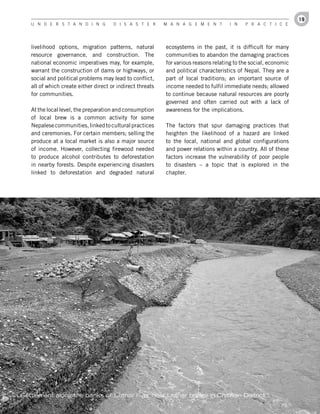
Settlement along the banks of Lothar river near Lothar bridge in Chitwan District
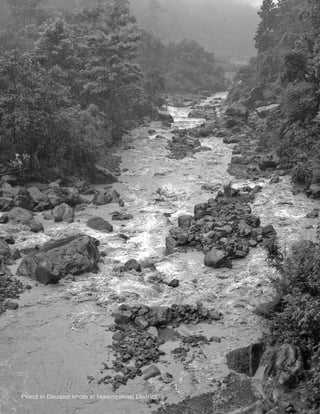
Flood in Deusad khola in Nawalparasi District
21
U n d e r s t a n d i n g   d i s a s t e r   M a n a g e M e n t   i n   P r a c t i c e


                                                 c ha pt e r


     Practical Approaches
                                                        3
                to Disaster
             Management
22
     U n d e r s t a n d i n g         d i s a s t e r      M a n a g e M e n t       i n   P r a c t i c e


     Practical Action works with communities to             both development and disaster management.
     reduce the impacts of disasters and to alleviate       The existing capacities of the community, such
     poverty, with a particular geographical focus on       as the livelihoods and assets, are the basis to
     the districts within Narayani and the Karnali          enhance their ability to improve economic status
     watersheds of central and western Nepal. It takes      and increase resilience. Practical Action along
     an approach that recognises the cross implications     with the communities have initiated integrated
     of these challenges and addresses them jointly         approaches of building resilience by improving
     by reducing vulnerability. Community based             capacities of community and stakeholders to
     Disaster Management (CBDM) concentrates on             reduce hazard stresses, sensitivity and better
     risk reduction measures to where the greatest risk     preparedness such as early warning to reduce
     lies and the worse impacts are likely to be felt.      disaster risks. By incorporating good practices
     This strategy aims to ensure that disaster plans       of each approach into community led actions
     are based on the attributes and weaknesses of          Practical Action attempts at mainstreaming DRR
     the community, and is premised on the belief that      into development at local, district and national
     the existing knowledge of those at risk is vital for   level.


     1. Disaster management approaches

     Disaster management has come along different           vegetables by relatives and neighbours during
     approaches each adamant in different aspects of        funeral, helping disabled and building resting
     disaster management. They vary from traditional        platforms and public shelter houses.
     relief approach to recent ambitious total disaster
     risk management approach. Disaster management          For decades development programmes considered
     is linked to a number of disciplines, contexts,        DRR to ‘prevent development from being
     cultures and practices. So, this chapter briefly       destroyed’ for sustainability of development
     describes the approaches context for practical         achievements.
     application.
                                                            Sustainable	 development	 approach considers
     Traditional	 relief	 approach evolved with the         understanding relationship between disaster,
     kindness and humanity; one has to help others in       environmental degradation and sustainable
     peril. This is based on the fundamental principles     development. DRR is an integral part of
     of humanity and strategy for coexistence with the      development programme with the efforts to
     hope one will get help if s/he helped others. This     enhance the capacities of communities and
     must have been inherited and developed through         coping systems at various levels and sectors
     generations to modern civilisation from natural        towards self reliance and self sufficiency in
     mammalian characters of caring and rearing off         managing disaster effectively. This approach
     springs, family and group security and defending       facilitates the adoption of disaster mitigation
     predators and competitors. Relief approaches           programmes at the local level including structural
     generally perceive disasters made by supernatural      and non structural measures. This is a holistic
     powers. These approaches continue today and            approach of sustainable development promoting
     practices are embedded in cultures and religion.       the culture of prevention and incorporation of
     Examples such as collection of grains and              disaster management in development planning.
23
U n d e r s t a n d i n g          d i s a s t e r      M a n a g e M e n t        i n   P r a c t i c e


Vulnerability	 reduction	 approach is a recent          to different disasters and accordingly disaster
concept that complements existing approaches to         management planning was initiated as piloting.
disaster management and views vulnerability as an       However, implementation process could not take
interaction between a community, its environment        momentum for various reasons.
and hazards. This approach addresses both the
vulnerability and resilience by dealing with the        Vulnerability	 to	 resilience	 approach	 (V2R) is to
causes of stresses and disasters, and strengthening     capacitate vulnerable communities to absorb
communities at risk. It includes a number of            hazard stresses and shocks and bring their
coordinated activities on vulnerability assessment,     livelihoods back to original position. It focuses on
prevention and mitigation, and preparedness for         building adaptive capacity of livelihood elements
response. The strategies are development oriented       to enhance their resilience capacities. It is a two
and espoused to sustainable development. This           way approach of reducing hazard, exposure and
insists on the building resilience capacity of the      sensitivity at one side and enhancing coping
communities through strengthening their livelihood      and restoration capacity of those vulnerable on
capacities and governance.                              the other. There are some broad measures such
                                                        as building linkages between upstream and
Total	 disaster	 risk	 management	 approach is          downstream communities where those who get
conglomeration of all disaster management               benefited (down stream community in particular)
approaches in holistic manner. This is an               pay for environmental services and upstream
ideal concept and a purposive viewpoint                 communities contribute to maintain ecosystem
trying to address disaster management issues            healthy. This focuses on community based
holistically and comprehensively. It focuses on         disaster management. Integrated watershed
the underlying causes of disasters, the existing        management is an appropriate strategy to DRR for
conditions of risks and vulnerability of people         various hazards where vulnerable elements can be
and their assets to different hazards. It also          transformed into resilient ones incorporating all
emphasizes multilevel, multidimensional and             aspects of disaster management. V2R envisages
multidisciplinary cooperation and collaboration in      mainstreaming DRR into development. In Nepali
disaster management. It is a shift from response        context where high mountains in the north and
and relief to preparedness. Nepal tried to adopt        the Tarai are linked through hydrological systems
this approach from 2002 in its 10th plan.               watershed management is the best place to
Twenty three districts were identified vulnerable       envisage V2R.


2. Disaster management and development
Disasters are the greatest challenge for development.   Furthermore, the experience of disasters worldwide,
When one occurs it can claim lives, cause injuries,     even in developing countries have shown that the
wipe out livelihoods, property and infrastructure,      poorest are affected worst by a disaster as they
and cause disruptions on a national scale. Frequent     often live in the highest risk areas, are less able
small scale hazards and stresses can cause even         to protect themselves in anticipation of a disaster
greater losses, particularly for the poorest groups.    and even less able to recover afterwards. In
Amongst such devastation and upheaval progress          addition to this, people in poverty face a greater
made in poverty alleviation can be eradicated and       risk from the spread of disease, the erosion of
development plans could be set back.                    natural resources, conflict and global economic
24
     U n d e r s t a n d i n g        d i s a s t e r     M a n a g e M e n t          i n    P r a c t i c e


     trends which are likely to present more regular      Those in poverty are not only marginalised
     threats than a flood or earthquake.                  geographically into high risk areas, but also lack
                                                          support mechanisms that can help them deal with
     Most people within Nepal experience some             a disaster. Poverty is characterised by a lack of
     degree of risk, but, because of their low economic   rights and/or an inability to access resources and
     status, significant numbers are forced to live       services. This marginalisation is linked to location
     in close proximity to a hazard, either on river      and can be compound by disasters - there are a
     embankments, flood plains, or steep slopes.          number of examples from Nepal where families
     In Nawalparasi District of the tarai region, for     who have lost property and assets in disasters have
     example, many people are highly exposed to the       had to resettle in less favourable areas that lacks
     flooding of Narayani. These communities rely on      basic services and opportunities.
     subsistence agriculture and livestock rearing, and
     with little surplus assets and few resources they    In all, poverty is a major contributor to vulnerability,
     have insufficient means to prevent a disaster,       and both are similarly affected by processes of
     protect what assets they have or to recover after.   social, economic and political systems.


     3. Reducing vulnerability

     A key strategy for Practical Action’s approach       practices of upstream communities, then linking
     to development and disaster management is            the downstream villages to the higher villages can
     to reduce the vulnerability of those groups          create awareness of the issue and encourage the
     that are at highest risk and/or marginalised.        upstream communities towards better watersheds
     Vulnerability includes being subject to ‘the         conservation and providing flood information. In
     conditions determined by social, economic,           this example, supportive relationships can be
     physical, environmental and governance factors       built by sharing the benefit of the river between
     or processes which increase susceptibility to        communities. Many downstream communities
     hazards and the impact of hazards’ (Pasteur,         earn revenue through stone and sand extraction, in
     2010). Within this definition, the physical causes   addition to environmental services such as water
     of vulnerability, such as the natural surroundings   for domestic use and irrigation and, if these are
     and hazard origins, present the most immediate       shared with the upstream communities, it helps to
     risk, and the social and economic processes limit    create trust in the upstream communities helping
     the capacity, particularly of those in poverty, to   conserve watershed, information sharing on the
     deal with the physical factors.                      hazard potential and early information on flood to
                                                          benefit the downstream communities.
     The physical contributors to a community’s
     vulnerability can often be addressed by              Reducing vulnerability requires assessing (see
     a combination of physical measures and               Chapter 4), and addressing all factors broadening
     establishing connections. In a community that        the focus of disaster reduction from the physical
     is susceptible to floods, the physical threat        hazard itself to the wider processes that hinder
     can be decreased by reinforcing embankments,         a community’s ability to deal with a disaster.
     and, if the flooding is caused by the agricultural   However, it is true that the political, social and
25
U n d e r s t a n d i n g               d i s a s t e r          M a n a g e M e n t              i n    P r a c t i c e


Box 3.1. Indigenous knowledge and practices
People in Kaligandaki basin in western Nepal have always witnessed the Siberian crane flying south in March. The crane's
migration denotes the Kaligandaki communities the time for seasonal migration to up hills to sow seeds. Similarly when the
cranes fly north in September/October it indicates the beginning of winter and the time for harvesting crops and returning
back to the lower hills. The timely migration of these cranes provided important information to the communities when there
was no calendar. Those who don’t migrate, this signal is they should start sowing the seed for summer vegetables that grow
through the season (climbers such as gourds and cucumbers) and carry out maintenance to house roofs - if made of thatch -
is carried out so that the buildings are safe from rainfall during the summer.

After the monsoon, houses and foot trails are repaired and doors and windows are repainted by the end of September, which
is aligned with the Dashain festival. As the preparation and reconstruction work is linked to different cultural practices and
embedded in the annual calendar, this ensures that houses, common property or infrastructure gets regular maintenance.
Along with the social, economic and environmental benefits, these traditions help ensure the community can reduce the risk
of hazard associated with the seasons.


economic factors, being abstract and ingrained                    on the causes, vulnerability and potential future
in a country’s configuration as they are, are                     consequences, and actions required to reduce
more difficult to alter in favour of the poor. More               further disaster risk in the new destination. Safety
immediate reductions in vulnerability can be                      factors must be considered during the time of
made by addressing the physical hazards, but if a                 reconstruction such as raising free board and
community has the ability to deal with a disaster,                increasing span of the bridge if floods were the
then it is imperative to gain recognition of their                reason of disaster. Planned response and recovery
situation at higher levels.                                       measures are rare in Nepal hence it is difficult to
                                                                  state an example in place. The end result should
Less attention by planners is generally given to the              be an increase in resilience, whereby communities
smaller hazards that threaten people’s property,                  have greater ability to withstand and change in
assets and livelihood. A holistic approach to                     response to a hazard.
development and DRR planning enables reducing
vulnerability to these issues, saving on the cost of              The context of vulnerability keeps on changing
rescue, relief and recovery measures. Measures                    due to long term trends, markets, governance and
taken to address vulnerability should be initiated                other socio economic dynamics. As described in
during the prevention and preparedness stages of                  Ch. seven, climate change has added additional
disaster planning to limit the effect of a hazard and             uncertainty to the vulnerability context and
ensure communities are ready in anticipation of a                 preparedness for usual hazards, particularly those
threat. However, there is much that must be done                  related to weather events, may not be sufficient
in the response and recovery stages to ensure that                in the future. Better access to information and
vulnerability is not increased as a result of either              efficient forecasting systems and new appropriate
the disaster or even the response strategy. For                   technologies and approaches are becoming
example, resettlement should be made in safer                     essential to the poor communities to deal with the
places; victims should be made aware enough                       vulnerabilities generated by multiple hazards.
26
     U n d e r s t a n d i n g          d i s a s t e r      M a n a g e M e n t         i n   P r a c t i c e


     4. Community Based Disaster Management (CBDM)

     Those vulnerable to disasters are not passive           long term achievements. To this purpose as well,
     victims, but the key actors for dealing with a          CBDMs seek to create links with other actors
     threat and increasing resilience. This is the central   from outside the community that may become
     perspective of CBDM which works with groups at          stakeholders in disaster management plans.
     the local level where vulnerability is highest. It is   Recognising that, whilst a community has local
     based on the understanding that those at risk from      expertise, there are limitations in its ability to act
     a hazard have the skills, knowledge and experience      in response to a hazard, this has the advantage of
     that can be built on in order to plan and prepare       increasing the resource base of the community. A
     for a disaster. Although a community may live in a      community can then draw upon these stakeholders
     fragile area, their indigenous knowledge holds in-      - who may be local, regional, national or even
     depth understanding of the situation and is based       global – as support. Typical external stakeholders
     on familiarity with the locality developed through      may include meteorological stations (providing
     the day to day engagement with the surrounding          flood warning information); universities (expert
     geography, natural environment and local affairs.       advice and latest research); local suppliers
     In order to survive in risky situations, perhaps for    for communication tools; and the emergency
     many decades, communities often already have            services (for response during a disaster). It is
     the survival techniques passed down through             important to include local government officials
     generation.                                             from the early planning stages in order to bestow
                                                             authority to the plans and feed into the national
     Communities are also the ultimate users and             government’s disaster and development plans.
     implementers of disaster management plans,              To ensure sustained disaster preparedness and
     and, therefore, projects must be context specific       to permanently reduce vulnerability, linkage
     and tailored to the local settings and needs.           between the actions of the community level and
     Community members should be engaged in all              national level action must be a key objective of
     aspects of disaster management, including ‘the          a CBDM approach (see chapter 6 for integrating
     identification, analysis, planning, implementation,     community level plans into the national level).
     monitoring and evaluation of disaster risks in
     order to reduce their vulnerabilities and enhance       Local communities can have indigenous ideas
     their capacities’ (UNISDR, 2006). The direct            and practices to avoid and manage small scale
     involvement of a community in disaster planning         stresses despite some superstitious perceptions.
     is essential to determine the appropriate solutions     Successful practices can be incorporated into
     and to ensure that information is generated in a        community plan for DRR and management. In
     manner and language that is accessible for all          many villages in the tarai, communities are
     members. Furthermore, by working closely at the         mixed up from different origins particularly in
     local level, disaster management can be more            the hills from where they had migrated. In such
     inclusive for those vulnerable groups within a          a context there are some additional benefits to
     community, such as women and disabled.                  accumulate indigenous knowledge and practices
                                                             from different communities. However, it is worth
     Ensuring community ownership of disaster                considering whether the idea and practice would
     management is considered vital for sustainable,         work for the locality.
27
U n d e r s t a n d i n g           d i s a s t e r       M a n a g e M e n t         i n   P r a c t i c e


Natural resource management to reduce                     natural resource management reduces hazards
underlying risks                                          and disaster risks. Over exploitation, on the other
Natural ecosystems often provide physical                 hand, decreases the capacity of nature to sustain
barriers, absorb stresses such that the strength of       hazards and stresses and enhances environment
hazard is reduced, and moderate the impacts of            for hazards.
disasters. Healthy ecosystems provide resources
and capacities for community resilience such that         Natural resource management involves management
their livelihoods are restored quickly after a disaster   of natural systems and social processes which
shock. For example if there is well stocked forest,       affect natural resources. It involves management of
communities can utilize timber for reconstruction         different sectors such as agriculture, forests, water
of homes, wooden bridges, tools for agriculture           resources, livestock, land use, biodiversity and socio
and rejuvenate their livelihoods quickly.                 economic development activities such as health,
                                                          sanitation, education and communication which have
On the other hand, degradation of ecosystems              implication to natural resources [Box 3.2].
leads to hazards as it is a hazard in itself.
Deforestation leads to soil erosion, landslides           A best practical approach of natural resource
and flood. Degraded lands are more sensitive to           management in relation to disaster management
excessive rainfall, drought and extreme weather           is integrated management of watershed focusing
events. Natural resources are also affected by            on prevailing hazards and vulnerabilities. In the
hazards. Fire damages forests; landslide damages          context of climate change future trend of hazards
water resources and so forth. Therefore, there            particularly those weather induced should bear
is close relationship between natural resource            in mind while planning disaster management
management and disaster management; wise                  activities including managing local resources.


 5. Livelihood strategies and disaster management

By working closely with a community, disaster             Livelihood strategies depend on the available
management programmes gain a more accurate                and potential access to capitals. The capitals
picture of the opportunities and constraints              can be clustered into different groups [Box 3.2].
faced in relation to a hazard. Understanding the          Strength in a capital can influence and improve
livelihoods of a community - the means involved           other capital. For example human capital utilises
in generating a living and attaining a good quality       other capitals; financial capital can exchange
of life – provides a key indicator of a community’s       services and utilities from different capitals such
vulnerability or resilience in relation to a hazard.      as access to physical capital which is a sum of
                                                          all basic infrastructures that produce goods and
Livelihoods are not just a job or an income source,       services.
but include the ‘assets, skills, technologies and
activities required to make a living and have a good      The capitals are important in the DRR perspective
quality of life’ (Pasteur, 2010). Acknowledging           in two ways - firstly they provide defence and
all the elements – or ‘capitals’ – involved in            resilience capacities to hazards and stresses,
generating a living makes it possible to see that         and secondly they are vulnerable to different
some livelihoods, particularly those of the poor,         disasters. Failing to manage capitals properly can
can lack the constituents that make them secure.          create distress.
28
     U n d e r s t a n d i n g                   d i s a s t e r      M a n a g e M e n t              i n     P r a c t i c e


     Communities that have weak livelihoods are                         further increasing vulnerability (Pasteur, 2010).
     typically more vulnerable to a hazard as they are                  Families affected by flood and landslide often
     often inadequately protected or lack the finance                   start collecting sand and gravels in the stream
     to move when faced with a threat and have little                   beds or wood in the forest to sell in the nearby
     resources to draw upon during a disaster. If a                     market. This raises risk of landslides and limited
     family is only able to carry out subsistence farming               availability of forest resources to other families.
     then they are likely to have little extra money in
     order to protect their produce from an outbreak of                 The aim of a livelihood centred approach is to
     locust, or may not be able to cure themselves if                   strengthen and diversify assets so that they
     they are affected by a disease.                                    remain a reliable resource and coping strategy
                                                                        in the event of a disaster. Livelihoods can be
     All livelihoods are at risk from a hazard if the                   strengthened by either physical protection -
     capitals that underpin them are disrupted and                      such as building irrigation schemes to defend
     those based on agriculture are particularly                        against drought and defensive walls along a river
     susceptible. Farmers possessing small area of                      embankment to stop the erosion of land or by
     land to grow only one type of crop will struggle                   creating linkages that can provide support, such
     to maintain an adequate supply of food if a flood                  as agriculture service centres that supply seeds
     or landslide blankets their fields. Such was the                   and information and provide training and skills
     situation for communities in Daldale, Nawalparasi,                 for agriculture, fisheries and bee keeping.
     when flood in Baulaha Khola destroyed their rice
     crop and land in 2007. To recover from the crop                    Diversifying livelihoods means increasing the
     loss and food shortage, families worked as daily                   options for making a living. Having an alternative
     labourers for minimum wage.                                        crop that can be grown during a dry period can
                                                                        ensure that food supply continues during a disaster
     Furthermore, if conventional forms of livelihood                   or having a non agricultural option may bring in
     are unavailable or destroyed because of a hazard,                  an income when a flood occurs. If a livelihood can
     this can force people to take riskier steps for                    be maintained during a hazard event communities
     income generation, such as farming in more                         can focus on the recovery stage and are less likely
     dangerous areas or entering into prostitution, thus                to become more vulnerable as a result.


     Box 3.2. Agricultural livelihood capitals

     Capitals contribute to the functioning of daily life, self protection and development, and the level of access to these capital
     determines the extent to which a particular community group, household or individual is vulnerable to external trends, shocks
     and seasonality and is able to absorb the effect and impact of a disaster.

     Human     – Health and strength carries out physical labour and tool usage such as knowledge on crops, varieties, fertilisers,
                 disease, pest management and knowledge in inter cultural operations (planting, weeding and irrigation).
     Physical – Irrigation, roads, bridges, footpaths, market place, equipments, storage facilities.
     Social    – Labour exchange practices; rules and institutions to distribute resources, kinships, culture, governance, formal
                 and informal networks and institutions such as cooperatives, market linkages and service providers.
     Natural – Forests, river, underground water, land, biodiversity, weather and climate.
     Financial – Cash or savings for investment, credit facilities, livestock, crops, subsidies when required, seeds and fertilisers
29
U n d e r s t a n d i n g          d i s a s t e r      M a n a g e M e n t        i n   P r a c t i c e


   Weak livelihoods                                        Strong livelihoods
   •	 Reliant on a single form of livelihood/              •	 Diverse option spread that include options
      reliant on one source of input/output                   for generating a income even if disaster
                                                              strikes

   •	 Low income/subsistence level                         •	 More profitable

   •	 Contribute to degradation of the natural             •	 Manage natural resources sustainably to
      environment/add stress to the geology of                protect and reinforce ecosystems
      the area

   •	 Rely on outside support                              •	 Are in the control of local community

   •	 May involve personal risk                            •	 Have strong linkages and access to the
                                                              resources, services and markets

   •	 Isolated from social and technical services,         •	 Are resistant to a disaster
      networks, markets

   •	 Sensitive to even small scale stresses and           •	 Are flexible enough to defend and tolerate
      shocks                                                  stresses and socks.

   •	 Likely to be wiped out in a disaster                 •	 Possess potentiality of restoration


 6. Conclusion: communities prepared for disasters
However, the combination of these approaches            on the networks set up by the CBDM approach
should result in communities that have the capacity     when external support is required. Their livelihoods
to prepare for, withstand, and make a quick             options do not cease during a disaster and, in
recovery from a hazard stress. Local ownership of       non disaster times, increased productivity should
disaster management should mean that community          improve the economic situation of communities
members are in charge of the process and can            and strengthen their capacity to deal with future
instigate disaster plans on their own accord, drawing   threats. This is a position of resilience.
30
       U n d e r s t a n d i n g               d i s a s t e r          M a n a g e M e n t             i n     P r a c t i c e


     Box 3.3. Natural resource management to strengthen livelihoods

       Simalgiri is a village of 47 households on the bank of Rapti River next to the Chitwan National Park in Chitwan. Agriculture,
       livestock rearing, daily wage work on agriculture and fishing are parts of livelihoods and income. They own small pieces of
       land with de facto use right.

       Some of the major hazards faced by the Simalgiri community were flash floods, particularly during the summer months from
       June to October, wildlife intrusion year round and lack of water for irrigation between November and May. Limited skills
       provided opportunities to plant maize only. The grains produced was only sufficient to cover food supply for 3 to 6 months.
       To fulfil gap shared cropping in others' land and daily wage work.

       In 2007 a natural wetland was improved by constructing a dam and linking it through a channel to the farming fields. Two
       shallow tube wells were constructed to increase water supply. These provided irrigation for crops during the winter and dry
       period, thereby reducing sensitivity of crops to droughts.

       They received trainings and inputs on cereals and vegetables for two years along with best practices. Crop production
       increased in quantity and variety. Today, communities are growing crops in different seasons compared to the growth of only
       one type of crop - maize in the past. People are selling vegetables after household consumption in the local markets. Food
       security has improved drastically with greater production from their land.

       The upstream and downstream communities are linked with telephones to help them receive flood information at an earlier
       stage which helps them prepare better, save their livestock and other important portable necessities. A disaster management
       committee has also been formed at the local government level which has responsibility of preparedness and response to
       disasters.

       With support from national park and other stakeholders the community erected low voltage electric fencing around the village
       to prevent wildlife intrusion. Community have constructed flood dykes with support from different stakeholders which can
       protect the village from medium scale flood. The outcomes have secured and increased livelihood assets, both in quantity
       and quality. Although vulnerability to more severe flooding still exists and the communities still have further development
       requirements, they now have food security for almost the whole year and the self-confidence to bounce back from shocks and
       stresses.


 Farmers in Simalgiri village planting rice in March after gaining access
 to improved irrigation facility
31
U n d e r s t a n d i n g   d i s a s t e r   M a n a g e M e n t   i n   P r a c t i c e


                                                 c ha pt e r


    Practical Methods for
                                                        4
          CBDM Planning
32
     U n d e r s t a n d i n g                  d i s a s t e r       M a n a g e M e n t                   i n     P r a c t i c e


     Advance planning is imperative for disaster                          Municipalities (urban communities) to integrate
     management; it can minimise risk, substantially                      these strategies into their development plans.
     reduce loss and significantly ease the drudgery
     and cost of rescue, relief, resettlement and                         This chapter describes a practical approach to
     reconstruction. It provides the opportunity to                       disaster management based on field experiences
     implement appropriate mitigation strategies, which                   gained while preparing disaster management plans
     distinguish disaster preparedness from pure relief                   for 59 village development committees (VDCs are
     work, and also incorporate DRR into development                      the lowest administrative and development units)
     plans. With the active participation of vulnerable                   in Nepal’s Chitwan and Nawalparasi Districts. It
     communities, the Community Based Disaster                            is a modified version of a paper that appeared
     Management approach to planning helps identify                       in http://practicalaction.org/docs/region_nepal/
     local hazards, devise locally appropriate strategies                 practical-approaches-cbdm.pdf [Practical Action
     and formulate development activities. Because the                    2009]. The needs of the local communities
     community participates in the development and                        in these areas provided the impetus for the
     implementation of these plans their ownership                        development of locally owned, community based,
     and sustained use of the plans is ensured.                           multi stakeholder disaster management plans,
     Whilst the plans are tailored to the context of the                  and as explained in detail in chapter six much
     community, a key objective is to enable local bodies                 effort was given to link the plans of the VDCs into
     such as Village Development Committees and                           the national and international disaster policies


     Figure 4.1. CBDM planning process at local level


            1.	Assessment	of	vulnerable	VDCs/
            municipalities	to	different	disasters	
                    and	their	ranking
                                                           3.1	VDC	level	orientation	
                                                              and	consultations	
                  2.	Selection	of	VDCs/                                                                    Planning	method
                 municipalities	for	disaster	
                                                           3.2
                                                                   Ward/community	


                  management	planning
                                                                   level	assessment


                                                                                      Data	collection


                                                                                                          3.3.1	Vulnerability	
                                                                                                         analysis,	prioritization	
                                                                                                        and	root	causes	analysis
               3.	Disaster	management	plan	
               preparation	in	selected	VDCs/
                      municipalities	                                                                   3.1.2	Community,	VDC	
                                                                                                         capacity	assessment
                                                            3.3	Planning	workshop
            4.	Broader	stakeholder	consultation,	                                                           3.1.3	Disaster	
             verification	of	draft	plans	and	final	          3.4	Cost	estimate	of	                        management	action	
                                                                                                           plan	preparation
                    draft	plan	preparation	                 physical	infrastructures


                                                                  3.5	Draft	Plan
                  5.	Endorsement	of	plans	
                     for	implementation
33
U n d e r s t a n d i n g           d i s a s t e r     M a n a g e M e n t         i n   P r a c t i c e


that have provisions to do so. The objective of the     at these levels such as VDCs and DDCs , and
prepared plans is to enable communities and local       supported by local and national stakeholders. The
governments to prevent, reduce and effectively          active participation of vulnerable communities
respond to stresses, shocks and potentially             and other appropriate stakeholders is essential.
disastrous events and implementing them has             The planning process consists of five major steps
been an essential component of poverty reduction        described below and illustrated in the flow chart
and sustainable development. The communities            [figure 4.1]. The process can be modified based
that have implemented activities from their plans       on local contexts.
have developed resilience to different stresses,
shocks and potential disasters.                         Different tools can be used to analyse vulnerabilities
                                                        and risks and devise strategies to deal with
Disaster management planning process                    different hazardous situations. Community level
As communities fall under the constituency of           assessments of vulnerability and capacity are best
local and district government, developing the           conducted using participatory tools (Actionaid,
plans should be led by the appropriate agencies         nd; Blaikie et al, 1994; Cannon et al, 2003)


1. Vulnerability assessment of VDCs, municipalities and their priority ranking

a)      Vulnerable    or    potentially   vulnerable    b) The ranking of the VDCs according to their
     communities can be identified by the existing         communities’ vulnerability status is then
     hazards they face and the stresses and                discussed by representatives of the various
     disastrous events and losses suffered in the          stakeholder groups – members of District Disaster
     past. Secondary information, from documents           Management/Rescue         Committee      (DDMC),
     and records in DDC, VDC and municipality              political party representatives, relevant I/NGOs,
     offices is collected, analysed and collated.          district level experts and VDC and municipality
     The VDCs and municipalities are grouped               representatives. These deliberations provide an
     together on the type of vulnerability faced by        opportunity for the ranking of individual VDCs
     the communities within their constituency             and municipalities to be changed. Detailed and
     those vulnerable to flood, landslides, and            objective information helps to minimise conflicts
     susceptible to drought. Factors such as existing      of interest and reduces the time taken to reach
     hazards, levels of risk, exposure of population       a consensus. In the event of disputes, the
     and threats to livelihoods and assets, coping         district disaster management/rescue committee
     strategies, degrees of resilience and issues of       will make the final decision. The ranking
     governance are all considered in categorising         identifies the most vulnerable communities and
     the level of vulnerability represented by each        selects the VDCs that will be prioritised for the
     VDC (highly vulnerable, vulnerable, moderately        development of disaster management plans plus
     vulnerable).                                          the implementation of risk reduction initiatives.
34
     U n d e r s t a n d i n g           d i s a s t e r      M a n a g e M e n t         i n    P r a c t i c e


     2. Selection of VDC/municipality for CBDM planning

     a) All the VDCs and municipalities representing             The task force may be comprised of officers
        vulnerable communities, no matter what                   from the District Development Office, District
        their ranking, can be selected for disaster              Technical Offices, District Administration
        management planning provided that adequate               Office, District Agriculture and Livestock
        resources and time are available. When                   Offices, other relevant Government Offices and
        resources are limited, it may be necessary               NGOs. The taskforce should be coordinated by
        to prioritise the most vulnerable and disaster           the Planning Officer or Disaster Focal Person
        prone VDCs identified in the ranking exercise            of the DDC. This provides the necessary link to
        above. Political influences and other stakeholder        the VDCs, municipalities and other stakeholders
        interests may need to be taken into account              and ensures the integration of DRR into District
        in making these choices. The commitment to               Development Planning.
        implement plans once formulated and other
        factors may also influence the choice of which        c) The taskforce should develop Terms of
        VDC or municipality is prioritised. It is suggested      Reference (ToR) and a work plan for the
        that an independent arbitrator (possibly an              CBDM process. It is important to define
        NGO, a group of independent non aligned                  and agree a methodology (what is to be
        experts or a consortium) should facilitate the           done, when, where, how and by whom) and
        inevitable consultation to choose which VDC              a budget. The ToR and work plan should be
        or municipality should be selected as the DDC            approved by the DDMC or the DDC who than
        planning officers will need assistance.                  organises the human resources, budget and
                                                                 other necessities from either the government
     b) The overall leadership for coordinating the              or other sources. With the constraints of the
        planning process should be led by the local              ToR and the resources available, the taskforce
        government officials. A task force can be                may decide to employ consultants/service
        formed by the DDMC to steer the process                  providers/supporting institutions to deliver
        which is facilitated by an independent advisor.          specific components of the planning process.


     3. Disaster management planning of selected VDCs/municipalities
     In order to ensure that all VDC and municipality         vulnerabilities in their respective communities.
     stakeholders have a similar understanding                Enlightened stakeholders can inform other
     regarding vulnerability and disasters, orientation       members of their VDCs and communities thereby
     workshops need to be held. The workshop will             increasing the amount of people sensitive to
     help update those at the VDC and municipality            disaster and vulnerability issues. This will facilitate
     levels who were not involved in the district level       the identification of vulnerable communities
     consultation processes. Discussions on theoretical       within their respective VDCs.
     and practical aspects of DRR will increase the
     awareness of participants on the importance of           The members of the local government taskforce
     disaster management. With this information, VDC          need to coordinate; facilitate and monitor the
     personnel will be able to identify hazards and           planning processes and methods in the field.
35
U n d e r s t a n d i n g          d i s a s t e r      M a n a g e M e n t         i n    P r a c t i c e


Timely feedback to the consultants/service              questionnaires or checklists. Data should include
providers/supporting institutions helps to address      information on the numbers and groups (age,
the needs and priorities of the stakeholders active     gender) of people, assets and livelihoods, natural
in different VDCs. Monitoring the process by Chief      resources and infrastructure affected by locally
District Officer, Local Development Officer and         occurring hazards. On the other side different
other members of the DDMC makes the overall             information should be collected on capacities
planning more effective.                                of local communities and stakeholders such as
                                                        community and VDC/municipality to manage
VDC/municipality disaster management planning           disasters in the context of identified vulnerability
should follow the following steps:                      and locally available resources and their resilience
                                                        potential. This information will be analysed in the
3.1 Ward and community level                            planning workshop. Information on capacities
assessments                                             should include the ability of the community to
Wards are sub divisions of VDCs or municipalities       cope and manage the impacts of hazards and
and consist of different villages, settlements and      shocks, and the availability of services and facilities
communities. Wards and communities identified           (health posts, shelters, ambulance, fire service and
in the orientation workshops should be visited to       trained personnel). Past events and their impacts
collect information on the hazards and stresses         are of particular relevance. The information from
to which they are exposed. Using participatory          community discussions and checklists can be
vulnerability assessment methods and tools,             checked against information recorded in relevant
information on local experiences, losses, coping        VDC offices. The information gathered from ward
strategies, capacities and resilience to the            level assessments and that collected from primary
impact of hazards can be collected. This enables        and secondary sources must be used in unison to
communities to identify their vulnerabilities,          cross check the validity.
capacities and gaps. This information, while
essential for the preparation of CBDM plans, also       3.3 Planning workshops
provides a pool of information for the development      Once the necessary information is gathered, a
of VDC disaster management plans. It may not be         planning workshop should be organised for as
possible for the consultants or taskforce members       many stakeholders from each VDC/municipality
to visit every community (nor every family in           as possible. Workshops can be organised for
each community). During the VDC orientation             individual VDCs or for up to three similarly
workshops, it should be possible to identify a          vulnerable VDCs. There are both benefits and
representative sample of communities to be              constraints in organising workshops together for
visited. Vulnerable communities within wards can        more than one VDC. Having more than one VDC
be clustered on the basis of similar vulnerabilities.   present provides the opportunity for adjoining
Facilitators may need to visit as many areas and        VDCs to manage disasters in coordinated way.
sites as possible to collect and verify information.    Furthermore, detailed plan development can be
All information needs to be recorded and collated       carried out in separate groups. However, care
for later interpretation and use.                       must be taken to ensure that representatives of
                                                        the most vulnerable communities participate in
3.2 Data collection                                     the workshop and have the chance to express
Relevant information can be collected from VDC/         their opinions as they are most frequently
municipality records and from communities using         disenfranchised at such opportunities. The
36
     U n d e r s t a n d i n g         d i s a s t e r      M a n a g e M e n t        i n    P r a c t i c e


     participation of local government officials, such      different sources relating to their specific VDC.
     as DDC Planning Officer or members of the DDMC         Where members from more than one VDC are
     is essential for the legitimacy of the planning        participating in a workshop, common issues such
     process. Other participants should include:            as methods for analysing and prioritising data can
                                                            be discussed in plenary and issues specifically
     •	 VDC president, vice president, secretary and        relating to a particular VDC will be discussed in a
        relevant staff                                      separate group. Facilitators will help to maintain
     •	 Ward members or representatives of political        focus in the groups, clarify misunderstandings
        parties whose constituency includes the VDC/        and defuse disagreements.
        municipality
     •	 Representation for the local Nepal Red Cross        The stakeholders representing each VDC or
        Society in the VDC (or the area if their branch     municipality will be guided through a three stage
        is not in the office)                               process; (a) situation (vulnerability and risk)
     •	 Community forest user groups and other              analysis, (b) root causes analysis, (c) capacity
        resource user groups                                analysis and (d) the drafting of a disaster
     •	 Representatives from among disaster affected/       management plan.
        vulnerable community
     •	 Individuals with expert knowledge on disasters      a)	Situation	analysis
        and coping strategies                               Information collected from different parts of the
     •	 Representatives of women and marginalised/          VDC (see 3.1 and 3.2 above) relating to hazards
        groups                                              is examined. Initially all the prevailing hazards
     •	 Representatives from civil society/I/NGOs           are listed.
        working in the field of disaster management
        in the VDC                                          Building on the data collected in communities
     •	 Representatives of respective government line       and supplemented by the participants’ own
        agencies in the VDC or from areas such as           recollections of past events, the severity, frequency
        agriculture, forestry, livestock development,       and impact of hazards and stresses are discussed
        health, security                                    and tabulated.

     An initial orientation of the participants is needed   Some of the hazards listed may not appear in the
     to ensure a common understanding of disaster           historical timeline as they might be “normally”
     management. The duration of the planning               occurring annual small scale stresses, or very
     process is dependent on the understanding              infrequent events. Discussions among the
     and engagement of the participants, but past           participants will determine whether they need to
     experience suggests that a four day residential        be included in the draft plan or not.
     workshop is usually sufficient; the first day
     being devoted to the introductory session while        Discussion and analysis of frequency, severity
     the following three days are devoted to the            and losses from each event and the reasons for
     development of the disaster management plan.           the impacts of hazard event will help participants
                                                            to understand why planned interventions are
     3.3.1 Planning methodology                             needed to reduce their impact and aid recovery.
     The participants from each VDC will initially          Participants will begin to recognise how their
     examine and verify the information collected from      communities can improve their resilience.
37
U n d e r s t a n d i n g          d i s a s t e r      M a n a g e M e n t        i n   P r a c t i c e


The hazards and stresses can be categorised             ranking of identified hazards and stresses is
into high, moderate and low impact events on            necessary. Four categories are used to classify the
the basis of the losses to life, property, land,        frequency, severity and impacts of past hazards at
livestock, infrastructure and natural resources. The    ward or community level; high, medium, low and
frequency in which such events occur is relevant.       negligible. Participants need to understand and
For example, an earthquake may cause massive            agree on this classification. Using information
losses, but occur very infrequently. A combination      collected at ward and community levels, a matrix
of severity and frequency will determine the            can be constructed for each VDC or municipality.
importance of a particular hazard with respect to
its impact on the affected community.                   Suggested	indicators:
                                                        High: The hazard occurs frequently and is
Suggested	indicators:                                   extremely damaging. Communities suffer large
High	 frequency	 hazard: One that has occurred          losses and recovery takes a long time. External
at least twice in 5 years or 3 times in 10 years.       support is needed.
The occurrence of the hazard appears to have
increased in recent decades.                            Medium: The damage caused by the hazard
                                                        are less, but still significant. Recovery requires
Medium	frequency	hazard: One that has occurred          external support.
1 to 2 times in the last 5 years or at least twice in
the past decade.                                        Low: The hazard causes relatively little damage
                                                        and the community is able to cope without
Low	frequency	hazard: Hazards that have occurred        external support.
only once in the last 10 years or more.
                                                        Zero: The hazard either did not occur, or if it did,
Highly	severe	hazard: One that has caused severe        it caused negligible damage.
damage in past events.
                                                        As plans are made to deal with future events, the
Medium	 severe	 hazard: One that has caused             participants need to be made aware if and how the
moderate damage in past events.                         circumstances that determine their relationship
                                                        to a hazard have changed. Factors which may
Low	 severe	 hazard: One that has not created a         influence future events include development
situation where external support has been sought.       activities such as road or bridge construction,
The affected family or community has been able          embankment works, population growth, changes
to cope and manage using their own capacities           in cropping patterns and the impacts of climate
and resources.                                          change. Future vulnerabilities in the face of such
                                                        changes need to be taken into consideration. The
Community	vulnerability	to	hazards                      exposure, sensitivity and resilience of different
Each hazard or stress experienced in the past or        livelihood strategies and assets to particular
more recently, may not necessarily have affected        hazards and stresses are of particular relevance
every community within the VDC to the same              with respect to future hazardous events. Detailed
extent. Some communities may have been severely         consideration of the location and number of
affected while others remained almost untouched.        exposed households, the location of fields and their
In order to account for this, community or ward         exposure to flooding and erosion is important.
38
     U n d e r s t a n d i n g          d i s a s t e r        M a n a g e M e n t        i n   P r a c t i c e


     Table 4.1. Summary of hazard analysis
                                   Flood                Fire                Cold wave               Hazard N
                                   High Medium High Medium High Medium High Medium
      Severity and frequency       1       1            1       1           -         -         -

      Ward level assessment        5       4            -       2           -         1

      Vulnerability assessment     5       -            -       3           -         1

      Total                        11      5            1       6           1         2


     The production of a hazard map for each                   Four categories of hazards, based on
     community or ward is a useful resource that brings        destructiveness, frequency of past occurrence and
     together this information in an understandable            degree of vulnerability are identified. Based on
     form. The relationship between hazard, exposure,          the past occurrence some important hazards such
     sensitivity and resilience is simply displayed.           as earthquakes and other low level hazards might
                                                               have rated zero but may in the future become more
     Both qualitative and quantitative information             frequent or increase in intensity. Low level hazards
     is valuable in assessing current and future               cannot be ignored. Expert information (for instance
     vulnerabilities. Most of the information will be          climate change predictions) may ultimately
     collected at the community level prior to the             need to be taken into consideration, but for the
     planning workshop. Information such as 6,000              current purposes of developing the VDC disaster
     people are extremely exposed to flooding in Ward          management plans, it can be omitted as there are
     5, or winter crops in 10 hectares worth XX,000            existing hazards more important to deal with.
     rupees are vulnerable to drought. Cold waves in
     Ward 3 contribute to a more detailed picture of           The remaining hazards need to be prioritised
     the vulnerability of individual communities or            based on their severity and frequency and the
     wards. The basis for formulating risk reduction           vulnerability of the specific ward or community.
     plans is the relationship between the hazard, its
     nature, frequency and impact, and the exposure            Priority ranking should draw information from
     and sensitivity or resilience of the component            tables on frequency, severity and current and future
     or assets of the affected communities. A hazard           exposure (vulnerability) of different assets such as
     that impacts negatively on many sectors - such            land, crops, livestock, infrastructure and human
     as agriculture, water and health - or assets of           life analysed separately and categorised into high,
     a community or particular livelihood strategies           medium and low categories. Hazard 1 (flood) has
     indicates a high degree of vulnerability. Qualitative     the highest score (11) in the high category and
     and quantitative information from community and           also scored (5) in the medium category. Similarly,
     ward assessments is summarised in table 1.                hazard 2 (fire) scored second highest score (1 in
39
U n d e r s t a n d i n g        d i s a s t e r     M a n a g e M e n t        i n    P r a c t i c e


high and 6 in medium categories). Although both      particularly human factors that contribute to
fire and cold wave have 1 point on high category,    hazard that are being included in the action
fire has greater potential to create disastrous      plan. There are different PRA tools to analyse
situations as it spreads in more community (wards)   root causes one of which can be used. The root
and more livelihood elements are affected. This      cause analysis exercise helps understand cause
sort of analysis provides an objective view of the   and effect relationships between different factors
disaster risks faced by the people in a vulnerable   that ultimately lead to vulnerability of a particular
community and forms the basis for the preparation    disaster. The supportive information to identify root
of the disaster management plan.                     causes would be available during community level
                                                     assessments and vulnerability analysis as well.
Past experience has shown that a plan can be
prepared by taking account of the three top-         c)	 Community	 and	 VDC/municipality	 capacity	
ranked hazards, as these have proven to have         analysis
the greatest impact on the affected community.       Having prioritised the hazards and their root
However, management of these three hazards           causes analysed, the stakeholders need to asses
should enhance the capacities of the affected        the capacities of the community and VDC to
communities to manage less significant hazards,      cope with and manage disasters needs. Again,
and the VDC or DDC can select other hazards that     this is done using the information gathered
should be in the plan.                               from the ward assessments, VDC records and
                                                     the judgment of participants. Some resources
Many hazards are seasonal in nature and are          essential include early warning systems, boats,
most severe at particular times of the year. This    life jackets, trained rescue groups, access to
particularly applies to weather related hazards      different services such as communications and
such as floods, droughts and cold waves. It is,      emergency shelter (this is not an exhaustive list).
therefore, useful to prepare a seasonal calendar     Alternative livelihood options or access to means
which identifies when particular hazards most        of maintaining minimum standards of living for
commonly occur.                                      the duration of a disaster as well as the means to
                                                     rebuild livelihoods are essential components of
The calendar indicates that preparedness             any disaster management plan.
activities to cope with floods should be completed
before the middle of June each year, while           Some of the necessary capacities are institutional,
awareness activities on fire prevention should       such as trained personnel, access to humanitarian
start in February. Some disaster events such         support, health workers, and issues of governance.
as earthquakes, outbreak of certain diseases         Others are material inputs such as boats, rescue
and industrial accidents are unpredictable and,      equipment and emergency food supplies.
therefore, can not be anticipated.                   Community awareness, preparedness and the
                                                     existence of an evacuation plan (contingency
b)	Root	causes	analysis                              plan) helps to limit losses and save lives. The
Each hazard has different causes behind, both        physical infrastructure such as roads, bridges and
natural and man made. Causes and contributing        embankments play an important part in protecting
factors for each prioritised hazard for CBDM plan    communities. Participants of the workshop
need to be analysed in detail. It helps to devise    should carry out a detailed analysis, based on the
strategies and actions to mitigate the factors       information available from data collection at step
40
     U n d e r s t a n d i n g                d i s a s t e r          M a n a g e M e n t              i n     P r a c t i c e


     Box 4.1. Negligence to smaller issues may cost high

     Generally, smaller issues may be ignored by planners but these play an important role in disaster events, for example,
     neglecting to extinguish fires after cooking in picnic locations. Raising awareness on the smaller issues might be overlooked
     by the planners who think they are not important. Some malpractices, such as slash and burn and shifting agriculture
     practices, might be so firmly embedded in local culture that they are not perceived as hazardous and are consequently
     overlooked or not disclosed in the planning process. In one example, communities hesitated to disclose their practice of
     making and selling liquor, which was one of the main contributors to deforestation. Awareness of all the causes, contributing
     factors and impacts of livelihood strategies in increasing vulnerability is crucial in CBDM planning. People will not give up
     their traditional practices unless better alternative options for livelihoods are made available. Appropriate policy needs to be
     coupled with access to technologies that encourage this transformation.


     3.2 and additional information they would have,                    the activity such as community, VDC, and DDC to
     of what assets exist and what capabilities can                     support if the lead agency would require support,
     be enhanced needs to be carried out in order to                    when to implement the activity. An estimated
     identify elements for inclusion in the VDC plan.                   cost is in a corresponding cell to the activity.

     d)	 Preparation	 of	 disaster	 management	 plan	 of	               3.3.2 Estimate costs of physical
     action                                                             infrastructure
     After the stakeholders have evaluated in detail the                The final aspect of disaster management planning
     vulnerabilities and capacities of communities, a                   is the costing of the physical infrastructures, such
     plan of action is prepared. With particular focus on               as embankments, check dams, access to roads and
     the prioritised hazards identified in the foregoing                shelters identified as being necessary to reduce the
     phases of the workshop, this takes account of the                  exposure of some communities. Similarly, EWS,
     different measures needed to be taken at each stage                rescue equipment and other more expensive hardware
     of the disaster management cycle. The work plan                    may be identified in the plan. Estimating the cost of
     contains the tasks to be carried out before, during,               these resources should be undertaken by technical
     and after a disaster.                                              personnel from the VDC and DDC in consultation with
                                                                        the relevant communities. This will involve site visits
     A simple format of a work plan is given below                      and feasibility studies before costs can be inserted
     and an example is provided as an annex to this                     into the plans. As costs are steadily increasing and
     document. Contained in this are columns stating                    can change according to context and market prices,
     the activities to be carried out in particular                     the estimation for large scale structures is best
     locations, agency to take lead role to implement                   undertaken shortly before implementation.


     4. Stakeholder consultation and plan verification

     The draft plan prepared using the procedures                          the event of a disaster
     above should include:                                              •	 A cost estimation for the physical infrastructure
                                                                           needed above
     •	 A list of actions to prevent communities from a                 •	 Certain predictable activities for recovery
        hazard, including structural and non structural                    stages (the losses caused by disaster largely
        measures                                                           determine the activities and the costs of
     •	 A procedural plan for communities to follow in                     recovery stage)
41
   U n d e r s t a n d i n g       d i s a s t e r     M a n a g e M e n t       i n   P r a c t i c e


   The draft plan should be distributed to the         The draft plan should then be shared with
   participants of the planning workshops in their     the relevant government and civil society
   villages such that each has opportunity to review   organisations at district level for comment and
   among community and provide further comments,       feedback. A consultation workshop can be held
   feedbacks, and additions from the community.        for this purpose. National ministries and relevant
   VDC can distribute and again collect the document   departments, such as the Ministries of Home
   with feedbacks and provide to facilitator for       Affairs and Disaster Management and Local
   incorporation of feedbacks in the final draft.      Development should be consulted for their inputs.
   The plan may be amended to incorporate all the      The final plan should incorporate all the relevant
   feedback collected.                                 comments and feedback accumulated.


   5. Approval of plan and implementation

   The final plan should be endorsed by the            is an essential part of sustainable development,
   respective VDC or Municipality Council and          there are different possible roles for outside
   approved for inclusion in their local development   communities, agencies and stakeholders in the
   plan. Similarly, the plans of the different VDCs    plan. These stakeholders might not have initially
   and municipalities within one district should       been involved in the planning processes, but the
   together be endorsed by the DDC Council             plan should be communicated to all concerned
   and approved for inclusion in the District          stakeholders who might be able to contribute to the
   Development Plan. The DRR plans should form         implementation of the plan. Coordination among
   part of the Periodic Development Plans of both      various stakeholders and agencies is crucial for
   the relevant VDC/municipality and DDC. As DRR       the ultimate implementation of the plan.


Discussion in community and participants preparing CBDM plan
District level stakeholder consultation meeting for VDC level
Disaster Management Plan in Nawalparasi District
43
U n d e r s t a n d i n g   d i s a s t e r   M a n a g e M e n t   i n   P r a c t i c e


                                                 c ha pt e r


                 Implementation of
                                                        5
                      CBDM Plans
44
     U n d e r s t a n d i n g         d i s a s t e r      M a n a g e M e n t       i n   P r a c t i c e


     After the planning stages, the implementation          first few hours of a flood. Treating disasters as a
     of disaster plans is the initial step to reducing      cycle recognises the continual nature of mitigating
     vulnerability to a hazard. Based on the priorities     disaster risk and draws attention to how each
     identified in the vulnerability assessment,            stage is connected to the next. By addressing
     communities, with support of disaster agencies,        the whole disaster cycle, communities develop
     work to address the threat and ultimately limit        the capacities needed to prepare, act, rebuild
     the effect that a potential future disaster would      and learn, thereby increasing their power over a
     have. Effective disaster management does not           hazard and boosting their resilience to disasters.
     wait for a disaster to strike before acting, but
     starts as early as possible when a particular threat   The model also helps to understand disaster
     to human life and livelihoods is identified. There     management and its close linkage with the
     are certain actions that are only applicable when      development activities by the local planners,
     or after a hazard event occurs, but, by thoroughly     community leaders and general community
     preparing in the pre disaster phase, a community       members as DRR and development activities are
     will be ready to implement these measures when         related - one affecting the other. Integration of
     required.                                              development and DRR helps to reduce disaster risk
                                                            while isolation increases the problem or lessens
     The standard model for understanding when and          the outputs of inputs and investments. Local
     how to act in relation to a hazard is the disaster     governments or disaster management bodies would
     management cycle, which treats disasters on a          be better to take leadership on formulation and
     timeline divided into the ‘pre’, ‘during’ and ‘post’   implementation of disaster management plans.
     disaster stages. The model provides guideline for      Local governments or DMC can plan activities
     communities, practitioners, planners and policy        in different stages based on the hazard calendar
     makers when and how to devise strategies and           identified during CBDM planning. For example,
     activities for particular hazards. The management      the hazard reduction and preparedness activities
     plan provides DMCs a guideline to decide and           before the probable month of hazards, response
     implement when and how to take preventive              during hazard event and recovery and reviving
     measures and prepare for response and relief           activities after hazard event is over. It becomes
     measures in the vulnerable communities. As             almost year round intervention where there are
     a simple concept, the model can be applied to          more than one hazard arising at different period
     different types of hazards, but the four stages will   in a year. The usual development practices runs
     appear differently in practice for fast and slow       together with DRR activities throughout the year.
     onset hazards. For example, for the latter, the        Therefore, disaster management plans should be
     ‘during’ disaster period will be protracted over       integrated to development plans, in other words,
     a longer period and will not generate the same         DRR and development should be integrated to
     intensity or urgency as experienced during the         each other.
45
U n d e r s t a n d i n g           d i s a s t e r       M a n a g e M e n t          i n     P r a c t i c e


Figure 5.1. Disaster management cycle


                                    Disaster
                                                     Response                     During disaster
                                     Event
                                                                                       phase


      Before disaster phase

             Preparedness


                                                                Restoration and          After disaster
     Preventive measures                                        reconstruction               phase
   (mitigation of hazards and
   their contributing factors)


1. Pre disaster phase
Preparation before a hazard is the most crucial            governance mechanism have long reaching impacts
opportunity for drastically reducing the effect and        on disaster mitigation. While construction of flood
impact of a hazard. By preparing for a disaster,           barrier can be considered as short term mitigation
communities are proactive in addressing the threat         measure, conservation of watersheds is a long
and disaster agencies are not limited to reacting to       term mitigation measure for rainfall induced flash
an event. Both are working together to protect the         flood. Overall objective of mitigation in disaster
lives, livelihoods and property, and, when a hazard        management is to reduce the magnitude of hazard,
occurs, the efforts in the pre disaster stage will help    exposure and sensitivity to hazard and increase
the next two stages to be carried out more efficiently.    coping capacity of the community and their assets.
The actions required prior to a disaster can be split      The objective is seldom achieved in full as hazards
into two strategies, mitigation and preparedness.          are part of dynamic natural and socio economic
                                                           processes. So, certain degree of vulnerability is
Hazard mitigation                                          anticipated even after successful implementation
Activities undertaken to reduce the impact of hazards      of mitigation measures. Preparedness activities are
are an integral part of community plans. These             necessary for risk management and to reduce losses
range from the building of barriers which protect          if the hazards occur.
communities from the physical aspect of a hazard,
such as the construction of flood proof housing,           Preparedness
to training in alternative, more resilient livelihood      Preparedness is getting ready for a hazard and
strategies and linkages made with support networks.        being able to act when one occurs. Preparation
Where possible, efforts are made to address the root       begins at the planning stage where, as explained in
causes of vulnerability. Mitigation involves both short    the last chapter, village level disaster management
term and long term activities in different sectors for     committees are helped to develop plans based
long durations. For example, raising awareness and         on a community’s context. The type of measures
understanding the hazards and their root causes            required depends upon the nature of the hazard
are continuous activities lasting for longer period        and the existing capacities of the community. The
of time. Establishment of institutions, policy and         components such as establishing early warning
46
     U n d e r s t a n d i n g            d i s a s t e r             M a n a g e M e n t                  i n   P r a c t i c e


     systems, plotting and rehearsing evacuation                       the information received, it may be too late to
     procedures, participating in training to deal with                take any action and the message could not be
     the aftermath of disasters (search, rescue and                    relied upon in the future which undermines the
     first aid courses) and stockpiling emergency                      usefulness of the EWS. Hence, setting up a
     supplies could be included. Even relatively                       system which guarantees regular and accurate
     simple measures, such as storing belongings                       updates is essential.
     and important documents (land registration
     certificate, citizenship, ration card, passport) in               Figure 5.2 an ideal early warning system and
     safer places, are useful practices that can help                  figure 5.3 at end of this chapter reveals the EWS
     prepare for disasters.                                            mechanism set up in the downstream of Narayani
                                                                       River in Nawalparasi District based on telephone
     Installing effective and well connected                           and radio communication. Within vulnerable
     communication channels plays a vital role in                      community, mix of telephones, hand mikes,
     early warning systems (EWS). As widely available                  sirens and other indigenous means of quick
     tools; telephones - mobile or landline, radios,                   communication can be utilised.
     sirens, television broadcasts, and hand mikes
     can be used to disseminate information about a                    Providing training for rescue, storage of emergency
     hazard. Multiple communication channels help                      goods, medicine, construction or maintenance
     disseminate warning signs to a wider community                    of emergency shelters are some examples of
     and lower the risk of disrupted service. Ensuring                 preparedness for particular hazards. The overall
     the authenticity and reliability of information is                objective of activities at the preparedness level is
     important for the effectiveness of the EWS. If                    to be prepared to defend or respond better to the
     people find that a hazard scenario differs from                   anticipated hazard.


                            Figure 5.2. Early Warning System for disaster risk management

                                                     Research	and	monitoring	centre


                                                        Information	relay	station


                             Radios,	Televisions,	       Rescue	agencies,	units	         Stakeholders	for	
                             Telecommunication	           (DDRC,	Police,	Army,	       rescue	and	relief	(Red	
                                   centres                     DDC	etc)                Cross,	Health	service	
                                                                                            office	etc)


                                                        Vulnerable	communities
47
U n d e r s t a n d i n g         d i s a s t e r      M a n a g e M e n t         i n   P r a c t i c e


2. During disaster phase

In the event of a fast onset disaster, the situation   specific equipment may need to be mobilised.
is likely to be chaotic where people are shocked       The special requirements for particular groups
and confused. The task at this stage is primarily to   such as pregnant, handicapped, children and old
safeguard human life. Rescue and relief measures       age should be taken into account while carrying
involve searching for lost people, treating those      out rescue and relief operations. There may be
injured, arranging temporary shelter and food and      people who have lost their family members in
clothes. The response measures laid out in the         the disaster and may need special counselling
planning stage are now implemented and should          services. Social, cultural and psychological issues
establish some order and coherence. In a well          should be considered to respect the local context.
planned response, specific people will take up pre     Awareness and skills of rescue and relief crew
determined roles, such as communication team of        for all these operations should be raised during
DMC may inform vulnerable communities, rescue          preparedness stage.
teams, volunteers, supporting agencies and so
forth. Within the community, alarm raisers will        The security of the area is an important concern
blow sirens and announce the situation through         during a disaster and the disruption, particularly
hand mikes or best appropriate means available.        to the physical surroundings, can cause and
Life boat operators will organise rescue operations,   provoke the emergence of other hazards, such as
shelter managers will manage temporary shelters        the spread of fire, diseases, or structural collapse.
and first aid personnel will start treating the        Some disasters may have a second wave of hazards
injured. Overall management of the rescue and          such as earthquake may generate fire due to short
relief activities should be led and coordinated by     circuits, floods may be followed by diarrhoea, or
the DMC through different sub committees and           social conflicts and looting due to unfavourable
task forces as necessary. These sub committees/        situation. Good preparation may allow actions
taskforces should be well prepared in advance          to be taken to minimise the extent of a hazard
during preparedness phase with sufficient              and further losses - hazard suppression, such as
understanding of their roles and adequate skills       extinguishing fire, can be carried out if possible.
to execute their roles.
                                                       Precautionary actions on health, security,
The procedures organised for rescue and escape         communication, and maintaining law and order
should coordinate the effort and utilising             are essential. Coordinated actions on these issues
communication channels will ensure that the            prevent tailored hazards due to main hazard; help
response is based on relevant information and the      prevent additional losses. Generally, responsibility
community is able to draw on external support.         of maintaining security, law and order are taken
                                                       over by police. Local communities, volunteers and
As identified in the initial vulnerability             DMC should help and cooperate with the police
assessment, some groups within a community             to fulfil their responsibilities. A taskforce should
are at a greater threat from a hazard due to           be active in the disaster affected site for primary
age, physique and health conditions and these          treatment; based on the severity of injuries patients
issues must be considered while carrying out           should be referred to hospitals for further treatment.
rescue operations. The rescue mission may be           Availability of ambulances, fire extinguishers, water
led by the prioritisation of particular groups and     purification tool kit and proper sanitation facilities
48
     U n d e r s t a n d i n g         d i s a s t e r      M a n a g e M e n t        i n   P r a c t i c e


     should be ensured as precautionary actions to          DMC and other stakeholders frequently review the
     prevent secondary hazards and losses.                  day’s work and plan for the time ahead.

     Ideally a community should be adequately               Another important task is to make detail inventory
     equipped to respond to a disaster, yet some            of loss, affected population and potential impacts,
     certain types and magnitudes of hazard will            document them and submit to authorities.
     inevitably be out of the capacity of a community       Detail database of the situation, losses and the
     to face using only their immediate resources – a       rescue and relief operations and their outcomes
     strong earthquake, for instance, will require heavy    should be documented on a day to day basis and
     machinery for rescue particularly at reconstruction    communicated to the authorities. On the ground,
     stage. To overcome this, communities will call         VDC/DMC should take lead in collaboration with
     upon the relevant external support, such as the        security agencies. VDC/DMC should report to
     emergency services, and through the connections        district disaster rescue committee (DDRC) and
     made in the pre disaster stage. The Sphere Project     DDRC further reports to central agencies. This helps
     has developed different norms and standards for        agencies and stakeholders to monitor the losses,
     this stage known as the ‘humanitarian charter and      situation and plan for immediate reinforcement to
     minimum standards on disaster response’ (2004).        enhance rescue and relief actions. This is equally
     Ideally governments and other rescue and relief        important for recovery stage. The inventory of
     agencies are responsible to maintain these standards   losses and impacts is also helpful for mitigation
     but it depends on the government’s capacity to         and preparedness activities in the future.
     do so. If the disaster is beyond the capacity and
     preparedness of the agencies or capacity of the        Many hazards are slow onset such as drought
     agencies, these standards cannot be met. In such       compared to flood, fire and earthquake. In the
     situation, efforts to achieve optimum standards,       case of slow onset hazards both pre and during
     stakeholders should understand the situation and       disaster stage activities may go side by side.
     accordingly cooperate with the agencies.               Activities include mitigating hazard where
                                                            possible, reducing sensitivity to hazard such as
     DMC should meet time to time, preferably               supply of water, reducing risk of fire, disease
     day to day, to review the situation, rescue            epidemics and famine. Similarly, rescuing worst
     and relief process and activities, and devise          affected families and their assets come together as
     appropriate strategies and actions on the ground.      rescue and relief operations. Generally slow onset
     Other stakeholders may be invited as necessary         hazards last for longer. So, long term preparations
     who can advice DMC and help on rescue and relief.      and coping mechanisms are necessary.


     3. Post disaster

     Once the community’s immediate needs are               disaster conditions must be improved to avoid
     addressed, the focus in the post disaster stage        same kind of vulnerability during or after a
     is on returning to normal. Reconstructing              disaster. Care must be taken not to replicate the
     infrastructure, replacing lost assets, rebuilding      existing causes of vulnerability or even worsen
     homes and resuming livelihoods are actions for         them. However, the post disaster stage is an
     recovery. However, while returning to life after       opportunity to increase resilience to hazards.
49
U n d e r s t a n d i n g          d i s a s t e r      M a n a g e M e n t       i n   P r a c t i c e


As disaster management is conceived as a cycle,         at different level. At the community level,
the recovery stage is not the end point and             communities could discuss on how things were
actions taken in this stage should contribute to        prevented or how and why there were greater
the mitigation of future hazards.                       losses. They could discuss on how the situation
                                                        could be mitigated or better managed in future
Reconstruction                                          if it occurred. Similarly, community can assess
Most recovery programmes invest in large scale          their capacity to cope with particular disaster
infrastructure such as road networks and essential      and review their disaster management plan based
services. Frequently, external contractors are          on the experiences and learning. At the local
employed to carry out the work as swiftly as            government level similar questions should be an
possible often under the direction of external          agenda for review. Additional issue would be the
funding agencies. These top down interventions          evaluation of ‘skills and capacity’ of DMC or VDC
pay scant regard to local needs and cultural            to lead and coordinate mitigation, preparedness,
sensitivities and often result in the construction      rescue and relief activities. Future strategies can
of unsuitable housing and infrastructure which do       be devised based on the lessons where low capacity
little to reduce the future vulnerability of affected   and skill areas should be in focus in future while
communities.                                            maintaining good practices and achievements.
                                                        The review should take place at district, province
The building back better principle for reconstruction   and national level. Such reviews provide guidance
aims to improve the situation communities               for future course of disaster management.
experienced prior to a disaster. As with all
stages of a CBDM approach, it is led by the             There are many lessons that a community and
active participation of communities in both the         stakeholders can learn from their response to a
planning and implementation of reconstruction.          disaster:
Communities receive training to rebuild houses          •	 How well were procedures followed and
and these skills can consequently be used as               coordination between different task groups
another livelihood option. Where implemented,              maintained? What are the gaps to be fulfilled
this approach has been found to be more efficient,         in future?
quicker and sustainable than the usual centralised      •	 Did the communications systems work, why and
‘top-down’ delivery mechanisms adopted by many             how can they be made effective in future?
agencies.                                               •	 Which infrastructure not strong enough, why?
                                                        •	 How promptly was information acted on?
Learning for future                                     •	 Was the information supplied accurate?
To develop better methods of dealing with disasters     •	 How fast did the emergency services respond?
and to further reduce vulnerability to hazards, it
is important that both communities and disaster         The whole management cycle should be reviewed
agencies learn from each event. In many areas           in addition to ‘during disaster’ stage. It helps to
hazards are recurring phenomena so collating            understand dynamisms of hazards, vulnerabilities
the experiences and looking for areas that need         and capacities:
improvement feeds into the preparation for the          •	 Was the community sufficiently prepared?
next event.                                             •	 Was there any aspect that could have been
                                                           foreseen and over looked?
The process of ‘learning from past events’ not          •	 Were there any groups that were more affected;
to repeat the same mistakes again is facilitated           reason for that?
50
     U n d e r s t a n d i n g               d i s a s t e r          M a n a g e M e n t             i n     P r a c t i c e


     •	 Would any physical protection have helped                      Learning by the community and VDC/DMC can be
        prevent a disaster?                                            fed into the CBDM plan and later implemented.
     •	 Could the community have benefited from                        District and national level stakeholders can be fed
        networks’ support?                                             into future strategies and policies. Other agencies
     •	 How well did livelihoods withstand the hazard,                 and NGOs involved should also review the process
        what worked and what did not?                                  and outputs of the operations at different stage.
     •	 How long did it take to recover?                               The limitations can be fed into on going works as
     •	 Has vulnerability increased due to the hazard?                 well. Implementation of lesson learned and not
        If yes, how?                                                   to repeat the same mistakes strategy should be
     •	 What changes or improvements are necessary                     fed back in to the next preparation stage by all
        in the existing mechanisms and practices?                      concerned at different level.

     The learning should be shared during community                    Specific hazards based measures
     meetings where DMC/VDC and other stakeholders                     landslides and floods
     can review their own effectiveness to cope with such              Floods and landslides can be mitigated to some
     situations. Feed backs to each other can be shared                extent through conservation measures in the
     through joint meetings, workshops and networks.                   watersheds. However, it is a long term objective


     Box 5.1. Disaster management activities at different phases

     Pre	disaster	
     •	 Set up institutions, governance and functioning mechanisms.
     •	 Update past disaster events and analyse reasons and root causes for the disaster
     •	 Assess hazards, exposure, sensitivity, coping capacity and vulnerability to different disasters
     •	 Review human resources, equipments, fund and other resource situation available and required
     •	 Plan mitigation activities for short and longer terms to reduce underlying risks for individual hazards such as check
         dams, spurs, bridges, water supply, fire prevention measures
     •	 Plan preparedness, rescue and relief activities, and the resources and technologies needed
     •	 Raise awareness and train volunteers, communities and planners in the required skills and capacities
     •	 Prepare relief materials, emergency shelters, rescue tools and equipments and operating mechanism
     •	 Establish early warning systems and communication mechanisms that reach vulnerable communities
     •	 Organise preparedness meetings, orientations, and rehearsal exercises for rescue and relief
     •	 Start contingency planning

     During	disaster
     •	 Inform vulnerable communities; mobilise volunteers and activate communication channel to inform as much as relevant
         stakeholders
     •	 Search and rescue, bring affected to shelter, organise treatments
     •	 Mobilise health workers, maintain security, distribute relief materials, provide counselling
     •	 Manage dead bodies (handing over to the relatives, cremation), document losses
     •	 Survey and assess situation of needs, supplies and manage resources to fulfil gaps
     •	 Manage temporary shelter (includes ensuring clean and accessible water and sanitation)
     •	 Review situation and effectiveness of rescue and relief operation
     •	 Keep record of lives lost during each operation and their effectiveness for future review

     Post	disaster
     •	 Survey in detail the losses, causes and future impacts, review pre and during disaster activities
     •	 Health and livelihood support to disaster victims
     •	 Resettlement and restoration of livelihoods of affected families
     •	 Reconstruct physical infrastructures like schools, bridges, culverts, irrigation channels and roads
     •	 Provision of subsidies and allowances for victims such as ration, low interest credit, tax discount
     •	 Review of disaster management plans, strategies and policies where necessary
     •	 Mitigation and preparedness activities for likely future disasters
51
U n d e r s t a n d i n g          d i s a s t e r      M a n a g e M e n t        i n    P r a c t i c e


and is affected by various issues and trends.           There is nothing that can be done to prevent
Constructional measures such as strengthening           an earthquake from occurring or to reduce its
embankments and dams that can reduce the                magnitude, but following building codes in all
sensitivity to the floods to some scale. During flood   construction area is a key measure for preventing
disaster, search and rescue of people and their         the associated loss and damage. Communities can
belongings buried or washed away is the focus of        prepare for the response and recovery stage. The
immediate action. Well trained human resources          immediate response to an earthquake prioritises
and equipment, coordinated efforts and timely           the search and rescue of people, and suppressing
actions are necessary. There can be mechanised          fires to avoid the potential of further disaster.
equipments where available; otherwise simple tools      Planning for the rescue response needs to take
such as spade, shovel, ropes can be used at the         into consideration the likely collapse of buildings
community level. Search and rescue during flood         and the threats caused by the surroundings. The
requires boats, ropes, life jackets, trained human      reconstruction stage is the opportunity to make
resources for swimming as specific requirement.         property and infrastructure earthquake resilient,
                                                        but prior to this the cleaning of debris will be the
Other search and rescue activities can be similar       main focus. Other rescue and relief operations
to other disaster events. Vulnerable communities,       are similar provided that the infrastructures for
respective government agencies and stakeholders         shelter are not damaged. Temporary arrangement
should have preparedness plans ready in advance         of tented camps may require. Earthquakes when
which can be applied during a disaster.                 occurred in the form of a disaster affect larger
                                                        geographic areas making rescue difficult. National
During the rescue stage, priority is given to saving    and international collaborations are required in
lives and assets second to the possible extent. As      such consequences.
some people within a community have specific
vulnerability to a hazard, the specific issues and      Drought
needs of affected people of different age, physique     Drought is a creeping hazard and takes longer
and health conditions should be considered while        to reach its full severity. If a region receives less
carrying out rescue operations.                         than its average precipitation, generally 250 mm
                                                        rainfall equivalent in a year than it is generally
Floods and landslides can bring to other hazards        classified as drought conditions. This level of
such as communicable diseases (diarrhoea,               rainfall or below creates stress on water resources
cholera), famine and disruptions. Preventive            with negative implications for human lives and
and preparedness measures such as maintaining           ecosystems in that affected area. The water stress
hygiene, security and sufficient supply of food         situation is created by the increased demand of
and logistic materials are important to prevent         water with the increased population and lack
further losses.                                         of proper management of water resources that
                                                        cannot be regarded to drought.
Earthquakes
Earthquakes are the most sudden disaster with           Because the lower parts of Nepal are in the
the strongest potential to cause severe damage,         drainage basin to the Himalayas, they can
particularly to infrastructure. The aftermath can       experience both floods and droughts in different
create widespread disruption and lead to other          seasons. However, despite some examples of
hazards such as fire, landslides, and floods.           drying of springs for drinking water the effect
52
     U n d e r s t a n d i n g         d i s a s t e r      M a n a g e M e n t       i n   P r a c t i c e


     of drought is solely due to the lack of water for      masks and globes are preventive or preparedness
     irrigation purposes.                                   measures. There are specific characteristics of
                                                            diseases and pandemic situations that can be
     Prevention of drought is almost impossible.            acquired from medical or public health sector
     Preparedness strategies can be possible for low        services.
     scale and short duration droughts. In many parts
     of the world drought is a seasonal phenomena for       At the community level there are a number of
     which communities have developed approaches            factors that provide breeding ground for disease
     and practices to cope with the situations such         factors and vectors. Hygiene (drainage, sewerage
     as enhanced storage facility, recycling of waste       system, nutrition, waste disposal systems) at
     water and seasonal migration. Improving access to      personal, household and community level can
     water resources, efficient irrigation technologies -   have implications on the disease outbreaks.
     such as drip irrigation, drought tolerant or less
     water demanding variety crops or livestock are         Wind storms
     some options. However, it takes a long time for        There are EWS available at the regional
     a community to gain the capacity to change all         level. Establishing access to the information
     these practices.                                       available at the weather stations for vulnerable
                                                            communities is crucial in preparedness and
     Disease pandemics                                      prevention of losses. The strength of the storm,
     Disease may have multiple causes in both hazard        possible affected areas, duration and measures
     and vulnerable sides. It varies in scale from the      to be taken should be informed to the vulnerable
     personal to global. Viral and bacterial diseases       population. Preparedness for rescue and relief
     have the potential to spread fast and affect           operations are similar to flood and earthquake.
     large areas of population. All the preventive,         Dry winds can fan fire. Therefore, precaution to
     preparedness and remedial measures should and          prevent associated disasters is necessary such as
     can go side by side or together in practice in the     switching off electricity, suppression of fire and
     case of disease pandemics.                             escaping to safer places.

     Vaccinations have been widely applied immunising       Storms are seasonal phenomena. They have
     people from the effects and preventing a               been more unpredictable in recent years due to
     pandemic. Awareness on various measures                the impact of global warming and are likely to
     required preventing spread of the disease,             be more severe and unpredictable in the future.
     storage and supply of sufficient medicine,             Populations in the coastal areas, islands, deltas,
     effective surveillance, arrangement of easy and        plains and windward sides are more vulnerable
     timely access to medical treatment are some            to different storms. Storms are given different
     important issues to be considered in practice as       names in different places and are categorised
     preparedness. Exposure to the disease source           based on their damaging strengths.
     and susceptibility (or immunity) of the victim
     to a particular disease factor decide on the risk      Shelter belts (row of stronger trees around the
     of disease. There are different guidelines for         agriculture field) can provide defence to certain
     particular disease. However, maintaining hygiene,      storm stress. Appropriate orientation of building
     keeping away from the source such as minimising        can withstand wind storms such as corner part of
     travels and meetings, reducing interaction, using      the building faced to windward side.
53
U n d e r s t a n d i n g        d i s a s t e r    M a n a g e M e n t           i n   P r a c t i c e


Table 5.2. Scope of management measures of different hazards

                                                                       During
 Hazards      Description         Preparation       Mitigation                          Post disaster
                                                                       disaster
 Landslides   Movement of         early warning,    Both structural    Rescue           Rehabilitation,
 and floods   landmass, water     Structural and    and non            and relief,      reconstruction,
              in excess mostly    non structural    structural         prevention       recovery of
              with debris         measures          measures           to secondary     livelihoods
                                  to reduce                            hazards.
                                  sensitivity

 Drought      Lack of water       water storage     Alternate          Protecting lives Recovering
              for plants and      where possible    sources of         and crops        livelihoods
              animals                               water where
                                                    possible

 Earthquake   Shaking of          Building          There is           Search and       Rehabilitating
              earth surface       earthquake        nothing that       rescue           displaced
              due to seismic      resilient         can be done                         people
              forces              infrastructures   to prevent an      Putting out      Reconstruction
                                                    earthquake         fires            of better
                                                    from occurring                      building and
                                                    or to reduce its                    infrastructure
                                                    magnitude                           to withstand
                                                                                        higher
                                                                                        magnitude
                                                                                        earthquakes in
                                                                                        the future

 Disease      Outbreak            •	 The	preventive,	preparedness	and	remedial
 pandemics    of disease             measures can and should go side by side or
              affecting larger       together in practice
              population at a     •	 Awareness	of	general	hygiene	
              time                •	 Vaccination	programmes	
                                  •	 Surveillances	and	treatments
                                  •	 Prevention	to	spreading	out	of	diseases

 Wind         Strong blow of      EWS available                        Preventive       Rehabilitation
 storms       wind damaging       at the regional                      measures to      and
              assets              level                                fire             reconstruction
54
      U n d e r s t a n d i n g                 d i s a s t e r            M a n a g e M e n t                i n       P r a c t i c e


     Figure 5.3. Flood early warning and rescue communication system Narayani and Rapti River, Chitwan District


                            Flood	Gauge	Station-Devghat,	Narayani	            Flood	Gauge	Station-Rajaiy,	Rapti	River
                               River	Depatment	of	Hydrology	and	             Depatment	of	Hydrology	and	Meteorology
                                         Meteorology                                      Badri	Dhakal
                                   Krishna	Bahadur	Adhikari                             Ph	9845164691
                                       Ph	9806880380


                                                           District	Administration	Office
                                                                Chief	District	Officer
                                                      Cell:	9855055333,	Ph:	056-521944


     District	Development	Committee                                                                                 District	Police	Office	
                                                 Nepal	Army,	Kasara             Nepal	Army,	Bharatpur
     Local	Dev.	Officer:	9855055178                                                                                       Bharatpur
                                                 Cell:	9755000600                Cell:	9745055050
         Communication	Officer:	                                                                                     Cell:	9855057666
                                                  Ph:	056-620600                  Ph:	056-520222
               9855059010                                                                                             Ph:	056-520999


        Armed	Police	Force	(APF),	                         APF	Border	Security	Force,	                          Nepal	Redcross	Society,	
                Bhandara                                           Bharatpur                                           Bharatpur
           Cell:	9745039884                                   Cell:	9755000360                                  President:	9855055977
            Ph:	056-550499                                     Ph:	056-520544                                      Ph:	056-520133


                                                                  Radio	and	Television
                                                       Radion	Triveni	100.6	MHz	 056-533141
                                                                                                                  Nepal	Redcross	Society
            Ilaka	Police	Offices                       Hamro	FM	94	MHz	             056-532996
                                                       Radio	Chitwan	94.6	MHz	 056-562567                   District	Branch	and	Sub-Branches
                                                       Vijay	FM	101.6	MHz	          056-501404
                                                       Kalika	FM	95.2	MHz	          056-527159
                                                       Synergy	FM	91.6	MHz	         056-526917
                                                       Radio	Narayani	105.2	MHz	 056-621698


            Narayani	River	Affected	VDCs                                                                           Rapti	River	Affected	VDCs
     Mangalpur	 9845066588                                                                                 Piple	      9855058224
     Gunjanagar	 9845050881,	056-591314                                                                    Bhandara	 9845054915,	056-505015
     Divyanagar	 9845397559,	056-620261                                                                    Kathar	     9741078310,	056-620474
     Meghauli	    9845050088,	056-620610                                                                   Kumroj	     9845079399
                                                                                                           Bachauli	 9845054920,	056-580003
                                                                                                           Patihani	   9845048425,	056-621283
                                                                                                           Jagatpur	 9845048456
                                                                                                           Sukranagar		9845051642,	056-620415
                                                                                                           Meghauli	 9845050088,	056-620610
55
U n d e r s t a n d i n g   d i s a s t e r   M a n a g e M e n t   i n   P r a c t i c e


                                                 c ha pt e r


          Integrating DRR and
                                                        6
             Development into
          Policy and Practice
56
     U n d e r s t a n d i n g           d i s a s t e r      M a n a g e M e n t         i n   P r a c t i c e


     Given the scale and prevalence of hazards in             The challenge for disaster and development
     Nepal and the poverty associated, there is               organisations is to ensure that the institutions and
     only so much that disaster and development               policies at the higher level work in favour of the
     organisations can do to address widespread               community - often the most forgotten in disaster
     vulnerability by working on specific hazards             and development plans (this being a contributor
     at the community level. I/NGOs may be                    to their vulnerability) - by responding to the local
     constrained by location, financial factors or            situation, vulnerabilities and capacities. There are
     capacity limitations. At the same time I/NGOs            many international, regional and national policies
     are not the only agencies responsible for disaster       which set out guidelines for disaster management
     preparedness. Disaster management needs to               and development such as the Sphere Project,
     be prioritised on a national and international           the Hyogo Framework for Action (HFA), and the
     level and, therefore, governments must produce           Millennium Development Goals. Of these, certain
     and, more importantly, implement disaster                policies at least acknowledge the importance of
     planning that treat the problem holistically. If         community within disaster management, whilst their
     used effectively and with careful consideration          implementation may differ, for various reasons from
     of the most vulnerable, the policies, institutions       the principles. This chapter charts the importance
     and codes of practice used in national planning          of national level planning for disaster risk and the
     should be able to reduce on a national scale the         processes that can be followed to obtain high level
     losses associated with disasters.                        actions to reflect the local level needs within Nepal.


     1. The need for national level planning

     Reaching all areas
     If disaster resilience is to reach the scale at which    Action Plan for Disaster Management 1996 has
     it is needed, particularly within a country as hazard    only produced plans for five of Nepal’s seventy
     prone and diverse as Nepal, co-ordination and finance    five districts, and only Chitwan District has been
     must come from the national level. Disaster policies     formally launched by the Nepal Government
     and institutions can provide oversight to ensure that    (ICIMOD, 2007). Whilst some districts, such as
     all regions are included in development planning,        Chitwan and Nawalparasi, have formulated and
     and, by understanding the country’s wide hazards         implemented disaster management plans for
     scenario, it becomes possible to prioritise and target   vulnerable VDCs with assistance from different
     the most vulnerable areas, communities and groups.       I/NGOs some of highest risk areas of Nepal lack
     A geographic map of the hazards can assess the           detail assessment of vulnerability, hindering the
     implications of different regions and areas. Knowing     ability to adequately prepare for a threat.
     that different regions have consequences for others,
     such as upstream farming practises contributes to        Holistic view of disaster issues
     downstream flooding, government may tackle this          National planning has the potential to provide
     problem by implementing training or creating laws        an oversight of the whole disaster problem.
     to stop the damaging practises.                          Supported with detail identification and analysis
                                                              of causes and effects of particular hazards,
     Currently Nepal’s disaster preparedness provision        thorough planning helps us understand the range
     does not cover all geographic areas. The National        of issues related to disasters, how they interlink,
57
U n d e r s t a n d i n g         d i s a s t e r      M a n a g e M e n t       i n   P r a c t i c e


and the best ways to deal with. The national level     Better support
is the ideal place to link together and address        An overview of the whole problem helps to create
the socio economic contributors to disasters, the      efficiency in disaster support. By recognising
natural factors, and even the global aspects that      the scale of the problems and its effect for areas
may influence a disaster. National level plans may     such as the economy, governments might be
consider the smaller but more frequent threats to      convinced to increase the support for disaster
communities and also has an important role to          management. Support can become systematic
play in taking into consideration emergent threats,    and more methodically applied by prioritising the
particularly those posed by climate change.            highest risk areas and making better use of the
                                                       relevant ministries and government resources.
Integrating development and disaster                   A government’s access to populations, for
plans                                                  example, and its use of communication channels
A most crucial connection to be realised at the        could be effectively used for raising awareness.
national level is the relationship between poverty     Local governments can channel government
and disasters, and this should inform national         and external funding into the areas of greatest
level planning for both DRR and development            vulnerability. At present, resources are invested
aspirations. The link should hopefully convince        sporadically within Nepal, but, if these can
governments to create policies and institutions        be systematised at the national level, greater
that address the needs of the poorest and, by          outputs can be achieved with more efficient
doing so, lower the impact of a disaster. National     use of available resources, and synergy created
strategies that are aware of the environmental         between the actions of the government, civil
aspects of hazard creation and livelihood practise     society organisations and communities.
should be more sensitive to implications that future
development, such as infrastructure construction,      Providing stability during disasters
population settlement and natural resource use         When a disaster occurs, national policies and
will have on the likelihood of disasters. Achieving    procedures provide a framework for operations
this acknowledgement would be a major step to          which can add clarity to an otherwise situation of
altering the underlying causes that contribute to      chaos. Whilst widespread physical damage may
vulnerability.                                         have occurred and confusion may be rife, having
                                                       guidelines to follow can provide a degree of
There should be an obligatory mechanism to             stability that stops the situation becoming worse
integrate DRR initiatives in development plans         and speeds a recovery.
at all levels. When the government leads in
implementing and facilitating integration of           Widen the focus from post disaster work
development and DRR plans, there is less               However, there is a greater need for national
chance of duplication and gap of activities.           planning that fully considers the risk of disaster
More importantly, national policy can create           as part of an ongoing situation and, therefore,
an environment of synergy where different              focuses on preparedness and mitigation for a
stakeholders put their efforts jointly on              disaster. If national planning follows all the
development and protect development outcomes           aspects mentioned in its policies institutions
from natural and man made hazards.                     will be able to address the whole disaster
58
     U n d e r s t a n d i n g           d i s a s t e r       M a n a g e M e n t        i n    P r a c t i c e


     cycle, rather than merely focus on responding to          by individuals at the district and national policy
     individual disaster events and post disaster work,        level for planned initiatives for DRR, yet this needs
     which is a current limitation on reducing disaster        to be translated into the institutional level.
     risk and impact within Nepal at present. The lack
     of sufficient disaster management plans for the           However, whilst forming better national planning
     majority of districts means many District Disaster        it is important that the plans are implemented, put
     Relief Committees typically focus only on the post        into operation, and adhered to if the plans are to
     disaster work, and is a problem characteristic of         be effective. Integrated disaster and development
     a general lack of recognition to the importance of        plans need to be relevant to the community level
     preventive measures, community based approaches           in order to ensure those with the greatest needs
     and integrating development with DRR (ICIMOD              are helped and that the policies are not instigated
     2007). The need for these approaches is realised          top down measures that increase vulnerability.


     2. National and international policies looking to the local
     There are policies already in place that                  disasters UNISDR, 2005). The action plan
     acknowledge the importance of the community               explicitly identifies the assessment of disaster
     level contribution in disaster management. Certain        risks, early warning systems, enhancement of
     international policies and strategies such as HFA         community resilience capacity, reduction of
     recognise the role of local level actions in reducing     hazards and risks, and preparedness strategies
     disaster risks and suggest the institutional              and activities at all levels.
     arrangements that could help enable this action
     (UNISDR, 2005). In many countries particularly            The HFA sets out three strategic goals for DRR
     those of South Asia like Nepal, Bangladesh and            action:
     India appropriate national policies and strategies        •	 The more effective integration of disaster risk
     recognise community level actions on DRR and                 considerations into sustainable development
     include provisions for the integration of local              policies, planning and programming at all
     disaster management plans into development                   levels, with a special emphasis on disaster
     planning. Appropriate institutions and resources             prevention, mitigation, preparedness and
     are in existence and ready to be utilised right              vulnerability reduction;
     down to local levels (GOB, 1999; GOI, 2005;               •	 The development and strengthening of
     GON, 1990; GON, nd).                                         institutions, mechanisms and capacities at all
                                                                  levels, in particular at the community level,
     HFA                                                          that can systematically contribute to building
     The HFA (2005-2015) was set up by the UN for                 resilience to hazards;
     ‘the substantial reduction of disaster losses, in lives   •	 The systematic incorporation of risk reduction
     and in social, economic and environmental assets             approaches into the design and implementation
     of communities and countries’. It prioritises DRR            of emergency preparedness, response and
     at local and national level and the establishment            recovery programmes in the reconstruction of
     of strong and functional institutions to manage              affected communities.
59
U n d e r s t a n d i n g           d i s a s t e r      M a n a g e M e n t        i n    P r a c t i c e


Within these goals, 5 prioritised actions are            which includes most Ministries and Departments.
identified for achieving the objectives.                 Ministry of Home Affairs acts as secretariat to the
•	 Ensure that DRR is a national and a local             committee while other ministry and departments
   priority with a strong institutional basis for        are members. The committee draws upon their
   implementation                                        support in different sector according to their
•	 Identify, assess and monitor disaster risks and       scope of work. Similarly, District Disaster Rescue
   enhance early warning                                 Committees, under the Chairmanship of the Chief
•	 Use knowledge, innovation and education to            District Officer were set up including almost all
   build a culture of safety and resilience at all       government agencies in the district as well as
   levels                                                representation from civil society organisations.
•	 Reduce the underlying risks factors                   DDC acts as secretariat to the committee and
•	 Strengthen disaster preparedness for effective        others are members. Local Development Officer in
   response at all levels                                the DDC is a member secretary of the committee.
                                                         These institutions coordinate rescue and relief
Each priority action should incorporate four key         activities throughout the country. However, as
issues such as multi hazard approach, gender             their role is not proactive, but limited to response,
perspective and cultural diversity, community            they are widely regarded as ineffective, and the
and vulnerable constituencies and technology             act has undergone a series of amendment.
transfer. Priority actions provide outlines to
formulate national strategies.                           The Disaster (Rescue) Act of Nepal (1983),
                                                         including its subsequent revisions, has highlighted
Within Nepal, the national strategy for disaster         the planned implementation of disaster management
risk management was endorsed by the government           at district and national levels. In addition, the
in 2009 and aims to synchronise national actions         Local Governance Act of 1998 recognises the
with the HFA. Government as signatory to the HFA         indispensable roles of local bodies, such as VDCs,
has to comply with and has to report to UN on the        municipalities and DDCs in disaster management.
implementation progress of HFA in the country.           The new draft “Disaster Management Act” (drafted
However, the priority actions of the strategy are        in 2008), which will supersede the 1983 Act,
yet to be fully adopted into practice at the district    recognises the importance of preparedness and
and VDC level with an adequate functioning               includes provision for the integration of disaster
mechanism.                                               management plans into development planning with
                                                         adequate institutions and resources right down to
Nepal’s national planning                                local levels.
Since the Disaster (Relief) Act of 1983, Nepal has
had policies and institutions to respond to disasters.   In some districts where disaster events are
DRR was first discussed in 10th national plan            experienced more frequently, community level
in 2002. Then sectoral strategies such as water          actions have been initiated with support from
resources strategy (2002), national water plan           donors and I/NGOs. In traditional manner DDRCs
(2005) and water induced disaster management             organise preparedness meetings for flood in the
policy (2006) were formulated. Building codes            district only after getting support from donors and
to earthquake hazards were enforced in 2003.             I/NGOs. Some DDCs frequently experiencing flood
A National Disaster Rescue Committee was set             hazards in the district have started to allocate
up under the Chairmanship of the Prime Minister          budgetary resources to the DRR activities.
60
     U n d e r s t a n d i n g           d i s a s t e r        M a n a g e M e n t          i n      P r a c t i c e


     Figure 6.1. Disaster and development institutions at the local level within Nepal


                                                                                                      HFA	2005-2015
                                                                                                         UNISDR

                                                   National	Disaster	
                                                  Management	Council


                             National	Disaster	                                Technical	Committees
                              Management	                                •	 Preparedness	committee
                                 Authority                               •	 Rescue	&	relief		   	        	
                                                                         	 management	committee
                                                                         •	Restoration	and
                                                                         	 reconstruction	committee


                                                   Regional	Disaster	
                                                     Management	
                                                      Committee


                                                    District	Disaster	                             Line	agencies	and	
                                                     Management	                                      stakeholders
                                                      Committee


                                                     Local	Disaster	
                                                     Management	
                                                  Committee	(VDC-DMC)


     Source: NSRDM, 2009


     Initiatives have reached up to VDC level as well.           implementation of strategies and plans nationwide
     For example, Chitwan and Nawalparasi Districts              in the field as it will be legally mandatory for
     have set up DMCs for the specific purpose of DRR            officers to prepare and implement such plans.
     activities in more vulnerable VDCs to different
     hazards and disasters following the endorsement             The provisions of these policies and their
     of their disaster management plans, and allocated           acknowledgement of the local level provide
     resources for the fulfilment of the plans. These            opportunities to integrate the concerns of the
     efforts, though slower in pace, can be regarded             community in to the national level disaster
     as the start of putting policy and strategy into            planning, and by doing so achieve disaster
     practice. It is expected that the promulgation              reduction and poverty alleviation assistance that
     of the new act and regulations will speed up the            is appropriate to their situation.
61
U n d e r s t a n d i n g         d i s a s t e r      M a n a g e M e n t       i n   P r a c t i c e


3. Building up from the community level - using the local development plans

The development of disaster management plans at        and Nawalparasi. The VDCs and DDCs are the key
the community level is an ideal tool to use when       actors at the local level and have a remit for DRR
linking the local level interests with the national.   work to be included in their development plans.
The participatory nature of vulnerability and          The VDCs and, below them, the DMCs should be
capacity assessments means that the community’s        able to include prioritised activities of disaster
interests and situations are captured in the plan      management plan into annual plans of VDC, and
and can be represented at a higher level. With         the DDCs should do the same to ensure that they
these in existence it becomes easier to resist the     are included in the national planning processes. In
top down measures that could be inappropriate          short, development and DRR should be integrated
for the community. The integration of these plans      from the early planning phase.
into the periodic development plans of VDCs and
municipalities is the first step of formality for      The Ministries for Home Affairs, Local
the plans and a chance to recognise community          Development, and the Department of Water
issues.                                                induced disaster are key actors that contribute
                                                       in the DRR by enabling local and national
The next step is to incorporate the local plans        stakeholders to implement national and local
in district and national level development plans       level disaster management strategies and plans.
to provide bottom up linkages with planning and        The other ministries and their district level
implementation. Though planned locally, there are      offices such as health, agriculture and forestry
certain activities such as building embankments in     can contribute in the respected sector. VDCs and
rivers like Narayani, setting up of EWS nationwide     DDCs should have commitment and capacity to
and linking them with vulnerable communities,          facilitate integration of plans through different
conservation of lager watersheds which extends         agencies.
to more than one VDC, construction of link/access
roads which cannot be achieved without district/       The incorporation of local DRR planning process
national level or financial support. Creating the      and plans into the national planning process
links is also beneficial for national planning. The    will result into the reduction of vulnerability
priority areas at the local level requiring support    and increased resilience of the community.
have already been identified and prioritised           This process also requires enhanced capacity
making it easier for higher level agencies to          of the stakeholders. This can be hoped to be in
provide support.                                       practice widely once the enable environment is
                                                       ensured through policy instruments, political
Within Nepal, there is already a bottom up             stability and presence of elected bodies in the
approach for development planning that runs            local government. Furthermore, understanding on
from the VDCs up to the national level, with 14        disaster management should be raised up in the
formal stages between the two in which projects        planners specially government officers. Efforts
are scrutinised annually. This process should be       from community and national and international
used to incorporate activities to integrate the DRR    stakeholders are essential to bring a concept of
plans, as has been initiated to practice in Chitwan    ‘safe place to live’ into reality.
Integration of DRR into development in
Kirtipur village, Nawalparasi District
63
U n d e r s t a n d i n g   d i s a s t e r   M a n a g e M e n t   i n   P r a c t i c e


                                                 c ha pt e r


                            Climate Change
                                                        7
                                   and DRR
64
     U n d e r s t a n d i n g            d i s a s t e r       M a n a g e M e n t       i n   P r a c t i c e


     This book has described a practical approach to            implications of climate change because of the
     disaster management followed with communities              prevalence of hazards.
     in the hazard prone context of Nepal. Different
     types of disaster have been considered - flooding,         For communities that are already susceptible to
     landslide, drought, earthquake and pest outbreak,          disasters and living in poverty, climate change is
     and the relationship with poverty explored. These          a burden difficult to comprehend or overcome.
     issues are challenging enough, however, those              For disaster and development organisations it
     that are particularly vulnerable to them face              requires altering approaches to deal with an issue
     a new threat, and one that has the potential to            that from now on must be tackled proactively
     undermine success in both disaster prevention              just to stop the risk and increasing poverty.
     and development. Climate change is recognised              Measures are being applied within Nepal and
     to be seriously altering natural conditions and            other vulnerable locations around the world to
     scientists are observing its effects in many regions       limit the effects of climate change. This chapter
     around the world. It is already accepted that              describes the implications of a changing climate
     the poorest people in developing countries are,            in the context of disaster risk and poverty and
     and will continue to be worst affected. Nepal is           explains some of the methods for preventing the
     expected to be highly susceptible to the negative          new threat realising its full disastrous potential.


     1. What is climate change

     Climate change is an associated phenomenon of              the most recent science from the Intergovernmental
     global warming – the average increase in near              Panel on Climate Change (IPCC) state that it is
     surface air and ocean temperatures around the              ‘very likely’ (90 per cent) that human actions
     world. As the lower atmosphere heats up, its               are responsible for the exponential increase
     temperature and moisture levels vary and, as a             in global temperatures experienced since the
     result, the climate system becomes altered. This           mid 1700s. The emission of greenhouse gases
     process creates differences in a region’s typical          (GHG), most notably carbon dioxide mainly from
     weather and seasonal conditions noticeable over            developed countries, is considered to be the most
     a 20-30 year period. Global warming may be                 significant contributor to global warming and
     partially the consequence of natural causes, but           climate change.


     2. Climate change in Nepal

     Nepal has a wide range of climate zones, a consequence     Temperature
     of its diverse geology and topography. Within a short      The annual mean temperature in Nepal has
     geological area the climate varies from subtropical in     increased in the last thirty years, particularly in
     the Tarai, to alpine in the high Himalayas. As a result,   Dhankuta (in the eastern development region)
     changes in the climate affect each region differently      and Lamjung (in the western development region)
     but, because of the inter linkages between them, the       and at a faster rate (0.06 degree per year) than
     impacts are not contained and results in knock on          the global average (Practical Action, 2009).
     effects in other areas.                                    However, the change in temperature is not
65
U n d e r s t a n d i n g               d i s a s t e r          M a n a g e M e n t              i n     P r a c t i c e


  Box 7.1. Nepal’s climate scenario

Globally, Nepal falls within a subtropical climate zone. However, due to its unique physiology and topography it possesses
enormous climatic and ecological diversity within a North South span of about 140 km. The climate zones range from
subtropical in the tarai to arctic in the North.

Precipitation
The climate of Nepal is largely dominated by the south easterly monsoon which brings most of the precipitation during the
rainy summer months (June to September). Monsoonal precipitation is the most important climatic element for agriculture
as well as for the water resources of the country. The average annual precipitation is 1,768 mm (Shrestha et al. 2000) and,
depending on the location, between 70 to 85 per cent of annual precipitation occurs during the monsoon period (Singh
1985).

As mentioned above, the rate of rainfall increases with altitude on the windward side and sharply decreases on the northern
side of the mountains. In the higher altitude areas, summer monsoon precipitation occurs in solid form which nourishes large
numbers of glaciers, especially those situated in eastern and central Nepal.

Outside the monsoon period, the winter season caused by the westerly winds dominates rest of the year. The associated
systems are commonly known as western disturbances and originate from over the Mediterranean Sea, forming lows which
are steered eastwards. These disturbances bring snow and rain during winter and spring, most significantly in the north
western part of the country, where it plays a major role replenishing glaciers and snow fields and contributes to the supply of
melt water use in agriculture during the dry season between February and April. (Seko and Takahashi 1991)

Temperature
Nepal’s temperature is directly related with season and altitude of the location. The rains of the monsoon starting in early
June check the increase in daily temperature, and so the maximum temperature of the year occurs in May or early June.
From October the temperature starts significantly decreasing and reaches the annual minimum in December or January.

Altitude is the major factor in the variation of temperature, with temperature patterns following the topographical variation.
The hottest part of the country is in the tarai belt, where the extreme maximum temperature reaches more than 45ºC, and
this gradually decreases moving towards the North. Over the Siwalik range the maximum temperature varies between 26° to
30°C. The maximum temperature ranges between 22°C to 26°C in the middle mountain regions and below 22°C in the high
mountains and Himalayas...

(Adopted from Practical Action. 2009. Temporal and spatial variability of climate change over Nepal (1976-2005).
Kathmandu, Nepal: Practical Action


uniform in Nepal, even within the same ecological                  Precipitation
region, and there are various micro climates with                  Distribution of precipitation is also highly varied,
different temperatures. The general trend shows                    with the eastern region receiving more precipitation
that the rise in the mean temperature greater                      than the west. From the trend observed between
(0.09 degree per year) in the higher altitudes as                  1976 and 2005 it is expected that the regions with
compared to lower altitudes (0.042 degree per                      already high precipitation will receive more rainfall
year), meaning that the mountains and hills are                    and those with low precipitation will see further
warming at faster rate than the tarai. Temperature                 decreases (Figure 7.1). Over the past decades
rise in these areas increase the rate of snow and                  rainfall has become more intense, with less frequent
glacier melt, releasing a higher volume of water to                rainstorms dropping more water in a shorter period
flow into lower regions.                                           of time, and longer gaps of no rain in between.
66
     U n d e r s t a n d i n g           d i s a s t e r      M a n a g e M e n t         i n    P r a c t i c e


     From the analysis of monthly precipitation over last     length; rainfall patterns; crop quality; change in leaf
     30 year, it is noted that rainfall at the beginning of   growth and shedding; flowering time of plants; and
     the monsoon (June) has decreased and increased           animal behaviour (bird nesting and migration) are
     at its end in September (Practical Action, 2009).        examples of indicators noted by farmers in particular
                                                              that the climate is changing. A fuller picture of the
     Local observations                                       effects of climate change in different areas of Nepal
     Scientific studies are important for providing           will be gained by incorporating scientific analysis
     accurate and independent assessments of change           and local level knowledge. By linking the two it will
     in the climate, but communities also have relevant       be possible to verify community observations and
     observations from their intimate involvement with        provide more reliable context specific predictions
     the natural environment. Differences in seasonal         for the future.

     Figure 7.1. Annual precipitation trend across Nepal (1976-2005)


     3. Climate change and disasters

     The change in Nepal’s climate conditions are             Worsening current problems
     not isolated phenomena but have significant              Climate change is said to have a magnifying effect
     consequences for human livelihoods and other             on disasters, in that it is likely to exacerbate
     living systems, most catastrophically by increasing      existing problems. Many of Nepal’s hazards
     disaster risk. Over two thirds of disasters globally     (described in Chapter 2) are expected to get
     are related to weather and climate. Climate              worse as a result. A higher rate of glacial melting
     change affects the physical aspect of hazard in          has increased the volume of water that passes
     two ways; it adds to existing stresses and hazards       from the high hills down to the tarai through
     and secondly creates adverse and extreme weather         rivers and over land. As this happens, it increases
     events that are hazardous in themselves, such as         the instances of flooding and speeds land erosion
     storm surges, cold and heat waves.                       in lower regions. At least 20 glacier lakes out of
67
U n d e r s t a n d i n g         d i s a s t e r     M a n a g e M e n t        i n   P r a c t i c e


2323 so far identified are now at risk of bursting    erosion and generates landslides and floods in
because of the higher temperatures, posing a          the region. These events also damage agricultural
serious threat of flash floods (ICIMOD, 2001).        lands and other assets downstream in the Tarai.

Drought, rain fed floods and storms are worsening     New threats
due to climate change mixed with socio economic       Change in the climate can intensify normal weather
practices. More water is necessary for the            patterns into extreme weather events. Whilst the
increasing population but recharge of aquifers        average annual rainfall for a region may stay the
has dwindled down due to erratic pattern of           same, alterations in precipitation timings can bring
precipitation. Springs and dig wells are reported     extended periods of drought and intense moments
drying off and this worsens the drought situation.    of high rainfall. The tarai and mid-hill regions of
Longer drought conditions have aggravated fire        Nepal are currently experiencing an increased rate
hazards burning forests and settlements. On the       of erratic rainfall which damages crops, property
other hand, intensive rainfall causes soil erosion,   and land and can lead to flooding. In lower areas
landslides and floods which are increasing in the     of the high mountains such as lower Mustang and
recent years while crops are badly affected due       parts of Jumla where there used to be snowfall
to lack of water due to longer gaps between two       are experiencing precipitation in the form of rain
successive rainfalls. Storms are other hazards        which accelerates soil erosion and flooding.
threatening livelihood elements such as houses,
crops and trees.                                      Higher temperatures are also linked to changing
                                                      environment to favourable to disease vectors
Disaster risk is further heightened because           spread higher altitudes. Malaria, encephalitis,
climate change amplifies the effects of damaging      and other vector born diseases are now reported to
human practises. Where the natural environment        exist in higher altitudes where they were not found
is already depleted through the use of                in the past but the temperature has become more
unsustainable practises, ecosystems will be less      favourable for their existence. Farmers elsewhere
able to withstand the variances in water levels or    are noticing new diseases and pests affecting
temperature rises. In turn, damaged ecosystems        their crops. Outbreak of viruses and tuber moth
provide weaker protection against physical threats    in potatoes, Aphids in rape mustard, diseases
and, therefore, the likelihood of an associated       in apple are some examples that are directly
disaster event increases. This is the case in the     linked to temperature change although further
Churiya range, where settlements and agricultural     investigations are necessary to confirm the claim.
practices have degraded the landscape and             The distribution of mosquitoes is also expanding
weakened the natural defence system. Natural          into higher altitudes, although temperature rise
defence system becomes weak when vegetations          may not be the only reason for this.
which provide cover to surface are cleared off for
agriculture and settlement; loose soil is exposed     Any changes in weather or seasonal patterns can
open, natural recharge and discharge balance          instigate new disasters for those that rely on the
of water is disturbed through soil erosion,           natural conditions for their livelihoods. Altered
quarrying sand, gravel, haphazard infrastructures     seasonal dates – either too early or delayed –
construction such as roads without considering        or a variance in seasonal precipitation makes it
disaster risk and carrying capacity of land. As       difficult to plan for farming and can result in some
a result, excessive rainfall now accelerates soil     practices becoming unfeasible. If a community
68
     U n d e r s t a n d i n g        d i s a s t e r     M a n a g e M e n t       i n   P r a c t i c e


     does not have alternative options to generate a      diminished livelihoods increases, so does their
     livelihood or maintain food supplies then the risk   vulnerability to a hazard. When a disaster strikes,
     of famine becomes greater.                           being less able to withstand it, livelihoods and
                                                          assets are affected, poverty is further increased
     Reducing resilience                                  and the cycle of vulnerability is worsened.
     Whilst the threats are new and heightened,
     climate change also undermines the capacity to       In all, climate change increases the vulnerability
     deal with hazards. By putting pressure on natural    of those that are already susceptible to disasters
     resources such as water, forests and land, the       and poverty by:
     productiveness, profitability and even viability     •	 Increasing the disaster risk in places where
     of certain (particularly subsistence) livelihoods       the poorest people live
     is challenged. With less financial capital, people   •	 Adding strain on the natural protection against
     have little spare funds to prepare for a disaster,      hazards
     protect their property and other assets, and         •	 Undermining the livelihoods that provide
     recover afterwards. As the poverty of those with        resilience against a disaster


     4. Dealing with climate change: DRR and development approaches

     The onset of climate change has major                therefore, is even more urgent. To an extent, the
     ramifications for efforts both to reduce disaster    strategies for increasing disasters resilience –
     risk and poverty. Development agencies have          working closely with the community; increasing
     begun to initiate programmes that enable people      and strengthening livelihood options; linking
     to take action in response to changes in their       communities into networks and external
     climate and surroundings. Being able to avoid and    stakeholders; enhancing local techniques; making
     withstand a disaster is a key part of adaptation     use of local knowledge; and identifying the most
     strategies and understanding how climate change      vulnerable groups are vital for overcoming the
     will alter hazards which is an important concern     increased threat caused by climate change.
     for disaster management. As such, the two share
     common approaches and, given the link between        However, the extra burden of climate change
     disasters - climate change and poverty, an           requires vulnerability strategies to extend their
     appropriate solution to these issues is to address   focus beyond the hazard context and socio
     the underlying causes of vulnerability.              economic factors. Greater consideration should
                                                          be given to the long term changes in the natural
     Reducing vulnerability                               conditions, particularly weather and seasonal
     As explained earlier, people are vulnerable to       patterns, and from this determine how hazards
     disasters largely because of the conditions          and community capacity will change in the
     associated with poverty. The same is applicable      future. If enough is known about the likely
     to climate change, which is also another factor      outcomes, specific actions may be taken with
     increasing their vulnerability to disasters.         the community to prepare – a higher rate of
     Addressing the underlying causes of vulnerability,   glacial melt may warrant downstream protection
69
U n d e r s t a n d i n g           d i s a s t e r       M a n a g e M e n t       i n   P r a c t i c e


measures; depleted water reserves may demand              Protecting natural systems
improvements in the way water is used and stored;         Given that the natural environment plays such a
and property and assets may have to be protected          vital role in hazard prevention and the generation
against extreme weather events.                           of livelihoods, as well as being at threat from
                                                          climate change, protecting it is an important and
Need for better climate science                           necessary resilience measure against the increased
However, one of the main complications in                 threat. A healthy ecosystem will be better able
dealing with climate change is the uncertainty            to withstand changed conditions than one that
in understanding its exact implications. The              is depleted and already damaged; therefore,
effects occur over a 20 - 30 year period, making          promoting natural resource management, halting
it difficult to describe detailed outcomes for a          unsustainable practises, and replenishing plant
specific location. As such, climate science is            and tree cover are key strategies for boosting the
not currently able to make accurate predictions           natural protection.
that can reliably inform long term planning at the
local level. The current imprecision requires care        Targeted measures can also address specific
to avoid impeding a community with measures               problems; certain crops or trees that can survive
that could prove unsuitable to future conditions          with altered water levels, on land that has been
or that lock people into a particular development         deemed unusable, or outside the typical growing
path. This is a difficult issue to tackle, particularly   season, can be planted helping the community
as impacts in many areas are already witnessed            to find out about these options increases their
and are expected, but not assured, to get worse.          resilience. Low input sustainable agricultural
                                                          practices such as system of rice intensification
Effective disaster management makes use of                (SRI) optimises the efficient use of water
shorter projections of atmospheric conditions -           and nutrients and crops withstanding adverse
weather forecasting provides critical information         environment; thus demanding less water, fertiliser
for EWS and seasonal data informs agricultural            input and pesticides. Organic agriculture uses
planning, increasing the resilience of livelihoods.       natural and locally available environment friendly
However, whilst in most cases there is a better           resources and inputs which have long term
supply of this information, it is often inaccessible      environmental benefits on both adaptation and
to communities because scientists are unaware             mitigation. Within Nepal, better water resource
of their need or are unused to dealing with the           management will be a particularly important
local level. Disaster management projects can             action for dealing with the faster rate of glacial
reduce vulnerability by filling the gaps in the           melt in some areas, and lowering water table in
communication of this information, but, in order          others. Based on experiences from community
to enhance long term resilience, projects should          based adaptation programmes, the management
look to future improvements in climate science            of whole watershed is seen as a viable option
and seek to make connections between this                 for adaptation to climate change. Watershed
and communities. As more reliable and relevant            management involves soil conservation, water
climate information becomes available, more               resources conservation and utilisation, forests
hazard specific technological improvements can            conservation, proper land use, livestock
be developed with greater confidence to protect           management and appropriate livelihood strategies
against new and heightened risks.                         suitable to local ecosystems. Watersheds differ
70
     U n d e r s t a n d i n g                d i s a s t e r          M a n a g e M e n t               i n    P r a c t i c e


     Box 7.2. Integrated watershed management: a no regret option to CCA and DRR

     Landslide and flood is one of the major disaster risks in Jugedi Khola watershed in Chitwan District, Nepal. Both
     socioeconomic practices (such as deforestation, cultivating unsuitable hill slopes, uncontrolled grazing and lack of skills for
     alternate livelihood options) and erratic pattern of rainfall enhanced floods during summer and drought and forest fire risks
     during winter.

     Between 2004 and 2007 a range of activities in improving livelihood capacities and improving watershed condition were
     implemented. Communities learned to grow vegetables during winter as additional income source, improved livestock
     rearing, conserved soil and forests and utilised water resources to irrigate crops by improving existing irrigation channels.
     Some farmers chose to cultivate bananas instead of rice which would bring more income in limited water availability
     situation. Soil erosion was managed by controlling gulley in the micro catchments and applying appropriate slopping
     agriculture land technology and by conserving forests through community forestry.

     Although rainfall is becoming more erratic and potentiality of hazards still exists, natural ecosystem is improved providing
     better defence and minimises the disaster risks. Alternative options on growing crops and improved irrigation facilities have
     enhanced production and income.

     Stabilisation of steep land through terracing and tree planting, improving water management, construction of flood barriers
     help prevent small scale disasters; introduction of intensive vegetable gardening and improved livestock breeds strengthen
     livelihoods, as increased agricultural biodiversity is a key livelihood strategy for coping with changing and more challenging
     environmental conditions. Sustainability of livelihood initiatives are ensured by establishing an institutional set up of
     community based organisations and linking them to service providers and markets to carry over the activities in the future.


     in sizes from less than a sq km to thousand sq                      these changes must come from the international
     kms covering many countries. Communities                            and national level whilst being responsive to the
     can be involved in managing micro watersheds                        needs and experiences of those most at risk.
     which are eventually part of larger watersheds.
     Governments have to take initiatives at national                    National
     and international level for larger watersheds.                      Most critically, counteracting climate change
                                                                         must be an important consideration for disaster
     Furthermore, protecting natural ecosystems                          and development planning and natural resource
     is perceived to be a ‘no regrets’ option as its                     management. With particular attention to the
     appropriate use benefits livelihood practices and                   community level and the most vulnerable groups,
     addresses the threat of climate change despite                      specific considerations must be given to how
     the uncertainty of climate science (see box 7.2).                   people, both in rural and urban areas, will adapt
                                                                         to rising temperatures, shifting rainfall patterns,
     Climate and disaster policies                                       changed ecosystems, increases in river flow
     The issues brought about by climate change require                  and, generally the higher likelihood of associated
     global action and coordination in redressing them.                  disasters. In order to ensure adaptation measures
     To prevent further global warming, reducing the                     are appropriate and effective for the context,
     level of GHGs emitted into the atmosphere is                        vulnerable communities should be at the centre of
     imperative of industrialised and rapidly emerging                   planning and action for adaptation initiatives and
     economies. For Nepal, and other developing                          feed into the national level planning. Responding
     countries, adaptation actions are most urgent for                   to the needs of the most vulnerable will include
     protecting the most vulnerable populations whilst                   a way of ensuring that adaptation support from
     the wider implications must be addressed over                       the international level can be channelled down to
     the long term. The impetus and responsibility for                   where the need is most urgent.
71
U n d e r s t a n d i n g         d i s a s t e r      M a n a g e M e n t        i n    P r a c t i c e


As a general measure, all levels of government         climate change funding; the creation of a funding
should be open to and accommodating of                 mechanism; setting up of a system for the transfer
climate science in order to understand the             of technology and learning on best adaptation
exact implications. Climate change needs to be         practice; and an insurance mechanism to help
considered in all sectors of national operations       countries respond to climate related disasters.
- from agricultural planning to energy supply as       Unfortunately, the conference in Copenhagen
hydro dams are affected by changed river flow          failed to reach an agreement leaving the people
and reflected at all levels of policies, strategies,   vulnerable to climate change. Negotiations
plans and actions. Movement into the tarai and         towards an international treaty are still on going
urban areas is already increasing because of           and hopefully a decision that incorporates all
depleted natural reserves and therefore, migration     points mentioned above will be agreed upon.
planning, resource allocation and urban and
rural developments will need to respond to these       HFA
new patterns. As damaged ecosystems are the            The HFA is focused to DRR and recent reviews and
precursor to many problems related to climate          elaborations linked to HFA have put concerns in the
change, national policies for conserving forests,      context of climate change to the traditional disaster
biodiversity and land would be able to build on        events. There is ample information available and
the local level initiatives and provide ‘no regrets’   experience on dealing with disasters that can be
measures that are particularly beneficial to           utilised to reduce vulnerability to climate change.
Nepal’s farming population and advantageous to         There is a need to integrate both streams (DRR and
all sectors of society.                                CCA) on the ground and the communities have to
                                                       face single or combined effects of disaster with or
International                                          without climate change. Efforts have been made in
Support for these national level actions should        practice at the ground level such as climate change
come from the international community, and             is recognised as one of the causes to accelerate
particularly from the largest historic emitters. In    disasters. HFA strongly recommends policy and
2009, the United Nations Framework Convention          institutions both at local and national level to
on Climate Change (UNFCCC) was expected to             recognise the need for regional cooperation to DRR.
bring about an agreement between nations on            Integration of DRR and CCA and mainstreaming
dealing with climate change, including means           them into development planning is crucial to
to help developing countries prepare. This             address the disaster vulnerability in the context of
should have included pledges for adaptation to         climate change.
Water collection intake, Deusad khola irrigation scheme in
Kirtipur village, Nawalparasi District
73
U n d e r s t a n d i n g   d i s a s t e r   M a n a g e M e n t   i n   P r a c t i c e


                                                 c ha pt e r


                                      Conclusions
                                                        8
74
     U n d e r s t a n d i n g         d i s a s t e r      M a n a g e M e n t        i n   P r a c t i c e


     Concern on DRR is growing. Exposure to different       to aggravate hazards increasing vulnerability to
     hazards is increasing caused by both natural and       disasters. These factors are linked to the local,
     manmade factors. In recent decades and future,         national and global configurations and power
     particularly in the context of climate change,         relations within a country. People and their assets
     exposure to multiple hazard environments               in different regions are differently and uniformly
     will affect lager populations and systems. As          exposed to different hazards. There are downstream
     impacts of climate change are wide ranging and         effects of hazards, particularly weather and water
     deep reaching to constituents of natural and           induced hazards such as flood and drought.
     socio economic systems, exposure and stresses          Socio economic and long term impacts are due
     are likely to be more frequent, powerful and           to affect broader communities through intricate
     uncertain. Rapid but unplanned urbanisation and        socio economic ties, linkages and dependencies
     speedy migration to urban areas are putting larger     between people in different regions.
     population exposed to hazard stresses and disaster
     risks particularly in Nepal and in the region.         Disaster management has been in isolation
                                                            although international and national policies
     Disasters are not new to human kind. Civilisation      acknowledge the integrated and community
     has faced great disasters in the past sustaining       based approaches. Still there is more focus on
     huge losses. Disaster management discourse has         the rescue responding to disaster events. There
     come a long way from concept of ‘act of divine         is a need to establish models at different districts
     power’ to a capacity of forecasting of occurrence of   and regions to replicate them nationwide.
     some hazards in advance. Although disaster risks       Stakeholders’ awareness on the approaches
     could not be eliminated, they are not inevitable.      and national commitment is necessary to build
     Based on the nature of hazard it can be prevented      on disaster resilient societies. This demands
     or minimised and their impacts can be mitigated        mutually connected strategies and actions
     with better support and appropriate measures.          between different ministries and sectors for short
     There are various options through which we could       and long term. Past experiences showed that
     reduce damaging strength of hazard, decrease           local governments should take lead in field level
     exposure and sensitivity of vulnerable entity to       implementation of long term strategies and plans
     particular hazards. On the other hand disaster         supported by national governments.
     impacts can be moderated through various
     preventive, response and recovery measures. Most       Disaster management planning needs practical
     important aspect realised recently is resilient        approaches such that community and stakeholders
     capacity of vulnerable family or community.            better understand their vulnerability, underlying
                                                            causes and appropriate methodologies to build up
     Nepal is particularly vulnerable to various hazard     resilience capacities. Stakeholder participation in
     stresses and disasters due to natural factors          all stages of planning and implementation creates
     such as topography, geographic location and            better ownership of plans by the stakeholders.
     climate. Moreover, human behaviour in terms of         Local governments such as VDCs and DDCs should
     socio economic practices such as lack of proper        take lead in the process. This provides conducive
     management of natural resources, poor governance       environment to integrate DRR and development.
     and carelessness to preparedness and mitigating        Small scale hazards can be mitigated through
     small scale hazards have increased the risk            development interventions such as sensitivity and
     potential. Human factors are major contributors        impacts of drought which can be mitigated to a
75
U n d e r s t a n d i n g         d i s a s t e r      M a n a g e M e n t       i n   P r a c t i c e


large extent by improving access to water resources    development activities and priority should be
through irrigation channels, tube wells and water      given to such development projects which enable
efficient irrigation technologies. Better natural      communities to better cope with the adversities
resource management provides services to cope          they have been facing.
with adverse situations and helps build on resilient
capacities of the community. There are numerous        Climate change will aggravate the hazards in
examples of indigenous practices, project              future and make coping capacities weaker. Hazard
implementation; national replication of successful     dynamics is likely to change. Small scale hazards
intervention that has influenced the process.          may become stronger and more frequent. Whole
                                                       ecosystem is exposed to climate change and is
Influencing policy through practice is yet to          unavoidable. Disaster management will have to
be established. Culture of working together by         go through a state of uncertainty in the context
government agencies and civil society needs to         of climate change. However, development of
be promoted. It helps to create synergy to better      technology such as in forecasting and early warning
results at all level and environment for mutual        will help preparedness to certain degree. Work
learning. Contemporary advocacy practices do not       should not be delayed to act on the root causes
fully harbour practical learning. So, the gap lies     of vulnerabilities and building our capacities to
between formulation of policy and strategy and         adjust livelihood practices in the consequences.
their implementation. Local level planners such
as in the VDCs and district level have limited         Efforts are necessary from individuals to nations.
access to knowledge and information on disaster        The world is facing various problems brought about
management. External inputs are necessary              by unbalanced development, rapid population
to raise knowledge, skills and confidence to           growth and over exploitation of natural resources.
enable them in integrating disaster management         Time is running out and it could be too late to
into development. National level policies and          understand the risks associated with natural
strategies should have mandatory provisions to         phenomena, environmental pollution, ecosystem
integrate disaster management into development         degradation and impacts of climate change which
at local, district and national level. Development     demand mutually coordinated efforts from all to
risk assessment should be mandatory to each            mitigate the adverse impacts of climate change.
76
     U n d e r s t a n d i n g                d i s a s t e r           M a n a g e M e n t               i n     P r a c t i c e


     References
     Action Aid, n.d. Participatory Vulnerability analysis a step-by-step guide to field staff. Action Aid International
     Blaikie, P, et al. 1994. At Risk: Natural Hazards, People’s Vulnerability, and Disasters. Routledge, New York
     Cannon, T., J. Twigg, and J. Rowell. 2003. ‘Social Vulnerability, Sustainable Livelihoods and Disasters’. Report to DFID Conflict
          and Humanitarian Assistance Department (CHAD) and Sustainable Livelihoods Support Office; www.livelihoods.org/
          static/tcannon_NN197.htm
     Central Bureau of Statistics (CBS). 2003. Population monograph of Nepal (Volume I and II). CBS. Kathmandu, Nepal
     Central Bureau of Statistics (CBS). 2007. Nepal Demographic Survey. CBS. Kathmandu, Nepal
     District Development Committee (DDC) Chitwan. 2004. District Profile of Chitwan. DDC Chitwan, Nepal.
     District Development Committee (DDC) Chitwan. 2009. Community Based Disaster Management Plan. DDC Chitwan, Nepal
     District Development Committee (DDC) Nawalparasi. 2009. Community Based Disaster Management Plan. DDC Nawalparasi,
             Nepal
     Government of Bangladesh. 1999. Standing Orders on Disasters 1999. Ministry of Disaster Management and Relief. Disaster
           Management Bureau, Government of Peoples’ Republic of Bangladesh, Dhaka
     Government of India. 2005. Disaster Management Act. Ministry of Law and Justice. GoI. India
     Government of Nepal. 1990. Disaster (Rescue) Act 2039 (second amendment). Kanun Kitab Byabastha Samiti. GoN.
           Kathmandu, Nepal
     Ministry of Forests and Soil Conservation (GoN/MFSC), 2002. Nepal Biodiversity Strategy. Ministry of Forests and Soil
            Conservation. GoN/MFSC. Kathmandu, Nepal
     International Centre for Integrated Mountain Development (ICIMOD). 2001. Inventory of glaciers, glacier lakes and glacier
            lake outburst floods: monitoring and early warning systems in the Hindu-kush Himalayan region – Nepal. ICIMOD.
            Kathmandu, Nepal
     International Centre for Integrated Mountain Development (ICIMOD). 2007. Disaster preparedness for natural hazards: current
            status in Nepal. ICIMOD. Kathmandu, Nepal
     International Federation of Red Cross and Red Crescents (IFRC), nd. Disaster Management. IFRC. http://www.ifrc.org/what/
            disasters/about/index.asp. Access: (28 July, 2009)
     ISDR. 2009. Global Assessment report on Disaster Risk Reduction. United Nations, Geneva, Switzerland.
     Ministry for Home Affairs (MoHA), 2009. National Strategy for Disaster Risk Management in Nepal, 2009. MoHA. Kathmandu,
            Nepal
     Mool, P.K, Bajracharya, S.R. and Joshi, S.P. 2001. Inventory of Glaciers, Glacial Lakes and Glacial Lake Outburst Floods,
           Monitoring and Early Warning Systems in the Hindu Kush-Himalayan Region: Nepal. ICIMOD & UNEP RRC-AP: (http://
           books.icimod.org/index.php/search/publication/131)
     Pasteur, K. 2010. Vulnerability to Resilience (V2R). Practical Action. United Kingdom.
     Practical Action. 2009. Practical approaches on community based disaster management planning, Practical Action. Kathmandu,
            Nepal
     Practical Action. 2009. Temporal and spatial variability of climate change over Nepal (1976 – 2005). Practical Action.
            Kathmandu, Nepal
     United Nations International Strategy for Disaster Risk Reduction (UNISDR). 2009. UNISDR Terminology on Disaster Risk
           Reduction. UNISDR: http://www.unisdr.org/eng/terminology/terminology-2009-eng.html
     United Nations. 2001. Millennium Development Goals. United Nations: www.un.org/millenniumgoals.
     United Nations International Strategy for Disaster Risk Reduction (UNISDR). 2005. Hyogo Framework for Action 2005-2015:
           Building the Resilience of Nations and Communities to Disasters. UNISDR
     United Nations International Strategy for Disaster Risk Reduction (UNISDR). 2006. A Guide to community based DRR in
           Central Asia, UNISDR
Practical Action: Overview

       ECONOMIST Dr. E.F. Schumacher, author of “Small is Beautiful”, founded Practical
       Action in 1966. It was established with the objective of reducing poverty through
       the wider use of appropriate technologies in the developing world. With a Head
       Office in the UK Practical Action works through country and regional offices in
       Bangladesh, Kenya, Nepal, Peru, Sri Lanka, Sudan and Zimbabwe.

       In 1979, Practical Action started its work in Nepal, initially concentrating on the
       development and transfers of micro hydro technologies, building the capacities
       of local manufacturers and rural entrepreneurs, and advocating for appropriate
       policies and institutions in the sector. After establishment of the Country Office in
       the 1998, Practical Action diversified its activities into other forms of renewable
       energy and expanding into agro processing, rural transport and disaster management.
       Since 2003, Practical Action’s programme in Nepal has been directed by the
       four International Programme Aims (IPAs): Reducing vulnerability; Markets and
       livelihoods; Improving access t o useful services. Systems and structures; and
       Responding to new technologies.

       Practical Action believes that the right intervention - however small – can create
       jobs, improve health and livelihoods, give access to services and help people lead
       better lives. In its every effort, Practical Action aims to bring about positive and
       lasting changes in people’s lives. Practical Action’s programmes are driven by the
       needs of both the rural and urban poor, and are launched through partnership with
       government, non government (I/NGOs) and private sector stakeholders. In Nepal,
       Practical Action is operating through a General Agreement and separate Project
       Agreements with the Social Welfare Council of the Government of Nepal.


Practical Action Nepal Office
Pandol Marg, Lazimpat, PO Box 15135
Kathmandu, Nepal
T + 977-1-4446015/4434482 | F + 977-1-4445995
E practicalaction@practicalaction.org.np
                                                                                  9 789937 813587
W www.practicalaction.org/nepal

Understanding disaster-management-in-practice

  • 1.
    Understanding Disaster Management in Practice with reference to Nepal
  • 3.
    Understanding Disaster Management in Practice with reference to Nepal
  • 4.
    © Practical Action,2010 Citation: Practical Action. 2010. Understanding Disaster Management in Practice: with reference to Nepal. Kathmandu, Nepal: Practical Action ISBN: 978-9937-8135-8-7 Study Team: Dinanath Bhandari Yuwan Malakar Ben Murphy No use of this publication may be made for resale or other commercial purpose without prior permission of the copyright holder. This publication has been produced with the assistance of the UKaid from the Department for International Development (DFID). The contents of this publication are the sole responsibility of the author/s and can in no way be taken to reflect the views of Practical Action and DFID.
  • 5.
    Preface Nepal, along withthree quarters of human population occupying a quarter of the global landmass is facing unprecedented disaster risks. People are being exposed to more frequent and severe hazards becoming vulnerable to the impact of natural physical phenomena and less able to cope. While hazards may be increasing in frequency and severity, their impacts are exacerbated by a series of dynamic processes including population growth, increasing levels of poverty and marginalisation, environmental degradation, poor planning and preparedness and the impacts of climate change. Disasters damage natural and physical resources on which people’s livelihoods depend. While different hazards have specific effects, the ultimate impact of each hazard on resource and poor people is mostly to disrupt or destroy their livelihoods. Small farmers, artisans and fishermen are affected both through the loss of assets and the loss of employment opportunities. Prevailing poverty, characterised by low level of awareness, limited resources, including access to skills and knowledge, limit livelihood options. These constraints limit opportunities to build resilience. The vulnerability of the poor is predicted to increase in the future under pressure from increasing human population, environmental degradation, unsustainable socio economic practices and the adverse impacts of climate change. Currently two thirds of disasters are estimated to be meteorologically induced. Climate change is likely to increase the frequency and severity of such disasters. Disaster management in the past has focused on the aftermath of sudden onset large scale events such as earthquakes, volcanic eruptions, floods or tsunamis. Yet more deaths, accumulated losses and greater suffering is caused by slow onset and creeping hazards such as drought, disease, invasive species and the degradation of natural resources. The cumulative effect of a succession of several small adverse events can devastate the lives and livelihoods of poor people; frequently driving them from subsistence to a state of total destitution. Disasters affect poor countries and poor people the most. According to UNDP, 24 out of 49 least developed countries face high levels of disaster risks. Nepal is no exception. Not only are the people of poor countries worst affected by disasters, they also lack the capacity to deal with the consequences of a disastrous event. Lack of capacity to deal with the aftermath of a major disaster developing countries are in the mercy of external humanitarian aid. This exacerbates the situation which is often characterised by food shortages, civil unrest and furthermore creates dependency. Despite irrefutable evidence that mitigation activities can reduce the negative impacts of disasters, developing countries are reluctant to spend money to limit the impacts of an event that might only occur some time in the future time or not.
  • 6.
    Linking DRR approachesto development can overcome this dichotomy. DRR and development must be coherent. Disasters put development at risk if development continues without considering future disaster risks. Hazards turn into disasters where there is a low level of physical and social development. For example floods may happen because of the absence of necessary flood management or counter disaster infrastructure such as embankments and drainage channels. In some cases poorly planned infrastructure development can itself be the cause of disasters such as outburst of dams and collapse of mines. Although external efforts are necessarily driven by the disasters they seek to prevent, local communities should be the major drivers of DRR strategies. They are at the forefront and the first to suffer and respond. Each community should be aware of the hazards they are exposed to, recognise the potential risks and plan interventions to reduce the risk of hazard impacts turning into disasters. DRR should be an integral part of development processes to reduce potential losses and ensure that development gains are sustainable at all levels – local, national and regional. This book is written by Dinanath Bhandari, DRR Project Manager and Yuwan Malakar, DRR Project Officer, Practical Action and Ben Murphy, Practical Action UK. The authors benefited from the guidance and support of Pieter Van Den Ende, International Project Manager and Gehendra Gurung, Nepal Team Leader, Reducing Vulnerability Programme. The achievements described in this publication are a tribute to the hard work and dedication of Practical Action staff, the members of MADE and SAHAMATI, numerous local government officials and other collaborators and the hard working communities. It is hoped that the improvements in the communities’ lives will inspire other like minded organisations to adopt a livelihood centered approach to disaster management. Lastly, thanks to Upendra Shrestha, Fundraising and Communications Manager for his assistance and Shradha Giri, Communications Officer from Practical Action for rigorously working on language and structure of the book and bringing physically to this shape. Achyut Luitel Country Director
  • 7.
    Contents Foreword ............................................................................................................................................vii ACroNymS.............................................................................................................................................ix Chapter 1Introduction 1. Concern about disaster ........................................................................................................... 2 2. The role of disaster management ............................................................................................. 3 3. Terms used in disaster management ........................................................................................ 3 4. Organisation of this book ........................................................................................................ 9 Chapter 2 Factors of disasters Nepal Profile 1. Geology and topography ....................................................................................................... 13 2. Weather and climate ............................................................................................................ 13 3. Ecosystems ......................................................................................................................... 14 4. Human factors .................................................................................................................... 18 Chapter 3 Practical Approaches to disaster management 1. Disaster management approaches ......................................................................................... 22 2. Disaster management and development ................................................................................. 23 3. Reducing vulnerability.......................................................................................................... 24 4. Community Based Disaster Management (CBDM) ................................................................... 26 5. Livelihood strategies and disaster management....................................................................... 28 6. Conclusion: communities prepared for disasters...................................................................... 30 Chapter 4 Practical methods for CBdm Planning 1. Vulnerability assessment of VDCs, municipalities and their priority ranking ............................... 33 2. Selection of VDC/municipality for community based disaster management planning ................... 33 3. The disaster management planning of selected VDCs/municipalities ......................................... 34 4. Stakeholder consultation and plan verification ........................................................................ 40 5. Approval of plan and implementation..................................................................................... 41 Chapter 5 Implementation of CBdm Plans 1. Pre disaster phase ............................................................................................................... 45 2. During disaster phase........................................................................................................... 47 3. Post disaster ....................................................................................................................... 48
  • 8.
    Chapter 6 Integratingdrr and development into Policy and Practice 1. The need for national level planning ...................................................................................... 56 2. National and international policies looking to the local ............................................................ 58 3. Building up from the community level - using the local development plans ............................... 61 Chapter 7 Climate Change and drr 1. What is climate change ........................................................................................................ 64 2. Climate change in Nepal ...................................................................................................... 64 3. Climate change and disasters................................................................................................ 66 4. Dealing with climate change: DRR and development approaches .............................................. 68 Chapter 8 Conclusions ................................................................................................................73 references ............................................................................................................................. 76 Box 1.2 Successful DRR .................................................................................................................. 7 1.3 Effects and impacts of a disaster: Gig Tso GLOF .................................................................... 8 3.1 Indigenous knowledge and practices ................................................................................... 25 3.2 Agricultural livelihood capitals ........................................................................................... 28 3.3 Natural resource management to strengthen livelihoods ........................................................ 30 4.1 Negligence to smaller issues may cost high ......................................................................... 40 5.1 Disaster management activities at different phases .............................................................. 50 7.1 Nepal’s climate scenario .................................................................................................... 65 7.2 Integrated watershed management: a no regret option to CCA and DRR.................................. 70 Table 1.1 Natural hazards are biophysical phenomena and generally fall into the following categories............................................................................................................. 4 4.1 Summary of hazard analysis ............................................................................................... 38 5.2 Scope of management measures of different hazards............................................................ 53 Figure 4.1 CBDRM planning process at local level ............................................................................... 32 5.1 Disaster management cycle................................................................................................ 45 5.2 Early Warning System for disaster risk management ............................................................. 46 5.3 Flood early warning and rescue communication system Narayani and Rapti River, Chitwan District .............................................................................................. 54 6.1 Disaster and development institutions at the local level within Nepal ..................................... 60 7.1 Annual precipitation trend across Nepal (1976-2005) .......................................................... 66
  • 9.
    Foreword Disaster Risk Reduction(DRR) strategies must be included in all development processes as the recognition of negative impact of hazards disbars attainment of Millennium Development Goals (MDGs). While the Hyogo1 Framework for Action (HFA) places DRR firmly in the centre of development activities, a focus on national level and technical solutions with little recognition of existing local capacities has resulted in minimal progress on the implementation of DRR actions at the local level. (Global Assessment Report 2009, Views from the Front-line Report). Work done in the past by Practical Action and other NGOs with poor communities demonstrate that communities are not passive victims waiting for disasters to strike, but rather have the capacity to build their resilience to disasters. By adopting a holistic approach, focusing on people’s livelihoods, their assets and the environment on which they depend, communities can adopt appropriate strategies that dramatically reduce the impact of disasters. Building on local knowledge, resources and with appropriate support even the poorest deprived communities are able to engage in activities that increase their resilience to prevailing future hazards. In January 2007 Practical Action Nepal Office joined Bangladesh, Sri Lanka, Peru and Zimbabwe in the implementation of the DFID CHF funded project entitled “Livelihood Centred Approaches to Disaster Management.” The project focuses on the roles and linkages between poor communities and district and national institutions in relation to both disaster management and development. The project has two main components: • Community level activities which reduce the impact of particular hazards by increasing livelihood opportunities, increasing resilience, reducing vulnerability, while fostering preparedness to deal with the hazard and its aftermath. • Advocacy and capacity building to link community based experiences with district and national level institutions. Community based experiences and best practices are documented and used to demonstrate the validity of the livelihoods approach to disaster management to government institutions. 1 www.unisdr.org. Summary of the Hyogo Framework for Action 2005-2015: “Building the Resilience of Nations and Communities to Disasters”.
  • 10.
    Ultimately, the projectaims to influence development and disaster preparedness and mitigation processes to adopt a livelihood centered approach to disaster management. This book documents lessons learned during the implementation of the project in Nepal. It describes the prevailing physical, institutional and socio economic context and details of activities and interventions. It describes how participatory hazard and vulnerability analysis leads to the development of community development plans while accounting prevalent future risks. Improved and diversified livelihood strategies, including the adoption of new income generating opportunities have increased incomes, food security, better health and resilience of targeted communities while reducing their exposure to prevailing future hazards. The aftermath of project implementation reveals that a livelihood centered approach reduces both poverty and vulnerability. Evidence in increased resilience of communities that have adopted livelihood centered approach has a positive impact on local development processes. Collaborating with existing community and local government structures has resulted in the mainstreaming of DRR into poverty reduction in two districts –Chitwan and Nawalparasi. Both Practical Action and the concerned district authorities have approached the national level policy makers to replicate the process in other vulnerable districts of Nepal. Pieter Van Den Ende
  • 11.
    Acronyms CBDM Community Based Disaster Management CBO Community Based Organisation CBS Central Bureau of Statistics CRA Community Risk Analysis DADO District Agriculture Development Office DDC District Development Committee DDRC District Disaster Rescue Committee DFID Department for International Development DHM Department of Hydrology and Meteorology DMC Disaster Management Committee DRR Disaster Risk Reduction GHG Greenhouse Gas GLOF Glacier Lake Outburst Flood HFA Hyogo Framework for Action ICIMOD International Centre for Integrated Mountain Development IFRC International Federation of Red Cross and Red Crescent Societies I/NGO International/Non Governmental Organisation IPCC Intergovernmental Panel on Climate Change LDC Least Developed Country MDG Millennium Development Goal MLD Ministry for Local Development MOHA Ministry of Home Affairs NSDRM National Strategy for Disaster Risk Management PVA Participatory Vulnerability Analysis UNDP United Nations Development Programme UNFCCC United Nations Framework Convention on Climate Change UN/ISDR United Nations/ International Strategy for Disaster Reduction V2R Vulnerability to Resilience VDC Village Development Committee
  • 13.
    1 U n de r s t a n d i n g d i s a s t e r M a n a g e M e n t i n P r a c t i c e c ha pt e r Introduction 1
  • 14.
    2 U n d e r s t a n d i n g d i s a s t e r M a n a g e M e n t i n P r a c t i c e 1. Concern about disaster A disaster is an adverse situation that overwhelms of urbanisation, economic and territorial the capacity of those in the vicinity to protect development, and ecosystem decline’ (ibid). their lives and livelihoods, and in most instances requires external help in dealing with the losses. Alongside its prevalence of various hazards, Nepal Disasters arise from hazards, and, crucially, it is has many of the characteristics that increase disaster the impact on human life that distinguishes the impacts - high local level vulnerability associated former from the latter. With its uniquely varied with poverty levels, depleted natural resources, geology, topography and climate, Nepal is very fragile land and infrastructure; and increasing familiar with a range and frequency of hazards intensive risk as urbanisation rises in some areas. and, unfortunately, its population has experienced Nepal experiences high floods once to twice a the drastic consequences when these hazards decade with increasing trend in the recent decades manifest into disasters. In many regions of Nepal, and counts perhaps highest losses. However, losses the threat of disaster is a persistent concern. from drought, fire and disease outbreak are more frequent and cause greater economic loss although Globally, nearly all hazards carry a higher risk less information is documented. of culminating in a disaster, a fact that reveals the inseparable human influences in disaster Between 1971 and 2007 about 133,000 creation. Between 1970 and 2007, the United people were affected annually and 9350 houses Nations recorded that the highest death tolls and destroyed. During the last 24 years epidemics economic losses occurred in more concentrated claimed over 10,000 lives followed by flash flood geographic areas, evidence that the worst that took 6584 lives. At least 4013 people were impacts are felt where exposure and vulnerability killed by landslide and floods between 1993 and to hazards are intensified within smaller but more 2007. According to the Ministry of Information, populated areas (ISDR, 2009). At the same time, there has been annual average loss worth of vast areas experienced more frequent low intensity NPR 1, 208,000,000 for every last decade. Many losses (typically from weather events) which, casualties do not come into the national reporting whilst claiming fewer fatalities, persistently effect due to remoteness and other unforeseen reasons. more people, livelihoods, local infrastructure and Since 1993, landslides and floods have become property (ibid). The increase in the impacts from almost annual disastrous events in the country. low-intensity events is associated with better reporting of losses and new problems linked to Fortunately, disasters are not inevitable, even climate change, but primarily it indicates ‘locally where there is a high rate of hazards. With better specific increases in exposure, vulnerability support, a disaster can be completely averted or and hazard in the context of broader processes its impacts reduced to limit loss and disruption.
  • 15.
    3 U n de r s t a n d i n g d i s a s t e r M a n a g e M e n t i n P r a c t i c e 2. The role of disaster management Ultimately, disaster management aims to reduce programmes plan for the whole disaster process the impact of disasters. The ways of achieving this including a range of activities at different stages have varied and evolved over time. The earliest of disaster management. The strategies include and still predominate approach is for agencies to risk reduction such as hazard, exposure and provide relief to those affected once a disaster has sensitivity reduction, impact reduction, and happened. Rescue assistance, medical support, capacity building for resilience addressing not food and water supply are vital for saving lives only the impacts but the factors that turn a which prevent further harm. However, responding hazard into a disaster. Poverty is well understood to a disaster can only do so much, and a level of to significantly increase the disaster impact, loss is almost inevitable before a rescue operation a fact that is observable in nearly all events can even arrive. As well as wasting precious time, around the world as it is the poorest that are relying on external support is not desirable for the most affected each time. This leads to the communities at risk of a disaster, particularly as view that disasters are a symptom of incomplete, they often have a capacity to deal with a disaster inappropriate or inequitable development. As already. a development organisation that specialises in working with communities to develop technologies More recent approaches, such as that followed to alleviate poverty, Practical Action aims to break by Practical Action, take a more holistic view the cycle that makes people in poverty particularly and seek to reduce the risk of a disaster. Rather susceptible to disasters and disasters particularly than waiting to respond, disaster management detrimental to poverty. 3. Terms used in disaster management Disaster management has developed a discourse mechanism of the people in that vicinity is that helps to conceptualise the whole process of overwhelmed. a disaster, covering the contributors, categorising the implications, and explaining solutions. A brief Hazards manifest in different forms determined explanation of some terms useful for understanding by their origins broadly classified into two groups: and applying this book is given below. natural hazards and man made or technological hazards. The dynamics involved measures the Hazard two as either slow or rapid onset. However, the A hazard is an event, or its potential, that distinction in both categories is not clear cut. threatens to cause damage and disruption for Hazards can originate from a single source or a particular area at a certain time threatening a combination, and can gradually emerge in a lives, livelihoods, property, infrastructure and sequential pattern of slow and fast phases such the natural environment, as well as normal socio as land degradation, glacier lake formation which economic operations. An important distinction to are slow to a point and then generate disastrous note is that, whilst hazards act as catalysts for results such as landslide due to land degradation disasters, it is not inevitable that one should lead in the hills, glacier lakes are also slow in the to the other. Disasters only occur if the coping formation but at certain point they exceed the
  • 16.
    4 U n d e r s t a n d i n g d i s a s t e r M a n a g e M e n t i n P r a c t i c e dam capacity and outburst. On the other hand, and generating flood afterwards and drought one hazard can invite another hazard or disaster enhancing forest fire. Following example helps risk for example famine could invite conflicts, to understand role of natural or human factors robbery; landslide damming river temporarily associated to a particular hazard. Example 1.1. Natural hazards are biophysical phenomena and generally fall into the following categories. Hazards Natural Human Induced Flood Flood is a natural phenomenon but it is also exacerbated by human activities such as deforestation, construction of dam Earthquake Earthquake is a natural phenomenon. However, the losses of assets depend on their susceptibility to the earthquake Landslide Landslide is generally considered natural. Human activities enhance them to a scale either in short or longer term such as mining, shifting cultivation and deforestation Drought Drought is a natural phenomenon. Its impacts may mix to other factors. Recent human induced climate change is likely to escalate drought severity. Wildlife Intrusion Wildlife intrusion can be attributed to both natural and human induced. Many factors may be involved. It is largely associated with encroachment of wildlife habitat by humans. Road Accidents Vehicle accident on the road is human induced. Difficult terrain/slide are natural factors Industrial Accidents Industrial accidents are human induced hazards Outbreak of Epidemic Biological hazard; mostly natural but also due to enhanced environment to outbreak and transfer by mankind • Geophysical - earthquakes, landslides, • Biological - disease epidemics, insect/ tsunamis and volcanic activity pest outbreak, animal plague and wildlife • Hydrological - avalanches and floods intrusion. • Climatological - extreme temperatures, drought Man made hazards are typical threats posed and wildfires by conflict, industrial accidents, pollution and • Meteorological - cyclones and storms/wave dangerous use of machinery and transport. Many surges hazards once considered as naturally occurring
  • 17.
    5 U n de r s t a n d i n g d i s a s t e r M a n a g e M e n t i n P r a c t i c e are now identified as a result of human induced terms of frequency and intensity as well. Extreme environmental changes. For example, an increase weather events are relevant example. in the threat from flooding is linked to the escalating rate of deforestation in watershed areas, and the Sensitivity risk famine is often considered to be a human Sensitivity measures the likelihood of being induced hazard. That there is no clear boundary affected by a hazard and is an indicator to how well between natural and man made origins (except for protected or capacitated to defend those exposed to events such as earthquakes and volcanoes) is due to a hazard are? An elephant is less sensitive to a tiger human reliance on the natural environment. Whilst than a deer as the former has stronger defending the hazards are undesirable, their source may be capacity in general. A community at the bank of essential to human life: a river provides water for river is exposed to flooding but their sensitivity will agricultural irrigation and livestock production, but be low if the embankment is reinforced. A house extreme and unmanageable floods pose a threat to with a lightening rod is less sensitive to being these practices as well as lives and property. struck by lightning during a thunderstorm. The risk associated with exposure can be reduced by Understanding the dynamics of a hazard is decreasing sensitivity, yet the exposure itself still essential for assessing the potential threat to a remains: a mouth mask may reduce a person’s community and determining which risk reduction sensitivity to flu but their exposure remains when measures to follow. Slow onset or creeping in close contact with someone carrying the virus. hazards are protracted events such as drought, A house away from the river bank may still be desertification, and some forms of pollution which sensitive to flooding but its low exposure (or say gradually increase to their full potential. Rapid zero exposure) makes it less vulnerable to flood. onset hazards, such as, road accidents, industrial However, in some cases exposure and sensitivity accidents, flash floods, earthquakes, landslides, come together confusing to segregate. Sensitivity storms, and volcanoes occur faster, reach their and defending capacity are opposite properties disaster potential sooner, and move quickly to each other whereas exposure and sensitivity in spreading in terms of physical movement contribute in the similar way to vulnerability. damaging and affecting areas. Vulnerability Exposure Vulnerability is a core concept in both DRR Exposure is a gauge of the potential threat and and poverty reduction work. Broadly, it is used defined by physical proximity to, as well as, the extent to understand a group’s overall susceptibility to of interaction with a hazard. If individuals and their any negative consequences that will throw them properties are close to a river bank, their exposure deeper in poverty or even tip them into destitution. to flooding is higher than those further away or on DRR considers the wide aspect of vulnerability higher ground. In the context of slow onset hazards, but also contains a specific assessment in relation the duration of exposure also determines the scale to disaster risk. Being vulnerable to a disaster is of risk. For example, the longer a community suffers considered to be the ‘diminished capacity of an from drought it increases the potential for stress and individual or a group to anticipate, cope with, losses. In some hazards such as diseases it is both resist and recover from the impact of a natural or physical distance and interaction such as in the case man made hazard’ (IFRC, nd). of exposure to HIV. In the case of hazards where exposure is uncertain or its probability is the same The physical aspects of a hazard, and a group’s across the area and assets, exposure is measured in relationship to them, determines a proportion of
  • 18.
    6 U n d e r s t a n d i n g d i s a s t e r M a n a g e M e n t i n P r a c t i c e vulnerability - individuals or their properties are adversely affected or lost and is dynamic with not classed as susceptible to a disaster if they respect to development, trends, governance, are not exposed to a hazard, and vulnerability environmental changes etc can be reduced by decreasing sensitivity. Even for individuals or families exposed equally to the Disaster risk2 same hazard, variances in sensitivity can alter the Disaster risk refers to the probability that harmful level of vulnerability. consequences or expected losses will result from a hazard event. It can also be described as the As such vulnerability can be expressed as the probability of a disaster. Risk is measured by relationship between hazard, exposure and assessing a hazard’s characteristics such as the capacity: likelihood and magnitude of its occurrence and the corresponding vulnerability level of those In this relationship vulnerability can be reduced expected to be affected: either by limiting the hazard potential, decreasing exposure and/or capacity. Disaster risk = Hazard × Vulnerability VULNERABILITY = HAZARD x EXPOSURE In this equation, risk only exists if there is CAPACITY vulnerability to the hazard event. For instance, if a family lives downstream from a strong dam Assessing the ‘capacity’ to deal with a disaster or far away from the river all together, their broadens the concept of vulnerability from the decreased sensitivity and exposure would make focus on the physical hazard. The ability to deal them physically less vulnerable to flooding, and, with a hazard is influenced or as is for the case therefore, there is no risk. Likewise, if the family of those with high vulnerability - limited by many lives in a flood prone area but is well prepared for social, political and economic conditions. Amongst flooding then vulnerability will decrease and the other attributes, strong livelihoods, access to probability of a hazard culminating in a disaster credit, and influence in disaster plans form part is lowered. of the capacity to deal with a disaster; however, these are often absent in those considered to be The formula does not provide precise valuations vulnerable disasters. As explained in the course of risk. This provides likelihood of disaster event. of this book, poverty is a key contributor to There is high disaster risk if the vulnerability is vulnerability; it limits the capacity to deal with a high or hazard is severe or both. Determining risk is hazard and increases exposure for those forced to particularly difficult; being partly based on human live in the most high risk places through a lack of perceptions is reliant to a degree on personal financial capital or civic rights. knowledge and information. But both the concept of disaster risk and its equation helps to show Given the changeability of these factors, the that disasters are not inevitable; the probability concept of vulnerability is relative term to that a hazard becomes a disaster for communities understand the situation of a family, community can be reduced by taking appropriate action to or assets with respect to potentiality of being address vulnerability. 2 Information on this term is adopted from “Vulnerability to Resilience (V2R)”, publication of Practical Action.
  • 19.
    7 U n de r s t a n d i n g d i s a s t e r M a n a g e M e n t i n P r a c t i c e Example 1.2. Successful DRR In some countries, disaster risk is successfully lowered. Japan experiences frequent earthquakes which proved disastrous in the past, but now, as a result of appropriate technologies, widespread awareness raising, preparedness and institutional response mechanisms, they are less likely to result in serious losses or disruptions. Even when affected, the majority of people are able to cope and recover as a result of having insurance cover and secure jobs. Similarly, Australia has suffered six years of severe drought and, though farmers experienced reduced harvests, the drought has not resulted in widespread death or drastic food shortages. Farmers have been able to adapt to changing circumstances, many have diversified to different livelihoods, and government support is available to help people cope. Effect When a disaster occurs, its effects are the risk, the impacts are more detrimental to those immediate consequences, most often estimated already struggling. Financial losses, damages immediately or calculated to the extent of to property and disruptions to work patterns possible through some sort of enumerations by are much more harmful to groups that rely on the direct near term losses and the coverage of subsistence livelihoods. Damages to the natural a disaster. Figures and information on deaths, environment are often insufficiently covered in injuries, and property losses calculate the effects. impact assessments, yet these add to the scale In reference to disasters, the terms ‘effect’ and and duration of the effects on smallholder farmers ‘impact’ are often used interchangeably; however, who depend on natural resources. effect explicitly refers to the initial consequences directly resulting from the force of the hazard Due to their limited access to the services, event. The example in example 1.3 clarifies the impacts for the poor appear less on the national distinction where first paragraph describes effects database systems. The society is always more or and the second impacts less dynamic and impacts are both qualitative and quantitative in nature. So, there are problems Impact measuring the actual total impacts. The impact is the sum of all effects imposed by a disaster, a total of the short and long term Mitigation results including the indirect consequences. Mitigation in disaster management is the Impact indicators cover a broad range of areas, reduction of disaster effects and impacts. The from those directly concerned with humans UNISDR (2009) defines the term as ‘structural (death toll, livelihood losses and psychological and non structural measures undertaken to impacts) to the socio economic, cultural, physical limit the adverse impact of natural hazards, (infrastructure and landscape) and environmental environmental degradation and technological consequences. hazards’. Mitigation is an important component in aspects of the disaster management cycle (see The impact of one disaster varies for different Chapter 5). All activities carried out before a sections of a population, and even certain groups disaster are considered as mitigating the potential within communities. It is often the poorest for severe impacts; those during mitigate the loss and most vulnerable people that experience and further losses; and the post disaster work is an the greatest impact from a disaster because, important opportunity for reducing the potential aside from facing a higher exposure to disaster from future disasters.
  • 20.
    8 U n d e r s t a n d i n g d i s a s t e r M a n a g e M e n t i n P r a c t i c e Example 1.3. Effects and impacts of a disaster: Gig Tso GLOF In 1985 a glacier lake, Dig Tsho in Mt. Everest region burst and a glacier lake outburst flood (GLOF) flooded Bhote Koshi River. The GLOF destroyed the Namche hydropower project that was built at the cost of US$ 1.5 million approximately. Many agriculture fields along the banks of Bhote Koshi and down the confluence, along Dhud Koshi River were destroyed. In some villages such as Ghat in Chaurikharka, 5 houses and a monastery were destroyed. 14 suspended bridges across the Dhudh Koshi and Bhote Koshi Rivers were destroyed. Long distances of foot trail along the river banks were crumbled down in many places that cut off communication and transport for a long time. Some livestock were reported killed though actual data is not available. No human death or injury was reported as it happened during the daytime and people escaped the risky zones. The effect spread down to 90 kms in the downstream destroying foot trails, foot bridges, agriculture lands, forests and other properties. This warranted relocation of the Namche hydropower project site in Thame village and it took some more years to get electricity supply in the Khumbu region. The damage was irreparable as the destroyed bridges were replaced by temporary crossing which only worked during winter and dry seasons. In monsoon seasons the temporary crossings were often washed away by the increased water level in the river and required reconstruction year after another. Construction of longer span and higher free board suspended bridges were initiated some years later but took years to complete. During the reconstruction, longer span and high free board bridges required as stream banks were washed away and river bed rose due to debris deposition that required greater costs. Restoration of vegetation damaged by the GLOF took many years in the downstream and it is still in the recovering phase in the upper reaches (even after 20 years) as ecologically it takes longer, particularly in its sub alpine and alpine region. Some villagers hailing from Ghat area had to relocate their houses higher up in the terraces. In many stretches, foot trails had to be modified to change their alignments from the original one. Tourism is main source of income in the region but the number of tourists visiting the area remained below average from the usual statistics as infrastructures were damaged. Resilience Resilience is the ability to cope or endure a these actions themselves, or can draw upon local stress, the opposite of vulnerability. A resilient support to deal with a disaster as independent community is equipped with certain capacities from external assistance as possible. However, which can be employed in anticipation during the most comprehensive state of resilience is and before a disaster strikes: determined by wider factors, such as the degree • Absorb stresses or destructive forces through to which the whole social system is capable of resistance or adaptation learning from past disasters, its ability to improve • Manage or maintain certain basic functions risk reduction measures, and its willingness to (such as clean water supply or market systems) address the vulnerability of the poorest. and structures during disastrous events • Recover or ‘bounce back’ after an event Resilience to disasters requires constant vigilance, particularly in hazard prone areas like Nepal. It Strategies for increasing resilience capacities is not an end state as such, but the approach start with being able to foresee a potentially described in this book aims for communities to threatening event and progress to the ability reach a level of resilience whereby they have the to take action to prevent, protect, or respond ability, using their own means, to take action and, appropriately when they do occur. Resilient ultimately, reduce both the disaster risk and the communities are able to implement the majority of underlying causes of their vulnerability.
  • 21.
    9 U n de r s t a n d i n g d i s a s t e r M a n a g e M e n t i n P r a c t i c e 4. Organisation of this book This book charts the approach to DRR and poverty chapter five explains the whole disaster cycle and alleviation followed by Practical Action. It aims to identifies and precautionary steps that should be be informative of the relationship between disasters implemented at each stage. and poverty and makes suggestion on the basis of the project work with Nepali communities. Those Chapter six describes ways to link local level plans with a particular interest in Nepal will find that its with higher level process and disaster practitioners focus - starting with the Nepal profile in chapter as well as government organisations will find it two illuminates the physical and human features useful for understanding how communities can of the country, yet the approach described is benefit from inclusion in national and international applicable anywhere if tailored to the context. Given policies. Nepal’s situation, it is highly relevant for multiple hazard contexts. Chapter three outlines the logical Chapter seven explains the impact of climate progression from disaster and poverty focus to a change for those that are already susceptible vulnerability approach, and explains why working to disasters and draws upon Practical Action’s with communities is important to the imperative. experience in dealing with this new threat to outline ways in which this extra burden for The practical planning processes outlined in those in poverty can be averted. Finally, the chapter four are the initial steps for reducing book acknowledges that neither disasters nor vulnerability. The explanation of the community vulnerability are static processes but evolving selection process, vulnerability assessments and challenges that require constant learning and plan formation make it a valuable resource for improvement to approaches. The book hopes to local, regional and national planners and policy give the reader a key lesson i.e. by working together makers, disaster practitioners and organisations with communities it is possible to simultaneously hoping to work with community knowledge at reduce the losses, distress and disruptions caused the local level. Putting these plans into practice, by disaster and alleviate poverty.
  • 22.
    Baulaha khola bridgeabutment damaged by flood
  • 23.
    11 U n de r s t a n d i n g d i s a s t e r M a n a g e M e n t i n P r a c t i c e c ha pt e r Factors of Disasters- 2 Nepal Profile
  • 24.
    12 U n d e r s t a n d i n g d i s a s t e r M a n a g e M e n t i n P r a c t i c e Nepal has experienced many disasters in the past, flooding destroys acres of agricultural land and a a product of its unique natural features combining particularly bad flood in 2001 washed away 120 with local, regional and global conditions. These houses in Ghailaghari in Jagatpur VDC and over factors give Nepal a prevalence of natural hazards 500 people were affected. Wind spreads the seeds which present a constant threat to large population and spores of many important species such as and occasionally lead to various catastrophic Bombax ceiba and Alstonia scholaris to rejuvenate events. The most common disasters are flooding the local biodiversity, but storm winds can damage which can occur relatively frequently, perhaps property, natural resources and even claim lives in only on a minor scale and may be confined to less protected communities. certain regions or communities. Drought i.e. shortage of water for irrigation occurs almost Disasters, therefore, are inextricably linked to the annually which often induces fire hazard. Fire human context. Nepal has a population of over causes greater loss in the forest and biodiversity 27 million (2009 projection). About 30 per cent but the impact of drought and fire losses are of that figure lives below the poverty level and the poorly represented in the national information majority of the population are considered to be system as the government fails to prevent such particularly at risk of a hazard because of location hazards. Nepal also experiences extraordinary and/or socioeconomic factors. Human activities natural events such as earthquakes (Nepal stands are also a major contributor to the likelihood and 11th as the most at risk country in the world) extent of a disaster; people have to engage with and flooding from glacial lake outbursts, which, the natural environment on a daily basis and can although less common, happen on a greater aggravate the natural conditions in ways that lead magnitude and affect a larger number of people. to extreme events. The problem is more acute in According to the disaster loss record maintained Nepal, where the topography is highly pronounced, by Ministry of Home Affairs, at least 1000 people socio economic activities are linked closely to the are killed each year due to different disasters in natural environment, and disturbances in one Nepal, not to mention the non fatal victims and region can easily lead to consequent effects in the high costs associated with recovery. other areas - destructive practices like slash and burn agriculture in the upstream areas increases Yet most of Nepal’s naturally occurring hazards cannot risk of flood downstream. Understanding the be isolated and treated separately from the other process involved in a disaster event requires processes they relate to. Except for earthquakes, analysing hazards at the locality, linking them to the source of a hazard can be an essential resource wider driving factors, and assessing the human for communities, and can only become disastrous interaction. This chapter profiles the features of when they occur on a scale that adversely affects Nepal as the origins of natural hazards, providing those in the vicinity. The river Rapti, for example, an account of the geology and topography, climate is an important source of water, surface irrigation, and ecological conditions that interact with human and many ecological services in Chitwan, but its activities and have proved disastrous in the past.
  • 25.
    13 U n de r s t a n d i n g d i s a s t e r M a n a g e M e n t i n P r a c t i c e 1. Geology and topography The topography of an area is formed by the relief and enhances hazard severity. The physical landscape plays terrain of the earth’s surface, producing various structures a part in shaping the weather for an area and also the from mountains ranges to plains planes, valleys to context for the type of ecosystems that can flourish cliffs. These features are a major factor contributing to and the options for socio economic activities. Whilst disasters, determining the characteristics of a hazard - playing such a primary role in disasters, it is impossible its origin, extent and severity. Strong geology - where to change the physical landscapes of an area. However, the earth’s surface is made up of stable rocks and can DRR measures are possible by understanding the withstand shocks and stresses - can provide a defence nature of these regions and how they contribute to both to hazards but weak geology, on the other hand, vulnerability and resilience. 2. Weather and climate Weather is the day-to-day conditions of the implementation of activities to reduce the temperature and precipitation for a particular impacts. Knowing that high rainfall is expected region and expressed in indicators such as in three days, a community can make decision to sunshine, cloud, wind, rainfall, cold and secure property and livelihoods. warmth. Weather conditions are generated by the interaction between the earth’s surface and the Average atmospheric conditions over significantly density of temperature and moisture elements in longer periods (20-30 years) are referred to as the the atmosphere. As the most dynamic aspect of climate. Different climatic regions are associated the atmosphere, weather is temporary and can with different areas of the world classified into change variously within a day, however sustained tropical, dry, moderate, continental and polar – yet weather patterns for a region are associated Nepal is unique as it is one of the few countries with particular seasons – such as the winter or to experience the greatest range of climate zones monsoon period which are longer term (months) within a comparatively small geographic area (see expression of typical conditions. chapter 7). For a particular region, the climate is considered as being more or less permanent, The weather is a vital input for many livelihood although recently this has been challenged practices, particularly those involved in crop by the onset of climatic change. Changes in based agriculture, yet adverse conditions can climatic conditions can heighten or increase the be hazardous. Storms, cold and heat waves, likelihood of extreme weather events or contribute heavy rain, hail and snow fall are weather events to other hazards by speeding biodiversity loss, that create stresses and can lead to disasters. desertification, and disease and insect outbreaks. Accurate weather forecasting is a key tool for Further explanation of the link between climate disaster management as it provides a signal for change and disaster is provided in the chapter 7.
  • 26.
    14 U n d e r s t a n d i n g d i s a s t e r M a n a g e M e n t i n P r a c t i c e 3. Ecosystems An ecosystem is an intricate network of living endemic species. It also harbours a lake covering organisms such as plants, animals and bacteria, 10.8 sq km at an altitude of 2990 m above sea interacting with and within a physical environment. level (HMGN/MFSC, 2002). At similar altitude They may be any scale of living community from a (900 to 1500 meter) south of Annapurna range small puddle to a whole planet but, for the purposes in central Nepal (Kaski District) harbours Schima- of disaster management and development, focus Castanopsis forests whereas in other areas Pinus is given to the processes that are involved in roxburghii is common. South of the range is green sustaining human life. Principally, ecosystems and productive as it receives more rainfall. On provide humans with food, water and energy, but the other hand, north of it (Mustang and Manang they are also utilised for livelihoods, particularly Districts) are dry at the similar altitude and those based on agricultural, and fulfilling needs harbours dry sub alpine and alpine vegetation. beyond subsistence living. In single hill too, south facing slopes are covered by Pinus roxburghii and north facing slopes are Not all aspects of an ecosystem are beneficial for covered by Schima-Castanopsis vegetations at the humans and if a careful balance in the interactions same altitude because south facing slopes are between living organisms is not maintained there more exposed to solar radiation and thus drier. is the potential for a disaster. Whilst animals and In general, eastern Nepal receives more rainfall wildlife help rejuvenate the ecosystem, excessive and Ilam-Dhankuta area is appropriate for tea and population rises in one species can lead to decline cardamom whereas western Nepal is less potential in another. Human encroachment into the habitat for these crops. Instead, Jumla and Dolpa areas in of wild animal often leads to conflicts and danger the west are potential for apple production. for both sides. Many insects are useful for cross pollination of plants, but Nepal has several crops Appropriate management of ecosystems helps eating species, like locust, white flies, brown reduce disaster risks. Appropriate utilisation plant hopper, that destroy yields and an outbreak of ecosystem services provides inputs to DRR of these varieties may result in food scarcity and of vulnerable livelihood assets. Collection of famine. Human diseases, such as flu viruses, can fallen leaves and dry matter from forests and also be spread by vectors, passing on bacteria with establishing firebreak lines provides input to the potential to affect large populations within a agriculture in the form of manure and fuel wood few weeks. for household energy later and reduces fire risk in the forest. Conservation of watersheds improves Nepal is home to 118 ecosystems, 75 vegetation water availability and reduces soil erosion. Small types and at least 35 forest types, and, because actions on the ground generate bigger results in the of its diverse topography and climate there are ecosystems. Such information about ecosystem marked differences in ecosystems within short function should be considered in the development distances. For example, the Rara National Park and DRR initiatives for which awareness of (106 sq km) in the mid western hills harbours 16 community and stakeholders is important.
  • 27.
    15 U n de r s t a n d i n g d i s a s t e r M a n a g e M e n t i n P r a c t i c e Features of Nepal 100 to 200 m above sea level. It is generally Though not a spatially expansive country, Nepal flat land with fertile alluvial soil beneficial for has a vast geographic range, rising from the agriculture. Livestock rearing and trade are the southern plains to the world’s highest mountains other main occupations in this region. in the north. It spans to five physiographic regions: tarai, Siwalik, mid hills, high mountains and There are over 6000 streams and rivers in Nepal Trans-Himalayas, and these shape Nepal’s diverse and these drain through the tarai region channelled weather, climate, ecosystems characteristics as by three major river systems – Koshi, Gandaki and well as the livelihoods pursued by the population. Karnali - and many second and third order rivers. The combination of these factors also determines As the most down stream and flattest area in the the type of hazards and disasters that occur within country the area is normally prone to flooding, yet the country: increased sedimentation from upstream regions has raised the river beds and now even average The tarai region floods overwhelm embankments and dams. The tarai, lies at the south of Nepal and A study carried out in the Chitwan and Nawalparasi stretches as a belt across the full length of the Districts identified the threat of over 15 hazards country, nearly 800 km from east to west and in many VDCs in each district - flooding was 17 per cent of the total land area of Nepal. It forms acknowledged as the most significant rapid onset a border with India and is the northern most limit hazard and drought, particularly during the winter, of the Indo Gangetic plain. From north to south it as the slow onset in each district (DDC Chitwan, only covers 30-40 km with an elevation between 2009 and DDC Nawalparasi, 2009). Fire is also Source: Google earth
  • 28.
    16 U n d e r s t a n d i n g d i s a s t e r M a n a g e M e n t i n P r a c t i c e equally important hazard in the tarai and damages The Siwalik has weak topography making it forests and houses in particular. sensitive to soil erosion and unsuitable for agriculture. However, the hills are experiencing The population is increasing in the tarai at a a rise in inhabitants due to population pressure faster rate in the last 3-4 decades. In 1961, the in the tarai and migration from the upper population in Chitwan District stood at 67,882, hills. Agriculture and livestock keeping are it had reached 183,644 by 1971 and in 2001 it the main occupation of the inhabitant. These stood at 470,713 (CBS, 2003). The population unsustainable socio economic activities have was projected to increase over 625,000 in 2009 led to a faster degradation of ecosystems. The (CBS, 2007). This trend is fuelled by migration region is already highly prone to landslides; mass from the hills and mountains as living conditions wasting and debris flow add significant amounts worsen in hills and mountains and people want to of sediment load into the major rivers that live in emerging new cities in the plains. The tarai cause problems downstream. Climate change has become a more attractive option for relocation is also likely to exacerbate the problems in the after successful malaria eradication programme Siwalik, with subsequent problems in the tarai by the government and settlement initiatives in where vulnerability to sediment deposition, land the tarai region. scouring and inundation has already increased in recent decades. The Siwalik region Commonly known as the Churiya, the Siwalik are The hill region the foot hills that rise abruptly from the tarai. Here After the Siwalik, the middle mountain range, the elevation ranges from 700 to 1,500 m above or Mahabharat, extends the length of Nepal, sea level. Extending west to east, it lies north of intersected only by antecedent rivers such as the the tarai except at Chitwan and Dang where it Koshi, Gandaki, Karnali and Mahakali. It makes up touches the southern border, creating the inner 68 per cent of Nepal’s total land area. Its altitude tarai or dun valleys. The Siwalik is discontinued ranges from 1500 to 3000 m above sea level and near Koilabas and Butwal as the Mahabharat in some places reaches 4000 m making it the first range adjoins the tarai. great barrier to the monsoon winds. The slopes of the Mahabharat are steep and sparsely cultivated, The Siwalik Hills are composed of poorly with settlements in the hill slope. There are few consolidated coarse sediments which allow valleys in the middle hill but these are the site of rainwater infiltration to recharge the tarai. Many some increasingly urbanised cities. seasonal streams, active during monsoons, also originate in Siwalik and flow south to the tarai. For Due to the steep topography, the region is vulnerable the past decades, these have widened at a faster to landslides and flooding, particularly during the rate. Any disturbance to this range during the monsoon season, and these are exacerbated by monsoon season (between June and September) poor land use practices. Agriculture is the mainstay heightens flood hazards in both the Siwalik and for majority of population and cropping takes place tarai zones, whilst in the winter and pre monsoon in the hill terraces and flood plains of rivers in the seasons water shortage is a major problem. Drought valleys. Degradation has decreased productivity and has increased in frequency over the recent years due the resultant pressure on natural resources has led to various issues such as dwindling underground to desertification in some districts. The situation is aquifers and increased resource exploitation. likely to increase famine events, spread diarrhoeal
  • 29.
    17 U n de r s t a n d i n g d i s a s t e r M a n a g e M e n t i n P r a c t i c e diseases and create further environmental stresses. (GLOF in the short run and less water availability In addition, erratic patterns of rainfall, storms, in the long run), a potential source of disasters hail, forest fire and drought are increasing hazards for millions of people in the South Asia region. At and likely to get worse with the further advance of least 20 glacier lakes are identified as being at risk climate change. of breaking out of their moraine dams according to a study by the ICIMOD (Mool et al, 2001). Outward migration from the mid hills is increasing, Water shortages during dry periods in particular generally to the tarai and the urban area within will affect irrigation, hydropower, ground water the hill region. The population is increasing in recharge and ecosystems in downstream areas of cities, such as Kathmandu and Pokhara. Nepal. The Himalayan range is also vulnerable to avalanches and rock fall. The high mountain range This range, consisting of some of the highest peaks The Trans-Himalayan region in the world, runs at Nepal’s northern frontier to the The land north of the high Himalayas is part of China. In west Nepal it extends to part of Tibetan the Tibetan plateau and described as the Trans- plateau and covers 15 per cent of the total land Himalayan region. This region mainly covers area. The mountains serve as the ultimate barrier the areas west of the Kaligandaki basin and the to the monsoon rains which drop the highest districts of Manang, Mustang, Dolpo and Humla. precipitation on its southern slopes. Lumle on the southern slopes of Annapurna Range receives over As the monsoon rain is blocked by the high 5400 mm while Mustang to the north of it only mountains, the Trans-Himalayan region is known receives around 250 mm per year. as a rain shadow area with an annual precipitation of less than 250 ml. Due to its higher altitude Much of the region is covered with snow providing the region is very cold, yet changes in its climate the source of perennial rivers that serve millions have seen the temperature rise in recent years of people in Nepal, India and Bangladesh. There based on 30 year weather data between 1976 and are over 2323 glaciers in Nepal alone (Mool et 2005 (Practical Action, 2009). Adverse effects al, 2001). The population in the high mountain on the ecosystem and livestock and agriculture range itself is small, with people engaged in livelihoods are likely to arise due to climate livestock raising, agriculture, wool preparation, induced desertification in the region. seasonal trading and seasonal migration for livelihood generation. The area is also famous Strong wind and drought are major stresses in the for mountaineering, nature based and adventure region and small scale earthquakes are almost tourism. However, as the Himalayas are the annual events. youngest and most fragile mountains, they are sensitive to human disturbances, climatic Many hazards have extended across the variability and changing weather. physiographic regions. A destructive earthquake in 1933 damaged Kathmandu and other areas of The glaciers in the Himalayas are believed to be Nepal followed by large scale earthquakes in 1966, melting at a faster rate. This means higher flow 1980 and 1988. Flood and landslides in the hills and the threat of glacier lake outburst floods have downstream effects along their catchments.
  • 30.
    18 U n d e r s t a n d i n g d i s a s t e r M a n a g e M e n t i n P r a c t i c e 4. Human factors As the descriptions above testify, Nepal’s natural rescue or recovery making the community more conditions can be challenging and in many regions dependent on external help. Returning to a normal there is always a certain degree of risk that cannot existence will also take longer if local resources fully overcome. Human interactions in these are too weak to withstand a hazard and there settings can make the situation worse, provoking are few other options for pursuing a livelihood. a natural hazard and leading to a disaster. Furthermore, the causal relationship between damaging livelihood practices and disasters can Damaging socio economic activities and be cyclical – deforestation or over farming in livelihood practices can weaken the capacity of one area may lead to or increase the chances of the natural defence against hazards. Over 85 per disaster, forcing the community to move and clear cent of Nepal’s population is involved in some land elsewhere adding pressure on resources in form of agriculture as a livelihood source and the new location. subsequently deforestation and changes in land use are two of the most significant contributing Man made constructions, as such is a major factors to many disasters in the country. Overuse alteration to the natural surroundings, have the of these practises contributes to the loss of potential to undermine the geological strength biodiversity and desertification as experienced in of an area; if not carried out properly or in an the middle hill region - leaving ground surface unsuitable location, mining and settlement bare of the tree and plant coverage that holds construction adds pressure on the lands. Gravel soil together, protects it from the impact of rain quarrying, agriculture, and deforestation in the and slows rainwater run-off. Without this natural Siwalik Hills, where the geology is weakest, protection, the landslides and floods of the Siwalik have accelerated erosion in an area that is region occur more frequently and with a higher already susceptible to disturbances. Man made magnitude. The development of infrastructure and constructions can increase the threat from the settlements, as is happening in the tarai and mid physical surroundings during a disaster; however, hill regions, creates an even greater demand on with thoughtful planning and suitable materials, the natural environment. Increased urbanisation infrastructure can reduce the risk of disasters and has resulted in a greater exploitation of water, stresses by providing coping measures during a forests and land resources. disaster and preventing a disaster from reaching its full potential. Depleted natural resources limit the coping and recovery options of a community in the event of The ways that humans interact with their natural a disaster, and heavily increase the scale and environment is not just determined by the duration of the impacts. A lack of alternative environment itself, but are a result of wider social, food supply can slow attempts at relocation, economic and political factors that influence
  • 31.
    19 U n d e r s t a n d i n g d i s a s t e r M a n a g e M e n t i n P r a c t i c e livelihood options, migration patterns, natural ecosystems in the past, it is difficult for many resource governance, and construction. The communities to abandon the damaging practices national economic imperatives may, for example, for various reasons relating to the social, economic warrant the construction of dams or highways, or and political characteristics of Nepal. They are a social and political problems may lead to conflict, part of local traditions; an important source of all of which create either direct or indirect threats income needed to fulfil immediate needs; allowed for communities. to continue because natural resources are poorly governed and often carried out with a lack of At the local level, the preparation and consumption awareness for the implications. of local brew is a common activity for some Nepalese communities, linked to cultural practices The factors that spur damaging practices that and ceremonies. For certain members; selling the heighten the likelihood of a hazard are linked produce at a local market is also a major source to the local, national and global configurations of income. However, collecting firewood needed and power relations within a country. All of these to produce alcohol contributes to deforestation factors increase the vulnerability of poor people in nearby forests. Despite experiencing disasters to disasters – a topic that is explored in the linked to deforestation and degraded natural chapter. Settlement along the banks of Lothar river near Lothar bridge in Chitwan District
  • 32.
    Flood in Deusadkhola in Nawalparasi District
  • 33.
    21 U n de r s t a n d i n g d i s a s t e r M a n a g e M e n t i n P r a c t i c e c ha pt e r Practical Approaches 3 to Disaster Management
  • 34.
    22 U n d e r s t a n d i n g d i s a s t e r M a n a g e M e n t i n P r a c t i c e Practical Action works with communities to both development and disaster management. reduce the impacts of disasters and to alleviate The existing capacities of the community, such poverty, with a particular geographical focus on as the livelihoods and assets, are the basis to the districts within Narayani and the Karnali enhance their ability to improve economic status watersheds of central and western Nepal. It takes and increase resilience. Practical Action along an approach that recognises the cross implications with the communities have initiated integrated of these challenges and addresses them jointly approaches of building resilience by improving by reducing vulnerability. Community based capacities of community and stakeholders to Disaster Management (CBDM) concentrates on reduce hazard stresses, sensitivity and better risk reduction measures to where the greatest risk preparedness such as early warning to reduce lies and the worse impacts are likely to be felt. disaster risks. By incorporating good practices This strategy aims to ensure that disaster plans of each approach into community led actions are based on the attributes and weaknesses of Practical Action attempts at mainstreaming DRR the community, and is premised on the belief that into development at local, district and national the existing knowledge of those at risk is vital for level. 1. Disaster management approaches Disaster management has come along different vegetables by relatives and neighbours during approaches each adamant in different aspects of funeral, helping disabled and building resting disaster management. They vary from traditional platforms and public shelter houses. relief approach to recent ambitious total disaster risk management approach. Disaster management For decades development programmes considered is linked to a number of disciplines, contexts, DRR to ‘prevent development from being cultures and practices. So, this chapter briefly destroyed’ for sustainability of development describes the approaches context for practical achievements. application. Sustainable development approach considers Traditional relief approach evolved with the understanding relationship between disaster, kindness and humanity; one has to help others in environmental degradation and sustainable peril. This is based on the fundamental principles development. DRR is an integral part of of humanity and strategy for coexistence with the development programme with the efforts to hope one will get help if s/he helped others. This enhance the capacities of communities and must have been inherited and developed through coping systems at various levels and sectors generations to modern civilisation from natural towards self reliance and self sufficiency in mammalian characters of caring and rearing off managing disaster effectively. This approach springs, family and group security and defending facilitates the adoption of disaster mitigation predators and competitors. Relief approaches programmes at the local level including structural generally perceive disasters made by supernatural and non structural measures. This is a holistic powers. These approaches continue today and approach of sustainable development promoting practices are embedded in cultures and religion. the culture of prevention and incorporation of Examples such as collection of grains and disaster management in development planning.
  • 35.
    23 U n de r s t a n d i n g d i s a s t e r M a n a g e M e n t i n P r a c t i c e Vulnerability reduction approach is a recent to different disasters and accordingly disaster concept that complements existing approaches to management planning was initiated as piloting. disaster management and views vulnerability as an However, implementation process could not take interaction between a community, its environment momentum for various reasons. and hazards. This approach addresses both the vulnerability and resilience by dealing with the Vulnerability to resilience approach (V2R) is to causes of stresses and disasters, and strengthening capacitate vulnerable communities to absorb communities at risk. It includes a number of hazard stresses and shocks and bring their coordinated activities on vulnerability assessment, livelihoods back to original position. It focuses on prevention and mitigation, and preparedness for building adaptive capacity of livelihood elements response. The strategies are development oriented to enhance their resilience capacities. It is a two and espoused to sustainable development. This way approach of reducing hazard, exposure and insists on the building resilience capacity of the sensitivity at one side and enhancing coping communities through strengthening their livelihood and restoration capacity of those vulnerable on capacities and governance. the other. There are some broad measures such as building linkages between upstream and Total disaster risk management approach is downstream communities where those who get conglomeration of all disaster management benefited (down stream community in particular) approaches in holistic manner. This is an pay for environmental services and upstream ideal concept and a purposive viewpoint communities contribute to maintain ecosystem trying to address disaster management issues healthy. This focuses on community based holistically and comprehensively. It focuses on disaster management. Integrated watershed the underlying causes of disasters, the existing management is an appropriate strategy to DRR for conditions of risks and vulnerability of people various hazards where vulnerable elements can be and their assets to different hazards. It also transformed into resilient ones incorporating all emphasizes multilevel, multidimensional and aspects of disaster management. V2R envisages multidisciplinary cooperation and collaboration in mainstreaming DRR into development. In Nepali disaster management. It is a shift from response context where high mountains in the north and and relief to preparedness. Nepal tried to adopt the Tarai are linked through hydrological systems this approach from 2002 in its 10th plan. watershed management is the best place to Twenty three districts were identified vulnerable envisage V2R. 2. Disaster management and development Disasters are the greatest challenge for development. Furthermore, the experience of disasters worldwide, When one occurs it can claim lives, cause injuries, even in developing countries have shown that the wipe out livelihoods, property and infrastructure, poorest are affected worst by a disaster as they and cause disruptions on a national scale. Frequent often live in the highest risk areas, are less able small scale hazards and stresses can cause even to protect themselves in anticipation of a disaster greater losses, particularly for the poorest groups. and even less able to recover afterwards. In Amongst such devastation and upheaval progress addition to this, people in poverty face a greater made in poverty alleviation can be eradicated and risk from the spread of disease, the erosion of development plans could be set back. natural resources, conflict and global economic
  • 36.
    24 U n d e r s t a n d i n g d i s a s t e r M a n a g e M e n t i n P r a c t i c e trends which are likely to present more regular Those in poverty are not only marginalised threats than a flood or earthquake. geographically into high risk areas, but also lack support mechanisms that can help them deal with Most people within Nepal experience some a disaster. Poverty is characterised by a lack of degree of risk, but, because of their low economic rights and/or an inability to access resources and status, significant numbers are forced to live services. This marginalisation is linked to location in close proximity to a hazard, either on river and can be compound by disasters - there are a embankments, flood plains, or steep slopes. number of examples from Nepal where families In Nawalparasi District of the tarai region, for who have lost property and assets in disasters have example, many people are highly exposed to the had to resettle in less favourable areas that lacks flooding of Narayani. These communities rely on basic services and opportunities. subsistence agriculture and livestock rearing, and with little surplus assets and few resources they In all, poverty is a major contributor to vulnerability, have insufficient means to prevent a disaster, and both are similarly affected by processes of protect what assets they have or to recover after. social, economic and political systems. 3. Reducing vulnerability A key strategy for Practical Action’s approach practices of upstream communities, then linking to development and disaster management is the downstream villages to the higher villages can to reduce the vulnerability of those groups create awareness of the issue and encourage the that are at highest risk and/or marginalised. upstream communities towards better watersheds Vulnerability includes being subject to ‘the conservation and providing flood information. In conditions determined by social, economic, this example, supportive relationships can be physical, environmental and governance factors built by sharing the benefit of the river between or processes which increase susceptibility to communities. Many downstream communities hazards and the impact of hazards’ (Pasteur, earn revenue through stone and sand extraction, in 2010). Within this definition, the physical causes addition to environmental services such as water of vulnerability, such as the natural surroundings for domestic use and irrigation and, if these are and hazard origins, present the most immediate shared with the upstream communities, it helps to risk, and the social and economic processes limit create trust in the upstream communities helping the capacity, particularly of those in poverty, to conserve watershed, information sharing on the deal with the physical factors. hazard potential and early information on flood to benefit the downstream communities. The physical contributors to a community’s vulnerability can often be addressed by Reducing vulnerability requires assessing (see a combination of physical measures and Chapter 4), and addressing all factors broadening establishing connections. In a community that the focus of disaster reduction from the physical is susceptible to floods, the physical threat hazard itself to the wider processes that hinder can be decreased by reinforcing embankments, a community’s ability to deal with a disaster. and, if the flooding is caused by the agricultural However, it is true that the political, social and
  • 37.
    25 U n de r s t a n d i n g d i s a s t e r M a n a g e M e n t i n P r a c t i c e Box 3.1. Indigenous knowledge and practices People in Kaligandaki basin in western Nepal have always witnessed the Siberian crane flying south in March. The crane's migration denotes the Kaligandaki communities the time for seasonal migration to up hills to sow seeds. Similarly when the cranes fly north in September/October it indicates the beginning of winter and the time for harvesting crops and returning back to the lower hills. The timely migration of these cranes provided important information to the communities when there was no calendar. Those who don’t migrate, this signal is they should start sowing the seed for summer vegetables that grow through the season (climbers such as gourds and cucumbers) and carry out maintenance to house roofs - if made of thatch - is carried out so that the buildings are safe from rainfall during the summer. After the monsoon, houses and foot trails are repaired and doors and windows are repainted by the end of September, which is aligned with the Dashain festival. As the preparation and reconstruction work is linked to different cultural practices and embedded in the annual calendar, this ensures that houses, common property or infrastructure gets regular maintenance. Along with the social, economic and environmental benefits, these traditions help ensure the community can reduce the risk of hazard associated with the seasons. economic factors, being abstract and ingrained on the causes, vulnerability and potential future in a country’s configuration as they are, are consequences, and actions required to reduce more difficult to alter in favour of the poor. More further disaster risk in the new destination. Safety immediate reductions in vulnerability can be factors must be considered during the time of made by addressing the physical hazards, but if a reconstruction such as raising free board and community has the ability to deal with a disaster, increasing span of the bridge if floods were the then it is imperative to gain recognition of their reason of disaster. Planned response and recovery situation at higher levels. measures are rare in Nepal hence it is difficult to state an example in place. The end result should Less attention by planners is generally given to the be an increase in resilience, whereby communities smaller hazards that threaten people’s property, have greater ability to withstand and change in assets and livelihood. A holistic approach to response to a hazard. development and DRR planning enables reducing vulnerability to these issues, saving on the cost of The context of vulnerability keeps on changing rescue, relief and recovery measures. Measures due to long term trends, markets, governance and taken to address vulnerability should be initiated other socio economic dynamics. As described in during the prevention and preparedness stages of Ch. seven, climate change has added additional disaster planning to limit the effect of a hazard and uncertainty to the vulnerability context and ensure communities are ready in anticipation of a preparedness for usual hazards, particularly those threat. However, there is much that must be done related to weather events, may not be sufficient in the response and recovery stages to ensure that in the future. Better access to information and vulnerability is not increased as a result of either efficient forecasting systems and new appropriate the disaster or even the response strategy. For technologies and approaches are becoming example, resettlement should be made in safer essential to the poor communities to deal with the places; victims should be made aware enough vulnerabilities generated by multiple hazards.
  • 38.
    26 U n d e r s t a n d i n g d i s a s t e r M a n a g e M e n t i n P r a c t i c e 4. Community Based Disaster Management (CBDM) Those vulnerable to disasters are not passive long term achievements. To this purpose as well, victims, but the key actors for dealing with a CBDMs seek to create links with other actors threat and increasing resilience. This is the central from outside the community that may become perspective of CBDM which works with groups at stakeholders in disaster management plans. the local level where vulnerability is highest. It is Recognising that, whilst a community has local based on the understanding that those at risk from expertise, there are limitations in its ability to act a hazard have the skills, knowledge and experience in response to a hazard, this has the advantage of that can be built on in order to plan and prepare increasing the resource base of the community. A for a disaster. Although a community may live in a community can then draw upon these stakeholders fragile area, their indigenous knowledge holds in- - who may be local, regional, national or even depth understanding of the situation and is based global – as support. Typical external stakeholders on familiarity with the locality developed through may include meteorological stations (providing the day to day engagement with the surrounding flood warning information); universities (expert geography, natural environment and local affairs. advice and latest research); local suppliers In order to survive in risky situations, perhaps for for communication tools; and the emergency many decades, communities often already have services (for response during a disaster). It is the survival techniques passed down through important to include local government officials generation. from the early planning stages in order to bestow authority to the plans and feed into the national Communities are also the ultimate users and government’s disaster and development plans. implementers of disaster management plans, To ensure sustained disaster preparedness and and, therefore, projects must be context specific to permanently reduce vulnerability, linkage and tailored to the local settings and needs. between the actions of the community level and Community members should be engaged in all national level action must be a key objective of aspects of disaster management, including ‘the a CBDM approach (see chapter 6 for integrating identification, analysis, planning, implementation, community level plans into the national level). monitoring and evaluation of disaster risks in order to reduce their vulnerabilities and enhance Local communities can have indigenous ideas their capacities’ (UNISDR, 2006). The direct and practices to avoid and manage small scale involvement of a community in disaster planning stresses despite some superstitious perceptions. is essential to determine the appropriate solutions Successful practices can be incorporated into and to ensure that information is generated in a community plan for DRR and management. In manner and language that is accessible for all many villages in the tarai, communities are members. Furthermore, by working closely at the mixed up from different origins particularly in local level, disaster management can be more the hills from where they had migrated. In such inclusive for those vulnerable groups within a a context there are some additional benefits to community, such as women and disabled. accumulate indigenous knowledge and practices from different communities. However, it is worth Ensuring community ownership of disaster considering whether the idea and practice would management is considered vital for sustainable, work for the locality.
  • 39.
    27 U n de r s t a n d i n g d i s a s t e r M a n a g e M e n t i n P r a c t i c e Natural resource management to reduce natural resource management reduces hazards underlying risks and disaster risks. Over exploitation, on the other Natural ecosystems often provide physical hand, decreases the capacity of nature to sustain barriers, absorb stresses such that the strength of hazards and stresses and enhances environment hazard is reduced, and moderate the impacts of for hazards. disasters. Healthy ecosystems provide resources and capacities for community resilience such that Natural resource management involves management their livelihoods are restored quickly after a disaster of natural systems and social processes which shock. For example if there is well stocked forest, affect natural resources. It involves management of communities can utilize timber for reconstruction different sectors such as agriculture, forests, water of homes, wooden bridges, tools for agriculture resources, livestock, land use, biodiversity and socio and rejuvenate their livelihoods quickly. economic development activities such as health, sanitation, education and communication which have On the other hand, degradation of ecosystems implication to natural resources [Box 3.2]. leads to hazards as it is a hazard in itself. Deforestation leads to soil erosion, landslides A best practical approach of natural resource and flood. Degraded lands are more sensitive to management in relation to disaster management excessive rainfall, drought and extreme weather is integrated management of watershed focusing events. Natural resources are also affected by on prevailing hazards and vulnerabilities. In the hazards. Fire damages forests; landslide damages context of climate change future trend of hazards water resources and so forth. Therefore, there particularly those weather induced should bear is close relationship between natural resource in mind while planning disaster management management and disaster management; wise activities including managing local resources. 5. Livelihood strategies and disaster management By working closely with a community, disaster Livelihood strategies depend on the available management programmes gain a more accurate and potential access to capitals. The capitals picture of the opportunities and constraints can be clustered into different groups [Box 3.2]. faced in relation to a hazard. Understanding the Strength in a capital can influence and improve livelihoods of a community - the means involved other capital. For example human capital utilises in generating a living and attaining a good quality other capitals; financial capital can exchange of life – provides a key indicator of a community’s services and utilities from different capitals such vulnerability or resilience in relation to a hazard. as access to physical capital which is a sum of all basic infrastructures that produce goods and Livelihoods are not just a job or an income source, services. but include the ‘assets, skills, technologies and activities required to make a living and have a good The capitals are important in the DRR perspective quality of life’ (Pasteur, 2010). Acknowledging in two ways - firstly they provide defence and all the elements – or ‘capitals’ – involved in resilience capacities to hazards and stresses, generating a living makes it possible to see that and secondly they are vulnerable to different some livelihoods, particularly those of the poor, disasters. Failing to manage capitals properly can can lack the constituents that make them secure. create distress.
  • 40.
    28 U n d e r s t a n d i n g d i s a s t e r M a n a g e M e n t i n P r a c t i c e Communities that have weak livelihoods are further increasing vulnerability (Pasteur, 2010). typically more vulnerable to a hazard as they are Families affected by flood and landslide often often inadequately protected or lack the finance start collecting sand and gravels in the stream to move when faced with a threat and have little beds or wood in the forest to sell in the nearby resources to draw upon during a disaster. If a market. This raises risk of landslides and limited family is only able to carry out subsistence farming availability of forest resources to other families. then they are likely to have little extra money in order to protect their produce from an outbreak of The aim of a livelihood centred approach is to locust, or may not be able to cure themselves if strengthen and diversify assets so that they they are affected by a disease. remain a reliable resource and coping strategy in the event of a disaster. Livelihoods can be All livelihoods are at risk from a hazard if the strengthened by either physical protection - capitals that underpin them are disrupted and such as building irrigation schemes to defend those based on agriculture are particularly against drought and defensive walls along a river susceptible. Farmers possessing small area of embankment to stop the erosion of land or by land to grow only one type of crop will struggle creating linkages that can provide support, such to maintain an adequate supply of food if a flood as agriculture service centres that supply seeds or landslide blankets their fields. Such was the and information and provide training and skills situation for communities in Daldale, Nawalparasi, for agriculture, fisheries and bee keeping. when flood in Baulaha Khola destroyed their rice crop and land in 2007. To recover from the crop Diversifying livelihoods means increasing the loss and food shortage, families worked as daily options for making a living. Having an alternative labourers for minimum wage. crop that can be grown during a dry period can ensure that food supply continues during a disaster Furthermore, if conventional forms of livelihood or having a non agricultural option may bring in are unavailable or destroyed because of a hazard, an income when a flood occurs. If a livelihood can this can force people to take riskier steps for be maintained during a hazard event communities income generation, such as farming in more can focus on the recovery stage and are less likely dangerous areas or entering into prostitution, thus to become more vulnerable as a result. Box 3.2. Agricultural livelihood capitals Capitals contribute to the functioning of daily life, self protection and development, and the level of access to these capital determines the extent to which a particular community group, household or individual is vulnerable to external trends, shocks and seasonality and is able to absorb the effect and impact of a disaster. Human – Health and strength carries out physical labour and tool usage such as knowledge on crops, varieties, fertilisers, disease, pest management and knowledge in inter cultural operations (planting, weeding and irrigation). Physical – Irrigation, roads, bridges, footpaths, market place, equipments, storage facilities. Social – Labour exchange practices; rules and institutions to distribute resources, kinships, culture, governance, formal and informal networks and institutions such as cooperatives, market linkages and service providers. Natural – Forests, river, underground water, land, biodiversity, weather and climate. Financial – Cash or savings for investment, credit facilities, livestock, crops, subsidies when required, seeds and fertilisers
  • 41.
    29 U n de r s t a n d i n g d i s a s t e r M a n a g e M e n t i n P r a c t i c e Weak livelihoods Strong livelihoods • Reliant on a single form of livelihood/ • Diverse option spread that include options reliant on one source of input/output for generating a income even if disaster strikes • Low income/subsistence level • More profitable • Contribute to degradation of the natural • Manage natural resources sustainably to environment/add stress to the geology of protect and reinforce ecosystems the area • Rely on outside support • Are in the control of local community • May involve personal risk • Have strong linkages and access to the resources, services and markets • Isolated from social and technical services, • Are resistant to a disaster networks, markets • Sensitive to even small scale stresses and • Are flexible enough to defend and tolerate shocks stresses and socks. • Likely to be wiped out in a disaster • Possess potentiality of restoration 6. Conclusion: communities prepared for disasters However, the combination of these approaches on the networks set up by the CBDM approach should result in communities that have the capacity when external support is required. Their livelihoods to prepare for, withstand, and make a quick options do not cease during a disaster and, in recovery from a hazard stress. Local ownership of non disaster times, increased productivity should disaster management should mean that community improve the economic situation of communities members are in charge of the process and can and strengthen their capacity to deal with future instigate disaster plans on their own accord, drawing threats. This is a position of resilience.
  • 42.
    30 U n d e r s t a n d i n g d i s a s t e r M a n a g e M e n t i n P r a c t i c e Box 3.3. Natural resource management to strengthen livelihoods Simalgiri is a village of 47 households on the bank of Rapti River next to the Chitwan National Park in Chitwan. Agriculture, livestock rearing, daily wage work on agriculture and fishing are parts of livelihoods and income. They own small pieces of land with de facto use right. Some of the major hazards faced by the Simalgiri community were flash floods, particularly during the summer months from June to October, wildlife intrusion year round and lack of water for irrigation between November and May. Limited skills provided opportunities to plant maize only. The grains produced was only sufficient to cover food supply for 3 to 6 months. To fulfil gap shared cropping in others' land and daily wage work. In 2007 a natural wetland was improved by constructing a dam and linking it through a channel to the farming fields. Two shallow tube wells were constructed to increase water supply. These provided irrigation for crops during the winter and dry period, thereby reducing sensitivity of crops to droughts. They received trainings and inputs on cereals and vegetables for two years along with best practices. Crop production increased in quantity and variety. Today, communities are growing crops in different seasons compared to the growth of only one type of crop - maize in the past. People are selling vegetables after household consumption in the local markets. Food security has improved drastically with greater production from their land. The upstream and downstream communities are linked with telephones to help them receive flood information at an earlier stage which helps them prepare better, save their livestock and other important portable necessities. A disaster management committee has also been formed at the local government level which has responsibility of preparedness and response to disasters. With support from national park and other stakeholders the community erected low voltage electric fencing around the village to prevent wildlife intrusion. Community have constructed flood dykes with support from different stakeholders which can protect the village from medium scale flood. The outcomes have secured and increased livelihood assets, both in quantity and quality. Although vulnerability to more severe flooding still exists and the communities still have further development requirements, they now have food security for almost the whole year and the self-confidence to bounce back from shocks and stresses. Farmers in Simalgiri village planting rice in March after gaining access to improved irrigation facility
  • 43.
    31 U n de r s t a n d i n g d i s a s t e r M a n a g e M e n t i n P r a c t i c e c ha pt e r Practical Methods for 4 CBDM Planning
  • 44.
    32 U n d e r s t a n d i n g d i s a s t e r M a n a g e M e n t i n P r a c t i c e Advance planning is imperative for disaster Municipalities (urban communities) to integrate management; it can minimise risk, substantially these strategies into their development plans. reduce loss and significantly ease the drudgery and cost of rescue, relief, resettlement and This chapter describes a practical approach to reconstruction. It provides the opportunity to disaster management based on field experiences implement appropriate mitigation strategies, which gained while preparing disaster management plans distinguish disaster preparedness from pure relief for 59 village development committees (VDCs are work, and also incorporate DRR into development the lowest administrative and development units) plans. With the active participation of vulnerable in Nepal’s Chitwan and Nawalparasi Districts. It communities, the Community Based Disaster is a modified version of a paper that appeared Management approach to planning helps identify in http://practicalaction.org/docs/region_nepal/ local hazards, devise locally appropriate strategies practical-approaches-cbdm.pdf [Practical Action and formulate development activities. Because the 2009]. The needs of the local communities community participates in the development and in these areas provided the impetus for the implementation of these plans their ownership development of locally owned, community based, and sustained use of the plans is ensured. multi stakeholder disaster management plans, Whilst the plans are tailored to the context of the and as explained in detail in chapter six much community, a key objective is to enable local bodies effort was given to link the plans of the VDCs into such as Village Development Committees and the national and international disaster policies Figure 4.1. CBDM planning process at local level 1. Assessment of vulnerable VDCs/ municipalities to different disasters and their ranking 3.1 VDC level orientation and consultations 2. Selection of VDCs/ Planning method municipalities for disaster 3.2 Ward/community management planning level assessment Data collection 3.3.1 Vulnerability analysis, prioritization and root causes analysis 3. Disaster management plan preparation in selected VDCs/ municipalities 3.1.2 Community, VDC capacity assessment 3.3 Planning workshop 4. Broader stakeholder consultation, 3.1.3 Disaster verification of draft plans and final 3.4 Cost estimate of management action plan preparation draft plan preparation physical infrastructures 3.5 Draft Plan 5. Endorsement of plans for implementation
  • 45.
    33 U n de r s t a n d i n g d i s a s t e r M a n a g e M e n t i n P r a c t i c e that have provisions to do so. The objective of the at these levels such as VDCs and DDCs , and prepared plans is to enable communities and local supported by local and national stakeholders. The governments to prevent, reduce and effectively active participation of vulnerable communities respond to stresses, shocks and potentially and other appropriate stakeholders is essential. disastrous events and implementing them has The planning process consists of five major steps been an essential component of poverty reduction described below and illustrated in the flow chart and sustainable development. The communities [figure 4.1]. The process can be modified based that have implemented activities from their plans on local contexts. have developed resilience to different stresses, shocks and potential disasters. Different tools can be used to analyse vulnerabilities and risks and devise strategies to deal with Disaster management planning process different hazardous situations. Community level As communities fall under the constituency of assessments of vulnerability and capacity are best local and district government, developing the conducted using participatory tools (Actionaid, plans should be led by the appropriate agencies nd; Blaikie et al, 1994; Cannon et al, 2003) 1. Vulnerability assessment of VDCs, municipalities and their priority ranking a) Vulnerable or potentially vulnerable b) The ranking of the VDCs according to their communities can be identified by the existing communities’ vulnerability status is then hazards they face and the stresses and discussed by representatives of the various disastrous events and losses suffered in the stakeholder groups – members of District Disaster past. Secondary information, from documents Management/Rescue Committee (DDMC), and records in DDC, VDC and municipality political party representatives, relevant I/NGOs, offices is collected, analysed and collated. district level experts and VDC and municipality The VDCs and municipalities are grouped representatives. These deliberations provide an together on the type of vulnerability faced by opportunity for the ranking of individual VDCs the communities within their constituency and municipalities to be changed. Detailed and those vulnerable to flood, landslides, and objective information helps to minimise conflicts susceptible to drought. Factors such as existing of interest and reduces the time taken to reach hazards, levels of risk, exposure of population a consensus. In the event of disputes, the and threats to livelihoods and assets, coping district disaster management/rescue committee strategies, degrees of resilience and issues of will make the final decision. The ranking governance are all considered in categorising identifies the most vulnerable communities and the level of vulnerability represented by each selects the VDCs that will be prioritised for the VDC (highly vulnerable, vulnerable, moderately development of disaster management plans plus vulnerable). the implementation of risk reduction initiatives.
  • 46.
    34 U n d e r s t a n d i n g d i s a s t e r M a n a g e M e n t i n P r a c t i c e 2. Selection of VDC/municipality for CBDM planning a) All the VDCs and municipalities representing The task force may be comprised of officers vulnerable communities, no matter what from the District Development Office, District their ranking, can be selected for disaster Technical Offices, District Administration management planning provided that adequate Office, District Agriculture and Livestock resources and time are available. When Offices, other relevant Government Offices and resources are limited, it may be necessary NGOs. The taskforce should be coordinated by to prioritise the most vulnerable and disaster the Planning Officer or Disaster Focal Person prone VDCs identified in the ranking exercise of the DDC. This provides the necessary link to above. Political influences and other stakeholder the VDCs, municipalities and other stakeholders interests may need to be taken into account and ensures the integration of DRR into District in making these choices. The commitment to Development Planning. implement plans once formulated and other factors may also influence the choice of which c) The taskforce should develop Terms of VDC or municipality is prioritised. It is suggested Reference (ToR) and a work plan for the that an independent arbitrator (possibly an CBDM process. It is important to define NGO, a group of independent non aligned and agree a methodology (what is to be experts or a consortium) should facilitate the done, when, where, how and by whom) and inevitable consultation to choose which VDC a budget. The ToR and work plan should be or municipality should be selected as the DDC approved by the DDMC or the DDC who than planning officers will need assistance. organises the human resources, budget and other necessities from either the government b) The overall leadership for coordinating the or other sources. With the constraints of the planning process should be led by the local ToR and the resources available, the taskforce government officials. A task force can be may decide to employ consultants/service formed by the DDMC to steer the process providers/supporting institutions to deliver which is facilitated by an independent advisor. specific components of the planning process. 3. Disaster management planning of selected VDCs/municipalities In order to ensure that all VDC and municipality vulnerabilities in their respective communities. stakeholders have a similar understanding Enlightened stakeholders can inform other regarding vulnerability and disasters, orientation members of their VDCs and communities thereby workshops need to be held. The workshop will increasing the amount of people sensitive to help update those at the VDC and municipality disaster and vulnerability issues. This will facilitate levels who were not involved in the district level the identification of vulnerable communities consultation processes. Discussions on theoretical within their respective VDCs. and practical aspects of DRR will increase the awareness of participants on the importance of The members of the local government taskforce disaster management. With this information, VDC need to coordinate; facilitate and monitor the personnel will be able to identify hazards and planning processes and methods in the field.
  • 47.
    35 U n de r s t a n d i n g d i s a s t e r M a n a g e M e n t i n P r a c t i c e Timely feedback to the consultants/service questionnaires or checklists. Data should include providers/supporting institutions helps to address information on the numbers and groups (age, the needs and priorities of the stakeholders active gender) of people, assets and livelihoods, natural in different VDCs. Monitoring the process by Chief resources and infrastructure affected by locally District Officer, Local Development Officer and occurring hazards. On the other side different other members of the DDMC makes the overall information should be collected on capacities planning more effective. of local communities and stakeholders such as community and VDC/municipality to manage VDC/municipality disaster management planning disasters in the context of identified vulnerability should follow the following steps: and locally available resources and their resilience potential. This information will be analysed in the 3.1 Ward and community level planning workshop. Information on capacities assessments should include the ability of the community to Wards are sub divisions of VDCs or municipalities cope and manage the impacts of hazards and and consist of different villages, settlements and shocks, and the availability of services and facilities communities. Wards and communities identified (health posts, shelters, ambulance, fire service and in the orientation workshops should be visited to trained personnel). Past events and their impacts collect information on the hazards and stresses are of particular relevance. The information from to which they are exposed. Using participatory community discussions and checklists can be vulnerability assessment methods and tools, checked against information recorded in relevant information on local experiences, losses, coping VDC offices. The information gathered from ward strategies, capacities and resilience to the level assessments and that collected from primary impact of hazards can be collected. This enables and secondary sources must be used in unison to communities to identify their vulnerabilities, cross check the validity. capacities and gaps. This information, while essential for the preparation of CBDM plans, also 3.3 Planning workshops provides a pool of information for the development Once the necessary information is gathered, a of VDC disaster management plans. It may not be planning workshop should be organised for as possible for the consultants or taskforce members many stakeholders from each VDC/municipality to visit every community (nor every family in as possible. Workshops can be organised for each community). During the VDC orientation individual VDCs or for up to three similarly workshops, it should be possible to identify a vulnerable VDCs. There are both benefits and representative sample of communities to be constraints in organising workshops together for visited. Vulnerable communities within wards can more than one VDC. Having more than one VDC be clustered on the basis of similar vulnerabilities. present provides the opportunity for adjoining Facilitators may need to visit as many areas and VDCs to manage disasters in coordinated way. sites as possible to collect and verify information. Furthermore, detailed plan development can be All information needs to be recorded and collated carried out in separate groups. However, care for later interpretation and use. must be taken to ensure that representatives of the most vulnerable communities participate in 3.2 Data collection the workshop and have the chance to express Relevant information can be collected from VDC/ their opinions as they are most frequently municipality records and from communities using disenfranchised at such opportunities. The
  • 48.
    36 U n d e r s t a n d i n g d i s a s t e r M a n a g e M e n t i n P r a c t i c e participation of local government officials, such different sources relating to their specific VDC. as DDC Planning Officer or members of the DDMC Where members from more than one VDC are is essential for the legitimacy of the planning participating in a workshop, common issues such process. Other participants should include: as methods for analysing and prioritising data can be discussed in plenary and issues specifically • VDC president, vice president, secretary and relating to a particular VDC will be discussed in a relevant staff separate group. Facilitators will help to maintain • Ward members or representatives of political focus in the groups, clarify misunderstandings parties whose constituency includes the VDC/ and defuse disagreements. municipality • Representation for the local Nepal Red Cross The stakeholders representing each VDC or Society in the VDC (or the area if their branch municipality will be guided through a three stage is not in the office) process; (a) situation (vulnerability and risk) • Community forest user groups and other analysis, (b) root causes analysis, (c) capacity resource user groups analysis and (d) the drafting of a disaster • Representatives from among disaster affected/ management plan. vulnerable community • Individuals with expert knowledge on disasters a) Situation analysis and coping strategies Information collected from different parts of the • Representatives of women and marginalised/ VDC (see 3.1 and 3.2 above) relating to hazards groups is examined. Initially all the prevailing hazards • Representatives from civil society/I/NGOs are listed. working in the field of disaster management in the VDC Building on the data collected in communities • Representatives of respective government line and supplemented by the participants’ own agencies in the VDC or from areas such as recollections of past events, the severity, frequency agriculture, forestry, livestock development, and impact of hazards and stresses are discussed health, security and tabulated. An initial orientation of the participants is needed Some of the hazards listed may not appear in the to ensure a common understanding of disaster historical timeline as they might be “normally” management. The duration of the planning occurring annual small scale stresses, or very process is dependent on the understanding infrequent events. Discussions among the and engagement of the participants, but past participants will determine whether they need to experience suggests that a four day residential be included in the draft plan or not. workshop is usually sufficient; the first day being devoted to the introductory session while Discussion and analysis of frequency, severity the following three days are devoted to the and losses from each event and the reasons for development of the disaster management plan. the impacts of hazard event will help participants to understand why planned interventions are 3.3.1 Planning methodology needed to reduce their impact and aid recovery. The participants from each VDC will initially Participants will begin to recognise how their examine and verify the information collected from communities can improve their resilience.
  • 49.
    37 U n de r s t a n d i n g d i s a s t e r M a n a g e M e n t i n P r a c t i c e The hazards and stresses can be categorised ranking of identified hazards and stresses is into high, moderate and low impact events on necessary. Four categories are used to classify the the basis of the losses to life, property, land, frequency, severity and impacts of past hazards at livestock, infrastructure and natural resources. The ward or community level; high, medium, low and frequency in which such events occur is relevant. negligible. Participants need to understand and For example, an earthquake may cause massive agree on this classification. Using information losses, but occur very infrequently. A combination collected at ward and community levels, a matrix of severity and frequency will determine the can be constructed for each VDC or municipality. importance of a particular hazard with respect to its impact on the affected community. Suggested indicators: High: The hazard occurs frequently and is Suggested indicators: extremely damaging. Communities suffer large High frequency hazard: One that has occurred losses and recovery takes a long time. External at least twice in 5 years or 3 times in 10 years. support is needed. The occurrence of the hazard appears to have increased in recent decades. Medium: The damage caused by the hazard are less, but still significant. Recovery requires Medium frequency hazard: One that has occurred external support. 1 to 2 times in the last 5 years or at least twice in the past decade. Low: The hazard causes relatively little damage and the community is able to cope without Low frequency hazard: Hazards that have occurred external support. only once in the last 10 years or more. Zero: The hazard either did not occur, or if it did, Highly severe hazard: One that has caused severe it caused negligible damage. damage in past events. As plans are made to deal with future events, the Medium severe hazard: One that has caused participants need to be made aware if and how the moderate damage in past events. circumstances that determine their relationship to a hazard have changed. Factors which may Low severe hazard: One that has not created a influence future events include development situation where external support has been sought. activities such as road or bridge construction, The affected family or community has been able embankment works, population growth, changes to cope and manage using their own capacities in cropping patterns and the impacts of climate and resources. change. Future vulnerabilities in the face of such changes need to be taken into consideration. The Community vulnerability to hazards exposure, sensitivity and resilience of different Each hazard or stress experienced in the past or livelihood strategies and assets to particular more recently, may not necessarily have affected hazards and stresses are of particular relevance every community within the VDC to the same with respect to future hazardous events. Detailed extent. Some communities may have been severely consideration of the location and number of affected while others remained almost untouched. exposed households, the location of fields and their In order to account for this, community or ward exposure to flooding and erosion is important.
  • 50.
    38 U n d e r s t a n d i n g d i s a s t e r M a n a g e M e n t i n P r a c t i c e Table 4.1. Summary of hazard analysis Flood Fire Cold wave Hazard N High Medium High Medium High Medium High Medium Severity and frequency 1 1 1 1 - - - Ward level assessment 5 4 - 2 - 1 Vulnerability assessment 5 - - 3 - 1 Total 11 5 1 6 1 2 The production of a hazard map for each Four categories of hazards, based on community or ward is a useful resource that brings destructiveness, frequency of past occurrence and together this information in an understandable degree of vulnerability are identified. Based on form. The relationship between hazard, exposure, the past occurrence some important hazards such sensitivity and resilience is simply displayed. as earthquakes and other low level hazards might have rated zero but may in the future become more Both qualitative and quantitative information frequent or increase in intensity. Low level hazards is valuable in assessing current and future cannot be ignored. Expert information (for instance vulnerabilities. Most of the information will be climate change predictions) may ultimately collected at the community level prior to the need to be taken into consideration, but for the planning workshop. Information such as 6,000 current purposes of developing the VDC disaster people are extremely exposed to flooding in Ward management plans, it can be omitted as there are 5, or winter crops in 10 hectares worth XX,000 existing hazards more important to deal with. rupees are vulnerable to drought. Cold waves in Ward 3 contribute to a more detailed picture of The remaining hazards need to be prioritised the vulnerability of individual communities or based on their severity and frequency and the wards. The basis for formulating risk reduction vulnerability of the specific ward or community. plans is the relationship between the hazard, its nature, frequency and impact, and the exposure Priority ranking should draw information from and sensitivity or resilience of the component tables on frequency, severity and current and future or assets of the affected communities. A hazard exposure (vulnerability) of different assets such as that impacts negatively on many sectors - such land, crops, livestock, infrastructure and human as agriculture, water and health - or assets of life analysed separately and categorised into high, a community or particular livelihood strategies medium and low categories. Hazard 1 (flood) has indicates a high degree of vulnerability. Qualitative the highest score (11) in the high category and and quantitative information from community and also scored (5) in the medium category. Similarly, ward assessments is summarised in table 1. hazard 2 (fire) scored second highest score (1 in
  • 51.
    39 U n de r s t a n d i n g d i s a s t e r M a n a g e M e n t i n P r a c t i c e high and 6 in medium categories). Although both particularly human factors that contribute to fire and cold wave have 1 point on high category, hazard that are being included in the action fire has greater potential to create disastrous plan. There are different PRA tools to analyse situations as it spreads in more community (wards) root causes one of which can be used. The root and more livelihood elements are affected. This cause analysis exercise helps understand cause sort of analysis provides an objective view of the and effect relationships between different factors disaster risks faced by the people in a vulnerable that ultimately lead to vulnerability of a particular community and forms the basis for the preparation disaster. The supportive information to identify root of the disaster management plan. causes would be available during community level assessments and vulnerability analysis as well. Past experience has shown that a plan can be prepared by taking account of the three top- c) Community and VDC/municipality capacity ranked hazards, as these have proven to have analysis the greatest impact on the affected community. Having prioritised the hazards and their root However, management of these three hazards causes analysed, the stakeholders need to asses should enhance the capacities of the affected the capacities of the community and VDC to communities to manage less significant hazards, cope with and manage disasters needs. Again, and the VDC or DDC can select other hazards that this is done using the information gathered should be in the plan. from the ward assessments, VDC records and the judgment of participants. Some resources Many hazards are seasonal in nature and are essential include early warning systems, boats, most severe at particular times of the year. This life jackets, trained rescue groups, access to particularly applies to weather related hazards different services such as communications and such as floods, droughts and cold waves. It is, emergency shelter (this is not an exhaustive list). therefore, useful to prepare a seasonal calendar Alternative livelihood options or access to means which identifies when particular hazards most of maintaining minimum standards of living for commonly occur. the duration of a disaster as well as the means to rebuild livelihoods are essential components of The calendar indicates that preparedness any disaster management plan. activities to cope with floods should be completed before the middle of June each year, while Some of the necessary capacities are institutional, awareness activities on fire prevention should such as trained personnel, access to humanitarian start in February. Some disaster events such support, health workers, and issues of governance. as earthquakes, outbreak of certain diseases Others are material inputs such as boats, rescue and industrial accidents are unpredictable and, equipment and emergency food supplies. therefore, can not be anticipated. Community awareness, preparedness and the existence of an evacuation plan (contingency b) Root causes analysis plan) helps to limit losses and save lives. The Each hazard has different causes behind, both physical infrastructure such as roads, bridges and natural and man made. Causes and contributing embankments play an important part in protecting factors for each prioritised hazard for CBDM plan communities. Participants of the workshop need to be analysed in detail. It helps to devise should carry out a detailed analysis, based on the strategies and actions to mitigate the factors information available from data collection at step
  • 52.
    40 U n d e r s t a n d i n g d i s a s t e r M a n a g e M e n t i n P r a c t i c e Box 4.1. Negligence to smaller issues may cost high Generally, smaller issues may be ignored by planners but these play an important role in disaster events, for example, neglecting to extinguish fires after cooking in picnic locations. Raising awareness on the smaller issues might be overlooked by the planners who think they are not important. Some malpractices, such as slash and burn and shifting agriculture practices, might be so firmly embedded in local culture that they are not perceived as hazardous and are consequently overlooked or not disclosed in the planning process. In one example, communities hesitated to disclose their practice of making and selling liquor, which was one of the main contributors to deforestation. Awareness of all the causes, contributing factors and impacts of livelihood strategies in increasing vulnerability is crucial in CBDM planning. People will not give up their traditional practices unless better alternative options for livelihoods are made available. Appropriate policy needs to be coupled with access to technologies that encourage this transformation. 3.2 and additional information they would have, the activity such as community, VDC, and DDC to of what assets exist and what capabilities can support if the lead agency would require support, be enhanced needs to be carried out in order to when to implement the activity. An estimated identify elements for inclusion in the VDC plan. cost is in a corresponding cell to the activity. d) Preparation of disaster management plan of 3.3.2 Estimate costs of physical action infrastructure After the stakeholders have evaluated in detail the The final aspect of disaster management planning vulnerabilities and capacities of communities, a is the costing of the physical infrastructures, such plan of action is prepared. With particular focus on as embankments, check dams, access to roads and the prioritised hazards identified in the foregoing shelters identified as being necessary to reduce the phases of the workshop, this takes account of the exposure of some communities. Similarly, EWS, different measures needed to be taken at each stage rescue equipment and other more expensive hardware of the disaster management cycle. The work plan may be identified in the plan. Estimating the cost of contains the tasks to be carried out before, during, these resources should be undertaken by technical and after a disaster. personnel from the VDC and DDC in consultation with the relevant communities. This will involve site visits A simple format of a work plan is given below and feasibility studies before costs can be inserted and an example is provided as an annex to this into the plans. As costs are steadily increasing and document. Contained in this are columns stating can change according to context and market prices, the activities to be carried out in particular the estimation for large scale structures is best locations, agency to take lead role to implement undertaken shortly before implementation. 4. Stakeholder consultation and plan verification The draft plan prepared using the procedures the event of a disaster above should include: • A cost estimation for the physical infrastructure needed above • A list of actions to prevent communities from a • Certain predictable activities for recovery hazard, including structural and non structural stages (the losses caused by disaster largely measures determine the activities and the costs of • A procedural plan for communities to follow in recovery stage)
  • 53.
    41 U n d e r s t a n d i n g d i s a s t e r M a n a g e M e n t i n P r a c t i c e The draft plan should be distributed to the The draft plan should then be shared with participants of the planning workshops in their the relevant government and civil society villages such that each has opportunity to review organisations at district level for comment and among community and provide further comments, feedback. A consultation workshop can be held feedbacks, and additions from the community. for this purpose. National ministries and relevant VDC can distribute and again collect the document departments, such as the Ministries of Home with feedbacks and provide to facilitator for Affairs and Disaster Management and Local incorporation of feedbacks in the final draft. Development should be consulted for their inputs. The plan may be amended to incorporate all the The final plan should incorporate all the relevant feedback collected. comments and feedback accumulated. 5. Approval of plan and implementation The final plan should be endorsed by the is an essential part of sustainable development, respective VDC or Municipality Council and there are different possible roles for outside approved for inclusion in their local development communities, agencies and stakeholders in the plan. Similarly, the plans of the different VDCs plan. These stakeholders might not have initially and municipalities within one district should been involved in the planning processes, but the together be endorsed by the DDC Council plan should be communicated to all concerned and approved for inclusion in the District stakeholders who might be able to contribute to the Development Plan. The DRR plans should form implementation of the plan. Coordination among part of the Periodic Development Plans of both various stakeholders and agencies is crucial for the relevant VDC/municipality and DDC. As DRR the ultimate implementation of the plan. Discussion in community and participants preparing CBDM plan
  • 54.
    District level stakeholderconsultation meeting for VDC level Disaster Management Plan in Nawalparasi District
  • 55.
    43 U n de r s t a n d i n g d i s a s t e r M a n a g e M e n t i n P r a c t i c e c ha pt e r Implementation of 5 CBDM Plans
  • 56.
    44 U n d e r s t a n d i n g d i s a s t e r M a n a g e M e n t i n P r a c t i c e After the planning stages, the implementation first few hours of a flood. Treating disasters as a of disaster plans is the initial step to reducing cycle recognises the continual nature of mitigating vulnerability to a hazard. Based on the priorities disaster risk and draws attention to how each identified in the vulnerability assessment, stage is connected to the next. By addressing communities, with support of disaster agencies, the whole disaster cycle, communities develop work to address the threat and ultimately limit the capacities needed to prepare, act, rebuild the effect that a potential future disaster would and learn, thereby increasing their power over a have. Effective disaster management does not hazard and boosting their resilience to disasters. wait for a disaster to strike before acting, but starts as early as possible when a particular threat The model also helps to understand disaster to human life and livelihoods is identified. There management and its close linkage with the are certain actions that are only applicable when development activities by the local planners, or after a hazard event occurs, but, by thoroughly community leaders and general community preparing in the pre disaster phase, a community members as DRR and development activities are will be ready to implement these measures when related - one affecting the other. Integration of required. development and DRR helps to reduce disaster risk while isolation increases the problem or lessens The standard model for understanding when and the outputs of inputs and investments. Local how to act in relation to a hazard is the disaster governments or disaster management bodies would management cycle, which treats disasters on a be better to take leadership on formulation and timeline divided into the ‘pre’, ‘during’ and ‘post’ implementation of disaster management plans. disaster stages. The model provides guideline for Local governments or DMC can plan activities communities, practitioners, planners and policy in different stages based on the hazard calendar makers when and how to devise strategies and identified during CBDM planning. For example, activities for particular hazards. The management the hazard reduction and preparedness activities plan provides DMCs a guideline to decide and before the probable month of hazards, response implement when and how to take preventive during hazard event and recovery and reviving measures and prepare for response and relief activities after hazard event is over. It becomes measures in the vulnerable communities. As almost year round intervention where there are a simple concept, the model can be applied to more than one hazard arising at different period different types of hazards, but the four stages will in a year. The usual development practices runs appear differently in practice for fast and slow together with DRR activities throughout the year. onset hazards. For example, for the latter, the Therefore, disaster management plans should be ‘during’ disaster period will be protracted over integrated to development plans, in other words, a longer period and will not generate the same DRR and development should be integrated to intensity or urgency as experienced during the each other.
  • 57.
    45 U n de r s t a n d i n g d i s a s t e r M a n a g e M e n t i n P r a c t i c e Figure 5.1. Disaster management cycle Disaster Response During disaster Event phase Before disaster phase Preparedness Restoration and After disaster Preventive measures reconstruction phase (mitigation of hazards and their contributing factors) 1. Pre disaster phase Preparation before a hazard is the most crucial governance mechanism have long reaching impacts opportunity for drastically reducing the effect and on disaster mitigation. While construction of flood impact of a hazard. By preparing for a disaster, barrier can be considered as short term mitigation communities are proactive in addressing the threat measure, conservation of watersheds is a long and disaster agencies are not limited to reacting to term mitigation measure for rainfall induced flash an event. Both are working together to protect the flood. Overall objective of mitigation in disaster lives, livelihoods and property, and, when a hazard management is to reduce the magnitude of hazard, occurs, the efforts in the pre disaster stage will help exposure and sensitivity to hazard and increase the next two stages to be carried out more efficiently. coping capacity of the community and their assets. The actions required prior to a disaster can be split The objective is seldom achieved in full as hazards into two strategies, mitigation and preparedness. are part of dynamic natural and socio economic processes. So, certain degree of vulnerability is Hazard mitigation anticipated even after successful implementation Activities undertaken to reduce the impact of hazards of mitigation measures. Preparedness activities are are an integral part of community plans. These necessary for risk management and to reduce losses range from the building of barriers which protect if the hazards occur. communities from the physical aspect of a hazard, such as the construction of flood proof housing, Preparedness to training in alternative, more resilient livelihood Preparedness is getting ready for a hazard and strategies and linkages made with support networks. being able to act when one occurs. Preparation Where possible, efforts are made to address the root begins at the planning stage where, as explained in causes of vulnerability. Mitigation involves both short the last chapter, village level disaster management term and long term activities in different sectors for committees are helped to develop plans based long durations. For example, raising awareness and on a community’s context. The type of measures understanding the hazards and their root causes required depends upon the nature of the hazard are continuous activities lasting for longer period and the existing capacities of the community. The of time. Establishment of institutions, policy and components such as establishing early warning
  • 58.
    46 U n d e r s t a n d i n g d i s a s t e r M a n a g e M e n t i n P r a c t i c e systems, plotting and rehearsing evacuation the information received, it may be too late to procedures, participating in training to deal with take any action and the message could not be the aftermath of disasters (search, rescue and relied upon in the future which undermines the first aid courses) and stockpiling emergency usefulness of the EWS. Hence, setting up a supplies could be included. Even relatively system which guarantees regular and accurate simple measures, such as storing belongings updates is essential. and important documents (land registration certificate, citizenship, ration card, passport) in Figure 5.2 an ideal early warning system and safer places, are useful practices that can help figure 5.3 at end of this chapter reveals the EWS prepare for disasters. mechanism set up in the downstream of Narayani River in Nawalparasi District based on telephone Installing effective and well connected and radio communication. Within vulnerable communication channels plays a vital role in community, mix of telephones, hand mikes, early warning systems (EWS). As widely available sirens and other indigenous means of quick tools; telephones - mobile or landline, radios, communication can be utilised. sirens, television broadcasts, and hand mikes can be used to disseminate information about a Providing training for rescue, storage of emergency hazard. Multiple communication channels help goods, medicine, construction or maintenance disseminate warning signs to a wider community of emergency shelters are some examples of and lower the risk of disrupted service. Ensuring preparedness for particular hazards. The overall the authenticity and reliability of information is objective of activities at the preparedness level is important for the effectiveness of the EWS. If to be prepared to defend or respond better to the people find that a hazard scenario differs from anticipated hazard. Figure 5.2. Early Warning System for disaster risk management Research and monitoring centre Information relay station Radios, Televisions, Rescue agencies, units Stakeholders for Telecommunication (DDRC, Police, Army, rescue and relief (Red centres DDC etc) Cross, Health service office etc) Vulnerable communities
  • 59.
    47 U n de r s t a n d i n g d i s a s t e r M a n a g e M e n t i n P r a c t i c e 2. During disaster phase In the event of a fast onset disaster, the situation specific equipment may need to be mobilised. is likely to be chaotic where people are shocked The special requirements for particular groups and confused. The task at this stage is primarily to such as pregnant, handicapped, children and old safeguard human life. Rescue and relief measures age should be taken into account while carrying involve searching for lost people, treating those out rescue and relief operations. There may be injured, arranging temporary shelter and food and people who have lost their family members in clothes. The response measures laid out in the the disaster and may need special counselling planning stage are now implemented and should services. Social, cultural and psychological issues establish some order and coherence. In a well should be considered to respect the local context. planned response, specific people will take up pre Awareness and skills of rescue and relief crew determined roles, such as communication team of for all these operations should be raised during DMC may inform vulnerable communities, rescue preparedness stage. teams, volunteers, supporting agencies and so forth. Within the community, alarm raisers will The security of the area is an important concern blow sirens and announce the situation through during a disaster and the disruption, particularly hand mikes or best appropriate means available. to the physical surroundings, can cause and Life boat operators will organise rescue operations, provoke the emergence of other hazards, such as shelter managers will manage temporary shelters the spread of fire, diseases, or structural collapse. and first aid personnel will start treating the Some disasters may have a second wave of hazards injured. Overall management of the rescue and such as earthquake may generate fire due to short relief activities should be led and coordinated by circuits, floods may be followed by diarrhoea, or the DMC through different sub committees and social conflicts and looting due to unfavourable task forces as necessary. These sub committees/ situation. Good preparation may allow actions taskforces should be well prepared in advance to be taken to minimise the extent of a hazard during preparedness phase with sufficient and further losses - hazard suppression, such as understanding of their roles and adequate skills extinguishing fire, can be carried out if possible. to execute their roles. Precautionary actions on health, security, The procedures organised for rescue and escape communication, and maintaining law and order should coordinate the effort and utilising are essential. Coordinated actions on these issues communication channels will ensure that the prevent tailored hazards due to main hazard; help response is based on relevant information and the prevent additional losses. Generally, responsibility community is able to draw on external support. of maintaining security, law and order are taken over by police. Local communities, volunteers and As identified in the initial vulnerability DMC should help and cooperate with the police assessment, some groups within a community to fulfil their responsibilities. A taskforce should are at a greater threat from a hazard due to be active in the disaster affected site for primary age, physique and health conditions and these treatment; based on the severity of injuries patients issues must be considered while carrying out should be referred to hospitals for further treatment. rescue operations. The rescue mission may be Availability of ambulances, fire extinguishers, water led by the prioritisation of particular groups and purification tool kit and proper sanitation facilities
  • 60.
    48 U n d e r s t a n d i n g d i s a s t e r M a n a g e M e n t i n P r a c t i c e should be ensured as precautionary actions to DMC and other stakeholders frequently review the prevent secondary hazards and losses. day’s work and plan for the time ahead. Ideally a community should be adequately Another important task is to make detail inventory equipped to respond to a disaster, yet some of loss, affected population and potential impacts, certain types and magnitudes of hazard will document them and submit to authorities. inevitably be out of the capacity of a community Detail database of the situation, losses and the to face using only their immediate resources – a rescue and relief operations and their outcomes strong earthquake, for instance, will require heavy should be documented on a day to day basis and machinery for rescue particularly at reconstruction communicated to the authorities. On the ground, stage. To overcome this, communities will call VDC/DMC should take lead in collaboration with upon the relevant external support, such as the security agencies. VDC/DMC should report to emergency services, and through the connections district disaster rescue committee (DDRC) and made in the pre disaster stage. The Sphere Project DDRC further reports to central agencies. This helps has developed different norms and standards for agencies and stakeholders to monitor the losses, this stage known as the ‘humanitarian charter and situation and plan for immediate reinforcement to minimum standards on disaster response’ (2004). enhance rescue and relief actions. This is equally Ideally governments and other rescue and relief important for recovery stage. The inventory of agencies are responsible to maintain these standards losses and impacts is also helpful for mitigation but it depends on the government’s capacity to and preparedness activities in the future. do so. If the disaster is beyond the capacity and preparedness of the agencies or capacity of the Many hazards are slow onset such as drought agencies, these standards cannot be met. In such compared to flood, fire and earthquake. In the situation, efforts to achieve optimum standards, case of slow onset hazards both pre and during stakeholders should understand the situation and disaster stage activities may go side by side. accordingly cooperate with the agencies. Activities include mitigating hazard where possible, reducing sensitivity to hazard such as DMC should meet time to time, preferably supply of water, reducing risk of fire, disease day to day, to review the situation, rescue epidemics and famine. Similarly, rescuing worst and relief process and activities, and devise affected families and their assets come together as appropriate strategies and actions on the ground. rescue and relief operations. Generally slow onset Other stakeholders may be invited as necessary hazards last for longer. So, long term preparations who can advice DMC and help on rescue and relief. and coping mechanisms are necessary. 3. Post disaster Once the community’s immediate needs are disaster conditions must be improved to avoid addressed, the focus in the post disaster stage same kind of vulnerability during or after a is on returning to normal. Reconstructing disaster. Care must be taken not to replicate the infrastructure, replacing lost assets, rebuilding existing causes of vulnerability or even worsen homes and resuming livelihoods are actions for them. However, the post disaster stage is an recovery. However, while returning to life after opportunity to increase resilience to hazards.
  • 61.
    49 U n de r s t a n d i n g d i s a s t e r M a n a g e M e n t i n P r a c t i c e As disaster management is conceived as a cycle, at different level. At the community level, the recovery stage is not the end point and communities could discuss on how things were actions taken in this stage should contribute to prevented or how and why there were greater the mitigation of future hazards. losses. They could discuss on how the situation could be mitigated or better managed in future Reconstruction if it occurred. Similarly, community can assess Most recovery programmes invest in large scale their capacity to cope with particular disaster infrastructure such as road networks and essential and review their disaster management plan based services. Frequently, external contractors are on the experiences and learning. At the local employed to carry out the work as swiftly as government level similar questions should be an possible often under the direction of external agenda for review. Additional issue would be the funding agencies. These top down interventions evaluation of ‘skills and capacity’ of DMC or VDC pay scant regard to local needs and cultural to lead and coordinate mitigation, preparedness, sensitivities and often result in the construction rescue and relief activities. Future strategies can of unsuitable housing and infrastructure which do be devised based on the lessons where low capacity little to reduce the future vulnerability of affected and skill areas should be in focus in future while communities. maintaining good practices and achievements. The review should take place at district, province The building back better principle for reconstruction and national level. Such reviews provide guidance aims to improve the situation communities for future course of disaster management. experienced prior to a disaster. As with all stages of a CBDM approach, it is led by the There are many lessons that a community and active participation of communities in both the stakeholders can learn from their response to a planning and implementation of reconstruction. disaster: Communities receive training to rebuild houses • How well were procedures followed and and these skills can consequently be used as coordination between different task groups another livelihood option. Where implemented, maintained? What are the gaps to be fulfilled this approach has been found to be more efficient, in future? quicker and sustainable than the usual centralised • Did the communications systems work, why and ‘top-down’ delivery mechanisms adopted by many how can they be made effective in future? agencies. • Which infrastructure not strong enough, why? • How promptly was information acted on? Learning for future • Was the information supplied accurate? To develop better methods of dealing with disasters • How fast did the emergency services respond? and to further reduce vulnerability to hazards, it is important that both communities and disaster The whole management cycle should be reviewed agencies learn from each event. In many areas in addition to ‘during disaster’ stage. It helps to hazards are recurring phenomena so collating understand dynamisms of hazards, vulnerabilities the experiences and looking for areas that need and capacities: improvement feeds into the preparation for the • Was the community sufficiently prepared? next event. • Was there any aspect that could have been foreseen and over looked? The process of ‘learning from past events’ not • Were there any groups that were more affected; to repeat the same mistakes again is facilitated reason for that?
  • 62.
    50 U n d e r s t a n d i n g d i s a s t e r M a n a g e M e n t i n P r a c t i c e • Would any physical protection have helped Learning by the community and VDC/DMC can be prevent a disaster? fed into the CBDM plan and later implemented. • Could the community have benefited from District and national level stakeholders can be fed networks’ support? into future strategies and policies. Other agencies • How well did livelihoods withstand the hazard, and NGOs involved should also review the process what worked and what did not? and outputs of the operations at different stage. • How long did it take to recover? The limitations can be fed into on going works as • Has vulnerability increased due to the hazard? well. Implementation of lesson learned and not If yes, how? to repeat the same mistakes strategy should be • What changes or improvements are necessary fed back in to the next preparation stage by all in the existing mechanisms and practices? concerned at different level. The learning should be shared during community Specific hazards based measures meetings where DMC/VDC and other stakeholders landslides and floods can review their own effectiveness to cope with such Floods and landslides can be mitigated to some situations. Feed backs to each other can be shared extent through conservation measures in the through joint meetings, workshops and networks. watersheds. However, it is a long term objective Box 5.1. Disaster management activities at different phases Pre disaster • Set up institutions, governance and functioning mechanisms. • Update past disaster events and analyse reasons and root causes for the disaster • Assess hazards, exposure, sensitivity, coping capacity and vulnerability to different disasters • Review human resources, equipments, fund and other resource situation available and required • Plan mitigation activities for short and longer terms to reduce underlying risks for individual hazards such as check dams, spurs, bridges, water supply, fire prevention measures • Plan preparedness, rescue and relief activities, and the resources and technologies needed • Raise awareness and train volunteers, communities and planners in the required skills and capacities • Prepare relief materials, emergency shelters, rescue tools and equipments and operating mechanism • Establish early warning systems and communication mechanisms that reach vulnerable communities • Organise preparedness meetings, orientations, and rehearsal exercises for rescue and relief • Start contingency planning During disaster • Inform vulnerable communities; mobilise volunteers and activate communication channel to inform as much as relevant stakeholders • Search and rescue, bring affected to shelter, organise treatments • Mobilise health workers, maintain security, distribute relief materials, provide counselling • Manage dead bodies (handing over to the relatives, cremation), document losses • Survey and assess situation of needs, supplies and manage resources to fulfil gaps • Manage temporary shelter (includes ensuring clean and accessible water and sanitation) • Review situation and effectiveness of rescue and relief operation • Keep record of lives lost during each operation and their effectiveness for future review Post disaster • Survey in detail the losses, causes and future impacts, review pre and during disaster activities • Health and livelihood support to disaster victims • Resettlement and restoration of livelihoods of affected families • Reconstruct physical infrastructures like schools, bridges, culverts, irrigation channels and roads • Provision of subsidies and allowances for victims such as ration, low interest credit, tax discount • Review of disaster management plans, strategies and policies where necessary • Mitigation and preparedness activities for likely future disasters
  • 63.
    51 U n de r s t a n d i n g d i s a s t e r M a n a g e M e n t i n P r a c t i c e and is affected by various issues and trends. There is nothing that can be done to prevent Constructional measures such as strengthening an earthquake from occurring or to reduce its embankments and dams that can reduce the magnitude, but following building codes in all sensitivity to the floods to some scale. During flood construction area is a key measure for preventing disaster, search and rescue of people and their the associated loss and damage. Communities can belongings buried or washed away is the focus of prepare for the response and recovery stage. The immediate action. Well trained human resources immediate response to an earthquake prioritises and equipment, coordinated efforts and timely the search and rescue of people, and suppressing actions are necessary. There can be mechanised fires to avoid the potential of further disaster. equipments where available; otherwise simple tools Planning for the rescue response needs to take such as spade, shovel, ropes can be used at the into consideration the likely collapse of buildings community level. Search and rescue during flood and the threats caused by the surroundings. The requires boats, ropes, life jackets, trained human reconstruction stage is the opportunity to make resources for swimming as specific requirement. property and infrastructure earthquake resilient, but prior to this the cleaning of debris will be the Other search and rescue activities can be similar main focus. Other rescue and relief operations to other disaster events. Vulnerable communities, are similar provided that the infrastructures for respective government agencies and stakeholders shelter are not damaged. Temporary arrangement should have preparedness plans ready in advance of tented camps may require. Earthquakes when which can be applied during a disaster. occurred in the form of a disaster affect larger geographic areas making rescue difficult. National During the rescue stage, priority is given to saving and international collaborations are required in lives and assets second to the possible extent. As such consequences. some people within a community have specific vulnerability to a hazard, the specific issues and Drought needs of affected people of different age, physique Drought is a creeping hazard and takes longer and health conditions should be considered while to reach its full severity. If a region receives less carrying out rescue operations. than its average precipitation, generally 250 mm rainfall equivalent in a year than it is generally Floods and landslides can bring to other hazards classified as drought conditions. This level of such as communicable diseases (diarrhoea, rainfall or below creates stress on water resources cholera), famine and disruptions. Preventive with negative implications for human lives and and preparedness measures such as maintaining ecosystems in that affected area. The water stress hygiene, security and sufficient supply of food situation is created by the increased demand of and logistic materials are important to prevent water with the increased population and lack further losses. of proper management of water resources that cannot be regarded to drought. Earthquakes Earthquakes are the most sudden disaster with Because the lower parts of Nepal are in the the strongest potential to cause severe damage, drainage basin to the Himalayas, they can particularly to infrastructure. The aftermath can experience both floods and droughts in different create widespread disruption and lead to other seasons. However, despite some examples of hazards such as fire, landslides, and floods. drying of springs for drinking water the effect
  • 64.
    52 U n d e r s t a n d i n g d i s a s t e r M a n a g e M e n t i n P r a c t i c e of drought is solely due to the lack of water for masks and globes are preventive or preparedness irrigation purposes. measures. There are specific characteristics of diseases and pandemic situations that can be Prevention of drought is almost impossible. acquired from medical or public health sector Preparedness strategies can be possible for low services. scale and short duration droughts. In many parts of the world drought is a seasonal phenomena for At the community level there are a number of which communities have developed approaches factors that provide breeding ground for disease and practices to cope with the situations such factors and vectors. Hygiene (drainage, sewerage as enhanced storage facility, recycling of waste system, nutrition, waste disposal systems) at water and seasonal migration. Improving access to personal, household and community level can water resources, efficient irrigation technologies - have implications on the disease outbreaks. such as drip irrigation, drought tolerant or less water demanding variety crops or livestock are Wind storms some options. However, it takes a long time for There are EWS available at the regional a community to gain the capacity to change all level. Establishing access to the information these practices. available at the weather stations for vulnerable communities is crucial in preparedness and Disease pandemics prevention of losses. The strength of the storm, Disease may have multiple causes in both hazard possible affected areas, duration and measures and vulnerable sides. It varies in scale from the to be taken should be informed to the vulnerable personal to global. Viral and bacterial diseases population. Preparedness for rescue and relief have the potential to spread fast and affect operations are similar to flood and earthquake. large areas of population. All the preventive, Dry winds can fan fire. Therefore, precaution to preparedness and remedial measures should and prevent associated disasters is necessary such as can go side by side or together in practice in the switching off electricity, suppression of fire and case of disease pandemics. escaping to safer places. Vaccinations have been widely applied immunising Storms are seasonal phenomena. They have people from the effects and preventing a been more unpredictable in recent years due to pandemic. Awareness on various measures the impact of global warming and are likely to required preventing spread of the disease, be more severe and unpredictable in the future. storage and supply of sufficient medicine, Populations in the coastal areas, islands, deltas, effective surveillance, arrangement of easy and plains and windward sides are more vulnerable timely access to medical treatment are some to different storms. Storms are given different important issues to be considered in practice as names in different places and are categorised preparedness. Exposure to the disease source based on their damaging strengths. and susceptibility (or immunity) of the victim to a particular disease factor decide on the risk Shelter belts (row of stronger trees around the of disease. There are different guidelines for agriculture field) can provide defence to certain particular disease. However, maintaining hygiene, storm stress. Appropriate orientation of building keeping away from the source such as minimising can withstand wind storms such as corner part of travels and meetings, reducing interaction, using the building faced to windward side.
  • 65.
    53 U n de r s t a n d i n g d i s a s t e r M a n a g e M e n t i n P r a c t i c e Table 5.2. Scope of management measures of different hazards During Hazards Description Preparation Mitigation Post disaster disaster Landslides Movement of early warning, Both structural Rescue Rehabilitation, and floods landmass, water Structural and and non and relief, reconstruction, in excess mostly non structural structural prevention recovery of with debris measures measures to secondary livelihoods to reduce hazards. sensitivity Drought Lack of water water storage Alternate Protecting lives Recovering for plants and where possible sources of and crops livelihoods animals water where possible Earthquake Shaking of Building There is Search and Rehabilitating earth surface earthquake nothing that rescue displaced due to seismic resilient can be done people forces infrastructures to prevent an Putting out Reconstruction earthquake fires of better from occurring building and or to reduce its infrastructure magnitude to withstand higher magnitude earthquakes in the future Disease Outbreak • The preventive, preparedness and remedial pandemics of disease measures can and should go side by side or affecting larger together in practice population at a • Awareness of general hygiene time • Vaccination programmes • Surveillances and treatments • Prevention to spreading out of diseases Wind Strong blow of EWS available Preventive Rehabilitation storms wind damaging at the regional measures to and assets level fire reconstruction
  • 66.
    54 U n d e r s t a n d i n g d i s a s t e r M a n a g e M e n t i n P r a c t i c e Figure 5.3. Flood early warning and rescue communication system Narayani and Rapti River, Chitwan District Flood Gauge Station-Devghat, Narayani Flood Gauge Station-Rajaiy, Rapti River River Depatment of Hydrology and Depatment of Hydrology and Meteorology Meteorology Badri Dhakal Krishna Bahadur Adhikari Ph 9845164691 Ph 9806880380 District Administration Office Chief District Officer Cell: 9855055333, Ph: 056-521944 District Development Committee District Police Office Nepal Army, Kasara Nepal Army, Bharatpur Local Dev. Officer: 9855055178 Bharatpur Cell: 9755000600 Cell: 9745055050 Communication Officer: Cell: 9855057666 Ph: 056-620600 Ph: 056-520222 9855059010 Ph: 056-520999 Armed Police Force (APF), APF Border Security Force, Nepal Redcross Society, Bhandara Bharatpur Bharatpur Cell: 9745039884 Cell: 9755000360 President: 9855055977 Ph: 056-550499 Ph: 056-520544 Ph: 056-520133 Radio and Television Radion Triveni 100.6 MHz 056-533141 Nepal Redcross Society Ilaka Police Offices Hamro FM 94 MHz 056-532996 Radio Chitwan 94.6 MHz 056-562567 District Branch and Sub-Branches Vijay FM 101.6 MHz 056-501404 Kalika FM 95.2 MHz 056-527159 Synergy FM 91.6 MHz 056-526917 Radio Narayani 105.2 MHz 056-621698 Narayani River Affected VDCs Rapti River Affected VDCs Mangalpur 9845066588 Piple 9855058224 Gunjanagar 9845050881, 056-591314 Bhandara 9845054915, 056-505015 Divyanagar 9845397559, 056-620261 Kathar 9741078310, 056-620474 Meghauli 9845050088, 056-620610 Kumroj 9845079399 Bachauli 9845054920, 056-580003 Patihani 9845048425, 056-621283 Jagatpur 9845048456 Sukranagar 9845051642, 056-620415 Meghauli 9845050088, 056-620610
  • 67.
    55 U n de r s t a n d i n g d i s a s t e r M a n a g e M e n t i n P r a c t i c e c ha pt e r Integrating DRR and 6 Development into Policy and Practice
  • 68.
    56 U n d e r s t a n d i n g d i s a s t e r M a n a g e M e n t i n P r a c t i c e Given the scale and prevalence of hazards in The challenge for disaster and development Nepal and the poverty associated, there is organisations is to ensure that the institutions and only so much that disaster and development policies at the higher level work in favour of the organisations can do to address widespread community - often the most forgotten in disaster vulnerability by working on specific hazards and development plans (this being a contributor at the community level. I/NGOs may be to their vulnerability) - by responding to the local constrained by location, financial factors or situation, vulnerabilities and capacities. There are capacity limitations. At the same time I/NGOs many international, regional and national policies are not the only agencies responsible for disaster which set out guidelines for disaster management preparedness. Disaster management needs to and development such as the Sphere Project, be prioritised on a national and international the Hyogo Framework for Action (HFA), and the level and, therefore, governments must produce Millennium Development Goals. Of these, certain and, more importantly, implement disaster policies at least acknowledge the importance of planning that treat the problem holistically. If community within disaster management, whilst their used effectively and with careful consideration implementation may differ, for various reasons from of the most vulnerable, the policies, institutions the principles. This chapter charts the importance and codes of practice used in national planning of national level planning for disaster risk and the should be able to reduce on a national scale the processes that can be followed to obtain high level losses associated with disasters. actions to reflect the local level needs within Nepal. 1. The need for national level planning Reaching all areas If disaster resilience is to reach the scale at which Action Plan for Disaster Management 1996 has it is needed, particularly within a country as hazard only produced plans for five of Nepal’s seventy prone and diverse as Nepal, co-ordination and finance five districts, and only Chitwan District has been must come from the national level. Disaster policies formally launched by the Nepal Government and institutions can provide oversight to ensure that (ICIMOD, 2007). Whilst some districts, such as all regions are included in development planning, Chitwan and Nawalparasi, have formulated and and, by understanding the country’s wide hazards implemented disaster management plans for scenario, it becomes possible to prioritise and target vulnerable VDCs with assistance from different the most vulnerable areas, communities and groups. I/NGOs some of highest risk areas of Nepal lack A geographic map of the hazards can assess the detail assessment of vulnerability, hindering the implications of different regions and areas. Knowing ability to adequately prepare for a threat. that different regions have consequences for others, such as upstream farming practises contributes to Holistic view of disaster issues downstream flooding, government may tackle this National planning has the potential to provide problem by implementing training or creating laws an oversight of the whole disaster problem. to stop the damaging practises. Supported with detail identification and analysis of causes and effects of particular hazards, Currently Nepal’s disaster preparedness provision thorough planning helps us understand the range does not cover all geographic areas. The National of issues related to disasters, how they interlink,
  • 69.
    57 U n de r s t a n d i n g d i s a s t e r M a n a g e M e n t i n P r a c t i c e and the best ways to deal with. The national level Better support is the ideal place to link together and address An overview of the whole problem helps to create the socio economic contributors to disasters, the efficiency in disaster support. By recognising natural factors, and even the global aspects that the scale of the problems and its effect for areas may influence a disaster. National level plans may such as the economy, governments might be consider the smaller but more frequent threats to convinced to increase the support for disaster communities and also has an important role to management. Support can become systematic play in taking into consideration emergent threats, and more methodically applied by prioritising the particularly those posed by climate change. highest risk areas and making better use of the relevant ministries and government resources. Integrating development and disaster A government’s access to populations, for plans example, and its use of communication channels A most crucial connection to be realised at the could be effectively used for raising awareness. national level is the relationship between poverty Local governments can channel government and disasters, and this should inform national and external funding into the areas of greatest level planning for both DRR and development vulnerability. At present, resources are invested aspirations. The link should hopefully convince sporadically within Nepal, but, if these can governments to create policies and institutions be systematised at the national level, greater that address the needs of the poorest and, by outputs can be achieved with more efficient doing so, lower the impact of a disaster. National use of available resources, and synergy created strategies that are aware of the environmental between the actions of the government, civil aspects of hazard creation and livelihood practise society organisations and communities. should be more sensitive to implications that future development, such as infrastructure construction, Providing stability during disasters population settlement and natural resource use When a disaster occurs, national policies and will have on the likelihood of disasters. Achieving procedures provide a framework for operations this acknowledgement would be a major step to which can add clarity to an otherwise situation of altering the underlying causes that contribute to chaos. Whilst widespread physical damage may vulnerability. have occurred and confusion may be rife, having guidelines to follow can provide a degree of There should be an obligatory mechanism to stability that stops the situation becoming worse integrate DRR initiatives in development plans and speeds a recovery. at all levels. When the government leads in implementing and facilitating integration of Widen the focus from post disaster work development and DRR plans, there is less However, there is a greater need for national chance of duplication and gap of activities. planning that fully considers the risk of disaster More importantly, national policy can create as part of an ongoing situation and, therefore, an environment of synergy where different focuses on preparedness and mitigation for a stakeholders put their efforts jointly on disaster. If national planning follows all the development and protect development outcomes aspects mentioned in its policies institutions from natural and man made hazards. will be able to address the whole disaster
  • 70.
    58 U n d e r s t a n d i n g d i s a s t e r M a n a g e M e n t i n P r a c t i c e cycle, rather than merely focus on responding to by individuals at the district and national policy individual disaster events and post disaster work, level for planned initiatives for DRR, yet this needs which is a current limitation on reducing disaster to be translated into the institutional level. risk and impact within Nepal at present. The lack of sufficient disaster management plans for the However, whilst forming better national planning majority of districts means many District Disaster it is important that the plans are implemented, put Relief Committees typically focus only on the post into operation, and adhered to if the plans are to disaster work, and is a problem characteristic of be effective. Integrated disaster and development a general lack of recognition to the importance of plans need to be relevant to the community level preventive measures, community based approaches in order to ensure those with the greatest needs and integrating development with DRR (ICIMOD are helped and that the policies are not instigated 2007). The need for these approaches is realised top down measures that increase vulnerability. 2. National and international policies looking to the local There are policies already in place that disasters UNISDR, 2005). The action plan acknowledge the importance of the community explicitly identifies the assessment of disaster level contribution in disaster management. Certain risks, early warning systems, enhancement of international policies and strategies such as HFA community resilience capacity, reduction of recognise the role of local level actions in reducing hazards and risks, and preparedness strategies disaster risks and suggest the institutional and activities at all levels. arrangements that could help enable this action (UNISDR, 2005). In many countries particularly The HFA sets out three strategic goals for DRR those of South Asia like Nepal, Bangladesh and action: India appropriate national policies and strategies • The more effective integration of disaster risk recognise community level actions on DRR and considerations into sustainable development include provisions for the integration of local policies, planning and programming at all disaster management plans into development levels, with a special emphasis on disaster planning. Appropriate institutions and resources prevention, mitigation, preparedness and are in existence and ready to be utilised right vulnerability reduction; down to local levels (GOB, 1999; GOI, 2005; • The development and strengthening of GON, 1990; GON, nd). institutions, mechanisms and capacities at all levels, in particular at the community level, HFA that can systematically contribute to building The HFA (2005-2015) was set up by the UN for resilience to hazards; ‘the substantial reduction of disaster losses, in lives • The systematic incorporation of risk reduction and in social, economic and environmental assets approaches into the design and implementation of communities and countries’. It prioritises DRR of emergency preparedness, response and at local and national level and the establishment recovery programmes in the reconstruction of of strong and functional institutions to manage affected communities.
  • 71.
    59 U n de r s t a n d i n g d i s a s t e r M a n a g e M e n t i n P r a c t i c e Within these goals, 5 prioritised actions are which includes most Ministries and Departments. identified for achieving the objectives. Ministry of Home Affairs acts as secretariat to the • Ensure that DRR is a national and a local committee while other ministry and departments priority with a strong institutional basis for are members. The committee draws upon their implementation support in different sector according to their • Identify, assess and monitor disaster risks and scope of work. Similarly, District Disaster Rescue enhance early warning Committees, under the Chairmanship of the Chief • Use knowledge, innovation and education to District Officer were set up including almost all build a culture of safety and resilience at all government agencies in the district as well as levels representation from civil society organisations. • Reduce the underlying risks factors DDC acts as secretariat to the committee and • Strengthen disaster preparedness for effective others are members. Local Development Officer in response at all levels the DDC is a member secretary of the committee. These institutions coordinate rescue and relief Each priority action should incorporate four key activities throughout the country. However, as issues such as multi hazard approach, gender their role is not proactive, but limited to response, perspective and cultural diversity, community they are widely regarded as ineffective, and the and vulnerable constituencies and technology act has undergone a series of amendment. transfer. Priority actions provide outlines to formulate national strategies. The Disaster (Rescue) Act of Nepal (1983), including its subsequent revisions, has highlighted Within Nepal, the national strategy for disaster the planned implementation of disaster management risk management was endorsed by the government at district and national levels. In addition, the in 2009 and aims to synchronise national actions Local Governance Act of 1998 recognises the with the HFA. Government as signatory to the HFA indispensable roles of local bodies, such as VDCs, has to comply with and has to report to UN on the municipalities and DDCs in disaster management. implementation progress of HFA in the country. The new draft “Disaster Management Act” (drafted However, the priority actions of the strategy are in 2008), which will supersede the 1983 Act, yet to be fully adopted into practice at the district recognises the importance of preparedness and and VDC level with an adequate functioning includes provision for the integration of disaster mechanism. management plans into development planning with adequate institutions and resources right down to Nepal’s national planning local levels. Since the Disaster (Relief) Act of 1983, Nepal has had policies and institutions to respond to disasters. In some districts where disaster events are DRR was first discussed in 10th national plan experienced more frequently, community level in 2002. Then sectoral strategies such as water actions have been initiated with support from resources strategy (2002), national water plan donors and I/NGOs. In traditional manner DDRCs (2005) and water induced disaster management organise preparedness meetings for flood in the policy (2006) were formulated. Building codes district only after getting support from donors and to earthquake hazards were enforced in 2003. I/NGOs. Some DDCs frequently experiencing flood A National Disaster Rescue Committee was set hazards in the district have started to allocate up under the Chairmanship of the Prime Minister budgetary resources to the DRR activities.
  • 72.
    60 U n d e r s t a n d i n g d i s a s t e r M a n a g e M e n t i n P r a c t i c e Figure 6.1. Disaster and development institutions at the local level within Nepal HFA 2005-2015 UNISDR National Disaster Management Council National Disaster Technical Committees Management • Preparedness committee Authority • Rescue & relief management committee • Restoration and reconstruction committee Regional Disaster Management Committee District Disaster Line agencies and Management stakeholders Committee Local Disaster Management Committee (VDC-DMC) Source: NSRDM, 2009 Initiatives have reached up to VDC level as well. implementation of strategies and plans nationwide For example, Chitwan and Nawalparasi Districts in the field as it will be legally mandatory for have set up DMCs for the specific purpose of DRR officers to prepare and implement such plans. activities in more vulnerable VDCs to different hazards and disasters following the endorsement The provisions of these policies and their of their disaster management plans, and allocated acknowledgement of the local level provide resources for the fulfilment of the plans. These opportunities to integrate the concerns of the efforts, though slower in pace, can be regarded community in to the national level disaster as the start of putting policy and strategy into planning, and by doing so achieve disaster practice. It is expected that the promulgation reduction and poverty alleviation assistance that of the new act and regulations will speed up the is appropriate to their situation.
  • 73.
    61 U n de r s t a n d i n g d i s a s t e r M a n a g e M e n t i n P r a c t i c e 3. Building up from the community level - using the local development plans The development of disaster management plans at and Nawalparasi. The VDCs and DDCs are the key the community level is an ideal tool to use when actors at the local level and have a remit for DRR linking the local level interests with the national. work to be included in their development plans. The participatory nature of vulnerability and The VDCs and, below them, the DMCs should be capacity assessments means that the community’s able to include prioritised activities of disaster interests and situations are captured in the plan management plan into annual plans of VDC, and and can be represented at a higher level. With the DDCs should do the same to ensure that they these in existence it becomes easier to resist the are included in the national planning processes. In top down measures that could be inappropriate short, development and DRR should be integrated for the community. The integration of these plans from the early planning phase. into the periodic development plans of VDCs and municipalities is the first step of formality for The Ministries for Home Affairs, Local the plans and a chance to recognise community Development, and the Department of Water issues. induced disaster are key actors that contribute in the DRR by enabling local and national The next step is to incorporate the local plans stakeholders to implement national and local in district and national level development plans level disaster management strategies and plans. to provide bottom up linkages with planning and The other ministries and their district level implementation. Though planned locally, there are offices such as health, agriculture and forestry certain activities such as building embankments in can contribute in the respected sector. VDCs and rivers like Narayani, setting up of EWS nationwide DDCs should have commitment and capacity to and linking them with vulnerable communities, facilitate integration of plans through different conservation of lager watersheds which extends agencies. to more than one VDC, construction of link/access roads which cannot be achieved without district/ The incorporation of local DRR planning process national level or financial support. Creating the and plans into the national planning process links is also beneficial for national planning. The will result into the reduction of vulnerability priority areas at the local level requiring support and increased resilience of the community. have already been identified and prioritised This process also requires enhanced capacity making it easier for higher level agencies to of the stakeholders. This can be hoped to be in provide support. practice widely once the enable environment is ensured through policy instruments, political Within Nepal, there is already a bottom up stability and presence of elected bodies in the approach for development planning that runs local government. Furthermore, understanding on from the VDCs up to the national level, with 14 disaster management should be raised up in the formal stages between the two in which projects planners specially government officers. Efforts are scrutinised annually. This process should be from community and national and international used to incorporate activities to integrate the DRR stakeholders are essential to bring a concept of plans, as has been initiated to practice in Chitwan ‘safe place to live’ into reality.
  • 74.
    Integration of DRRinto development in Kirtipur village, Nawalparasi District
  • 75.
    63 U n de r s t a n d i n g d i s a s t e r M a n a g e M e n t i n P r a c t i c e c ha pt e r Climate Change 7 and DRR
  • 76.
    64 U n d e r s t a n d i n g d i s a s t e r M a n a g e M e n t i n P r a c t i c e This book has described a practical approach to implications of climate change because of the disaster management followed with communities prevalence of hazards. in the hazard prone context of Nepal. Different types of disaster have been considered - flooding, For communities that are already susceptible to landslide, drought, earthquake and pest outbreak, disasters and living in poverty, climate change is and the relationship with poverty explored. These a burden difficult to comprehend or overcome. issues are challenging enough, however, those For disaster and development organisations it that are particularly vulnerable to them face requires altering approaches to deal with an issue a new threat, and one that has the potential to that from now on must be tackled proactively undermine success in both disaster prevention just to stop the risk and increasing poverty. and development. Climate change is recognised Measures are being applied within Nepal and to be seriously altering natural conditions and other vulnerable locations around the world to scientists are observing its effects in many regions limit the effects of climate change. This chapter around the world. It is already accepted that describes the implications of a changing climate the poorest people in developing countries are, in the context of disaster risk and poverty and and will continue to be worst affected. Nepal is explains some of the methods for preventing the expected to be highly susceptible to the negative new threat realising its full disastrous potential. 1. What is climate change Climate change is an associated phenomenon of the most recent science from the Intergovernmental global warming – the average increase in near Panel on Climate Change (IPCC) state that it is surface air and ocean temperatures around the ‘very likely’ (90 per cent) that human actions world. As the lower atmosphere heats up, its are responsible for the exponential increase temperature and moisture levels vary and, as a in global temperatures experienced since the result, the climate system becomes altered. This mid 1700s. The emission of greenhouse gases process creates differences in a region’s typical (GHG), most notably carbon dioxide mainly from weather and seasonal conditions noticeable over developed countries, is considered to be the most a 20-30 year period. Global warming may be significant contributor to global warming and partially the consequence of natural causes, but climate change. 2. Climate change in Nepal Nepal has a wide range of climate zones, a consequence Temperature of its diverse geology and topography. Within a short The annual mean temperature in Nepal has geological area the climate varies from subtropical in increased in the last thirty years, particularly in the Tarai, to alpine in the high Himalayas. As a result, Dhankuta (in the eastern development region) changes in the climate affect each region differently and Lamjung (in the western development region) but, because of the inter linkages between them, the and at a faster rate (0.06 degree per year) than impacts are not contained and results in knock on the global average (Practical Action, 2009). effects in other areas. However, the change in temperature is not
  • 77.
    65 U n de r s t a n d i n g d i s a s t e r M a n a g e M e n t i n P r a c t i c e Box 7.1. Nepal’s climate scenario Globally, Nepal falls within a subtropical climate zone. However, due to its unique physiology and topography it possesses enormous climatic and ecological diversity within a North South span of about 140 km. The climate zones range from subtropical in the tarai to arctic in the North. Precipitation The climate of Nepal is largely dominated by the south easterly monsoon which brings most of the precipitation during the rainy summer months (June to September). Monsoonal precipitation is the most important climatic element for agriculture as well as for the water resources of the country. The average annual precipitation is 1,768 mm (Shrestha et al. 2000) and, depending on the location, between 70 to 85 per cent of annual precipitation occurs during the monsoon period (Singh 1985). As mentioned above, the rate of rainfall increases with altitude on the windward side and sharply decreases on the northern side of the mountains. In the higher altitude areas, summer monsoon precipitation occurs in solid form which nourishes large numbers of glaciers, especially those situated in eastern and central Nepal. Outside the monsoon period, the winter season caused by the westerly winds dominates rest of the year. The associated systems are commonly known as western disturbances and originate from over the Mediterranean Sea, forming lows which are steered eastwards. These disturbances bring snow and rain during winter and spring, most significantly in the north western part of the country, where it plays a major role replenishing glaciers and snow fields and contributes to the supply of melt water use in agriculture during the dry season between February and April. (Seko and Takahashi 1991) Temperature Nepal’s temperature is directly related with season and altitude of the location. The rains of the monsoon starting in early June check the increase in daily temperature, and so the maximum temperature of the year occurs in May or early June. From October the temperature starts significantly decreasing and reaches the annual minimum in December or January. Altitude is the major factor in the variation of temperature, with temperature patterns following the topographical variation. The hottest part of the country is in the tarai belt, where the extreme maximum temperature reaches more than 45ºC, and this gradually decreases moving towards the North. Over the Siwalik range the maximum temperature varies between 26° to 30°C. The maximum temperature ranges between 22°C to 26°C in the middle mountain regions and below 22°C in the high mountains and Himalayas... (Adopted from Practical Action. 2009. Temporal and spatial variability of climate change over Nepal (1976-2005). Kathmandu, Nepal: Practical Action uniform in Nepal, even within the same ecological Precipitation region, and there are various micro climates with Distribution of precipitation is also highly varied, different temperatures. The general trend shows with the eastern region receiving more precipitation that the rise in the mean temperature greater than the west. From the trend observed between (0.09 degree per year) in the higher altitudes as 1976 and 2005 it is expected that the regions with compared to lower altitudes (0.042 degree per already high precipitation will receive more rainfall year), meaning that the mountains and hills are and those with low precipitation will see further warming at faster rate than the tarai. Temperature decreases (Figure 7.1). Over the past decades rise in these areas increase the rate of snow and rainfall has become more intense, with less frequent glacier melt, releasing a higher volume of water to rainstorms dropping more water in a shorter period flow into lower regions. of time, and longer gaps of no rain in between.
  • 78.
    66 U n d e r s t a n d i n g d i s a s t e r M a n a g e M e n t i n P r a c t i c e From the analysis of monthly precipitation over last length; rainfall patterns; crop quality; change in leaf 30 year, it is noted that rainfall at the beginning of growth and shedding; flowering time of plants; and the monsoon (June) has decreased and increased animal behaviour (bird nesting and migration) are at its end in September (Practical Action, 2009). examples of indicators noted by farmers in particular that the climate is changing. A fuller picture of the Local observations effects of climate change in different areas of Nepal Scientific studies are important for providing will be gained by incorporating scientific analysis accurate and independent assessments of change and local level knowledge. By linking the two it will in the climate, but communities also have relevant be possible to verify community observations and observations from their intimate involvement with provide more reliable context specific predictions the natural environment. Differences in seasonal for the future. Figure 7.1. Annual precipitation trend across Nepal (1976-2005) 3. Climate change and disasters The change in Nepal’s climate conditions are Worsening current problems not isolated phenomena but have significant Climate change is said to have a magnifying effect consequences for human livelihoods and other on disasters, in that it is likely to exacerbate living systems, most catastrophically by increasing existing problems. Many of Nepal’s hazards disaster risk. Over two thirds of disasters globally (described in Chapter 2) are expected to get are related to weather and climate. Climate worse as a result. A higher rate of glacial melting change affects the physical aspect of hazard in has increased the volume of water that passes two ways; it adds to existing stresses and hazards from the high hills down to the tarai through and secondly creates adverse and extreme weather rivers and over land. As this happens, it increases events that are hazardous in themselves, such as the instances of flooding and speeds land erosion storm surges, cold and heat waves. in lower regions. At least 20 glacier lakes out of
  • 79.
    67 U n de r s t a n d i n g d i s a s t e r M a n a g e M e n t i n P r a c t i c e 2323 so far identified are now at risk of bursting erosion and generates landslides and floods in because of the higher temperatures, posing a the region. These events also damage agricultural serious threat of flash floods (ICIMOD, 2001). lands and other assets downstream in the Tarai. Drought, rain fed floods and storms are worsening New threats due to climate change mixed with socio economic Change in the climate can intensify normal weather practices. More water is necessary for the patterns into extreme weather events. Whilst the increasing population but recharge of aquifers average annual rainfall for a region may stay the has dwindled down due to erratic pattern of same, alterations in precipitation timings can bring precipitation. Springs and dig wells are reported extended periods of drought and intense moments drying off and this worsens the drought situation. of high rainfall. The tarai and mid-hill regions of Longer drought conditions have aggravated fire Nepal are currently experiencing an increased rate hazards burning forests and settlements. On the of erratic rainfall which damages crops, property other hand, intensive rainfall causes soil erosion, and land and can lead to flooding. In lower areas landslides and floods which are increasing in the of the high mountains such as lower Mustang and recent years while crops are badly affected due parts of Jumla where there used to be snowfall to lack of water due to longer gaps between two are experiencing precipitation in the form of rain successive rainfalls. Storms are other hazards which accelerates soil erosion and flooding. threatening livelihood elements such as houses, crops and trees. Higher temperatures are also linked to changing environment to favourable to disease vectors Disaster risk is further heightened because spread higher altitudes. Malaria, encephalitis, climate change amplifies the effects of damaging and other vector born diseases are now reported to human practises. Where the natural environment exist in higher altitudes where they were not found is already depleted through the use of in the past but the temperature has become more unsustainable practises, ecosystems will be less favourable for their existence. Farmers elsewhere able to withstand the variances in water levels or are noticing new diseases and pests affecting temperature rises. In turn, damaged ecosystems their crops. Outbreak of viruses and tuber moth provide weaker protection against physical threats in potatoes, Aphids in rape mustard, diseases and, therefore, the likelihood of an associated in apple are some examples that are directly disaster event increases. This is the case in the linked to temperature change although further Churiya range, where settlements and agricultural investigations are necessary to confirm the claim. practices have degraded the landscape and The distribution of mosquitoes is also expanding weakened the natural defence system. Natural into higher altitudes, although temperature rise defence system becomes weak when vegetations may not be the only reason for this. which provide cover to surface are cleared off for agriculture and settlement; loose soil is exposed Any changes in weather or seasonal patterns can open, natural recharge and discharge balance instigate new disasters for those that rely on the of water is disturbed through soil erosion, natural conditions for their livelihoods. Altered quarrying sand, gravel, haphazard infrastructures seasonal dates – either too early or delayed – construction such as roads without considering or a variance in seasonal precipitation makes it disaster risk and carrying capacity of land. As difficult to plan for farming and can result in some a result, excessive rainfall now accelerates soil practices becoming unfeasible. If a community
  • 80.
    68 U n d e r s t a n d i n g d i s a s t e r M a n a g e M e n t i n P r a c t i c e does not have alternative options to generate a diminished livelihoods increases, so does their livelihood or maintain food supplies then the risk vulnerability to a hazard. When a disaster strikes, of famine becomes greater. being less able to withstand it, livelihoods and assets are affected, poverty is further increased Reducing resilience and the cycle of vulnerability is worsened. Whilst the threats are new and heightened, climate change also undermines the capacity to In all, climate change increases the vulnerability deal with hazards. By putting pressure on natural of those that are already susceptible to disasters resources such as water, forests and land, the and poverty by: productiveness, profitability and even viability • Increasing the disaster risk in places where of certain (particularly subsistence) livelihoods the poorest people live is challenged. With less financial capital, people • Adding strain on the natural protection against have little spare funds to prepare for a disaster, hazards protect their property and other assets, and • Undermining the livelihoods that provide recover afterwards. As the poverty of those with resilience against a disaster 4. Dealing with climate change: DRR and development approaches The onset of climate change has major therefore, is even more urgent. To an extent, the ramifications for efforts both to reduce disaster strategies for increasing disasters resilience – risk and poverty. Development agencies have working closely with the community; increasing begun to initiate programmes that enable people and strengthening livelihood options; linking to take action in response to changes in their communities into networks and external climate and surroundings. Being able to avoid and stakeholders; enhancing local techniques; making withstand a disaster is a key part of adaptation use of local knowledge; and identifying the most strategies and understanding how climate change vulnerable groups are vital for overcoming the will alter hazards which is an important concern increased threat caused by climate change. for disaster management. As such, the two share common approaches and, given the link between However, the extra burden of climate change disasters - climate change and poverty, an requires vulnerability strategies to extend their appropriate solution to these issues is to address focus beyond the hazard context and socio the underlying causes of vulnerability. economic factors. Greater consideration should be given to the long term changes in the natural Reducing vulnerability conditions, particularly weather and seasonal As explained earlier, people are vulnerable to patterns, and from this determine how hazards disasters largely because of the conditions and community capacity will change in the associated with poverty. The same is applicable future. If enough is known about the likely to climate change, which is also another factor outcomes, specific actions may be taken with increasing their vulnerability to disasters. the community to prepare – a higher rate of Addressing the underlying causes of vulnerability, glacial melt may warrant downstream protection
  • 81.
    69 U n de r s t a n d i n g d i s a s t e r M a n a g e M e n t i n P r a c t i c e measures; depleted water reserves may demand Protecting natural systems improvements in the way water is used and stored; Given that the natural environment plays such a and property and assets may have to be protected vital role in hazard prevention and the generation against extreme weather events. of livelihoods, as well as being at threat from climate change, protecting it is an important and Need for better climate science necessary resilience measure against the increased However, one of the main complications in threat. A healthy ecosystem will be better able dealing with climate change is the uncertainty to withstand changed conditions than one that in understanding its exact implications. The is depleted and already damaged; therefore, effects occur over a 20 - 30 year period, making promoting natural resource management, halting it difficult to describe detailed outcomes for a unsustainable practises, and replenishing plant specific location. As such, climate science is and tree cover are key strategies for boosting the not currently able to make accurate predictions natural protection. that can reliably inform long term planning at the local level. The current imprecision requires care Targeted measures can also address specific to avoid impeding a community with measures problems; certain crops or trees that can survive that could prove unsuitable to future conditions with altered water levels, on land that has been or that lock people into a particular development deemed unusable, or outside the typical growing path. This is a difficult issue to tackle, particularly season, can be planted helping the community as impacts in many areas are already witnessed to find out about these options increases their and are expected, but not assured, to get worse. resilience. Low input sustainable agricultural practices such as system of rice intensification Effective disaster management makes use of (SRI) optimises the efficient use of water shorter projections of atmospheric conditions - and nutrients and crops withstanding adverse weather forecasting provides critical information environment; thus demanding less water, fertiliser for EWS and seasonal data informs agricultural input and pesticides. Organic agriculture uses planning, increasing the resilience of livelihoods. natural and locally available environment friendly However, whilst in most cases there is a better resources and inputs which have long term supply of this information, it is often inaccessible environmental benefits on both adaptation and to communities because scientists are unaware mitigation. Within Nepal, better water resource of their need or are unused to dealing with the management will be a particularly important local level. Disaster management projects can action for dealing with the faster rate of glacial reduce vulnerability by filling the gaps in the melt in some areas, and lowering water table in communication of this information, but, in order others. Based on experiences from community to enhance long term resilience, projects should based adaptation programmes, the management look to future improvements in climate science of whole watershed is seen as a viable option and seek to make connections between this for adaptation to climate change. Watershed and communities. As more reliable and relevant management involves soil conservation, water climate information becomes available, more resources conservation and utilisation, forests hazard specific technological improvements can conservation, proper land use, livestock be developed with greater confidence to protect management and appropriate livelihood strategies against new and heightened risks. suitable to local ecosystems. Watersheds differ
  • 82.
    70 U n d e r s t a n d i n g d i s a s t e r M a n a g e M e n t i n P r a c t i c e Box 7.2. Integrated watershed management: a no regret option to CCA and DRR Landslide and flood is one of the major disaster risks in Jugedi Khola watershed in Chitwan District, Nepal. Both socioeconomic practices (such as deforestation, cultivating unsuitable hill slopes, uncontrolled grazing and lack of skills for alternate livelihood options) and erratic pattern of rainfall enhanced floods during summer and drought and forest fire risks during winter. Between 2004 and 2007 a range of activities in improving livelihood capacities and improving watershed condition were implemented. Communities learned to grow vegetables during winter as additional income source, improved livestock rearing, conserved soil and forests and utilised water resources to irrigate crops by improving existing irrigation channels. Some farmers chose to cultivate bananas instead of rice which would bring more income in limited water availability situation. Soil erosion was managed by controlling gulley in the micro catchments and applying appropriate slopping agriculture land technology and by conserving forests through community forestry. Although rainfall is becoming more erratic and potentiality of hazards still exists, natural ecosystem is improved providing better defence and minimises the disaster risks. Alternative options on growing crops and improved irrigation facilities have enhanced production and income. Stabilisation of steep land through terracing and tree planting, improving water management, construction of flood barriers help prevent small scale disasters; introduction of intensive vegetable gardening and improved livestock breeds strengthen livelihoods, as increased agricultural biodiversity is a key livelihood strategy for coping with changing and more challenging environmental conditions. Sustainability of livelihood initiatives are ensured by establishing an institutional set up of community based organisations and linking them to service providers and markets to carry over the activities in the future. in sizes from less than a sq km to thousand sq these changes must come from the international kms covering many countries. Communities and national level whilst being responsive to the can be involved in managing micro watersheds needs and experiences of those most at risk. which are eventually part of larger watersheds. Governments have to take initiatives at national National and international level for larger watersheds. Most critically, counteracting climate change must be an important consideration for disaster Furthermore, protecting natural ecosystems and development planning and natural resource is perceived to be a ‘no regrets’ option as its management. With particular attention to the appropriate use benefits livelihood practices and community level and the most vulnerable groups, addresses the threat of climate change despite specific considerations must be given to how the uncertainty of climate science (see box 7.2). people, both in rural and urban areas, will adapt to rising temperatures, shifting rainfall patterns, Climate and disaster policies changed ecosystems, increases in river flow The issues brought about by climate change require and, generally the higher likelihood of associated global action and coordination in redressing them. disasters. In order to ensure adaptation measures To prevent further global warming, reducing the are appropriate and effective for the context, level of GHGs emitted into the atmosphere is vulnerable communities should be at the centre of imperative of industrialised and rapidly emerging planning and action for adaptation initiatives and economies. For Nepal, and other developing feed into the national level planning. Responding countries, adaptation actions are most urgent for to the needs of the most vulnerable will include protecting the most vulnerable populations whilst a way of ensuring that adaptation support from the wider implications must be addressed over the international level can be channelled down to the long term. The impetus and responsibility for where the need is most urgent.
  • 83.
    71 U n de r s t a n d i n g d i s a s t e r M a n a g e M e n t i n P r a c t i c e As a general measure, all levels of government climate change funding; the creation of a funding should be open to and accommodating of mechanism; setting up of a system for the transfer climate science in order to understand the of technology and learning on best adaptation exact implications. Climate change needs to be practice; and an insurance mechanism to help considered in all sectors of national operations countries respond to climate related disasters. - from agricultural planning to energy supply as Unfortunately, the conference in Copenhagen hydro dams are affected by changed river flow failed to reach an agreement leaving the people and reflected at all levels of policies, strategies, vulnerable to climate change. Negotiations plans and actions. Movement into the tarai and towards an international treaty are still on going urban areas is already increasing because of and hopefully a decision that incorporates all depleted natural reserves and therefore, migration points mentioned above will be agreed upon. planning, resource allocation and urban and rural developments will need to respond to these HFA new patterns. As damaged ecosystems are the The HFA is focused to DRR and recent reviews and precursor to many problems related to climate elaborations linked to HFA have put concerns in the change, national policies for conserving forests, context of climate change to the traditional disaster biodiversity and land would be able to build on events. There is ample information available and the local level initiatives and provide ‘no regrets’ experience on dealing with disasters that can be measures that are particularly beneficial to utilised to reduce vulnerability to climate change. Nepal’s farming population and advantageous to There is a need to integrate both streams (DRR and all sectors of society. CCA) on the ground and the communities have to face single or combined effects of disaster with or International without climate change. Efforts have been made in Support for these national level actions should practice at the ground level such as climate change come from the international community, and is recognised as one of the causes to accelerate particularly from the largest historic emitters. In disasters. HFA strongly recommends policy and 2009, the United Nations Framework Convention institutions both at local and national level to on Climate Change (UNFCCC) was expected to recognise the need for regional cooperation to DRR. bring about an agreement between nations on Integration of DRR and CCA and mainstreaming dealing with climate change, including means them into development planning is crucial to to help developing countries prepare. This address the disaster vulnerability in the context of should have included pledges for adaptation to climate change.
  • 84.
    Water collection intake,Deusad khola irrigation scheme in Kirtipur village, Nawalparasi District
  • 85.
    73 U n de r s t a n d i n g d i s a s t e r M a n a g e M e n t i n P r a c t i c e c ha pt e r Conclusions 8
  • 86.
    74 U n d e r s t a n d i n g d i s a s t e r M a n a g e M e n t i n P r a c t i c e Concern on DRR is growing. Exposure to different to aggravate hazards increasing vulnerability to hazards is increasing caused by both natural and disasters. These factors are linked to the local, manmade factors. In recent decades and future, national and global configurations and power particularly in the context of climate change, relations within a country. People and their assets exposure to multiple hazard environments in different regions are differently and uniformly will affect lager populations and systems. As exposed to different hazards. There are downstream impacts of climate change are wide ranging and effects of hazards, particularly weather and water deep reaching to constituents of natural and induced hazards such as flood and drought. socio economic systems, exposure and stresses Socio economic and long term impacts are due are likely to be more frequent, powerful and to affect broader communities through intricate uncertain. Rapid but unplanned urbanisation and socio economic ties, linkages and dependencies speedy migration to urban areas are putting larger between people in different regions. population exposed to hazard stresses and disaster risks particularly in Nepal and in the region. Disaster management has been in isolation although international and national policies Disasters are not new to human kind. Civilisation acknowledge the integrated and community has faced great disasters in the past sustaining based approaches. Still there is more focus on huge losses. Disaster management discourse has the rescue responding to disaster events. There come a long way from concept of ‘act of divine is a need to establish models at different districts power’ to a capacity of forecasting of occurrence of and regions to replicate them nationwide. some hazards in advance. Although disaster risks Stakeholders’ awareness on the approaches could not be eliminated, they are not inevitable. and national commitment is necessary to build Based on the nature of hazard it can be prevented on disaster resilient societies. This demands or minimised and their impacts can be mitigated mutually connected strategies and actions with better support and appropriate measures. between different ministries and sectors for short There are various options through which we could and long term. Past experiences showed that reduce damaging strength of hazard, decrease local governments should take lead in field level exposure and sensitivity of vulnerable entity to implementation of long term strategies and plans particular hazards. On the other hand disaster supported by national governments. impacts can be moderated through various preventive, response and recovery measures. Most Disaster management planning needs practical important aspect realised recently is resilient approaches such that community and stakeholders capacity of vulnerable family or community. better understand their vulnerability, underlying causes and appropriate methodologies to build up Nepal is particularly vulnerable to various hazard resilience capacities. Stakeholder participation in stresses and disasters due to natural factors all stages of planning and implementation creates such as topography, geographic location and better ownership of plans by the stakeholders. climate. Moreover, human behaviour in terms of Local governments such as VDCs and DDCs should socio economic practices such as lack of proper take lead in the process. This provides conducive management of natural resources, poor governance environment to integrate DRR and development. and carelessness to preparedness and mitigating Small scale hazards can be mitigated through small scale hazards have increased the risk development interventions such as sensitivity and potential. Human factors are major contributors impacts of drought which can be mitigated to a
  • 87.
    75 U n de r s t a n d i n g d i s a s t e r M a n a g e M e n t i n P r a c t i c e large extent by improving access to water resources development activities and priority should be through irrigation channels, tube wells and water given to such development projects which enable efficient irrigation technologies. Better natural communities to better cope with the adversities resource management provides services to cope they have been facing. with adverse situations and helps build on resilient capacities of the community. There are numerous Climate change will aggravate the hazards in examples of indigenous practices, project future and make coping capacities weaker. Hazard implementation; national replication of successful dynamics is likely to change. Small scale hazards intervention that has influenced the process. may become stronger and more frequent. Whole ecosystem is exposed to climate change and is Influencing policy through practice is yet to unavoidable. Disaster management will have to be established. Culture of working together by go through a state of uncertainty in the context government agencies and civil society needs to of climate change. However, development of be promoted. It helps to create synergy to better technology such as in forecasting and early warning results at all level and environment for mutual will help preparedness to certain degree. Work learning. Contemporary advocacy practices do not should not be delayed to act on the root causes fully harbour practical learning. So, the gap lies of vulnerabilities and building our capacities to between formulation of policy and strategy and adjust livelihood practices in the consequences. their implementation. Local level planners such as in the VDCs and district level have limited Efforts are necessary from individuals to nations. access to knowledge and information on disaster The world is facing various problems brought about management. External inputs are necessary by unbalanced development, rapid population to raise knowledge, skills and confidence to growth and over exploitation of natural resources. enable them in integrating disaster management Time is running out and it could be too late to into development. National level policies and understand the risks associated with natural strategies should have mandatory provisions to phenomena, environmental pollution, ecosystem integrate disaster management into development degradation and impacts of climate change which at local, district and national level. Development demand mutually coordinated efforts from all to risk assessment should be mandatory to each mitigate the adverse impacts of climate change.
  • 88.
    76 U n d e r s t a n d i n g d i s a s t e r M a n a g e M e n t i n P r a c t i c e References Action Aid, n.d. Participatory Vulnerability analysis a step-by-step guide to field staff. Action Aid International Blaikie, P, et al. 1994. At Risk: Natural Hazards, People’s Vulnerability, and Disasters. Routledge, New York Cannon, T., J. Twigg, and J. Rowell. 2003. ‘Social Vulnerability, Sustainable Livelihoods and Disasters’. Report to DFID Conflict and Humanitarian Assistance Department (CHAD) and Sustainable Livelihoods Support Office; www.livelihoods.org/ static/tcannon_NN197.htm Central Bureau of Statistics (CBS). 2003. Population monograph of Nepal (Volume I and II). CBS. Kathmandu, Nepal Central Bureau of Statistics (CBS). 2007. Nepal Demographic Survey. CBS. Kathmandu, Nepal District Development Committee (DDC) Chitwan. 2004. District Profile of Chitwan. DDC Chitwan, Nepal. District Development Committee (DDC) Chitwan. 2009. Community Based Disaster Management Plan. DDC Chitwan, Nepal District Development Committee (DDC) Nawalparasi. 2009. Community Based Disaster Management Plan. DDC Nawalparasi, Nepal Government of Bangladesh. 1999. Standing Orders on Disasters 1999. Ministry of Disaster Management and Relief. Disaster Management Bureau, Government of Peoples’ Republic of Bangladesh, Dhaka Government of India. 2005. Disaster Management Act. Ministry of Law and Justice. GoI. India Government of Nepal. 1990. Disaster (Rescue) Act 2039 (second amendment). Kanun Kitab Byabastha Samiti. GoN. Kathmandu, Nepal Ministry of Forests and Soil Conservation (GoN/MFSC), 2002. Nepal Biodiversity Strategy. Ministry of Forests and Soil Conservation. GoN/MFSC. Kathmandu, Nepal International Centre for Integrated Mountain Development (ICIMOD). 2001. Inventory of glaciers, glacier lakes and glacier lake outburst floods: monitoring and early warning systems in the Hindu-kush Himalayan region – Nepal. ICIMOD. Kathmandu, Nepal International Centre for Integrated Mountain Development (ICIMOD). 2007. Disaster preparedness for natural hazards: current status in Nepal. ICIMOD. Kathmandu, Nepal International Federation of Red Cross and Red Crescents (IFRC), nd. Disaster Management. IFRC. http://www.ifrc.org/what/ disasters/about/index.asp. Access: (28 July, 2009) ISDR. 2009. Global Assessment report on Disaster Risk Reduction. United Nations, Geneva, Switzerland. Ministry for Home Affairs (MoHA), 2009. National Strategy for Disaster Risk Management in Nepal, 2009. MoHA. Kathmandu, Nepal Mool, P.K, Bajracharya, S.R. and Joshi, S.P. 2001. Inventory of Glaciers, Glacial Lakes and Glacial Lake Outburst Floods, Monitoring and Early Warning Systems in the Hindu Kush-Himalayan Region: Nepal. ICIMOD & UNEP RRC-AP: (http:// books.icimod.org/index.php/search/publication/131) Pasteur, K. 2010. Vulnerability to Resilience (V2R). Practical Action. United Kingdom. Practical Action. 2009. Practical approaches on community based disaster management planning, Practical Action. Kathmandu, Nepal Practical Action. 2009. Temporal and spatial variability of climate change over Nepal (1976 – 2005). Practical Action. Kathmandu, Nepal United Nations International Strategy for Disaster Risk Reduction (UNISDR). 2009. UNISDR Terminology on Disaster Risk Reduction. UNISDR: http://www.unisdr.org/eng/terminology/terminology-2009-eng.html United Nations. 2001. Millennium Development Goals. United Nations: www.un.org/millenniumgoals. United Nations International Strategy for Disaster Risk Reduction (UNISDR). 2005. Hyogo Framework for Action 2005-2015: Building the Resilience of Nations and Communities to Disasters. UNISDR United Nations International Strategy for Disaster Risk Reduction (UNISDR). 2006. A Guide to community based DRR in Central Asia, UNISDR
  • 90.
    Practical Action: Overview ECONOMIST Dr. E.F. Schumacher, author of “Small is Beautiful”, founded Practical Action in 1966. It was established with the objective of reducing poverty through the wider use of appropriate technologies in the developing world. With a Head Office in the UK Practical Action works through country and regional offices in Bangladesh, Kenya, Nepal, Peru, Sri Lanka, Sudan and Zimbabwe. In 1979, Practical Action started its work in Nepal, initially concentrating on the development and transfers of micro hydro technologies, building the capacities of local manufacturers and rural entrepreneurs, and advocating for appropriate policies and institutions in the sector. After establishment of the Country Office in the 1998, Practical Action diversified its activities into other forms of renewable energy and expanding into agro processing, rural transport and disaster management. Since 2003, Practical Action’s programme in Nepal has been directed by the four International Programme Aims (IPAs): Reducing vulnerability; Markets and livelihoods; Improving access t o useful services. Systems and structures; and Responding to new technologies. Practical Action believes that the right intervention - however small – can create jobs, improve health and livelihoods, give access to services and help people lead better lives. In its every effort, Practical Action aims to bring about positive and lasting changes in people’s lives. Practical Action’s programmes are driven by the needs of both the rural and urban poor, and are launched through partnership with government, non government (I/NGOs) and private sector stakeholders. In Nepal, Practical Action is operating through a General Agreement and separate Project Agreements with the Social Welfare Council of the Government of Nepal. Practical Action Nepal Office Pandol Marg, Lazimpat, PO Box 15135 Kathmandu, Nepal T + 977-1-4446015/4434482 | F + 977-1-4445995 E practicalaction@practicalaction.org.np 9 789937 813587 W www.practicalaction.org/nepal