












Immersion through Flipping, Mastery and Standards-based Grading Developing 21 st  Century Skills in the World Language Classroom Teaching independence, increasing confidence, embedding higher- order thinking skills, and  self awareness of learning styles. Kimberly Huegerich,  South Hamilton MS/HS Twitter: @donakimberly http://theactivelearner.blogspot.com
The Flippin’ Classroom A family approach using: Flipped class Standards-based grading Immersion Mastery  Kimberly Huegerich    South Hamilton CSD http://theactivelearner.blogspot.com
 
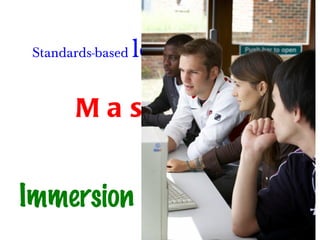
Mastery  learning Standards-based  learning Flip class Immersion
Why? Increased independent students & homeschooled  Increased popularity of online course Increased populations of diverse learners Increased availability of technology Increased need for multilingual speakers
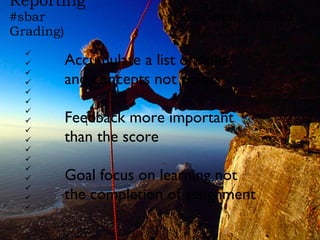
Standards-Based Assessment & Reporting  #sbar  (Competency-based Grading) Accumulate a list of skills  and concepts not points Feedback more important  than the score Goal focus on learning not  the completion of assignment


Grading 0-4 4 = exceeds 3 = secure 2 = developing 1 = beginning 0 = no attempt or not observed yet
MASTERY LEARNING
 
80%
 
Flip Class


listen


BLOGS
IMMERSION hands-on practice conversación
 
 
Flipped – Immersion cycle
 
FAMILIAS
 
Every 2 weeks
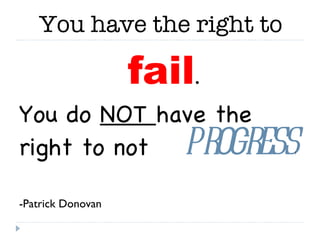
You have the right to  fail . You do  NOT  have the right to not -Patrick Donovan progress !
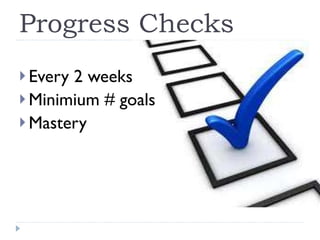
Progress Checks Every 2 weeks Minimium # goals Mastery


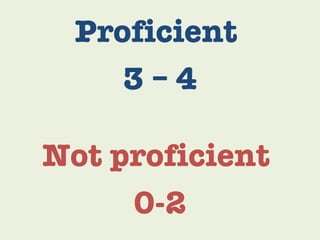
Proficient  3 – 4 Not proficient  0-2
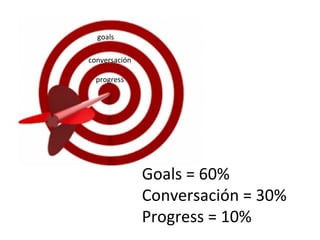
goals conversación progress Goals = 60% Conversación = 30% Progress = 10%
World Languages making connections
How to manage?
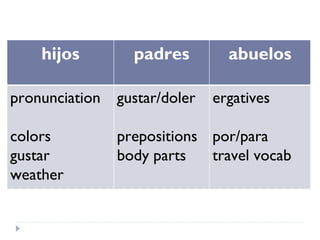
hijos padres abuelos pronunciation colors gustar weather gustar/doler prepositions body parts ergatives por/para travel vocab
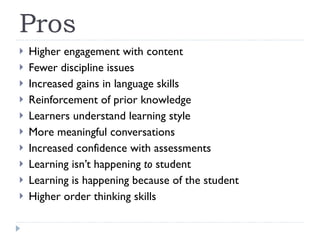
Pros Higher engagement with content Fewer discipline issues Increased gains in language skills Reinforcement of prior knowledge Learners understand learning style More meaningful conversations Increased confidence with assessments Learning isn’t happening  to  student Learning is happening because of the student Higher order thinking skills
Cons It’s change. Parents confused with 75% being “proficient” It’s change. “ Where do I start?”  “What do I do?”  It’s change. Student need to learn  how  to learn It’s change. It’s a lot of work for both student and teacher It’s change.
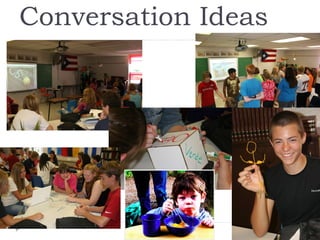
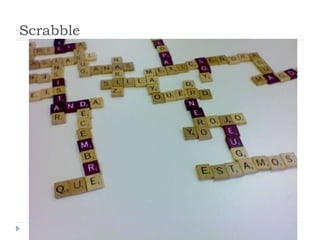
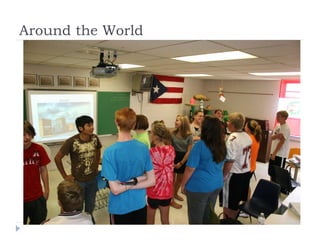
Conversation tips say/repeat Q/A student ask questions Q/A – pechaflikr, ppt. speed dating, Around World Presentation – dice, props, skit “ craft”: conversation cubes, bendaroos, student image Manipulative – scrabble, pattern puzzles
Your choice! I want to see student examples and conversation examples I want to see conversation with a mixed level classroom
Conversation Ideas
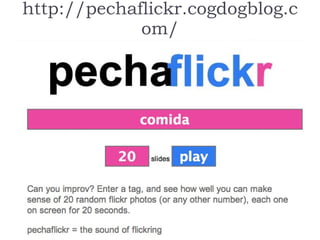
http://pechaflickr.cogdogblog.com/ pechaflickr = the sound of flickring Can you improv? Enter a tag, and see how well you can make sense of 20 random flickr photos (or any other number), each one on screen for 20 seconds.
Scrabble
 
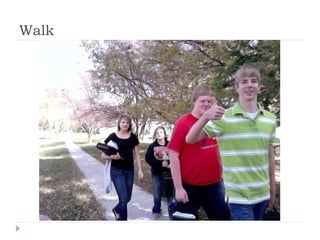
Walk
Speed Dating, uh I mean talking
Around the World


The Flippin' Classroom IWLA 2011

  • 1.
    Immersion through Flipping,Mastery and Standards-based Grading Developing 21 st Century Skills in the World Language Classroom Teaching independence, increasing confidence, embedding higher- order thinking skills, and self awareness of learning styles. Kimberly Huegerich, South Hamilton MS/HS Twitter: @donakimberly http://theactivelearner.blogspot.com
  • 2.
    The Flippin’ ClassroomA family approach using: Flipped class Standards-based grading Immersion Mastery Kimberly Huegerich South Hamilton CSD http://theactivelearner.blogspot.com
  • 3.
  • 4.
    Mastery learningStandards-based learning Flip class Immersion
  • 5.
    Why? Increased independentstudents & homeschooled Increased popularity of online course Increased populations of diverse learners Increased availability of technology Increased need for multilingual speakers
  • 6.
    Standards-Based Assessment &Reporting #sbar (Competency-based Grading) Accumulate a list of skills and concepts not points Feedback more important than the score Goal focus on learning not the completion of assignment
  • 7.
  • 8.
  • 9.
  • 10.
  • 11.
  • 12.
  • 13.
  • 14.
  • 15.
    Grading 0-4 4= exceeds 3 = secure 2 = developing 1 = beginning 0 = no attempt or not observed yet
  • 16.
  • 17.
  • 18.
  • 19.
  • 20.
  • 21.
  • 22.
  • 23.
  • 24.
  • 25.
  • 26.
  • 27.
  • 28.
  • 29.
  • 30.
  • 31.
  • 32.
  • 33.
  • 34.
  • 35.
  • 36.
  • 37.
  • 38.
  • 39.
  • 40.
    You have theright to fail . You do NOT have the right to not -Patrick Donovan progress !
  • 41.
    Progress Checks Every2 weeks Minimium # goals Mastery
  • 42.
  • 43.
  • 44.
  • 45.
  • 46.
  • 47.
  • 48.
  • 49.
    Proficient 3– 4 Not proficient 0-2
  • 50.
    goals conversación progressGoals = 60% Conversación = 30% Progress = 10%
  • 51.
  • 52.
  • 53.
    hijos padres abuelospronunciation colors gustar weather gustar/doler prepositions body parts ergatives por/para travel vocab
  • 54.
    Pros Higher engagementwith content Fewer discipline issues Increased gains in language skills Reinforcement of prior knowledge Learners understand learning style More meaningful conversations Increased confidence with assessments Learning isn’t happening to student Learning is happening because of the student Higher order thinking skills
  • 55.
    Cons It’s change.Parents confused with 75% being “proficient” It’s change. “ Where do I start?” “What do I do?” It’s change. Student need to learn how to learn It’s change. It’s a lot of work for both student and teacher It’s change.
  • 56.
    Conversation tips say/repeatQ/A student ask questions Q/A – pechaflikr, ppt. speed dating, Around World Presentation – dice, props, skit “ craft”: conversation cubes, bendaroos, student image Manipulative – scrabble, pattern puzzles
  • 57.
    Your choice! Iwant to see student examples and conversation examples I want to see conversation with a mixed level classroom
  • 58.
  • 59.
    http://pechaflickr.cogdogblog.com/ pechaflickr =the sound of flickring Can you improv? Enter a tag, and see how well you can make sense of 20 random flickr photos (or any other number), each one on screen for 20 seconds.
  • 60.
  • 61.
  • 62.
  • 63.
    Speed Dating, uhI mean talking
  • 64.
  • 65.
  • 66.

Editor's Notes

  • #55 30% more engagement in III 25% more engagement in II 30% less discipline issues in II