HATCH-WAXMAN ACT
Submitted by:Anu Paul P
First year M.Pharm
(Pharmaceutics)
St.Jame΄s college of pharmaceutical sciences,chalakudy
CONTENTS
 Introduction
 Objectives of the act
 Drug approval
 New branded drug approval
 Generic drug approval
 New drug exclusivity
 Challenging patent exclusivity
 Patent term extension and patent litigation under the act
 Benefits for branded manufacturers
 Conclusion
 Reference
INTRODUCTION
 Hatch-waxman act also known as THE DRUG PRICE COMPETITION AND PATENT
TERM RESTORATION ACT.
 It was enacted in 1984
 Before 1962 new drug approval based on safety alone and in 1962 proof of
efficacy made compulsory for marketing approval of a new drug
 Generic companies were required to submit their own comprehensive NDA
which were costly and time consuming
 To overcome above problems ,an act was needed to promote generic
companies.
OBJECTIVES OF THE ACT
 Reducing the cost associated with the approval of a generic drug
 Allowing early – experimental use
 Motivating the generic drug manufactures
DRUG APPROVAL
 The FDA requires every new drug ,including generic drugs, to be safe and
effective
 Before the adoption of the Hatch-Waxman Act,the FDA required branded and
generic drug companies alike to demonstrate the safety and efficacy of their
products in the same manner through a NDA
 The Act changed certain aspects of the NDA process and the new drug’s
patent term
 Hatch –Waxman Act created an abbreviated process to allow generic drug
companies to obtain FDA approval of generic drugs .so it is easier for generic
drug companies to demonstrate safety and efficacy of their generic drugs.
NEW BRANDED DRUG APPROVAL
 A branded drug company seeking FDA approval to market a new drug must
submit an NDA to the FDA .The information provided in the NDA allows the
FDA to determine whether :
1) The new drug is both safe and effective
2) Certain other requirements such as labeling and good manufacturing
processes

GENERIC DRUG APPROVAL
 The FDA reviews generic drug applications for compliance with the
appropriate scientific and regulatory criteria. If an application meets those
criteria ,the FDA may grant either:
A) Tentative approval
B) Final approval
 Under the Hatch–Waxman Act ,generic drug companies can typically file one
of two different kinds of abbreviated applications for approval of a generic
drugs:
A) An Abbreviated New Drug Application (ANDA)
B) A Section 505(b) (2) application , which is often called a paper NDA
a)Abbreviated New Drug Applications
(ANDA)
 Under an ANDA ,a generic drug company must establish that the generic drug
is effectively a duplicate of the branded,NDA drug ,which is referred to as the
Reference Listed Drug(RLD).The generic drug company must show that the
proposed generic drug :
 a) Has the same active ingredient,route of administration,dosage form
strength and intended use as the RLD
 b) Is bioequivalent with the RLD ,so that it performs in the same manner as
the RLD in the body
b)Section 505(b)(2)Applications
 A proposed generic drug may differ in significant ways from the RLD,
 Under these circumstances, the proposed generic drug must be approved
through the section 505(b)(2) paper NDA application process.
 This application includes less data than an NDA but more data than an ANDA
NEW DRUG EXCLUSIVITY
 A)Non-patent Exclusivities
 (1) Orphan drug exclusivity,
 that treats a disease or condition that affects less than 200000 people in the
US
 This exclusivity period is seven years ,but only applies to use in treating the
specific rare disease or condition.
(2)New chemical entity(NCE)exclusivity
 This is granted if the FDA has not previously approved the active drug moiety
 NCE exclusivity bars a generic drug company from filing an application for
approval of a generic drug five years from the first approval of the relevant
NDA .
 This exclusivity period is over five years
(3)New clinical study exclusivity
 This applies when new clinical studies lead to new or changed formulations
,dosing regimens or patent population.
 This exclusivity sometimes called data exclusivity , prohibits the FDA from
approving a generic drug application for the new dosage form
 This exclusivity period is three years
(4)Pediatric exclusivity
 This applies if the FDA requested that the NDA holder conduct studies with
the drug in pediatric populations .
 Pediatric exclusivity adds six months of exclusivity
B) Patent exclusivity & the orange book
 An NDA holder must provide the FDA with the patent number and expiration
date of any patent that claims either:
 The drug ,including the active ingredient and the formulation for the active
ingredient
 A method of using the drug ,but not other inventions such as ;
 ;- metabolites
 ;- synthetic intermediates
 ;- methods of making the drug
 When the FDA approves the NDA ,the FDA publishes the patent information in
the FDA΄S Approved Drug Products with Therapeutic Equivalence
Determinations publications(orange book)
CHALLENGING PATENT EXCLUSIVITY
 Paragraph 1 certification that no relevant patent is listed in the orange book
 Paragraph 2 certification that the listed patent has expired
 Paragraph 3 certification that the listed patent will expire before the
requested approval
 Paragraph 4 certification that the listed patent is invalid
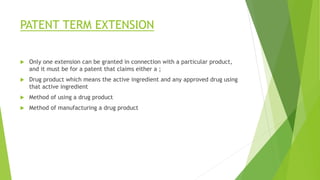
PATENT TERM EXTENSION
 Only one extension can be granted in connection with a particular product,
and it must be for a patent that claims either a ;
 Drug product which means the active ingredient and any approved drug using
that active ingredient
 Method of using a drug product
 Method of manufacturing a drug product
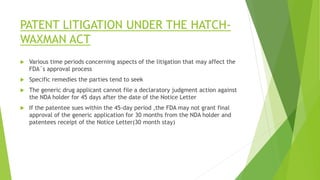
PATENT LITIGATION UNDER THE HATCH-
WAXMAN ACT
 Various time periods concerning aspects of the litigation that may affect the
FDA΄s approval process
 Specific remedies the parties tend to seek
 The generic drug applicant cannot file a declaratory judgment action against
the NDA holder for 45 days after the date of the Notice Letter
 If the patentee sues within the 45-day period ,the FDA may not grant final
approval of the generic application for 30 months from the NDA holder and
patentees receipt of the Notice Letter(30 month stay)
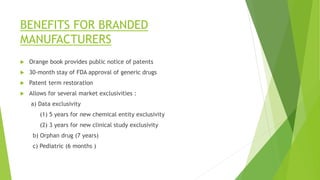
BENEFITS FOR BRANDED
MANUFACTURERS
 Orange book provides public notice of patents
 30-month stay of FDA approval of generic drugs
 Patent term restoration
 Allows for several market exclusivities :
a) Data exclusivity
(1) 5 years for new chemical entity exclusivity
(2) 3 years for new clinical study exclusivity
b) Orphan drug (7 years)
c) Pediatric (6 months )
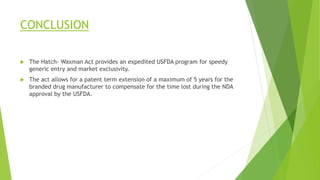
CONCLUSION
 The Hatch- Waxman Act provides an expedited USFDA program for speedy
generic entry and market exclusivity.
 The act allows for a patent term extension of a maximum of 5 years for the
branded drug manufacturer to compensate for the time lost during the NDA
approval by the USFDA.
REFERENCE
 https://www.slideshare.in
 https://en.wikipedia.org
HATCH -WAXMAN ACT

HATCH -WAXMAN ACT

  • 1.
    HATCH-WAXMAN ACT Submitted by:AnuPaul P First year M.Pharm (Pharmaceutics) St.Jame΄s college of pharmaceutical sciences,chalakudy
  • 2.
    CONTENTS  Introduction  Objectivesof the act  Drug approval  New branded drug approval  Generic drug approval  New drug exclusivity  Challenging patent exclusivity  Patent term extension and patent litigation under the act  Benefits for branded manufacturers  Conclusion  Reference
  • 3.
    INTRODUCTION  Hatch-waxman actalso known as THE DRUG PRICE COMPETITION AND PATENT TERM RESTORATION ACT.  It was enacted in 1984  Before 1962 new drug approval based on safety alone and in 1962 proof of efficacy made compulsory for marketing approval of a new drug  Generic companies were required to submit their own comprehensive NDA which were costly and time consuming  To overcome above problems ,an act was needed to promote generic companies.
  • 4.
    OBJECTIVES OF THEACT  Reducing the cost associated with the approval of a generic drug  Allowing early – experimental use  Motivating the generic drug manufactures
  • 5.
    DRUG APPROVAL  TheFDA requires every new drug ,including generic drugs, to be safe and effective  Before the adoption of the Hatch-Waxman Act,the FDA required branded and generic drug companies alike to demonstrate the safety and efficacy of their products in the same manner through a NDA  The Act changed certain aspects of the NDA process and the new drug’s patent term  Hatch –Waxman Act created an abbreviated process to allow generic drug companies to obtain FDA approval of generic drugs .so it is easier for generic drug companies to demonstrate safety and efficacy of their generic drugs.
  • 6.
    NEW BRANDED DRUGAPPROVAL  A branded drug company seeking FDA approval to market a new drug must submit an NDA to the FDA .The information provided in the NDA allows the FDA to determine whether : 1) The new drug is both safe and effective 2) Certain other requirements such as labeling and good manufacturing processes 
  • 7.
    GENERIC DRUG APPROVAL The FDA reviews generic drug applications for compliance with the appropriate scientific and regulatory criteria. If an application meets those criteria ,the FDA may grant either: A) Tentative approval B) Final approval  Under the Hatch–Waxman Act ,generic drug companies can typically file one of two different kinds of abbreviated applications for approval of a generic drugs: A) An Abbreviated New Drug Application (ANDA) B) A Section 505(b) (2) application , which is often called a paper NDA
  • 8.
    a)Abbreviated New DrugApplications (ANDA)  Under an ANDA ,a generic drug company must establish that the generic drug is effectively a duplicate of the branded,NDA drug ,which is referred to as the Reference Listed Drug(RLD).The generic drug company must show that the proposed generic drug :  a) Has the same active ingredient,route of administration,dosage form strength and intended use as the RLD  b) Is bioequivalent with the RLD ,so that it performs in the same manner as the RLD in the body
  • 9.
    b)Section 505(b)(2)Applications  Aproposed generic drug may differ in significant ways from the RLD,  Under these circumstances, the proposed generic drug must be approved through the section 505(b)(2) paper NDA application process.  This application includes less data than an NDA but more data than an ANDA
  • 10.
    NEW DRUG EXCLUSIVITY A)Non-patent Exclusivities  (1) Orphan drug exclusivity,  that treats a disease or condition that affects less than 200000 people in the US  This exclusivity period is seven years ,but only applies to use in treating the specific rare disease or condition.
  • 11.
    (2)New chemical entity(NCE)exclusivity This is granted if the FDA has not previously approved the active drug moiety  NCE exclusivity bars a generic drug company from filing an application for approval of a generic drug five years from the first approval of the relevant NDA .  This exclusivity period is over five years
  • 12.
    (3)New clinical studyexclusivity  This applies when new clinical studies lead to new or changed formulations ,dosing regimens or patent population.  This exclusivity sometimes called data exclusivity , prohibits the FDA from approving a generic drug application for the new dosage form  This exclusivity period is three years
  • 13.
    (4)Pediatric exclusivity  Thisapplies if the FDA requested that the NDA holder conduct studies with the drug in pediatric populations .  Pediatric exclusivity adds six months of exclusivity
  • 14.
    B) Patent exclusivity& the orange book  An NDA holder must provide the FDA with the patent number and expiration date of any patent that claims either:  The drug ,including the active ingredient and the formulation for the active ingredient  A method of using the drug ,but not other inventions such as ;  ;- metabolites  ;- synthetic intermediates  ;- methods of making the drug  When the FDA approves the NDA ,the FDA publishes the patent information in the FDA΄S Approved Drug Products with Therapeutic Equivalence Determinations publications(orange book)
  • 15.
    CHALLENGING PATENT EXCLUSIVITY Paragraph 1 certification that no relevant patent is listed in the orange book  Paragraph 2 certification that the listed patent has expired  Paragraph 3 certification that the listed patent will expire before the requested approval  Paragraph 4 certification that the listed patent is invalid
  • 16.
    PATENT TERM EXTENSION Only one extension can be granted in connection with a particular product, and it must be for a patent that claims either a ;  Drug product which means the active ingredient and any approved drug using that active ingredient  Method of using a drug product  Method of manufacturing a drug product
  • 17.
    PATENT LITIGATION UNDERTHE HATCH- WAXMAN ACT  Various time periods concerning aspects of the litigation that may affect the FDA΄s approval process  Specific remedies the parties tend to seek  The generic drug applicant cannot file a declaratory judgment action against the NDA holder for 45 days after the date of the Notice Letter  If the patentee sues within the 45-day period ,the FDA may not grant final approval of the generic application for 30 months from the NDA holder and patentees receipt of the Notice Letter(30 month stay)
  • 18.
    BENEFITS FOR BRANDED MANUFACTURERS Orange book provides public notice of patents  30-month stay of FDA approval of generic drugs  Patent term restoration  Allows for several market exclusivities : a) Data exclusivity (1) 5 years for new chemical entity exclusivity (2) 3 years for new clinical study exclusivity b) Orphan drug (7 years) c) Pediatric (6 months )
  • 19.
    CONCLUSION  The Hatch-Waxman Act provides an expedited USFDA program for speedy generic entry and market exclusivity.  The act allows for a patent term extension of a maximum of 5 years for the branded drug manufacturer to compensate for the time lost during the NDA approval by the USFDA.
  • 20.