IMPRESSION TECHNIQUES IN
COMPLETE DENTURE
PRESENTED BY- DR SAHIL SHAIKH
GUIDED BY- DR MANISH CHAUHAN
DR ARTI GANGURDE
Contents:-
Introduction.
The Basic Requirements of Impression
Fundamental Rules of impression making.
Definitions of Impression and complete denture impression.
Objectives of impression making.
Classification of impression techniques.
Theories of Impression Making.
Pressure theory
-Minimal pressure theory
-Selective pressure theory
Steps in making of impression in edentulous patients.
Selecting a correct impression techniques
Preliminary Impressions and Fabrication of Custom Trays.
Border Moulding.
Maxillary & Mandibular Final Impressions.
Techniques
- Border Moulded Custom Tray Technique .
- Border Moulded Compound Tray Technique.
- Halperin’s Technique.
 Special Considerations.
Factors Which Complicate Impression Making.
Conclusion.
References.

Introduction
“The Journey Of Thousand Miles Begins with One Step’’-Iao Tsu said.
According to De’van “the impression must be in the
mind of the dentist before it can be in hand” it is this knowledge and
experience that enable a dentist to create desirable results.
The Basic Requirements of impression
making
Knowledge of the oral anatomy.
Knowledge of a basic & reliable technique.
Knowledge & understanding of materials.
Skill.
Patient management.
Fundamental rules of impression
making
Rule-1-Radiographically,Visually and digitally examine the
oral cavity.
Rule-2-Surgically remove such abnormal formation as
would prevent successful completion of impression.
Rule-3- Obtain the required extention outline.
Rule-4-locate and provide for areas of variable tissue
displaceability.
Rule-5-Obtain the required retention outline.
Rule-6-Obtain the required adaptations.
Definitions-
Impression- A negative likeness or copy in reverse of the
surface of an object; an imprint of the teeth and adjacent
structures for use in dentistry ( GPT 10)
“A complete denture impression is a negative
registration of the entire denture –bearing, stabilizing,
and border seal areas present in the edentulous
mouth”( GPT 10)
Objectives of impression making as
stated by Carl O.Boucher in 1944
are -
Preservation of the alveolar ridges.
Support.
Retention.
Stability.
Esthetics.
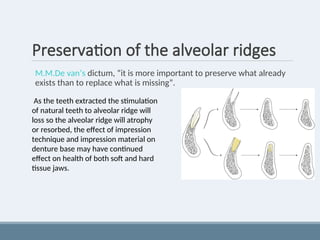
Preservation of the alveolar ridges
M.M.De van’s dictum, “it is more important to preserve what already
exists than to replace what is missing”.
As the teeth extracted the stimulation
of natural teeth to alveolar ridge will
loss so the alveolar ridge will atrophy
or resorbed, the effect of impression
technique and impression material on
denture base may have continued
effect on health of both soft and hard
tissue jaws.
Support
“Denture support is the resistance to vertical forces of mastication and
to occlusal or other forces applied in a direction toward the basal seat”.
Areas of support:-
Primary-
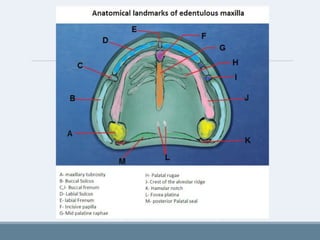
Maxilla:- Posterior ridges, flat areas of the palate.
Mandibular-buccal shelf, posterior ridges, pear shaped pad.
Secondary-
Maxilla- anterior ridge and all ridge slopes
Mandibular - Anterior ridge and all ridge slopes.
Slight-vestibular areas.
Improving support
Surgical removal of pendulous tissue.
Use of tissue-conditioning materials.
Surgical reduction of sharp or spiny mandibular
ridges.
Surgical enlargement of ridge.
Implants.
Retention
Definition:-
“Retention of a denture is its resistance to removal in a direction
opposite to that of the insertion”
Factors of retention are-
Adhesion
Cohesion
Interfacial surface tension
Mechanical locking into undercuts
Peripheral seal and atmospheric pressure
Oral and facial musculature.
Stability
Definition:-
“the stability of a denture is the ability to remain securely in
place when it is subjected to horizontal movements”.
Denture requires-
Retention
Noninterfering occlusion
Proper tooth arrangement
Proper form and contour of the polished surfaces
Good control and co-ordination of the patient’s
musculature.
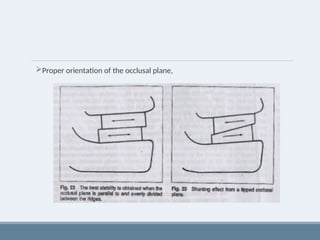
Proper orientation of the occlusal plane,
Esthetics in complete
denture-
The esthetics of complete dentures can be affected by various factors,
including tooth shape, size, color, and arrangement. The shape and size
of the teeth can affect the overall appearance of the dentures, as well
as the patient's facial structure and profile. The color of the teeth is also
important, as it can affect the natural look of the dentures and how
they blend in with the patient's remaining teeth.
Factors affecting the esthetics
in complete denture
The arrangement of the teeth is another important factor to consider
when it comes to esthetics in complete dentures. The dentist must
ensure that the teeth are arranged in a way that looks natural and
balanced, while also taking into account the patient's bite and chewing
function. Using visuals can help illustrate these points and make them
easier for the audience to understand.
Classification of impression
techniques
A)Based on the Theories of impression making :-
-Pressure theory
-Minimal pressure theory
-Selective pressure theory
B)Based on the position of the mouth while making the
impression:-
-Open mouth
-Closed mouth
C)Based on the method of manipulation for border molding
-Hand manipulation
-Functional movements
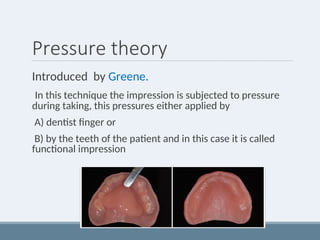
Pressure theory
Introduced by Greene.
In this technique the impression is subjected to pressure
during taking, this pressures either applied by
A) dentist finger or
B) by the teeth of the patient and in this case it is called
functional impression
Functional impression
techniques
a)Used in complete denture that is delivered ,relieved on its internal
aspects and filled with the slow-seating impression material(tissue
conditioning material)
b) The patient wears prosthesis for several days, allowing the tissue
to be recorded in function.
c) The complete impression then is converted to hard reline material
via laboratory processing
d) This seeks to create a denture base that models the functional
loaded tissue.
e) Records the oral tissues in a functional and displaced form. The
materials used for this technique include impression compound,
waxes and soft liners.
f) The oral soft tissues are resilient and thus tend to return to their
anatomical position once the forces are relieved. Dentures made
by this technique tend to get displaced due to the tissue rebound
at rest. During function, the constant pressure exerted onto the
soft tissues limit the blood circulation leading to residual ridge
resorption
Minimal pressure theory
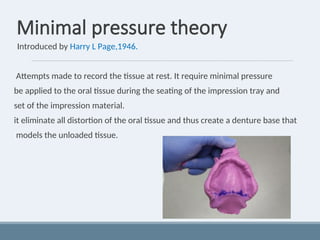
Introduced by Harry L Page,1946.
Attempts made to record the tissue at rest. It require minimal pressure
be applied to the oral tissue during the seating of the impression tray and
set of the impression material.
it eliminate all distortion of the oral tissue and thus create a denture base that
models the unloaded tissue.
Requirement of (Monostatic)
technique-
a)The impression is made with the oral mucous membrane and
the jaws in a normal, relaxed condition. Border molding is not
done here.
b) The impression is made with an oversized tray. Spaced tray
c) It requires a material of high fluidity (low viscosity) Impression
material of choice is impression plaster, alginate.
d) Retention is mainly due to interfacial surface tension. The
monostatic technique results in a denture, which is closely
adapted to the mucosa of the denture-bearing area but has poor
peripheral seal.
ADVANTAGES
High regards for the tissue health
and preservation
Good stability due to close
adaptation of denture bases
Well suited for cases like
monostatic, and flabby ridges
DISADVANTAGES
Less tissue coverage
Reduced retention
Lack of border-molding reduces
effective border seal
Lack of border seal permits food
lodgment
Compromised aesthetics due to
short denture flanges
Selective pressure theory
Advocated by Boucher.
a)Uses a custom tray constructed with less relief in the primary
denture stress bearing area and greater relief in the non bearing
areas.
b)Variation in relief result in theoretically in greater amount of
pressure being applied directly to the primary bearing area ,which
are biologically and biomechanically more capable of supporting
and distributing the load.
c) Low pressure is applied through greater relief for impression
materials to the non bearing areas
This technique seeks to create a denture base that selecting loads
the oral tissue during function of the prostheses, thus optimizing
the stability and retention of the prostheses.
ADVANTAGES
Technique provides maximum
coverage with the least possible
interferences with health of
surrounding tissues.
Technique considers the
physiologic functions of the tissues
of the basal seat therefore
appears more sound and
appealing
DISADVANTAGES
Some consider that it is impossible
to record areas with varying
degree of pressure.
Since some areas are still recorded
under functional load, the denture
still faces the potential danger of
rebounding and loosing retention.
ii. Depending on the
technique
 Open mouth impressions
The open mouth impression is built in a tray which carries the
impression material of choice into the desired contact with the
supporting tissues and into an approximate relation to the peripheral
tissues when the mouth is opened and without applied pressure
The rationale behind this method is that the dentures do not dislodge
when subjected to biting force.
a) The open mouth methods provide clearance for the tissues that are
pulled over the edges of the dentures as in function of speech.
b)It develops a contour of impression surface which is in harmony with
the relaxed supporting tissues, and which may be out of perfect
adaptation with these tissues when the denture is subjected to occlusal
loading.
Close mouth impression technique-
-These require wax occlusal rims to be fabricated on the preliminary
cast.
-The patient is made to close on these rims and a generous clearance is
made for the various frenula so that the patient can manipulate his
tissues by closing, grimacing, sucking and swallowing to form
peripheral borders.
Making impressions for the
Edentulous Patient
1)Examination and Conditioning of the patient and the mouth.
2) Selection of impression material.
3) Selection of impression tray.
4) Seating of the patient.
5) Selection of impression technique.
6) Making the preliminary impression.
7) Constructing the primary cast.
8) Fabricating the custom tray.
9) Border molding.
10)Making the final impression.
3 Ms of successful impression-
1)MOULD(Tray).
2)METHOD(Technique).
3)MATERIAL(Impression Material).
Choosing the correct impression
technique
Factors affecting choice of impression technique are:-
The theories of impression
Clinical findings
Experience of the dentist
Availability of materials
Patient related factors
Preliminary impression
materials
Impression compound:- It is a mucocompressive,
thermoplastic, non-elastic impression material.
(thermoplastic-the material which gets softened by
heating and hardened by cooling without any chemical
change)
Alternative Names:-
Impression compound
Dental compound
Model compound
Modelling compound.
ADA specification no.is 03
Types-2 types
1) Type1:- Impression compound (low fusing
material) fusion temperature
approximately above 45degree c. E.g. Impression
compound, green stick compound or
tracing compound.
2) Type2:- Impression compound (high fusing material) fusion
temperature approximately above 70degree c.
E.g. compound.
Green stick compound(Kerr modelling compound
sticks)
Brown-(132-133’F or 55.5-56.1Degree c.)
Green-(122-124’F or 50-51.5 Degree c.)
Gray-(128-130’F or 53.3-54.4 Degree c.)
White-(132-134’F or 55.5-56.6 Degree c.)
Black-(133-135’F or 56.1-57.2 Degree c.)
Alginate:-
Final impression materials
Alginate
Rubber base
ZOE paste
Tissue conditioners
Impression plaster
waxes
Selection of impression tray
Definition:-
“A device that is used to carry, confine, and control impression
material while making an impression”
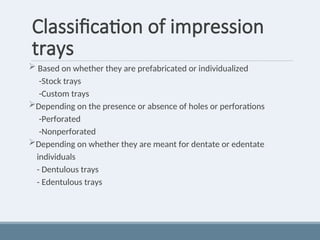
Classification of impression
trays
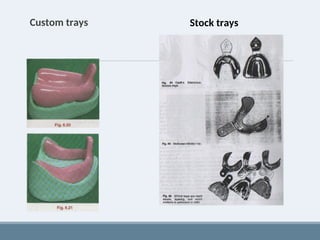
 Based on whether they are prefabricated or individualized
-Stock trays
-Custom trays
Depending on the presence or absence of holes or perforations
-Perforated
-Nonperforated
Depending on whether they are meant for dentate or edentate
individuals
- Dentulous trays
- Edentulous trays
Custom trays Stock trays
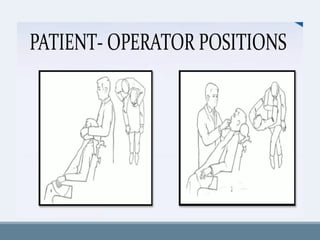
Seating of a patient
For maxillary impressions
For mandibular impressions
Making the impression
Selective pressure technique.
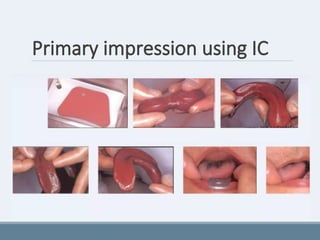
The preliminary impression
Synonyms:- Primary impression
Definition:- “A negative likeness made for the purpose of
diagnosis, treatment planning, or the fabrication of a tray”
Why two impressions:-preliminary and final?
Preliminary impression is made
-Using alginate
-Using impression compound
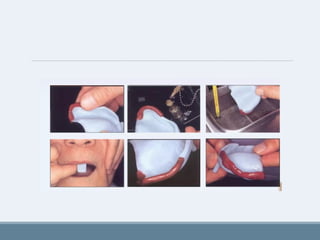
Selecting the stock tray
Patient preparation and trial run
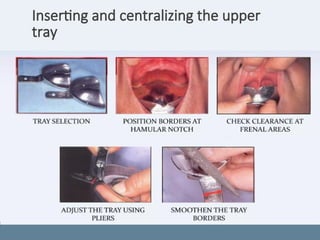
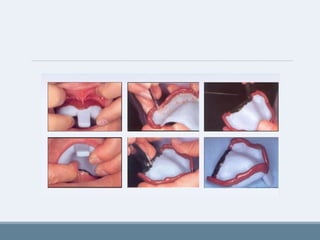
Inserting and centralizing the upper
tray
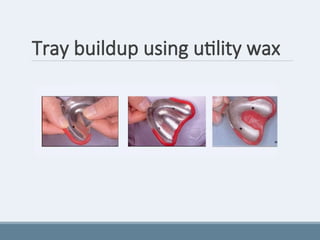
Tray buildup using utility wax
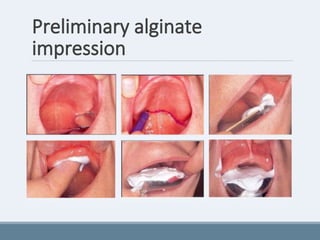
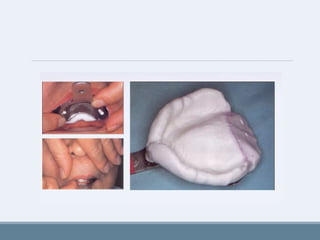
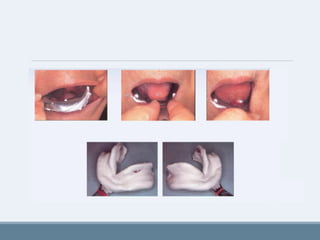
Preliminary alginate
impression
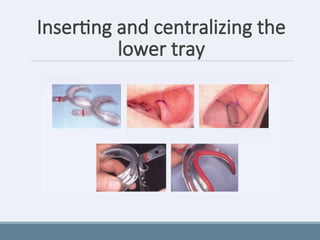
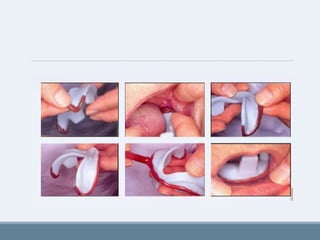
Inserting and centralizing the
lower tray
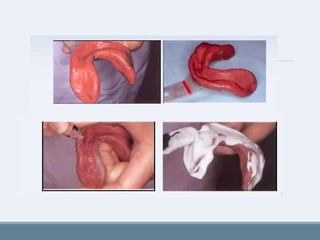
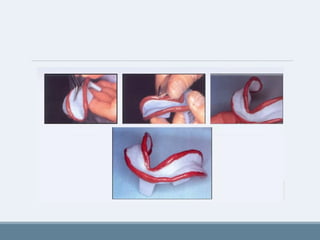
Primary impression using IC
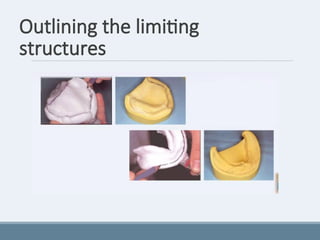
Outlining the limiting
structures
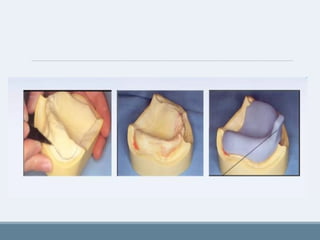
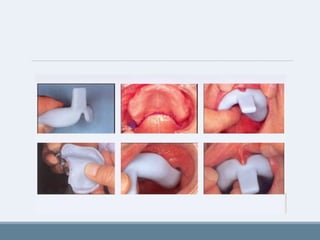
Border molding
Synonyms:-muscle trimming, peripheral tracing .
Definitions:-
1) “The shaping of the border areas of an impression
tray by functional or manual manipulation of the tissue
adjacent to the borders to duplicate the contour and
size of the vestibule”.
2) “Determining the extension of a prosthesis by using
tissue function or manual manipulation of the tissues
to shape the border areas of an impression material”.
Importance of border molding-
Requirements of a material to be used for border molding-smith et al
stated 7 points:-
1) Have sufficient body to allow it to remain in position on the borders
during loading of the tray.
2) Allow some reshaping of the form of the borders without adhering to
the fingers.
3) Have a setting time of 3-5minutes.
4) Retain adequate flow while seating in the mouth.
5) Allow finger placement of the material into deficient parts after
seating the tray.
6) Not cause excessive displacement of the tissues of the vestibule.
7) Be readily trimmed and shaped so that excess material can be carved
and the borders shaped before the final impression is made.
Border molding materials
1) Modelling compound sticks
2) reshaping acrylic resins
3) Tissue conditioners
4) Polyether impression paste
5) Impression waxes
6) Periopak
Methods of border molding
1) Functional methods
2) Manual or digital manipulation which simulates the muscle action
3) Combination
Functional movements
-Smiling, whistling and grinning motion-molds the labial and buccal
borders.
-Sucking motion-buccal frenum and buccal borders.
-Licking the lips and other tongue movements-lingual border.
-Swallowing motion-lingual border and floor of the mouth.
-Occluding-some operators provide bite or occlusal rims so that the
patient can exert biting pressure.
-Opening and closing or side to side movements of the jaw.
The border molding may be done with the mouth open or closed.
Open mouth technique
Closed mouth technique
Sequence of border molding
Segment by segment or
In one step (eg.one step technique with polyether)
Border molding with stick
compound
Maxillary border molding
Labial frenum and labial flange
Buccal frenum and buccal flange
Coronoid notch
Posterior palatal seal-
A) Arbitrary techniques
-Conventional technique (Winkler)
-Boucher’s technique
B) Physiologic techniques
-Fluid wax technique
-Stick compound technique
-Extended palatal technique
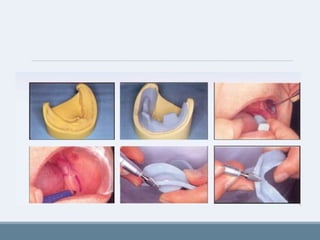
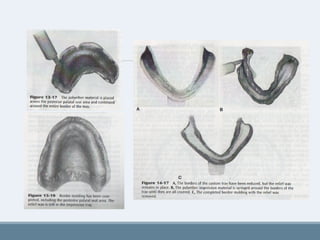
Border molding by polyether
material
Recording all of the border simultaneously has 2 general advantages-
1) No. of insertions of the tray is reduced to one,
2) Developing all borders simultaneously avoids propagation of errors
caused by a mistake in one section affecting the border contours in
other.
Drawbacks of materials
Winkler acrylic resins
Tissue conditioning materials
Metallic pastes and elastomeric materials
Impression waxes
Making of final impression
Synonyms:-wash impression or master impression
Definition:- “The impression that represents the completion of the
registration of the surface or object”(GPT-6).
The final impression is made using –
1) Border molded custom tray or
2) border molded impression compound tray
STEPS-
Checking the retention.
Preparing and instructing the patient.
Preparing the tray for final impression.
The final impression materials:-ZOE impression paste or
medium-bodied elastomeric impression materials.
Removing the impression.
Factors which complicate
impression making
-Unco-operative patients
-Excessive salivation
-Hyperactive gag reflex
-Causes of gagging
1) Iatrogenic
2) systemic problems
3) Anatomical problems
4) psychological factors
5) current medication
6) problems in the existing prosthesis.
Management of the gagging patient
1) Reduction of amount and duration of stimuli(prosthodontic
management).
2) Distraction maneuvers
3) Progressive desensitization
4) Pharmacologic management
Conclusion
“Act as though it is impossible to fail and success will fall in your
hands.”
Two major requirements for success are good rapport and the patients
complete confidence in the ability of the dentist.
References
Bernard levin- Impression for complete dentures.
Zarb-Bolender-Twelfth edition,Ninth Edition-Prosthodontic
treatment for edentolous patients-complete denture and
implant.
Sheldon Winkler-2nd Edition-Essentials of complete denture
prosthodontics.
Charles M.Heartwell jr.Arthur o.Rahn.-Fourth edition-Syllabus of
Complete Dentures.
John Joy Manappallil-1st
Edition-Complete denture
prosthodontics.
V.Shama Bhat,B.T.Nandish-1st
Edition -Science of dental
materials-Clinical Applications.
THANK YOU.

complete denture in prosthodontics SEMINAR.ppt

  • 1.
    IMPRESSION TECHNIQUES IN COMPLETEDENTURE PRESENTED BY- DR SAHIL SHAIKH GUIDED BY- DR MANISH CHAUHAN DR ARTI GANGURDE
  • 2.
    Contents:- Introduction. The Basic Requirementsof Impression Fundamental Rules of impression making. Definitions of Impression and complete denture impression. Objectives of impression making. Classification of impression techniques. Theories of Impression Making. Pressure theory -Minimal pressure theory -Selective pressure theory Steps in making of impression in edentulous patients.
  • 3.
    Selecting a correctimpression techniques Preliminary Impressions and Fabrication of Custom Trays. Border Moulding. Maxillary & Mandibular Final Impressions. Techniques - Border Moulded Custom Tray Technique . - Border Moulded Compound Tray Technique. - Halperin’s Technique.  Special Considerations. Factors Which Complicate Impression Making. Conclusion. References. 
  • 4.
    Introduction “The Journey OfThousand Miles Begins with One Step’’-Iao Tsu said. According to De’van “the impression must be in the mind of the dentist before it can be in hand” it is this knowledge and experience that enable a dentist to create desirable results.
  • 5.
    The Basic Requirementsof impression making Knowledge of the oral anatomy. Knowledge of a basic & reliable technique. Knowledge & understanding of materials. Skill. Patient management.
  • 6.
    Fundamental rules ofimpression making Rule-1-Radiographically,Visually and digitally examine the oral cavity. Rule-2-Surgically remove such abnormal formation as would prevent successful completion of impression. Rule-3- Obtain the required extention outline. Rule-4-locate and provide for areas of variable tissue displaceability. Rule-5-Obtain the required retention outline. Rule-6-Obtain the required adaptations.
  • 7.
    Definitions- Impression- A negativelikeness or copy in reverse of the surface of an object; an imprint of the teeth and adjacent structures for use in dentistry ( GPT 10) “A complete denture impression is a negative registration of the entire denture –bearing, stabilizing, and border seal areas present in the edentulous mouth”( GPT 10)
  • 8.
    Objectives of impressionmaking as stated by Carl O.Boucher in 1944 are - Preservation of the alveolar ridges. Support. Retention. Stability. Esthetics.
  • 9.
    Preservation of thealveolar ridges M.M.De van’s dictum, “it is more important to preserve what already exists than to replace what is missing”. As the teeth extracted the stimulation of natural teeth to alveolar ridge will loss so the alveolar ridge will atrophy or resorbed, the effect of impression technique and impression material on denture base may have continued effect on health of both soft and hard tissue jaws.
  • 10.
    Support “Denture support isthe resistance to vertical forces of mastication and to occlusal or other forces applied in a direction toward the basal seat”. Areas of support:- Primary- Maxilla:- Posterior ridges, flat areas of the palate. Mandibular-buccal shelf, posterior ridges, pear shaped pad. Secondary- Maxilla- anterior ridge and all ridge slopes Mandibular - Anterior ridge and all ridge slopes. Slight-vestibular areas.
  • 12.
    Improving support Surgical removalof pendulous tissue. Use of tissue-conditioning materials. Surgical reduction of sharp or spiny mandibular ridges. Surgical enlargement of ridge. Implants.
  • 13.
    Retention Definition:- “Retention of adenture is its resistance to removal in a direction opposite to that of the insertion” Factors of retention are- Adhesion Cohesion Interfacial surface tension Mechanical locking into undercuts Peripheral seal and atmospheric pressure Oral and facial musculature.
  • 14.
    Stability Definition:- “the stability ofa denture is the ability to remain securely in place when it is subjected to horizontal movements”. Denture requires- Retention Noninterfering occlusion Proper tooth arrangement Proper form and contour of the polished surfaces Good control and co-ordination of the patient’s musculature.
  • 15.
    Proper orientation ofthe occlusal plane,
  • 16.
    Esthetics in complete denture- Theesthetics of complete dentures can be affected by various factors, including tooth shape, size, color, and arrangement. The shape and size of the teeth can affect the overall appearance of the dentures, as well as the patient's facial structure and profile. The color of the teeth is also important, as it can affect the natural look of the dentures and how they blend in with the patient's remaining teeth.
  • 17.
    Factors affecting theesthetics in complete denture The arrangement of the teeth is another important factor to consider when it comes to esthetics in complete dentures. The dentist must ensure that the teeth are arranged in a way that looks natural and balanced, while also taking into account the patient's bite and chewing function. Using visuals can help illustrate these points and make them easier for the audience to understand.
  • 18.
    Classification of impression techniques A)Basedon the Theories of impression making :- -Pressure theory -Minimal pressure theory -Selective pressure theory B)Based on the position of the mouth while making the impression:- -Open mouth -Closed mouth C)Based on the method of manipulation for border molding -Hand manipulation -Functional movements
  • 19.
    Pressure theory Introduced byGreene. In this technique the impression is subjected to pressure during taking, this pressures either applied by A) dentist finger or B) by the teeth of the patient and in this case it is called functional impression
  • 20.
    Functional impression techniques a)Used incomplete denture that is delivered ,relieved on its internal aspects and filled with the slow-seating impression material(tissue conditioning material) b) The patient wears prosthesis for several days, allowing the tissue to be recorded in function. c) The complete impression then is converted to hard reline material via laboratory processing d) This seeks to create a denture base that models the functional loaded tissue.
  • 21.
    e) Records theoral tissues in a functional and displaced form. The materials used for this technique include impression compound, waxes and soft liners. f) The oral soft tissues are resilient and thus tend to return to their anatomical position once the forces are relieved. Dentures made by this technique tend to get displaced due to the tissue rebound at rest. During function, the constant pressure exerted onto the soft tissues limit the blood circulation leading to residual ridge resorption
  • 22.
    Minimal pressure theory Introducedby Harry L Page,1946. Attempts made to record the tissue at rest. It require minimal pressure be applied to the oral tissue during the seating of the impression tray and set of the impression material. it eliminate all distortion of the oral tissue and thus create a denture base that models the unloaded tissue.
  • 23.
    Requirement of (Monostatic) technique- a)Theimpression is made with the oral mucous membrane and the jaws in a normal, relaxed condition. Border molding is not done here. b) The impression is made with an oversized tray. Spaced tray c) It requires a material of high fluidity (low viscosity) Impression material of choice is impression plaster, alginate. d) Retention is mainly due to interfacial surface tension. The monostatic technique results in a denture, which is closely adapted to the mucosa of the denture-bearing area but has poor peripheral seal.
  • 24.
    ADVANTAGES High regards forthe tissue health and preservation Good stability due to close adaptation of denture bases Well suited for cases like monostatic, and flabby ridges DISADVANTAGES Less tissue coverage Reduced retention Lack of border-molding reduces effective border seal Lack of border seal permits food lodgment Compromised aesthetics due to short denture flanges
  • 25.
    Selective pressure theory Advocatedby Boucher. a)Uses a custom tray constructed with less relief in the primary denture stress bearing area and greater relief in the non bearing areas. b)Variation in relief result in theoretically in greater amount of pressure being applied directly to the primary bearing area ,which are biologically and biomechanically more capable of supporting and distributing the load. c) Low pressure is applied through greater relief for impression materials to the non bearing areas
  • 26.
    This technique seeksto create a denture base that selecting loads the oral tissue during function of the prostheses, thus optimizing the stability and retention of the prostheses.
  • 27.
    ADVANTAGES Technique provides maximum coveragewith the least possible interferences with health of surrounding tissues. Technique considers the physiologic functions of the tissues of the basal seat therefore appears more sound and appealing DISADVANTAGES Some consider that it is impossible to record areas with varying degree of pressure. Since some areas are still recorded under functional load, the denture still faces the potential danger of rebounding and loosing retention.
  • 28.
    ii. Depending onthe technique  Open mouth impressions The open mouth impression is built in a tray which carries the impression material of choice into the desired contact with the supporting tissues and into an approximate relation to the peripheral tissues when the mouth is opened and without applied pressure
  • 29.
    The rationale behindthis method is that the dentures do not dislodge when subjected to biting force. a) The open mouth methods provide clearance for the tissues that are pulled over the edges of the dentures as in function of speech. b)It develops a contour of impression surface which is in harmony with the relaxed supporting tissues, and which may be out of perfect adaptation with these tissues when the denture is subjected to occlusal loading.
  • 30.
    Close mouth impressiontechnique- -These require wax occlusal rims to be fabricated on the preliminary cast. -The patient is made to close on these rims and a generous clearance is made for the various frenula so that the patient can manipulate his tissues by closing, grimacing, sucking and swallowing to form peripheral borders.
  • 31.
    Making impressions forthe Edentulous Patient 1)Examination and Conditioning of the patient and the mouth. 2) Selection of impression material. 3) Selection of impression tray. 4) Seating of the patient. 5) Selection of impression technique. 6) Making the preliminary impression. 7) Constructing the primary cast. 8) Fabricating the custom tray. 9) Border molding. 10)Making the final impression.
  • 32.
    3 Ms ofsuccessful impression- 1)MOULD(Tray). 2)METHOD(Technique). 3)MATERIAL(Impression Material).
  • 33.
    Choosing the correctimpression technique Factors affecting choice of impression technique are:- The theories of impression Clinical findings Experience of the dentist Availability of materials Patient related factors
  • 34.
    Preliminary impression materials Impression compound:-It is a mucocompressive, thermoplastic, non-elastic impression material. (thermoplastic-the material which gets softened by heating and hardened by cooling without any chemical change) Alternative Names:- Impression compound Dental compound Model compound Modelling compound.
  • 35.
    ADA specification no.is03 Types-2 types 1) Type1:- Impression compound (low fusing material) fusion temperature approximately above 45degree c. E.g. Impression compound, green stick compound or tracing compound. 2) Type2:- Impression compound (high fusing material) fusion temperature approximately above 70degree c. E.g. compound.
  • 36.
    Green stick compound(Kerrmodelling compound sticks) Brown-(132-133’F or 55.5-56.1Degree c.) Green-(122-124’F or 50-51.5 Degree c.) Gray-(128-130’F or 53.3-54.4 Degree c.) White-(132-134’F or 55.5-56.6 Degree c.) Black-(133-135’F or 56.1-57.2 Degree c.) Alginate:-
  • 37.
    Final impression materials Alginate Rubberbase ZOE paste Tissue conditioners Impression plaster waxes
  • 38.
    Selection of impressiontray Definition:- “A device that is used to carry, confine, and control impression material while making an impression”
  • 39.
    Classification of impression trays Based on whether they are prefabricated or individualized -Stock trays -Custom trays Depending on the presence or absence of holes or perforations -Perforated -Nonperforated Depending on whether they are meant for dentate or edentate individuals - Dentulous trays - Edentulous trays
  • 40.
  • 41.
    Seating of apatient For maxillary impressions For mandibular impressions
  • 42.
  • 43.
    The preliminary impression Synonyms:-Primary impression Definition:- “A negative likeness made for the purpose of diagnosis, treatment planning, or the fabrication of a tray” Why two impressions:-preliminary and final? Preliminary impression is made -Using alginate -Using impression compound
  • 44.
    Selecting the stocktray Patient preparation and trial run
  • 45.
  • 46.
    Tray buildup usingutility wax
  • 47.
  • 49.
  • 51.
  • 53.
  • 57.
    Border molding Synonyms:-muscle trimming,peripheral tracing . Definitions:- 1) “The shaping of the border areas of an impression tray by functional or manual manipulation of the tissue adjacent to the borders to duplicate the contour and size of the vestibule”. 2) “Determining the extension of a prosthesis by using tissue function or manual manipulation of the tissues to shape the border areas of an impression material”.
  • 58.
    Importance of bordermolding- Requirements of a material to be used for border molding-smith et al stated 7 points:- 1) Have sufficient body to allow it to remain in position on the borders during loading of the tray. 2) Allow some reshaping of the form of the borders without adhering to the fingers. 3) Have a setting time of 3-5minutes.
  • 59.
    4) Retain adequateflow while seating in the mouth. 5) Allow finger placement of the material into deficient parts after seating the tray. 6) Not cause excessive displacement of the tissues of the vestibule. 7) Be readily trimmed and shaped so that excess material can be carved and the borders shaped before the final impression is made.
  • 60.
    Border molding materials 1)Modelling compound sticks 2) reshaping acrylic resins 3) Tissue conditioners 4) Polyether impression paste 5) Impression waxes 6) Periopak
  • 61.
    Methods of bordermolding 1) Functional methods 2) Manual or digital manipulation which simulates the muscle action 3) Combination
  • 62.
    Functional movements -Smiling, whistlingand grinning motion-molds the labial and buccal borders. -Sucking motion-buccal frenum and buccal borders. -Licking the lips and other tongue movements-lingual border. -Swallowing motion-lingual border and floor of the mouth. -Occluding-some operators provide bite or occlusal rims so that the patient can exert biting pressure. -Opening and closing or side to side movements of the jaw.
  • 63.
    The border moldingmay be done with the mouth open or closed. Open mouth technique Closed mouth technique
  • 64.
    Sequence of bordermolding Segment by segment or In one step (eg.one step technique with polyether)
  • 65.
    Border molding withstick compound Maxillary border molding Labial frenum and labial flange Buccal frenum and buccal flange Coronoid notch Posterior palatal seal- A) Arbitrary techniques -Conventional technique (Winkler) -Boucher’s technique B) Physiologic techniques -Fluid wax technique -Stick compound technique -Extended palatal technique
  • 70.
    Border molding bypolyether material Recording all of the border simultaneously has 2 general advantages- 1) No. of insertions of the tray is reduced to one, 2) Developing all borders simultaneously avoids propagation of errors caused by a mistake in one section affecting the border contours in other.
  • 72.
    Drawbacks of materials Winkleracrylic resins Tissue conditioning materials Metallic pastes and elastomeric materials Impression waxes
  • 73.
    Making of finalimpression Synonyms:-wash impression or master impression Definition:- “The impression that represents the completion of the registration of the surface or object”(GPT-6). The final impression is made using – 1) Border molded custom tray or 2) border molded impression compound tray
  • 74.
    STEPS- Checking the retention. Preparingand instructing the patient. Preparing the tray for final impression. The final impression materials:-ZOE impression paste or medium-bodied elastomeric impression materials. Removing the impression.
  • 75.
    Factors which complicate impressionmaking -Unco-operative patients -Excessive salivation -Hyperactive gag reflex -Causes of gagging 1) Iatrogenic 2) systemic problems 3) Anatomical problems 4) psychological factors 5) current medication 6) problems in the existing prosthesis.
  • 76.
    Management of thegagging patient 1) Reduction of amount and duration of stimuli(prosthodontic management). 2) Distraction maneuvers 3) Progressive desensitization 4) Pharmacologic management
  • 77.
    Conclusion “Act as thoughit is impossible to fail and success will fall in your hands.” Two major requirements for success are good rapport and the patients complete confidence in the ability of the dentist.
  • 78.
    References Bernard levin- Impressionfor complete dentures. Zarb-Bolender-Twelfth edition,Ninth Edition-Prosthodontic treatment for edentolous patients-complete denture and implant. Sheldon Winkler-2nd Edition-Essentials of complete denture prosthodontics. Charles M.Heartwell jr.Arthur o.Rahn.-Fourth edition-Syllabus of Complete Dentures. John Joy Manappallil-1st Edition-Complete denture prosthodontics. V.Shama Bhat,B.T.Nandish-1st Edition -Science of dental materials-Clinical Applications.
  • 79.