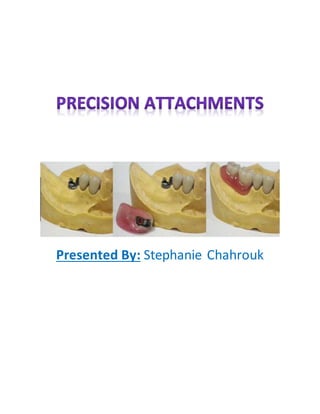
Presented By: Stephanie Chahrouk
Historical Background
Definition
Precision: Quality or state of being precise
Attachment: Mechanical device for the fixation, retention and stabilization of dental prosthesis.
INTRODUCTION
• The desire to balance between functional stability and cosmetic appeal in
partial dentures gave rise to the development of Precision Attachments
• Precision Attachments have always been surrounded by an aura of mystery.
• The use of Precision Attachments for partial denture retention is
• • A practice builder for the better class of dentistry
• • It helps to elevate the general standard of partial denture prosthetics.
• The precision attachment is sometimes said to be a connecting link between fixed and
removable partial denture as it incorporates features common to both types of
construction.
Winder
• “Winders design” Screw joint retention
Parr (1886)
• Extracoronal socket attachment
Stair
• Telescopic abutment restoration
Ash (1912)
• Split bar attachment system
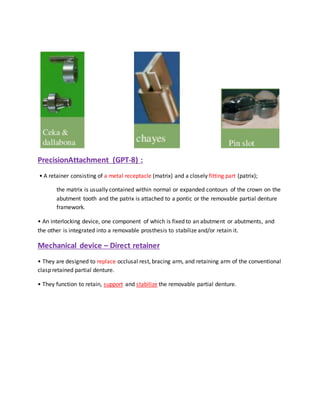
PrecisionAttachment (GPT-8) :
• A retainer consisting of a metal receptacle (matrix) and a closely fitting part (patrix);
the matrix is usually contained within normal or expanded contours of the crown on the
abutment tooth and the patrix is attached to a pontic or the removable partial denture
framework.
• An interlocking device, one component of which is fixed to an abutment or abutments, and
the other is integrated into a removable prosthesis to stabilize and/or retain it.
Mechanical device – Direct retainer
• They are designed to replace occlusal rest, bracing arm, and retaining arm of the conventional
clasp retained partial denture.
• They function to retain, support and stabilize the removable partial denture.
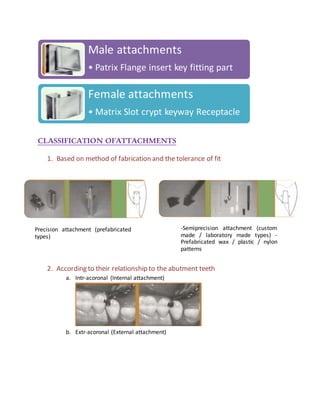
CLASSIFICATION OFATTACHMENTS
1. Based on method of fabrication and the tolerance of fit
2. According to their relationship to the abutment teeth
a. Intr-acoronal (Internal attachment)
b. Extr-acoronal (External attachment)
Male attachments
• Patrix Flange insert key fitting part
Female attachments
• Matrix Slot crypt keyway Receptacle
Precision attachment (prefabricated
types)
-Semiprecision attachment (custom
made / laboratory made types) -
Prefabricated wax / plastic / nylon
patterns
3. Based on stiffness of the resulting joint
a. Rigid attachments
b. Resilient attachments (Non rigid)
4. Based on geometric configuration and design of the attachment.
a. Key and Keyway
b. Interlocks
c. Ball and socket
d. Bar and clip / sleeve
e. Hinge
f. Telescopic
g. Push button
h. Latch
i. Screw units
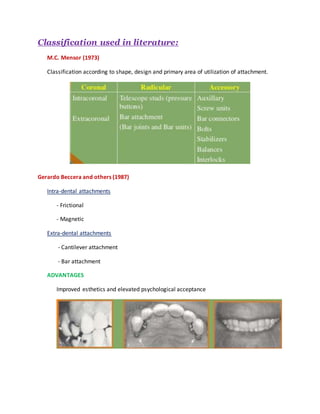
Classification used in literature:
M.C. Mensor (1973)
Classification according to shape, design and primary area of utilization of attachment.
Gerardo Beccera and others (1987)
Intra-dental attachments
- Frictional
- Magnetic
Extra-dental attachments
- Cantilever attachment
- Bar attachment
ADVANTAGES
Improved esthetics and elevated psychological acceptance
Mechanical advantage
 Direct the forces along the long axis of the teeth / more apically
 Force application closer to the fulcrum of the tooth
 Reduces Non axial loading
 Decreases Torquing forces
 Rotational movement of the abutment
 In Distal extension base cases – “Broken stress philosophy”
 Reduced stress to the abutment
 Stress free rotational/vertical movements
 Cross arch load transfer and prosthesis stabilization
 Compared to conventional clasp retained partial denture
 Less liable to fracture than clasp
 Less bulky and more esthetics
 Better retention and stability
 Less food stagnation
DISADVANTAGES
 Complexity of design, procedures for fabrication & clinical treatment
 Minimum occlusogingival abutment height (4-6mm)
 To incorporate attachment without overcontouring
 Enough length of parallel contact
 Anatomy of the tooth – Limited faciolingual tooth width (incisor and canine areas)
 Expensive
 Complexity of laboratory and clinical procedure
 Attachment maintenance (repair or periodic replacement)
 Wearing of attachment components
 Require high technical expertise – Dentist and laboratory technician
 Requires aggressive tooth preparation
 Cooperation and manual dexterity on the part of the patient
 Difficult to insert and remove
 Visually or manually challenged patient
 Increase demandonoral hygiene performance
Removable Prosthodontics
 As a retainer in a removable tooth supported partial denture
 4 large well rounded abutments are available
 For esthetic concern in the anterior part of the mouth
 Stress Breakers
 Free end saddles/Distal Extension Base cases (DEB)
 When cantilevered pontic is to be used as abutment
 For movable joints in sectional dentures
 Periodontal involvement of the tooth
 Contraindicates rigid FPDs
 Most efficient bilateral bracing and support are essential
 Divergent abutment teeth with high survey lines – parallel path of placement.
 As a retainers in tooth supported over denture
FixedProsthodontics
 As a connector in fixed partial denture construction (long span bridges)
 To overcome alignment problems where abutments have differing path of withdrawal.
IMPLANTPROSTHODONTICS
 Implant supported over denture
 They are used for connection between the tooth and the implant
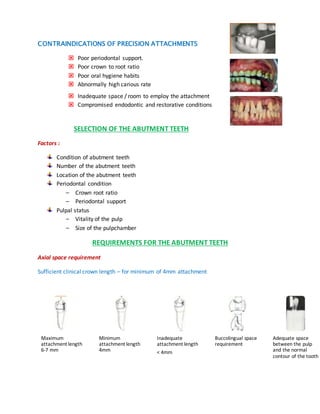
CONTRAINDICATIONS OF PRECISION ATTACHMENTS
 Poor periodontal support.
 Poor crown to root ratio
 Poor oral hygiene habits
 Abnormally high carious rate
 Inadequate space / room to employ the attachment
 Compromised endodontic and restorative conditions
SELECTION OF THE ABUTMENT TEETH
Factors :
Condition of abutment teeth
Number of the abutment teeth
Location of the abutment teeth
Periodontal condition
– Crown root ratio
– Periodontal support
Pulpal status
– Vitality of the pulp
– Size of the pulpchamber
REQUIREMENTS FOR THE ABUTMENT TEETH
Axial space requirement
Sufficient clinical crown length – for minimum of 4mm attachment
Maximum
attachment length
6-7 mm
Minimum
attachment length
4mm
Inadequate
attachment length
< 4mm
Buccolingual space
requirement
Adequate space
between the pulp
and the normal
contour of the tooth
 Full crownretainers
 Intracoronal attachments
Ideal Contours
More retentive /rigidIdeal contours
Cariesprotection
 Partial coverage retainers
 KennedysCl IIIpartial denture
 Splintedabutmentteeth
Most vulnerable
Inadequate retention
Marginal leakage
 Inlays/onlays/ pinledges
 Notusedfor intracoronal attachments
Lack of retention
Marginal caries
Lesslife
Selection of the attachments
 Intracoronal vs Extracoronal
 Resilient vs Non resilient
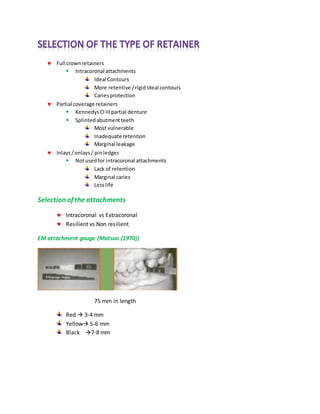
EM attachment gauge (Matsuo (1970))
75 mm in length
Red  3-4 mm
Yellow 5-6 mm
Black 7-8 mm
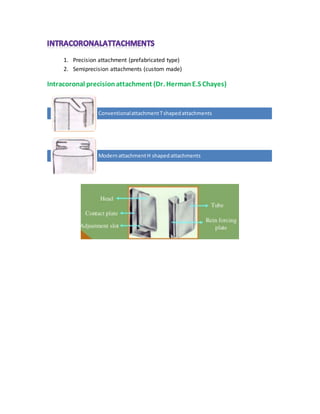
1. Precision attachment (prefabricated type)
2. Semiprecision attachments (custom made)
Intracoronal precisionattachment (Dr. HermanE.S Chayes)
ConventionalattachmentTshapedattachments
ModernattachmentH shapedattachments
Frictional :Preiskel groupI
Retention –Surface area contact
Functionof the length
– Controlledbyheightof clinical crown
– Intermaxillaryspace available
Functionof cross sectional dimensions
Mechanical : Preiskel groupII
Auxillarymechanical retentive features
Ex. Springloadedplunger/clips
Passive Attachment:
Matrix: Simple channels closes at one end to provide stop
Matrix: Solid slide
Channels of passive attachment may be round / elliptical slides
DEPENDINGON ARTICULARRETENTION
Passive attachment Active attachment LockedprecisionattachmentOmegaBeyeler
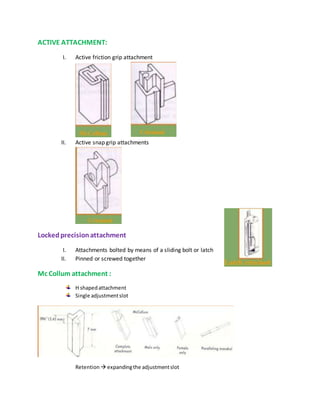
ACTIVE ATTACHMENT:
I. Active friction grip attachment
II. Active snap grip attachments
Lockedprecisionattachment
I. Attachments bolted by means of a sliding bolt or latch
II. Pinned or screwed together
Mc Collum attachment :
H shapedattachment
Single adjustmentslot
Retention  expandingthe adjustmentslot
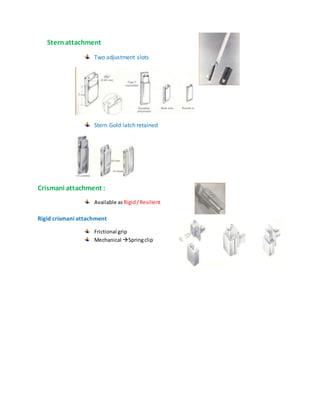
Sternattachment
Two adjustment slots
Stern Gold latch retained
Crismani attachment :
Available as Rigid/Resilient
Rigid crismani attachment
Frictional grip
Mechanical Springclip
Semiprecisionattachments
Semiprecision rest – intracoronal rest seat and resilient lingual arm.
“Laboratory fabricated rigid metalic extension (patrix) of a fixed or removable
dental prosthesis that fits into a slot type key way (matrix) in a cast restoration
allowing some movement between the component”.
Gillete (1923):
The firstsemiprecisionattachment
Rectangulardeeprestwithbuccal andlingual wroughtclaspsarms
Ira D Zinner (1979):
Lockingsemiprecisionattachment
Nonlockingsemiprecisionattachment
Louis blatter fein(1969) : Four aspects of rest seat preparation
Occlusal form / outline form – controls amount of rotation
Proximal form / side walls – lateral force control
The angle of the proximal wall with the gingival floor
Circular(Rigid – lockingtype) Dove tail (Rigid – lockingtype)
RectangularResilient Mortice Some resiliency(Non-lockingtype)
Parallel outline Taperingoutline
Gingival floor form: serves the function of reciprocation
Advantages:
 Versatility for clinical situations – employing various rest seat outline forms.
 Variation in tooth size and shapes are easily accommodated.
 Better crown contour compared to prefabricated type
Disadvantages:
 Long term wear is more – softness of alloy used.
 No standardization of sizing : Lack of interchangeability of male and female
attachment.
 Greater degree of laboratory skill and attention in detail.
Flat
Inclined
•Mortice occlusal
Channeled
•Rectangularocclusal form
EXTRA-CORONAL ATTACHMENTS
1. Introduced by Henry R. Boos (1900)
2. Modified by F Ewing Roach (1908)
Application: Kennedy‟s class I and class II
Boitel (1978)
Rigid attachments
Resilient attachments
Bar attachments
Advantages:
 No alteration of contour of the abutment crown
 Can be used in short abutment teeth
 Greater freedom in the design
 Ease of insertion and removal
Disadvantages (Wolf RE 1980):
 Lack of occlusal stability
 Bulky
 Rebasing problems
 Improper control of force distribution
 Encroachment on the gingival papilla – use of mini attachment
EXTRACORONALATTACHMENT
Rigidattachments Hingedattachments(Stressbreaking
action)
ResilientattachmentsERA
O-ring
ROLEOF ATTACHMENTS AS STRESS BREAKER
Broken stress philosophy
Mensor  stress can only be selected, altered or blocked
“Stress director”
Shohet (1969) Kratochvil (1981)
Low intensity forces on abutment teeth in contrast to rigid attachments.
Rationale of stress breaker  movement should be strictly only to displaceable tissue
Disadvantages of stress director:
 More complex, increased wear and breakage
 Increased bone resorption and trauma
 Occlusal contacts difficult to maintain
 Spring like device  tendency to fatigue
Rigid system
Non-rigid system
•Stress breaker Broken
References:
Removable Partial Dentures by Olcay Sakar editor

Precision attachments

  • 1.
  • 2.
    Historical Background Definition Precision: Qualityor state of being precise Attachment: Mechanical device for the fixation, retention and stabilization of dental prosthesis. INTRODUCTION • The desire to balance between functional stability and cosmetic appeal in partial dentures gave rise to the development of Precision Attachments • Precision Attachments have always been surrounded by an aura of mystery. • The use of Precision Attachments for partial denture retention is • • A practice builder for the better class of dentistry • • It helps to elevate the general standard of partial denture prosthetics. • The precision attachment is sometimes said to be a connecting link between fixed and removable partial denture as it incorporates features common to both types of construction. Winder • “Winders design” Screw joint retention Parr (1886) • Extracoronal socket attachment Stair • Telescopic abutment restoration Ash (1912) • Split bar attachment system
  • 3.
    PrecisionAttachment (GPT-8) : •A retainer consisting of a metal receptacle (matrix) and a closely fitting part (patrix); the matrix is usually contained within normal or expanded contours of the crown on the abutment tooth and the patrix is attached to a pontic or the removable partial denture framework. • An interlocking device, one component of which is fixed to an abutment or abutments, and the other is integrated into a removable prosthesis to stabilize and/or retain it. Mechanical device – Direct retainer • They are designed to replace occlusal rest, bracing arm, and retaining arm of the conventional clasp retained partial denture. • They function to retain, support and stabilize the removable partial denture.
  • 4.
    CLASSIFICATION OFATTACHMENTS 1. Basedon method of fabrication and the tolerance of fit 2. According to their relationship to the abutment teeth a. Intr-acoronal (Internal attachment) b. Extr-acoronal (External attachment) Male attachments • Patrix Flange insert key fitting part Female attachments • Matrix Slot crypt keyway Receptacle Precision attachment (prefabricated types) -Semiprecision attachment (custom made / laboratory made types) - Prefabricated wax / plastic / nylon patterns
  • 6.
    3. Based onstiffness of the resulting joint a. Rigid attachments b. Resilient attachments (Non rigid) 4. Based on geometric configuration and design of the attachment. a. Key and Keyway b. Interlocks c. Ball and socket d. Bar and clip / sleeve e. Hinge f. Telescopic g. Push button h. Latch i. Screw units
  • 7.
    Classification used inliterature: M.C. Mensor (1973) Classification according to shape, design and primary area of utilization of attachment. Gerardo Beccera and others (1987) Intra-dental attachments - Frictional - Magnetic Extra-dental attachments - Cantilever attachment - Bar attachment ADVANTAGES Improved esthetics and elevated psychological acceptance
  • 8.
    Mechanical advantage  Directthe forces along the long axis of the teeth / more apically  Force application closer to the fulcrum of the tooth  Reduces Non axial loading  Decreases Torquing forces  Rotational movement of the abutment  In Distal extension base cases – “Broken stress philosophy”  Reduced stress to the abutment  Stress free rotational/vertical movements  Cross arch load transfer and prosthesis stabilization  Compared to conventional clasp retained partial denture  Less liable to fracture than clasp  Less bulky and more esthetics  Better retention and stability  Less food stagnation DISADVANTAGES  Complexity of design, procedures for fabrication & clinical treatment  Minimum occlusogingival abutment height (4-6mm)  To incorporate attachment without overcontouring  Enough length of parallel contact  Anatomy of the tooth – Limited faciolingual tooth width (incisor and canine areas)  Expensive  Complexity of laboratory and clinical procedure  Attachment maintenance (repair or periodic replacement)  Wearing of attachment components  Require high technical expertise – Dentist and laboratory technician  Requires aggressive tooth preparation  Cooperation and manual dexterity on the part of the patient  Difficult to insert and remove  Visually or manually challenged patient  Increase demandonoral hygiene performance
  • 9.
    Removable Prosthodontics  Asa retainer in a removable tooth supported partial denture  4 large well rounded abutments are available  For esthetic concern in the anterior part of the mouth  Stress Breakers  Free end saddles/Distal Extension Base cases (DEB)  When cantilevered pontic is to be used as abutment  For movable joints in sectional dentures  Periodontal involvement of the tooth  Contraindicates rigid FPDs  Most efficient bilateral bracing and support are essential  Divergent abutment teeth with high survey lines – parallel path of placement.  As a retainers in tooth supported over denture FixedProsthodontics  As a connector in fixed partial denture construction (long span bridges)  To overcome alignment problems where abutments have differing path of withdrawal. IMPLANTPROSTHODONTICS  Implant supported over denture  They are used for connection between the tooth and the implant
  • 10.
    CONTRAINDICATIONS OF PRECISIONATTACHMENTS  Poor periodontal support.  Poor crown to root ratio  Poor oral hygiene habits  Abnormally high carious rate  Inadequate space / room to employ the attachment  Compromised endodontic and restorative conditions SELECTION OF THE ABUTMENT TEETH Factors : Condition of abutment teeth Number of the abutment teeth Location of the abutment teeth Periodontal condition – Crown root ratio – Periodontal support Pulpal status – Vitality of the pulp – Size of the pulpchamber REQUIREMENTS FOR THE ABUTMENT TEETH Axial space requirement Sufficient clinical crown length – for minimum of 4mm attachment Maximum attachment length 6-7 mm Minimum attachment length 4mm Inadequate attachment length < 4mm Buccolingual space requirement Adequate space between the pulp and the normal contour of the tooth
  • 11.
     Full crownretainers Intracoronal attachments Ideal Contours More retentive /rigidIdeal contours Cariesprotection  Partial coverage retainers  KennedysCl IIIpartial denture  Splintedabutmentteeth Most vulnerable Inadequate retention Marginal leakage  Inlays/onlays/ pinledges  Notusedfor intracoronal attachments Lack of retention Marginal caries Lesslife Selection of the attachments  Intracoronal vs Extracoronal  Resilient vs Non resilient EM attachment gauge (Matsuo (1970)) 75 mm in length Red  3-4 mm Yellow 5-6 mm Black 7-8 mm
  • 12.
    1. Precision attachment(prefabricated type) 2. Semiprecision attachments (custom made) Intracoronal precisionattachment (Dr. HermanE.S Chayes) ConventionalattachmentTshapedattachments ModernattachmentH shapedattachments
  • 13.
    Frictional :Preiskel groupI Retention–Surface area contact Functionof the length – Controlledbyheightof clinical crown – Intermaxillaryspace available Functionof cross sectional dimensions Mechanical : Preiskel groupII Auxillarymechanical retentive features Ex. Springloadedplunger/clips Passive Attachment: Matrix: Simple channels closes at one end to provide stop Matrix: Solid slide Channels of passive attachment may be round / elliptical slides DEPENDINGON ARTICULARRETENTION Passive attachment Active attachment LockedprecisionattachmentOmegaBeyeler
  • 14.
    ACTIVE ATTACHMENT: I. Activefriction grip attachment II. Active snap grip attachments Lockedprecisionattachment I. Attachments bolted by means of a sliding bolt or latch II. Pinned or screwed together Mc Collum attachment : H shapedattachment Single adjustmentslot Retention  expandingthe adjustmentslot
  • 15.
    Sternattachment Two adjustment slots SternGold latch retained Crismani attachment : Available as Rigid/Resilient Rigid crismani attachment Frictional grip Mechanical Springclip
  • 16.
    Semiprecisionattachments Semiprecision rest –intracoronal rest seat and resilient lingual arm. “Laboratory fabricated rigid metalic extension (patrix) of a fixed or removable dental prosthesis that fits into a slot type key way (matrix) in a cast restoration allowing some movement between the component”. Gillete (1923): The firstsemiprecisionattachment Rectangulardeeprestwithbuccal andlingual wroughtclaspsarms Ira D Zinner (1979): Lockingsemiprecisionattachment Nonlockingsemiprecisionattachment Louis blatter fein(1969) : Four aspects of rest seat preparation Occlusal form / outline form – controls amount of rotation Proximal form / side walls – lateral force control The angle of the proximal wall with the gingival floor Circular(Rigid – lockingtype) Dove tail (Rigid – lockingtype) RectangularResilient Mortice Some resiliency(Non-lockingtype) Parallel outline Taperingoutline
  • 17.
    Gingival floor form:serves the function of reciprocation Advantages:  Versatility for clinical situations – employing various rest seat outline forms.  Variation in tooth size and shapes are easily accommodated.  Better crown contour compared to prefabricated type Disadvantages:  Long term wear is more – softness of alloy used.  No standardization of sizing : Lack of interchangeability of male and female attachment.  Greater degree of laboratory skill and attention in detail. Flat Inclined •Mortice occlusal Channeled •Rectangularocclusal form
  • 18.
    EXTRA-CORONAL ATTACHMENTS 1. Introducedby Henry R. Boos (1900) 2. Modified by F Ewing Roach (1908) Application: Kennedy‟s class I and class II Boitel (1978) Rigid attachments Resilient attachments Bar attachments Advantages:  No alteration of contour of the abutment crown  Can be used in short abutment teeth  Greater freedom in the design  Ease of insertion and removal Disadvantages (Wolf RE 1980):  Lack of occlusal stability  Bulky  Rebasing problems  Improper control of force distribution  Encroachment on the gingival papilla – use of mini attachment EXTRACORONALATTACHMENT Rigidattachments Hingedattachments(Stressbreaking action) ResilientattachmentsERA O-ring
  • 19.
    ROLEOF ATTACHMENTS ASSTRESS BREAKER Broken stress philosophy Mensor  stress can only be selected, altered or blocked “Stress director” Shohet (1969) Kratochvil (1981) Low intensity forces on abutment teeth in contrast to rigid attachments. Rationale of stress breaker  movement should be strictly only to displaceable tissue Disadvantages of stress director:  More complex, increased wear and breakage  Increased bone resorption and trauma  Occlusal contacts difficult to maintain  Spring like device  tendency to fatigue Rigid system Non-rigid system •Stress breaker Broken
  • 20.