1
SUPPORT IN COMPLETE
DENTURE PROSTHESIS
Presented by
-------------------------------------------------------
Dr PRATIK HODAR (Pg 1st yr)
Guided by -
Dr P. Balaji Raman
Dr SashiPurna
Dr Durga raju
Dr Ashwin Aidasani
Dr Abhay Narayane
DR. HSRSM DENTAL COLLEGE AND HOSPITAL, HINGOLI
DEPARTMENT OF PROSTHODONTICS
 Introduction
 Definition
 Types
 Importance
 Anatomical consideration
1. Oral mucous membrane
2. Denture supporting area
 Factors affecting support
 Conclusion
 Refrence
2
 Dentist must base their technique on
understanding of the biological aspect of the
relationship between the denture base and
supporting tissue.
3
 THE FOUNDATION AREA ON WHICH A DENTAL
PROSTHESIS RESTS.(GPT 8TH EDITION)
 SUPPORT IS THAT QUALITY WHICH RESISTS
VERTICAL MOVEMENT OR DISPLACEMENT OF THE
DENTURE TOWARD THE BASAL SEAT.
4
› Initial support –
 Through impression procedures
 Functional loading of supporting tissues
› Long term
 Directing occlusal forces towards resistant tissues
5
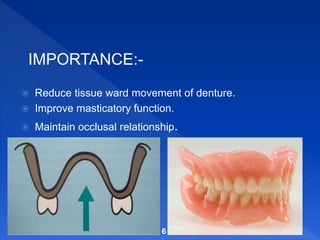
 Reduce tissue ward movement of denture.
 Improve masticatory function.
 Maintain occlusal relationship.
6
IMPORTANCE:-
 Oral mucous membrane:
1. Definition.
2. Classification .
3. Importance for support.
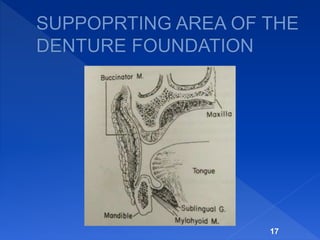
 Denture supporting areas:
1. Maxillarysupporting area.
2. Mandibular supporting area.
3. Anatomical landmarks.
4. Bone.
7
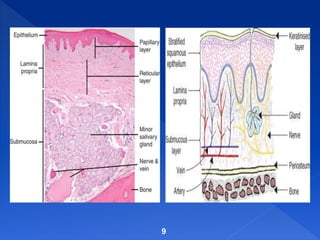
 The oral cavity is lined by soft tissue known as
mucous membrane.
 Mucous membrane composed of 2 layers,
- MUCOSA : It is made of stratified squamous
epithelium & Connective tissue called Lamina
Propria.
- SUBMUCOSA : It is formed by connective
tissue. It may contain glands , fatty tisue,
muscle, transmitting blood vessels and nerve.
8
9
10
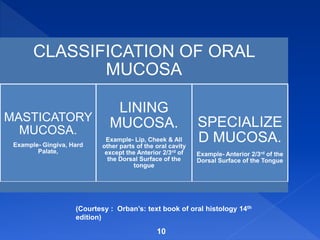
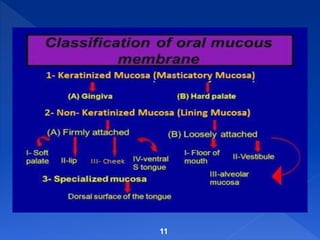
CLASSIFICATION OF ORAL
MUCOSA
MASTICATORY
MUCOSA.
Example- Gingiva, Hard
Palate,
LINING
MUCOSA.
Example- Lip, Cheek & All
other parts of the oral cavity
except the Anterior 2/3rd of
the Dorsal Surface of the
tongue
SPECIALIZE
D MUCOSA.
Example- Anterior 2/3rd of the
Dorsal Surface of the Tongue
(Courtesy : Orban’s: text book of oral histology 14th
edition)
11
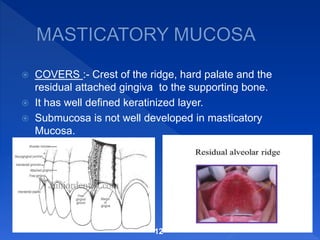
 COVERS :- Crest of the ridge, hard palate and the
residual attached gingiva to the supporting bone.
 It has well defined keratinized layer.
 Submucosa is not well developed in masticatory
Mucosa.
12
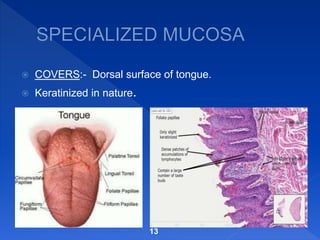
 COVERS:- Dorsal surface of tongue.
 Keratinized in nature.
13
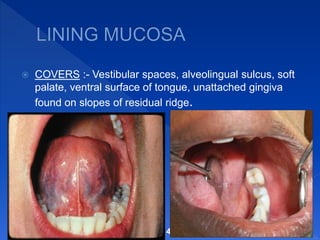
 COVERS :- Vestibular spaces, alveolingual sulcus, soft
palate, ventral surface of tongue, unattached gingiva
found on slopes of residual ridge.
14
 Gives cushioning effect
 Medium thickness and uniform resiliency favors
prognosis.
 Thick mucous membrane- retention is
compromised more than stability
 Thin and atrophic membrane gets damaged and
ulcerated.
 Inflamed mucosa :
1. Before denture insertion- elimination and treat for
inflammation
2. After denture insertion- ask patient to stop wearing
denture 5-6 days till it gets normal.
15
 Yemm in 1972
-Stress can induce increase activity of masseter and
temporalis muscles in denture wearers, which in turn
cause tooth contact and eventually soreness of the
mucosal tissues.
 Lindan in 1961
-0.13 gm/ mm2 will displace soft tissues by 95%
16
17
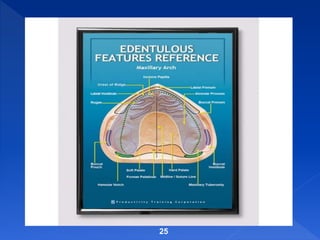
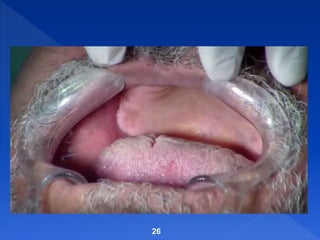
Primary stress bearing areas
 Hard palate
 Maxillary tuberosity
 Secondary stress bearing area
 Residual alveolar ridge
 Rugae
18
(Courtesy : Zarb, Hobkirk : text book of
prosthodontic treatment for edentulous patient 13th
edition)
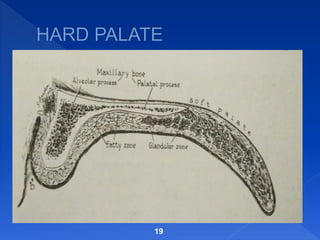
19
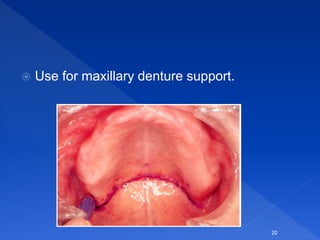
 Use for maxillary denture support.
20
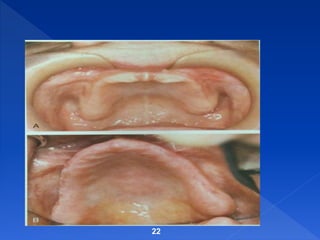
• Large Tuberosity-
• provides fine bearing surfaces.
• But, have problems also –
1. Encroachment on the inter-ridge distance;
2. large or opposing undercuts
Fibrous Tuberosity-
Surgically reduced.
21
22
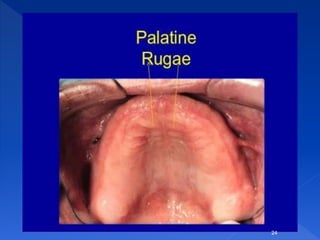
 They are raised area of dense connective
tissue radiating from the median suture in
anterior 1/3rd of palate
 Resists anterior displacement of denture
23
24
25
26
MANDIBULAR
 primary stress bearing areas
 Buccal shelf
 Retro molar pad
 Secondary
 Residual alveolar ridge
(Courtesy : Zarb, Hobkirk : text book of prosthodontic
treatment for edentulous patient 13th edition)
27
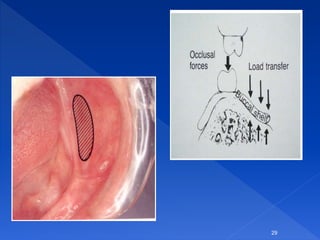
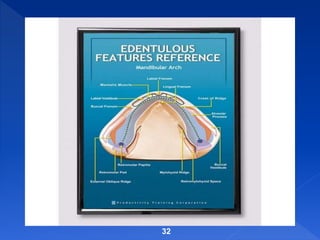
 Borders:
1. Externally- external oblique lines
2. Internally- residual ridge
3. Anterior- buccal frenum
4. Posteriorly- retro molar pad
 Parallel to the floor
 Forces directed right angle
 Very dense trabeculation
28
29
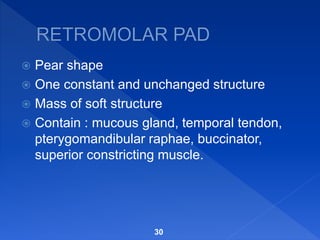
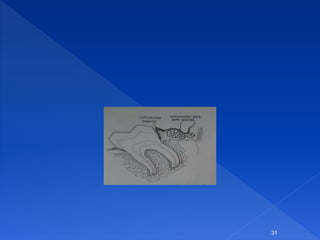
 Pear shape
 One constant and unchanged structure
 Mass of soft structure
 Contain : mucous gland, temporal tendon,
pterygomandibular raphae, buccinator,
superior constricting muscle.
30
31
32
33
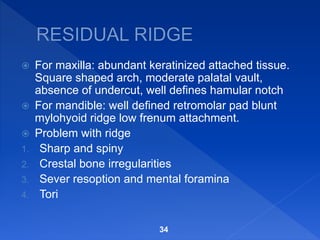
 For maxilla: abundant keratinized attached tissue.
Square shaped arch, moderate palatal vault,
absence of undercut, well defines hamular notch
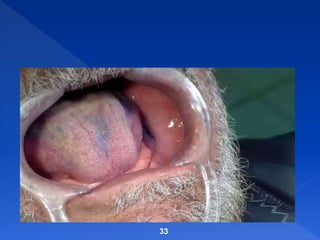
 For mandible: well defined retromolar pad blunt
mylohyoid ridge low frenum attachment.
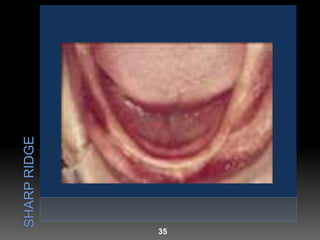
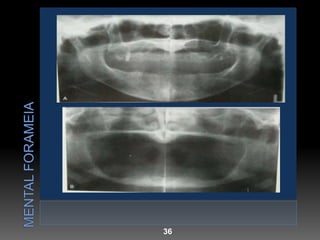
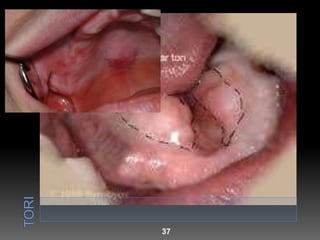
 Problem with ridge
1. Sharp and spiny
2. Crestal bone irregularities
3. Sever resoption and mental foramina
4. Tori
34
35
36
37
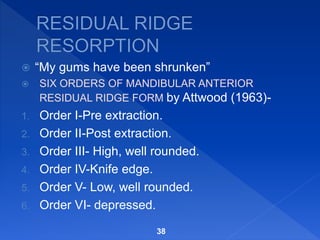
 “My gums have been shrunken”
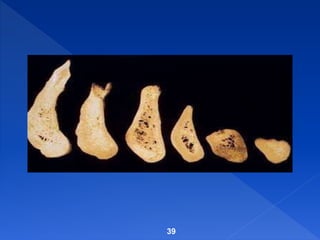
 SIX ORDERS OF MANDIBULAR ANTERIOR
RESIDUAL RIDGE FORM by Attwood (1963)-
1. Order I-Pre extraction.
2. Order II-Post extraction.
3. Order III- High, well rounded.
4. Order IV-Knife edge.
5. Order V- Low, well rounded.
6. Order VI- depressed.
38
39
 Consequences: ----
Compromised support
1. -Movement of dentures
2. -Instability of prosthesis
 Prevention
-Minimizing the forces transmitted to supporting
tissues
-Decrease the movement of prosthesis
40
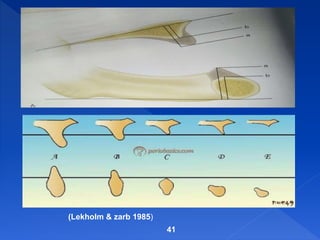
41
(Lekholm & zarb 1985)
 Gordan GS Genent HK after the age of 40xyrs, the
skeleton decreases, so that by age of 65 approximately
1/3rd of bone minerals are lost.
 SOBOLIK(1960)writes that constant pressure will cause
bone resorption, but intermittent pressure favours bone
formation.
 PENDLETION(1951)has said that pressure applied to
bone in an abnormal direction will result in resorption.
42
REVIEW OF LITERATURE
 STAHL(1948) showed that ridge resorption increase
with the severity of diabetes.
 PERSON(1957) noted that during a rapid and intense
loss of alveolar bone in diabetic, the long bone and
pelvis remained intact.
 NORDIN(1960) Osteoporosis is generalized condition of
bone in which the volume of bone in skeleton is
reduced.
43
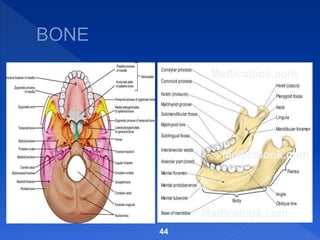
44
45
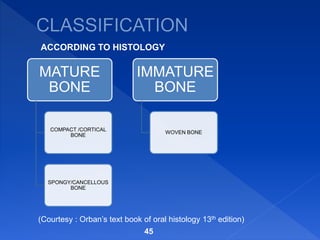
ACCORDING TO HISTOLOGY
MATURE
BONE
COMPACT /CORTICAL
BONE
SPONGY/CANCELLOUS
BONE
IMMATURE
BONE
WOVEN BONE
(Courtesy : Orban’s text book of oral histology 13th edition)
46
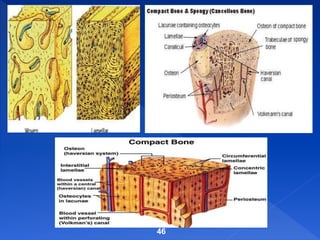
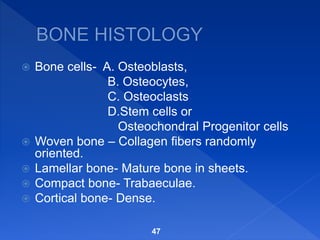
 Bone cells- A. Osteoblasts,
B. Osteocytes,
C. Osteoclasts
D.Stem cells or
Osteochondral Progenitor cells
 Woven bone – Collagen fibers randomly
oriented.
 Lamellar bone- Mature bone in sheets.
 Compact bone- Trabaeculae.
 Cortical bone- Dense.
47
 It is in continuous flux throughout life. (Frost ; enlow)
 ADULTS : Formation= Resorption
 SENILITY : Formation< Resorption
 Placement of denture after extraction require 6 weeks/ 2
months.
48
 WOLF LAW- Change in form follows a change in
function owing alteration of the internal architecture and
external conformation of bone.
 NEUFELD REPORTED: In some specimens studied,
the trabecular pattern was arranged in such a way that it
indicated that there was some adaptation of structure of
bone to the bone to presence of an appliance in region
near the superior space of alveolar process.
49
 1] Its original size and consistency;
 2] the persons general health;
 3] forces developed by the surrounding
musculature;
 4] the severity the location of periodontal disease
(Hausman ; Hedegard)
 5] forces accruing from the wearing of dental
prosthesis;
 6] surgery at the time of removal of the tooth;
 7] the relative length of the time different parts of
the jaws has been edentulous.
50
 Include:- all denture bearing area.
 Exclude:- all relief area.
 Snow shoe effect
 Watt 1961
-mean denture bearing area
maxilla (22.96 cm2)
mandible (12.25 cm2)
51
 Large surface area
 Nature of supporting area
 Impression procedure
 Accuracy of fit
 Direct bone anchorage
52
1] Recording the tissue impression at their rest position.
2] Decreasing the size of food table.
3] Developing an occlusion that eliminates, as much as
possible, horizontal forces and those that produce torque.
4] Extending the denture base for maximum coverage
within physiologic limit.
5] Biting with the knife and fork, that is, placing small
masses of food over the posterior tooth where the
supporting bone is best suited to resist force.
6] Removing the denture for at least 8 of every 24 hours for
tissue to rest.
53
 Selection of regions that should provide
primary and secondary support depends on
anatomic variation unique to each patient.
54
 Orbans: Oral histology and embryology 14th edition
 Charles heartwell: syallabus of complet denture 4th
edition.
 Jhon sharry : Complet denture prosthodontic 3rd edition.
 Zarb and Bolender : prosthodontic treatment for
edentulos patient 12th edition.
 Zarb and Bolender : prosthodontic treatment for
edentulos patient 13th edition.
55
 Sheldon wrinkler : essentials of complete denture
prosthodontics 3rd edition.
 Karl mish : Contemporary implant dentistry 3rd edition.
 Glossary of prosthodontics terms 8th edition.
 A contemporary review of the factors involved in
complete dentures Part III: Support T. E. Jacobson & A.
J. Krol JPD 1983;49:306-313.
 A review of residual ridge resorption and bone density:
Esa klemetti
56
57

Presentation1 support for complete denture

  • 1.
    1 SUPPORT IN COMPLETE DENTUREPROSTHESIS Presented by ------------------------------------------------------- Dr PRATIK HODAR (Pg 1st yr) Guided by - Dr P. Balaji Raman Dr SashiPurna Dr Durga raju Dr Ashwin Aidasani Dr Abhay Narayane DR. HSRSM DENTAL COLLEGE AND HOSPITAL, HINGOLI DEPARTMENT OF PROSTHODONTICS
  • 2.
     Introduction  Definition Types  Importance  Anatomical consideration 1. Oral mucous membrane 2. Denture supporting area  Factors affecting support  Conclusion  Refrence 2
  • 3.
     Dentist mustbase their technique on understanding of the biological aspect of the relationship between the denture base and supporting tissue. 3
  • 4.
     THE FOUNDATIONAREA ON WHICH A DENTAL PROSTHESIS RESTS.(GPT 8TH EDITION)  SUPPORT IS THAT QUALITY WHICH RESISTS VERTICAL MOVEMENT OR DISPLACEMENT OF THE DENTURE TOWARD THE BASAL SEAT. 4
  • 5.
    › Initial support–  Through impression procedures  Functional loading of supporting tissues › Long term  Directing occlusal forces towards resistant tissues 5
  • 6.
     Reduce tissueward movement of denture.  Improve masticatory function.  Maintain occlusal relationship. 6 IMPORTANCE:-
  • 7.
     Oral mucousmembrane: 1. Definition. 2. Classification . 3. Importance for support.  Denture supporting areas: 1. Maxillarysupporting area. 2. Mandibular supporting area. 3. Anatomical landmarks. 4. Bone. 7
  • 8.
     The oralcavity is lined by soft tissue known as mucous membrane.  Mucous membrane composed of 2 layers, - MUCOSA : It is made of stratified squamous epithelium & Connective tissue called Lamina Propria. - SUBMUCOSA : It is formed by connective tissue. It may contain glands , fatty tisue, muscle, transmitting blood vessels and nerve. 8
  • 9.
  • 10.
    10 CLASSIFICATION OF ORAL MUCOSA MASTICATORY MUCOSA. Example-Gingiva, Hard Palate, LINING MUCOSA. Example- Lip, Cheek & All other parts of the oral cavity except the Anterior 2/3rd of the Dorsal Surface of the tongue SPECIALIZE D MUCOSA. Example- Anterior 2/3rd of the Dorsal Surface of the Tongue (Courtesy : Orban’s: text book of oral histology 14th edition)
  • 11.
  • 12.
     COVERS :-Crest of the ridge, hard palate and the residual attached gingiva to the supporting bone.  It has well defined keratinized layer.  Submucosa is not well developed in masticatory Mucosa. 12
  • 13.
     COVERS:- Dorsalsurface of tongue.  Keratinized in nature. 13
  • 14.
     COVERS :-Vestibular spaces, alveolingual sulcus, soft palate, ventral surface of tongue, unattached gingiva found on slopes of residual ridge. 14
  • 15.
     Gives cushioningeffect  Medium thickness and uniform resiliency favors prognosis.  Thick mucous membrane- retention is compromised more than stability  Thin and atrophic membrane gets damaged and ulcerated.  Inflamed mucosa : 1. Before denture insertion- elimination and treat for inflammation 2. After denture insertion- ask patient to stop wearing denture 5-6 days till it gets normal. 15
  • 16.
     Yemm in1972 -Stress can induce increase activity of masseter and temporalis muscles in denture wearers, which in turn cause tooth contact and eventually soreness of the mucosal tissues.  Lindan in 1961 -0.13 gm/ mm2 will displace soft tissues by 95% 16
  • 17.
  • 18.
    Primary stress bearingareas  Hard palate  Maxillary tuberosity  Secondary stress bearing area  Residual alveolar ridge  Rugae 18 (Courtesy : Zarb, Hobkirk : text book of prosthodontic treatment for edentulous patient 13th edition)
  • 19.
  • 20.
     Use formaxillary denture support. 20
  • 21.
    • Large Tuberosity- •provides fine bearing surfaces. • But, have problems also – 1. Encroachment on the inter-ridge distance; 2. large or opposing undercuts Fibrous Tuberosity- Surgically reduced. 21
  • 22.
  • 23.
     They areraised area of dense connective tissue radiating from the median suture in anterior 1/3rd of palate  Resists anterior displacement of denture 23
  • 24.
  • 25.
  • 26.
  • 27.
    MANDIBULAR  primary stressbearing areas  Buccal shelf  Retro molar pad  Secondary  Residual alveolar ridge (Courtesy : Zarb, Hobkirk : text book of prosthodontic treatment for edentulous patient 13th edition) 27
  • 28.
     Borders: 1. Externally-external oblique lines 2. Internally- residual ridge 3. Anterior- buccal frenum 4. Posteriorly- retro molar pad  Parallel to the floor  Forces directed right angle  Very dense trabeculation 28
  • 29.
  • 30.
     Pear shape One constant and unchanged structure  Mass of soft structure  Contain : mucous gland, temporal tendon, pterygomandibular raphae, buccinator, superior constricting muscle. 30
  • 31.
  • 32.
  • 33.
  • 34.
     For maxilla:abundant keratinized attached tissue. Square shaped arch, moderate palatal vault, absence of undercut, well defines hamular notch  For mandible: well defined retromolar pad blunt mylohyoid ridge low frenum attachment.  Problem with ridge 1. Sharp and spiny 2. Crestal bone irregularities 3. Sever resoption and mental foramina 4. Tori 34
  • 35.
  • 36.
  • 37.
  • 38.
     “My gumshave been shrunken”  SIX ORDERS OF MANDIBULAR ANTERIOR RESIDUAL RIDGE FORM by Attwood (1963)- 1. Order I-Pre extraction. 2. Order II-Post extraction. 3. Order III- High, well rounded. 4. Order IV-Knife edge. 5. Order V- Low, well rounded. 6. Order VI- depressed. 38
  • 39.
  • 40.
     Consequences: ---- Compromisedsupport 1. -Movement of dentures 2. -Instability of prosthesis  Prevention -Minimizing the forces transmitted to supporting tissues -Decrease the movement of prosthesis 40
  • 41.
  • 42.
     Gordan GSGenent HK after the age of 40xyrs, the skeleton decreases, so that by age of 65 approximately 1/3rd of bone minerals are lost.  SOBOLIK(1960)writes that constant pressure will cause bone resorption, but intermittent pressure favours bone formation.  PENDLETION(1951)has said that pressure applied to bone in an abnormal direction will result in resorption. 42 REVIEW OF LITERATURE
  • 43.
     STAHL(1948) showedthat ridge resorption increase with the severity of diabetes.  PERSON(1957) noted that during a rapid and intense loss of alveolar bone in diabetic, the long bone and pelvis remained intact.  NORDIN(1960) Osteoporosis is generalized condition of bone in which the volume of bone in skeleton is reduced. 43
  • 44.
  • 45.
    45 ACCORDING TO HISTOLOGY MATURE BONE COMPACT/CORTICAL BONE SPONGY/CANCELLOUS BONE IMMATURE BONE WOVEN BONE (Courtesy : Orban’s text book of oral histology 13th edition)
  • 46.
  • 47.
     Bone cells-A. Osteoblasts, B. Osteocytes, C. Osteoclasts D.Stem cells or Osteochondral Progenitor cells  Woven bone – Collagen fibers randomly oriented.  Lamellar bone- Mature bone in sheets.  Compact bone- Trabaeculae.  Cortical bone- Dense. 47
  • 48.
     It isin continuous flux throughout life. (Frost ; enlow)  ADULTS : Formation= Resorption  SENILITY : Formation< Resorption  Placement of denture after extraction require 6 weeks/ 2 months. 48
  • 49.
     WOLF LAW-Change in form follows a change in function owing alteration of the internal architecture and external conformation of bone.  NEUFELD REPORTED: In some specimens studied, the trabecular pattern was arranged in such a way that it indicated that there was some adaptation of structure of bone to the bone to presence of an appliance in region near the superior space of alveolar process. 49
  • 50.
     1] Itsoriginal size and consistency;  2] the persons general health;  3] forces developed by the surrounding musculature;  4] the severity the location of periodontal disease (Hausman ; Hedegard)  5] forces accruing from the wearing of dental prosthesis;  6] surgery at the time of removal of the tooth;  7] the relative length of the time different parts of the jaws has been edentulous. 50
  • 51.
     Include:- alldenture bearing area.  Exclude:- all relief area.  Snow shoe effect  Watt 1961 -mean denture bearing area maxilla (22.96 cm2) mandible (12.25 cm2) 51
  • 52.
     Large surfacearea  Nature of supporting area  Impression procedure  Accuracy of fit  Direct bone anchorage 52
  • 53.
    1] Recording thetissue impression at their rest position. 2] Decreasing the size of food table. 3] Developing an occlusion that eliminates, as much as possible, horizontal forces and those that produce torque. 4] Extending the denture base for maximum coverage within physiologic limit. 5] Biting with the knife and fork, that is, placing small masses of food over the posterior tooth where the supporting bone is best suited to resist force. 6] Removing the denture for at least 8 of every 24 hours for tissue to rest. 53
  • 54.
     Selection ofregions that should provide primary and secondary support depends on anatomic variation unique to each patient. 54
  • 55.
     Orbans: Oralhistology and embryology 14th edition  Charles heartwell: syallabus of complet denture 4th edition.  Jhon sharry : Complet denture prosthodontic 3rd edition.  Zarb and Bolender : prosthodontic treatment for edentulos patient 12th edition.  Zarb and Bolender : prosthodontic treatment for edentulos patient 13th edition. 55
  • 56.
     Sheldon wrinkler: essentials of complete denture prosthodontics 3rd edition.  Karl mish : Contemporary implant dentistry 3rd edition.  Glossary of prosthodontics terms 8th edition.  A contemporary review of the factors involved in complete dentures Part III: Support T. E. Jacobson & A. J. Krol JPD 1983;49:306-313.  A review of residual ridge resorption and bone density: Esa klemetti 56
  • 57.