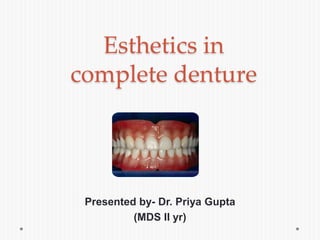
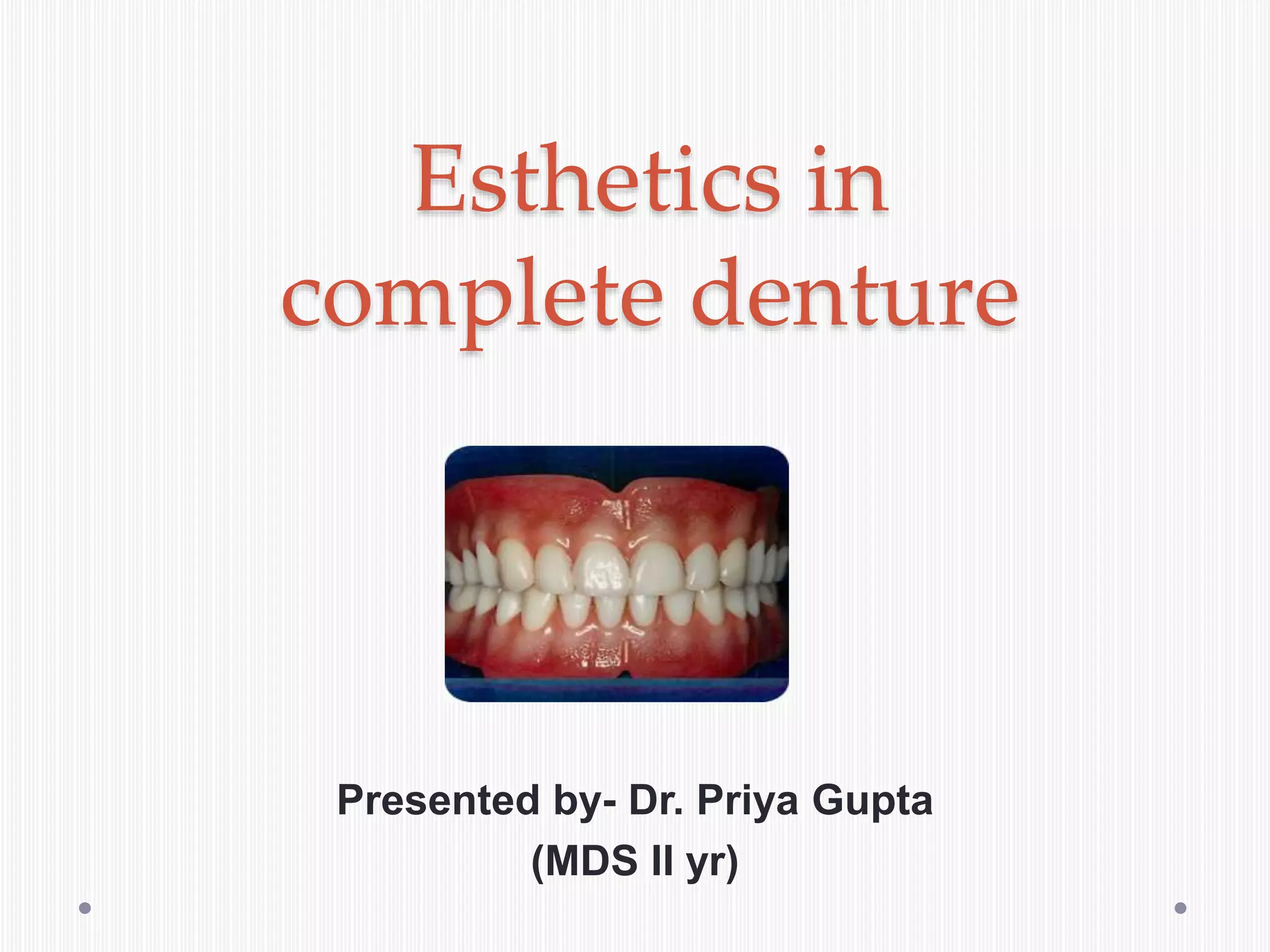
Esthetics in
complete denture
Presented by- Dr. Priya Gupta
(MDS II yr)
Contents:-
1. Introduction
2. Definition
3. Review of literature
4. Fundamentals of esthetics
5. Impression making
6. Jaw relation
7. Anterior tooth selection
Dentogenic concept
Dynesthetic interpretation of dentogenic concept
SPA factor
8. Anterior and posterior teeth arrangement
9. Characterization of denture
10. Errors in esthetics
11. Summary
12. References
Introduction:-
• Frush’ states, “The acceptance of treatment by the
patient is made considerably easier when the prosthesis
accomplishes two basic esthetic needs:
 the portrayal of a physiologic norm
 an actual improvement in the attractiveness of the smile
• Esthetics goes much further than the simple placement
of teeth in occlusion rims. The dentist must consider both
the anatomy and physiology of the face, as well as
artistic principles, to achieve a natural looking denture.
Beauty lies in the eyes of the beholde
We greet the world with our
Definition:-
• Glossary of Prosthodontic Terms -
Esthetics can be defined as the branch of philosophy
dealing with beauty. Descriptive of a specific creation
that results from such a study: objectifies beauty and
attractiveness and elicits pleasure.
• Denture esthetics : the effect produced by a dental
prosthesis that affects the beauty and attractiveness of
the person.
History
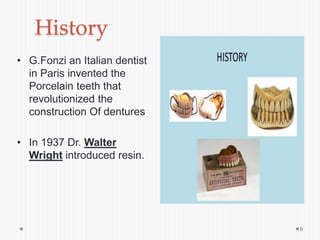
• G.Fonzi an Italian dentist
in Paris invented the
Porcelain teeth that
revolutionized the
construction Of dentures
• In 1937 Dr. Walter
Wright introduced resin.
6
Review of literature:-
• John P Frush And Roland D Fisher in 1955
• They introduced the word “dentogenic” in prosthetic
dentistry to ease the selection of anterior teeth in
complete denture prosthodontics.
Factors of Dentogenic restorations, sex, age, and
personality has improved appearance of the
denture wearer.
• Donald F K in 1956 studied relation between the
denture esthetics and denture base.
• The factors relating to the denture base are the
reproduction of the contours of the tissue covered by the
base, and its staining to reproduce the natural tissue
hues.
Indications for esthetic denture bases in patients
with active upper lip, patient with prominent
premaxillary area, theatrical performers and
singers, produces psychologic effect on the patient
• Frush and fisher in 1958, they studied the qualities of
femininity, masculinity, personality and the various
physiologic ages in smile.
• Richard E. lombardi in 1973 ,he studied the science
and principles of visual perception and their influence in
creating intense vitality, beauty, and realism on denture
prosthesis.
By application of Dynesthetic techniques to the
Dentogenic concept have accomplished the pleasing
personality, masculinity, and femininity, effectively.
Principles of esthetics such as unity, composition,
dominance, proportion, illusion in denture esthetics.
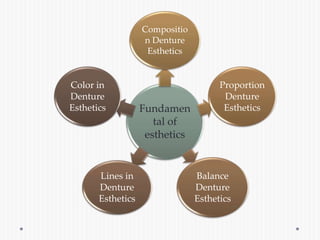
Fundamen
tal of
esthetics
Compositio
n Denture
Esthetics
Proportion
Denture
Esthetics
Balance
Denture
Esthetics
Lines in
Denture
Esthetics
Color in
Denture
Esthetics
Composition:
• The increase of visibility is proportional to the increase in
contrast.
• The relationship between objects made visible by
contrasts is called composition.
• Contrast: It is that factor which makes the various
elements of a composition visible.
• The eye can differentiate the parts of an object due to
contrast of colors, lines, patterns, textures, etc.
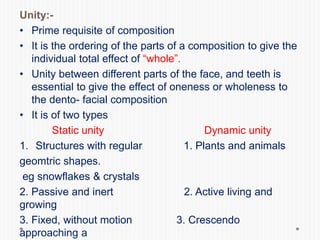
Unity:-
• Prime requisite of composition
• It is the ordering of the parts of a composition to give the
individual total effect of “whole”.
• Unity between different parts of the face, and teeth is
essential to give the effect of oneness or wholeness to
the dento- facial composition
• It is of two types
Static unity Dynamic unity
1. Structures with regular 1. Plants and animals
geomtric shapes.
eg snowflakes & crystals
2. Passive and inert 2. Active living and
growing
3. Fixed, without motion 3. Crescendo
approaching a
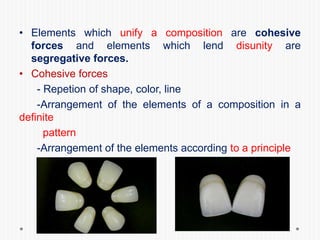
• Elements which unify a composition are cohesive
forces and elements which lend disunity are
segregative forces.
• Cohesive forces
- Repetion of shape, color, line
-Arrangement of the elements of a composition in a
definite
pattern
-Arrangement of the elements according to a principle
-presence of a border.
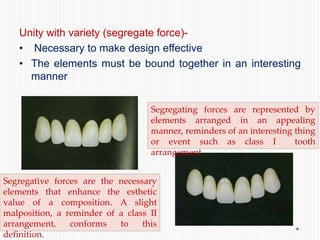
Unity with variety (segregate force)-
• Necessary to make design effective
• The elements must be bound together in an interesting
manner
Segregating forces are represented by
elements arranged in an appealing
manner, reminders of an interesting thing
or event such as class I tooth
arrangement.
Segregative forces are the necessary
elements that enhance the esthetic
value of a composition. A slight
malposition, a reminder of a class II
arrangement, conforms to this
definition.
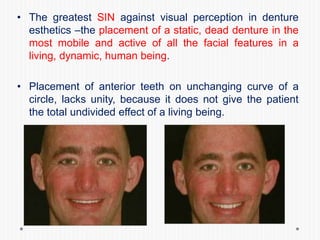
• The greatest SIN against visual perception in denture
esthetics –the placement of a static, dead denture in the
most mobile and active of all the facial features in a
living, dynamic, human being.
• Placement of anterior teeth on unchanging curve of a
circle, lacks unity, because it does not give the patient
the total undivided effect of a living being.
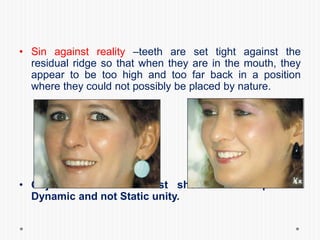
• Sin against reality –teeth are set tight against the
residual ridge so that when they are in the mouth, they
appear to be too high and too far back in a position
where they could not possibly be placed by nature.
• Objective of the dentist should be to provide
Dynamic and not Static unity.
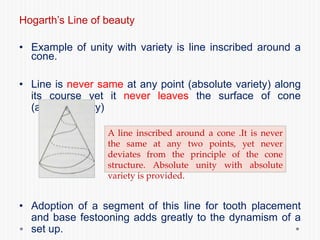
Hogarth’s Line of beauty
• Example of unity with variety is line inscribed around a
cone.
• Line is never same at any point (absolute variety) along
its course yet it never leaves the surface of cone
(absolute unity)
• Adoption of a segment of this line for tooth placement
and base festooning adds greatly to the dynamism of a
set up.
A line inscribed around a cone .It is never
the same at any two points, yet never
deviates from the principle of the cone
structure. Absolute unity with absolute
variety is provided.
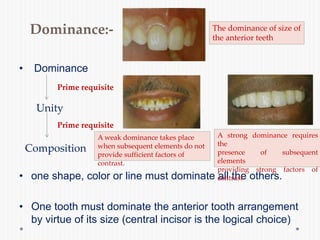
Dominance:-
• Dominance
• one shape, color or line must dominate all the others.
• One tooth must dominate the anterior tooth arrangement
by virtue of its size (central incisor is the logical choice)
Unity
Composition
Prime requisite
Prime requisite
The dominance of size of
the anterior teeth
A weak dominance takes place
when subsequent elements do not
provide sufficient factors of
contrast.
A strong dominance requires
the
presence of subsequent
elements
providing strong factors of
contrast
• The dominance of dental composition is increased by
increasing mold size, using lighter teeth, placing the
teeth farther anteriorly and increasing the exposed
gingivoincisal length, are all method of increasing
visibility.
• For a patient with soft personality , dominance may be
produced by minimizing these factors and for a patient of
strong personality all or part of the above features may
be restored.
Symmetry:-
• It is the regularity of arrangement of forms either from left to
right as in horizontal symmetry, or from a central point to
either side like a mirror image as in radiating symmetry.
• The horizontal symmetry looks repetitive and uninteresting
while the radiating symmetry looks dynamic and interesting.
• In a dento-facial composition radiating symmetry of the teeth
is more esthetically appealing and is associated with
youthfulness while horizontal symmetry is less appealing and
is associated with aging.
Proportion:-
• The relationship of the various units which are different
from each other in a composition but are associated with
each other through a certain repetitive mathematical
factor called as Repeated ratio.
• The proportion between the various elements of a
harmonious composition, in which the cohesive and
segregate forces are equally balanced and its various
units in an esthetically appealing, respective proportion
to each other is the Golden proportion.
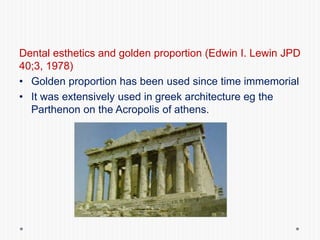
Dental esthetics and golden proportion (Edwin I. Lewin JPD
40;3, 1978)
• Golden proportion has been used since time immemorial
• It was extensively used in greek architecture eg the
Parthenon on the Acropolis of athens.
Proportion between teeth
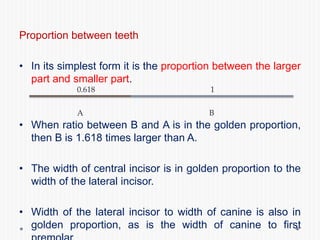
• In its simplest form it is the proportion between the larger
part and smaller part.
• When ratio between B and A is in the golden proportion,
then B is 1.618 times larger than A.
• The width of central incisor is in golden proportion to the
width of the lateral incisor.
• Width of the lateral incisor to width of canine is also in
golden proportion, as is the width of canine to first
A B
0.618 1
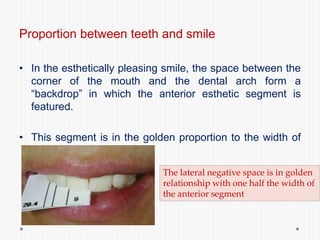
Proportion between teeth and smile
• In the esthetically pleasing smile, the space between the
corner of the mouth and the dental arch form a
“backdrop” in which the anterior esthetic segment is
featured.
• This segment is in the golden proportion to the width of
the smile.
The lateral negative space is in golden
relationship with one half the width of
the anterior segment
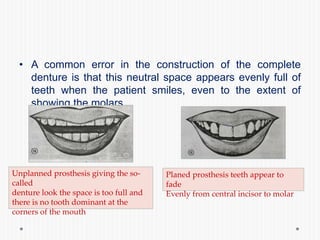
• A common error in the construction of the complete
denture is that this neutral space appears evenly full of
teeth when the patient smiles, even to the extent of
showing the molars.
Unplanned prosthesis giving the so-
called
denture look the space is too full and
there is no tooth dominant at the
corners of the mouth
Planed prosthesis teeth appear to
fade
Evenly from central incisor to molar
Form of the corner of the anterior esthetic segment
• In any smile the central incisor dominate.
• The next dominant harmony should be in the region of
canine or premolar.
• One of these teeth should be dominant to mark the
corner of the mouth, and to stress the visual strength
contained in the arch.
• The most difficult aspect of the prosthodontics is to
establish the exact shape of the corner of the arch so as
to be in complete harmony with the visual personality
projected by the patient.
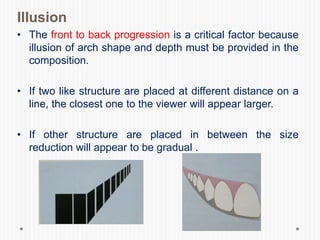
Illusion
• The front to back progression is a critical factor because
illusion of arch shape and depth must be provided in the
composition.
• If two like structure are placed at different distance on a
line, the closest one to the viewer will appear larger.
• If other structure are placed in between the size
reduction will appear to be gradual .
• Buccal corridor helps achieve this gradation by altering
the light.
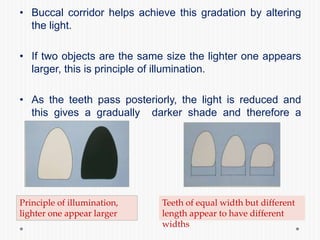
• If two objects are the same size the lighter one appears
larger, this is principle of illumination.
• As the teeth pass posteriorly, the light is reduced and
this gives a gradually darker shade and therefore a
smaller appearance.
Principle of illumination,
lighter one appear larger
Teeth of equal width but different
length appear to have different
widths
Balance in denture esthetics
• The word denotes the stability resulting from equalization
or exact adjustment of opposing forces.
• Balance suggests a steadiness that results when all
parts are properly adjusted to each other, when no one
part or constituting force is out of proportion to another.
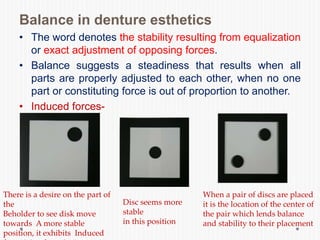
• Induced forces-
There is a desire on the part of
the
Beholder to see disk move
towards A more stable
position, it exhibits Induced
Disc seems more
stable
in this position
When a pair of discs are placed
it is the location of the center of
the pair which lends balance
and stability to their placement
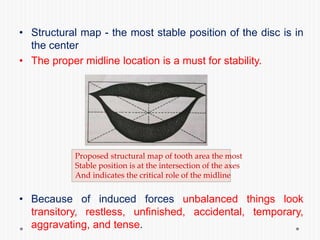
• Structural map - the most stable position of the disc is in
the center
• The proper midline location is a must for stability.
• Because of induced forces unbalanced things look
transitory, restless, unfinished, accidental, temporary,
aggravating, and tense.
Proposed structural map of tooth area the most
Stable position is at the intersection of the axes
And indicates the critical role of the midline
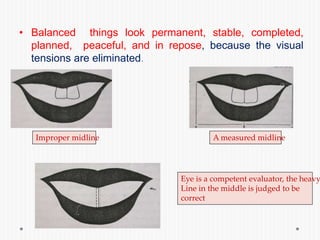
• Balanced things look permanent, stable, completed,
planned, peaceful, and in repose, because the visual
tensions are eliminated.
Improper midline A measured midline
Eye is a competent evaluator, the heavy
Line in the middle is judged to be
correct
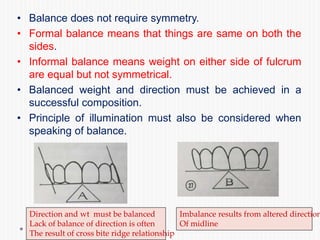
• Balance does not require symmetry.
• Formal balance means that things are same on both the
sides.
• Informal balance means weight on either side of fulcrum
are equal but not symmetrical.
• Balanced weight and direction must be achieved in a
successful composition.
• Principle of illumination must also be considered when
speaking of balance.
Direction and wt must be balanced
Lack of balance of direction is often
The result of cross bite ridge relationship
Imbalance results from altered direction
Of midline
Line in denture esthetics:-
• Line is involved in
- shape of the tooth
- relationship between the adjacent teeth
- between the teeth and the matrix
- between the teeth and the background
- between the teeth and the dark space area between upper
and the lower teeth when the mouth is open
• Line is also involved in line formed by the incisal edges
and buccal cusp tips of the teeth, in the occlusal plane,
and the perspective illusion created by the total
composition.
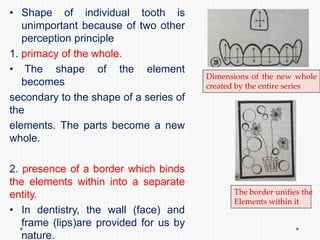
• Shape of individual tooth is
unimportant because of two other
perception principle
1. primacy of the whole.
• The shape of the element
becomes
secondary to the shape of a series of
the
elements. The parts become a new
whole.
2. presence of a border which binds
the elements within into a separate
entity.
• In dentistry, the wall (face) and
frame (lips)are provided for us by
nature.
Dimensions of the new whole
created by the entire series
The border unifies the
Elements within it
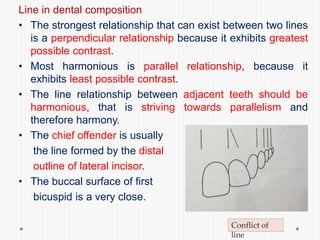
Line in dental composition
• The strongest relationship that can exist between two lines
is a perpendicular relationship because it exhibits greatest
possible contrast.
• Most harmonious is parallel relationship, because it
exhibits least possible contrast.
• The line relationship between adjacent teeth should be
harmonious, that is striving towards parallelism and
therefore harmony.
• The chief offender is usually
the line formed by the distal
outline of lateral incisor.
• The buccal surface of first
bicuspid is a very close.
Conflict of
line
• It is often necessary to reduce the distolabioincisal
contour and the incisal third of the distal outline of the
lateral incisor to eliminate the conflicting line.
• The neck of the lateral incisor may be kept out labially to
minimize the line conflict.
• The line formed by the labial outline of the cuspid is
especially important because it is close to the line formed
by the lower lip as it curves upward towards the
commisure, it completes the smile line.
• If the incisal edge is tipped lingually, the line formed by
the labial surface of the cuspid is more nearly parallel to
the line of the lower lip and exhibits a soft relationship.
• As the cuspid is tipped more labially at the incisal edge it
becomes more perpendicular to lip line and exhibits a
strong relationship.
• If the incisal edges of the anterior teeth parallel the line of
the lower lip as in the smiling line, a harmonious
relationship exists.
Cuspid Lip Relation-ship
• The occlusal plane is another critical line and must be
located in proper position. The plane must not be allowed
to drop as it progress posteriorly to prevent sin against
reality and beauty.
• The lines of the matrix at the gingival must be curved to
The maxillary bite rim is built parallel to
Camper’s line.
Occlusal plane must rise as it
progresses posteriorly
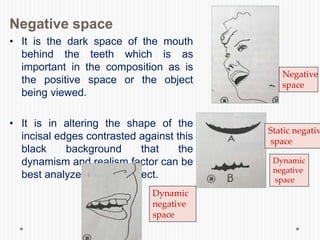
Negative space
• It is the dark space of the mouth
behind the teeth which is as
important in the composition as is
the positive space or the object
being viewed.
• It is in altering the shape of the
incisal edges contrasted against this
black background that the
dynamism and realism factor can be
best analyzed for their effect.
Negative
space
Static negativ
space
Dynamic
negative
space
Dynamic
negative
space
Color in denture esthetics
• Hue - characteristic of a color, eg Red, Yellow, Blue
• Intensity - amount of pigment in the color being described
• Value - lightness or darkness of a color
• Value in denture esthetics –
The problem of matching is one of selecting proper value,
not the proper color (hue). The selection of correct lightness
or darkness results in successful shade selection.
• Factors affecting color
- amount of light striking the tooth
- texture of the tooth, glaze (without glaze or convoluted
surface, less reflection)
- inciso-gingival angulation
- background against which a color is seen (dark
background makes color seem lighter)
- lighter tooth appears closer and vive-versa.(principle of
illumination)
• Shade selection
Personality-1) strong, outgoing, vivacious, dynamic, zippy,
indicator for a lighter shade
2) Weak, opposite of strong, darker shade
3) Average, between strong and weak
• Skin color (background)
- Dark skinned, shades adjusted downwards because
background will make shade appear lighter
- Light skinned- lighter
- Average- intermediate
• with age skin wrinkles and appear darker
• strong features require lighter teeth
• Heavy lipped individual with a low lip line require a lighter
shade
• The mouth with the reduced amount of illumination on the
teeth makes the strongest demand for lightness of shade.
Dentogenic concept (John P Frush , Roland D
Fischer JPD 5:587-595, 1955)
• Dentogenic describes such a denture (or restoration) as
is eminently suitable in that , for the wearer , the denture
adds to the persons charm, character, dignity or beauty in
full expressive smile.
• Dentogenic means the art, practice and technique used
to achieve the esthetic goal in dentistry
SPA- Factor( John P Frush , Roland D Fischer JPD
6:161-172, 1956)
INTERPRETATION OF SEX
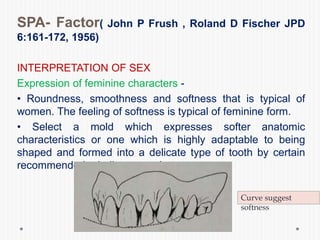
Expression of feminine characters -
• Roundness, smoothness and softness that is typical of
women. The feeling of softness is typical of feminine form.
• Select a mold which expresses softer anatomic
characteristics or one which is highly adaptable to being
shaped and formed into a delicate type of tooth by certain
recommended grinding procedures.
Curve suggest
softness
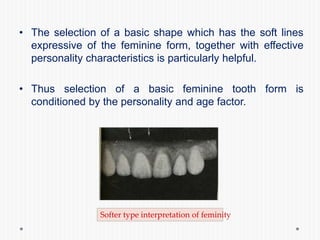
• The selection of a basic shape which has the soft lines
expressive of the feminine form, together with effective
personality characteristics is particularly helpful.
• Thus selection of a basic feminine tooth form is
conditioned by the personality and age factor.
Softer type interpretation of feminity
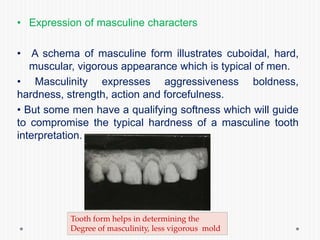
• Expression of masculine characters
• A schema of masculine form illustrates cuboidal, hard,
muscular, vigorous appearance which is typical of men.
• Masculinity expresses aggressiveness boldness,
hardness, strength, action and forcefulness.
• But some men have a qualifying softness which will guide
to compromise the typical hardness of a masculine tooth
interpretation.
Tooth form helps in determining the
Degree of masculinity, less vigorous mold
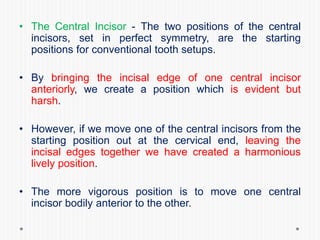
• The Central Incisor - The two positions of the central
incisors, set in perfect symmetry, are the starting
positions for conventional tooth setups.
• By bringing the incisal edge of one central incisor
anteriorly, we create a position which is evident but
harsh.
• However, if we move one of the central incisors from the
starting position out at the cervical end, leaving the
incisal edges together we have created a harmonious
lively position.
• The more vigorous position is to move one central
incisor bodily anterior to the other.
The Lateral Incisors
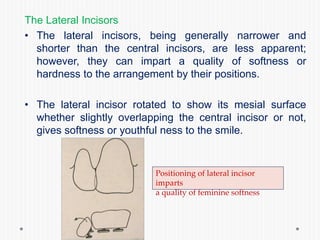
• The lateral incisors, being generally narrower and
shorter than the central incisors, are less apparent;
however, they can impart a quality of softness or
hardness to the arrangement by their positions.
• The lateral incisor rotated to show its mesial surface
whether slightly overlapping the central incisor or not,
gives softness or youthful ness to the smile.
Positioning of lateral incisor
imparts
a quality of feminine softness
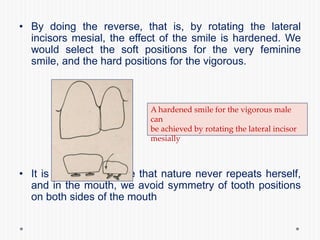
• By doing the reverse, that is, by rotating the lateral
incisors mesial, the effect of the smile is hardened. We
would select the soft positions for the very feminine
smile, and the hard positions for the vigorous.
• It is important to note that nature never repeats herself,
and in the mouth, we avoid symmetry of tooth positions
on both sides of the mouth
A hardened smile for the vigorous male
can
be achieved by rotating the lateral incisor
mesially
The Cuspid Teeth
• The cuspids should never be set with the tip of the tooth
out labially further than the cervical end, except in very
rare instances where ,we have to harmonize the
arrangement with a rough or primitive type of patient.
• A prominent cuspid eminence gives to the cuspids
greater importance and therefore gives to the smile a
vigorous appearance more suitable to the masculine
sex.
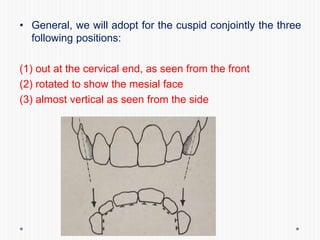
• General, we will adopt for the cuspid conjointly the three
following positions:
(1) out at the cervical end, as seen from the front
(2) rotated to show the mesial face
(3) almost vertical as seen from the side
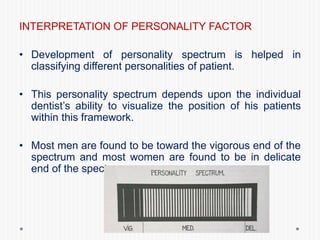
INTERPRETATION OF PERSONALITY FACTOR
• Development of personality spectrum is helped in
classifying different personalities of patient.
• This personality spectrum depends upon the individual
dentist’s ability to visualize the position of his patients
within this framework.
• Most men are found to be toward the vigorous end of the
spectrum and most women are found to be in delicate
end of the spectrum.
There are three divisions of personality spectrum :
• Delicate- meaning fragile, frail, the opposite of robust.
• Medium pleasing- meaning normal, moderately robust,
healthy and of intelligent appearance.
• Vigorous- meaning opposite of delicate; hard and
aggressive in appearance, muscular type.
• When we incorporate the personality factor in esthetics
we do so keeping in mind the influence of the sex and
age factors as we proceed.
• The introduction of different aspects of the personality
into dental elements to permit a more precise
characterization of the dental composition gave origin to
SPA concept of Frush and Fisher.
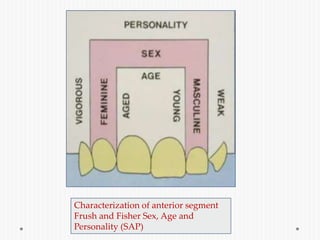
Characterization of anterior segment
Frush and Fisher Sex, Age and
Personality (SAP)
INTERPRETATION OF AGE
• Symbols of youth in the natural teeth are lightness of
shade, the unblemished form of the newly erupted teeth,
earliest appearance of the mamellon is present at the
incisal edge of the central and lateral incisors.
• The cuspid presents a pointed tip which is very sharp in
appearance.
• The mamellon is soon abraded away, and the tooth
assumes the youthful adult form evidenced by the
enamel incisal edge of variable depth and of bluish hue.
• Later the sharp tip of the cuspid wears down to a more
mature form.
• As we advance along the chronologic life line of the
individual, normal wear, trauma, and, in some instances,
malocclusion, and disease make inroads upon the
original purity of tooth form.
• The tooth ages with the individual, and, very often, the
mouth condition gets far ahead of the chronologic life
line.
• In the artificial tooth, then, we may reflect the
appropriate age effects by such means as grinding the
incisal edges and removing the incisal enamel at such
an inclination and to such depth as to convey reality to
composition.
• The sharp tip of the cuspid suggests youth, and, as age
increases, it should be judiciously shaped, not abruptly
horizontally flattened, but artistically ground so as to
imply abrasion against opposing teeth.
Dynesthetic interpretation of the dentogenic concept
• To construct the dentogenic restoration effectively is a matter
of learning and of interpreting the sex, personality, and age of
the patient properly in the complete denture.
• There are three important parts of the complete denture
prosthesis. – The tooth – Tooth position – The matrix.
• If we can treat the tooth, its position, and its matrix correctly,
the pleasing personality, masculinity and femininity and the
age of the patient, are effectively created.
• By the application of dynesthetic techniques to the
dentogenic concept has considered ease to accomplish this.
Dynesthetic theory
• Patient’s sex, personality, and age are considered as primary
factors. Where as dynesthetic techniques are considered as
secondary factors of dentogenic restorations.
• For e.g. , artificial teeth are selected according to the
personality of the patient, subsequent sculpturing is directed
toward accentuating masculinity or femininity, and the denture
base color and contour helps to satisfy the age factor.
• These secondary factors are called dynesthetics.
• Dynesthetics means vital beauty.
• Prefix dyn taken from greek word dynamis, meaning
power.
• Means producing effect of movement or progression. As
we know edentulous mouth is in constant and permanent
change, our efforts should be in fabricating prosthesis
which follows the physiologic age changes in the
tissues.
• Dynesthetic techniques.
• It concerns with three important divisions of denture
fabrication. The tooth, its position, and its matrix.
• Techniques includes
1. Mold selection
2. Depth grinding
3. Abrasion
4. Identification of masculinity or femininity
5. Smiling line
6. specific positioning and rotation of anterior teeth
7. Embrasures and diastemas
8. Buccal corridor
9. Long axes of the teeth
10. Gum line denture base contouring and tissue stippling
Dynesthetic considerations to the production of a
Dentogenic restoration.
• Progressive abrasion of the artificial tooth is done as the
age of the patient progresses.
• Depth perception is limited in the artificial tooth because
the contact point is too near the labial surface. The
perception is increased by depth grinding. This is a cut
made on the labial mesial line angle of the artificial tooth.
• In personality mold selection, a delicate mold is
feminine, vigorous mold is masculine and medium
pleasing personality mold for both.
THE THIRD DIMENSION-DEPTH GRINDING
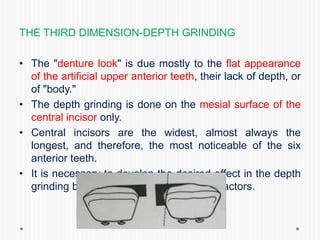
• The "denture look" is due mostly to the flat appearance
of the artificial upper anterior teeth, their lack of depth, or
of "body."
• The depth grinding is done on the mesial surface of the
central incisor only.
• Central incisors are the widest, almost always the
longest, and therefore, the most noticeable of the six
anterior teeth.
• It is necessary to develop the desired effect in the depth
grinding by consideration of these main factors.
• A flat thin narrow tooth is delicate looking and fits
delicate women ( little depth grinding)
• A thick bony big sized tooth heavily carved on it’s labial
surface is vigorous and to be used exclusively for men (
severe depth grinding)
• For the average patient the depth grinding will be an
average between delicate and vigorous
• Depth grinding reduces the width of the central incisor
according to the severity of grinding to be accomplished.
LIP SUPPORT
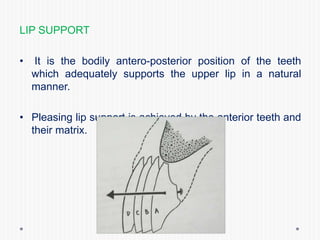
• It is the bodily antero-posterior position of the teeth
which adequately supports the upper lip in a natural
manner.
• Pleasing lip support is achieved by the anterior teeth and
their matrix.
MIDLINE
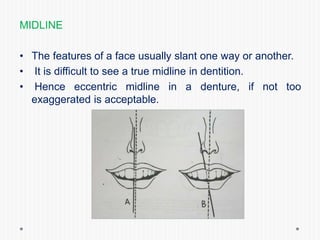
• The features of a face usually slant one way or another.
• It is difficult to see a true midline in dentition.
• Hence eccentric midline in a denture, if not too
exaggerated is acceptable.
LABIOVERSION
• Labioversion is necessary because the most pleasing effect
is obtained when the long axes of the central incisors are
either vertical or with a slight labial inclination.
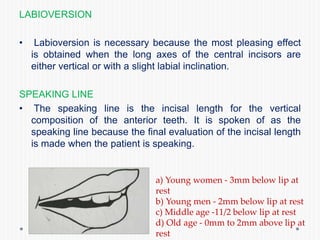
SPEAKING LINE
• The speaking line is the incisal length for the vertical
composition of the anterior teeth. It is spoken of as the
speaking line because the final evaluation of the incisal length
is made when the patient is speaking.
a) Young women - 3mm below lip at
rest
b) Young men - 2mm below lip at rest
c) Middle age -11/2 below lip at rest
d) Old age - 0mm to 2mm above lip at
rest
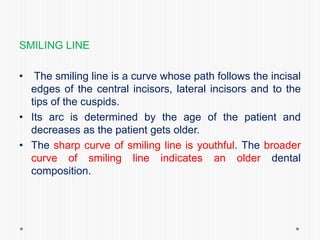
SMILING LINE
• The smiling line is a curve whose path follows the incisal
edges of the central incisors, lateral incisors and to the
tips of the cuspids.
• Its arc is determined by the age of the patient and
decreases as the patient gets older.
• The sharp curve of smiling line is youthful. The broader
curve of smiling line indicates an older dental
composition.
SPECIFIC POSITIONING AND ROTATION OF ANTERIOR
TEETH
• The high level of incisal edge of lateral incisor to the central
incisor is indication of older dental composition.
• Incisal edge of lateral incisor in level with the central incisor is
indication of youth.
• Central incisor position: Their placement control’s
1-midline
2-speaking line
3-lip support
4-labioversion
5-smiling line composition
• Lateral incisor position: Its rotation will either harden or soften
the dental composition.
• Cuspid position: It supports the anterior arch form in its widest
part and controls the size of buccal corridor
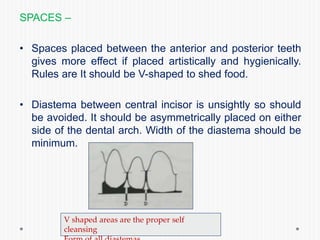
SPACES –
• Spaces placed between the anterior and posterior teeth
gives more effect if placed artistically and hygienically.
Rules are It should be V-shaped to shed food.
• Diastema between central incisor is unsightly so should
be avoided. It should be asymmetrically placed on either
side of the dental arch. Width of the diastema should be
minimum.
V shaped areas are the proper self
cleansing
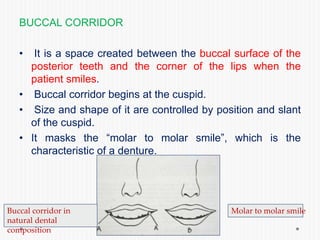
BUCCAL CORRIDOR
• It is a space created between the buccal surface of the
posterior teeth and the corner of the lips when the
patient smiles.
• Buccal corridor begins at the cuspid.
• Size and shape of it are controlled by position and slant
of the cuspid.
• It masks the “molar to molar smile”, which is the
characteristic of a denture.
Buccal corridor in
natural dental
composition
Molar to molar smile
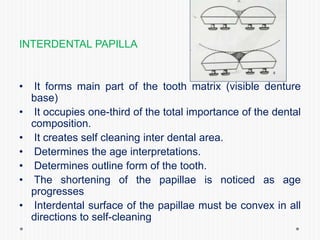
INTERDENTAL PAPILLA
• It forms main part of the tooth matrix (visible denture
base)
• It occupies one-third of the total importance of the dental
composition.
• It creates self cleaning inter dental area.
• Determines the age interpretations.
• Determines outline form of the tooth.
• The shortening of the papillae is noticed as age
progresses
• Interdental surface of the papillae must be convex in all
directions to self-cleaning
Achieving complete
denture esthetics
• Accurate impressions
• Jaw relation
• Selection of anterior teeth
• Arrangement of teeth
• Characterisation of denture base
Impression stage
• Role of esthetics is to develop labial and buccal borders
so that they are not only retentive but also support the
lips and cheeks properly.
• Care must be taken not to over support these structures
with borders that are too thick.
• Functions of the denture base
-Support the artificial teeth & provide retention
-restore the form and appearance of lost soft
tissues and alveolar bone
Denture esthetics is more than tooth selection
• In maxilla the resorption of bone takes place labially and
bucally with reduction in height and width of the alveolar
process
• Little if any resorption takes place in the depth of the
sulcus where at the root apices there is little alveolar
bone.
• The denture base by implication be as thin as possible in
this region.
• Thickness can cause unnatural plumping of the upper lip
at the base of the nose and give upper lip a convexity.
• Thickness in the premolar and molar regions region is
permissible and can even enhance retention by allowing
a more effective lateral seal with the cheeks.
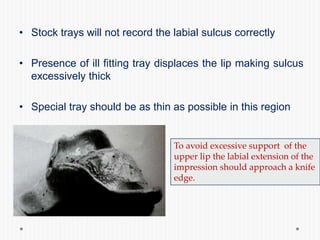
• Stock trays will not record the labial sulcus correctly
• Presence of ill fitting tray displaces the lip making sulcus
excessively thick
• Special tray should be as thin as possible in this region
To avoid excessive support of the
upper lip the labial extension of the
impression should approach a knife
edge.
• The same technique can be applied to taking the lower
impression
• If alveolar process is well developed then the technique
is similar to that of upper.
• Resorption be pronounced , then the lack of definite
demarcation between the sulcus and the remainder of
the denture space makes the technique difficult to justify.
Registration Stage/ Jaw relation
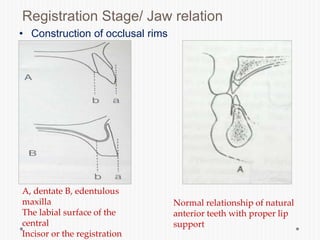
• Construction of occlusal rims
A, dentate B, edentulous
maxilla
The labial surface of the
central
Incisor or the registration
Normal relationship of natural
anterior teeth with proper lip
support
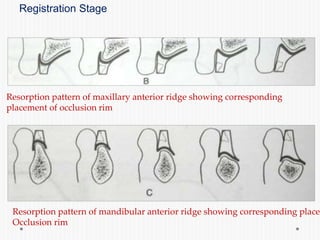
Registration Stage
Resorption pattern of maxillary anterior ridge showing corresponding
placement of occlusion rim
Resorption pattern of mandibular anterior ridge showing corresponding placem
Occlusion rim
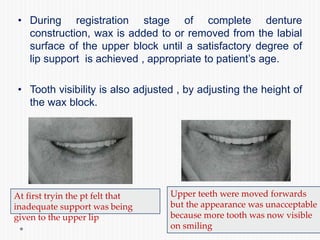
• During registration stage of complete denture
construction, wax is added to or removed from the labial
surface of the upper block until a satisfactory degree of
lip support is achieved , appropriate to patient’s age.
• Tooth visibility is also adjusted , by adjusting the height of
the wax block.
At first tryin the pt felt that
inadequate support was being
given to the upper lip
Upper teeth were moved forwards
but the appearance was unacceptable
because more tooth was now visible
on smiling
Anterior teeth selection
• There are no thumb rule for this procedure however there
are anatomic landmarks that can be used as guides.
• Shade selection: Its based on patients hair and eye color
skin complexion and age
• It has been recommended to select
1) Darker shade for older
2) Darker shades for men with vigorous and bold
personality
3) Lighter shade for women patients with delicate
personality
4) Lighter shade may be selected for central incisor than for
canine
5) For young patients anterior teeth should be selected with
blue/gray incisal edge or translucent incisal edge.
Observation of shade guide:
• Outside the mouth along the side of the nose, helps in
establishing basic hue, brialliance and saturation.
• under the lips with only the incisal edge exposed - this
will reveal the color of teeth when the patient mouth is
relaxed.
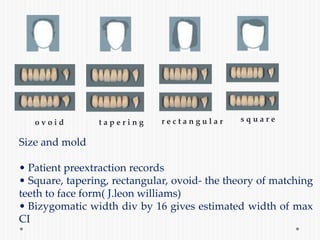
o v o i d t a p e r i n g r e c t a n g u l a r s q u a r e
Size and mold
• Patient preextraction records
• Square, tapering, rectangular, ovoid- the theory of matching
teeth to face form( J.leon williams)
• Bizygomatic width div by 16 gives estimated width of max
CI
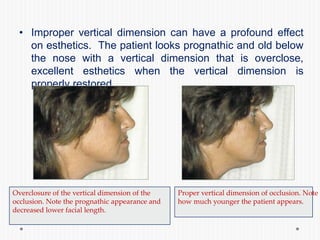
• Improper vertical dimension can have a profound effect
on esthetics. The patient looks prognathic and old below
the nose with a vertical dimension that is overclose,
excellent esthetics when the vertical dimension is
properly restored.
Overclosure of the vertical dimension of the
occlusion. Note the prognathic appearance and
decreased lower facial length.
Proper vertical dimension of occlusion. Note
how much younger the patient appears.
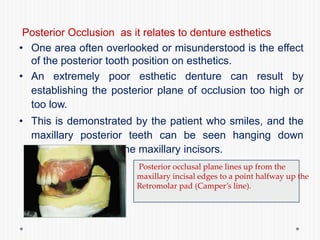
Posterior Occlusion as it relates to denture esthetics
• One area often overlooked or misunderstood is the effect
of the posterior tooth position on esthetics.
• An extremely poor esthetic denture can result by
establishing the posterior plane of occlusion too high or
too low.
• This is demonstrated by the patient who smiles, and the
maxillary posterior teeth can be seen hanging down
below the plane of the maxillary incisors.
Posterior occlusal plane lines up from the
maxillary incisal edges to a point halfway up the
Retromolar pad (Camper’s line).
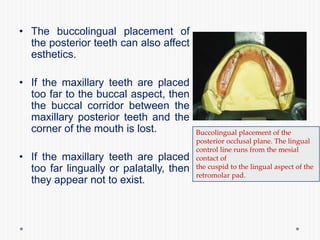
• The buccolingual placement of
the posterior teeth can also affect
esthetics.
• If the maxillary teeth are placed
too far to the buccal aspect, then
the buccal corridor between the
maxillary posterior teeth and the
corner of the mouth is lost.
• If the maxillary teeth are placed
too far lingually or palatally, then
they appear not to exist.
Buccolingual placement of the
posterior occlusal plane. The lingual
control line runs from the mesial
contact of
the cuspid to the lingual aspect of the
retromolar pad.
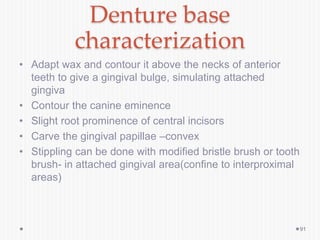
Denture base
characterisation
The esthetic denture bases are indicated for –
• Patients with an active upper lip,
• Patients with a prominent premaxillary process,
• Theatrical performers, singers, and others who may
expose normally unobserved gum tissue areas during
their performances, and the psychologic effect on the
patient.
88
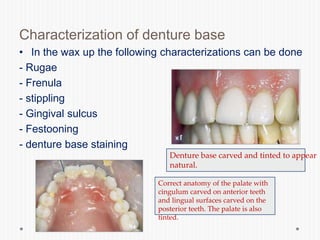
Characterization of denture base
• In the wax up the following characterizations can be done
- Rugae
- Frenula
- stippling
- Gingival sulcus
- Festooning
- denture base staining
Denture base carved and tinted to appear
natural.
Correct anatomy of the palate with
cingulum carved on anterior teeth
and lingual surfaces carved on the
posterior teeth. The palate is also
tinted.
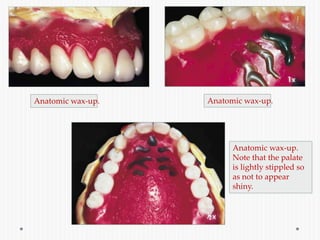
Anatomic wax-up. Anatomic wax-up.
Anatomic wax-up.
Note that the palate
is lightly stippled so
as not to appear
shiny.
Denture base
characterization
• Adapt wax and contour it above the necks of anterior
teeth to give a gingival bulge, simulating attached
gingiva
• Contour the canine eminence
• Slight root prominence of central incisors
• Carve the gingival papillae –convex
• Stippling can be done with modified bristle brush or tooth
brush- in attached gingival area(confine to interproximal
areas)
91
Denture base
characterization
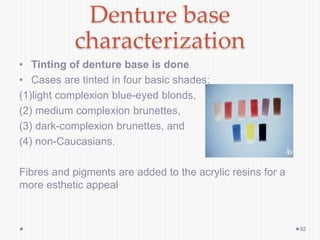
• Tinting of denture base is done
• Cases are tinted in four basic shades:
(1)light complexion blue-eyed blonds,
(2) medium complexion brunettes,
(3) dark-complexion brunettes, and
(4) non-Caucasians.
Fibres and pigments are added to the acrylic resins for a
more esthetic appeal
92
Tinting and staining of
dentures
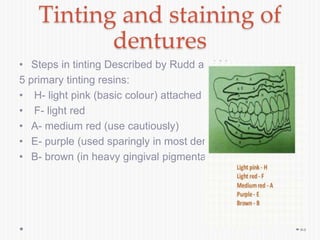
• Steps in tinting Described by Rudd and Morrow
5 primary tinting resins:
• H- light pink (basic colour) attached gingiva
• F- light red
• A- medium red (use cautiously)
• E- purple (used sparingly in most dentures)
• B- brown (in heavy gingival pigmentation)
93
Denture base
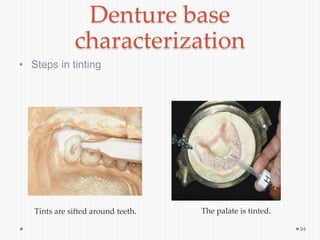
characterization
• Steps in tinting
94
Tints are sifted around teeth. The palate is tinted.
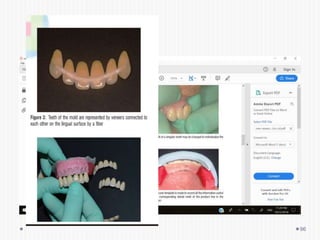
A New System for Choosing the Form and Size of Complete Denture Anterior
Teeth
Dario Melilli, Fabio Calandra1, Pietro Messina, Giuseppe A. Scardina
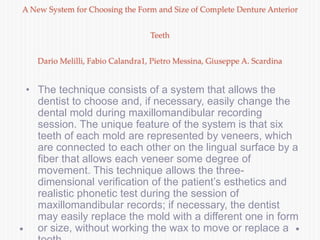
• The technique consists of a system that allows the
dentist to choose and, if necessary, easily change the
dental mold during maxillomandibular recording
session. The unique feature of the system is that six
teeth of each mold are represented by veneers, which
are connected to each other on the lingual surface by a
fiber that allows each veneer some degree of
movement. This technique allows the three-
dimensional verification of the patient’s esthetics and
realistic phonetic test during the session of
maxillomandibular records; if necessary, the dentist
may easily replace the mold with a different one in form
or size, without working the wax to move or replace a
96
Customized soft tissue reconstruction
using SR Nexco
The three-dimensional soft tissue contours should be
customized
with shade characterizations. In the same way as different
shades of wax are used for the try-in, different shades of resin
should be used to reproduce the colour variations found in the
natural gingiva. The light-curing lab composite SR Nexco® Paste
is ideally suited for this purpose. This material is available in a
comprehensive range of Gingiva shades including intensive
shade variants. Natural-looking soft-tissue esthetics can be
reproduced using a straightforward method. Given its non-sticky
consistency, the composite is easy to apply and does not need
to be warmed up prior to application.
97
98
Classification of esthetic
errors
Inharmonious dentofacial ratio
A) Shade disharmony
B) Compositional incompatibility
1. static denture in dynamic
mouth
2.Inharmonious strength or
weakness of dental
composition compared to
background features
a. Weak mouth with strong
face
b. strong mouth with weak
face
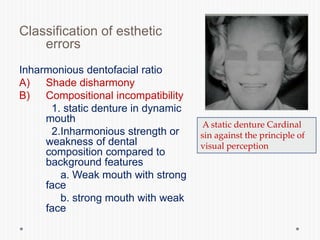
A static denture Cardinal
sin against the principle of
visual perception
• Intrinsic dental disharmony
A. Space allocation error
1 Inadequate vertical space allocation
2 excessive vertical space allocation
3 excessive horizontal space allocation
B. Structural line errors
1 elevated occlusal plane
2 occlusal plane drops down posteriorly
3 asymmetrical occlusal plane
C Unnatural lines
1 Reverse smiling line
2 unnatural axial inclination
3 cuspless posterior teeth
4 gradation errors
5 Age-Sex-Personality disharmony
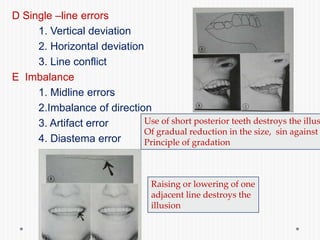
D Single –line errors
1. Vertical deviation
2. Horizontal deviation
3. Line conflict
E Imbalance
1. Midline errors
2.Imbalance of direction
3. Artifact error
4. Diastema error
Use of short posterior teeth destroys the illus
Of gradual reduction in the size, sin against
Principle of gradation
Raising or lowering of one
adjacent line destroys the
illusion
Summery:-
• For a complete denture prosthesis to be successful it
should be mechanically sound, physiologically
acceptable and esthetically pleasing.
• By having a knowledge about principles and
fundamentals of esthetics and by following simple steps
to incorporate this knowledge in complete dentures more
life like restorations can be fabricated.
References:-
• Zarb,Bolender, Prosthodontic treatment for edentulous
patients.Twelfth edition
• Sheldon Winkler, Essentials of complete denture
prosthodontics,second, edition 2000
• Richard E. Lambarde : The Principle of visual perception and
clinical application to denture esthetics , Journal of Prosthetic
Dentistry . 29:359-381 ,1973.
• John P. Frush, Ronald D Fisher :Introduction to Dentogenic
Restorations , Journal of Prosthetic Dentistry ,5:587-
595,1955.
• John P. Frush, Ronald D Fisher :The Dynesthetic
interpretation of Dentogenic concept, Journal of Prosthetic
Dentistry. 8:559-581, 1958.
• D J Lamb: Appearance and Aesthetics in denture practice,
wright bristel, 1987.
THANK YOU!!

Esthetics in complete denture

  • 1.
    Esthetics in complete denture Presentedby- Dr. Priya Gupta (MDS II yr)
  • 2.
    Contents:- 1. Introduction 2. Definition 3.Review of literature 4. Fundamentals of esthetics 5. Impression making 6. Jaw relation 7. Anterior tooth selection Dentogenic concept Dynesthetic interpretation of dentogenic concept SPA factor
  • 3.
    8. Anterior andposterior teeth arrangement 9. Characterization of denture 10. Errors in esthetics 11. Summary 12. References
  • 4.
    Introduction:- • Frush’ states,“The acceptance of treatment by the patient is made considerably easier when the prosthesis accomplishes two basic esthetic needs:  the portrayal of a physiologic norm  an actual improvement in the attractiveness of the smile • Esthetics goes much further than the simple placement of teeth in occlusion rims. The dentist must consider both the anatomy and physiology of the face, as well as artistic principles, to achieve a natural looking denture. Beauty lies in the eyes of the beholde We greet the world with our
  • 5.
    Definition:- • Glossary ofProsthodontic Terms - Esthetics can be defined as the branch of philosophy dealing with beauty. Descriptive of a specific creation that results from such a study: objectifies beauty and attractiveness and elicits pleasure. • Denture esthetics : the effect produced by a dental prosthesis that affects the beauty and attractiveness of the person.
  • 6.
    History • G.Fonzi anItalian dentist in Paris invented the Porcelain teeth that revolutionized the construction Of dentures • In 1937 Dr. Walter Wright introduced resin. 6
  • 7.
    Review of literature:- •John P Frush And Roland D Fisher in 1955 • They introduced the word “dentogenic” in prosthetic dentistry to ease the selection of anterior teeth in complete denture prosthodontics. Factors of Dentogenic restorations, sex, age, and personality has improved appearance of the denture wearer.
  • 8.
    • Donald FK in 1956 studied relation between the denture esthetics and denture base. • The factors relating to the denture base are the reproduction of the contours of the tissue covered by the base, and its staining to reproduce the natural tissue hues. Indications for esthetic denture bases in patients with active upper lip, patient with prominent premaxillary area, theatrical performers and singers, produces psychologic effect on the patient
  • 9.
    • Frush andfisher in 1958, they studied the qualities of femininity, masculinity, personality and the various physiologic ages in smile. • Richard E. lombardi in 1973 ,he studied the science and principles of visual perception and their influence in creating intense vitality, beauty, and realism on denture prosthesis. By application of Dynesthetic techniques to the Dentogenic concept have accomplished the pleasing personality, masculinity, and femininity, effectively. Principles of esthetics such as unity, composition, dominance, proportion, illusion in denture esthetics.
  • 10.
  • 11.
    Composition: • The increaseof visibility is proportional to the increase in contrast. • The relationship between objects made visible by contrasts is called composition. • Contrast: It is that factor which makes the various elements of a composition visible. • The eye can differentiate the parts of an object due to contrast of colors, lines, patterns, textures, etc.
  • 12.
    Unity:- • Prime requisiteof composition • It is the ordering of the parts of a composition to give the individual total effect of “whole”. • Unity between different parts of the face, and teeth is essential to give the effect of oneness or wholeness to the dento- facial composition • It is of two types Static unity Dynamic unity 1. Structures with regular 1. Plants and animals geomtric shapes. eg snowflakes & crystals 2. Passive and inert 2. Active living and growing 3. Fixed, without motion 3. Crescendo approaching a
  • 13.
    • Elements whichunify a composition are cohesive forces and elements which lend disunity are segregative forces. • Cohesive forces - Repetion of shape, color, line -Arrangement of the elements of a composition in a definite pattern -Arrangement of the elements according to a principle -presence of a border.
  • 14.
    Unity with variety(segregate force)- • Necessary to make design effective • The elements must be bound together in an interesting manner Segregating forces are represented by elements arranged in an appealing manner, reminders of an interesting thing or event such as class I tooth arrangement. Segregative forces are the necessary elements that enhance the esthetic value of a composition. A slight malposition, a reminder of a class II arrangement, conforms to this definition.
  • 15.
    • The greatestSIN against visual perception in denture esthetics –the placement of a static, dead denture in the most mobile and active of all the facial features in a living, dynamic, human being. • Placement of anterior teeth on unchanging curve of a circle, lacks unity, because it does not give the patient the total undivided effect of a living being.
  • 16.
    • Sin againstreality –teeth are set tight against the residual ridge so that when they are in the mouth, they appear to be too high and too far back in a position where they could not possibly be placed by nature. • Objective of the dentist should be to provide Dynamic and not Static unity.
  • 17.
    Hogarth’s Line ofbeauty • Example of unity with variety is line inscribed around a cone. • Line is never same at any point (absolute variety) along its course yet it never leaves the surface of cone (absolute unity) • Adoption of a segment of this line for tooth placement and base festooning adds greatly to the dynamism of a set up. A line inscribed around a cone .It is never the same at any two points, yet never deviates from the principle of the cone structure. Absolute unity with absolute variety is provided.
  • 18.
    Dominance:- • Dominance • oneshape, color or line must dominate all the others. • One tooth must dominate the anterior tooth arrangement by virtue of its size (central incisor is the logical choice) Unity Composition Prime requisite Prime requisite The dominance of size of the anterior teeth A weak dominance takes place when subsequent elements do not provide sufficient factors of contrast. A strong dominance requires the presence of subsequent elements providing strong factors of contrast
  • 19.
    • The dominanceof dental composition is increased by increasing mold size, using lighter teeth, placing the teeth farther anteriorly and increasing the exposed gingivoincisal length, are all method of increasing visibility. • For a patient with soft personality , dominance may be produced by minimizing these factors and for a patient of strong personality all or part of the above features may be restored.
  • 20.
    Symmetry:- • It isthe regularity of arrangement of forms either from left to right as in horizontal symmetry, or from a central point to either side like a mirror image as in radiating symmetry. • The horizontal symmetry looks repetitive and uninteresting while the radiating symmetry looks dynamic and interesting. • In a dento-facial composition radiating symmetry of the teeth is more esthetically appealing and is associated with youthfulness while horizontal symmetry is less appealing and is associated with aging.
  • 21.
    Proportion:- • The relationshipof the various units which are different from each other in a composition but are associated with each other through a certain repetitive mathematical factor called as Repeated ratio. • The proportion between the various elements of a harmonious composition, in which the cohesive and segregate forces are equally balanced and its various units in an esthetically appealing, respective proportion to each other is the Golden proportion.
  • 22.
    Dental esthetics andgolden proportion (Edwin I. Lewin JPD 40;3, 1978) • Golden proportion has been used since time immemorial • It was extensively used in greek architecture eg the Parthenon on the Acropolis of athens.
  • 23.
    Proportion between teeth •In its simplest form it is the proportion between the larger part and smaller part. • When ratio between B and A is in the golden proportion, then B is 1.618 times larger than A. • The width of central incisor is in golden proportion to the width of the lateral incisor. • Width of the lateral incisor to width of canine is also in golden proportion, as is the width of canine to first A B 0.618 1
  • 24.
    Proportion between teethand smile • In the esthetically pleasing smile, the space between the corner of the mouth and the dental arch form a “backdrop” in which the anterior esthetic segment is featured. • This segment is in the golden proportion to the width of the smile. The lateral negative space is in golden relationship with one half the width of the anterior segment
  • 25.
    • A commonerror in the construction of the complete denture is that this neutral space appears evenly full of teeth when the patient smiles, even to the extent of showing the molars. Unplanned prosthesis giving the so- called denture look the space is too full and there is no tooth dominant at the corners of the mouth Planed prosthesis teeth appear to fade Evenly from central incisor to molar
  • 26.
    Form of thecorner of the anterior esthetic segment • In any smile the central incisor dominate. • The next dominant harmony should be in the region of canine or premolar. • One of these teeth should be dominant to mark the corner of the mouth, and to stress the visual strength contained in the arch. • The most difficult aspect of the prosthodontics is to establish the exact shape of the corner of the arch so as to be in complete harmony with the visual personality projected by the patient.
  • 27.
    Illusion • The frontto back progression is a critical factor because illusion of arch shape and depth must be provided in the composition. • If two like structure are placed at different distance on a line, the closest one to the viewer will appear larger. • If other structure are placed in between the size reduction will appear to be gradual .
  • 28.
    • Buccal corridorhelps achieve this gradation by altering the light. • If two objects are the same size the lighter one appears larger, this is principle of illumination. • As the teeth pass posteriorly, the light is reduced and this gives a gradually darker shade and therefore a smaller appearance. Principle of illumination, lighter one appear larger Teeth of equal width but different length appear to have different widths
  • 29.
    Balance in dentureesthetics • The word denotes the stability resulting from equalization or exact adjustment of opposing forces. • Balance suggests a steadiness that results when all parts are properly adjusted to each other, when no one part or constituting force is out of proportion to another. • Induced forces- There is a desire on the part of the Beholder to see disk move towards A more stable position, it exhibits Induced Disc seems more stable in this position When a pair of discs are placed it is the location of the center of the pair which lends balance and stability to their placement
  • 30.
    • Structural map- the most stable position of the disc is in the center • The proper midline location is a must for stability. • Because of induced forces unbalanced things look transitory, restless, unfinished, accidental, temporary, aggravating, and tense. Proposed structural map of tooth area the most Stable position is at the intersection of the axes And indicates the critical role of the midline
  • 31.
    • Balanced thingslook permanent, stable, completed, planned, peaceful, and in repose, because the visual tensions are eliminated. Improper midline A measured midline Eye is a competent evaluator, the heavy Line in the middle is judged to be correct
  • 32.
    • Balance doesnot require symmetry. • Formal balance means that things are same on both the sides. • Informal balance means weight on either side of fulcrum are equal but not symmetrical. • Balanced weight and direction must be achieved in a successful composition. • Principle of illumination must also be considered when speaking of balance. Direction and wt must be balanced Lack of balance of direction is often The result of cross bite ridge relationship Imbalance results from altered direction Of midline
  • 33.
    Line in dentureesthetics:- • Line is involved in - shape of the tooth - relationship between the adjacent teeth - between the teeth and the matrix - between the teeth and the background - between the teeth and the dark space area between upper and the lower teeth when the mouth is open • Line is also involved in line formed by the incisal edges and buccal cusp tips of the teeth, in the occlusal plane, and the perspective illusion created by the total composition.
  • 34.
    • Shape ofindividual tooth is unimportant because of two other perception principle 1. primacy of the whole. • The shape of the element becomes secondary to the shape of a series of the elements. The parts become a new whole. 2. presence of a border which binds the elements within into a separate entity. • In dentistry, the wall (face) and frame (lips)are provided for us by nature. Dimensions of the new whole created by the entire series The border unifies the Elements within it
  • 35.
    Line in dentalcomposition • The strongest relationship that can exist between two lines is a perpendicular relationship because it exhibits greatest possible contrast. • Most harmonious is parallel relationship, because it exhibits least possible contrast. • The line relationship between adjacent teeth should be harmonious, that is striving towards parallelism and therefore harmony. • The chief offender is usually the line formed by the distal outline of lateral incisor. • The buccal surface of first bicuspid is a very close. Conflict of line
  • 36.
    • It isoften necessary to reduce the distolabioincisal contour and the incisal third of the distal outline of the lateral incisor to eliminate the conflicting line. • The neck of the lateral incisor may be kept out labially to minimize the line conflict. • The line formed by the labial outline of the cuspid is especially important because it is close to the line formed by the lower lip as it curves upward towards the commisure, it completes the smile line. • If the incisal edge is tipped lingually, the line formed by the labial surface of the cuspid is more nearly parallel to the line of the lower lip and exhibits a soft relationship.
  • 37.
    • As thecuspid is tipped more labially at the incisal edge it becomes more perpendicular to lip line and exhibits a strong relationship. • If the incisal edges of the anterior teeth parallel the line of the lower lip as in the smiling line, a harmonious relationship exists. Cuspid Lip Relation-ship
  • 38.
    • The occlusalplane is another critical line and must be located in proper position. The plane must not be allowed to drop as it progress posteriorly to prevent sin against reality and beauty. • The lines of the matrix at the gingival must be curved to The maxillary bite rim is built parallel to Camper’s line. Occlusal plane must rise as it progresses posteriorly
  • 39.
    Negative space • Itis the dark space of the mouth behind the teeth which is as important in the composition as is the positive space or the object being viewed. • It is in altering the shape of the incisal edges contrasted against this black background that the dynamism and realism factor can be best analyzed for their effect. Negative space Static negativ space Dynamic negative space Dynamic negative space
  • 40.
    Color in dentureesthetics • Hue - characteristic of a color, eg Red, Yellow, Blue • Intensity - amount of pigment in the color being described • Value - lightness or darkness of a color • Value in denture esthetics – The problem of matching is one of selecting proper value, not the proper color (hue). The selection of correct lightness or darkness results in successful shade selection.
  • 41.
    • Factors affectingcolor - amount of light striking the tooth - texture of the tooth, glaze (without glaze or convoluted surface, less reflection) - inciso-gingival angulation - background against which a color is seen (dark background makes color seem lighter) - lighter tooth appears closer and vive-versa.(principle of illumination) • Shade selection Personality-1) strong, outgoing, vivacious, dynamic, zippy, indicator for a lighter shade 2) Weak, opposite of strong, darker shade 3) Average, between strong and weak
  • 42.
    • Skin color(background) - Dark skinned, shades adjusted downwards because background will make shade appear lighter - Light skinned- lighter - Average- intermediate • with age skin wrinkles and appear darker • strong features require lighter teeth • Heavy lipped individual with a low lip line require a lighter shade • The mouth with the reduced amount of illumination on the teeth makes the strongest demand for lightness of shade.
  • 43.
    Dentogenic concept (JohnP Frush , Roland D Fischer JPD 5:587-595, 1955) • Dentogenic describes such a denture (or restoration) as is eminently suitable in that , for the wearer , the denture adds to the persons charm, character, dignity or beauty in full expressive smile. • Dentogenic means the art, practice and technique used to achieve the esthetic goal in dentistry
  • 44.
    SPA- Factor( JohnP Frush , Roland D Fischer JPD 6:161-172, 1956) INTERPRETATION OF SEX Expression of feminine characters - • Roundness, smoothness and softness that is typical of women. The feeling of softness is typical of feminine form. • Select a mold which expresses softer anatomic characteristics or one which is highly adaptable to being shaped and formed into a delicate type of tooth by certain recommended grinding procedures. Curve suggest softness
  • 45.
    • The selectionof a basic shape which has the soft lines expressive of the feminine form, together with effective personality characteristics is particularly helpful. • Thus selection of a basic feminine tooth form is conditioned by the personality and age factor. Softer type interpretation of feminity
  • 46.
    • Expression ofmasculine characters • A schema of masculine form illustrates cuboidal, hard, muscular, vigorous appearance which is typical of men. • Masculinity expresses aggressiveness boldness, hardness, strength, action and forcefulness. • But some men have a qualifying softness which will guide to compromise the typical hardness of a masculine tooth interpretation. Tooth form helps in determining the Degree of masculinity, less vigorous mold
  • 47.
    • The CentralIncisor - The two positions of the central incisors, set in perfect symmetry, are the starting positions for conventional tooth setups. • By bringing the incisal edge of one central incisor anteriorly, we create a position which is evident but harsh. • However, if we move one of the central incisors from the starting position out at the cervical end, leaving the incisal edges together we have created a harmonious lively position. • The more vigorous position is to move one central incisor bodily anterior to the other.
  • 48.
    The Lateral Incisors •The lateral incisors, being generally narrower and shorter than the central incisors, are less apparent; however, they can impart a quality of softness or hardness to the arrangement by their positions. • The lateral incisor rotated to show its mesial surface whether slightly overlapping the central incisor or not, gives softness or youthful ness to the smile. Positioning of lateral incisor imparts a quality of feminine softness
  • 49.
    • By doingthe reverse, that is, by rotating the lateral incisors mesial, the effect of the smile is hardened. We would select the soft positions for the very feminine smile, and the hard positions for the vigorous. • It is important to note that nature never repeats herself, and in the mouth, we avoid symmetry of tooth positions on both sides of the mouth A hardened smile for the vigorous male can be achieved by rotating the lateral incisor mesially
  • 50.
    The Cuspid Teeth •The cuspids should never be set with the tip of the tooth out labially further than the cervical end, except in very rare instances where ,we have to harmonize the arrangement with a rough or primitive type of patient. • A prominent cuspid eminence gives to the cuspids greater importance and therefore gives to the smile a vigorous appearance more suitable to the masculine sex.
  • 51.
    • General, wewill adopt for the cuspid conjointly the three following positions: (1) out at the cervical end, as seen from the front (2) rotated to show the mesial face (3) almost vertical as seen from the side
  • 52.
    INTERPRETATION OF PERSONALITYFACTOR • Development of personality spectrum is helped in classifying different personalities of patient. • This personality spectrum depends upon the individual dentist’s ability to visualize the position of his patients within this framework. • Most men are found to be toward the vigorous end of the spectrum and most women are found to be in delicate end of the spectrum.
  • 53.
    There are threedivisions of personality spectrum : • Delicate- meaning fragile, frail, the opposite of robust. • Medium pleasing- meaning normal, moderately robust, healthy and of intelligent appearance. • Vigorous- meaning opposite of delicate; hard and aggressive in appearance, muscular type.
  • 54.
    • When weincorporate the personality factor in esthetics we do so keeping in mind the influence of the sex and age factors as we proceed. • The introduction of different aspects of the personality into dental elements to permit a more precise characterization of the dental composition gave origin to SPA concept of Frush and Fisher.
  • 55.
    Characterization of anteriorsegment Frush and Fisher Sex, Age and Personality (SAP)
  • 56.
    INTERPRETATION OF AGE •Symbols of youth in the natural teeth are lightness of shade, the unblemished form of the newly erupted teeth, earliest appearance of the mamellon is present at the incisal edge of the central and lateral incisors. • The cuspid presents a pointed tip which is very sharp in appearance. • The mamellon is soon abraded away, and the tooth assumes the youthful adult form evidenced by the enamel incisal edge of variable depth and of bluish hue.
  • 57.
    • Later thesharp tip of the cuspid wears down to a more mature form. • As we advance along the chronologic life line of the individual, normal wear, trauma, and, in some instances, malocclusion, and disease make inroads upon the original purity of tooth form. • The tooth ages with the individual, and, very often, the mouth condition gets far ahead of the chronologic life line.
  • 58.
    • In theartificial tooth, then, we may reflect the appropriate age effects by such means as grinding the incisal edges and removing the incisal enamel at such an inclination and to such depth as to convey reality to composition. • The sharp tip of the cuspid suggests youth, and, as age increases, it should be judiciously shaped, not abruptly horizontally flattened, but artistically ground so as to imply abrasion against opposing teeth.
  • 59.
    Dynesthetic interpretation ofthe dentogenic concept • To construct the dentogenic restoration effectively is a matter of learning and of interpreting the sex, personality, and age of the patient properly in the complete denture. • There are three important parts of the complete denture prosthesis. – The tooth – Tooth position – The matrix. • If we can treat the tooth, its position, and its matrix correctly, the pleasing personality, masculinity and femininity and the age of the patient, are effectively created. • By the application of dynesthetic techniques to the dentogenic concept has considered ease to accomplish this.
  • 60.
    Dynesthetic theory • Patient’ssex, personality, and age are considered as primary factors. Where as dynesthetic techniques are considered as secondary factors of dentogenic restorations. • For e.g. , artificial teeth are selected according to the personality of the patient, subsequent sculpturing is directed toward accentuating masculinity or femininity, and the denture base color and contour helps to satisfy the age factor. • These secondary factors are called dynesthetics. • Dynesthetics means vital beauty.
  • 61.
    • Prefix dyntaken from greek word dynamis, meaning power. • Means producing effect of movement or progression. As we know edentulous mouth is in constant and permanent change, our efforts should be in fabricating prosthesis which follows the physiologic age changes in the tissues.
  • 62.
    • Dynesthetic techniques. •It concerns with three important divisions of denture fabrication. The tooth, its position, and its matrix. • Techniques includes 1. Mold selection 2. Depth grinding 3. Abrasion 4. Identification of masculinity or femininity 5. Smiling line 6. specific positioning and rotation of anterior teeth 7. Embrasures and diastemas 8. Buccal corridor 9. Long axes of the teeth 10. Gum line denture base contouring and tissue stippling
  • 63.
    Dynesthetic considerations tothe production of a Dentogenic restoration. • Progressive abrasion of the artificial tooth is done as the age of the patient progresses. • Depth perception is limited in the artificial tooth because the contact point is too near the labial surface. The perception is increased by depth grinding. This is a cut made on the labial mesial line angle of the artificial tooth. • In personality mold selection, a delicate mold is feminine, vigorous mold is masculine and medium pleasing personality mold for both.
  • 64.
    THE THIRD DIMENSION-DEPTHGRINDING • The "denture look" is due mostly to the flat appearance of the artificial upper anterior teeth, their lack of depth, or of "body." • The depth grinding is done on the mesial surface of the central incisor only. • Central incisors are the widest, almost always the longest, and therefore, the most noticeable of the six anterior teeth. • It is necessary to develop the desired effect in the depth grinding by consideration of these main factors.
  • 65.
    • A flatthin narrow tooth is delicate looking and fits delicate women ( little depth grinding) • A thick bony big sized tooth heavily carved on it’s labial surface is vigorous and to be used exclusively for men ( severe depth grinding) • For the average patient the depth grinding will be an average between delicate and vigorous • Depth grinding reduces the width of the central incisor according to the severity of grinding to be accomplished.
  • 66.
    LIP SUPPORT • Itis the bodily antero-posterior position of the teeth which adequately supports the upper lip in a natural manner. • Pleasing lip support is achieved by the anterior teeth and their matrix.
  • 67.
    MIDLINE • The featuresof a face usually slant one way or another. • It is difficult to see a true midline in dentition. • Hence eccentric midline in a denture, if not too exaggerated is acceptable.
  • 68.
    LABIOVERSION • Labioversion isnecessary because the most pleasing effect is obtained when the long axes of the central incisors are either vertical or with a slight labial inclination. SPEAKING LINE • The speaking line is the incisal length for the vertical composition of the anterior teeth. It is spoken of as the speaking line because the final evaluation of the incisal length is made when the patient is speaking. a) Young women - 3mm below lip at rest b) Young men - 2mm below lip at rest c) Middle age -11/2 below lip at rest d) Old age - 0mm to 2mm above lip at rest
  • 69.
    SMILING LINE • Thesmiling line is a curve whose path follows the incisal edges of the central incisors, lateral incisors and to the tips of the cuspids. • Its arc is determined by the age of the patient and decreases as the patient gets older. • The sharp curve of smiling line is youthful. The broader curve of smiling line indicates an older dental composition.
  • 70.
    SPECIFIC POSITIONING ANDROTATION OF ANTERIOR TEETH • The high level of incisal edge of lateral incisor to the central incisor is indication of older dental composition. • Incisal edge of lateral incisor in level with the central incisor is indication of youth. • Central incisor position: Their placement control’s 1-midline 2-speaking line 3-lip support 4-labioversion 5-smiling line composition • Lateral incisor position: Its rotation will either harden or soften the dental composition. • Cuspid position: It supports the anterior arch form in its widest part and controls the size of buccal corridor
  • 71.
    SPACES – • Spacesplaced between the anterior and posterior teeth gives more effect if placed artistically and hygienically. Rules are It should be V-shaped to shed food. • Diastema between central incisor is unsightly so should be avoided. It should be asymmetrically placed on either side of the dental arch. Width of the diastema should be minimum. V shaped areas are the proper self cleansing
  • 72.
    BUCCAL CORRIDOR • Itis a space created between the buccal surface of the posterior teeth and the corner of the lips when the patient smiles. • Buccal corridor begins at the cuspid. • Size and shape of it are controlled by position and slant of the cuspid. • It masks the “molar to molar smile”, which is the characteristic of a denture. Buccal corridor in natural dental composition Molar to molar smile
  • 73.
    INTERDENTAL PAPILLA • Itforms main part of the tooth matrix (visible denture base) • It occupies one-third of the total importance of the dental composition. • It creates self cleaning inter dental area. • Determines the age interpretations. • Determines outline form of the tooth. • The shortening of the papillae is noticed as age progresses • Interdental surface of the papillae must be convex in all directions to self-cleaning
  • 74.
    Achieving complete denture esthetics •Accurate impressions • Jaw relation • Selection of anterior teeth • Arrangement of teeth • Characterisation of denture base
  • 75.
    Impression stage • Roleof esthetics is to develop labial and buccal borders so that they are not only retentive but also support the lips and cheeks properly. • Care must be taken not to over support these structures with borders that are too thick. • Functions of the denture base -Support the artificial teeth & provide retention -restore the form and appearance of lost soft tissues and alveolar bone Denture esthetics is more than tooth selection
  • 76.
    • In maxillathe resorption of bone takes place labially and bucally with reduction in height and width of the alveolar process • Little if any resorption takes place in the depth of the sulcus where at the root apices there is little alveolar bone. • The denture base by implication be as thin as possible in this region. • Thickness can cause unnatural plumping of the upper lip at the base of the nose and give upper lip a convexity. • Thickness in the premolar and molar regions region is permissible and can even enhance retention by allowing a more effective lateral seal with the cheeks.
  • 77.
    • Stock trayswill not record the labial sulcus correctly • Presence of ill fitting tray displaces the lip making sulcus excessively thick • Special tray should be as thin as possible in this region To avoid excessive support of the upper lip the labial extension of the impression should approach a knife edge.
  • 78.
    • The sametechnique can be applied to taking the lower impression • If alveolar process is well developed then the technique is similar to that of upper. • Resorption be pronounced , then the lack of definite demarcation between the sulcus and the remainder of the denture space makes the technique difficult to justify.
  • 79.
    Registration Stage/ Jawrelation • Construction of occlusal rims A, dentate B, edentulous maxilla The labial surface of the central Incisor or the registration Normal relationship of natural anterior teeth with proper lip support
  • 80.
    Registration Stage Resorption patternof maxillary anterior ridge showing corresponding placement of occlusion rim Resorption pattern of mandibular anterior ridge showing corresponding placem Occlusion rim
  • 81.
    • During registrationstage of complete denture construction, wax is added to or removed from the labial surface of the upper block until a satisfactory degree of lip support is achieved , appropriate to patient’s age. • Tooth visibility is also adjusted , by adjusting the height of the wax block. At first tryin the pt felt that inadequate support was being given to the upper lip Upper teeth were moved forwards but the appearance was unacceptable because more tooth was now visible on smiling
  • 82.
    Anterior teeth selection •There are no thumb rule for this procedure however there are anatomic landmarks that can be used as guides. • Shade selection: Its based on patients hair and eye color skin complexion and age • It has been recommended to select 1) Darker shade for older 2) Darker shades for men with vigorous and bold personality 3) Lighter shade for women patients with delicate personality 4) Lighter shade may be selected for central incisor than for canine 5) For young patients anterior teeth should be selected with blue/gray incisal edge or translucent incisal edge.
  • 83.
    Observation of shadeguide: • Outside the mouth along the side of the nose, helps in establishing basic hue, brialliance and saturation. • under the lips with only the incisal edge exposed - this will reveal the color of teeth when the patient mouth is relaxed.
  • 84.
    o v oi d t a p e r i n g r e c t a n g u l a r s q u a r e Size and mold • Patient preextraction records • Square, tapering, rectangular, ovoid- the theory of matching teeth to face form( J.leon williams) • Bizygomatic width div by 16 gives estimated width of max CI
  • 85.
    • Improper verticaldimension can have a profound effect on esthetics. The patient looks prognathic and old below the nose with a vertical dimension that is overclose, excellent esthetics when the vertical dimension is properly restored. Overclosure of the vertical dimension of the occlusion. Note the prognathic appearance and decreased lower facial length. Proper vertical dimension of occlusion. Note how much younger the patient appears.
  • 86.
    Posterior Occlusion asit relates to denture esthetics • One area often overlooked or misunderstood is the effect of the posterior tooth position on esthetics. • An extremely poor esthetic denture can result by establishing the posterior plane of occlusion too high or too low. • This is demonstrated by the patient who smiles, and the maxillary posterior teeth can be seen hanging down below the plane of the maxillary incisors. Posterior occlusal plane lines up from the maxillary incisal edges to a point halfway up the Retromolar pad (Camper’s line).
  • 87.
    • The buccolingualplacement of the posterior teeth can also affect esthetics. • If the maxillary teeth are placed too far to the buccal aspect, then the buccal corridor between the maxillary posterior teeth and the corner of the mouth is lost. • If the maxillary teeth are placed too far lingually or palatally, then they appear not to exist. Buccolingual placement of the posterior occlusal plane. The lingual control line runs from the mesial contact of the cuspid to the lingual aspect of the retromolar pad.
  • 88.
    Denture base characterisation The estheticdenture bases are indicated for – • Patients with an active upper lip, • Patients with a prominent premaxillary process, • Theatrical performers, singers, and others who may expose normally unobserved gum tissue areas during their performances, and the psychologic effect on the patient. 88
  • 89.
    Characterization of denturebase • In the wax up the following characterizations can be done - Rugae - Frenula - stippling - Gingival sulcus - Festooning - denture base staining Denture base carved and tinted to appear natural. Correct anatomy of the palate with cingulum carved on anterior teeth and lingual surfaces carved on the posterior teeth. The palate is also tinted.
  • 90.
    Anatomic wax-up. Anatomicwax-up. Anatomic wax-up. Note that the palate is lightly stippled so as not to appear shiny.
  • 91.
    Denture base characterization • Adaptwax and contour it above the necks of anterior teeth to give a gingival bulge, simulating attached gingiva • Contour the canine eminence • Slight root prominence of central incisors • Carve the gingival papillae –convex • Stippling can be done with modified bristle brush or tooth brush- in attached gingival area(confine to interproximal areas) 91
  • 92.
    Denture base characterization • Tintingof denture base is done • Cases are tinted in four basic shades: (1)light complexion blue-eyed blonds, (2) medium complexion brunettes, (3) dark-complexion brunettes, and (4) non-Caucasians. Fibres and pigments are added to the acrylic resins for a more esthetic appeal 92
  • 93.
    Tinting and stainingof dentures • Steps in tinting Described by Rudd and Morrow 5 primary tinting resins: • H- light pink (basic colour) attached gingiva • F- light red • A- medium red (use cautiously) • E- purple (used sparingly in most dentures) • B- brown (in heavy gingival pigmentation) 93
  • 94.
    Denture base characterization • Stepsin tinting 94 Tints are sifted around teeth. The palate is tinted.
  • 95.
    A New Systemfor Choosing the Form and Size of Complete Denture Anterior Teeth Dario Melilli, Fabio Calandra1, Pietro Messina, Giuseppe A. Scardina • The technique consists of a system that allows the dentist to choose and, if necessary, easily change the dental mold during maxillomandibular recording session. The unique feature of the system is that six teeth of each mold are represented by veneers, which are connected to each other on the lingual surface by a fiber that allows each veneer some degree of movement. This technique allows the three- dimensional verification of the patient’s esthetics and realistic phonetic test during the session of maxillomandibular records; if necessary, the dentist may easily replace the mold with a different one in form or size, without working the wax to move or replace a
  • 96.
  • 97.
    Customized soft tissuereconstruction using SR Nexco The three-dimensional soft tissue contours should be customized with shade characterizations. In the same way as different shades of wax are used for the try-in, different shades of resin should be used to reproduce the colour variations found in the natural gingiva. The light-curing lab composite SR Nexco® Paste is ideally suited for this purpose. This material is available in a comprehensive range of Gingiva shades including intensive shade variants. Natural-looking soft-tissue esthetics can be reproduced using a straightforward method. Given its non-sticky consistency, the composite is easy to apply and does not need to be warmed up prior to application. 97
  • 98.
  • 99.
    Classification of esthetic errors Inharmoniousdentofacial ratio A) Shade disharmony B) Compositional incompatibility 1. static denture in dynamic mouth 2.Inharmonious strength or weakness of dental composition compared to background features a. Weak mouth with strong face b. strong mouth with weak face A static denture Cardinal sin against the principle of visual perception
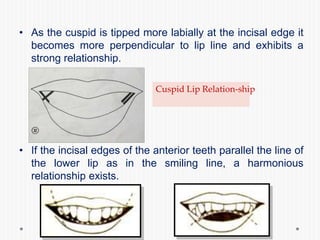
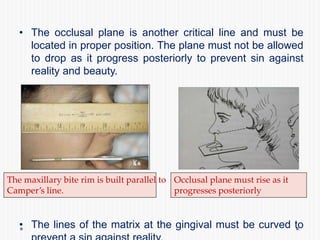
  • 100.
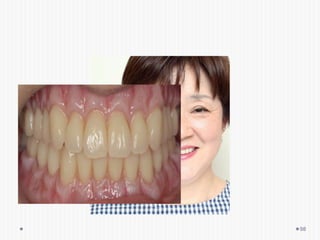
    • Intrinsic dentaldisharmony A. Space allocation error 1 Inadequate vertical space allocation 2 excessive vertical space allocation 3 excessive horizontal space allocation B. Structural line errors 1 elevated occlusal plane 2 occlusal plane drops down posteriorly 3 asymmetrical occlusal plane C Unnatural lines 1 Reverse smiling line 2 unnatural axial inclination 3 cuspless posterior teeth 4 gradation errors 5 Age-Sex-Personality disharmony
  • 101.
    D Single –lineerrors 1. Vertical deviation 2. Horizontal deviation 3. Line conflict E Imbalance 1. Midline errors 2.Imbalance of direction 3. Artifact error 4. Diastema error Use of short posterior teeth destroys the illus Of gradual reduction in the size, sin against Principle of gradation Raising or lowering of one adjacent line destroys the illusion
  • 102.
    Summery:- • For acomplete denture prosthesis to be successful it should be mechanically sound, physiologically acceptable and esthetically pleasing. • By having a knowledge about principles and fundamentals of esthetics and by following simple steps to incorporate this knowledge in complete dentures more life like restorations can be fabricated.
  • 103.
    References:- • Zarb,Bolender, Prosthodontictreatment for edentulous patients.Twelfth edition • Sheldon Winkler, Essentials of complete denture prosthodontics,second, edition 2000 • Richard E. Lambarde : The Principle of visual perception and clinical application to denture esthetics , Journal of Prosthetic Dentistry . 29:359-381 ,1973. • John P. Frush, Ronald D Fisher :Introduction to Dentogenic Restorations , Journal of Prosthetic Dentistry ,5:587- 595,1955. • John P. Frush, Ronald D Fisher :The Dynesthetic interpretation of Dentogenic concept, Journal of Prosthetic Dentistry. 8:559-581, 1958. • D J Lamb: Appearance and Aesthetics in denture practice, wright bristel, 1987.
  • 104.

Editor's Notes

  • #7 Since ancient times the most common material for false teeth were animal bone or ivory,especially from elephants or hippopotamus Pincus- venner smile or Hollywood smile!
  • #12 Y do we see.. We see because our eyes differetiate.. Our eyes differentiate because contrast exist in the situation being viewed.. As the amount of contrast increases, visibility increases. As the amount of contrast decreases, visibility decreases
  • #17  A 32-year-old edentulous patient with teeth set over the ridge with a straight line set-up resulting in the typical denture look. The superior esthetic results achieved by placing the maxillary anterior teeth to anatomic harmony.
  • #19 Just as unity is the prime requisite of a good composition, dominance is the prime requisite to provide unity.
  • #81 Occlusal rims should be made so that it should provide proper support to the lips. In severely resorbed cases more support is needed to the upper lip so that normal relationship is be maintained as in natural teeth.
  • #93 Denture base material ada no 12 is used for packing Most widely used tints are the Kayon dental stains or tinting resins. One Kayon Kit contains five shades
  • #94 Techniques for tinting denture base Johnson’s technique Winkler’s technique Chaudhary and Craig technique Plack, Todd, Woody technique
  • #95 Tints should be placed in eye dropper bottles with the glass droppers turned upside down to control the placement of the tints. The tints are sifted into the boiled out flasks and then are wet with monomer three or four teeth at a time .
  • #96 This kit consists of 18 maxillary and 6 mandibular anterior molds. The unique feature of the system is that six teeth of each mold are represented by veneers, which are connected to each other on the lingualsurface by a fiber that allows each veneer some degree of movement
  • #97 During the esthetic and phonetic test, the most suitable dental mold in size and form is chosen; hence, the anterior wax rim is removed from the right to the left canine and the chosen dental mold is placed for the aesthetic try-in