ULTRASONIC
MACHINING
PROCESS
USM
.
.
.
Ultrasonic
Waves of High
Frequency
Sound
.INFRA SONIC
WAVES
ULTRA SONIC
WAVES
AUDIBLE
WAVES
SUITABLE
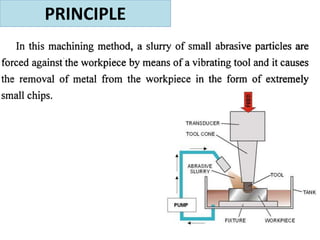
PRINCIPLE
.
Ultrasonic
Generator
Used to convert the current from low
frequency to high frequency
Abrasive Slurry
.
Transducer
Used to convert
Electrical energy
into Mechanical
Vibrations
.
Tool Holder
Made up of Titanium alloy , Monel ,
Aluminium, Stainless steel
.
Tool
Material
Low Carbon Material
and Stainless steel
The tool is brazed,
soldered or Fastened
mechanically to the
transducer through a
tool holder
Working of USM
Transducer
convert the high
frequency
electrical energy
into Mechanical
Vibrations
Oscillator convert the
Low frequency electrical
energy into high
frequency electrical
energy
20 – 30 HZ
Vibrations are
transferred to
tool material
Abrasive Slurry
Passed
Between the
vibrating tool
and work piece
The
refrigeration
system used
to cool the
abrasive
slurry to 5 –
6 Degree
celcius
COMPARISON
TRANSDUCER
TYPES OF TRANSDUCER
MAGNETOSTRICTIVE TRANSDUCER
.
Change in length is independent of
the direction of the magnetic field
But depend only on the
magnitude of the field and
Nature of the material
MAGNETOSTRICTIVE TRANSDUCER
LT battery used to
heat the filament
So electrons are
produced
Those electrons
are accelerated
by HT Battery
So AC current
Produced in the
circuit
So Rod start
to vibrate
due to
magnetostric
tive effect
This vibrations rod
create Ultrasonic
Waves , which sent out
MAGNETOSTRICTIVE TRANSDUCER
The Longitudinal Extension
and contraction of the Rod AB
produce an EMF in the coil L2
Resonance
Frequency of the
oscillatory circuit
Frequency of Vibrating
Rod
=
Resonance will occur when
At resonance , the rod vibrates vigorously and ultrasonic
waves are produced at high frequencies
Advantages –
Magnetostrictive Transducer
Disadvantages –
Magnetostrictive Transducer
PIEZOELECTRIC TRANSDUCER
Its more efficient than magnetostrictive transducer
The modern USM are of this type.
PIEZOELECTRIC
effect
crystal
Definition - Piezoelectric
• Piezoelectric transducers are a type of electro
acoustic transducer that convert the electrical
charges produced by some forms of solid
materials into energy.
• The word "piezoelectric" literally means
electricity caused by pressure.
Circuit
Arrangement of the circuit
Working LT battery used to
heat the filament
So electrons are
produced
Those electrons are
accelerated by HT Battery
So AC current
Produced in the
circuit
This AC current Passes
through L1 and L2 and
its transferred to
Secondary circuit
This AC current passed to the plates A and B and it make the
Crystal to vibrate due to the principle of inverse piezoelectric
effect. The vibrations of crystal creates Ultrasonic waves
Resonance
Advantages – Piezoelectric transducer
Disadvantages – Piezoelectric transducer
1. Piezoelectric quartz is high cost
2. Cutting and shaping of crystal is very complex.
MRR
MRR Per unit time
Wear Ratio
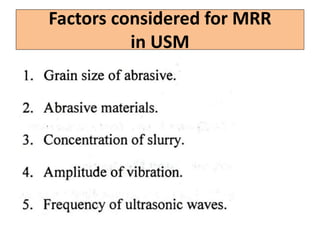
Factors considered for MRR
in USM
Grain size of Abrasives
Abrasive material
It Depend on
1.The type of material to be machined
2. Requirement of Surface finish
For Machining - Tungsten Carbide
- Die Steel
Boron Carbide
Silicon Carbide
Abrasives
For Machining - Glass
- Ceramics
Aluminium oxide
Concentration of Slurry
Abrasive Slurry = Abrasive Particles + Water
Amplitude of Vibration
MRR increase with the increase of Amplitude of Vibration
Frequency
MRR increases with the increase of Ultrasonic wave
Frequency
Process Parameters
Tool Material
Lengthy tool causes overstresses
So tool should be short and rigid
Process Parameters
Process Parameters
Wear Ratio
1.5 : 1 For Tungsten Carbide Work Pieces
100 : 1 For Glass Work Pieces
50 : 1 For Quartz Work Pieces
75 : 1 For Ceramics
1 : 1 For Hardened tool steel Work Pieces
Abrasive Material and
Cutting Power
Process Parameters
Advantages of USM
Disadvantages of USM
Applications

Ultrasonic machining process for micro manufacturing processes