HAEMOGLOBINOPATHIES
KUSHAL KUMAR
HAEMOGLOBINOPATHIES
• Inherited disorders of haemoglobin
• Sickle cell disease or sicking disorders
• Thalassemia syndrome
SICKLE CELL DISEASE (SCD)
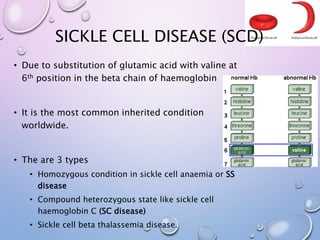
• Due to substitution of glutamic acid with valine at
6th position in the beta chain of haemoglobin
• It is the most common inherited condition
worldwide.
• The are 3 types
• Homozygous condition in sickle cell anaemia or SS
disease
• Compound heterozygous state like sickle cell
haemoglobin C (SC disease)
• Sickle cell beta thalassemia disease.
PATHOGENESIS
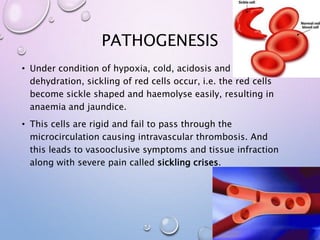
• Under condition of hypoxia, cold, acidosis and
dehydration, sickling of red cells occur, i.e. the red cells
become sickle shaped and haemolyse easily, resulting in
anaemia and jaundice.
• This cells are rigid and fail to pass through the
microcirculation causing intravascular thrombosis. And
this leads to vasooclusive symptoms and tissue infraction
along with severe pain called sickling crises.
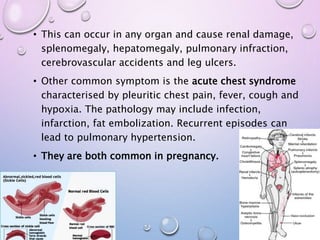
• This can occur in any organ and cause renal damage,
splenomegaly, hepatomegaly, pulmonary infraction,
cerebrovascular accidents and leg ulcers.
• Other common symptom is the acute chest syndrome
characterised by pleuritic chest pain, fever, cough and
hypoxia. The pathology may include infection,
infarction, fat embolization. Recurrent episodes can
lead to pulmonary hypertension.
• They are both common in pregnancy.
• Pregnant women can also have cardiac
dysfunction due to ventricular hypertrophy.
• These changes in the placenta can cause
preeclampsia and harmful effects on foetus.
• Many of these patient have chronic haemolytic
anaemia but are generally healthy except during
crises.
DIAGNOSIS
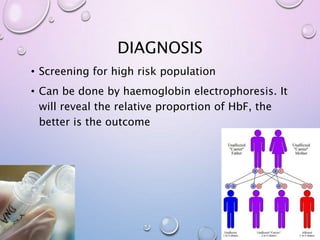
• Screening for high risk population
• Can be done by haemoglobin electrophoresis. It
will reveal the relative proportion of HbF, the
better is the outcome
COMPLICATION
• Maternal
• Acute painful sickling crises
• early onset preeclampsia and HELLP syndrome
• Infection like pyelonephritis and puerperal
sepsis
• Thrombosis
• Cardiac dysfunction
H aemolysis
E levated
L iver enzymes
L ow
P latelet count
• PERINATAL
• Miscarriage and preterm delivery
• Intrauterine growth restriction
• Intrauterine foetal death
• Isoimmunisation and haemolytic disease of
new-born
MANAGEMENT
• PRECONCEPTIONAL
• Pregnancy should be planed and chronic disease should be
assessed preconeptionally for end organ damage. Women
with HT, proteinuria and proliferative retinopathy should
be identified. An echocardiography done to assess the
presence of pulmonary HT and cardiac dysfunction.
• Those who have multiple blood transfusion should be
screened for iron overload and chelation done before
pregnancy
• Also for red cell antibodies as it may cause haemolytic
disease of new-born
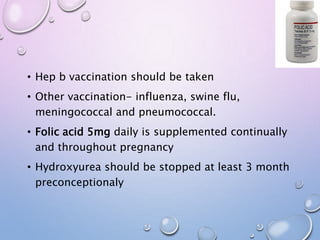
• Hep b vaccination should be taken
• Other vaccination- influenza, swine flu,
meningococcal and pneumococcal.
• Folic acid 5mg daily is supplemented continually
and throughout pregnancy
• Hydroxyurea should be stopped at least 3 month
preconceptionaly
• ANTEPARTUM MANAGEMENT
• Women should aim to avoid precipitating factors for sickle
cell crisis and should be advised to seek medical advice
early.
• Influenza vaccine should be administered
• Partner screen should be done and prenatal diagnosis
offered
• Folic acid 5mg daily and prophylactic antibiotic can be
given.
• Oral iron should be given only if lab evidence of iron
deficiency.
• SCD women should be considered for low dose aspirin
75mg once daily from 2 weeks of gestation in an effort to
reduce the risk of developing preeclampsia and IUGR.
• Bp and urinalysis should be performed at each
consultation, and midstream urine for culture performed
monthly to screen for asymptomatic bacteriuria.
• Apart from the routine 11-14 week and 18-20 week
anomaly scan, these women should be offered monthly
growth scan to check for IUGR.
• Routine prophylactic blood transfusion is not
recommended in pregnancy.
• COMPLICATIONS
• Acute painful sickling crisis
• Acute stroke
• Sever anaemia
• Acute crisis should be managed aggressively with
analgesics, hydration, antibiotic.
• Thromboprophylaxis should be considered in acute
painful crisis.
• Severe anaemia – blood transfusion may be needed
• INTRAPARTUM MANAGEMENT
• Elective delivery is preferable after 38 week of gestation. If
IUGR is present, earlier delivery may be indicated. Vaginal
delivery is preferred.
• If caesarean – general anaesthesia is best avoided and
epidural Anaesthesia preferred. Blood should be ready and
in case of atypical antibodies, blood should be
crossmatched for delivery
• Adequate hydration and oxygenation should be
maintained.
• POSTPARTUM MANAGEMENT
• Heparin is preferably given prophylactically to
prevent thrombosis. Infection should be watched and
vigorously treated in puerperium.
• Baby should also be tested for SCD
• CONTRACEPTION
• Combined OCP should be avoided.
• Progesterone is known to prevent sickle cell crisis
and it is only contraception ideal
• IUCD – risk of infection
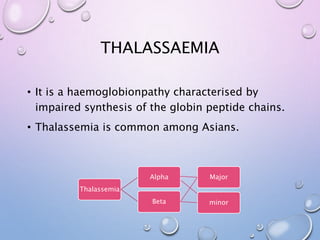
THALASSAEMIA
• It is a haemoglobionpathy characterised by
impaired synthesis of the globin peptide chains.
• Thalassemia is common among Asians.
Thalassemia
Alpha
Beta
Major
minor
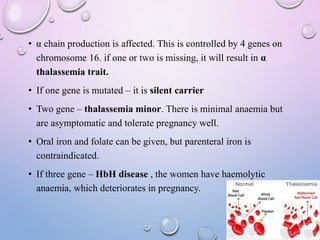
• α chain production is affected. This is controlled by 4 genes on
chromosome 16. if one or two is missing, it will result in α
thalassemia trait.
• If one gene is mutated – it is silent carrier
• Two gene – thalassemia minor. There is minimal anaemia but
are asymptomatic and tolerate pregnancy well.
• Oral iron and folate can be given, but parenteral iron is
contraindicated.
• If three gene – HbH disease , the women have haemolytic
anaemia, which deteriorates in pregnancy.
• Parenteral iron is contraindicated
• Oral iron should be given only when ferritin level are
reduced.
• If all four gene – α thalassemia major or Bart disease
• Here no α globin chain and only HbH and Hb bart. These foetuses die
in utero and this is one major cause for non immune hydrops. α
thalassemia is incompatible with life.
• Prenatal diagnosis
• Women with α thalassemia trait and HbH disease should be alerted
about the possibility of 1 in 4 chance of having a hydrops feteus, if the
partner has the same trait. Hence partner screening is important.
• Done by PCV and DNA analysis after chorionic villus sampling
• THALASSEMIA β MAJOR or COOLEY’S anaemia
• If two abnormal β globin genes are affected, it can lead to –
β thalassemia major or thalassemia intermedia.
• in this there is no β chain and infant need blood transfusions to survive
• Life expectancy is short and pregnancy is rare
• In such case, iron in any form is contrainticated.
• Folic acid should be given.
• Anaemia is treated with blood transfusion, desferroxamine, used for
chelation, should be avoided, low dose can be given in latter month if
required
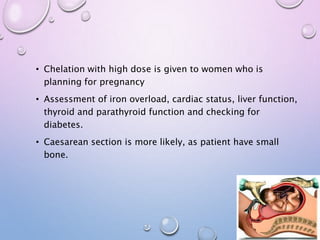
• Chelation with high dose is given to women who is
planning for pregnancy
• Assessment of iron overload, cardiac status, liver function,
thyroid and parathyroid function and checking for
diabetes.
• Caesarean section is more likely, as patient have small
bone.
• THALASSEMIA β MINOR or β Thalassemia trait
• Reduction of production of one normal β globin chain.
• These can encounter pregnancy
• Here HbA2 and HbF are increased
• There is low MCV and MCHC. Suspect in case of microcytic
hypochromic anaemia when the MCH is reduced an MCHC is normal.
• Diagnosis is confirmed by HbA2 estimation, should be done in all case
where MCH <27pg. A level more than 3.5% is diagnostic
• Hb electrophoresis may show increased concentration of
HbA2 and HbF
• Usually, the diagnosis is made only when microcytic
hypochromic anaemia fails to response iron.
• Majority response with good maternal and foetal outcome
• Folic acid is given. Iron is not indicated unless deficiency is
documented by serum ferritin level.
• Parenteral iron should not be given. Blood transfusion is
sometime needed before delivery.
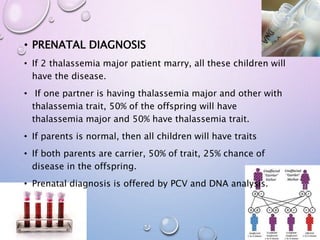
• PRENATAL DIAGNOSIS
• If 2 thalassemia major patient marry, all these children will
have the disease.
• If one partner is having thalassemia major and other with
thalassemia trait, 50% of the offspring will have
thalassemia major and 50% have thalassemia trait.
• If parents is normal, then all children will have traits
• If both parents are carrier, 50% of trait, 25% chance of
disease in the offspring.
• Prenatal diagnosis is offered by PCV and DNA analysis.
haemoglobinopathies

haemoglobinopathies

  • 1.
  • 2.
    HAEMOGLOBINOPATHIES • Inherited disordersof haemoglobin • Sickle cell disease or sicking disorders • Thalassemia syndrome
  • 3.
    SICKLE CELL DISEASE(SCD) • Due to substitution of glutamic acid with valine at 6th position in the beta chain of haemoglobin • It is the most common inherited condition worldwide. • The are 3 types • Homozygous condition in sickle cell anaemia or SS disease • Compound heterozygous state like sickle cell haemoglobin C (SC disease) • Sickle cell beta thalassemia disease.
  • 4.
    PATHOGENESIS • Under conditionof hypoxia, cold, acidosis and dehydration, sickling of red cells occur, i.e. the red cells become sickle shaped and haemolyse easily, resulting in anaemia and jaundice. • This cells are rigid and fail to pass through the microcirculation causing intravascular thrombosis. And this leads to vasooclusive symptoms and tissue infraction along with severe pain called sickling crises.
  • 5.
    • This canoccur in any organ and cause renal damage, splenomegaly, hepatomegaly, pulmonary infraction, cerebrovascular accidents and leg ulcers. • Other common symptom is the acute chest syndrome characterised by pleuritic chest pain, fever, cough and hypoxia. The pathology may include infection, infarction, fat embolization. Recurrent episodes can lead to pulmonary hypertension. • They are both common in pregnancy.
  • 6.
    • Pregnant womencan also have cardiac dysfunction due to ventricular hypertrophy. • These changes in the placenta can cause preeclampsia and harmful effects on foetus. • Many of these patient have chronic haemolytic anaemia but are generally healthy except during crises.
  • 7.
    DIAGNOSIS • Screening forhigh risk population • Can be done by haemoglobin electrophoresis. It will reveal the relative proportion of HbF, the better is the outcome
  • 8.
    COMPLICATION • Maternal • Acutepainful sickling crises • early onset preeclampsia and HELLP syndrome • Infection like pyelonephritis and puerperal sepsis • Thrombosis • Cardiac dysfunction H aemolysis E levated L iver enzymes L ow P latelet count
  • 9.
    • PERINATAL • Miscarriageand preterm delivery • Intrauterine growth restriction • Intrauterine foetal death • Isoimmunisation and haemolytic disease of new-born
  • 10.
    MANAGEMENT • PRECONCEPTIONAL • Pregnancyshould be planed and chronic disease should be assessed preconeptionally for end organ damage. Women with HT, proteinuria and proliferative retinopathy should be identified. An echocardiography done to assess the presence of pulmonary HT and cardiac dysfunction. • Those who have multiple blood transfusion should be screened for iron overload and chelation done before pregnancy • Also for red cell antibodies as it may cause haemolytic disease of new-born
  • 11.
    • Hep bvaccination should be taken • Other vaccination- influenza, swine flu, meningococcal and pneumococcal. • Folic acid 5mg daily is supplemented continually and throughout pregnancy • Hydroxyurea should be stopped at least 3 month preconceptionaly
  • 12.
    • ANTEPARTUM MANAGEMENT •Women should aim to avoid precipitating factors for sickle cell crisis and should be advised to seek medical advice early. • Influenza vaccine should be administered • Partner screen should be done and prenatal diagnosis offered • Folic acid 5mg daily and prophylactic antibiotic can be given. • Oral iron should be given only if lab evidence of iron deficiency.
  • 13.
    • SCD womenshould be considered for low dose aspirin 75mg once daily from 2 weeks of gestation in an effort to reduce the risk of developing preeclampsia and IUGR. • Bp and urinalysis should be performed at each consultation, and midstream urine for culture performed monthly to screen for asymptomatic bacteriuria. • Apart from the routine 11-14 week and 18-20 week anomaly scan, these women should be offered monthly growth scan to check for IUGR. • Routine prophylactic blood transfusion is not recommended in pregnancy.
  • 14.
    • COMPLICATIONS • Acutepainful sickling crisis • Acute stroke • Sever anaemia • Acute crisis should be managed aggressively with analgesics, hydration, antibiotic. • Thromboprophylaxis should be considered in acute painful crisis. • Severe anaemia – blood transfusion may be needed
  • 15.
    • INTRAPARTUM MANAGEMENT •Elective delivery is preferable after 38 week of gestation. If IUGR is present, earlier delivery may be indicated. Vaginal delivery is preferred. • If caesarean – general anaesthesia is best avoided and epidural Anaesthesia preferred. Blood should be ready and in case of atypical antibodies, blood should be crossmatched for delivery • Adequate hydration and oxygenation should be maintained.
  • 16.
    • POSTPARTUM MANAGEMENT •Heparin is preferably given prophylactically to prevent thrombosis. Infection should be watched and vigorously treated in puerperium. • Baby should also be tested for SCD • CONTRACEPTION • Combined OCP should be avoided. • Progesterone is known to prevent sickle cell crisis and it is only contraception ideal • IUCD – risk of infection
  • 17.
    THALASSAEMIA • It isa haemoglobionpathy characterised by impaired synthesis of the globin peptide chains. • Thalassemia is common among Asians. Thalassemia Alpha Beta Major minor
  • 18.
    • α chainproduction is affected. This is controlled by 4 genes on chromosome 16. if one or two is missing, it will result in α thalassemia trait. • If one gene is mutated – it is silent carrier • Two gene – thalassemia minor. There is minimal anaemia but are asymptomatic and tolerate pregnancy well. • Oral iron and folate can be given, but parenteral iron is contraindicated. • If three gene – HbH disease , the women have haemolytic anaemia, which deteriorates in pregnancy.
  • 19.
    • Parenteral ironis contraindicated • Oral iron should be given only when ferritin level are reduced. • If all four gene – α thalassemia major or Bart disease • Here no α globin chain and only HbH and Hb bart. These foetuses die in utero and this is one major cause for non immune hydrops. α thalassemia is incompatible with life. • Prenatal diagnosis • Women with α thalassemia trait and HbH disease should be alerted about the possibility of 1 in 4 chance of having a hydrops feteus, if the partner has the same trait. Hence partner screening is important. • Done by PCV and DNA analysis after chorionic villus sampling
  • 20.
    • THALASSEMIA βMAJOR or COOLEY’S anaemia • If two abnormal β globin genes are affected, it can lead to – β thalassemia major or thalassemia intermedia. • in this there is no β chain and infant need blood transfusions to survive • Life expectancy is short and pregnancy is rare • In such case, iron in any form is contrainticated. • Folic acid should be given. • Anaemia is treated with blood transfusion, desferroxamine, used for chelation, should be avoided, low dose can be given in latter month if required
  • 21.
    • Chelation withhigh dose is given to women who is planning for pregnancy • Assessment of iron overload, cardiac status, liver function, thyroid and parathyroid function and checking for diabetes. • Caesarean section is more likely, as patient have small bone.
  • 22.
    • THALASSEMIA βMINOR or β Thalassemia trait • Reduction of production of one normal β globin chain. • These can encounter pregnancy • Here HbA2 and HbF are increased • There is low MCV and MCHC. Suspect in case of microcytic hypochromic anaemia when the MCH is reduced an MCHC is normal. • Diagnosis is confirmed by HbA2 estimation, should be done in all case where MCH <27pg. A level more than 3.5% is diagnostic
  • 23.
    • Hb electrophoresismay show increased concentration of HbA2 and HbF • Usually, the diagnosis is made only when microcytic hypochromic anaemia fails to response iron. • Majority response with good maternal and foetal outcome • Folic acid is given. Iron is not indicated unless deficiency is documented by serum ferritin level. • Parenteral iron should not be given. Blood transfusion is sometime needed before delivery.
  • 24.
    • PRENATAL DIAGNOSIS •If 2 thalassemia major patient marry, all these children will have the disease. • If one partner is having thalassemia major and other with thalassemia trait, 50% of the offspring will have thalassemia major and 50% have thalassemia trait. • If parents is normal, then all children will have traits • If both parents are carrier, 50% of trait, 25% chance of disease in the offspring. • Prenatal diagnosis is offered by PCV and DNA analysis.