UH-DMML: Ongoing Data Mining Research 2006-2009 Data Mining and Machine Learning Group, Computer Science Department,  University of Houston, TX August 8, 2008 Abraham Bagherjeiran*   Ulvi Celepcikay  Chun-Sheng Chen  Ji Yeon Choo*  Wei Ding*     Paulo Martins   Christian Giusti*  Rachsuda Jiamthapthaksin  Dan Jiang*  Seungchan Lee  Rachana Parmar*  Vadeerat Rinsurongkawong Justin Thomas* Banafsheh Vaezian* Jing Wang*   Dr. Christoph F. Eick
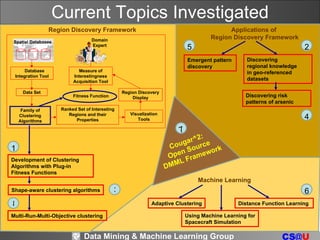
Current Topics Investigated Discovering  regional knowledge  in geo-referenced datasets Shape-aware clustering algorithms Emergent pattern  discovery Machine Learning  Region Discovery Framework Applications of  Region Discovery Framework Discovering risk patterns of arsenic Cougar^2:  Open Source  DMML Framework Development of Clustering Algorithms with Plug-in Fitness Functions Distance Function Learning  Adaptive Clustering Using Machine Learning for Spacecraft Simulation 1 2 8 3 4 5 6 7 Multi-Run-Multi-Objective clustering 3 Spatial Databases Data Set Domain Expert Measure of Interestingness Acquisition Tool Fitness Function Family of Clustering Algorithms Visualization Tools Ranked Set of Interesting Regions and their Properties Region Discovery Display Database Integration Tool
1. Development of  Clustering Algorithms  with Plug-in Fitness Functions
Clustering with Plug-in Fitness Functions Motivation: Finding subgroups in geo-referenced datasets has many applications. However, in many applications the subgroups to be searched for do not share the characteristics considered by traditional clustering algorithms, such as cluster compactness and separation. Consequently, it is desirable to develop clustering algorithms that provide plug-in fitness functions that allow domain experts to express desirable characteristics of subgroups they are looking for. Only very few clustering algorithms published in the literature provide plug-in fitness functions; consequently existing clustering paradigms have to be modified and extended by our research to provide such capabilities.  Many other applications for clustering with plug-in fitness functions exist.
Current Suite of Clustering Algorithms Representative-based: SCEC, SRIDHCR, SPAM, CLEVER Grid-based: SCMRG Agglomerative: MOSAIC Density-based: SCDE (not really plug-in but some fitness functions can be simulated) Clustering Algorithms Density-based Agglomerative-based Representative-based Grid-based
2. Discovering Regional Knowledge in Geo-Referenced Datasets
Mining Regional Knowledge in Spatial Datasets Objective : Develop and implement an integrated framework to automatically discover interesting regional patterns in spatial datasets.  Hierarchical Grid-based & Density-based Algorithms  Spatial Risk Patterns of Arsenic Framework for Mining Regional Knowledge Spatial Databases Integrated Data Set Domain Experts Fitness Functions Family of Clustering Algorithms Regional Association Mining Algorithms Ranked Set of Interesting Regions and their Properties Measures of interestingness  Regional  Knowledge
Finding Regional Co-location Patterns in Spatial Datasets Objective:  Find co-location regions using various clustering algorithms and novel fitness functions.  Applications: 1.  Finding regions on planet Mars where shallow and deep ice are co-located, using point and raster datasets. In figure 1, regions in red have very high co-location and regions in blue have anti co-location.  2.  Finding co-location patterns involving chemical concentrations with values on the wings of their statistical distribution in Texas ’  ground water supply. Figure 2 indicates discovered regions and their associated chemical patterns. Figure 1: Co-location regions involving deep and shallow ice on Mars Figure 2: Chemical co-location  patterns in Texas Water Supply
Regional Pattern Discovery via Principal Component Analysis Objective:  Discovering regions and regional patterns using Principal Component Analysis (PCA) Applications:  Region discovery, regional pattern discovery (i.e. finding  interesting sub-regions in Texas where arsenic is highly correlated with fluoride and pH) in spatial data, and regional regression. Idea:  Correlation patterns among attributes tend to be hidden globally. But with the help of statistical approaches and our region discovery framework, some interesting regional correlations among the attributes can be discovered.  Oner Ulvi Celepcikay Apply PCA-Based Fitness Function & Assign Rewards Calculate Principal Components & Variance Captured Discover Regions & Regional Patterns (Globally Hidden) Region Discovery Post-Processing
Regional Pattern Discovery via Principal Component Analysis Oner Ulvi Celepcikay Select best k value to retrieve k PCs
3. Shape-Aware Clustering Algorithms
Discovering Clusters of Arbitrary Shapes Objective:  Detect arbitrary shape clusters effectively and efficiently. 2 nd  Approach:  Approximate arbitrary shapes using unions of small convex polygons. 3 rd  Approach:  Employ density estimation techniques for discovering arbitrary shape clusters. 1 st  Approach:  Develop cluster evaluation measures for non-spherical cluster shapes. Derive a shape signature for a given shape.  (boundary-based, region-based, skeleton based shape representation) Transform the shape signature into a fitness function and use it in a clustering algorithm. Rachsuda Jiamthapthaksin, Christian Giusti, and Jiyeon Choo
4. Discovering Risk Patterns  of Arsenic
Discovering Spatial Patterns of Risk from Arsenic:   A Case Study of Texas Ground Water Wei Ding, Vadeerat Rinsurongkawong and   Rachsuda Jiamthapthaksin  Objective :  Analysis of Arsenic Contamination and its Causes. Collaboration with Dr. Bridget Scanlon and her research group at the University of Texas in Austin.  Our approach Experimental Results
5. Emergent Pattern Discovery
Objectives of Emergent Pattern Discovery Emergent patterns capture  how the  most  recent data differ from data in the past . Emergent pattern discovery finds  what is  new  in data . Challenges of emergent pattern discovery include: The development of a formal framework that characterizes  different types of emergent patterns The  development of a methodology to detect emergent patterns  in  spatio-temporal datasets The capability to find emergent patterns in regions of  arbitrary shape and granularity The development of scalable emergent pattern discovery algorithms that are able to  cope with  large data sizes and large numbers of patterns Time 0 Time 1 The change from time 0 to 1 Emergent pattern discovery for Earthquake data
Change Analysis by Comparing Clusters
CHANGE PREDICATES  Agreement(r,r’)= |r    r’| / |r    r’| Containment(r,r’)= |r    r’| / |r| Novelty (r’) = (r’ —(r1   …   rk)) Relative-Novelty(r’) = |r’ —(r1   …   rk)|/|r’| Disappearance(r)= (r—(r’1   …   r’k)) Relative-Disappearance(r)=  |r—(r’1   …    r’k) | / | r | Remark: “|” denotes size operator.
6. Machine Learning
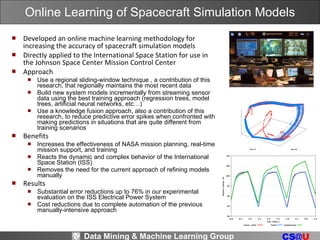
Online Learning of Spacecraft Simulation Models Developed an online machine learning methodology for increasing the accuracy of spacecraft simulation models Directly applied to the International Space Station for use in the Johnson Space Center Mission Control Center Approach Use a regional sliding-window technique , a contribution of this research, that regionally maintains the most recent data Build new system models incrementally from streaming sensor data using the best training approach (regression trees, model trees, artificial neural networks, etc…) Use a knowledge fusion approach, also a contribution of this research, to reduce predictive error spikes when confronted with making predictions in situations that are quite different from training scenarios Benefits Increases the effectiveness of NASA mission planning, real-time mission support, and training Reacts the dynamic and complex behavior of the International Space Station (ISS) Removes the need for the current approach of refining models manually Results Substantial error reductions up to 76% in our experimental evaluation on the ISS Electrical Power System Cost reductions due to complete automation of the previous manually-intensive approach
Distance Function Learning Using Intelligent Weight Updating and Supervised Clustering   Distance function: Measure the similarity between objects. Objective:   Construct a good distance function using AI and machine learning      techniques that learn attribute weights. The framework: Generate a distance function:   Apply  weight updating schemes / Search Strategies  to find a good distance function candidate Clustering: Use this distance function candidate in a  clustering algorithm  to cluster the dataset Evaluate the distance function:  We evaluate the goodness of the distance function by evaluating the clustering result according to a predefined  evaluation function. Bad  distance function   1 Good  distance function   2 Clustering   X Distance Function Q Cluster Goodness of  the Distance  Function Q q(X) Clustering Evaluation Weight Updating Scheme / Search Strategy
7. Cougar^2: Open Source Data Mining and Machine Learning Framework
Cougar^2 1  is a new framework for data mining and machine learning. Its goal is to simplify the transition of algorithms on paper to actual implementation. It provides an intuitive API for researchers. Its design is based on object oriented design principles and patterns. Developed using test first development (TFD) approach, it advocates TFD for new algorithm development. The framework has a unique design which separates learning algorithm configuration, the actual algorithm itself and the results produced by the algorithm. It allows easy storage and sharing of experiment configuration and results. Department of Computer Science, University of Houston, Houston TX FRAMEWORK ARCHITECTURE The framework architecture follows object oriented design patterns and principles. It has been developed using Test First Development approach and adding new code with unit tests is easy. There are two major components of the framework: Dataset and Learning algorithm.  Datasets  deal with how to read and write data. We have two types of datasets:  NumericDataset  where all the values are of type double and  NominalDataset  where all the values are of type int where each integer value is mapped to a value of a nominal attribute. We have a high level interface for Dataset and so one can write code using this interface and switching from one type of dataset to another type becomes really easy.  Learning algorithms  work on these data and return reusable results. To use a learning algorithm requires configuring the learner, running the learner and using the model built by the learner. We have separated these tasks in three separate parts:  Factory  – which does the configuration,  Learner  – which does actually learning/data mining task and builds the model and  Model  – which can be applied on new dataset or can be analyzed. Several algorithms have been implemented using the framework. The list includes SPAM, CLEVER and SCDE. Algorithm MOSAIC is currently under development. A region discovery framework and various interestingness measures like purity, variance, mean squared error have been implemented using the framework.  Developed using:  Java, JUnit, EasyMock Hosted at : https://cougarsquared.dev.java.net METHODS CURRENT WORK Typically machine learning and data mining algorithms are written using software like Matlab, Weka, RapidMiner (Formerly YALE) etc. Software like Matlab simplify the process of converting algorithm to code with little programming but often one has to sacrifice speed and usability. On the other extreme, software like Weka and RapidMiner increase the usability by providing GUI and plug-ins which requires researchers to develop GUI. Cougar^2 tries to address some of the issues with these software.  Reusable and Efficient software Test First Development Platform Independent Support research efforts into new algorithms  Analyze experiments by reading and reusing learned  models Intuitive API for researchers rather than GUI for end users Easy to share experiments and experiment results  Rachana Parmar, Justin Thomas, Rachsuda Jiamthapthaksin, Oner Ulvi Celepcikay ABSTRACT BENEFITS OF COUGAR^2 ABSTRACT 1: First version of Cougar^2 was developed by a Ph.D. student of the research group – Abraham  Bagherjeiran Region Discovery Factory Region Discovery Algorithm Region Discovery Model Dataset A SUPERVISED LEARNING EXAMPLE A REGION DISCOVERY EXAMPLE MOTIVATION Cougar^2 : Open Source Data Mining and Machine Learning Framework Parameter configuration Factory Learner Dataset Model creates builds uses Dataset applies to Hot No No Yes Sunny Outlook Overcast Cold Temp . Decision Tree Factory Decision Tree Learner Model (Decision Tree) Dataset Decision Tree Factory Decision Tree Learner Model (Decision Tree) Dataset
8. Multi-Run Multi-Objective Clustering
Objectives MRMO-Clustering Provide a system that automatically conducts experiments: different clustering algorithm and fitness functions parameters are selected using reinforcement learning, experiments will be run, the promising results will be stored, more experiments will be run, and finally the results are summarized presented to the user. Improve clustering results by using clusters obtained in different runs of a clustering algorithms; the final clustering result will be constructed by choosing clusters that have been obtained in different runs.  Support finding clusters that are good with respect to multiple objective (fitness) functions. Overcome initialization problems that most clustering algorithms face.
A MRMO System Architecture 1. Parameters  selecting unit 2. Clustering algorithms 3. Utilities  computing unit 4. Evaluate all results (need more results?) 6. Summary generation unit 5. Storage unit Geo-referenced datasets Yes No State : A_PARAM Reinforcement Learning State transition  operators :  A_PARAM Utility function: Fitness function(cross_quality + novelty + computing _time) A_PARAM,  clustering results

UHDMML.pps

  • 1.
    UH-DMML: Ongoing DataMining Research 2006-2009 Data Mining and Machine Learning Group, Computer Science Department, University of Houston, TX August 8, 2008 Abraham Bagherjeiran* Ulvi Celepcikay Chun-Sheng Chen Ji Yeon Choo* Wei Ding* Paulo Martins Christian Giusti* Rachsuda Jiamthapthaksin Dan Jiang* Seungchan Lee Rachana Parmar* Vadeerat Rinsurongkawong Justin Thomas* Banafsheh Vaezian* Jing Wang* Dr. Christoph F. Eick
  • 2.
    Current Topics InvestigatedDiscovering regional knowledge in geo-referenced datasets Shape-aware clustering algorithms Emergent pattern discovery Machine Learning Region Discovery Framework Applications of Region Discovery Framework Discovering risk patterns of arsenic Cougar^2: Open Source DMML Framework Development of Clustering Algorithms with Plug-in Fitness Functions Distance Function Learning Adaptive Clustering Using Machine Learning for Spacecraft Simulation 1 2 8 3 4 5 6 7 Multi-Run-Multi-Objective clustering 3 Spatial Databases Data Set Domain Expert Measure of Interestingness Acquisition Tool Fitness Function Family of Clustering Algorithms Visualization Tools Ranked Set of Interesting Regions and their Properties Region Discovery Display Database Integration Tool
  • 3.
    1. Development of Clustering Algorithms with Plug-in Fitness Functions
  • 4.
    Clustering with Plug-inFitness Functions Motivation: Finding subgroups in geo-referenced datasets has many applications. However, in many applications the subgroups to be searched for do not share the characteristics considered by traditional clustering algorithms, such as cluster compactness and separation. Consequently, it is desirable to develop clustering algorithms that provide plug-in fitness functions that allow domain experts to express desirable characteristics of subgroups they are looking for. Only very few clustering algorithms published in the literature provide plug-in fitness functions; consequently existing clustering paradigms have to be modified and extended by our research to provide such capabilities. Many other applications for clustering with plug-in fitness functions exist.
  • 5.
    Current Suite ofClustering Algorithms Representative-based: SCEC, SRIDHCR, SPAM, CLEVER Grid-based: SCMRG Agglomerative: MOSAIC Density-based: SCDE (not really plug-in but some fitness functions can be simulated) Clustering Algorithms Density-based Agglomerative-based Representative-based Grid-based
  • 6.
    2. Discovering RegionalKnowledge in Geo-Referenced Datasets
  • 7.
    Mining Regional Knowledgein Spatial Datasets Objective : Develop and implement an integrated framework to automatically discover interesting regional patterns in spatial datasets. Hierarchical Grid-based & Density-based Algorithms Spatial Risk Patterns of Arsenic Framework for Mining Regional Knowledge Spatial Databases Integrated Data Set Domain Experts Fitness Functions Family of Clustering Algorithms Regional Association Mining Algorithms Ranked Set of Interesting Regions and their Properties Measures of interestingness Regional Knowledge
  • 8.
    Finding Regional Co-locationPatterns in Spatial Datasets Objective: Find co-location regions using various clustering algorithms and novel fitness functions. Applications: 1. Finding regions on planet Mars where shallow and deep ice are co-located, using point and raster datasets. In figure 1, regions in red have very high co-location and regions in blue have anti co-location. 2. Finding co-location patterns involving chemical concentrations with values on the wings of their statistical distribution in Texas ’ ground water supply. Figure 2 indicates discovered regions and their associated chemical patterns. Figure 1: Co-location regions involving deep and shallow ice on Mars Figure 2: Chemical co-location patterns in Texas Water Supply
  • 9.
    Regional Pattern Discoveryvia Principal Component Analysis Objective: Discovering regions and regional patterns using Principal Component Analysis (PCA) Applications: Region discovery, regional pattern discovery (i.e. finding interesting sub-regions in Texas where arsenic is highly correlated with fluoride and pH) in spatial data, and regional regression. Idea: Correlation patterns among attributes tend to be hidden globally. But with the help of statistical approaches and our region discovery framework, some interesting regional correlations among the attributes can be discovered. Oner Ulvi Celepcikay Apply PCA-Based Fitness Function & Assign Rewards Calculate Principal Components & Variance Captured Discover Regions & Regional Patterns (Globally Hidden) Region Discovery Post-Processing
  • 10.
    Regional Pattern Discoveryvia Principal Component Analysis Oner Ulvi Celepcikay Select best k value to retrieve k PCs
  • 11.
  • 12.
    Discovering Clusters ofArbitrary Shapes Objective: Detect arbitrary shape clusters effectively and efficiently. 2 nd Approach: Approximate arbitrary shapes using unions of small convex polygons. 3 rd Approach: Employ density estimation techniques for discovering arbitrary shape clusters. 1 st Approach: Develop cluster evaluation measures for non-spherical cluster shapes. Derive a shape signature for a given shape. (boundary-based, region-based, skeleton based shape representation) Transform the shape signature into a fitness function and use it in a clustering algorithm. Rachsuda Jiamthapthaksin, Christian Giusti, and Jiyeon Choo
  • 13.
    4. Discovering RiskPatterns of Arsenic
  • 14.
    Discovering Spatial Patternsof Risk from Arsenic: A Case Study of Texas Ground Water Wei Ding, Vadeerat Rinsurongkawong and Rachsuda Jiamthapthaksin Objective : Analysis of Arsenic Contamination and its Causes. Collaboration with Dr. Bridget Scanlon and her research group at the University of Texas in Austin. Our approach Experimental Results
  • 15.
  • 16.
    Objectives of EmergentPattern Discovery Emergent patterns capture how the most recent data differ from data in the past . Emergent pattern discovery finds what is new in data . Challenges of emergent pattern discovery include: The development of a formal framework that characterizes different types of emergent patterns The development of a methodology to detect emergent patterns in spatio-temporal datasets The capability to find emergent patterns in regions of arbitrary shape and granularity The development of scalable emergent pattern discovery algorithms that are able to cope with large data sizes and large numbers of patterns Time 0 Time 1 The change from time 0 to 1 Emergent pattern discovery for Earthquake data
  • 17.
    Change Analysis byComparing Clusters
  • 18.
    CHANGE PREDICATES Agreement(r,r’)= |r  r’| / |r  r’| Containment(r,r’)= |r  r’| / |r| Novelty (r’) = (r’ —(r1  …  rk)) Relative-Novelty(r’) = |r’ —(r1  …  rk)|/|r’| Disappearance(r)= (r—(r’1  …  r’k)) Relative-Disappearance(r)= |r—(r’1  …  r’k) | / | r | Remark: “|” denotes size operator.
  • 19.
  • 20.
    Online Learning ofSpacecraft Simulation Models Developed an online machine learning methodology for increasing the accuracy of spacecraft simulation models Directly applied to the International Space Station for use in the Johnson Space Center Mission Control Center Approach Use a regional sliding-window technique , a contribution of this research, that regionally maintains the most recent data Build new system models incrementally from streaming sensor data using the best training approach (regression trees, model trees, artificial neural networks, etc…) Use a knowledge fusion approach, also a contribution of this research, to reduce predictive error spikes when confronted with making predictions in situations that are quite different from training scenarios Benefits Increases the effectiveness of NASA mission planning, real-time mission support, and training Reacts the dynamic and complex behavior of the International Space Station (ISS) Removes the need for the current approach of refining models manually Results Substantial error reductions up to 76% in our experimental evaluation on the ISS Electrical Power System Cost reductions due to complete automation of the previous manually-intensive approach
  • 21.
    Distance Function LearningUsing Intelligent Weight Updating and Supervised Clustering Distance function: Measure the similarity between objects. Objective: Construct a good distance function using AI and machine learning techniques that learn attribute weights. The framework: Generate a distance function: Apply weight updating schemes / Search Strategies to find a good distance function candidate Clustering: Use this distance function candidate in a clustering algorithm to cluster the dataset Evaluate the distance function: We evaluate the goodness of the distance function by evaluating the clustering result according to a predefined evaluation function. Bad distance function  1 Good distance function  2 Clustering X Distance Function Q Cluster Goodness of the Distance Function Q q(X) Clustering Evaluation Weight Updating Scheme / Search Strategy
  • 22.
    7. Cougar^2: OpenSource Data Mining and Machine Learning Framework
  • 23.
    Cougar^2 1 is a new framework for data mining and machine learning. Its goal is to simplify the transition of algorithms on paper to actual implementation. It provides an intuitive API for researchers. Its design is based on object oriented design principles and patterns. Developed using test first development (TFD) approach, it advocates TFD for new algorithm development. The framework has a unique design which separates learning algorithm configuration, the actual algorithm itself and the results produced by the algorithm. It allows easy storage and sharing of experiment configuration and results. Department of Computer Science, University of Houston, Houston TX FRAMEWORK ARCHITECTURE The framework architecture follows object oriented design patterns and principles. It has been developed using Test First Development approach and adding new code with unit tests is easy. There are two major components of the framework: Dataset and Learning algorithm. Datasets deal with how to read and write data. We have two types of datasets: NumericDataset where all the values are of type double and NominalDataset where all the values are of type int where each integer value is mapped to a value of a nominal attribute. We have a high level interface for Dataset and so one can write code using this interface and switching from one type of dataset to another type becomes really easy. Learning algorithms work on these data and return reusable results. To use a learning algorithm requires configuring the learner, running the learner and using the model built by the learner. We have separated these tasks in three separate parts: Factory – which does the configuration, Learner – which does actually learning/data mining task and builds the model and Model – which can be applied on new dataset or can be analyzed. Several algorithms have been implemented using the framework. The list includes SPAM, CLEVER and SCDE. Algorithm MOSAIC is currently under development. A region discovery framework and various interestingness measures like purity, variance, mean squared error have been implemented using the framework. Developed using: Java, JUnit, EasyMock Hosted at : https://cougarsquared.dev.java.net METHODS CURRENT WORK Typically machine learning and data mining algorithms are written using software like Matlab, Weka, RapidMiner (Formerly YALE) etc. Software like Matlab simplify the process of converting algorithm to code with little programming but often one has to sacrifice speed and usability. On the other extreme, software like Weka and RapidMiner increase the usability by providing GUI and plug-ins which requires researchers to develop GUI. Cougar^2 tries to address some of the issues with these software. Reusable and Efficient software Test First Development Platform Independent Support research efforts into new algorithms Analyze experiments by reading and reusing learned models Intuitive API for researchers rather than GUI for end users Easy to share experiments and experiment results Rachana Parmar, Justin Thomas, Rachsuda Jiamthapthaksin, Oner Ulvi Celepcikay ABSTRACT BENEFITS OF COUGAR^2 ABSTRACT 1: First version of Cougar^2 was developed by a Ph.D. student of the research group – Abraham Bagherjeiran Region Discovery Factory Region Discovery Algorithm Region Discovery Model Dataset A SUPERVISED LEARNING EXAMPLE A REGION DISCOVERY EXAMPLE MOTIVATION Cougar^2 : Open Source Data Mining and Machine Learning Framework Parameter configuration Factory Learner Dataset Model creates builds uses Dataset applies to Hot No No Yes Sunny Outlook Overcast Cold Temp . Decision Tree Factory Decision Tree Learner Model (Decision Tree) Dataset Decision Tree Factory Decision Tree Learner Model (Decision Tree) Dataset
  • 24.
  • 25.
    Objectives MRMO-Clustering Providea system that automatically conducts experiments: different clustering algorithm and fitness functions parameters are selected using reinforcement learning, experiments will be run, the promising results will be stored, more experiments will be run, and finally the results are summarized presented to the user. Improve clustering results by using clusters obtained in different runs of a clustering algorithms; the final clustering result will be constructed by choosing clusters that have been obtained in different runs. Support finding clusters that are good with respect to multiple objective (fitness) functions. Overcome initialization problems that most clustering algorithms face.
  • 26.
    A MRMO SystemArchitecture 1. Parameters selecting unit 2. Clustering algorithms 3. Utilities computing unit 4. Evaluate all results (need more results?) 6. Summary generation unit 5. Storage unit Geo-referenced datasets Yes No State : A_PARAM Reinforcement Learning State transition operators : A_PARAM Utility function: Fitness function(cross_quality + novelty + computing _time) A_PARAM, clustering results

Editor's Notes

  • #8 Given: A dataset O with a schema R A distance function d defined on instances of R A fitness function q(X) that evaluates clustering X={c 1 ,…,c k } as follows: q(X)=  c  X reward(c)=  c  X interestingness(c)  size(c)  with  >1 Objective: Find c 1 ,…,c k  O such that: c i  c j =  if i  j X={c 1 ,…,c k } maximizes q(X) All cluster c i  X are contiguous (each pair of objects belonging to c i has to be delaunay-connected with respect to c i and to d) c 1  ,…,  c k  O c 1 ,…,c k are usually ranked based on the reward each cluster receives, and low reward clusters are frequently not reported
  • #13 Rachsuda, Christian, Jiyeon, … Figure 1: Chain-like clusters in Volcano dataset. Figure 2 (a) Binary Complex9 original dataset; two class values Figure 2 (b) Binary Complex9 dataset density function
  • #15 Wei, Rachsuda, Vadeerat
  • #22 Chunsheng