The web pagefor this textbook
http://www.blackwellpublishers.co.uk/carnie
3.
Topic 1: Syntax:some background
•What is syntax?
•Syntax as a (cognitive) science
•Rules
•prescriptivism vs. descriptivism
•Evaluating Grammars
•Language as an instinct
4.
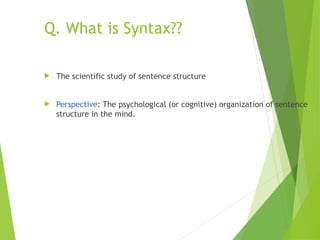
Q. What isSyntax??
The scientific study of sentence structure
Perspective: The psychological (or cognitive) organization of sentence
structure in the mind.
5.
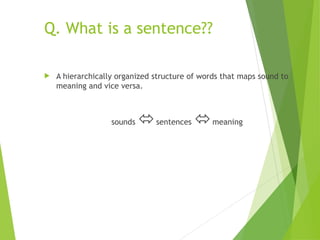
Q. What isa sentence??
A hierarchically organized structure of words that maps sound to
meaning and vice versa.
sounds sentences meaning
6.
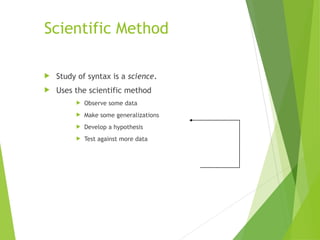
Scientific Method
Studyof syntax is a science.
Uses the scientific method
Observe some data
Make some generalizations
Develop a hypothesis
Test against more data
7.
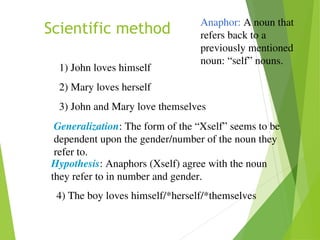
Scientific method
1) Johnloves himself
2) Mary loves herself
3) John and Mary love themselves
Generalization: The form of the “Xself” seems to be
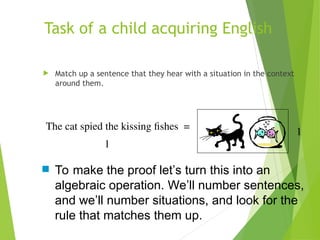
dependent upon the gender/number of the noun they
refer to.
Hypothesis: Anaphors (Xself) agree with the noun
they refer to in number and gender.
4) The boy loves himself/*herself/*themselves
Anaphor: A noun that
refers back to a
previously mentioned
noun: “self” nouns.
8.
Rules: A kindof hypothesis
In this class, we will encode our hypotheses
about sentence structure using rules.
A group of rules are called a Grammar.
Grammar is a scary word. But it doesn’t
mean what you think it does. A grammar in
the linguistic sense is a cognitive structure.
It is the part of the mind that generates and
understands language.
9.
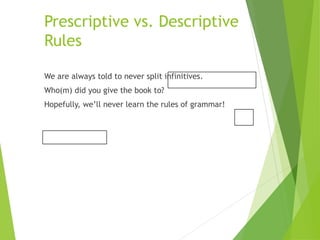
Prescriptive vs. Descriptive
Rules
Weare always told to never split infinitives.
Who(m) did you give the book to?
Hopefully, we’ll never learn the rules of grammar!
10.
Prescriptive vs. Descriptive
Prescriptive rules prescribe how we should speak
Descriptive rules describe how we actually speak.
Which is more scientific?
11.
Prescriptive Rules
Theseare made up by so called language mavens
These are made up by so called language mavens! Who are
they to tell you how to speak?!?
Prescriptive rules are often based on the rules of Latin or
“logic”. Who says Latin is so great? Why should language be
logical?
Descriptive rules are the way to go!
Descriptive rules are the way to go!
12.
Descriptive Rules
Therules we will use are said to generate the sentences of the
languages we are looking at. They actually build the sentences we
produce. They are sentence building rules.
The kind of grammar we are looking at is called generative grammar
(=group of rules that generate the sentences of a
language)
13.
Sources of Data
Corpora of Spoken & Written Language
Collections of recorded real world speech
Telephone recordings (LDC)
Newspapers, Books, Magazines
Folk tales etc recorded in the field.
14.
Sources of Data
*Where do you wonder if he lives?
– How do you know this is ungrammatical?
– Have you ever heard this sentence uttered?
– Will the fact that this sentence is ungrammatical appear in any corpus?
Every day, you produce grammatical sentences that have never been uttered
before.
15.
Sources of Data
Corpora are not sufficient. They don’t contain negative information (such as
what sentences are ungrammatical), and they can never contain all the
sentences of a language.
We need to access our mental
knowledge (also called “competence”)
about sentences.
16.
Sources of Data
A special experimental technique for tapping our syntactic knowledge.
This technique is called the acceptability judgement.
In the psychology literature, this is sometimes also called magnitude
estimation
17.
Acceptability Judgements
Unfortunately,sometimes acceptability judgements are called
intuitions.
The term ‘intuition’ has a negative connotation: makes us think of
fortune tellers and psychics.
However, acceptability judgements are both experimentally valid and
statistically sound.
18.
Acceptability Judgements
Wewill apply acceptability judgements in this class non-statistically.
For the most part this will give us the right results. Statistical proof of
judgements is possible, but we won’t bother.
19.
Performance vs. Competence
Performance refers to what we do
Competence refers to what we know about the language
Our scientific concern: Both
Our focus in this course: Competence
20.
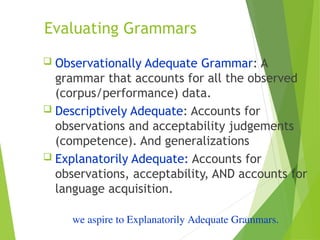
Evaluating Grammars
ObservationallyAdequate Grammar: A
grammar that accounts for all the observed
(corpus/performance) data.
Descriptively Adequate: Accounts for
observations and acceptability judgements
(competence). And generalizations
Explanatorily Adequate: Accounts for
observations, acceptability, AND accounts for
language acquisition.
we aspire to Explanatorily Adequate Grammars.
21.
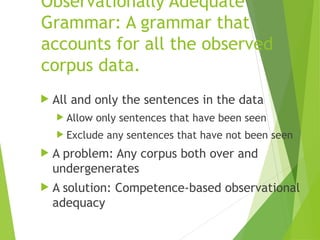
Observationally Adequate
Grammar: Agrammar that
accounts for all the observed
corpus data.
All and only the sentences in the data
Allow only sentences that have been seen
Exclude any sentences that have not been seen
A problem: Any corpus both over and
undergenerates
A solution: Competence-based observational
adequacy
22.
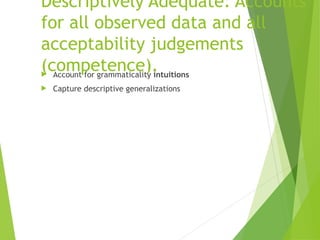
Descriptively Adequate: Accounts
forall observed data and all
acceptability judgements
(competence).
Account for grammaticality intuitions
Capture descriptive generalizations
23.
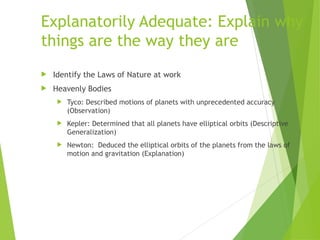
Explanatorily Adequate: Explainwhy
things are the way they are
Identify the Laws of Nature at work
Heavenly Bodies
Tyco: Described motions of planets with unprecedented accuracy
(Observation)
Kepler: Determined that all planets have elliptical orbits (Descriptive
Generalization)
Newton: Deduced the elliptical orbits of the planets from the laws of
motion and gravitation (Explanation)
24.
Chomsky's Conception ofan
Explanatorily Adequate Grammar
The Laws of Grammar: Universal Grammar
What's being explained by the laws: the miracle of language acquisition
25.
Learning vs. Acquisition
Learning involves conscious gaining of knowledge
Acquisition involves subconscious gaining of knowledge
Chemistry is learned. Languages are
acquired.
26.
How do weacquire languages?
Obviously this question is too big to answer here, but …
Are we instructed by our parents?
Do we mimic our parents?
NOPE!
1) Language is infinite: We produce sentences we’ve
never heard before
2) We know things about our language that we’ve never
been exposed to.
27.
Language as aninstinct
Despite what they may think, parents don’t teach
their children to speak!
They correct content not form:
(from Marcus et al. 1992)
Adult: Where is that big piece of paper I gave you yesterday?
Child: Remember? I writed on it.
Adult: Oh that’s right, don’t you have any paper down here,
buddy?
28.
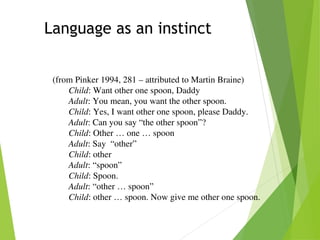
Language as aninstinct
(from Pinker 1994, 281 – attributed to Martin Braine)
Child: Want other one spoon, Daddy
Adult: You mean, you want the other spoon.
Child: Yes, I want other one spoon, please Daddy.
Adult: Can you say “the other spoon”?
Child: Other … one … spoon
Adult: Say “other”
Child: other
Adult: “spoon”
Child: Spoon.
Adult: “other … spoon”
Child: other … spoon. Now give me other one spoon.
29.
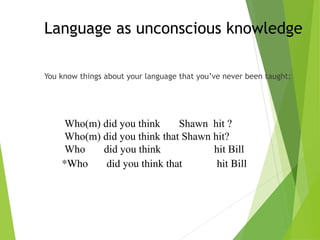
Language as unconsciousknowledge
You know things about your language that you’ve never been taught:
Who(m) did you think Shawn hit ?
Who(m) did you think that Shawn hit?
Who did you think hit Bill
*Who did you think that hit Bill
30.
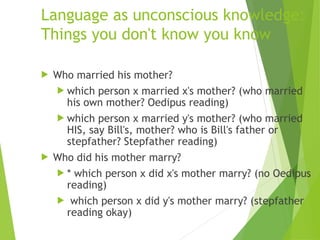
Language as unconsciousknowledge:
Things you don't know you know
Who married his mother?
which person x married x's mother? (who married
his own mother? Oedipus reading)
which person x married y's mother? (who married
HIS, say Bill's, mother? who is Bill's father or
stepfather? Stepfather reading)
Who did his mother marry?
* which person x did x's mother marry? (no Oedipus
reading)
which person x did y's mother marry? (stepfather
reading okay)
31.
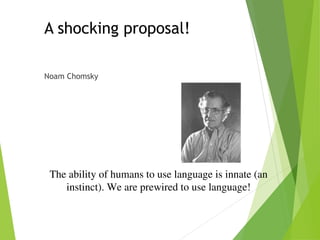
A shocking proposal!
NoamChomsky
The ability of humans to use language is innate (an
instinct). We are prewired to use language!
32.
Huh? languages differ?!?
Howcan language be an instinct if languages differ?
Proposal: Languages differ primarily in terms of what words are used,
and in a set number of “parameters”
These things are learned but the rest (the basic architecture of the
grammar) is innate.
33.
Refining Innateness
A particularlanguage is not innate (it is acquired), but the basic tools
that any given language uses are built in.
We’ll be looking at these tools. Both within languages, and
crosslinguistically to see what is universal (innate) and what varies
among languages.
34.
Task of achild acquiring English
Match up a sentence that they hear with a situation in the context
around them.
The cat spied the kissing fishes =
To make the proof let’s turn this into an
algebraic operation. We’ll number sentences,
and we’ll number situations, and look for the
rule that matches them up.
1
1
35.
What are basicbuilding blocks?
Example:
Inferring a curve from an infinite set of points
A grammar defines an infinite set of sentences
The logical problem: From a finite set of
data, a child must infer an infinite set of
sentences
Solution: we need a set of laws for making
grammars: Universal Grammar
36.
The content ofthis class
In this class, we will be looking at the innate principles that govern
sentence structure (Called Universal Grammar)
And we will be looking at the different ways in which languages
implement these innate principles.
37.
Universal Grammar (UG)
The building blocks that all languages use to construct the sentences
of their languages.
All languages use the same basic hardwired tools. It is the particular
implementation of these tools that varies between languages.
38.
Universal Grammar (UG)
Other evidence for UG
Human Specificity of Language
Distinct area of the brain
Crosslinguistic similarities in language acquisition (despite cultural
differences)
Lack of overt instruction
Language Universals
Summary
Performance/Competence
EvaluatingGrammars:
Observationally Adequate
Descriptively Adequate
Explanatorily Adequate
Learning vs. Acquisition
Innateness of Language
Universal Grammar: innate, hardwired building blocks of syntax.
41.
Summary about Syntax
Syntax is the scientific study of sentence structure
Syntax is a branch of psychology [linguistics is a branch
of psychology]
We study competence=knowledge
Competence is implicit knowledge
Discussion Topics
Whatthings that we know are learned? What things are acquired?
Language is an instinct. How is this an argument against prescriptive
rules?
There are some good reasons to keep prescriptive rules. What are
they?
Editor's Notes
#4 Syntax as a science? More questions than answers. When we speak of physics as a science we mean we are looking for the universal laws that govern physical events. But what does it mean to do syntax as a science? The”laws”of Spanish are different from the “laws” of English. There AREN’T any universal laws. Each language has its own arbitrary set.
To say some thing is a science we need to have some idea of what we are trying to explain. So the perspective we take is to say that scientific syntax is a branch of psychology: We study (seek to explain) the organization of sentence structure in the mind.
#5 Hierarchically organized structure: There is structure. Structures contain structures. Those structures might contain further structure. There is an outermost structure (the TOP of the hierarchy). There structures contained by it (LOWER, lesser structures)
Meanings can be hierarchically organized. The meaning of “the brown dog” contains the meaning of “brown”. The phrase “the brown dog” contains the word “brown”. So there’s a connection between the organization of the meaning and the organization of the phrases. When we can precisely specify that connection we call it a MAPPING. Our working hypothesis is that we can precisely specify it.
Notice the arrows between mng & sent go in both directions. Syntax shd tell us how to go from mng to sent (generation) and from sent to mng (understanding). Very important. Our syntax is neutral between these two views. It’s what computer scientists cal an “interface”. It lets us communicate in both directions.
Sound? That’s phonology. Phonology tells us what happens to the basic sounds of the lang (phon) when you put them together into words. But doesn’t tell you how to put words together. Syntax tells us that. Minimally it tells us what order the words shd come in.
#8 Scientific syntax seeks to understand the KNOWLEDGE of linguistic structure that a speaker has. We characterize that knowledge as follows: when a speaker knows the syntax of a language s/he knows a set of RULES (for generating and understanding), for getting from sound to meaning and back. We call the entire SET of rules a grammar. So a grammar is something a speaker KNOWS.
By hypothesis: you ALL know the grammars of your native language, and so does every native speaker. Without having studied “grammar”.
#9 A] don’t split infinitives. Based on Latin.
B] Never end a sentence with a preposition. Based on Latin. Inherited by Romance.
C] Always say “whom” unless “who” is the subject of a sentence. Based on Latin case=marking rules
D] Dont use “hopefully” to mean “I/We am/are hopeful that…” The subject of the sentence shd be the one who is hopeful.
John entered the office hopefully.
#14 When you make up ungrammatical examples, they should MAKE SENSE. There should be some context in which it OUGHT to make sense. But even in that context, the sentence doesn’t work;
Everybody has a guess about where John lives but nobody knows exactly where.
Sue wonders if he lives in Spain.
Alice wonders if he lives in Sardinia.
Where do you wonder if he lives?
Still sounds pretty funny. Why? Is it because you’ve never heard this sentence before?



![Summary about Syntax
Syntax is the scientific study of sentence structure
Syntax is a branch of psychology [linguistics is a branch
of psychology]
We study competence=knowledge
Competence is implicit knowledge](https://image.slidesharecdn.com/syntaxppt1-250322013338-52ef5bd4/85/Syntax-Nouns-Phrases-Competence-and-Performance-41-320.jpg)