Universal Design for Learning
Success for ALL
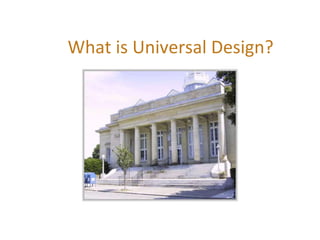
What is Universal Design?
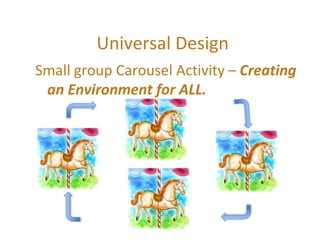
Universal Design
Small group Carousel Activity – Creating
an Environment for ALL.
Carousel Debrief…
➢How many modifications were suggested?
➢Was it easy to generate accessibility ideas?
➢What were some of your group’s thought
processes when you were creating
solutions?
➢Would it be easier to incorporate the ideas
generated when the building was built or to
go in and make alterations later?
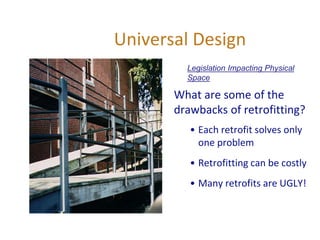
Universal Design
What are some of the
drawbacks of retrofitting?
• Each retrofit solves only
one problem
• Retrofitting can be costly
• Many retrofits are UGLY!
Legislation Impacting Physical
Space
Universal Design Defined…
“Consider the needs of the
broadest possible range of
users from the beginning”
Architect, Ron Mace
Universal Design Summarized
• It’s not one size fits all – but
alternatives.
• Designed from the beginning, not
added on later.
• Increases access opportunities
What does UD have to do with education
besides letting ALL students in the door?
What is Universal Design for
Learning (UDL) ?
UDL is an educational
approach to teaching,
learning, and
assessment.
Questions: 1. What might Universal Design mean for
teaching, learning and assessment?
2. UD in buildings is about access and environment. Is
it the same or how might it be different in the learning
environment?
What does research say about
Universal Design for Learning
(UDL) ?
• UDL is… "scientifically valid framework for guiding
educational practice,"
• UDL facilitates the design and implementation of a
flexible, responsive curriculum, UDL offers options for
how information is presented, how students respond
or demonstrate their knowledge and skills, and how
students are engaged in learning.
• UDL implementation provides the opportunity for all
students to access, participate in, and progress in the
education curriculum by reducing barriers to
instruction.
Barriers?
A building barrier might be stairs; a change made
to the building might be _______________.
A learning barrier might be a textbook; a change
made for learning might be_______________.
Pair up and plan a few…
A learning barrier might be ___________; a change
made for learning might be ______________.
Universal Design for Learning (UDL)
The Center for Applied Special
Technology (CAST) believes that…
“barriers to learning are not, in fact,
inherent in the capacities of
learners, but instead arise in
learners' interactions with inflexible
educational goals, materials,
methods, and assessments.”
Teaching Every Student in the Digital Age, p. vi
Dr. David Rose
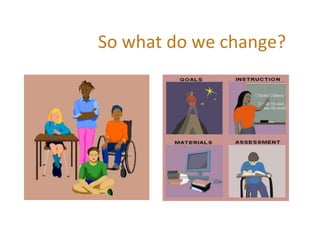
So what do we change?
Collaboratively Defining UDL…
1. The timer is set for 3 minutes and each person in each group
writes their own definition of UDL on an index card.
2. When everyone has completed their definition, they pass
their card clockwise to the next person in their group.
3. The person who receives the index card underlines what they
feel are the most important words in the definition.
4. The cards are progressively passed, and words underlined
until they reach the original writer.
5. Then, the group uses the underlined words to create a unified
definition of UDL.
6. Finally, each group presents their definition to the large
group.
Creating a Learning Environment
that Challenges and Engages All Students
Reflection Questions…
1. How can teachers at Sycamore
Middle School meet the
educational needs of all of their
students?
2. To meet the needs of the widest
range of students, what should
teachers consider when planning
their instruction?
When does UDL play out?
• Before Instruction
• During Instruction
• After Instruction
Let’s play with UDL…
AFTER instruction
• Employ ongoing or
alternate assessments to
determine progress, needs,
and future direction of
class
• Repeat planning cycle
• Make sure assessments
reflect UDL characteristics
• Assess continuously
through variety of formats
to track student progress
• Adapt delivery of
instruction as needed
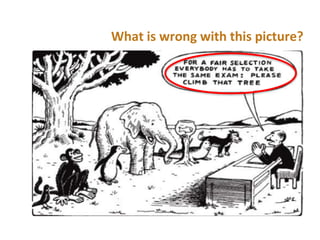
What is wrong with this picture?
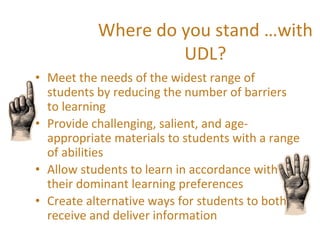
Where do you stand …with
UDL?
• Meet the needs of the widest range of
students by reducing the number of barriers
to learning
• Provide challenging, salient, and age-
appropriate materials to students with a range
of abilities
• Allow students to learn in accordance with
their dominant learning preferences
• Create alternative ways for students to both
receive and deliver information
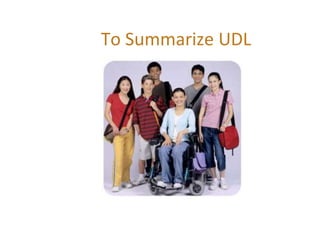
To Summarize UDL
Growing in a
Collaborative Climate
Anonymously write to these 2 prompts on two
paper strips, then fold and place the strips into 2
piles on your table:
1. What is one fear you have about
utilizing the UDL framework?
2. What is one thing that excites you about
UDL?
Now, pull randomly from the piles and discuss
openly at your table.
Return to your Learning Logs…
Previous Prompts…
➢How can teachers at Sycamore Middle School meet
the educational needs of all of their students?
➢To meet the needs of the widest range of students,
what should teachers consider when planning their
instruction?
With your new or refined understandings about
UDL, revise and add to your previous
suggestions.
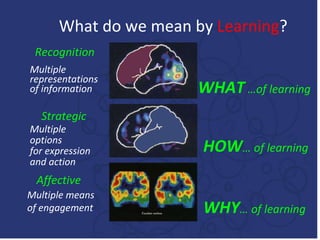
Affective
Strategic
Recognition
Multiple
representations
of information
Multiple
options
for expression
and action
Multiple means
of engagement
What do we mean by Learning?
WHAT …of learning
HOW… of learning
WHY… of learning
TIME FOR A POP Quiz!!!
1. Take out a piece of paper,
put your name on it and
number 1-3.
2. Move all materials off your
work area.
3. Find a piece of paper to
cover your answers.
What
alternatives are
there for more
UDL friendly
assessments?
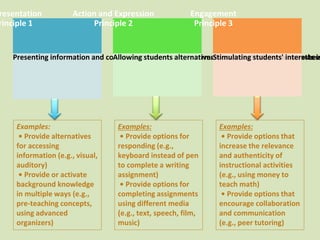
resentation
rinciple 1
Presenting information and course content in multiple formats so that all students can access
Action and Expression
Principle 2
Allowing students alternatives to express or demonstrate their
Engagement
Principle 3
Stimulating students' interests an
Examples:
• Provide alternatives
for accessing
information (e.g., visual,
auditory)
• Provide or activate
background knowledge
in multiple ways (e.g.,
pre-teaching concepts,
using advanced
organizers)
Examples:
• Provide options for
responding (e.g.,
keyboard instead of pen
to complete a writing
assignment)
• Provide options for
completing assignments
using different media
(e.g., text, speech, film,
music)
Examples:
• Provide options that
increase the relevance
and authenticity of
instructional activities
(e.g., using money to
teach math)
• Provide options that
encourage collaboration
and communication
(e.g., peer tutoring)
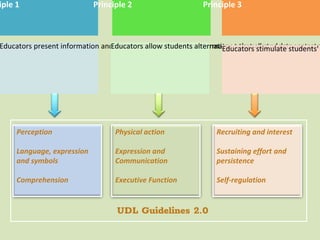
iple 1
Educators present information and course content in multiple formats so that all students can acce
Principle 2
Educators allow students alternatives to express or demonstrate
Principle 3
Educators stimulate students'
Perception
Language, expression
and symbols
Comprehension
Physical action
Expression and
Communication
Executive Function
Recruiting and interest
Sustaining effort and
persistence
Self-regulation
UDL Guidelines 2.0
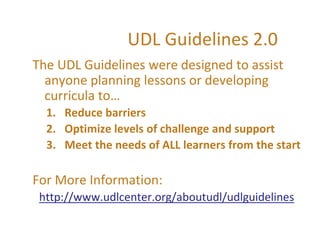
UDL Guidelines 2.0
The UDL Guidelines were designed to assist
anyone planning lessons or developing
curricula to…
1. Reduce barriers
2. Optimize levels of challenge and support
3. Meet the needs of ALL learners from the start
For More Information:
http://www.udlcenter.org/aboutudl/udlguidelines
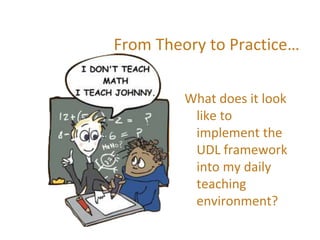
From Theory to Practice…
What does it look
like to
implement the
UDL framework
into my daily
teaching
environment?
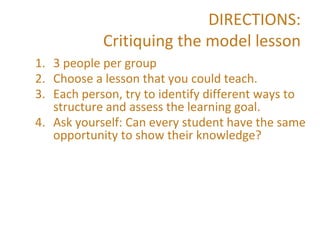
DIRECTIONS:
Critiquing the model lesson
1. 3 people per group
2. Choose a lesson that you could teach.
3. Each person, try to identify different ways to
structure and assess the learning goal.
4. Ask yourself: Can every student have the same
opportunity to show their knowledge?
Popcorn
Be ready to
pop up and
answer the
questions.
#1 – What is UDL?
#2 – What students need AND benefit
from UDL?
#3 – What time do we start tomorrow?

Udl overview presentation

  • 1.
    Universal Design forLearning Success for ALL
  • 2.
  • 3.
    Universal Design Small groupCarousel Activity – Creating an Environment for ALL.
  • 4.
    Carousel Debrief… ➢How manymodifications were suggested? ➢Was it easy to generate accessibility ideas? ➢What were some of your group’s thought processes when you were creating solutions? ➢Would it be easier to incorporate the ideas generated when the building was built or to go in and make alterations later?
  • 5.
    Universal Design What aresome of the drawbacks of retrofitting? • Each retrofit solves only one problem • Retrofitting can be costly • Many retrofits are UGLY! Legislation Impacting Physical Space
  • 6.
    Universal Design Defined… “Considerthe needs of the broadest possible range of users from the beginning” Architect, Ron Mace
  • 7.
    Universal Design Summarized •It’s not one size fits all – but alternatives. • Designed from the beginning, not added on later. • Increases access opportunities What does UD have to do with education besides letting ALL students in the door?
  • 8.
    What is UniversalDesign for Learning (UDL) ? UDL is an educational approach to teaching, learning, and assessment. Questions: 1. What might Universal Design mean for teaching, learning and assessment? 2. UD in buildings is about access and environment. Is it the same or how might it be different in the learning environment?
  • 9.
    What does researchsay about Universal Design for Learning (UDL) ? • UDL is… "scientifically valid framework for guiding educational practice," • UDL facilitates the design and implementation of a flexible, responsive curriculum, UDL offers options for how information is presented, how students respond or demonstrate their knowledge and skills, and how students are engaged in learning. • UDL implementation provides the opportunity for all students to access, participate in, and progress in the education curriculum by reducing barriers to instruction.
  • 10.
    Barriers? A building barriermight be stairs; a change made to the building might be _______________. A learning barrier might be a textbook; a change made for learning might be_______________. Pair up and plan a few… A learning barrier might be ___________; a change made for learning might be ______________.
  • 11.
    Universal Design forLearning (UDL) The Center for Applied Special Technology (CAST) believes that… “barriers to learning are not, in fact, inherent in the capacities of learners, but instead arise in learners' interactions with inflexible educational goals, materials, methods, and assessments.” Teaching Every Student in the Digital Age, p. vi Dr. David Rose
  • 12.
    So what dowe change?
  • 13.
    Collaboratively Defining UDL… 1.The timer is set for 3 minutes and each person in each group writes their own definition of UDL on an index card. 2. When everyone has completed their definition, they pass their card clockwise to the next person in their group. 3. The person who receives the index card underlines what they feel are the most important words in the definition. 4. The cards are progressively passed, and words underlined until they reach the original writer. 5. Then, the group uses the underlined words to create a unified definition of UDL. 6. Finally, each group presents their definition to the large group.
  • 14.
    Creating a LearningEnvironment that Challenges and Engages All Students
  • 15.
    Reflection Questions… 1. Howcan teachers at Sycamore Middle School meet the educational needs of all of their students? 2. To meet the needs of the widest range of students, what should teachers consider when planning their instruction?
  • 16.
    When does UDLplay out? • Before Instruction • During Instruction • After Instruction
  • 17.
    Let’s play withUDL… AFTER instruction • Employ ongoing or alternate assessments to determine progress, needs, and future direction of class • Repeat planning cycle • Make sure assessments reflect UDL characteristics • Assess continuously through variety of formats to track student progress • Adapt delivery of instruction as needed
  • 18.
    What is wrongwith this picture?
  • 19.
    Where do youstand …with UDL? • Meet the needs of the widest range of students by reducing the number of barriers to learning • Provide challenging, salient, and age- appropriate materials to students with a range of abilities • Allow students to learn in accordance with their dominant learning preferences • Create alternative ways for students to both receive and deliver information
  • 20.
  • 21.
    Growing in a CollaborativeClimate Anonymously write to these 2 prompts on two paper strips, then fold and place the strips into 2 piles on your table: 1. What is one fear you have about utilizing the UDL framework? 2. What is one thing that excites you about UDL? Now, pull randomly from the piles and discuss openly at your table.
  • 22.
    Return to yourLearning Logs… Previous Prompts… ➢How can teachers at Sycamore Middle School meet the educational needs of all of their students? ➢To meet the needs of the widest range of students, what should teachers consider when planning their instruction? With your new or refined understandings about UDL, revise and add to your previous suggestions.
  • 23.
    Affective Strategic Recognition Multiple representations of information Multiple options for expression andaction Multiple means of engagement What do we mean by Learning? WHAT …of learning HOW… of learning WHY… of learning
  • 24.
    TIME FOR APOP Quiz!!! 1. Take out a piece of paper, put your name on it and number 1-3. 2. Move all materials off your work area. 3. Find a piece of paper to cover your answers. What alternatives are there for more UDL friendly assessments?
  • 25.
    resentation rinciple 1 Presenting informationand course content in multiple formats so that all students can access Action and Expression Principle 2 Allowing students alternatives to express or demonstrate their Engagement Principle 3 Stimulating students' interests an Examples: • Provide alternatives for accessing information (e.g., visual, auditory) • Provide or activate background knowledge in multiple ways (e.g., pre-teaching concepts, using advanced organizers) Examples: • Provide options for responding (e.g., keyboard instead of pen to complete a writing assignment) • Provide options for completing assignments using different media (e.g., text, speech, film, music) Examples: • Provide options that increase the relevance and authenticity of instructional activities (e.g., using money to teach math) • Provide options that encourage collaboration and communication (e.g., peer tutoring)
  • 26.
    iple 1 Educators presentinformation and course content in multiple formats so that all students can acce Principle 2 Educators allow students alternatives to express or demonstrate Principle 3 Educators stimulate students' Perception Language, expression and symbols Comprehension Physical action Expression and Communication Executive Function Recruiting and interest Sustaining effort and persistence Self-regulation UDL Guidelines 2.0
  • 27.
    UDL Guidelines 2.0 TheUDL Guidelines were designed to assist anyone planning lessons or developing curricula to… 1. Reduce barriers 2. Optimize levels of challenge and support 3. Meet the needs of ALL learners from the start For More Information: http://www.udlcenter.org/aboutudl/udlguidelines
  • 28.
    From Theory toPractice… What does it look like to implement the UDL framework into my daily teaching environment?
  • 29.
    DIRECTIONS: Critiquing the modellesson 1. 3 people per group 2. Choose a lesson that you could teach. 3. Each person, try to identify different ways to structure and assess the learning goal. 4. Ask yourself: Can every student have the same opportunity to show their knowledge?
  • 30.
    Popcorn Be ready to popup and answer the questions. #1 – What is UDL? #2 – What students need AND benefit from UDL? #3 – What time do we start tomorrow?