UNIVERSAL DESIGN FOR LEARNING
&
DIFFERENTIATION
BY
TERRY L. LOCKHART
EDU 673
Dr. Angela Dallas
February 11, 2016
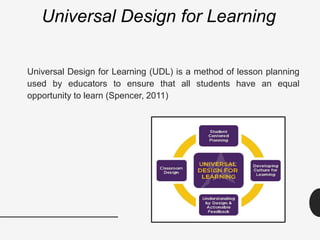
Universal Design for Learning
Universal Design for Learning (UDL) is a method of lesson planning
used by educators to ensure that all students have an equal
opportunity to learn (Spencer, 2011)
Differentiation Instruction
Differentiation instruction may be defined as the process by which
teachers change the way they teach to meet the needs of their
students (Strahan, Kronenberg, Burgner & Doherty, 2012).
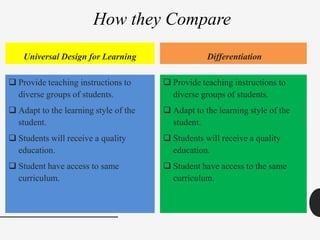
Universal Design for Learning
 Provide teaching instructions to
diverse groups of students.
 Adapt to the learning style of the
student.
 Students will receive a quality
education.
 Student have access to same
curriculum.
Differentiation
 Provide teaching instructions to
diverse groups of students.
 Adapt to the learning style of the
student.
 Students will receive a quality
education.
 Student have access to the same
curriculum.
How they Compare
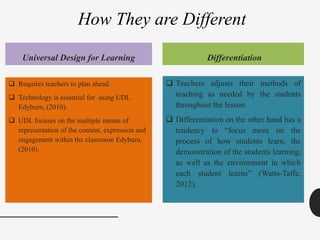
Universal Design for Learning
 Requires teachers to plan ahead.
 Technology is essential for using UDL
Edyburn, (2010).
 UDL focuses on the multiple means of
representation of the content, expression and
engagement within the classroom Edyburn,
(2010).
Differentiation
 Teachers adjusts their methods of
teaching as needed by the students
throughout the lesson.
 Differentiation on the other hand has a
tendency to “focus more on the
process of how students learn, the
demonstration of the students learning,
as well as the environment in which
each student learns” (Watts-Taffe,
2012).
How They are Different
How I Can Use UDL & Differentiation
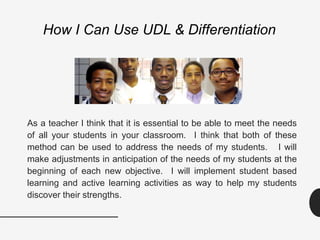
As a teacher I think that it is essential to be able to meet the needs
of all your students in your classroom. I think that both of these
method can be used to address the needs of my students. I will
make adjustments in anticipation of the needs of my students at the
beginning of each new objective. I will implement student based
learning and active learning activities as way to help my students
discover their strengths.
Presenting New Information
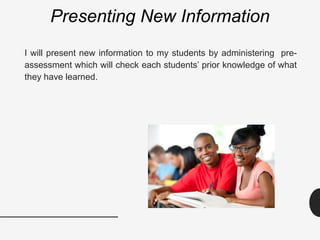
I will present new information to my students by administering pre-
assessment which will check each students’ prior knowledge of what
they have learned.
How Students Will Demonstrate Knowledge
The students will be able to demonstrate their prior knowledge by
being able to participate in various assessment tool, use KWL charts
and complete a survey on how they felt about the new topics being
discussed.
Strategies to Engage Students
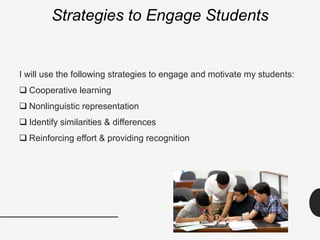
I will use the following strategies to engage and motivate my students:
 Cooperative learning
 Nonlinguistic representation
 Identify similarities & differences
 Reinforcing effort & providing recognition
References
Spencer, S. A. (2011). Universal Design for Learning: Assistance for Teachers in Today's Inclusive
Classrooms. Interdisciplinary Journal Of Teaching And Learning, 1(1), 10-22.
Strahan, D., Kronenberg, J., Burgner, R., Doherty, J., & Hedt, M. (2012). Differentiation in Action:
Developing a Logic Model for Responsive Teaching in an Urban Middle School. Research In Middle
Level Education Online, 35(8), 1-17
Edyburn, D. L. (2010). Would you recognize universal design for learning if you saw it? Ten propositions
for new directions for the second decade of UDL. Learning Disability Quarterly, (1), 33.
Watts-Taffe, S., Laster, B. (., Broach, L., Marinak, B., McDonald Connor, C., & Walker-Dalhouse, D.
(2012). Differentiated Instruction: Making Informed Teacher Decisions. Reading Teacher, 66(4), 303-
314. doi:10.1002/TRTR.01126.
Puckett, K (2013). Differentiating Instruction: A Practical Guide. Bridgepoint Education: San Diego, CA.
Retrieved February 4, 2016 from http://serc.carleton.edu/introgeo/cooperative/techniques.html

Udl & differentiation 673 2 8 16

  • 1.
    UNIVERSAL DESIGN FORLEARNING & DIFFERENTIATION BY TERRY L. LOCKHART EDU 673 Dr. Angela Dallas February 11, 2016
  • 2.
    Universal Design forLearning Universal Design for Learning (UDL) is a method of lesson planning used by educators to ensure that all students have an equal opportunity to learn (Spencer, 2011)
  • 3.
    Differentiation Instruction Differentiation instructionmay be defined as the process by which teachers change the way they teach to meet the needs of their students (Strahan, Kronenberg, Burgner & Doherty, 2012).
  • 4.
    Universal Design forLearning  Provide teaching instructions to diverse groups of students.  Adapt to the learning style of the student.  Students will receive a quality education.  Student have access to same curriculum. Differentiation  Provide teaching instructions to diverse groups of students.  Adapt to the learning style of the student.  Students will receive a quality education.  Student have access to the same curriculum. How they Compare
  • 5.
    Universal Design forLearning  Requires teachers to plan ahead.  Technology is essential for using UDL Edyburn, (2010).  UDL focuses on the multiple means of representation of the content, expression and engagement within the classroom Edyburn, (2010). Differentiation  Teachers adjusts their methods of teaching as needed by the students throughout the lesson.  Differentiation on the other hand has a tendency to “focus more on the process of how students learn, the demonstration of the students learning, as well as the environment in which each student learns” (Watts-Taffe, 2012). How They are Different
  • 6.
    How I CanUse UDL & Differentiation As a teacher I think that it is essential to be able to meet the needs of all your students in your classroom. I think that both of these method can be used to address the needs of my students. I will make adjustments in anticipation of the needs of my students at the beginning of each new objective. I will implement student based learning and active learning activities as way to help my students discover their strengths.
  • 7.
    Presenting New Information Iwill present new information to my students by administering pre- assessment which will check each students’ prior knowledge of what they have learned.
  • 8.
    How Students WillDemonstrate Knowledge The students will be able to demonstrate their prior knowledge by being able to participate in various assessment tool, use KWL charts and complete a survey on how they felt about the new topics being discussed.
  • 9.
    Strategies to EngageStudents I will use the following strategies to engage and motivate my students:  Cooperative learning  Nonlinguistic representation  Identify similarities & differences  Reinforcing effort & providing recognition
  • 10.
    References Spencer, S. A.(2011). Universal Design for Learning: Assistance for Teachers in Today's Inclusive Classrooms. Interdisciplinary Journal Of Teaching And Learning, 1(1), 10-22. Strahan, D., Kronenberg, J., Burgner, R., Doherty, J., & Hedt, M. (2012). Differentiation in Action: Developing a Logic Model for Responsive Teaching in an Urban Middle School. Research In Middle Level Education Online, 35(8), 1-17 Edyburn, D. L. (2010). Would you recognize universal design for learning if you saw it? Ten propositions for new directions for the second decade of UDL. Learning Disability Quarterly, (1), 33. Watts-Taffe, S., Laster, B. (., Broach, L., Marinak, B., McDonald Connor, C., & Walker-Dalhouse, D. (2012). Differentiated Instruction: Making Informed Teacher Decisions. Reading Teacher, 66(4), 303- 314. doi:10.1002/TRTR.01126. Puckett, K (2013). Differentiating Instruction: A Practical Guide. Bridgepoint Education: San Diego, CA. Retrieved February 4, 2016 from http://serc.carleton.edu/introgeo/cooperative/techniques.html