METACOGNITION AND
READING
COMPREHENSION
Wanna Phadyen
M6020019
INTRODUCTION
Reading comprehension
Cognitive and Metacognitive Reading
Strategies
The role of metacognition in Reading
Comprehension
Review of Previous Studies
Implementing Metacognitive Reading
Strategies in Classrooms
COGNITIVE AND
METACOGNITIVE STRATEGIES
Cognitive strategies
 Using dictionary
 Writing down
 Imaginary
 Activating background knowledge…
Metacognitive strategies
 Planned, intentional, goal directed, and future-oriented
mental processing that can be use to accomplish cognitive
tasks (Salataci & Akyel, 2002).
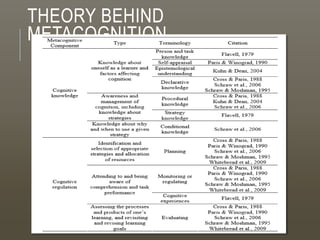
THEORY BEHIND
METACOGNITION
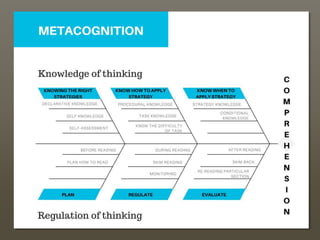
METACOGNITION
Metacognitive knowledge
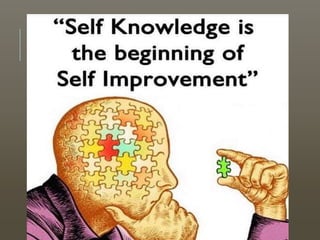
Self
Knowledge
METACOGNITION
Metacognitive knowledge
Task
Knowledge
METACOGNITION
Metacognitive knowledge
Strategies
Knowledge
METACOGNITION
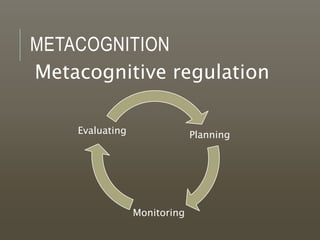
Metacognitive regulation
Planning
Monitoring
Evaluating
REVIEW OF PREVIOUS
STUDIES
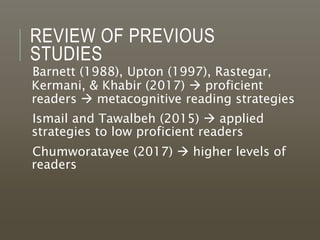
Barnett (1988), Upton (1997), Rastegar,
Kermani, & Khabir (2017)  proficient
readers  metacognitive reading strategies
Ismail and Tawalbeh (2015)  applied
strategies to low proficient readers
Chumworatayee (2017)  higher levels of
readers
IMPLEMENTING METACOGNITIVE
READING STRATEGIES IN
CLASSROOMS
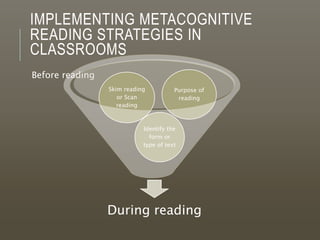
Before reading
During reading
Identify the
form or
type of text
Skim reading
or Scan
reading
Purpose of
reading
DURING READING
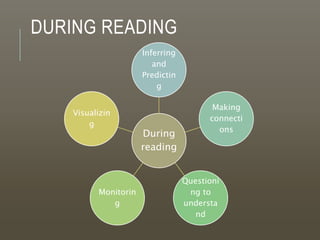
During
reading
Inferring
and
Predictin
g
Making
connecti
ons
Questioni
ng to
understa
nd
Monitorin
g
Visualizin
g
INFERRING
“It was dark I could barely see
my hand in front of my face. As
I stepped further into the room
I could feel the goose bumps
making their way up my skin.
All I could hear was the sound
of my own breathing, which
was suddenly coming in gasps.”
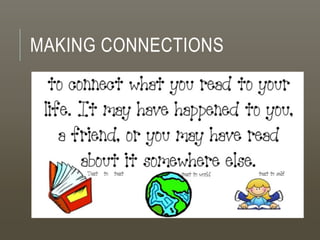
MAKING CONNECTIONS
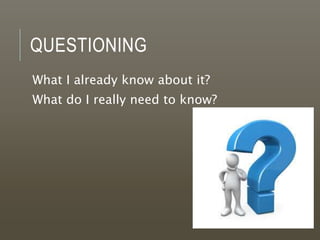
QUESTIONING
What I already know about it?
What do I really need to know?
MONITORING
Combine what they know with
new information they read to
help understand the text.
VISUALISING
EVALUATING – AFTER
READING
Summarize
Making story map
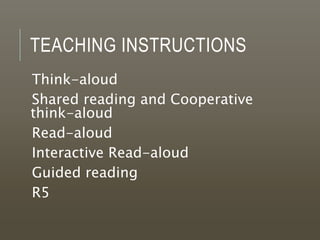
TEACHING INSTRUCTIONS
Think-aloud
Shared reading and Cooperative
think-aloud
Read-aloud
Interactive Read-aloud
Guided reading
R5
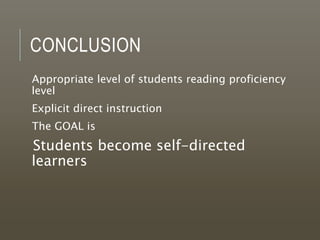
CONCLUSION
Appropriate level of students reading proficiency
level
Explicit direct instruction
The GOAL is
Students become self-directed
learners
THANK YOU!

Metacognition and reading comprehension

Editor's Notes

  • #3 The process of meaning from the contexts. Interactive activity between readers and contexts, and activity
  • #4 Cognitive – readers use to control or monitor their process of reading Meta – reading strategy awareness – help students regulate or monitor cognitive strategies
  • #5 This table shows the framework comparison among researchers
  • #6 Knowledge – combinations of information around 3 knowledge variables: self, task and strategies Self knowledge is knowing your own strengths and weaknesses, know your own abilities, self-knowledge is not always accurate. For example, I’m good at English, or I’m good at reading.
  • #7 Task knowledge is how one perceive the difficulty of the task, know what need to know, and know how to apply strategies
  • #8 Strategies knowledge is the ability to know when to apply cognitive strategy in the reading. This is related to the age or developmental stage of the individual. For example, strategy can be taught to young children, but they need to be reminded to use them. Like sounding it out when facing difficult word. While older students know strategies and know when to apply under different circumstances.
  • #9 Planning – before reading – plan how to read Monitoring – during reading – skim reading Evaluating – after reading – skim back – reread particular section
  • #11 Found the same findings that proficient readers showed more awareness of their use of metacognitive reading strategies in reading comprehension to the less proficient readers. Found improvement on their reading comprehension performance after trained to use strategies. Post graduate students – to become independent readers, teachers should provide explicit direct reading strategies.
  • #12 This is a vital step to help students get an overiew of the text and decide whether it is relevant. Scanning – searching for particular information Skimming – need to gain an overview – 1st paragraph, title, conclusion
  • #14 Reading between the line and draw a conclusion base on what author try to tell you.
  • #15 Taking something you already know and connecting to something you have read.
  • #16 Ask question what you have already known about the text, including in group and on their own
  • #17 What are their own original thoughts? Do they make change a long the way?
  • #18 Is making mental movie in your head as you read
  • #20 Read, relax – read on their own – teachers observe their reading habits Reflect, response – think about any strategies that they use while reading Rap – share their strategy with partner or whole group
  • #21 In conclusion, to make metacognition practical in real classrooms, teachers need to apply metacognitive strategies to appropriate students’ reading proficiency levels. In young students, direct explicit teaching is required. Teachers need to remind them to use strategies, such as sounding out words when learning to read. In contrast, secondary school students understand these strategies and know when they will be effective under different circumstances, students receive explicit instruction on how to guide their thinking, when to slow down, when it’s okay to speed up, and how to avoid wrong turns. The goal of teaching metacognition is that students become self-directed learners.