Universal design for learning
What is
UDL?
The design of instructional materials and methods
  that makes leering goals achievable by
  individuals with wide differences in their
  abilities
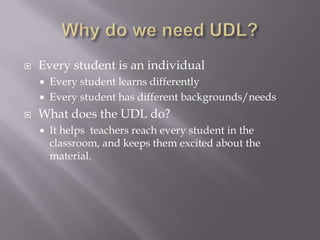
   Every student is an individual
       Every student learns differently
       Every student has different backgrounds/needs
   What does the UDL do?
       It helps teachers reach every student in the
        classroom, and keeps them excited about the
        material.
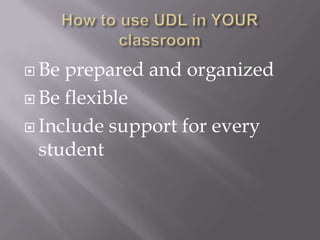
 Be prepared and organized
 Be flexible

 Include support for every
  student
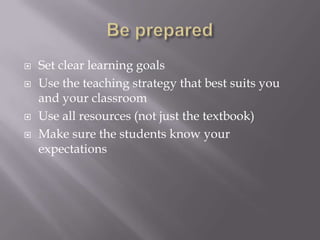
   Set clear learning goals
   Use the teaching strategy that best suits you
    and your classroom
   Use all resources (not just the textbook)
   Make sure the students know your
    expectations
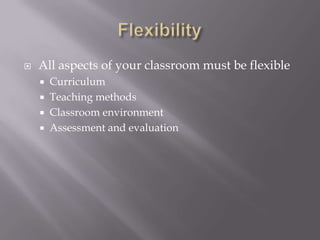
   All aspects of your classroom must be flexible
       Curriculum
       Teaching methods
       Classroom environment
       Assessment and evaluation
   Must understand the diversity of your room
   Instruction and materials must accommodate
    every student
   Must maintain high expectations
   Students must be responsible for their own
    learning
   Technology lets us teachers hit all learning
    styles and modify assignments/assessments to
    hit all learning styles.
   Recognition
   Strategic
   affective
   Used to Process patterns
       What are we learning?
       Patters of sounds, taste, smell, and touch
   Process actions and plans
       Planning to finish a project
       Know how to respond to a question
       Taking notes
       Listening to a lecture
   Process emotions evaluate patterns
       Patterns such as vocabulary
       Faces
       Objects
A website to help teachers apply UDL principles
  in their teaching to reach and engage all
  students. The goal of UDL is to enable all
  individuals to gain knowledge, skills and
  enthusiasm for learning. Learn about UDL,
  Check Your Curriculum, or Explore Resources
  for ideas on how to build options and
  flexibility into each element of your
  curriculum.
1.   http://www.educationworld.com/standards/
     state/index.shtml state standard
2.   http://www.nps.gov/history/nr/twhp/
     Social Studies guide to historical places
3.   http://www.pbs.org/teachers/socialstudies/
     a great resource for all Social Studies teachers
http://www.educationworld.com/standards/sta
   te/index.shtml
Above is a resource to check out other state
   standards from across America. A teach can
   use this in my different ways such as checking
   current student move in from another state to
   check previous knowledge.
http://www.nps.gov/history/nr/twhp/
The website above is great for any American
   history teacher. It allows the person to look up
   historical places across the nation and research
   them. They also have lessons plans for the
   teachers already made.
http://www.pbs.org/teachers/socialstudies/
The above website is a great resource for any
   Social Studies teacher. It allows the teacher or
   student to virtual look up any time period or
   place in the world.
www2.bakersfieldcollege.edu/
Laureate Education, Inc. (Executive Producer).
   (2010). Universal Design for Learning.
   Baltimore, MD: Author.
http://udlselfcheck.cast.org/resources.php#stan
   dards

Udl

  • 1.
  • 2.
  • 3.
    The design ofinstructional materials and methods that makes leering goals achievable by individuals with wide differences in their abilities
  • 4.
    Every student is an individual  Every student learns differently  Every student has different backgrounds/needs  What does the UDL do?  It helps teachers reach every student in the classroom, and keeps them excited about the material.
  • 5.
     Be preparedand organized  Be flexible  Include support for every student
  • 6.
    Set clear learning goals  Use the teaching strategy that best suits you and your classroom  Use all resources (not just the textbook)  Make sure the students know your expectations
  • 7.
    All aspects of your classroom must be flexible  Curriculum  Teaching methods  Classroom environment  Assessment and evaluation
  • 8.
    Must understand the diversity of your room  Instruction and materials must accommodate every student  Must maintain high expectations  Students must be responsible for their own learning
  • 9.
    Technology lets us teachers hit all learning styles and modify assignments/assessments to hit all learning styles.
  • 10.
    Recognition  Strategic  affective
  • 11.
    Used to Process patterns  What are we learning?  Patters of sounds, taste, smell, and touch
  • 12.
    Process actions and plans  Planning to finish a project  Know how to respond to a question  Taking notes  Listening to a lecture
  • 13.
    Process emotions evaluate patterns  Patterns such as vocabulary  Faces  Objects
  • 14.
    A website tohelp teachers apply UDL principles in their teaching to reach and engage all students. The goal of UDL is to enable all individuals to gain knowledge, skills and enthusiasm for learning. Learn about UDL, Check Your Curriculum, or Explore Resources for ideas on how to build options and flexibility into each element of your curriculum.
  • 15.
    1. http://www.educationworld.com/standards/ state/index.shtml state standard 2. http://www.nps.gov/history/nr/twhp/ Social Studies guide to historical places 3. http://www.pbs.org/teachers/socialstudies/ a great resource for all Social Studies teachers
  • 16.
    http://www.educationworld.com/standards/sta te/index.shtml Above is a resource to check out other state standards from across America. A teach can use this in my different ways such as checking current student move in from another state to check previous knowledge.
  • 17.
    http://www.nps.gov/history/nr/twhp/ The website aboveis great for any American history teacher. It allows the person to look up historical places across the nation and research them. They also have lessons plans for the teachers already made.
  • 18.
    http://www.pbs.org/teachers/socialstudies/ The above websiteis a great resource for any Social Studies teacher. It allows the teacher or student to virtual look up any time period or place in the world.
  • 19.
    www2.bakersfieldcollege.edu/ Laureate Education, Inc.(Executive Producer). (2010). Universal Design for Learning. Baltimore, MD: Author. http://udlselfcheck.cast.org/resources.php#stan dards