PRESENTED BY:
SOLEDAD P. LAPUZ
MAE A. ORONAN
DIFFERENTIATED
LITERATURE CIRCLES
LEARNING TARGETS
At the end of this lesson, you are expected to:
 Explain the benefits of differentiated literature circles
 Analyze challenges that beginning teachers face in
using literature circles
 Generate personal reminders in implementing
differentiated literature circles
Teachers are expected to improve communication
and collaboration among our students. The usage of
modified literature circles is one strategy to guarantee
student involvement. You will have a better
understanding of the foundational elements,certain
guiding principles,and developing adaptations of
literature circles in your class from this session.
Introduction
WHAT IS LITERATURE CIRCLES?
-It is a strategy that aims to engage
students in critical thinking and reflection as
they need to discuss and respond to a text
WHITTINGHAM, 2014
-Literature Circles aims to promote
collaborative discussions to construct new
knowledge. And these approaches will make
learners engaged in classroom discussion,
achieve set of outcomes, and accomplish the
prepared task.
LITERATURE CIRCLES ON
EDUCATIONAL PSYCHOLOGY
-It banks on the idea of social constructivism by Lev
Vygotsky. This theory suppose that learning exist through
socialization and the aid of
“MORE KNOWLEDGEABLE OTHER”
“ MORE KNOWLEDGEABLE OTHER”
(MKO)
• Does not dominate the group. He/she facilitates the
learning of the other members by clearning mental
blocks like;
• Difficult concepts, vocabulary, themes, interpretation
and others
LITERATURE CIRCLES ON LANGUAGE
EDUCATION
FROM ROSENBLATT’S TRANSACTIONAL THEORY(1978)
• It aims to immerse learners in comprehensively
understanding a text and eventually responding to
literary pieces in different ways
• This theory proved that it develop the children’s
positive attitude toward literature and reading.
Latendresse (2004)
-He also believed that literature circles are enjoyed
especially in elementary grades because this
methodology provides socialization opportunities that
learners enjoy.
SHELTON STRONG (2012)
-Literature circles is used of small led
discussions, involved in the reading the same piece
of literature. The group member come together to
share interpretations and insights about what they
read.
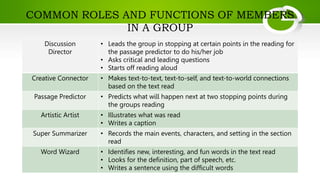
COMMON ROLES AND FUNCTIONS OF MEMBERS
IN A GROUP
Discussion
Director
• Leads the group in stopping at certain points in the reading for
the passage predictor to do his/her job
• Asks critical and leading questions
• Starts off reading aloud
Creative Connector • Makes text-to-text, text-to-self, and text-to-world connections
based on the text read
Passage Predictor • Predicts what will happen next at two stopping points during
the groups reading
Artistic Artist • Illustrates what was read
• Writes a caption
Super Summarizer • Records the main events, characters, and setting in the section
read
Word Wizard • Identifies new, interesting, and fun words in the text read
• Looks for the definition, part of speech, etc.
• Writes a sentence using the difficult words
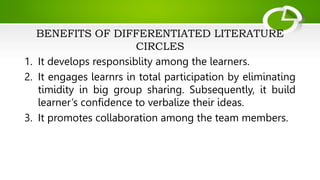
BENEFITS OF DIFFERENTIATED LITERATURE
CIRCLES
1. It develops responsiblity among the learners.
2. It engages learnrs in total participation by eliminating
timidity in big group sharing. Subsequently, it build
learner’s confidence to verbalize their ideas.
3. It promotes collaboration among the team members.
4. It provides scaffolding to break down reading difficulties
and to improve reading comprehension.
5. It rejuvenates excitement about teaching and invokes
eagerness about literature reading.
6. It helps the children learn appropriate responses to
literature and basic comprehension strategies used in
group strategy discussions about the literary text.
7. It relieves the learners of the pressure to perform
in large group conversations, and provides an
environment promoting safety and intimacy.
DANIELS (2002)
-The focus of the literature circles is to combine
literary skills and stragies, typically given in a non-
threatening and supportive atmosphere.
Fundamental Procedures of Literature Circles
1. Form a group of four to eight members.
2. Assign individual roles.
3. Select a literary piece and give each member a copy.
4. Read aloud some parts of the piece. While reading,
demonstrate the expected work or function of each
member.
5. Present thought-provoking or enduring questions to
stimulate debate, to act as a compass in their study, or to
solve after the activity.
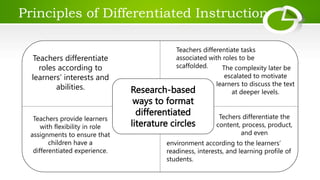
Principles of Differentiated Instruction
ways to
Research-based
ways to format
differentiated
literature circles
Teachers differentiate
roles according to
learners’ interests and
abilities.
The complexity later be
escalated to motivate
learners to discuss the text
at deeper levels.
Teachers provide learners
with flexibility in role
assignments to ensure that
children have a
differentiated experience.
Techers differentiate the
content, process, product,
and even
environment according to the learners’
readiness, interests, and learning profile of
students.
Teachers differentiate tasks
associated with roles to be
scaffolded.
Thank You!

DIFFERENTIATED-LITERATURE-CIRCLES.pptx

  • 1.
    PRESENTED BY: SOLEDAD P.LAPUZ MAE A. ORONAN DIFFERENTIATED LITERATURE CIRCLES
  • 2.
    LEARNING TARGETS At theend of this lesson, you are expected to:  Explain the benefits of differentiated literature circles  Analyze challenges that beginning teachers face in using literature circles  Generate personal reminders in implementing differentiated literature circles
  • 3.
    Teachers are expectedto improve communication and collaboration among our students. The usage of modified literature circles is one strategy to guarantee student involvement. You will have a better understanding of the foundational elements,certain guiding principles,and developing adaptations of literature circles in your class from this session. Introduction
  • 4.
    WHAT IS LITERATURECIRCLES? -It is a strategy that aims to engage students in critical thinking and reflection as they need to discuss and respond to a text
  • 5.
    WHITTINGHAM, 2014 -Literature Circlesaims to promote collaborative discussions to construct new knowledge. And these approaches will make learners engaged in classroom discussion, achieve set of outcomes, and accomplish the prepared task.
  • 6.
    LITERATURE CIRCLES ON EDUCATIONALPSYCHOLOGY -It banks on the idea of social constructivism by Lev Vygotsky. This theory suppose that learning exist through socialization and the aid of “MORE KNOWLEDGEABLE OTHER”
  • 7.
    “ MORE KNOWLEDGEABLEOTHER” (MKO) • Does not dominate the group. He/she facilitates the learning of the other members by clearning mental blocks like; • Difficult concepts, vocabulary, themes, interpretation and others
  • 8.
    LITERATURE CIRCLES ONLANGUAGE EDUCATION FROM ROSENBLATT’S TRANSACTIONAL THEORY(1978) • It aims to immerse learners in comprehensively understanding a text and eventually responding to literary pieces in different ways • This theory proved that it develop the children’s positive attitude toward literature and reading.
  • 9.
    Latendresse (2004) -He alsobelieved that literature circles are enjoyed especially in elementary grades because this methodology provides socialization opportunities that learners enjoy.
  • 10.
    SHELTON STRONG (2012) -Literaturecircles is used of small led discussions, involved in the reading the same piece of literature. The group member come together to share interpretations and insights about what they read.
  • 11.
    COMMON ROLES ANDFUNCTIONS OF MEMBERS IN A GROUP Discussion Director • Leads the group in stopping at certain points in the reading for the passage predictor to do his/her job • Asks critical and leading questions • Starts off reading aloud Creative Connector • Makes text-to-text, text-to-self, and text-to-world connections based on the text read Passage Predictor • Predicts what will happen next at two stopping points during the groups reading Artistic Artist • Illustrates what was read • Writes a caption Super Summarizer • Records the main events, characters, and setting in the section read Word Wizard • Identifies new, interesting, and fun words in the text read • Looks for the definition, part of speech, etc. • Writes a sentence using the difficult words
  • 12.
    BENEFITS OF DIFFERENTIATEDLITERATURE CIRCLES 1. It develops responsiblity among the learners. 2. It engages learnrs in total participation by eliminating timidity in big group sharing. Subsequently, it build learner’s confidence to verbalize their ideas. 3. It promotes collaboration among the team members.
  • 13.
    4. It providesscaffolding to break down reading difficulties and to improve reading comprehension. 5. It rejuvenates excitement about teaching and invokes eagerness about literature reading.
  • 14.
    6. It helpsthe children learn appropriate responses to literature and basic comprehension strategies used in group strategy discussions about the literary text. 7. It relieves the learners of the pressure to perform in large group conversations, and provides an environment promoting safety and intimacy.
  • 15.
    DANIELS (2002) -The focusof the literature circles is to combine literary skills and stragies, typically given in a non- threatening and supportive atmosphere.
  • 16.
    Fundamental Procedures ofLiterature Circles 1. Form a group of four to eight members. 2. Assign individual roles. 3. Select a literary piece and give each member a copy. 4. Read aloud some parts of the piece. While reading, demonstrate the expected work or function of each member. 5. Present thought-provoking or enduring questions to stimulate debate, to act as a compass in their study, or to solve after the activity.
  • 17.
    Principles of DifferentiatedInstruction ways to Research-based ways to format differentiated literature circles Teachers differentiate roles according to learners’ interests and abilities. The complexity later be escalated to motivate learners to discuss the text at deeper levels. Teachers provide learners with flexibility in role assignments to ensure that children have a differentiated experience. Techers differentiate the content, process, product, and even environment according to the learners’ readiness, interests, and learning profile of students. Teachers differentiate tasks associated with roles to be scaffolded.
  • 18.