Introduction
D-DSTC
OFDM Systems
D-DSTC OFDM
Summary
Asynchronous Differential Distributed Space-Time
Coding
M. R. Avendi
Department of Electrical Engineering & Computer Science
University of California, Irvine
Feb., 2014
1
Introduction
D-DSTC
OFDM Systems
D-DSTC OFDM
Summary
Outline
1 Introduction
2 D-DSTC
3 OFDM Systems
4 D-DSTC OFDM
5 Summary
2
Introduction
D-DSTC
OFDM Systems
D-DSTC OFDM
Summary
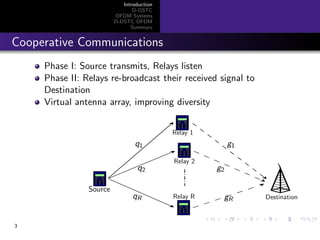
Cooperative Communications
Phase I: Source transmits, Relays listen
Phase II: Relays re-broadcast their received signal to
Destination
Virtual antenna array, improving diversity
q1
q2
qR
g1
g2
gR
Source
Destination
Relay 1
Relay 2
Relay R
3
Introduction
D-DSTC
OFDM Systems
D-DSTC OFDM
Summary
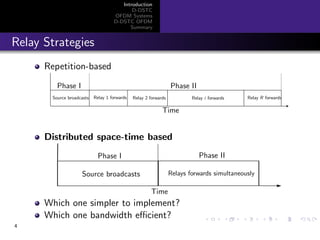
Relay Strategies
Repetition-based
Phase I Phase II
Source broadcasts Relay 1 forwards Relay 2 forwards Relay i forwards Relay R forwards
Time
Distributed space-time based
Phase I Phase II
Source broadcasts Relays forwards simultaneously
Time
Which one simpler to implement?
Which one bandwidth efficient?
4
Introduction
D-DSTC
OFDM Systems
D-DSTC OFDM
Summary
System Model
All channels are Rayleigh flat-fading
Phase I: Source transmits [s1, s2], (differential encoded)
Relays receive [x11, x12] and [x21, x22]
Phase II: Relays re-transmit [x11, x12] and [−x∗
22, x∗
21]
[s1, s2]
[x11, x12]
[−x∗
22, x∗
21]
[y1, y2]
q1
q2
g1
g2Source
Destination
Relay 1
Relay 2
5
Introduction
D-DSTC
OFDM Systems
D-DSTC OFDM
Summary
Synchronized Relay Networks
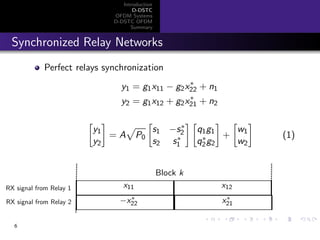
Perfect relays synchronization
y1 = g1x11 − g2x∗
22 + n1
y2 = g1x12 + g2x∗
21 + n2
y1
y2
= A P0
s1 −s∗
2
s2 s∗
1
q1g1
q∗
2g2
+
w1
w2
(1)
RX signal from Relay 1
RX signal from Relay 2
Block k
x11 x12
−x∗
22 x∗
21
6
Introduction
D-DSTC
OFDM Systems
D-DSTC OFDM
Summary
Asynchronous Relay Networks
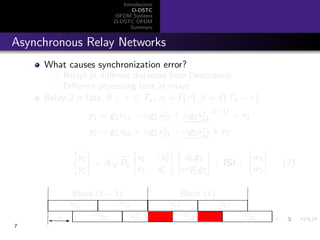
What causes synchronization error?
– Relays at different distances from Destination
– Different processing time at relays
Relay 2 is late, 0 ≤ τ ≤ Ts, α = f (τ), β = f (Ts − τ)
y1 = g1x11 − αg2x∗
22 + βg2x∗
21
(k−1)
+ n1
y2 = g1x12 + αg2x∗
21 − βg2x∗
22 + n2
y1
y2
= A P0
s1 −s∗
2
s2 s∗
1
q1g1
αq∗
2g2
+ ISI +
w1
w2
(2)
Block (k)Block (k − 1)
τ
x11 x12
−x∗
22 x∗
21
x11 x12
−x∗
22 x∗
21
7
Introduction
D-DSTC
OFDM Systems
D-DSTC OFDM
Summary
Asynchronous Relay Networks
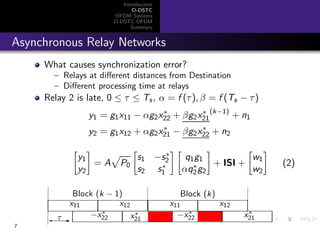
What causes synchronization error?
– Relays at different distances from Destination
– Different processing time at relays
Relay 2 is late, 0 ≤ τ ≤ Ts, α = f (τ), β = f (Ts − τ)
y1 = g1x11 − αg2x∗
22 + βg2x∗
21
(k−1)
+ n1
y2 = g1x12 + αg2x∗
21 − βg2x∗
22 + n2
y1
y2
= A P0
s1 −s∗
2
s2 s∗
1
q1g1
αq∗
2g2
+ ISI +
w1
w2
(2)
Block (k)Block (k − 1)
τ
x11 x12
−x∗
22 x∗
21
x11 x12
−x∗
22 x∗
21
7
Introduction
D-DSTC
OFDM Systems
D-DSTC OFDM
Summary
Asynchronous Relay Networks
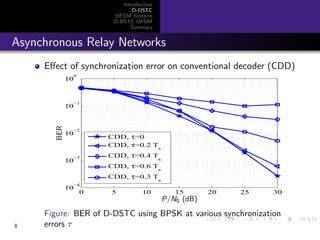
Effect of synchronization error on conventional decoder (CDD)
0 5 10 15 20 25 30
10
−4
10
−3
10
−2
10
−1
10
0
CDD, τ=0
CDD, τ=0.2 Ts
CDD, τ=0.4 T
s
CDD, τ=0.6 T
s
CDD, τ=0.3 T
s
P/N0 (dB)
BER
Figure: BER of D-DSTC using BPSK at various synchronization
errors τ8
Introduction
D-DSTC
OFDM Systems
D-DSTC OFDM
Summary
Frequency Selective Channels
Flat-fading channel, one tap filter h[k] = h0:
y[k] = h0x[k] + n[k]
Frequency selective channel, multiple taps filter:
h[k] =
L−1
l=0
hl δ[k − l]
y[k] = x ∗ h =
L
l=0
hl x[k − l] + n[k]
Inter Symbol Interference (ISI)
Orthogonal frequency-division multiplexing (OFDM)
9
Introduction
D-DSTC
OFDM Systems
D-DSTC OFDM
Summary
Point-to-Point OFDM Structure
x = [x1, · · · , xN ], y = [y1, · · · , yN]
yn = Hnxn + nn, n = 1, · · · , N
bits x
ˆx
Add
Remove
Cyclic Prefix
Cyclic Prefix
Modulation
Detection
X Xcp
ISI Channel
YcpYy
DFT
IDFT
Frequency diversity can be achieved by using channel coding
What are drawbacks of OFDM?
10
Introduction
D-DSTC
OFDM Systems
D-DSTC OFDM
Summary
Simulation Results
5 10 15 20 25 30
10
−4
10
−3
10
−2
10
−1
SNR per bit,[dB]
biterrorprobability
Ncp=0
Ncp=2
Ncp=4
Ncp=6
Ncp=8
theory
Figure: BER of OFDM system over a frequency-selective channel with
four taps, N = 128, using QPSK for different values of cyclic prefix
11
Introduction
D-DSTC
OFDM Systems
D-DSTC OFDM
Summary
Differential OFDM
v = [v1, · · · , vN ], x(k) = [x1, · · · , xN]
Differential Encoding: x
(k)
n = vnx
(k−1)
n , n = 1, · · · , N
Decoding: y
(k)
n = vny
(k−1)
n + wn, n = 1, · · · , N
Requires constant channel over two OFDM blocks, i.e., 2N
symbols
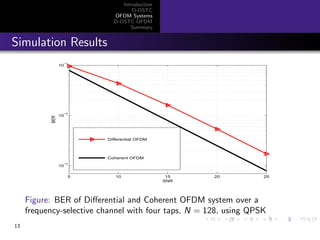
3 dB performance loss compared with coherent detection
12
Introduction
D-DSTC
OFDM Systems
D-DSTC OFDM
Summary
Simulation Results
5 10 15 20 25
10
−3
10
−2
10
−1
SNR
BER
Differential OFDM
Coherent OFDM
Figure: BER of Differential and Coherent OFDM system over a
frequency-selective channel with four taps, N = 128, using QPSK
13
Introduction
D-DSTC
OFDM Systems
D-DSTC OFDM
Summary
Asynchronous vs. Frequency Selectivity
Relay 2 is late:
y1 = g1x11 − αg2x∗
22 + βg2x∗
21
(k−1)
+ n1
y2 = g1x12 + αg2x∗
21 − βg2x∗
22 + n2
Relay 1-Destination channel: flat-fading, g1
Relay 2-Destination channel: can be assumed as frequency
selective, [αg2, βg2]
What is the difference between [αg2, βg2] and an actual
frequency-selective channel?
Block (k)Block (k − 1)
τ
x11 x12
−x∗
22 x∗
21
x11 x12
−x∗
22 x∗
21
14
Introduction
D-DSTC
OFDM Systems
D-DSTC OFDM
Summary
Differential Distributed Space-Time Coding OFDM
(D-DSTC OFDM)
Data symbols:
v1 = [v1(1), · · · , v1(N)], v2 = [v2(1), · · · , v2(N)]
Construct space-time matrices:
V(k) =
v1(k) −v∗
2 (k)
v2(k) v∗
1 (k)
, k = 1, · · · , N
Encode differentially: s(k) = V(k)s(k−1) =
s
(k)
1
s
(k)
2
Collect symbols:
s1 = [s1(1), · · · , s1(N)], s2 = [s2(1), · · · , s2(N)]
S1 = IDFT(s1), S2 = IDFT(s∗
2)
15
Introduction
D-DSTC
OFDM Systems
D-DSTC OFDM
Summary
D-DSTC OFDM continue
Phase I: Source transmits [S1, S2]
Relays receive [X11, X12] and [X21, X22]
Phase II: Relays re-transmit [X11, ctr(X∗
12)] and
[−X22, ctr(X∗
21)]
[S1, S2]
[X11, ctr(X∗
12)]
[−X22, ctr(X∗
21)]
[Y1, Y2]
q1
q2
g1
g2Source
Destination
Relay 1
Relay 2
16
Introduction
D-DSTC
OFDM Systems
D-DSTC OFDM
Summary
D-DSTC OFDM continue
Circular Time-Reversal: ctr(X) = [X(1), X(N), · · · , X(2)]
x
IDFT
−−−→ X
∗
−→ X∗ ctr
−→ ˜X
DFT
−−−→ x∗
At Destination: Remove Cyclic Prefix, apply DFT
y1 = [y1(1), · · · , y1(N)], y2 = [y2(1), · · · , y2(N)]
y(k)
=
y1(k)
y2(k)
= A P0
s1(k) −s∗
2 (k)
s2(k) s∗
1 (k)
H1
H2
+
W1
W2
,
k = 1, · · · , N
Differential decoding: y(k) = V(k)y(k−1) + ˜w(k)
17
Introduction
D-DSTC
OFDM Systems
D-DSTC OFDM
Summary
D-DSTC OFDM: Pros and Cons
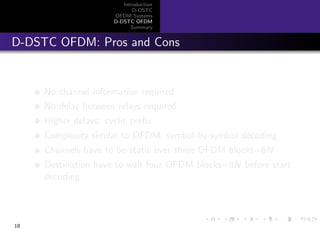
No channel information required
No delay between relays required
Higher delays: cyclic prefix
Complexity similar to OFDM, symbol-by-symbol decoding
Channels have to be static over three OFDM blocks=6N
Destination have to wait four OFDM blocks=8N before start
decoding
18
Introduction
D-DSTC
OFDM Systems
D-DSTC OFDM
Summary
D-DSTC OFDM: Pros and Cons
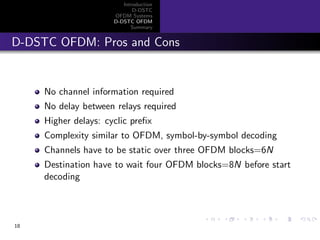
No channel information required
No delay between relays required
Higher delays: cyclic prefix
Complexity similar to OFDM, symbol-by-symbol decoding
Channels have to be static over three OFDM blocks=6N
Destination have to wait four OFDM blocks=8N before start
decoding
18
Introduction
D-DSTC
OFDM Systems
D-DSTC OFDM
Summary
Simulation Results
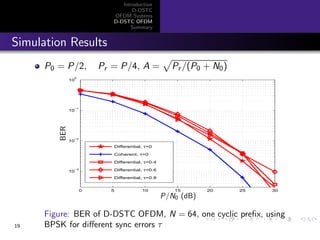
P0 = P/2, Pr = P/4, A = Pr /(P0 + N0)
0 5 10 15 20 25 30
10
−3
10
−2
10
−1
10
0
Differential, τ=0
Coherent, τ=0
Differential, τ=0.4
Differential, τ=0.6
Differential, τ=0.8
P/N0 (dB)
BER
Figure: BER of D-DSTC OFDM, N = 64, one cyclic prefix, using
BPSK for different sync errors τ19
Introduction
D-DSTC
OFDM Systems
D-DSTC OFDM
Summary
Summary
Asynchronous problem in distributed space-time coding
OFDM approach
Differential encoding and decoding
No channel or delay requirement
Thank You!
20

Asynchronous Differential Distributed Space-Time Coding

  • 1.
    Introduction D-DSTC OFDM Systems D-DSTC OFDM Summary AsynchronousDifferential Distributed Space-Time Coding M. R. Avendi Department of Electrical Engineering & Computer Science University of California, Irvine Feb., 2014 1
  • 2.
    Introduction D-DSTC OFDM Systems D-DSTC OFDM Summary Outline 1Introduction 2 D-DSTC 3 OFDM Systems 4 D-DSTC OFDM 5 Summary 2
  • 3.
    Introduction D-DSTC OFDM Systems D-DSTC OFDM Summary CooperativeCommunications Phase I: Source transmits, Relays listen Phase II: Relays re-broadcast their received signal to Destination Virtual antenna array, improving diversity q1 q2 qR g1 g2 gR Source Destination Relay 1 Relay 2 Relay R 3
  • 4.
    Introduction D-DSTC OFDM Systems D-DSTC OFDM Summary RelayStrategies Repetition-based Phase I Phase II Source broadcasts Relay 1 forwards Relay 2 forwards Relay i forwards Relay R forwards Time Distributed space-time based Phase I Phase II Source broadcasts Relays forwards simultaneously Time Which one simpler to implement? Which one bandwidth efficient? 4
  • 5.
    Introduction D-DSTC OFDM Systems D-DSTC OFDM Summary SystemModel All channels are Rayleigh flat-fading Phase I: Source transmits [s1, s2], (differential encoded) Relays receive [x11, x12] and [x21, x22] Phase II: Relays re-transmit [x11, x12] and [−x∗ 22, x∗ 21] [s1, s2] [x11, x12] [−x∗ 22, x∗ 21] [y1, y2] q1 q2 g1 g2Source Destination Relay 1 Relay 2 5
  • 6.
    Introduction D-DSTC OFDM Systems D-DSTC OFDM Summary SynchronizedRelay Networks Perfect relays synchronization y1 = g1x11 − g2x∗ 22 + n1 y2 = g1x12 + g2x∗ 21 + n2 y1 y2 = A P0 s1 −s∗ 2 s2 s∗ 1 q1g1 q∗ 2g2 + w1 w2 (1) RX signal from Relay 1 RX signal from Relay 2 Block k x11 x12 −x∗ 22 x∗ 21 6
  • 7.
    Introduction D-DSTC OFDM Systems D-DSTC OFDM Summary AsynchronousRelay Networks What causes synchronization error? – Relays at different distances from Destination – Different processing time at relays Relay 2 is late, 0 ≤ τ ≤ Ts, α = f (τ), β = f (Ts − τ) y1 = g1x11 − αg2x∗ 22 + βg2x∗ 21 (k−1) + n1 y2 = g1x12 + αg2x∗ 21 − βg2x∗ 22 + n2 y1 y2 = A P0 s1 −s∗ 2 s2 s∗ 1 q1g1 αq∗ 2g2 + ISI + w1 w2 (2) Block (k)Block (k − 1) τ x11 x12 −x∗ 22 x∗ 21 x11 x12 −x∗ 22 x∗ 21 7
  • 8.
    Introduction D-DSTC OFDM Systems D-DSTC OFDM Summary AsynchronousRelay Networks What causes synchronization error? – Relays at different distances from Destination – Different processing time at relays Relay 2 is late, 0 ≤ τ ≤ Ts, α = f (τ), β = f (Ts − τ) y1 = g1x11 − αg2x∗ 22 + βg2x∗ 21 (k−1) + n1 y2 = g1x12 + αg2x∗ 21 − βg2x∗ 22 + n2 y1 y2 = A P0 s1 −s∗ 2 s2 s∗ 1 q1g1 αq∗ 2g2 + ISI + w1 w2 (2) Block (k)Block (k − 1) τ x11 x12 −x∗ 22 x∗ 21 x11 x12 −x∗ 22 x∗ 21 7
  • 9.
    Introduction D-DSTC OFDM Systems D-DSTC OFDM Summary AsynchronousRelay Networks Effect of synchronization error on conventional decoder (CDD) 0 5 10 15 20 25 30 10 −4 10 −3 10 −2 10 −1 10 0 CDD, τ=0 CDD, τ=0.2 Ts CDD, τ=0.4 T s CDD, τ=0.6 T s CDD, τ=0.3 T s P/N0 (dB) BER Figure: BER of D-DSTC using BPSK at various synchronization errors τ8
  • 10.
    Introduction D-DSTC OFDM Systems D-DSTC OFDM Summary FrequencySelective Channels Flat-fading channel, one tap filter h[k] = h0: y[k] = h0x[k] + n[k] Frequency selective channel, multiple taps filter: h[k] = L−1 l=0 hl δ[k − l] y[k] = x ∗ h = L l=0 hl x[k − l] + n[k] Inter Symbol Interference (ISI) Orthogonal frequency-division multiplexing (OFDM) 9
  • 11.
    Introduction D-DSTC OFDM Systems D-DSTC OFDM Summary Point-to-PointOFDM Structure x = [x1, · · · , xN ], y = [y1, · · · , yN] yn = Hnxn + nn, n = 1, · · · , N bits x ˆx Add Remove Cyclic Prefix Cyclic Prefix Modulation Detection X Xcp ISI Channel YcpYy DFT IDFT Frequency diversity can be achieved by using channel coding What are drawbacks of OFDM? 10
  • 12.
    Introduction D-DSTC OFDM Systems D-DSTC OFDM Summary SimulationResults 5 10 15 20 25 30 10 −4 10 −3 10 −2 10 −1 SNR per bit,[dB] biterrorprobability Ncp=0 Ncp=2 Ncp=4 Ncp=6 Ncp=8 theory Figure: BER of OFDM system over a frequency-selective channel with four taps, N = 128, using QPSK for different values of cyclic prefix 11
  • 13.
    Introduction D-DSTC OFDM Systems D-DSTC OFDM Summary DifferentialOFDM v = [v1, · · · , vN ], x(k) = [x1, · · · , xN] Differential Encoding: x (k) n = vnx (k−1) n , n = 1, · · · , N Decoding: y (k) n = vny (k−1) n + wn, n = 1, · · · , N Requires constant channel over two OFDM blocks, i.e., 2N symbols 3 dB performance loss compared with coherent detection 12
  • 14.
    Introduction D-DSTC OFDM Systems D-DSTC OFDM Summary SimulationResults 5 10 15 20 25 10 −3 10 −2 10 −1 SNR BER Differential OFDM Coherent OFDM Figure: BER of Differential and Coherent OFDM system over a frequency-selective channel with four taps, N = 128, using QPSK 13
  • 15.
    Introduction D-DSTC OFDM Systems D-DSTC OFDM Summary Asynchronousvs. Frequency Selectivity Relay 2 is late: y1 = g1x11 − αg2x∗ 22 + βg2x∗ 21 (k−1) + n1 y2 = g1x12 + αg2x∗ 21 − βg2x∗ 22 + n2 Relay 1-Destination channel: flat-fading, g1 Relay 2-Destination channel: can be assumed as frequency selective, [αg2, βg2] What is the difference between [αg2, βg2] and an actual frequency-selective channel? Block (k)Block (k − 1) τ x11 x12 −x∗ 22 x∗ 21 x11 x12 −x∗ 22 x∗ 21 14
  • 16.
    Introduction D-DSTC OFDM Systems D-DSTC OFDM Summary DifferentialDistributed Space-Time Coding OFDM (D-DSTC OFDM) Data symbols: v1 = [v1(1), · · · , v1(N)], v2 = [v2(1), · · · , v2(N)] Construct space-time matrices: V(k) = v1(k) −v∗ 2 (k) v2(k) v∗ 1 (k) , k = 1, · · · , N Encode differentially: s(k) = V(k)s(k−1) = s (k) 1 s (k) 2 Collect symbols: s1 = [s1(1), · · · , s1(N)], s2 = [s2(1), · · · , s2(N)] S1 = IDFT(s1), S2 = IDFT(s∗ 2) 15
  • 17.
    Introduction D-DSTC OFDM Systems D-DSTC OFDM Summary D-DSTCOFDM continue Phase I: Source transmits [S1, S2] Relays receive [X11, X12] and [X21, X22] Phase II: Relays re-transmit [X11, ctr(X∗ 12)] and [−X22, ctr(X∗ 21)] [S1, S2] [X11, ctr(X∗ 12)] [−X22, ctr(X∗ 21)] [Y1, Y2] q1 q2 g1 g2Source Destination Relay 1 Relay 2 16
  • 18.
    Introduction D-DSTC OFDM Systems D-DSTC OFDM Summary D-DSTCOFDM continue Circular Time-Reversal: ctr(X) = [X(1), X(N), · · · , X(2)] x IDFT −−−→ X ∗ −→ X∗ ctr −→ ˜X DFT −−−→ x∗ At Destination: Remove Cyclic Prefix, apply DFT y1 = [y1(1), · · · , y1(N)], y2 = [y2(1), · · · , y2(N)] y(k) = y1(k) y2(k) = A P0 s1(k) −s∗ 2 (k) s2(k) s∗ 1 (k) H1 H2 + W1 W2 , k = 1, · · · , N Differential decoding: y(k) = V(k)y(k−1) + ˜w(k) 17
  • 19.
    Introduction D-DSTC OFDM Systems D-DSTC OFDM Summary D-DSTCOFDM: Pros and Cons No channel information required No delay between relays required Higher delays: cyclic prefix Complexity similar to OFDM, symbol-by-symbol decoding Channels have to be static over three OFDM blocks=6N Destination have to wait four OFDM blocks=8N before start decoding 18
  • 20.
    Introduction D-DSTC OFDM Systems D-DSTC OFDM Summary D-DSTCOFDM: Pros and Cons No channel information required No delay between relays required Higher delays: cyclic prefix Complexity similar to OFDM, symbol-by-symbol decoding Channels have to be static over three OFDM blocks=6N Destination have to wait four OFDM blocks=8N before start decoding 18
  • 21.
    Introduction D-DSTC OFDM Systems D-DSTC OFDM Summary SimulationResults P0 = P/2, Pr = P/4, A = Pr /(P0 + N0) 0 5 10 15 20 25 30 10 −3 10 −2 10 −1 10 0 Differential, τ=0 Coherent, τ=0 Differential, τ=0.4 Differential, τ=0.6 Differential, τ=0.8 P/N0 (dB) BER Figure: BER of D-DSTC OFDM, N = 64, one cyclic prefix, using BPSK for different sync errors τ19
  • 22.
    Introduction D-DSTC OFDM Systems D-DSTC OFDM Summary Summary Asynchronousproblem in distributed space-time coding OFDM approach Differential encoding and decoding No channel or delay requirement Thank You! 20