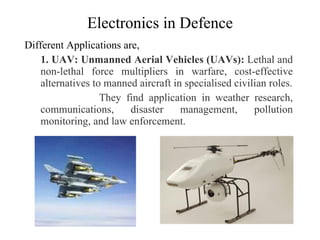
Electronics in Defence Different Applications are, 1. UAV: Unmanned Aerial Vehicles (UAVs):  Lethal and non-lethal force multipliers in warfare, cost-effective alternatives to manned aircraft in specialised civilian roles. They find application in weather research, communications, disaster management, pollution monitoring, and law enforcement.
2 .  LAKSHYA – DRDO :  i. Pilotless Target Aircraft (PTA) (named as “Lakshya”) is a reusable aerial target system ii. Operated from ground to provide aerial target for training of  gun and Missile crew and Air Defence pilots
3.  RADAR : It is an object-detection system which uses electromagnetic waves—specifically radio waves—to determine the range, altitude, direction, or speed of both moving and fixed objects.  ► One of the application is long-range radar antenna, known as  ALTAIR , used to detect and track space objects in conjunction with ABM testing at the Ronald Reagan Test Site on Kwajalein Atoll.
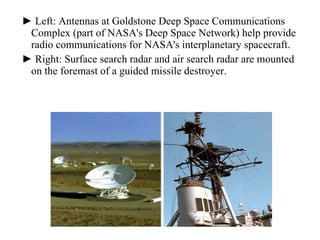
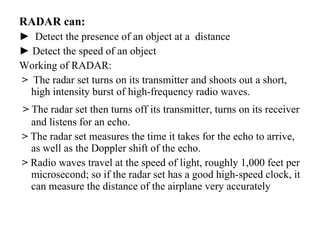
►  Left: Antennas at Goldstone Deep Space Communications Complex (part of NASA's Deep Space Network) help provide radio communications for NASA's interplanetary spacecraft.  ►  Right: Surface search radar and air search radar are mounted on the foremast of a guided missile destroyer.
RADAR can: ►  Detect the presence of an object at a  distance ►  Detect the speed of an object Working of RADAR: >   The radar set turns on its transmitter and shoots out a short, high intensity burst of high-frequency radio waves. >  The radar set then turns off its transmitter, turns on its receiver and listens for an echo. >  The radar set measures the time it takes for the echo to arrive, as well as the Doppler shift of the echo. >  Radio waves travel at the speed of light, roughly 1,000 feet per microsecond; so if the radar set has a good high-speed clock, it can measure the distance of the airplane very accurately
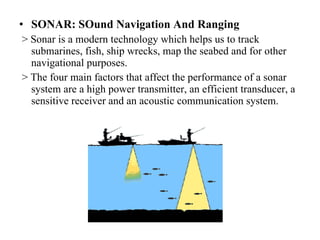
SONAR: SOund Navigation And Ranging > Sonar is a modern technology which helps us to track submarines, fish, ship wrecks, map the seabed and for other navigational purposes. > The four main factors that affect the performance of a sonar system are a high power transmitter, an efficient transducer, a sensitive receiver and an acoustic communication system.
Present day uses of sonar  : The military uses a large number of sonar systems to detect, identify and locate submarines.  In acoustic homing torpedoes, in acoustic explosive mines and in mine detection  In finding schools of fish  For depth sounding applications  Mapping of the seabed  Navigation purposes  Acoustic locating of submerged wrecks
Industries relating to this field: Hindustan Aeronautics Limited (HAL)  DRDO Bharat Electronics Limited (BEL)  Bharat Earth Movers Limited (BEML)  Mazagon Dock Limited (MDL)  Garden Reach Shipbuilders & Engineers Limited (GRSE)  Goa Sihipyard Limited (GSL)  Bharat Dynamics Limited (BDL)  Mishra Dhatu Nigam Limited (MIDHANI)

Ubp electronics in defence

  • 1.
    Electronics in DefenceDifferent Applications are, 1. UAV: Unmanned Aerial Vehicles (UAVs): Lethal and non-lethal force multipliers in warfare, cost-effective alternatives to manned aircraft in specialised civilian roles. They find application in weather research, communications, disaster management, pollution monitoring, and law enforcement.
  • 2.
    2 . LAKSHYA – DRDO : i. Pilotless Target Aircraft (PTA) (named as “Lakshya”) is a reusable aerial target system ii. Operated from ground to provide aerial target for training of gun and Missile crew and Air Defence pilots
  • 3.
    3. RADAR: It is an object-detection system which uses electromagnetic waves—specifically radio waves—to determine the range, altitude, direction, or speed of both moving and fixed objects. ► One of the application is long-range radar antenna, known as ALTAIR , used to detect and track space objects in conjunction with ABM testing at the Ronald Reagan Test Site on Kwajalein Atoll.
  • 4.
    ► Left:Antennas at Goldstone Deep Space Communications Complex (part of NASA's Deep Space Network) help provide radio communications for NASA's interplanetary spacecraft. ► Right: Surface search radar and air search radar are mounted on the foremast of a guided missile destroyer.
  • 5.
    RADAR can: ► Detect the presence of an object at a distance ► Detect the speed of an object Working of RADAR: > The radar set turns on its transmitter and shoots out a short, high intensity burst of high-frequency radio waves. > The radar set then turns off its transmitter, turns on its receiver and listens for an echo. > The radar set measures the time it takes for the echo to arrive, as well as the Doppler shift of the echo. > Radio waves travel at the speed of light, roughly 1,000 feet per microsecond; so if the radar set has a good high-speed clock, it can measure the distance of the airplane very accurately
  • 6.
    SONAR: SOund NavigationAnd Ranging > Sonar is a modern technology which helps us to track submarines, fish, ship wrecks, map the seabed and for other navigational purposes. > The four main factors that affect the performance of a sonar system are a high power transmitter, an efficient transducer, a sensitive receiver and an acoustic communication system.
  • 7.
    Present day usesof sonar : The military uses a large number of sonar systems to detect, identify and locate submarines. In acoustic homing torpedoes, in acoustic explosive mines and in mine detection In finding schools of fish For depth sounding applications Mapping of the seabed Navigation purposes Acoustic locating of submerged wrecks
  • 8.
    Industries relating tothis field: Hindustan Aeronautics Limited (HAL) DRDO Bharat Electronics Limited (BEL) Bharat Earth Movers Limited (BEML) Mazagon Dock Limited (MDL) Garden Reach Shipbuilders & Engineers Limited (GRSE) Goa Sihipyard Limited (GSL) Bharat Dynamics Limited (BDL) Mishra Dhatu Nigam Limited (MIDHANI)