Gender representation
Van Zoonen, bell hooks, Judith Butler
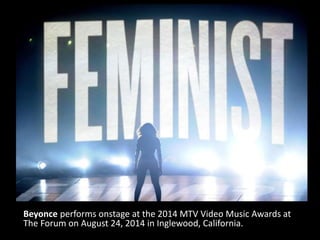
Beyonce performs onstage at the 2014 MTV Video Music Awards at
The Forum on August 24, 2014 in Inglewood, California.
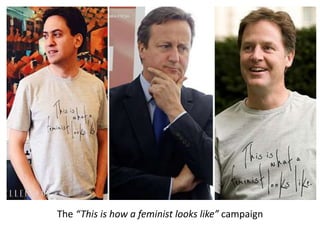
The “This is how a feminist looks like” campaign
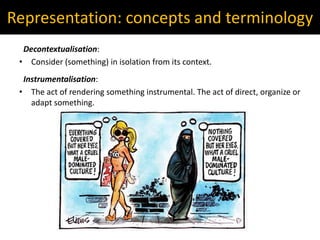
Apart from the obvious decontextualisation and
political instrumentalisation of the concept
feminism shown in the previous examples, some
other debates which imply ideological
confrontations have prompted from the media.
http://www.dailymail.co.uk/femail/article-2827035/Scandal-62p-hour-T-shirts-
Shame-feminists-betrayed-cause-writes-ROSIE-BOYCOTT.html
http://www.theguardian.com/world/2014/nov/04/feminist-t-shirts-made-
ethical-conditions-fawcett-society
http://www.theguardian.com/sustainable-business/sustainable-fashion-
blog/2014/nov/08/feminist-t-shirt-scandal-ethical-problem-economic
Feminism: concepts and terminology
Representation: concepts and terminology
Decontextualisation:
• Consider (something) in isolation from its context.
Instrumentalisation:
• The act of rendering something instrumental. The act of direct, organize or
adapt something.
Representation theories 3:
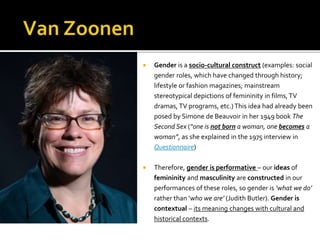
Liesbet van Zoonen
Representation of gender in the media
(feminist theory)
 In a patriarchal culture (Simone de Beauvoir), the
way women are represented as objects
(objectification/ Laura Mulvey) is different to the
representation of male bodies as a spectacle.
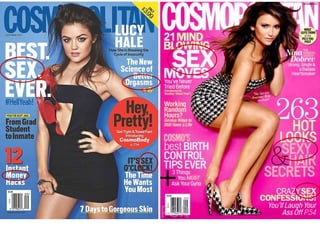
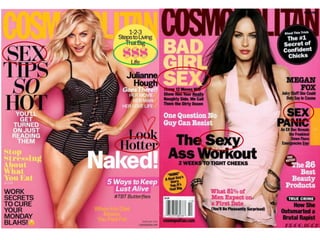
Representation of the female body is usually
objectified in the media for the pleasure of the male
viewer (examples: Hollywood films, reality TV, Daily
Mail representations of women, men’s magazines,
women’s magazines such as Cosmopolitan, various
examples offered in the documentary film Miss
representation) See Laura Mulvey (“the male gaze”)
See also the Laura Mulvey’s theory explained
PowerPoint presentation on the EXTENDED
READING: FEMINISTTHEORY section on the
Representation page in the subject’s website.
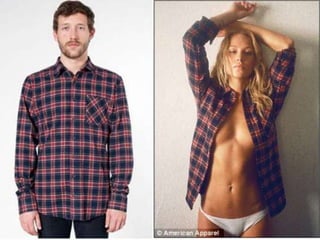
 Representations of males and females differ in the
media (hyper sexualisation of female bodies vs.
male bodies as spectacle (examples: sports; ageism
onTV and films: “the old guy with the young woman”
vs. “the old woman with the young boy”)
 Gender is a socio-cultural construct (examples: social
gender roles, which have changed through history;
lifestyle or fashion magazines; mainstream
stereotypical depictions of femininity in films,TV
dramas, TV programs, etc.)This idea had already been
posed by Simone de Beauvoir in her 1949 book The
Second Sex (“one is not born a woman, one becomes a
woman”, as she explained in the 1975 interview in
Questionnaire)
 Therefore, gender is performative – our ideas of
femininity and masculinity are constructed in our
performances of these roles, so gender is ‘what we do’
rather than ‘who we are’ (Judith Butler). Gender is
contextual – its meaning changes with cultural and
historical contexts.
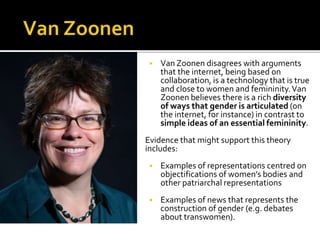
 Van Zoonen disagrees with arguments
that the internet, being based on
collaboration, is a technology that is true
and close to women and femininity.Van
Zoonen believes there is a rich diversity
of ways that gender is articulated (on
the internet, for instance) in contrast to
simple ideas of an essential femininity.
Evidence that might support this theory
includes:
 Examples of representations centred on
objectifications of women’s bodies and
other patriarchal representations
 Examples of news that represents the
construction of gender (e.g. debates
about transwomen).
Representation theories 4:
bell hooks
Representation of black females in the media
(feminist theory)
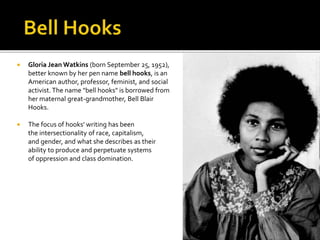
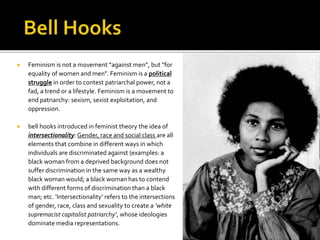
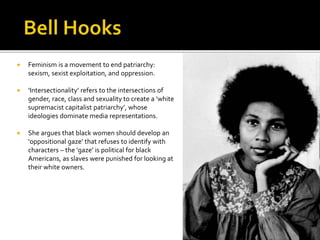
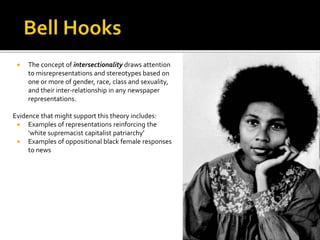
 Gloria Jean Watkins (born September 25, 1952),
better known by her pen name bell hooks, is an
American author, professor, feminist, and social
activist.The name "bell hooks" is borrowed from
her maternal great-grandmother, Bell Blair
Hooks.
 The focus of hooks' writing has been
the intersectionality of race, capitalism,
and gender, and what she describes as their
ability to produce and perpetuate systems
of oppression and class domination.
 Feminism is not a movement “against men”, but “for
equality of women and men”. Feminism is a political
struggle in order to contest patriarchal power, not a
fad, a trend or a lifestyle. Feminism is a movement to
end patriarchy: sexism, sexist exploitation, and
oppression.
 bell hooks introduced in feminist theory the idea of
intersectionality: Gender, race and social class are all
elements that combine in different ways in which
individuals are discriminated against (examples: a
black woman from a deprived background does not
suffer discrimination in the same way as a wealthy
black woman would; a black woman has to contend
with different forms of discrimination than a black
man; etc. ‘Intersectionality’ refers to the intersections
of gender, race, class and sexuality to create a ‘white
supremacist capitalist patriarchy’, whose ideologies
dominate media representations.
 Feminism is a movement to end patriarchy:
sexism, sexist exploitation, and oppression.
 ‘Intersectionality’ refers to the intersections of
gender, race, class and sexuality to create a ‘white
supremacist capitalist patriarchy’, whose
ideologies dominate media representations.
 She argues that black women should develop an
‘oppositional gaze’ that refuses to identify with
characters – the ‘gaze’ is political for black
Americans, as slaves were punished for looking at
their white owners.
 The concept of intersectionality draws attention
to misrepresentations and stereotypes based on
one or more of gender, race, class and sexuality,
and their inter-relationship in any newspaper
representations.
Evidence that might support this theory includes:
 Examples of representations reinforcing the
‘white supremacist capitalist patriarchy’
 Examples of oppositional black female responses
to news
Representation theories 5:
Judith Butler
Theory of gender performativity
Judith Butler
Judith Butler (born
February 24, 1956) is
an American
continental
philosopher and
gender theorist whose
work has influenced
political philosophy,
ethics and the fields of
feminist, queerand
literary theory.
• Gender is created in how we perform our gender roles – there is
no essential gender identity behind these roles, it is created in the
performance. Gender performativity is not a singular act but a
repetition and a ritual that becomes naturalised within the body.
• Any feminism concerned only with masculinity and femininity
excludes other forms of gender and sexuality. This creates ‘gender
trouble’ for those that do not fit the heterosexual norms.
• Butler is an important postmodern writer and has defined Queer
theory – theory which deconstructs and aims to destabilise
apparently fixed identities based on gender and sexualities.
Judith Butler: Theory of Gender Performativity
Gender Trouble (1990)
• In her most influential book Gender Trouble (1990), Butler
argued that feminism had made a mistake by trying to
assert that 'women' were a group with common
characteristics and interests.
• That approach, Butler said, performed 'an unwitting
regulation and reification of gender relations' -reinforcing a
binary view of gender relations in which human beings are
divided into two clear-cut groups, women and men.
• Rather than opening up possibilities for a person to form
and choose their own individual identity, therefore,
feminism had closed the options down.
Gender Trouble (1990)
Butler notes that feminists rejected the idea that
biology is destiny, but then developed an
account of patriarchal culture which assumed
that masculine and feminine genders would
inevitably be built, by culture, upon 'male' and
'female' bodies, making the same destiny just as
inescapable. That argument allows no room for
choice, difference or resistance.
Gender Trouble (1990)
• Butler prefers 'those historical and
anthropological positions that understand
gender as a relation among socially
constituted subjects in specifiable contexts’.
• In other words, rather than being a fixed
attribute in a person, gender should be seen
as a fluid variable which shifts and changes
in different contexts and at different times.
Gender Trouble (1990)
• Butler says: 'There is no gender identity behind
the expressions of gender; ... identity is
performatively constituted by the very
"expressions" that are said to be its results.'
(Gender Trouble, p. 25).
• In other words, gender is a performance; it's
what you do at particular times, rather than a
universal who you are.
Gender Trouble (1990)
Evidence that might support this theory includes:
• Examples of repetition of representations
reinforcing gender performances
• Examples of news that ‘queers’ gender norms.
 Butler is an important postmodern writer and has influenced
Queer theory – theory which deconstructs and aims to destabilise
apparently fixed identities based on gender and sexualities.
 According to Butler, gender is created in how we perform our
gender roles – there is no essential gender identity behind these
roles, it is created in the performance. Performativity is not a
singular act but a repetition and a ritual that becomes naturalised
within the body.
 Any feminism concerned only with masculinity and femininity
excludes other forms of gender and sexuality.This creates
‘gender trouble’ for those that do not fit the heterosexual norms.
Gender Trouble (1990)
“Gender is a performance and gender lifestyle
magazines provide the script for this
performance”
• To what extent do you agree with this
statement?
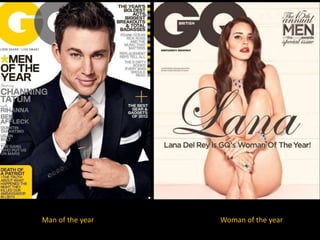
Man of the year Woman of the year
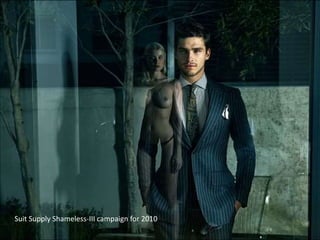
Suit Supply Shameless-III campaign for 2010

Gender representation_Academic theories

  • 1.
    Gender representation Van Zoonen,bell hooks, Judith Butler
  • 2.
    Beyonce performs onstageat the 2014 MTV Video Music Awards at The Forum on August 24, 2014 in Inglewood, California.
  • 4.
    The “This ishow a feminist looks like” campaign
  • 5.
    Apart from theobvious decontextualisation and political instrumentalisation of the concept feminism shown in the previous examples, some other debates which imply ideological confrontations have prompted from the media. http://www.dailymail.co.uk/femail/article-2827035/Scandal-62p-hour-T-shirts- Shame-feminists-betrayed-cause-writes-ROSIE-BOYCOTT.html http://www.theguardian.com/world/2014/nov/04/feminist-t-shirts-made- ethical-conditions-fawcett-society http://www.theguardian.com/sustainable-business/sustainable-fashion- blog/2014/nov/08/feminist-t-shirt-scandal-ethical-problem-economic Feminism: concepts and terminology
  • 6.
    Representation: concepts andterminology Decontextualisation: • Consider (something) in isolation from its context. Instrumentalisation: • The act of rendering something instrumental. The act of direct, organize or adapt something.
  • 7.
    Representation theories 3: Liesbetvan Zoonen Representation of gender in the media (feminist theory)
  • 8.
     In apatriarchal culture (Simone de Beauvoir), the way women are represented as objects (objectification/ Laura Mulvey) is different to the representation of male bodies as a spectacle. Representation of the female body is usually objectified in the media for the pleasure of the male viewer (examples: Hollywood films, reality TV, Daily Mail representations of women, men’s magazines, women’s magazines such as Cosmopolitan, various examples offered in the documentary film Miss representation) See Laura Mulvey (“the male gaze”) See also the Laura Mulvey’s theory explained PowerPoint presentation on the EXTENDED READING: FEMINISTTHEORY section on the Representation page in the subject’s website.  Representations of males and females differ in the media (hyper sexualisation of female bodies vs. male bodies as spectacle (examples: sports; ageism onTV and films: “the old guy with the young woman” vs. “the old woman with the young boy”)
  • 9.
     Gender isa socio-cultural construct (examples: social gender roles, which have changed through history; lifestyle or fashion magazines; mainstream stereotypical depictions of femininity in films,TV dramas, TV programs, etc.)This idea had already been posed by Simone de Beauvoir in her 1949 book The Second Sex (“one is not born a woman, one becomes a woman”, as she explained in the 1975 interview in Questionnaire)  Therefore, gender is performative – our ideas of femininity and masculinity are constructed in our performances of these roles, so gender is ‘what we do’ rather than ‘who we are’ (Judith Butler). Gender is contextual – its meaning changes with cultural and historical contexts.
  • 10.
     Van Zoonendisagrees with arguments that the internet, being based on collaboration, is a technology that is true and close to women and femininity.Van Zoonen believes there is a rich diversity of ways that gender is articulated (on the internet, for instance) in contrast to simple ideas of an essential femininity. Evidence that might support this theory includes:  Examples of representations centred on objectifications of women’s bodies and other patriarchal representations  Examples of news that represents the construction of gender (e.g. debates about transwomen).
  • 11.
    Representation theories 4: bellhooks Representation of black females in the media (feminist theory)
  • 12.
     Gloria JeanWatkins (born September 25, 1952), better known by her pen name bell hooks, is an American author, professor, feminist, and social activist.The name "bell hooks" is borrowed from her maternal great-grandmother, Bell Blair Hooks.  The focus of hooks' writing has been the intersectionality of race, capitalism, and gender, and what she describes as their ability to produce and perpetuate systems of oppression and class domination.
  • 13.
     Feminism isnot a movement “against men”, but “for equality of women and men”. Feminism is a political struggle in order to contest patriarchal power, not a fad, a trend or a lifestyle. Feminism is a movement to end patriarchy: sexism, sexist exploitation, and oppression.  bell hooks introduced in feminist theory the idea of intersectionality: Gender, race and social class are all elements that combine in different ways in which individuals are discriminated against (examples: a black woman from a deprived background does not suffer discrimination in the same way as a wealthy black woman would; a black woman has to contend with different forms of discrimination than a black man; etc. ‘Intersectionality’ refers to the intersections of gender, race, class and sexuality to create a ‘white supremacist capitalist patriarchy’, whose ideologies dominate media representations.
  • 14.
     Feminism isa movement to end patriarchy: sexism, sexist exploitation, and oppression.  ‘Intersectionality’ refers to the intersections of gender, race, class and sexuality to create a ‘white supremacist capitalist patriarchy’, whose ideologies dominate media representations.  She argues that black women should develop an ‘oppositional gaze’ that refuses to identify with characters – the ‘gaze’ is political for black Americans, as slaves were punished for looking at their white owners.
  • 15.
     The conceptof intersectionality draws attention to misrepresentations and stereotypes based on one or more of gender, race, class and sexuality, and their inter-relationship in any newspaper representations. Evidence that might support this theory includes:  Examples of representations reinforcing the ‘white supremacist capitalist patriarchy’  Examples of oppositional black female responses to news
  • 16.
    Representation theories 5: JudithButler Theory of gender performativity
  • 17.
    Judith Butler Judith Butler(born February 24, 1956) is an American continental philosopher and gender theorist whose work has influenced political philosophy, ethics and the fields of feminist, queerand literary theory.
  • 18.
    • Gender iscreated in how we perform our gender roles – there is no essential gender identity behind these roles, it is created in the performance. Gender performativity is not a singular act but a repetition and a ritual that becomes naturalised within the body. • Any feminism concerned only with masculinity and femininity excludes other forms of gender and sexuality. This creates ‘gender trouble’ for those that do not fit the heterosexual norms. • Butler is an important postmodern writer and has defined Queer theory – theory which deconstructs and aims to destabilise apparently fixed identities based on gender and sexualities. Judith Butler: Theory of Gender Performativity
  • 19.
    Gender Trouble (1990) •In her most influential book Gender Trouble (1990), Butler argued that feminism had made a mistake by trying to assert that 'women' were a group with common characteristics and interests. • That approach, Butler said, performed 'an unwitting regulation and reification of gender relations' -reinforcing a binary view of gender relations in which human beings are divided into two clear-cut groups, women and men. • Rather than opening up possibilities for a person to form and choose their own individual identity, therefore, feminism had closed the options down.
  • 20.
    Gender Trouble (1990) Butlernotes that feminists rejected the idea that biology is destiny, but then developed an account of patriarchal culture which assumed that masculine and feminine genders would inevitably be built, by culture, upon 'male' and 'female' bodies, making the same destiny just as inescapable. That argument allows no room for choice, difference or resistance.
  • 21.
    Gender Trouble (1990) •Butler prefers 'those historical and anthropological positions that understand gender as a relation among socially constituted subjects in specifiable contexts’. • In other words, rather than being a fixed attribute in a person, gender should be seen as a fluid variable which shifts and changes in different contexts and at different times.
  • 22.
    Gender Trouble (1990) •Butler says: 'There is no gender identity behind the expressions of gender; ... identity is performatively constituted by the very "expressions" that are said to be its results.' (Gender Trouble, p. 25). • In other words, gender is a performance; it's what you do at particular times, rather than a universal who you are.
  • 23.
    Gender Trouble (1990) Evidencethat might support this theory includes: • Examples of repetition of representations reinforcing gender performances • Examples of news that ‘queers’ gender norms.
  • 24.
     Butler isan important postmodern writer and has influenced Queer theory – theory which deconstructs and aims to destabilise apparently fixed identities based on gender and sexualities.  According to Butler, gender is created in how we perform our gender roles – there is no essential gender identity behind these roles, it is created in the performance. Performativity is not a singular act but a repetition and a ritual that becomes naturalised within the body.  Any feminism concerned only with masculinity and femininity excludes other forms of gender and sexuality.This creates ‘gender trouble’ for those that do not fit the heterosexual norms.
  • 25.

    Gender Trouble (1990) “Genderis a performance and gender lifestyle magazines provide the script for this performance” • To what extent do you agree with this statement?
  • 31.
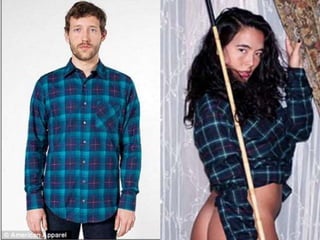
    Man of theyear Woman of the year
  • 38.
    Suit Supply Shameless-IIIcampaign for 2010
  • 39.
    Suit Supply Shameless-IIIcampaign for 2010
  • 40.
    Suit Supply Shameless-IIIcampaign for 2010

Editor's Notes

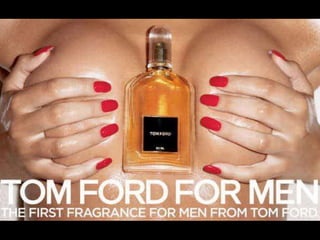
  • #35 Tom Ford
  • #36 Tom Ford
  • #37 Tom Ford
  • #38 Tom Ford
  • #39 Suit Supply Shameless-III-campagne-for-2010
  • #40 Suit Supply Shameless-III-campagne-for-2010
  • #41 Suit Supply Shameless-III-campagne-for-2010