Using Sound in Moving Image
What is the purpose or effect of sound in moving image extracts?
Using Sound in Moving Image
What is the purpose or effect of sound in moving image extracts?
Sound serves many purposes in moving image work, including;
1. It can make a scene more ‘realistic’/believable by providing the expected accompanying sounds to
an image/action
2. It can anchor meaning to a sequence, either through verbal communication (dialogue, voice over)
or an accompanying soundtrack (music/sound design)
3. It turns a 2 dimensional experience into a more immersive, 3D experience.
4. It can be used to convey additional meaning or information to the audience about a character, their
situation, an event, idea or location.
5. It can encourage an emotional response from the audience (empathy, trepidation)
6. It can be used to identify certain characters/events/themes within a narrative.
7. It can be used to suggest a particular genre, style or idea.
8. It can be used to smooth over transitions and make editing appear less conspicuous.
Using Sound in Moving Image
Speech: Dialogue, Narration, monologue
Music: Themes, Soundtrack, Leitmotifs, Underscore, Jingles, Sonic Logos
Sound Effects: Explosions, Sci-fi noises (e.g. light sabres), emphasis from
booms/swooshes)
Diegetic vs Non-diegetic
Sound can be divided into 2 main categories
Diegetic and Non-diegetic
Diegesis = ‘the total world of the story action’ (remember extra-diegetic gaze?)
Diegetic sound comes from the text’s ‘own world’. Character’s within the world
can/would be able to hear it. (dialogue, ambient sound, music played on screen (e.g. a
band’s live performance)
Non-diegetic sound is sound that has been added on from our world, rather than
theirs, and would not be audible to them. (e.g. theme music, narration)
More info here http://filmsound.org/terminology/diegetic.htm
Diegetic vs Non-diegetic
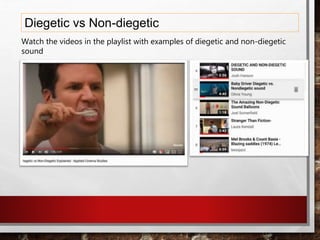
Watch the videos in the playlist with examples of diegetic and non-diegetic
sound
Diegetic vs Non-diegetic
http://www.youtube.com/watch?v=juVb1SDHWrk
Some filmmakers deliberately play around with this idea for artistic or humorous purposes
‘The amazing Non-Diegetic Balloons’
http://www.youtube.com/watch?v=5KUZVwsjTvw
Stranger Than Fiction
http://www.youtube.com/watch?v=M6hnxtl4g9M
Blazing Saddles
http://www.youtube.com/watch?v=N2xYaL_Mheg
Synchronous vs Asynchronous
‘Synchronous’ or in synch with refers to sound that matches what we see visually.
Asynchronous sound is sound that doesn’t. Both synchronous and asynchronous sound
could be diegetic or non-diegetic, depending on the context.
For instance if we see Character A making a phone call to Character B, but we can only
see Character A in their house (B is in another country and off screen) but we can hear
both of their voices clearly, both sounds are diegetic as they are from the character’s
world. But, only Character A’s sound is synchronous. B’s voice does not match what is
on screen, so is asynchronous.
Equally, most non-diegetic sound, such as the Jaws theme might be considered
asynchronous as it doesn’t match what we see on screen. But some non-diegetic
sound may be added to emphasise a certain movement or cut (boom!), or the action or
editing may be happening in time with the music. In which case it could be considered
synchronous.
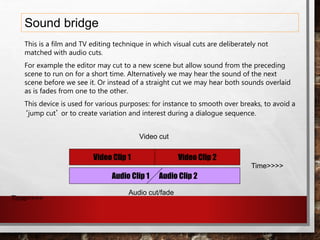
Sound bridge
Video Clip 2Video Clip 1
Audio Clip 1 Audio Clip 2
This is a film and TV editing technique in which visual cuts are deliberately not
matched with audio cuts.
For example the editor may cut to a new scene but allow sound from the preceding
scene to run on for a short time. Alternatively we may hear the sound of the next
scene before we see it. Or instead of a straight cut we may hear both sounds overlaid
as is fades from one to the other.
This device is used for various purposes: for instance to smooth over breaks, to avoid a
‘jump cut’ or to create variation and interest during a dialogue sequence.
Video cut
Audio cut/fade
Time>>>>
Time>>>>
Sound bridge
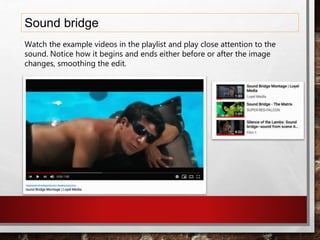
Watch the example videos in the playlist and play close attention to the
sound. Notice how it begins and ends either before or after the image
changes, smoothing the edit.
Music in Moving Image
Themes, in musical terms this is usually an instrumental piece that
opens and/or closes a film or TV programme. It identifies the film to
audience and acts almost like a kind of branding. When you hear John
Williams’ Indiana Jones theme, or The Rembrandts I’ll Be There For
it is hard not to think of the texts they have come to represent.
Films are increasingly use pop songs rather than bespoke orchestral
scores, since these bring with them many of their own
associations/connotations and can market the film/TV show to
audiences. The soundtrack album can also be a great source of income
as well as a marketing tool.
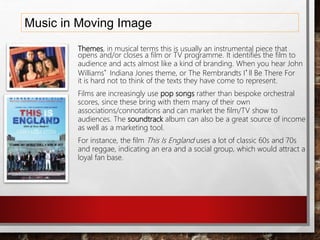
For instance, the film This Is England uses a lot of classic 60s and 70s
and reggae, indicating an era and a social group, which would attract a
loyal fan base.
Music in Moving Image
Leitmotifs, are types of themes or musical phrases that usually occur in film
music, although their origin is in classical music and opera (Wagner). They
function within the narrative to identify certain elements
(characters/places/etc). John Williams’ Star Wars score used a lot.
http://www.youtube.com/watch?v=QrbAg3zkpg4
Star Wars Main Theme, The Imperial March (Darth Vader), Jedi Theme
Sound logos/sonic branding are terms for the little mini-themes associated
with certain products.
See videos in playlist for examples
Counterpoint
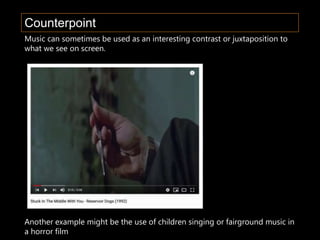
Music can sometimes be used as an interesting contrast or juxtaposition to
what we see on screen.
Another example might be the use of children singing or fairground music in
a horror film

Media Studies Moving image analysis sound

  • 2.
    Using Sound inMoving Image What is the purpose or effect of sound in moving image extracts?
  • 3.
    Using Sound inMoving Image What is the purpose or effect of sound in moving image extracts? Sound serves many purposes in moving image work, including; 1. It can make a scene more ‘realistic’/believable by providing the expected accompanying sounds to an image/action 2. It can anchor meaning to a sequence, either through verbal communication (dialogue, voice over) or an accompanying soundtrack (music/sound design) 3. It turns a 2 dimensional experience into a more immersive, 3D experience. 4. It can be used to convey additional meaning or information to the audience about a character, their situation, an event, idea or location. 5. It can encourage an emotional response from the audience (empathy, trepidation) 6. It can be used to identify certain characters/events/themes within a narrative. 7. It can be used to suggest a particular genre, style or idea. 8. It can be used to smooth over transitions and make editing appear less conspicuous.
  • 4.
    Using Sound inMoving Image Speech: Dialogue, Narration, monologue Music: Themes, Soundtrack, Leitmotifs, Underscore, Jingles, Sonic Logos Sound Effects: Explosions, Sci-fi noises (e.g. light sabres), emphasis from booms/swooshes)
  • 5.
    Diegetic vs Non-diegetic Soundcan be divided into 2 main categories Diegetic and Non-diegetic Diegesis = ‘the total world of the story action’ (remember extra-diegetic gaze?) Diegetic sound comes from the text’s ‘own world’. Character’s within the world can/would be able to hear it. (dialogue, ambient sound, music played on screen (e.g. a band’s live performance) Non-diegetic sound is sound that has been added on from our world, rather than theirs, and would not be audible to them. (e.g. theme music, narration) More info here http://filmsound.org/terminology/diegetic.htm
  • 6.
    Diegetic vs Non-diegetic Watchthe videos in the playlist with examples of diegetic and non-diegetic sound
  • 7.
    Diegetic vs Non-diegetic http://www.youtube.com/watch?v=juVb1SDHWrk Somefilmmakers deliberately play around with this idea for artistic or humorous purposes ‘The amazing Non-Diegetic Balloons’ http://www.youtube.com/watch?v=5KUZVwsjTvw Stranger Than Fiction http://www.youtube.com/watch?v=M6hnxtl4g9M Blazing Saddles http://www.youtube.com/watch?v=N2xYaL_Mheg
  • 8.
    Synchronous vs Asynchronous ‘Synchronous’or in synch with refers to sound that matches what we see visually. Asynchronous sound is sound that doesn’t. Both synchronous and asynchronous sound could be diegetic or non-diegetic, depending on the context. For instance if we see Character A making a phone call to Character B, but we can only see Character A in their house (B is in another country and off screen) but we can hear both of their voices clearly, both sounds are diegetic as they are from the character’s world. But, only Character A’s sound is synchronous. B’s voice does not match what is on screen, so is asynchronous. Equally, most non-diegetic sound, such as the Jaws theme might be considered asynchronous as it doesn’t match what we see on screen. But some non-diegetic sound may be added to emphasise a certain movement or cut (boom!), or the action or editing may be happening in time with the music. In which case it could be considered synchronous.
  • 9.
    Sound bridge Video Clip2Video Clip 1 Audio Clip 1 Audio Clip 2 This is a film and TV editing technique in which visual cuts are deliberately not matched with audio cuts. For example the editor may cut to a new scene but allow sound from the preceding scene to run on for a short time. Alternatively we may hear the sound of the next scene before we see it. Or instead of a straight cut we may hear both sounds overlaid as is fades from one to the other. This device is used for various purposes: for instance to smooth over breaks, to avoid a ‘jump cut’ or to create variation and interest during a dialogue sequence. Video cut Audio cut/fade Time>>>> Time>>>>
  • 10.
    Sound bridge Watch theexample videos in the playlist and play close attention to the sound. Notice how it begins and ends either before or after the image changes, smoothing the edit.
  • 11.
    Music in MovingImage Themes, in musical terms this is usually an instrumental piece that opens and/or closes a film or TV programme. It identifies the film to audience and acts almost like a kind of branding. When you hear John Williams’ Indiana Jones theme, or The Rembrandts I’ll Be There For it is hard not to think of the texts they have come to represent. Films are increasingly use pop songs rather than bespoke orchestral scores, since these bring with them many of their own associations/connotations and can market the film/TV show to audiences. The soundtrack album can also be a great source of income as well as a marketing tool. For instance, the film This Is England uses a lot of classic 60s and 70s and reggae, indicating an era and a social group, which would attract a loyal fan base.
  • 12.
    Music in MovingImage Leitmotifs, are types of themes or musical phrases that usually occur in film music, although their origin is in classical music and opera (Wagner). They function within the narrative to identify certain elements (characters/places/etc). John Williams’ Star Wars score used a lot. http://www.youtube.com/watch?v=QrbAg3zkpg4 Star Wars Main Theme, The Imperial March (Darth Vader), Jedi Theme Sound logos/sonic branding are terms for the little mini-themes associated with certain products. See videos in playlist for examples
  • 13.
    Counterpoint Music can sometimesbe used as an interesting contrast or juxtaposition to what we see on screen. Another example might be the use of children singing or fairground music in a horror film