Representation theories 6:
David Gaunlett
Identity and Media Representation
David Gauntlett
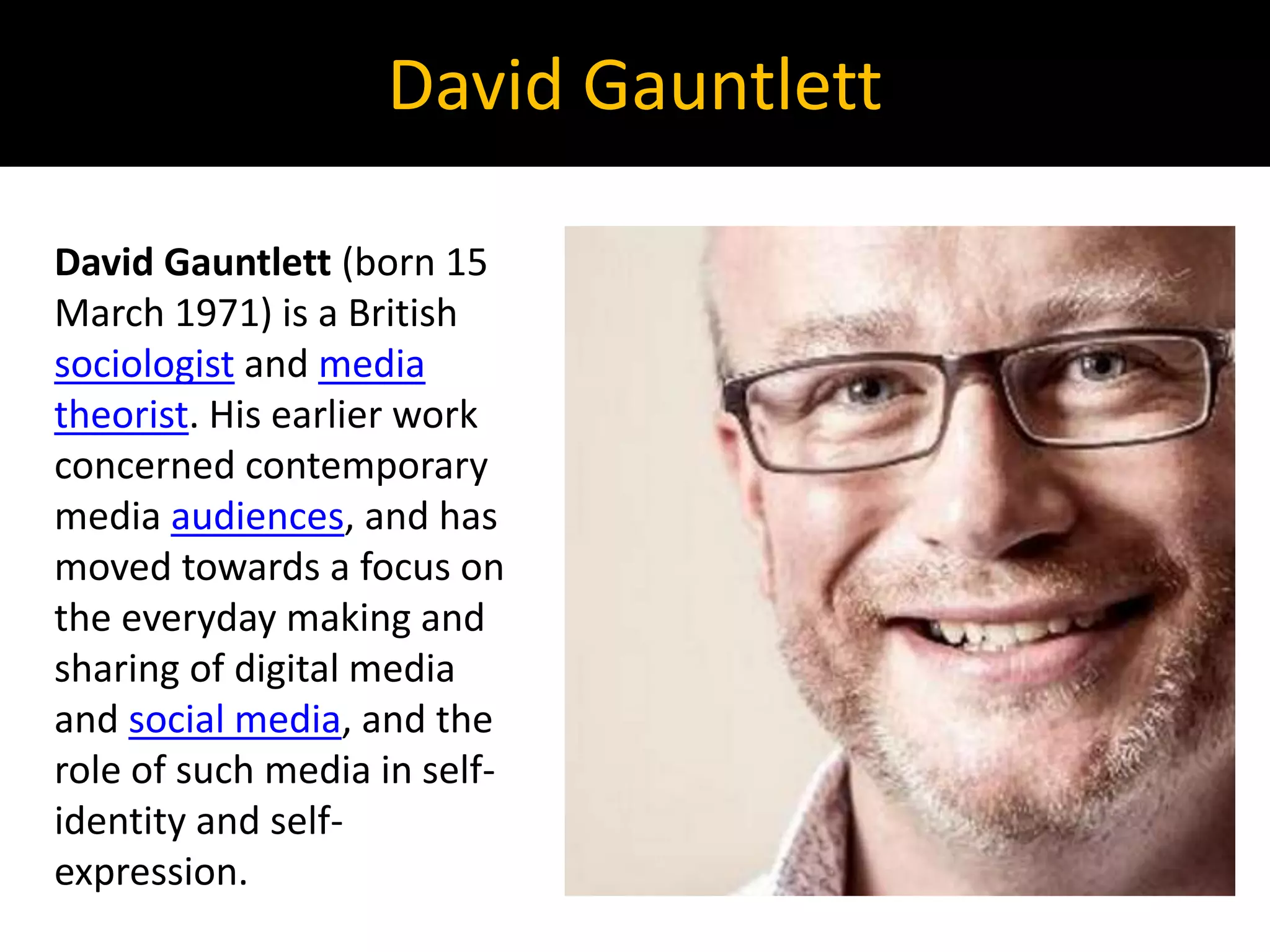
David Gauntlett (born 15
March 1971) is a British
sociologist and media
theorist. His earlier work
concerned contemporary
media audiences, and has
moved towards a focus on
the everyday making and
sharing of digital media
and social media, and the
role of such media in self-
identity and self-
expression.
“Identity is complicated. Everyone thinks they’ve got one. Magazines and talk
show hosts urge us to explore our ‘identity’. Religious and national identities are at
the heart of the major international conflicts. Artists play with the idea of
‘identity’ in the modern society. Blockbuster movie superheroes have emotional
conflicts about their ‘true’ identity. And the average teenager can create three
online ‘identities’ before breakfast…Thinking about self-identity and individuality
can cause some anxiety – at least in cultures where individuals are encouraged to
value their personal uniqueness. Each of us would like to think – to some extent –
that we have special, personal qualities, which make us distinctive and valuable to
the other people in our lives (or potential future friends). But does this mean
anything? Is individuality an illusion? Maybe we are all incredibly similar, but are
programmed to value minuscule bits of differentiation.”
(Gaunlett, David. Creative explorations: New approaches to identities and
audiences. Routledge, London. 2007)
David Gauntlett
“ I have argued against the view that men’s lifestyle magazines represent a
reassertion of old-fashioned masculine values, or a ‘back-lash’ against feminism.
Whilst certain pieces in the magazines might support such an argument, this is not
their primary purpose or selling point. Instead, their existence and popularity
shows men rather insecurely trying to find their place in the modern world,
seeking help regarding how to behave in their relationships and advice on how to
earn the attention, love and respect of women and the friendship of other men. In
post-traditional cultures, where identities are not ‘given’ but need to be
constructed and negotiated, and where an individual has to stablish their personal
ethics and mode of living, the magazines offer some reassurance to men who are
wondering ‘Is this right?’ and ‘Am I doing this OK?’, enabling a more confident
management of the narrative of the self”
(Gaunlett, David. Media, Gender, Identity. Routledge. London. 2002)
David Gauntlett
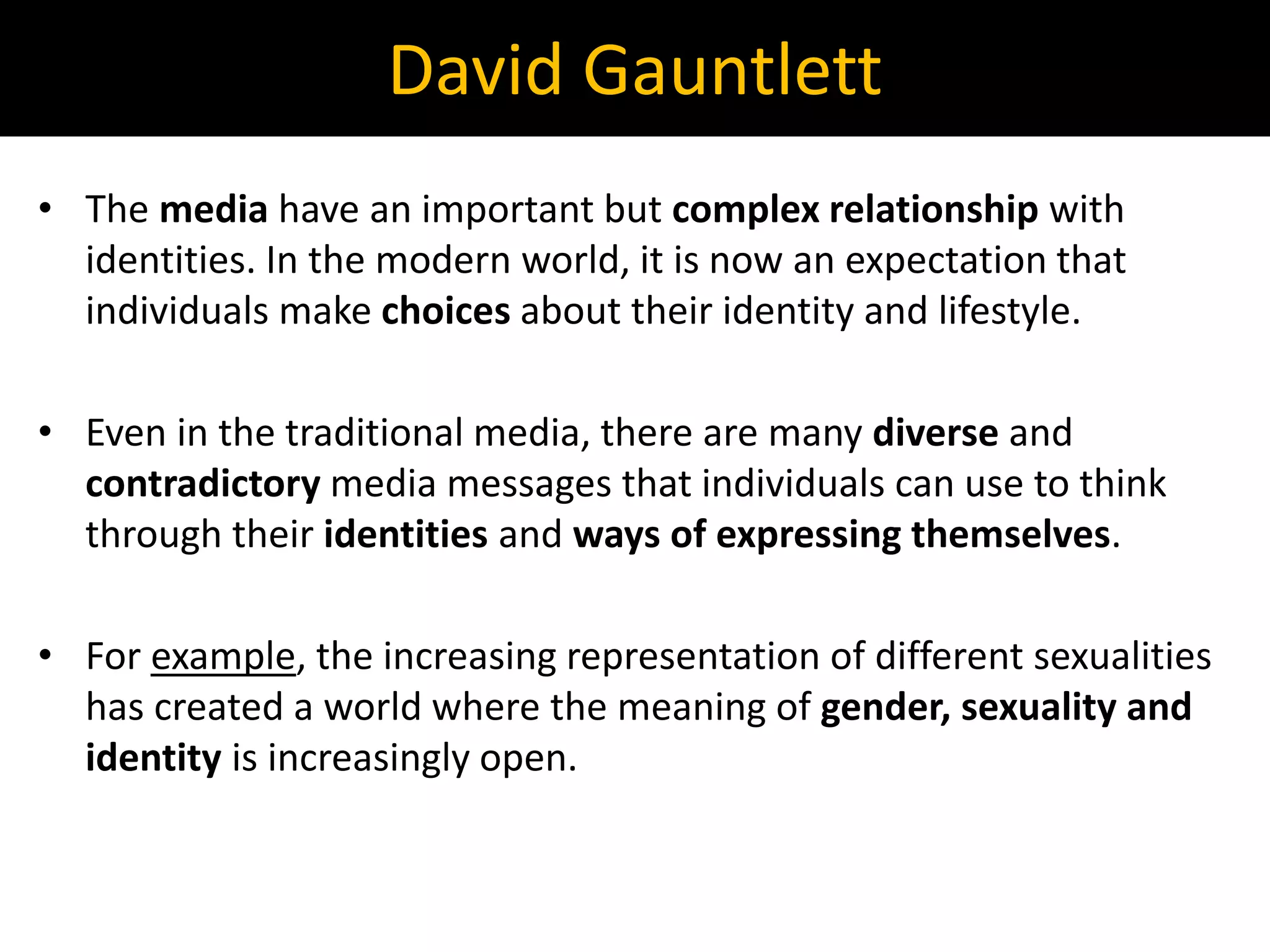
• The media have an important but complex relationship with
identities. In the modern world, it is now an expectation that
individuals make choices about their identity and lifestyle.
• Even in the traditional media, there are many diverse and
contradictory media messages that individuals can use to think
through their identities and ways of expressing themselves.
• For example, the increasing representation of different sexualities
has created a world where the meaning of gender, sexuality and
identity is increasingly open.
David Gauntlett
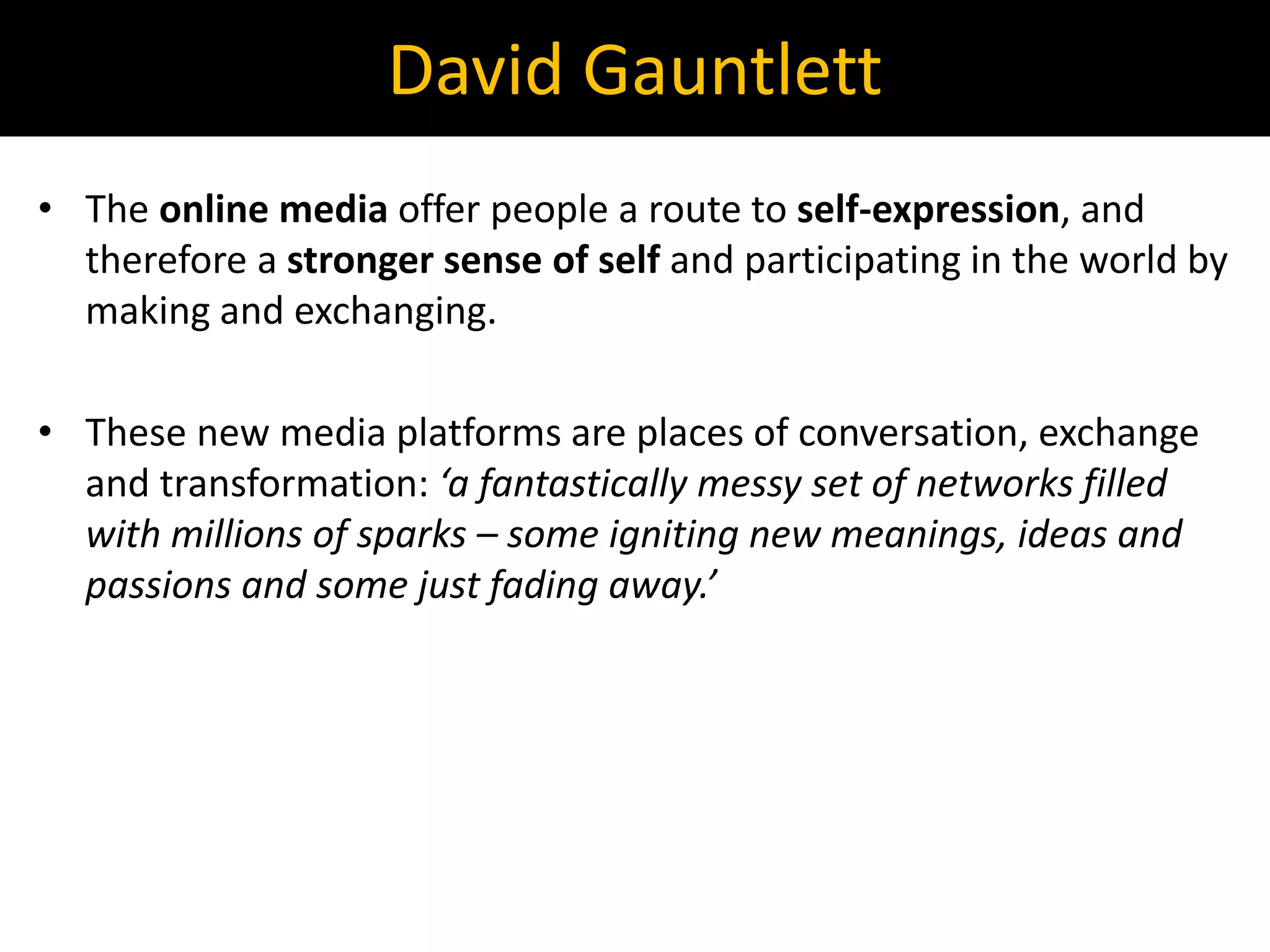
• The online media offer people a route to self-expression, and
therefore a stronger sense of self and participating in the world by
making and exchanging.
• These new media platforms are places of conversation, exchange
and transformation: ‘a fantastically messy set of networks filled
with millions of sparks – some igniting new meanings, ideas and
passions and some just fading away.’
David Gauntlett
David Gauntlett: Summary
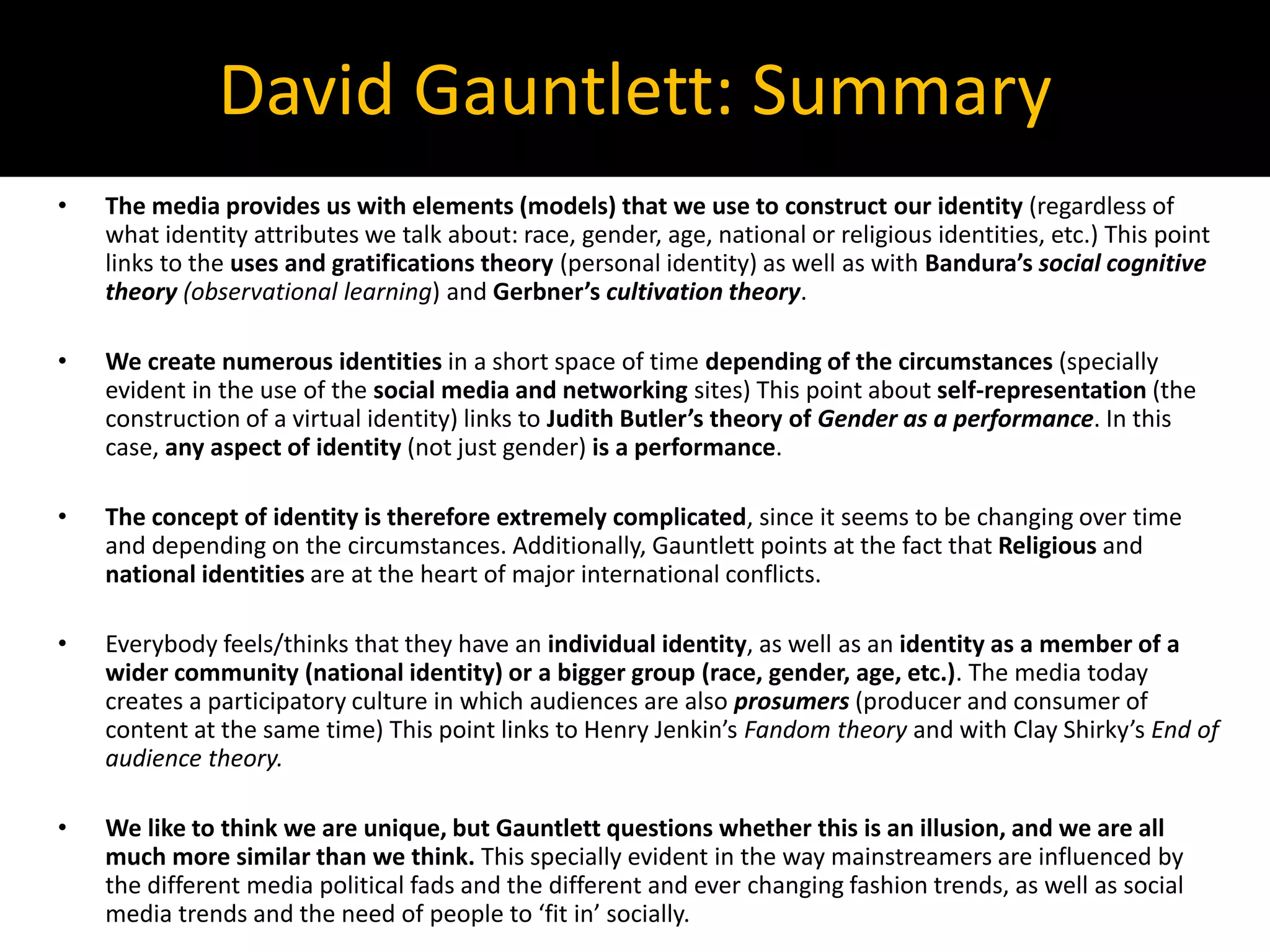
• The media provides us with elements (models) that we use to construct our identity (regardless of
what identity attributes we talk about: race, gender, age, national or religious identities, etc.) This point
links to the uses and gratifications theory (personal identity) as well as with Bandura’s social cognitive
theory (observational learning) and Gerbner’s cultivation theory.
• We create numerous identities in a short space of time depending of the circumstances (specially
evident in the use of the social media and networking sites) This point about self-representation (the
construction of a virtual identity) links to Judith Butler’s theory of Gender as a performance. In this
case, any aspect of identity (not just gender) is a performance.
• The concept of identity is therefore extremely complicated, since it seems to be changing over time
and depending on the circumstances. Additionally, Gauntlett points at the fact that Religious and
national identities are at the heart of major international conflicts.
• Everybody feels/thinks that they have an individual identity, as well as an identity as a member of a
wider community (national identity) or a bigger group (race, gender, age, etc.). The media today
creates a participatory culture in which audiences are also prosumers (producer and consumer of
content at the same time) This point links to Henry Jenkin’s Fandom theory and with Clay Shirky’s End of
audience theory.
• We like to think we are unique, but Gauntlett questions whether this is an illusion, and we are all
much more similar than we think. This specially evident in the way mainstreamers are influenced by
the different media political fads and the different and ever changing fashion trends, as well as social
media trends and the need of people to ‘fit in’ socially.

David Gaunlett Identity and media representation

  • 1.
    Representation theories 6: DavidGaunlett Identity and Media Representation
  • 2.
    David Gauntlett David Gauntlett(born 15 March 1971) is a British sociologist and media theorist. His earlier work concerned contemporary media audiences, and has moved towards a focus on the everyday making and sharing of digital media and social media, and the role of such media in self- identity and self- expression.
  • 3.
    “Identity is complicated.Everyone thinks they’ve got one. Magazines and talk show hosts urge us to explore our ‘identity’. Religious and national identities are at the heart of the major international conflicts. Artists play with the idea of ‘identity’ in the modern society. Blockbuster movie superheroes have emotional conflicts about their ‘true’ identity. And the average teenager can create three online ‘identities’ before breakfast…Thinking about self-identity and individuality can cause some anxiety – at least in cultures where individuals are encouraged to value their personal uniqueness. Each of us would like to think – to some extent – that we have special, personal qualities, which make us distinctive and valuable to the other people in our lives (or potential future friends). But does this mean anything? Is individuality an illusion? Maybe we are all incredibly similar, but are programmed to value minuscule bits of differentiation.” (Gaunlett, David. Creative explorations: New approaches to identities and audiences. Routledge, London. 2007) David Gauntlett
  • 4.
    “ I haveargued against the view that men’s lifestyle magazines represent a reassertion of old-fashioned masculine values, or a ‘back-lash’ against feminism. Whilst certain pieces in the magazines might support such an argument, this is not their primary purpose or selling point. Instead, their existence and popularity shows men rather insecurely trying to find their place in the modern world, seeking help regarding how to behave in their relationships and advice on how to earn the attention, love and respect of women and the friendship of other men. In post-traditional cultures, where identities are not ‘given’ but need to be constructed and negotiated, and where an individual has to stablish their personal ethics and mode of living, the magazines offer some reassurance to men who are wondering ‘Is this right?’ and ‘Am I doing this OK?’, enabling a more confident management of the narrative of the self” (Gaunlett, David. Media, Gender, Identity. Routledge. London. 2002) David Gauntlett
  • 5.
    • The mediahave an important but complex relationship with identities. In the modern world, it is now an expectation that individuals make choices about their identity and lifestyle. • Even in the traditional media, there are many diverse and contradictory media messages that individuals can use to think through their identities and ways of expressing themselves. • For example, the increasing representation of different sexualities has created a world where the meaning of gender, sexuality and identity is increasingly open. David Gauntlett
  • 6.
    • The onlinemedia offer people a route to self-expression, and therefore a stronger sense of self and participating in the world by making and exchanging. • These new media platforms are places of conversation, exchange and transformation: ‘a fantastically messy set of networks filled with millions of sparks – some igniting new meanings, ideas and passions and some just fading away.’ David Gauntlett
  • 7.
    David Gauntlett: Summary •The media provides us with elements (models) that we use to construct our identity (regardless of what identity attributes we talk about: race, gender, age, national or religious identities, etc.) This point links to the uses and gratifications theory (personal identity) as well as with Bandura’s social cognitive theory (observational learning) and Gerbner’s cultivation theory. • We create numerous identities in a short space of time depending of the circumstances (specially evident in the use of the social media and networking sites) This point about self-representation (the construction of a virtual identity) links to Judith Butler’s theory of Gender as a performance. In this case, any aspect of identity (not just gender) is a performance. • The concept of identity is therefore extremely complicated, since it seems to be changing over time and depending on the circumstances. Additionally, Gauntlett points at the fact that Religious and national identities are at the heart of major international conflicts. • Everybody feels/thinks that they have an individual identity, as well as an identity as a member of a wider community (national identity) or a bigger group (race, gender, age, etc.). The media today creates a participatory culture in which audiences are also prosumers (producer and consumer of content at the same time) This point links to Henry Jenkin’s Fandom theory and with Clay Shirky’s End of audience theory. • We like to think we are unique, but Gauntlett questions whether this is an illusion, and we are all much more similar than we think. This specially evident in the way mainstreamers are influenced by the different media political fads and the different and ever changing fashion trends, as well as social media trends and the need of people to ‘fit in’ socially.