Meghan Vs Kate in the newspapers
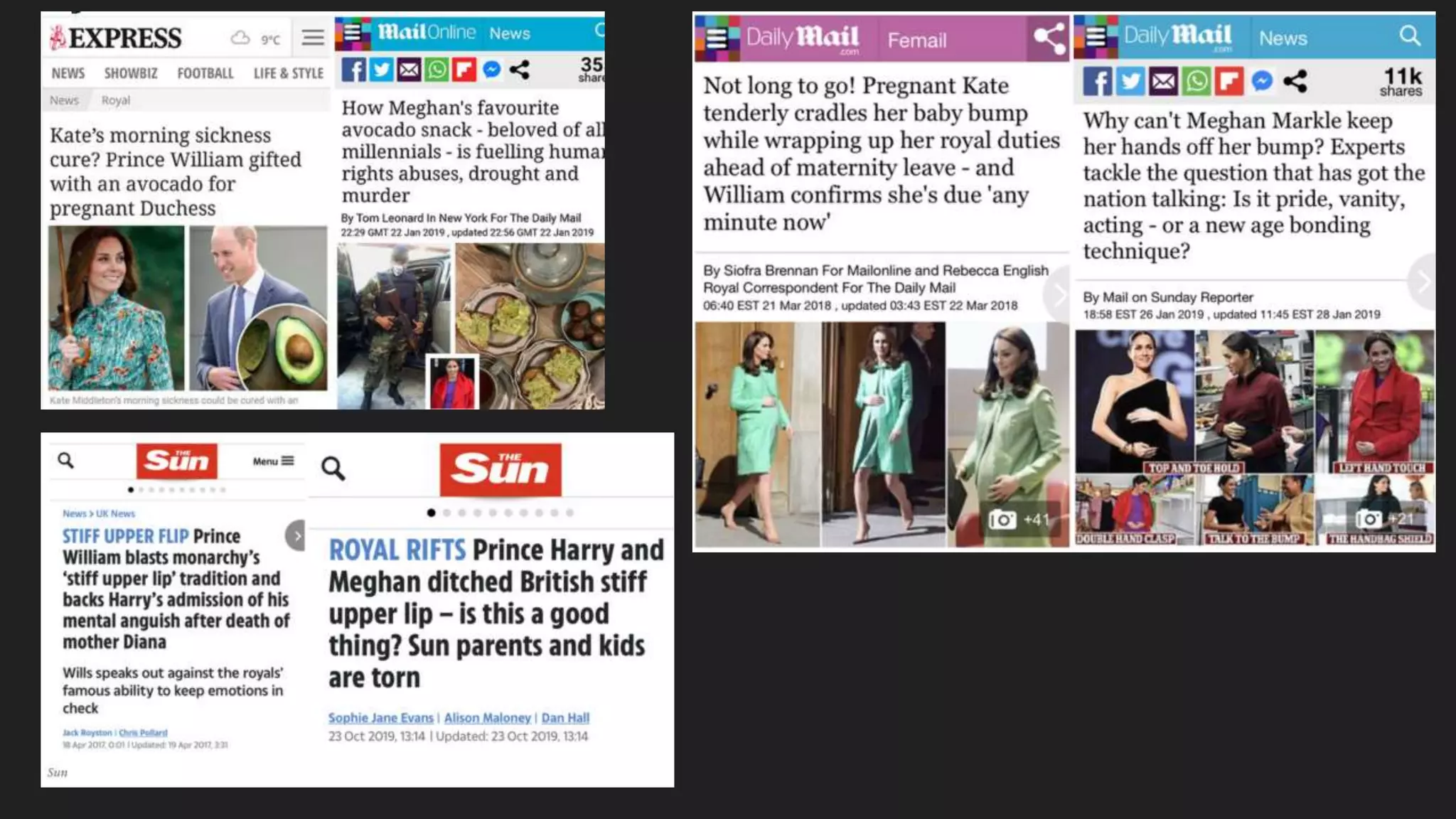
 Online commentators have noticed the way that Princess Kate (Duchess of Cornwall) and Princess Meghan
(Duchess of Sussex) are treated differently in the newspapers.
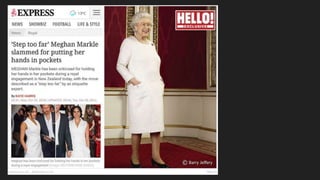
 Here are a few comparison of how the two women are treated differently by the same newspapers when
doing the same thing.
 The UK press’s hostile treatment of Princess Meghan was cited as one of the reasons for them moving out
of the country and relinquishing some of their Royal duties.
 Harry and Meghan are also suing several of the newspapers
Is race a factor?
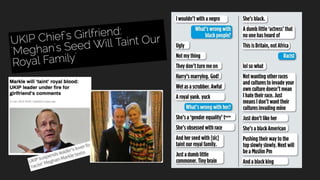
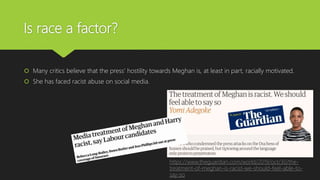
 Many critics believe that the press’ hostility towards Meghan is, at least in part, racially motivated.
 She has faced racist abuse on social media.
https://www.theguardian.com/world/2019/oct/30/the-
treatment-of-meghan-is-racist-we-should-feel-able-to-
say-so
Race in the Media
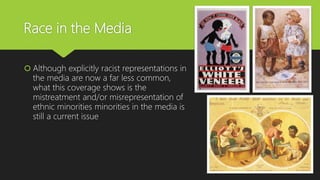
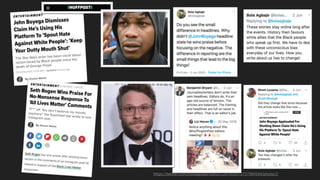
 Although explicitly racist representations in
the media are now a far less common,
what this coverage shows is the
mistreatment and/or misrepresentation of
ethnic minorities minorities in the media is
still a current issue
https://twitter.com/bolaagbaje/status/1267859371737964544/photo/2
A2 Media:
Post Colonialism
Linking the Representation of Race and Ethnicity in the Media and the Legacy of Empire
A brief history of colonialism…
 Complete this Kahoot presentation/quiz for a short history of colonialism, empire and slavery:
https://create.kahoot.it/v2/details/2ba17515-8a9f-4cd2-92d3-8f6213ffe44b
Summarising Colonialism
Colonialism is a product of imperialism (building empires)
Most European countries, including Britain, have a history of military
imperialism.
They attempted to build their empires by the conquest of less
developed countries across the globe and imposed their rule upon
them, usually to ensure a supply of cheap raw materials (and slave
labour) to help support the development of European economies.
Summarising Colonialism
The British Empire was the largest of these and a
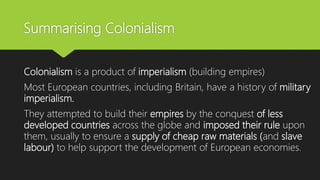
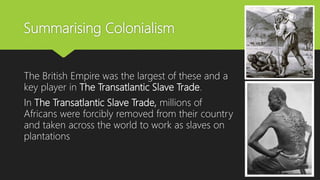
key player in The Transatlantic Slave Trade.
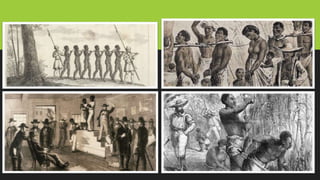
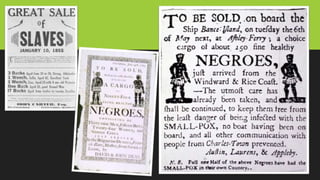
In The Transatlantic Slave Trade, millions of
Africans were forcibly removed from their country
and taken across the world to work as slaves on
plantations
Post Colonialism
Post Colonialism examines the legacy of colonialism and its long term
impact upon society.
Media theorists argue that the beliefs and values used to justify the
enslavement of Africans and colonization of non-European countries in the
past can be linked with the negative representations and treatment of black
and other ethnic minorities in the media today.
Representation of Race & Ethnicity
In Western Countries, most powerful positions in society, politics and the
media are occupied by white, Europeans.
They are able to control public discourse around race and ethnicity, including
via construction of media representations.
There are relatively few opportunities for ‘self representation’ of ethnic minority
groups.
Symbolic Annihilation
In the past ethnic minorities have often been underrepresented in the media,
lessening their ‘status’ and power in the real world This is called symbolic
annihilation (Gerbner, Hall). .
This also means that when they are represented, there is a greater burden of
representation upon them as audiences get to see a less diverse range of
representations.
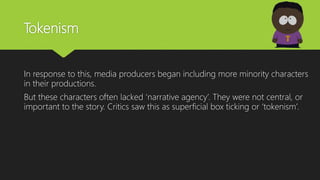
Tokenism
In response to this, media producers began including more minority characters
in their productions.
But these characters often lacked ‘narrative agency’. They were not central, or
important to the story. Critics saw this as superficial box ticking or ‘tokenism’.
Representation onscreen/offscreen
Today, we see more ethnic minorities represented in the media, so they are
more visible.
However, they are still underrepresented among the people who produce the
media, meaning that their ‘voice’ is still often unheard.
Representation onscreen/offscreen
A 2020 study by women in journalism found that there was a serious lack of diversity in UK
newsrooms https://womeninjournalism.co.uk/lack-diversity-british-newsrooms/
Following BLM campaigns in spring 2020, they studied a ‘snapshot’ of British TV.
They examined the presence of black and minority groups on prime time radio and TV news
programmes and the front pages of all national newspapers for a week 13-19th July 2020. Key
findings:
Not a single story by a Black reporter appeared on the front page of a UK newspaper
Just three BAME women were quoted on front pages of the newspapers over the course of the
week
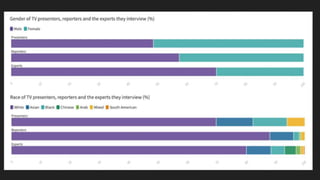
Only a 12 per cent of TV reporters on these top TV shows were Black or BAME
Newsnight failed to include a single non-white expert guest.
Media Show podcast https://www.bbc.co.uk/programmes/m000mktr (6mins,
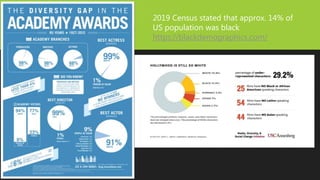
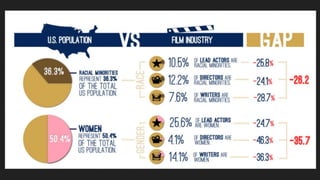
2019 Census stated that approx. 14% of
US population was black
https://blackdemographics.com/
Hall, Stereotypes and inequalities of power
 Cultural Theorist Stuart Hall noted that stereotypes tend to occur where there are inequalities of
power.
 Groups with power and that create representations are less likely to be stereotyped.
 Groups with less power/status are more likely to be stereotyped.
Justifications for colonialism
The basic assumptions in defence of colonial actions were:
 The colonized are savages in need of education and rehabilitation
 The culture of the colonized is not up to the standard of the colonizer
 The colonized nation is unable to manage and run itself properly, and thus it needs
the wisdom and expertise of the colonizer.
 The colonized nation embraces a set of religious beliefs incompatible with those of
the colonizer
 The colonized people pose dangerous threat to themselves and to the civilized
world if left alone
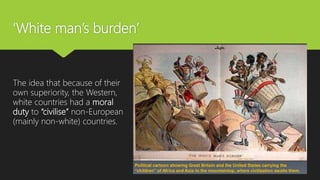
‘White man’s burden’
The idea that because of their
own superiority, the Western,
white countries had a moral
duty to “civilise” non-European
(mainly non-white) countries.
Justifying Colonialism
White, Western (European) viewed themselves as simply superior and as a
positive, ‘civilizing’ force upon the other, foreign, ‘primitive’ cultures and countries.
This superiority is presented as either in opposition to ‘savage’, dangerous and
‘uncivilised’ cultures that need taming, or ‘pitiful’, helpless and feckless peoples
who need our help.
In either case, the emphasis is on how different white and non-white cultures
were, rather than how similar.
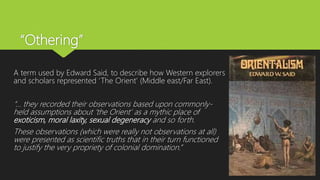
“Othering”
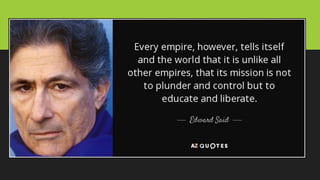
A term used by Edward Said, to describe how Western explorers
and scholars represented ‘The Orient’ (Middle east/Far East).
“... they recorded their observations based upon commonly-
held assumptions about ‘the Orient’ as a mythic place of
exoticism, moral laxity, sexual degeneracy and so forth.
These observations (which were really not observations at all)
were presented as scientific truths that in their turn functioned
to justify the very propriety of colonial domination.”
“Othering”
Stuart Hall and others have since used it to explain the way that dominant
social groups groups exert power over minority groups by representing them
as ‘the other’.
Doing this highlights how ‘different’ another country and its people are.
It tells the reader/audience that the other culture are ‘not the same’, that the
people are “not like us”.
It creates an “us vs them” narrative.
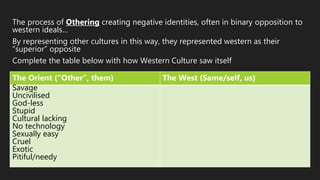
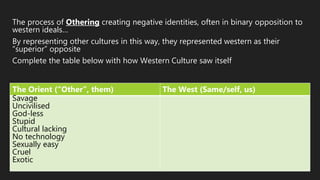
The process of Othering creating negative identities, often in binary opposition to
western ideals…
By representing other cultures in this way, they represented western as their
“superior” opposite
Complete the table below with how Western Culture saw itself
The Orient (“Other”, them) The West (Same/self, us)
Savage
Uncivilised
God-less
Stupid
Cultural lacking
No technology
Sexually easy
Cruel
Exotic
Pitiful/needy
The process of Othering creating negative identities, often in binary opposition to
western ideals…
By representing other cultures in this way, they represented western as their
“superior” opposite
Complete the table below with how Western Culture saw itself
The Orient (“Other”, them) The West (Same/self, us)
Savage
Uncivilised
God-less
Stupid
Cultural lacking
No technology
Sexually easy
Cruel
Exotic
Empires today
 Most of the old former empires established through military have now
desolved.
 But some countries still seem to exert significant power/influence over
others
 Why do you think that is?
 How do they do it?
Hollywood and Hegemony
Through a successful film industry, America is able to export not only it’s
films, but also its values and beliefs – its ideologies.
The history of Hollywood exemplifies this from 1917 onwards, when
President Wilson said ‘We need Hollywood to sell America’ , referring
not just to products such as Coca Cola and McDonalds or Levi’s, but
also selling its ethnocentric history, its cultural artefacts and its ideologies
(e.g. ‘The American Dream’)
Discuss: Consider what ideas, values and beliefs America is able to export
through its cultural exports. What examples can you think of?
Hollywood and Hegemony
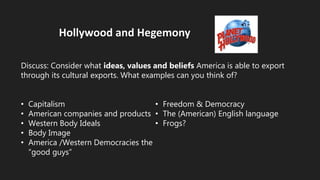
Discuss: Consider what ideas, values and beliefs America is able to export
through its cultural exports. What examples can you think of?
• Capitalism
• American companies and products
• Western Body Ideals
• Body Image
• America /Western Democracies the
“good guys”
• Freedom & Democracy
• The (American) English language
• Frogs?
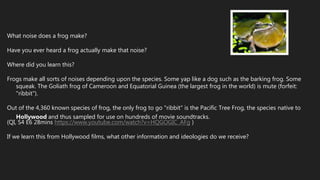
What noise does a frog make?
Have you ever heard a frog actually make that noise?
Where did you learn this?
Frogs make all sorts of noises depending upon the species. Some yap like a dog such as the barking frog. Some
squeak. The Goliath frog of Cameroon and Equatorial Guinea (the largest frog in the world) is mute (forfeit:
"ribbit").
Out of the 4,360 known species of frog, the only frog to go "ribbit" is the Pacific Tree Frog, the species native to
Hollywood and thus sampled for use on hundreds of movie soundtracks.
(QI, S4 E6 28mins https://www.youtube.com/watch?v=HQGOGIC_AFg )
If we learn this from Hollywood films, what other information and ideologies do we receive?
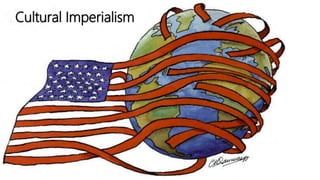
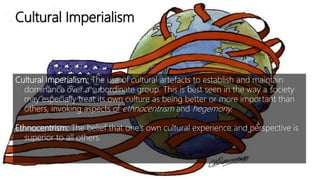
Cultural Imperialism
Cultural Imperialism: The use of cultural artefacts to establish and maintain
dominance over a subordinate group. This is best seen in the way a society
may especially treat its own culture as being better or more important than
others, invoking aspects of ethnocentrism and hegemony.
Ethnocentrism: The belief that one’s own cultural experience and perspective is
superior to all others.
Manuel Alvarado (1987)
Identified 4 common themes/stereotypes for ethnic minorities
in the media:
Dangerous
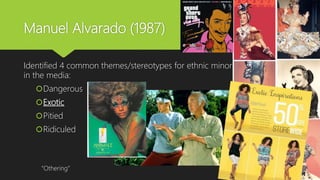
Exotic
Pitied
Ridiculed
Manuel Alvarado (1987)
Identified 4 common themes/stereotypes for ethnic minorities
in the media:
Dangerous
Exotic
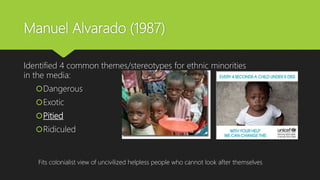
Pitied
Ridiculed
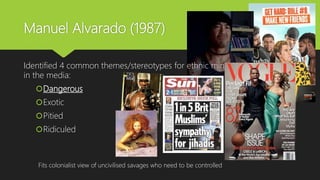
Manuel Alvarado (1987)
Identified 4 common themes/stereotypes for ethnic minorities
in the media:
Dangerous
Exotic
Pitied
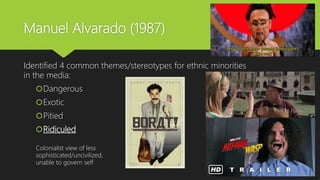
Ridiculed
Fits colonialist view of uncivilised savages who need to be controlled
Manuel Alvarado (1987)
Identified 4 common themes/stereotypes for ethnic minorities
in the media:
Dangerous
Exotic
Pitied
Ridiculed
“Othering”
Manuel Alvarado (1987)
Identified 4 common themes/stereotypes for ethnic minorities
in the media:
Dangerous
Exotic
Pitied
Ridiculed
Fits colonialist view of uncivilized helpless people who cannot look after themselves
Manuel Alvarado (1987)
Identified 4 common themes/stereotypes for ethnic minorities
in the media:
Dangerous
Exotic
Pitied
Ridiculed
Colonialist view of less
sophisticated/uncivilized,
unable to govern self
Stuart Hall’s ideas about Representation: Summary
• Representation is the production of meaning through language, with language defined in
its broadest sense as a system of signs
• The relationship between concepts and signs is governed by codes
• Stereotyping, as a form of representation, reduces people to a few simple characteristics
or traits
• Stereotyping tends to occur where there are inequalities of power, as subordinate or
excluded groups are constructed as different or ‘other’ (e.g. through ethnocentrism)
Stuart Hall (Y1 reminder)
https://www.youtube.com/watch?v=GzAJCoU9dLk
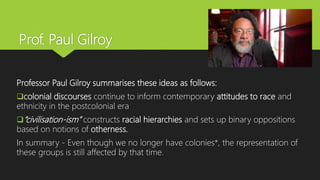
Prof. Paul Gilroy
Professor Paul Gilroy summarises these ideas as follows:
colonial discourses continue to inform contemporary attitudes to race and
ethnicity in the postcolonial era
“civilisation-ism” constructs racial hierarchies and sets up binary oppositions
based on notions of otherness.
In summary - Even though we no longer have colonies*, the representation of
these groups is still affected by that time.

A2 Media Studies: Post colonialist Theory (2020)

  • 2.
    Meghan Vs Katein the newspapers  Online commentators have noticed the way that Princess Kate (Duchess of Cornwall) and Princess Meghan (Duchess of Sussex) are treated differently in the newspapers.  Here are a few comparison of how the two women are treated differently by the same newspapers when doing the same thing.  The UK press’s hostile treatment of Princess Meghan was cited as one of the reasons for them moving out of the country and relinquishing some of their Royal duties.  Harry and Meghan are also suing several of the newspapers
  • 6.
    Is race afactor?  Many critics believe that the press’ hostility towards Meghan is, at least in part, racially motivated.  She has faced racist abuse on social media. https://www.theguardian.com/world/2019/oct/30/the- treatment-of-meghan-is-racist-we-should-feel-able-to- say-so
  • 7.
    Race in theMedia  Although explicitly racist representations in the media are now a far less common, what this coverage shows is the mistreatment and/or misrepresentation of ethnic minorities minorities in the media is still a current issue
  • 8.
  • 9.
    A2 Media: Post Colonialism Linkingthe Representation of Race and Ethnicity in the Media and the Legacy of Empire
  • 10.
    A brief historyof colonialism…  Complete this Kahoot presentation/quiz for a short history of colonialism, empire and slavery: https://create.kahoot.it/v2/details/2ba17515-8a9f-4cd2-92d3-8f6213ffe44b
  • 11.
    Summarising Colonialism Colonialism isa product of imperialism (building empires) Most European countries, including Britain, have a history of military imperialism. They attempted to build their empires by the conquest of less developed countries across the globe and imposed their rule upon them, usually to ensure a supply of cheap raw materials (and slave labour) to help support the development of European economies.
  • 12.
    Summarising Colonialism The BritishEmpire was the largest of these and a key player in The Transatlantic Slave Trade. In The Transatlantic Slave Trade, millions of Africans were forcibly removed from their country and taken across the world to work as slaves on plantations
  • 15.
    Post Colonialism Post Colonialismexamines the legacy of colonialism and its long term impact upon society. Media theorists argue that the beliefs and values used to justify the enslavement of Africans and colonization of non-European countries in the past can be linked with the negative representations and treatment of black and other ethnic minorities in the media today.
  • 16.
    Representation of Race& Ethnicity In Western Countries, most powerful positions in society, politics and the media are occupied by white, Europeans. They are able to control public discourse around race and ethnicity, including via construction of media representations. There are relatively few opportunities for ‘self representation’ of ethnic minority groups.
  • 17.
    Symbolic Annihilation In thepast ethnic minorities have often been underrepresented in the media, lessening their ‘status’ and power in the real world This is called symbolic annihilation (Gerbner, Hall). . This also means that when they are represented, there is a greater burden of representation upon them as audiences get to see a less diverse range of representations.
  • 18.
    Tokenism In response tothis, media producers began including more minority characters in their productions. But these characters often lacked ‘narrative agency’. They were not central, or important to the story. Critics saw this as superficial box ticking or ‘tokenism’.
  • 19.
    Representation onscreen/offscreen Today, wesee more ethnic minorities represented in the media, so they are more visible. However, they are still underrepresented among the people who produce the media, meaning that their ‘voice’ is still often unheard.
  • 20.
    Representation onscreen/offscreen A 2020study by women in journalism found that there was a serious lack of diversity in UK newsrooms https://womeninjournalism.co.uk/lack-diversity-british-newsrooms/ Following BLM campaigns in spring 2020, they studied a ‘snapshot’ of British TV. They examined the presence of black and minority groups on prime time radio and TV news programmes and the front pages of all national newspapers for a week 13-19th July 2020. Key findings: Not a single story by a Black reporter appeared on the front page of a UK newspaper Just three BAME women were quoted on front pages of the newspapers over the course of the week Only a 12 per cent of TV reporters on these top TV shows were Black or BAME Newsnight failed to include a single non-white expert guest. Media Show podcast https://www.bbc.co.uk/programmes/m000mktr (6mins,
  • 22.
    2019 Census statedthat approx. 14% of US population was black https://blackdemographics.com/
  • 24.
    Hall, Stereotypes andinequalities of power  Cultural Theorist Stuart Hall noted that stereotypes tend to occur where there are inequalities of power.  Groups with power and that create representations are less likely to be stereotyped.  Groups with less power/status are more likely to be stereotyped.
  • 25.
    Justifications for colonialism Thebasic assumptions in defence of colonial actions were:  The colonized are savages in need of education and rehabilitation  The culture of the colonized is not up to the standard of the colonizer  The colonized nation is unable to manage and run itself properly, and thus it needs the wisdom and expertise of the colonizer.  The colonized nation embraces a set of religious beliefs incompatible with those of the colonizer  The colonized people pose dangerous threat to themselves and to the civilized world if left alone
  • 27.
    ‘White man’s burden’ Theidea that because of their own superiority, the Western, white countries had a moral duty to “civilise” non-European (mainly non-white) countries.
  • 28.
    Justifying Colonialism White, Western(European) viewed themselves as simply superior and as a positive, ‘civilizing’ force upon the other, foreign, ‘primitive’ cultures and countries. This superiority is presented as either in opposition to ‘savage’, dangerous and ‘uncivilised’ cultures that need taming, or ‘pitiful’, helpless and feckless peoples who need our help. In either case, the emphasis is on how different white and non-white cultures were, rather than how similar.
  • 29.
    “Othering” A term usedby Edward Said, to describe how Western explorers and scholars represented ‘The Orient’ (Middle east/Far East). “... they recorded their observations based upon commonly- held assumptions about ‘the Orient’ as a mythic place of exoticism, moral laxity, sexual degeneracy and so forth. These observations (which were really not observations at all) were presented as scientific truths that in their turn functioned to justify the very propriety of colonial domination.”
  • 30.
    “Othering” Stuart Hall andothers have since used it to explain the way that dominant social groups groups exert power over minority groups by representing them as ‘the other’. Doing this highlights how ‘different’ another country and its people are. It tells the reader/audience that the other culture are ‘not the same’, that the people are “not like us”. It creates an “us vs them” narrative.
  • 31.
    The process ofOthering creating negative identities, often in binary opposition to western ideals… By representing other cultures in this way, they represented western as their “superior” opposite Complete the table below with how Western Culture saw itself The Orient (“Other”, them) The West (Same/self, us) Savage Uncivilised God-less Stupid Cultural lacking No technology Sexually easy Cruel Exotic Pitiful/needy
  • 32.
    The process ofOthering creating negative identities, often in binary opposition to western ideals… By representing other cultures in this way, they represented western as their “superior” opposite Complete the table below with how Western Culture saw itself The Orient (“Other”, them) The West (Same/self, us) Savage Uncivilised God-less Stupid Cultural lacking No technology Sexually easy Cruel Exotic
  • 33.
    Empires today  Mostof the old former empires established through military have now desolved.  But some countries still seem to exert significant power/influence over others  Why do you think that is?  How do they do it?
  • 34.
    Hollywood and Hegemony Througha successful film industry, America is able to export not only it’s films, but also its values and beliefs – its ideologies. The history of Hollywood exemplifies this from 1917 onwards, when President Wilson said ‘We need Hollywood to sell America’ , referring not just to products such as Coca Cola and McDonalds or Levi’s, but also selling its ethnocentric history, its cultural artefacts and its ideologies (e.g. ‘The American Dream’) Discuss: Consider what ideas, values and beliefs America is able to export through its cultural exports. What examples can you think of?
  • 35.
    Hollywood and Hegemony Discuss:Consider what ideas, values and beliefs America is able to export through its cultural exports. What examples can you think of? • Capitalism • American companies and products • Western Body Ideals • Body Image • America /Western Democracies the “good guys” • Freedom & Democracy • The (American) English language • Frogs?
  • 36.
    What noise doesa frog make? Have you ever heard a frog actually make that noise? Where did you learn this? Frogs make all sorts of noises depending upon the species. Some yap like a dog such as the barking frog. Some squeak. The Goliath frog of Cameroon and Equatorial Guinea (the largest frog in the world) is mute (forfeit: "ribbit"). Out of the 4,360 known species of frog, the only frog to go "ribbit" is the Pacific Tree Frog, the species native to Hollywood and thus sampled for use on hundreds of movie soundtracks. (QI, S4 E6 28mins https://www.youtube.com/watch?v=HQGOGIC_AFg ) If we learn this from Hollywood films, what other information and ideologies do we receive?
  • 37.
  • 38.
    Cultural Imperialism Cultural Imperialism:The use of cultural artefacts to establish and maintain dominance over a subordinate group. This is best seen in the way a society may especially treat its own culture as being better or more important than others, invoking aspects of ethnocentrism and hegemony. Ethnocentrism: The belief that one’s own cultural experience and perspective is superior to all others.
  • 39.
    Manuel Alvarado (1987) Identified4 common themes/stereotypes for ethnic minorities in the media: Dangerous Exotic Pitied Ridiculed
  • 40.
    Manuel Alvarado (1987) Identified4 common themes/stereotypes for ethnic minorities in the media: Dangerous Exotic Pitied Ridiculed
  • 41.
    Manuel Alvarado (1987) Identified4 common themes/stereotypes for ethnic minorities in the media: Dangerous Exotic Pitied Ridiculed Fits colonialist view of uncivilised savages who need to be controlled
  • 42.
    Manuel Alvarado (1987) Identified4 common themes/stereotypes for ethnic minorities in the media: Dangerous Exotic Pitied Ridiculed “Othering”
  • 43.
    Manuel Alvarado (1987) Identified4 common themes/stereotypes for ethnic minorities in the media: Dangerous Exotic Pitied Ridiculed Fits colonialist view of uncivilized helpless people who cannot look after themselves
  • 44.
    Manuel Alvarado (1987) Identified4 common themes/stereotypes for ethnic minorities in the media: Dangerous Exotic Pitied Ridiculed Colonialist view of less sophisticated/uncivilized, unable to govern self
  • 45.
    Stuart Hall’s ideasabout Representation: Summary • Representation is the production of meaning through language, with language defined in its broadest sense as a system of signs • The relationship between concepts and signs is governed by codes • Stereotyping, as a form of representation, reduces people to a few simple characteristics or traits • Stereotyping tends to occur where there are inequalities of power, as subordinate or excluded groups are constructed as different or ‘other’ (e.g. through ethnocentrism) Stuart Hall (Y1 reminder)
  • 46.
  • 47.
    Prof. Paul Gilroy ProfessorPaul Gilroy summarises these ideas as follows: colonial discourses continue to inform contemporary attitudes to race and ethnicity in the postcolonial era “civilisation-ism” constructs racial hierarchies and sets up binary oppositions based on notions of otherness. In summary - Even though we no longer have colonies*, the representation of these groups is still affected by that time.

Editor's Notes

  • #28 There are a number of arguments as to why colonisation happened – these are important to consider when we come to learn more about postcolonial theory since they can give you areas to critically debate.