Typologies of
Community
Grade 12 - HUMSS
PUZZLE ACTIVITY
Learning Targets
Compare and contrast typologies of
communities.
1.
Community Typologies
Gemeinschaft and Gesellschaft
-ideal types of human associations found in
communities. They were develop by German
sociologist Ferdinand Tonnies in his classic
work Gemeinschaft und Gesellschaft published
in 1887.
Gemeinschaft
-refers to human associations that are
characterized by being intimate, informal, caring,
homogenous and group welfare-oriented.
Gesellschaft
-pertains to human associations that are
characterized by being impersonal, formal,
rational, heterogenous and individualistically
oriented.
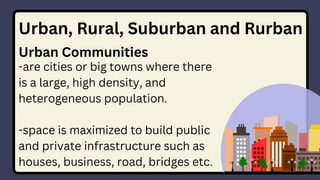
Urban, Rural, Suburban and Rurban
Urban Communities
-are cities or big towns where there
is a large, high density, and
heterogeneous population.
-space is maximized to build public
and private infrastructure such as
houses, business, road, bridges etc.
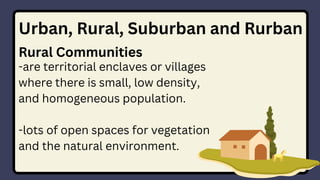
Urban, Rural, Suburban and Rurban
Rural Communities
-are territorial enclaves or villages
where there is small, low density,
and homogeneous population.
-lots of open spaces for vegetation
and the natural environment.
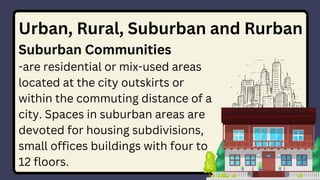
Urban, Rural, Suburban and Rurban
Suburban Communities
-are residential or mix-used areas
located at the city outskirts or
within the commuting distance of a
city. Spaces in suburban areas are
devoted for housing subdivisions,
small offices buildings with four to
12 floors.
Urban, Rural, Suburban and Rurban
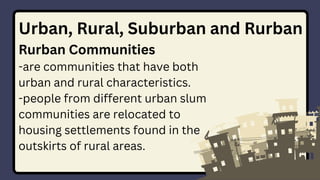
Rurban Communities
-are communities that have both
urban and rural characteristics.
-people from different urban slum
communities are relocated to
housing settlements found in the
outskirts of rural areas.
LOCAL AND GLOBAL
COMMUNITIES
Local Community
-a term often used to denote a
geographical bounded community such
as territorial enclave, village, barangay,
town, city, municipality, province, region
or even an entire country depending on
the point of reference.
LOCAL AND GLOBAL
COMMUNITIES
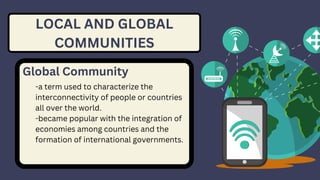
Global Community
-a term used to characterize the
interconnectivity of people or countries
all over the world.
-became popular with the integration of
economies among countries and the
formation of international governments.
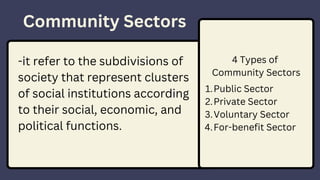
Community Sectors
-it refer to the subdivisions of
society that represent clusters
of social institutions according
to their social, economic, and
political functions.
4 Types of
Community Sectors
Public Sector
Private Sector
Voluntary Sector
For-benefit Sector
1.
2.
3.
4.
Public Sector
-a term referto the government
and its agencies.
-it is responsible for promoting
the common good, providing
security from external threats,
and maintaining peace and
order.
Private Sector
-is used to refer to businesses
or enterprises that are
responsible for producing
goods and services to meet
people's needs and wants,
promoting economic growth
and generating wealth.
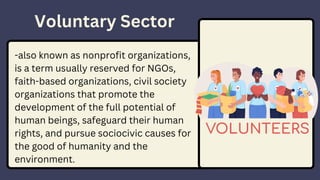
Voluntary Sector
-also known as nonprofit organizations,
is a term usually reserved for NGOs,
faith-based organizations, civil society
organizations that promote the
development of the full potential of
human beings, safeguard their human
rights, and pursue sociocivic causes for
the good of humanity and the
environment.
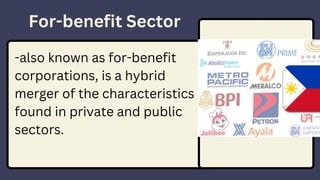
For-benefit Sector
-also known as for-benefit
corporations, is a hybrid
merger of the characteristics
found in private and public
sectors.
SOCIAL SPACE
is either a geographical or a virtual
community where the people gather or
network with one another due to common
interests.
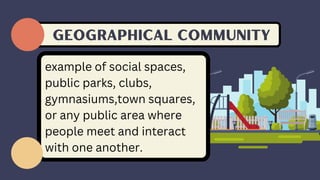
Geographical community
example of social spaces,
public parks, clubs,
gymnasiums,town squares,
or any public area where
people meet and interact
with one another.
VIRTUAL community
social space refers to electronic
hubs or forums where people
use the Internet and other
social media outlets or
platforms as a channel of
communication, interaction,
and exhange of ideas.
Typologies of Community.pdf

Typologies of Community.pdf

  • 1.
  • 2.
  • 8.
    Learning Targets Compare andcontrast typologies of communities. 1.
  • 9.
    Community Typologies Gemeinschaft andGesellschaft -ideal types of human associations found in communities. They were develop by German sociologist Ferdinand Tonnies in his classic work Gemeinschaft und Gesellschaft published in 1887.
  • 10.
    Gemeinschaft -refers to humanassociations that are characterized by being intimate, informal, caring, homogenous and group welfare-oriented. Gesellschaft -pertains to human associations that are characterized by being impersonal, formal, rational, heterogenous and individualistically oriented.
  • 11.
    Urban, Rural, Suburbanand Rurban Urban Communities -are cities or big towns where there is a large, high density, and heterogeneous population. -space is maximized to build public and private infrastructure such as houses, business, road, bridges etc.
  • 12.
    Urban, Rural, Suburbanand Rurban Rural Communities -are territorial enclaves or villages where there is small, low density, and homogeneous population. -lots of open spaces for vegetation and the natural environment.
  • 13.
    Urban, Rural, Suburbanand Rurban Suburban Communities -are residential or mix-used areas located at the city outskirts or within the commuting distance of a city. Spaces in suburban areas are devoted for housing subdivisions, small offices buildings with four to 12 floors.
  • 14.
    Urban, Rural, Suburbanand Rurban Rurban Communities -are communities that have both urban and rural characteristics. -people from different urban slum communities are relocated to housing settlements found in the outskirts of rural areas.
  • 15.
    LOCAL AND GLOBAL COMMUNITIES LocalCommunity -a term often used to denote a geographical bounded community such as territorial enclave, village, barangay, town, city, municipality, province, region or even an entire country depending on the point of reference.
  • 16.
    LOCAL AND GLOBAL COMMUNITIES GlobalCommunity -a term used to characterize the interconnectivity of people or countries all over the world. -became popular with the integration of economies among countries and the formation of international governments.
  • 17.
    Community Sectors -it referto the subdivisions of society that represent clusters of social institutions according to their social, economic, and political functions. 4 Types of Community Sectors Public Sector Private Sector Voluntary Sector For-benefit Sector 1. 2. 3. 4.
  • 18.
    Public Sector -a termreferto the government and its agencies. -it is responsible for promoting the common good, providing security from external threats, and maintaining peace and order.
  • 19.
    Private Sector -is usedto refer to businesses or enterprises that are responsible for producing goods and services to meet people's needs and wants, promoting economic growth and generating wealth.
  • 20.
    Voluntary Sector -also knownas nonprofit organizations, is a term usually reserved for NGOs, faith-based organizations, civil society organizations that promote the development of the full potential of human beings, safeguard their human rights, and pursue sociocivic causes for the good of humanity and the environment.
  • 21.
    For-benefit Sector -also knownas for-benefit corporations, is a hybrid merger of the characteristics found in private and public sectors.
  • 22.
    SOCIAL SPACE is eithera geographical or a virtual community where the people gather or network with one another due to common interests.
  • 23.
    Geographical community example ofsocial spaces, public parks, clubs, gymnasiums,town squares, or any public area where people meet and interact with one another.
  • 24.
    VIRTUAL community social spacerefers to electronic hubs or forums where people use the Internet and other social media outlets or platforms as a channel of communication, interaction, and exhange of ideas.