COMMUNITY
TYPOLOGIES
COMMUNITY
- A community is a term for groups of people living in
somewhat close area, and usually under common rules.
Community is a vital dimension in modern society and a key
element of social organization. The notion of community
suggests positive aspects of society and connections with
others, “good things” that will improve individual well-being
and bring benefits to society as a whole. Community has
emotional overtones. It indicates familiarity, social and
emotional cohesion, and commitment. It implies a degree of
attachment and belonging and a common sense of identity.
Community is anticipated to offer beneficial contributions to
build a strong and vibrant society. Community are the building
blocks that allow us to make sense of the world in which we
live, participate and share experience. They provide a sense
of identity and purpose, a sense of being a part of and
belonging
TWO TYPES OF COMMUNITIES
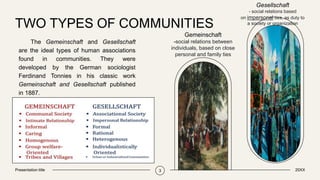
The Gemeinschaft and Gesellschaft
are the ideal types of human associations
found in communities. They were
developed by the German sociologist
Ferdinand Tonnies in his classic work
Gemeinschaft and Gesellschaft published
in 1887.
Presentation title 3 20XX
Gemeinschaft
-social relations between
individuals, based on close
personal and family ties
Gesellschaft
- social relations based
on impersonal ties, as duty to
a society or organization
1. RURAL
COMMUNITY
-is usually areas which are sparsely
settled places away from the influence of
large cities and towns. People in rural
areas live in villages, on farms and in
other isolated houses. Rural areas
usually have in agricultural character
Characteristics of rural communities:
 Greater personal interaction
 Deep, long term relationship
 Generally, peace and order exists
 Mutual give and take affairs
 Emphasis of shared values
 Vernacular is usually spoken
 Wider area
 Influence of blood relationships in
decision making
 Homogenious type of culture
 Belief in supernatural and
superstitious beliefs
 Relationship is more personal and
informal
 Less population
 Few establishments and institutions
 Few goods and services
2. URBAN
COMMUNITY
- are large in terms of land area and
population, advanced in science and
technology, with favorable physical
environment and a diverse cultures, and
the people are engaged in various
occupation
Characteristics of urban community:
 Advancement in science and technology
 Many business and establishments, recreational
centers, educational and religious institutions
 People are crowded
 Social heterogeneity
 Class extremes
 Greater population
 Many crimes are committed
 Family ties tend to be weak
 Limited space
 Greater impersonality among neighbours
 Shortage of employment
 Informal settlers are rampant
 A lot of hazards and dangers
 Greater number of separation of spouses and live-in
arrangements
 Major occupations are industrial, administrative, and
professional
 Divisions of labor and occupational specialization are
very much common
3. SUBURBAN COMMUNITY
- are usually to, but not in, cities. There
are fewer people than in urban
communities, but many more than in
rural communities. Houses are often in
neighbourhoods and many people have
yards
Characteristics of sub urban communities
 Often enjoy a variety of opportunities for
physical activity available like playgrounds and
sports fields, sidewalks and bikeways,
greenways and trails, public swimming pools
and lakes, nature parks and pet parks, plus
walking biking and bus riding to school.
 Low development density
 Separated homes, shops and workplaces
 Lack of activity centers and downtowns
 Poor street connectivity
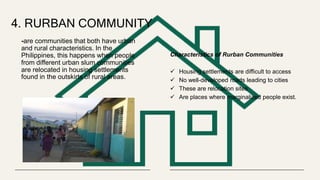
4. RURBAN COMMUNITY
-are communities that both have urban
and rural characteristics. In the
Philippines, this happens when people
from different urban slum communities
are relocated in housing settlements
found in the outskirts of rural areas.
Characteristics of Rurban Communities
 Housing settlements are difficult to access
 No well-developed roads leading to cities
 These are relocation sites
 Are places where marginalized people exist.
THANK
Members:
Glaiza Mia Delos Santos
Shanice Nicole Tabieros
Lyra Joy Abella
Atheena Kaira Yabes
Jake Harold Seguban
Ivan Kent Tabieros
Khent Hendryx Urbano
YOU

community-typologies.pptx

  • 1.
  • 2.
    COMMUNITY - A communityis a term for groups of people living in somewhat close area, and usually under common rules. Community is a vital dimension in modern society and a key element of social organization. The notion of community suggests positive aspects of society and connections with others, “good things” that will improve individual well-being and bring benefits to society as a whole. Community has emotional overtones. It indicates familiarity, social and emotional cohesion, and commitment. It implies a degree of attachment and belonging and a common sense of identity. Community is anticipated to offer beneficial contributions to build a strong and vibrant society. Community are the building blocks that allow us to make sense of the world in which we live, participate and share experience. They provide a sense of identity and purpose, a sense of being a part of and belonging
  • 3.
    TWO TYPES OFCOMMUNITIES The Gemeinschaft and Gesellschaft are the ideal types of human associations found in communities. They were developed by the German sociologist Ferdinand Tonnies in his classic work Gemeinschaft and Gesellschaft published in 1887. Presentation title 3 20XX Gemeinschaft -social relations between individuals, based on close personal and family ties Gesellschaft - social relations based on impersonal ties, as duty to a society or organization
  • 4.
    1. RURAL COMMUNITY -is usuallyareas which are sparsely settled places away from the influence of large cities and towns. People in rural areas live in villages, on farms and in other isolated houses. Rural areas usually have in agricultural character Characteristics of rural communities:  Greater personal interaction  Deep, long term relationship  Generally, peace and order exists  Mutual give and take affairs  Emphasis of shared values  Vernacular is usually spoken  Wider area  Influence of blood relationships in decision making  Homogenious type of culture  Belief in supernatural and superstitious beliefs  Relationship is more personal and informal  Less population  Few establishments and institutions  Few goods and services
  • 5.
    2. URBAN COMMUNITY - arelarge in terms of land area and population, advanced in science and technology, with favorable physical environment and a diverse cultures, and the people are engaged in various occupation Characteristics of urban community:  Advancement in science and technology  Many business and establishments, recreational centers, educational and religious institutions  People are crowded  Social heterogeneity  Class extremes  Greater population  Many crimes are committed  Family ties tend to be weak  Limited space  Greater impersonality among neighbours  Shortage of employment  Informal settlers are rampant  A lot of hazards and dangers  Greater number of separation of spouses and live-in arrangements  Major occupations are industrial, administrative, and professional  Divisions of labor and occupational specialization are very much common
  • 6.
    3. SUBURBAN COMMUNITY -are usually to, but not in, cities. There are fewer people than in urban communities, but many more than in rural communities. Houses are often in neighbourhoods and many people have yards Characteristics of sub urban communities  Often enjoy a variety of opportunities for physical activity available like playgrounds and sports fields, sidewalks and bikeways, greenways and trails, public swimming pools and lakes, nature parks and pet parks, plus walking biking and bus riding to school.  Low development density  Separated homes, shops and workplaces  Lack of activity centers and downtowns  Poor street connectivity
  • 7.
    4. RURBAN COMMUNITY -arecommunities that both have urban and rural characteristics. In the Philippines, this happens when people from different urban slum communities are relocated in housing settlements found in the outskirts of rural areas. Characteristics of Rurban Communities  Housing settlements are difficult to access  No well-developed roads leading to cities  These are relocation sites  Are places where marginalized people exist.
  • 8.
    THANK Members: Glaiza Mia DelosSantos Shanice Nicole Tabieros Lyra Joy Abella Atheena Kaira Yabes Jake Harold Seguban Ivan Kent Tabieros Khent Hendryx Urbano YOU