Unit II
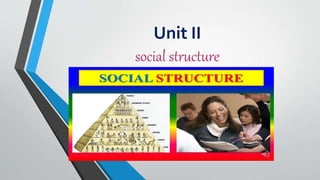
social structure
SOCIETY
• DEFINITION
• NATURE OF SOCIETY
• ELEMENT OF SOCIETY
• ADVANTAGES AND DISADVANTAGES OF SOCIETY
• TYPES OF SOCIETIES
Types of societies
• Sociologistshaveclassifiedthedifferenttypesof societiesintosixcategories:
1. Foraging societies
2. Pastoral societies
3. Horticultural societies
4. Agricultural societies
5. Industrial societies
6. Postindustrial societies
1. FORAGING SOCIETIES OR HUNTER
GATHERS
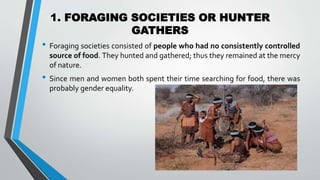
• Foraging societies consisted of people who had no consistently controlled
source of food. They hunted and gathered; thus they remained at the mercy
of nature.
• Since men and women both spent their time searching for food, there was
probably gender equality.
2. PASTORAL SOCIETIES
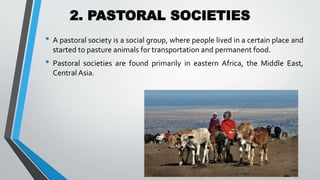
• A pastoral society is a social group, where people lived in a certain place and
started to pasture animals for transportation and permanent food.
• Pastoral societies are found primarily in eastern Africa, the Middle East,
Central Asia.
3. Horticultural society
• A horticultural society is an organization devoted to the study and culture
of cultivated plants. Such organizations may be local, regional, national, or
international.
• This type of societies cultivated vegetables, fruits and plants.
4. Agricultural society
• An agrarian society, or agricultural society, is any community whose
economy is based on producing and maintaining crops and farmland.
• Its key characteristic is that the economy, wealth and society in general is
centred primarily on agriculture.
5. INDUSTRIAL SOCIETIES
• In sociology, industrial society is a society driven by the use of technology
and machinery to enable mass production, supporting a large population with
a high capacity for division of labor.
6. POST INDUSTRIAL SOCIETIES
• In sociology, the post-industrial society is the stage of society's development
when the service sector generates more wealth than the manufacturing sector
of the economy.
COMMUNITY
• The word "community" is derived from Latin word communitas means
"common, public, shared by all or many".
A community is a group of people living in the same place or having a
particular characteristic in common such as norms, religion, values,
or identity.
DEFINITIONS
• “Community is a set of interrelationships among social institutions
in a locality” .
Bell and Newby
• “Community refers to a structure of relationships through which a
localized population provides its daily requirements”.
Hawley
CHARACTERSTICS OF COMMUNITY
1. A group of people
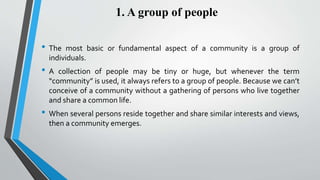
• The most basic or fundamental aspect of a community is a group of
individuals.
• A collection of people may be tiny or huge, but whenever the term
“community” is used, it always refers to a group of people. Because we can’t
conceive of a community without a gathering of persons who live together
and share a common life.
• When several persons reside together and share similar interests and views,
then a community emerges.
2. A definite locality
• It’s the next essential feature of a community.
• A community is defined by its location.
• A single individual can’t create a community on their own. Only when
people reside in a particular territory do they form a community.
3. Community Sentiment
• It is another key feature of community.
• Community feeling refers to an intense sense of wonder among the
members or a sensation of belonging together.
• A feeling of cooperation, togetherness, and togetherness is born as a result
of people living in the same area for an extended period of time.
4. Naturality
• Communities are self-organised.
• Individuals became members at birth because they were born into the
group.
5. Permanence
• A community is always a permanent organization.
• It refers to people who live in a particular area permanently.
6. Similarity
• In a number of ways, members of a community are similar.
• Similarities in language, culture, traditions, and customs are among the
many similarities seen among the members.
7.Total organized social life
• A community is defined by complete social organization.
• It implies that a community incorporates all elements of society. As a result,
a community is a miniature society.
TYPES OF COMMUNITY
1. RURAL COMMUNITY
2. URBAN COMMUNITY
3. SUB URBAN COMMUNITY
1. Rural Community
• Rural community is a natural phenomenon.
• It is present in every society of the world having distinct culture and pattern
of social life.
• People of this community mostly have Face to face ‘interaction with high
degree of homogeneity in their identities.
• Basic urban facilities like school, hospital, market, municipal office, police
station etc. are usually missing in this community.
2. Urban Community
• Urban community is the opposite of rural community.
• The urban people lifestyle are highly impersonal with each other along high
degree of complexity and heterogeneity in their living style and identities.
• It is actually a product of rational choice. Modern civic facilities are usually
available.
3. Sub-urban Community
• A suburban community is a residential area that exists at the outskirts of an
urban community. Such a community is a low-density area with the
commuting distance of a city.
• Sometimes it could be difficult to distinguish between urban and suburban
communities due to the similarities that exist between them.
• Moreover, the cost of housing here is quite low compared to an urban
community.
THANK YOU

social structure.pptx

  • 1.
  • 2.
    SOCIETY • DEFINITION • NATUREOF SOCIETY • ELEMENT OF SOCIETY • ADVANTAGES AND DISADVANTAGES OF SOCIETY • TYPES OF SOCIETIES
  • 3.
    Types of societies •Sociologistshaveclassifiedthedifferenttypesof societiesintosixcategories: 1. Foraging societies 2. Pastoral societies 3. Horticultural societies 4. Agricultural societies 5. Industrial societies 6. Postindustrial societies
  • 4.
    1. FORAGING SOCIETIESOR HUNTER GATHERS • Foraging societies consisted of people who had no consistently controlled source of food. They hunted and gathered; thus they remained at the mercy of nature. • Since men and women both spent their time searching for food, there was probably gender equality.
  • 5.
    2. PASTORAL SOCIETIES •A pastoral society is a social group, where people lived in a certain place and started to pasture animals for transportation and permanent food. • Pastoral societies are found primarily in eastern Africa, the Middle East, Central Asia.
  • 6.
    3. Horticultural society •A horticultural society is an organization devoted to the study and culture of cultivated plants. Such organizations may be local, regional, national, or international. • This type of societies cultivated vegetables, fruits and plants.
  • 7.
    4. Agricultural society •An agrarian society, or agricultural society, is any community whose economy is based on producing and maintaining crops and farmland. • Its key characteristic is that the economy, wealth and society in general is centred primarily on agriculture.
  • 8.
    5. INDUSTRIAL SOCIETIES •In sociology, industrial society is a society driven by the use of technology and machinery to enable mass production, supporting a large population with a high capacity for division of labor.
  • 9.
    6. POST INDUSTRIALSOCIETIES • In sociology, the post-industrial society is the stage of society's development when the service sector generates more wealth than the manufacturing sector of the economy.
  • 10.
  • 11.
    • The word"community" is derived from Latin word communitas means "common, public, shared by all or many". A community is a group of people living in the same place or having a particular characteristic in common such as norms, religion, values, or identity.
  • 12.
    DEFINITIONS • “Community isa set of interrelationships among social institutions in a locality” . Bell and Newby • “Community refers to a structure of relationships through which a localized population provides its daily requirements”. Hawley
  • 13.
  • 14.
    1. A groupof people • The most basic or fundamental aspect of a community is a group of individuals. • A collection of people may be tiny or huge, but whenever the term “community” is used, it always refers to a group of people. Because we can’t conceive of a community without a gathering of persons who live together and share a common life. • When several persons reside together and share similar interests and views, then a community emerges.
  • 15.
    2. A definitelocality • It’s the next essential feature of a community. • A community is defined by its location. • A single individual can’t create a community on their own. Only when people reside in a particular territory do they form a community.
  • 16.
    3. Community Sentiment •It is another key feature of community. • Community feeling refers to an intense sense of wonder among the members or a sensation of belonging together. • A feeling of cooperation, togetherness, and togetherness is born as a result of people living in the same area for an extended period of time.
  • 17.
    4. Naturality • Communitiesare self-organised. • Individuals became members at birth because they were born into the group.
  • 18.
    5. Permanence • Acommunity is always a permanent organization. • It refers to people who live in a particular area permanently.
  • 19.
    6. Similarity • Ina number of ways, members of a community are similar. • Similarities in language, culture, traditions, and customs are among the many similarities seen among the members.
  • 20.
    7.Total organized sociallife • A community is defined by complete social organization. • It implies that a community incorporates all elements of society. As a result, a community is a miniature society.
  • 21.
    TYPES OF COMMUNITY 1.RURAL COMMUNITY 2. URBAN COMMUNITY 3. SUB URBAN COMMUNITY
  • 22.
    1. Rural Community •Rural community is a natural phenomenon. • It is present in every society of the world having distinct culture and pattern of social life. • People of this community mostly have Face to face ‘interaction with high degree of homogeneity in their identities. • Basic urban facilities like school, hospital, market, municipal office, police station etc. are usually missing in this community.
  • 23.
    2. Urban Community •Urban community is the opposite of rural community. • The urban people lifestyle are highly impersonal with each other along high degree of complexity and heterogeneity in their living style and identities. • It is actually a product of rational choice. Modern civic facilities are usually available.
  • 24.
    3. Sub-urban Community •A suburban community is a residential area that exists at the outskirts of an urban community. Such a community is a low-density area with the commuting distance of a city. • Sometimes it could be difficult to distinguish between urban and suburban communities due to the similarities that exist between them. • Moreover, the cost of housing here is quite low compared to an urban community.
  • 25.