Public speaking is the act
of speaking in front of a
sizable number of people.
This involves a single speaker
and an audience.
Speeches can be classified
in two ways: according to
purpose and according to
delivery.
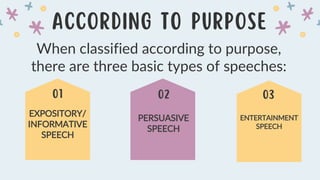
PERSUASIVE
SPEECH
ENTERTAINMENT
SPEECH
EXPOSITORY/
INFORMATIVE
SPEECH
When classified according to purpose,
there are three basic types of speeches:
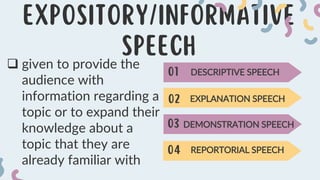
 given to provide the
audience with
information regarding a
topic or to expand their
knowledge about a
topic that they are
already familiar with
DESCRIPTIVE SPEECH
DEMONSTRATION SPEECH
EXPLANATION SPEECH
REPORTORIAL SPEECH
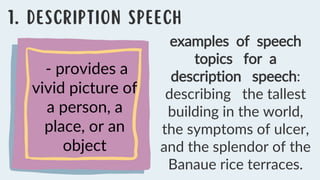
examples of speech
topics for a
description speech:
describing the tallest
building in the world,
the symptoms of ulcer,
and the splendor of the
Banaue rice terraces.
- provides a
vivid picture of
a person, a
place, or an
object
examples of speech
topics for a definition
speech:
explaining the effects of
global warming, the
concept of romanticism,
and the term opportunity
cost in economics.
- explains or
defines a
concept, term, or
an abstract topic
(e.g., idea,
principle,
philosophy)
examples of speech
topics for a
demonstration speech:
explaining how to track
animals in the wild, how
soap is made, and how to
create a compelling
résumé.
- presents
information
about how to do
something or
how something is
done
examples of speech topics
for a reportorial speech:
the papal visit, and the
outcome of the
national elections.
- serves to
describe or explain
an event or an
issue that is
interesting,
significant, or
unusual
o Credible
o Accurate
o Clear
o Memorable
aims to influence the audience
to accept the speaker’s position or
stand on an issue. Sales pitches,
political campaign talks, business
presentations, and debates are
examples of persuasive speech.
CONVINCING
SPEECH
This type of persuasive
speech is one in which the
speaker attempts to convince
the audience to adopt his or her
way of thinking or to change the
way they think about things
This type of speech is designed to
urge the audience to take a
particular action. When making an
actuation speech, the speaker
seeks to persuade the audience to
start doing the action now.
ACTUATION
SPEECH
1. Determine your goal.
2. Know your audience.
3. Organize the information.
4. Provide strong evidence.
aims to amuse audience members
and put them in a jovial mood.
Although it can also inform or
persuade, its primary focus is to
entertain an audience or create
a pleasant or interesting diversion.
• Tell a funny or a scary story.
• Use a humorous story or an
anecdote.
• Relate a personal experience.
• Incorporate drama by using
narration and dialogue.
• Use sarcasm and exaggeration.
There are various ways to make a speech
entertaining. Here are some of these
ways:
• Know your audience.
• Decide on a topic or theme.
• Start with an attention-grabber.
• Use simple language and vivid
descriptions.
• Use humor effectively.
• Use appropriate nonverbal cues.
On a short bond
paper, make your own
speech. It can be
informative,
persuasive, or
entertainment speech.
MEMORIZED
SPEECH
IMPROMPTU
SPEECH
MANUSCRIPT
SPEECH
When classified according to delivery,
there are four basic types of speeches:
EXTEMPORANEOUS
SPEECH
also known as a manuscript speech, is
done when a speaker reads a
prepared text or manuscript to the
audience. It may be prepared by
someone else or by the speaker
himself or herself.
1. Public Figures
2. Media Personalities
3. Spokespersons for
government and private
organizations
1. Outline and write your
speech well.
2. Format your speech
properly.
3. Practice your speech.
4. Vary your voice.
5. Look at the audience
from time to time.
A memorized speech requires you
to commit your speech to memory.
As with manuscript reading, you
also run the risk of sounding
mechanical during a memorized
delivery.
1.Keep it short.
2.Practice.
3.Visualize.
4.Project your voice.
5.Use pauses
appropriately.
Impromptu speech is delivered
with very little or no
preparation. It is generally brief
and unrehearsed since the speaker
does not have time to practice the
speech.
1.Opening-Rule of
Three-Clincher
2.Past-Present-Future
3.Point-Reason-Example
/Explanation-Point
1. Think first before speaking.
2. Consider the three major
parts of a speech.
3. Identify your main point.
4. Use signposts.
5. Keep your speech short.
6. Be confident.
Extemporaneous speech is delivered
with the speaker preparing a speech
outline or notes beforehand. Speech
outline or prepared notes are used
as a guide, and the speaker elaborates
on it using his or her own words.
 Identify the type of
extemporaneous
question that you
have to answer
 Determine if your
topic is informative or
persuasive.
 Stick to your topic and
look at all sides and
angles of the problem.
 Prepare the outline or notes.
 Rehearse your speech using
your outline or notes.
 Speak in a natural manner.
 Pay attention to the
audience’s nonverbal cues.
 Choosing the Topic
 Analyzing the Audience
 Sourcing the Information
 Outlining and Organizing
the Speech Contents

TYPES-OF-SPEECHES.pptx

  • 2.
    Public speaking isthe act of speaking in front of a sizable number of people. This involves a single speaker and an audience. Speeches can be classified in two ways: according to purpose and according to delivery.
  • 4.
  • 6.
     given toprovide the audience with information regarding a topic or to expand their knowledge about a topic that they are already familiar with DESCRIPTIVE SPEECH DEMONSTRATION SPEECH EXPLANATION SPEECH REPORTORIAL SPEECH
  • 7.
    examples of speech topicsfor a description speech: describing the tallest building in the world, the symptoms of ulcer, and the splendor of the Banaue rice terraces. - provides a vivid picture of a person, a place, or an object
  • 8.
    examples of speech topicsfor a definition speech: explaining the effects of global warming, the concept of romanticism, and the term opportunity cost in economics. - explains or defines a concept, term, or an abstract topic (e.g., idea, principle, philosophy)
  • 9.
    examples of speech topicsfor a demonstration speech: explaining how to track animals in the wild, how soap is made, and how to create a compelling résumé. - presents information about how to do something or how something is done
  • 10.
    examples of speechtopics for a reportorial speech: the papal visit, and the outcome of the national elections. - serves to describe or explain an event or an issue that is interesting, significant, or unusual
  • 11.
    o Credible o Accurate oClear o Memorable
  • 13.
    aims to influencethe audience to accept the speaker’s position or stand on an issue. Sales pitches, political campaign talks, business presentations, and debates are examples of persuasive speech.
  • 14.
    CONVINCING SPEECH This type ofpersuasive speech is one in which the speaker attempts to convince the audience to adopt his or her way of thinking or to change the way they think about things
  • 15.
    This type ofspeech is designed to urge the audience to take a particular action. When making an actuation speech, the speaker seeks to persuade the audience to start doing the action now. ACTUATION SPEECH
  • 16.
    1. Determine yourgoal. 2. Know your audience. 3. Organize the information. 4. Provide strong evidence.
  • 18.
    aims to amuseaudience members and put them in a jovial mood. Although it can also inform or persuade, its primary focus is to entertain an audience or create a pleasant or interesting diversion.
  • 19.
    • Tell afunny or a scary story. • Use a humorous story or an anecdote. • Relate a personal experience. • Incorporate drama by using narration and dialogue. • Use sarcasm and exaggeration. There are various ways to make a speech entertaining. Here are some of these ways:
  • 20.
    • Know youraudience. • Decide on a topic or theme. • Start with an attention-grabber. • Use simple language and vivid descriptions. • Use humor effectively. • Use appropriate nonverbal cues.
  • 21.
    On a shortbond paper, make your own speech. It can be informative, persuasive, or entertainment speech.
  • 23.
    MEMORIZED SPEECH IMPROMPTU SPEECH MANUSCRIPT SPEECH When classified accordingto delivery, there are four basic types of speeches: EXTEMPORANEOUS SPEECH
  • 24.
    also known asa manuscript speech, is done when a speaker reads a prepared text or manuscript to the audience. It may be prepared by someone else or by the speaker himself or herself.
  • 25.
    1. Public Figures 2.Media Personalities 3. Spokespersons for government and private organizations
  • 27.
    1. Outline andwrite your speech well. 2. Format your speech properly. 3. Practice your speech. 4. Vary your voice. 5. Look at the audience from time to time.
  • 28.
    A memorized speechrequires you to commit your speech to memory. As with manuscript reading, you also run the risk of sounding mechanical during a memorized delivery.
  • 30.
    1.Keep it short. 2.Practice. 3.Visualize. 4.Projectyour voice. 5.Use pauses appropriately.
  • 31.
    Impromptu speech isdelivered with very little or no preparation. It is generally brief and unrehearsed since the speaker does not have time to practice the speech.
  • 33.
  • 35.
    1. Think firstbefore speaking. 2. Consider the three major parts of a speech. 3. Identify your main point. 4. Use signposts. 5. Keep your speech short. 6. Be confident.
  • 36.
    Extemporaneous speech isdelivered with the speaker preparing a speech outline or notes beforehand. Speech outline or prepared notes are used as a guide, and the speaker elaborates on it using his or her own words.
  • 38.
     Identify thetype of extemporaneous question that you have to answer
  • 39.
     Determine ifyour topic is informative or persuasive.  Stick to your topic and look at all sides and angles of the problem.
  • 41.
     Prepare theoutline or notes.  Rehearse your speech using your outline or notes.  Speak in a natural manner.  Pay attention to the audience’s nonverbal cues.
  • 43.
     Choosing theTopic  Analyzing the Audience  Sourcing the Information  Outlining and Organizing the Speech Contents