PUBLIC SPEAKING
What ispublic speaking?
Public speaking is a form of communication that
includes a presenter and an audience. It is more
formal than casual conversation and requires an
organization of thoughts with a specific purpose or
goal in mind.
3.
PUBLIC SPEAKING
There areseveral specific elements of public speaking
that include:
1. Speaker- The speaker is the source of information and
sometimes referred to as the who.
2. Message - The message is what is communicated and
also referred to as the what.
3. Audience - The audience is the intended recipient of
the message.
4.
PUBLIC SPEAKING
4. Channel- The channel is the medium used to share
the message.
5. Effect- The effect is the result of the message having
been sent and received.
5.
SPEECH
What is speech?
•Speech is the expression of ideas and thoughts by
means of vocal sounds, or the faculty of thus expressing
ideas and thoughts.
•Speech is communication through talking or a talk given
to the audience.
6.
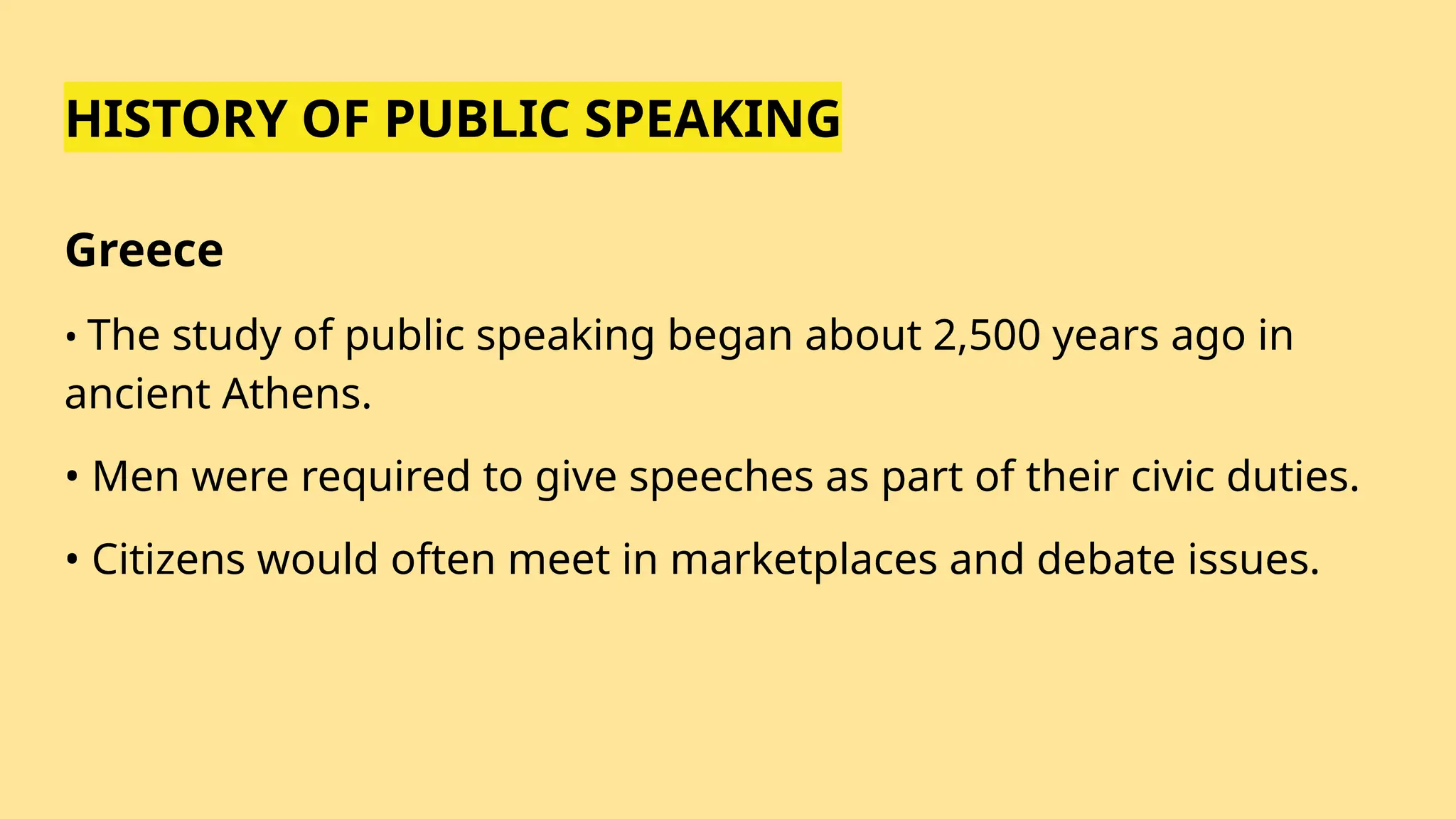
HISTORY OF PUBLICSPEAKING
Greece
• The study of public speaking began about 2,500 years ago in
ancient Athens.
• Men were required to give speeches as part of their civic duties.
• Citizens would often meet in marketplaces and debate issues.
7.
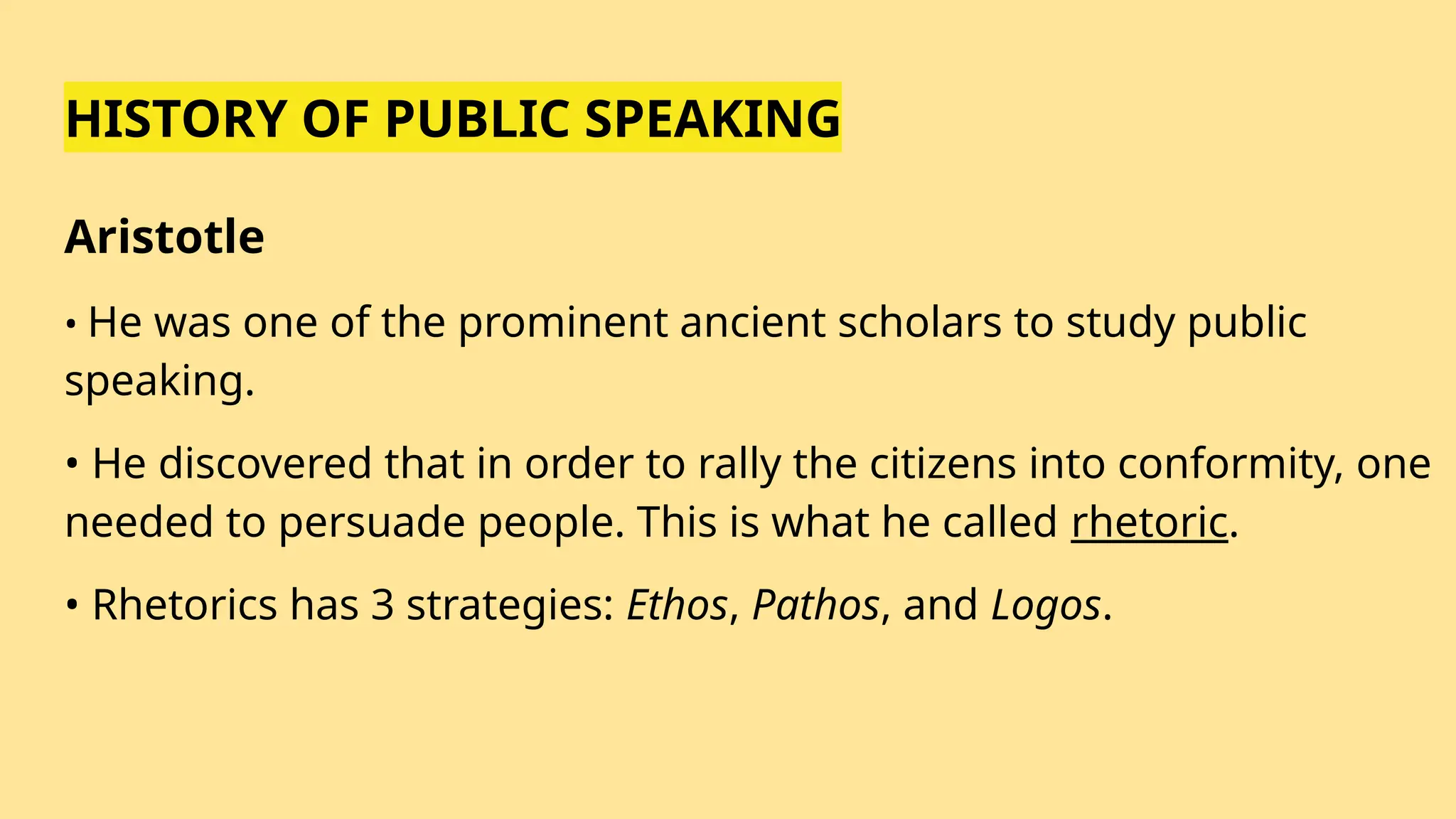
HISTORY OF PUBLICSPEAKING
Aristotle
• He was one of the prominent ancient scholars to study public
speaking.
• He discovered that in order to rally the citizens into conformity, one
needed to persuade people. This is what he called rhetoric.
• Rhetorics has 3 strategies: Ethos, Pathos, and Logos.
8.
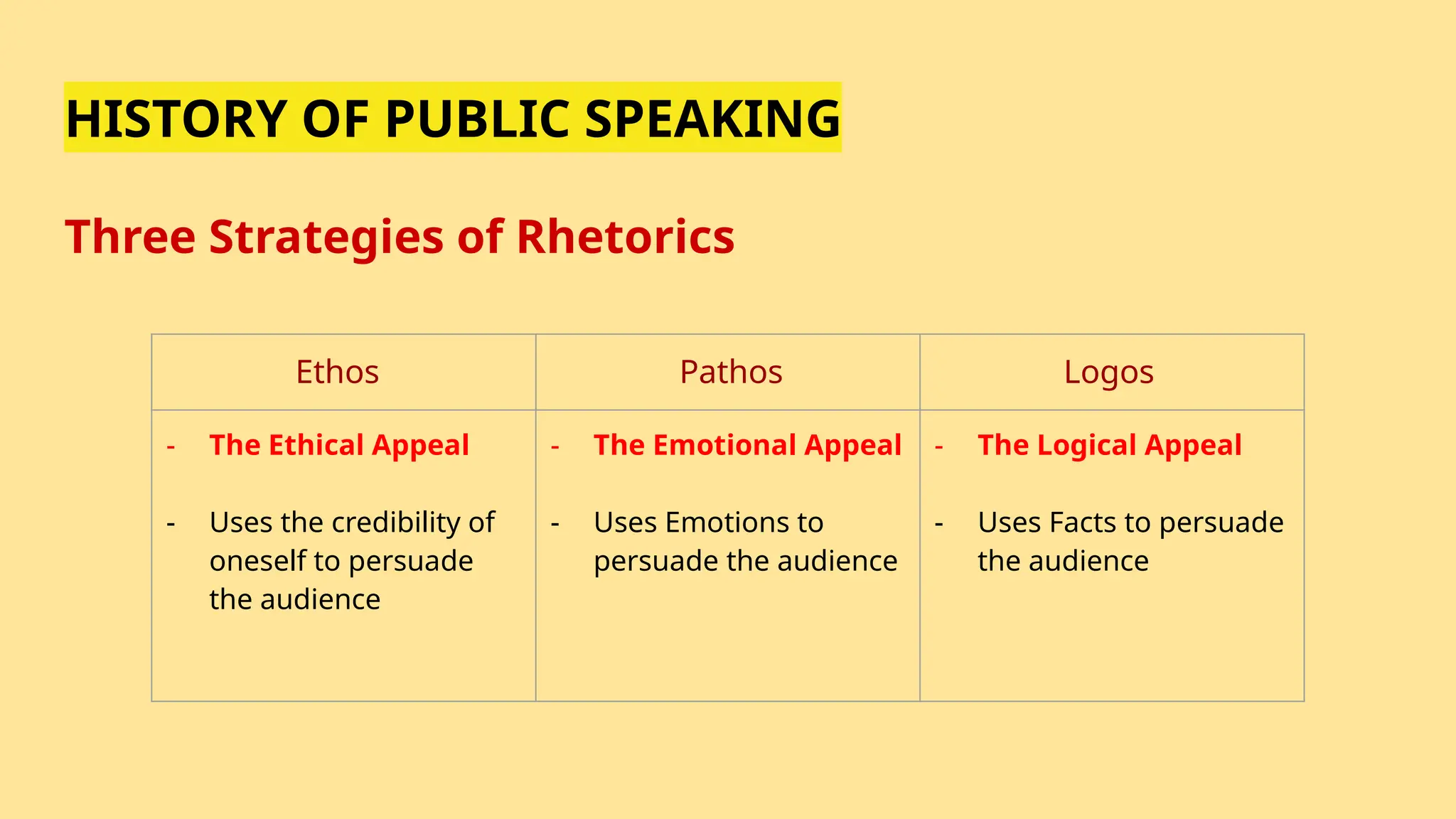
HISTORY OF PUBLICSPEAKING
Three Strategies of Rhetorics
Ethos Pathos Logos
- The Ethical Appeal
- Uses the credibility of
oneself to persuade
the audience
- The Emotional Appeal
- Uses Emotions to
persuade the audience
- The Logical Appeal
- Uses Facts to persuade
the audience
9.
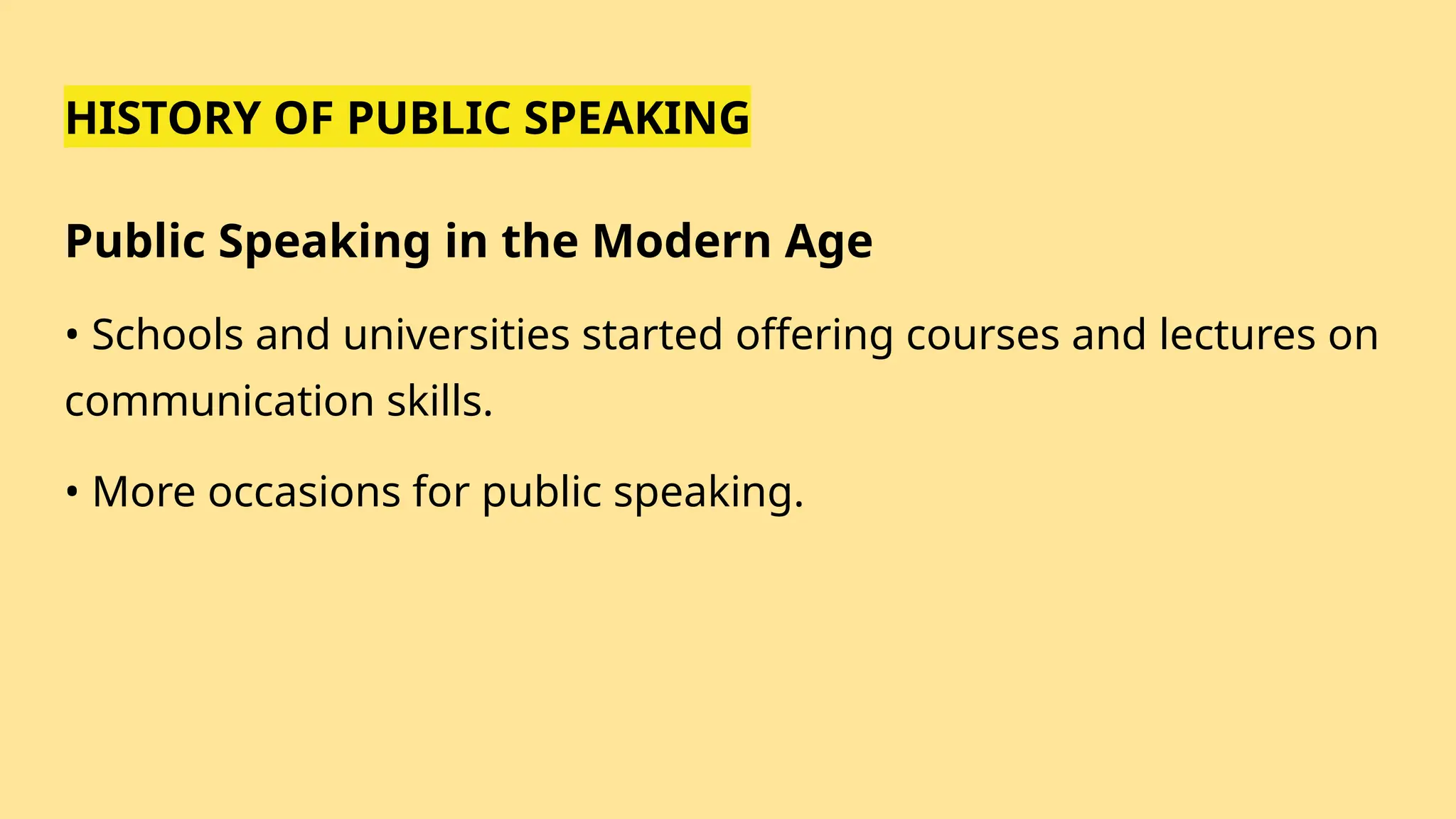
HISTORY OF PUBLICSPEAKING
Public Speaking in the Modern Age
• Schools and universities started offering courses and lectures on
communication skills.
• More occasions for public speaking.
10.
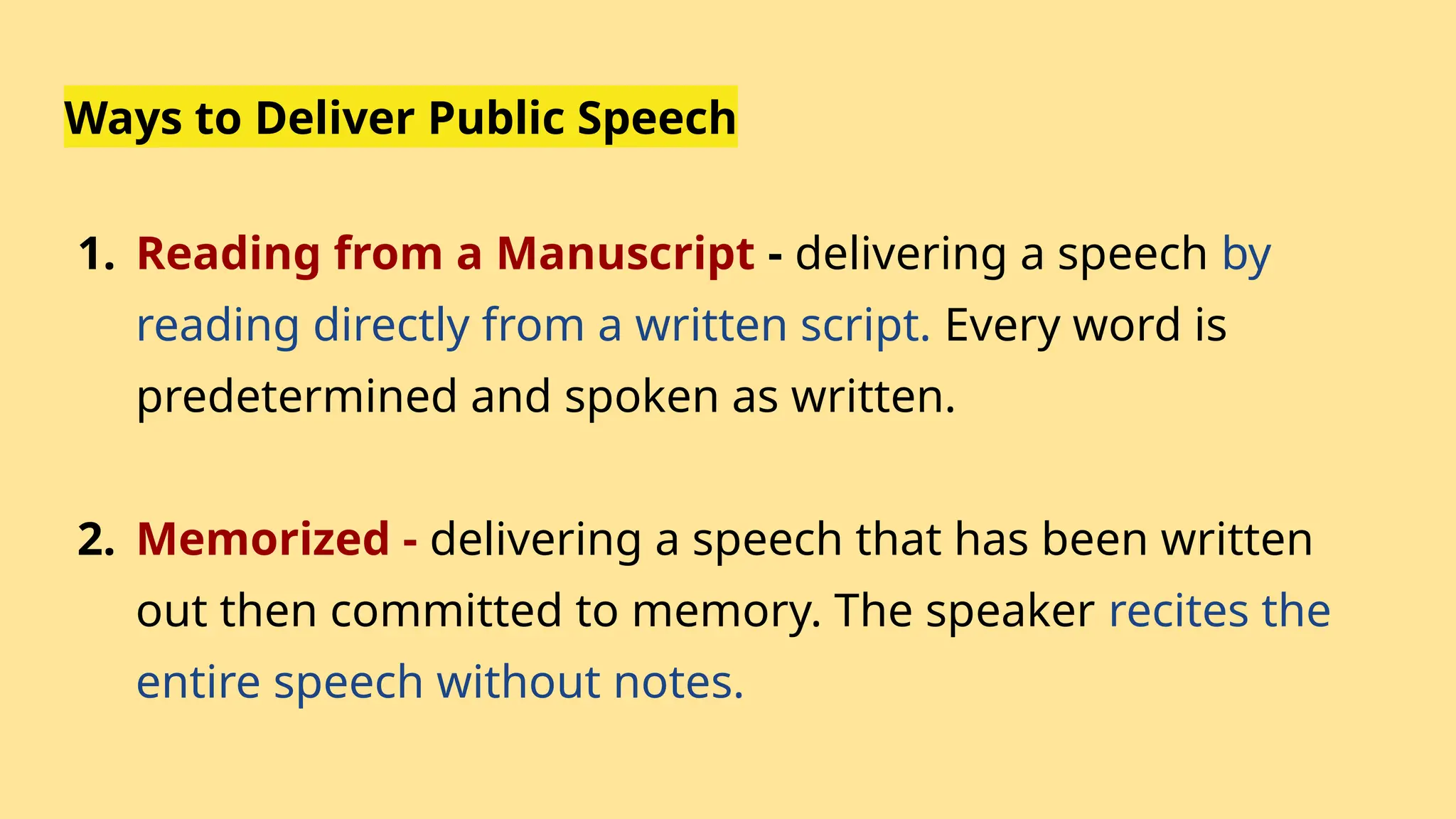
Ways to DeliverPublic Speech
1. Reading from a Manuscript - delivering a speech by
reading directly from a written script. Every word is
predetermined and spoken as written.
2. Memorized - delivering a speech that has been written
out then committed to memory. The speaker recites the
entire speech without notes.
11.
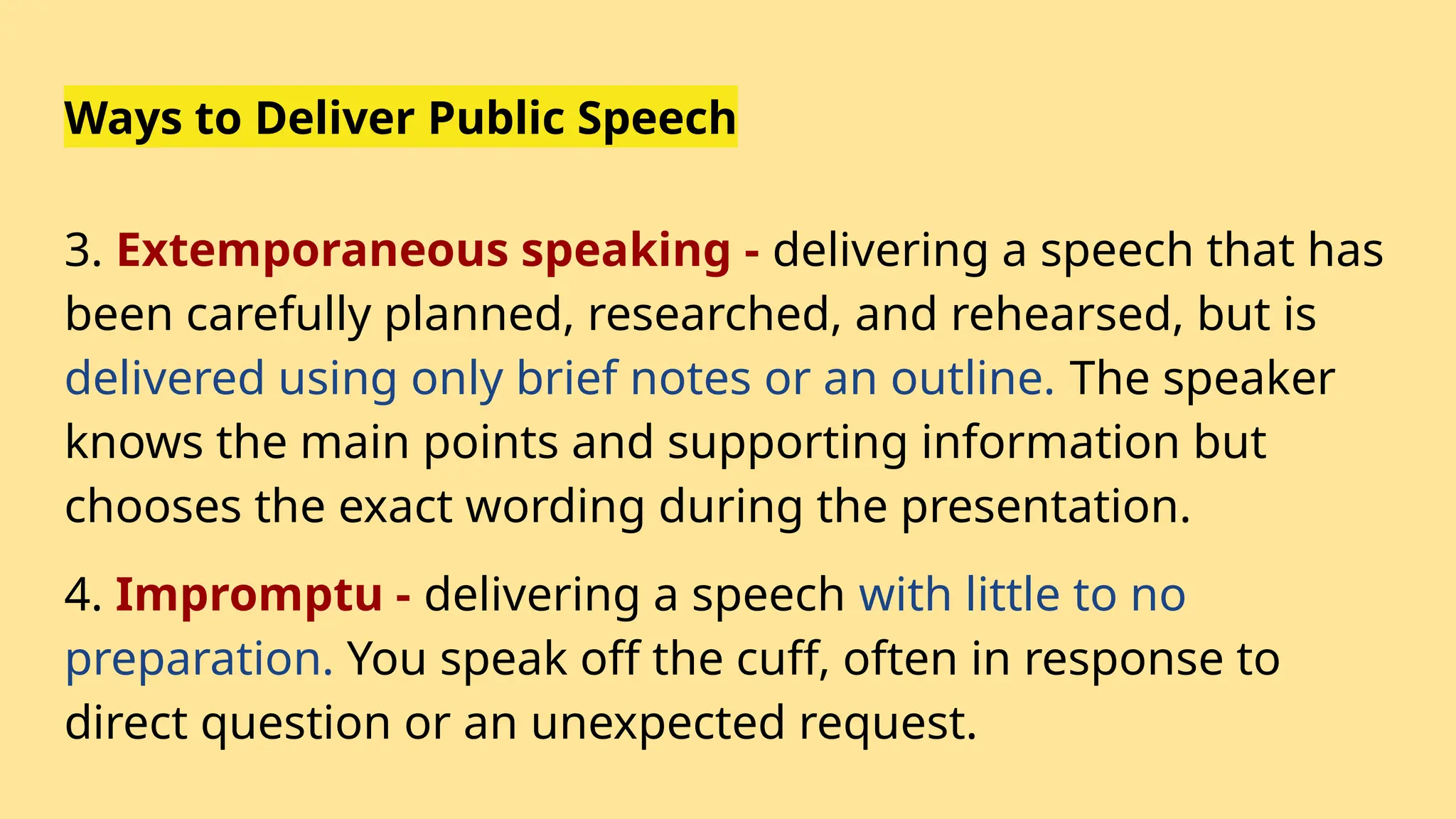
Ways to DeliverPublic Speech
3. Extemporaneous speaking - delivering a speech that has
been carefully planned, researched, and rehearsed, but is
delivered using only brief notes or an outline. The speaker
knows the main points and supporting information but
chooses the exact wording during the presentation.
4. Impromptu - delivering a speech with little to no
preparation. You speak off the cuff, often in response to
direct question or an unexpected request.
12.
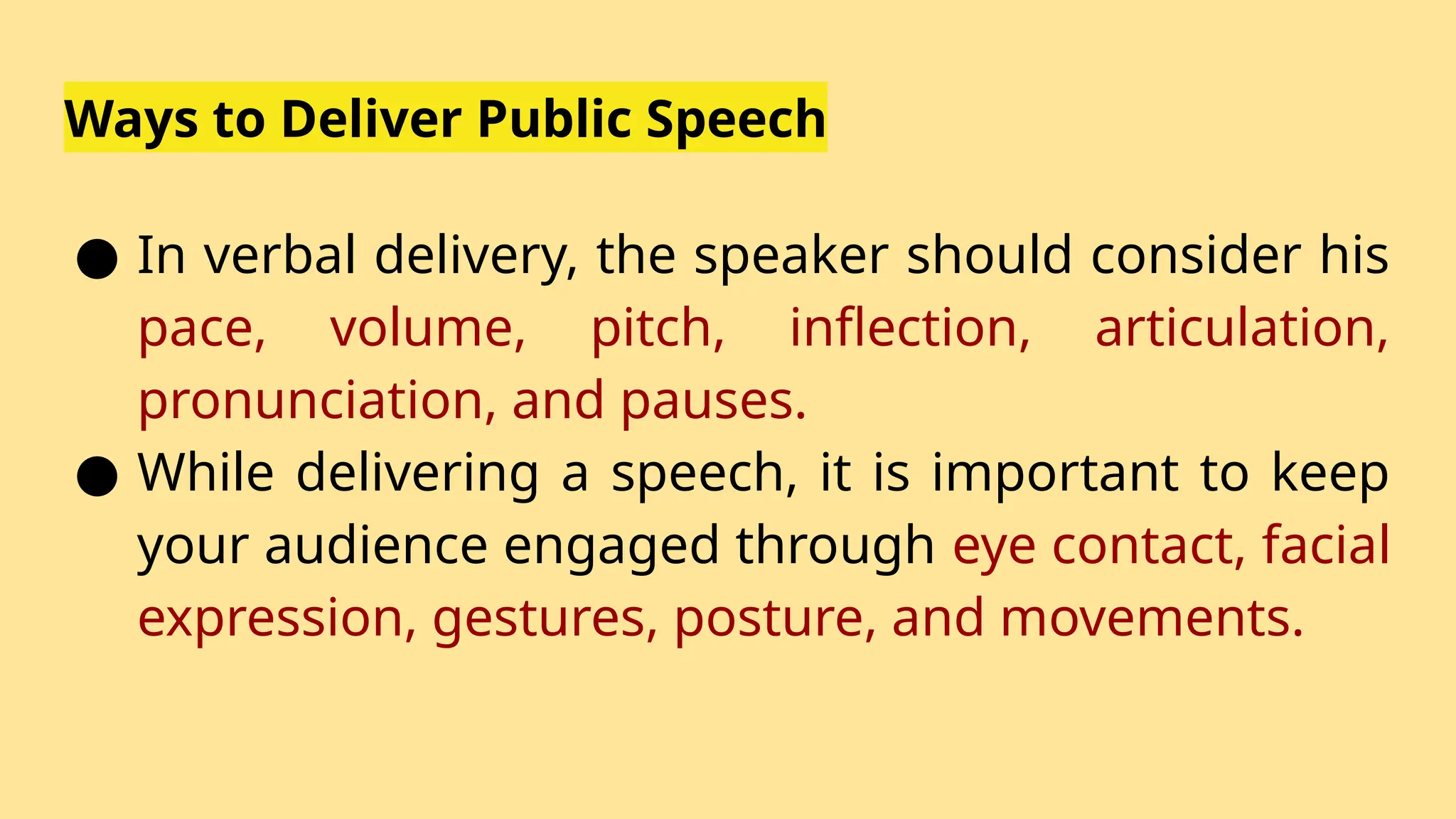
Ways to DeliverPublic Speech
● In verbal delivery, the speaker should consider his
pace, volume, pitch, inflection, articulation,
pronunciation, and pauses.
● While delivering a speech, it is important to keep
your audience engaged through eye contact, facial
expression, gestures, posture, and movements.
13.
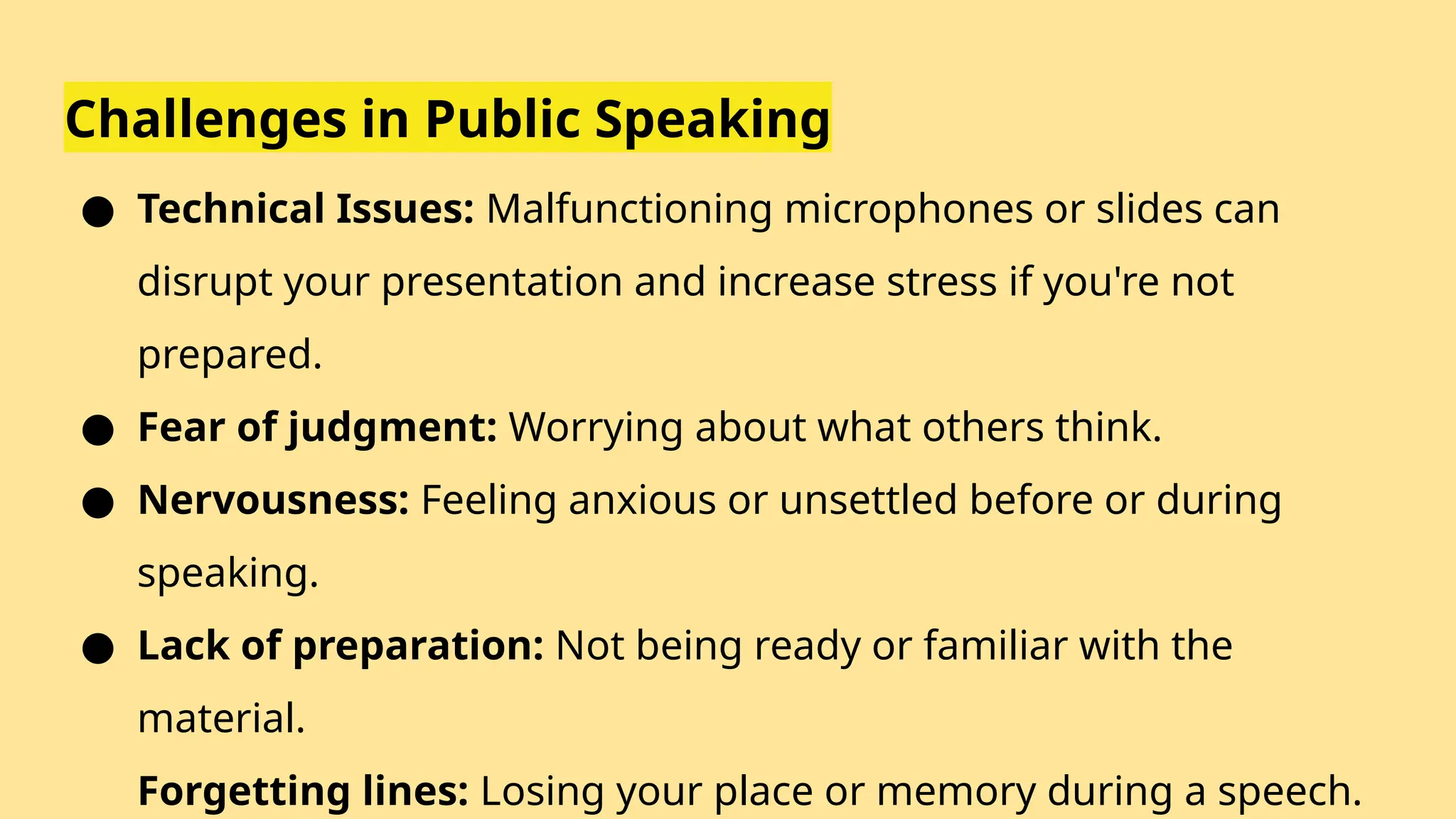
Challenges in PublicSpeaking
● Technical Issues: Malfunctioning microphones or slides can
disrupt your presentation and increase stress if you're not
prepared.
● Fear of judgment: Worrying about what others think.
● Nervousness: Feeling anxious or unsettled before or during
speaking.
● Lack of preparation: Not being ready or familiar with the
material.
Forgetting lines: Losing your place or memory during a speech.
14.
Tips On Howto Get Better
● Practice regularly: Builds confidence and reduces anxiety.
● Know your content: Being well-informed helps you speak
naturally.
● Understand your audience: Tailoring your message makes it
more effective.
● Use gestures and eye contact: Enhances engagement and
clarity.
● Start with small groups: Easier settings help build skills
15.
Importance of PublicSpeaking
● Public speaking is important because it enhances
communication skills, builds confidence, and develops
leadership qualities, benefiting both personal and
professional development.
● It also allows individuals to effectively share ideas,
influence others, and contribute to discussions on
important issues.
16.
Here's a moredetailed look at the importance of public
speaking:
For individual:
Improved Communication Skills - Practice in public
speaking helps individuals articulate their thoughts more
clearly, organize their ideas, and deliver messages
effectively.
Increased Confidence - Overcoming the fear of speaking in
front of others builds self-assurance and reduces anxiety.
17.
Enhanced Leadership Potential- Public speaking allows
individuals to present ideas, persuade others, and inspire
action, key qualities for leadership roles.
Personal Growth - Public speaking encourages self-
reflection, critical thinking, and the ability to adapt to
different audiences and situations.
18.
Benefits for ProfessionalSettings:
Thought Leadership - Public speaking allows individuals
to establish themselves as experts and thought leaders in
their respective fields.
Persuasion and Influence - Public speaking can be used
to persuade others, advocate for a cause, and influence
decision-making.
19.
Career Advancement -Strong public speaking skills are
highly valued in many professions, making individuals
more competitive in the job market.
Effective Team Management - Public speaking enables
leaders to communicate clearly, motivate teams, and
foster a positive work environment.



![Luminar Crack Free Download + Full Activation [2025]](https://cdn.slidesharecdn.com/ss_thumbnails/publicspeaking1-250316130347-78f7e216-250317074129-40c91d5e-thumbnail.jpg?width=640&height=640&fit=bounds)
![Microsoft Clipchamp Crack Free Download [Latest]](https://cdn.slidesharecdn.com/ss_thumbnails/publicspeaking1-250316130347-78f7e216-thumbnail.jpg?width=640&height=640&fit=bounds)
![FilmConvert Hazy Crack Free Download [2025]](https://cdn.slidesharecdn.com/ss_thumbnails/publicspeaking1-250316131601-ae10a4a2-thumbnail.jpg?width=640&height=640&fit=bounds)


![BluffTitler Crack + Serial Key Free [Latest]](https://cdn.slidesharecdn.com/ss_thumbnails/publicspeaking1-250316130224-3db1a85f-thumbnail.jpg?width=640&height=640&fit=bounds)
![CapCut Pro Free Download Crack [Latest 2025]](https://cdn.slidesharecdn.com/ss_thumbnails/publicspeaking1-250316125820-e04a6f94-thumbnail.jpg?width=640&height=640&fit=bounds)
![Filmworkz Nucoda Crack Free Download [2025]](https://cdn.slidesharecdn.com/ss_thumbnails/publicspeaking1-250316130714-19ac5e10-thumbnail.jpg?width=640&height=640&fit=bounds)
![MAGIX Video Pro X16 Free Download [Latest]](https://cdn.slidesharecdn.com/ss_thumbnails/publicspeaking1-250316130908-62575421-thumbnail.jpg?width=640&height=640&fit=bounds)


![Get Backup Pro Crack Free Download [Latest]](https://cdn.slidesharecdn.com/ss_thumbnails/publicspeaking-250316124947-c239b6fc-thumbnail.jpg?width=640&height=640&fit=bounds)
![HashiCorp Boundary Vault Crack Free 2025 [Latest]](https://cdn.slidesharecdn.com/ss_thumbnails/publicspeaking-250316124052-d4d39ce2-thumbnail.jpg?width=640&height=640&fit=bounds)
![Google Drive Full Crack Free Download [2025]](https://cdn.slidesharecdn.com/ss_thumbnails/publicspeaking-250316124401-9e07e841-thumbnail.jpg?width=640&height=640&fit=bounds)
![Arq Backup Crack Free Download 2025 [Latest]](https://cdn.slidesharecdn.com/ss_thumbnails/publicspeaking-250316125123-e0d3362f-thumbnail.jpg?width=640&height=640&fit=bounds)
![Growly Backup Crack + Serial Key Free [Latest]](https://cdn.slidesharecdn.com/ss_thumbnails/publicspeaking-250316124603-9ae514bf-thumbnail.jpg?width=640&height=640&fit=bounds)
![Seagate Toolkit Crack (2025) Free [Latest Version]](https://cdn.slidesharecdn.com/ss_thumbnails/publicspeaking-250316124708-cf0e1aab-thumbnail.jpg?width=640&height=640&fit=bounds)


