THE ART OF PUBLIC
SPEAKING
BY EWEN NELSON
INTRODUCTION
‱ Communications in its multiple forms pervades today’s business environment. With numerous job
interviews, conferencecalls, meetings, product presentations, workshops, and public events, more
and more leaders realize the importance of developing good interpersonal communication skills
within their company.
‱ Whether your goal is to enhance your professional growth, take your business to the next level, or
inspire, persuade and motivate other people to follow your lead, you will have to learn how to
convey your ideas in front of a group of people in a clear, structured and captivating manner.
BENEFITS OF DEVELOPING YOUR COMMUNICATION
SKILLS
‱ Opens up new opportunities for career advancement
‱ Positions you as an authority
‱ Sets you apart from your competition
‱ Attracts the right customers to your business
‱ Presents technical or business information effectively
‱ Produces a faster sales cycle
‱ Allows you to effectively market your business or promote your products to larger audiences
‱ Improves internal communication
‱ Helps you to easily assume leadership and train others
‱ Increases employees’productivity
‱ Prepares you for spontaneous speaking challenges (e.g. delivering a speech at short notice)
‱ Establishes greater credibility and helps your clients’loyalty
PERSONAL BENEFITS
‱ Increased self-confidence
‱ Improved communication skills
‱ Increased organizational skills
‱ Greater social influence
‱ Enhanced ability to listen
‱ Greater possibility of meeting new people
‱ Lesser anxiety and fear when speaking in front of others
‱ Improved memory
‱ Enhanced persuasion ability
‱ Greater control over emotions and body language
EVOLUTION OF PUBLIC SPEAKING
‱ Public speaking is a process, an act and an art of making a speech before an audience.
‱ It is not enough to talk in front of a group of people to be a brilliant public speaker. Your goal should
not be limited with informing your audience or expressing your thoughts publically, but to changing
emotions, actions, and attitudes, and toleaving your listeners moved by the words and touched by
their meaning.
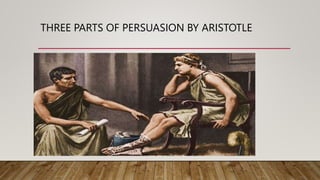
THREE PARTS OF PERSUASION BY ARISTOTLE
‱ The art of speaking in public is not new. Its long tradition can be traced back to Classical Greece
(approximately 490-322 BC). Any young men leaving at that time were expected to acquire and
develop public speaking skills as part of their duties as citizens.
‱
‱ The first rules of a public speech were elaborated on over 2000 years ago by the Greek philosopher
and teacher of Alexanderthe Great – Aristotle.
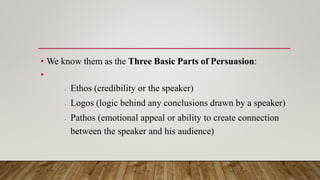
‱ We know them as the Three Basic Parts of Persuasion:
‱
‱ Ethos (credibility or the speaker)
‱ Logos (logic behind any conclusions drawn by a speaker)
‱ Pathos (emotional appeal or ability to create connection
between the speaker and his audience)
WHAT ARE THEY?
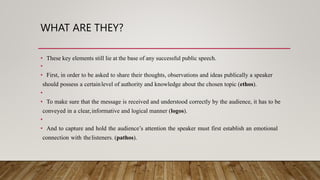
‱ These key elements still lie at the base of any successful public speech.
‱
‱ First, in order to be asked to share their thoughts, observations and ideas publically a speaker
should possess a certainlevel of authority and knowledge about the chosen topic (ethos).
‱
‱ To make sure that the message is received and understood correctly by the audience, it has to be
conveyed in a clear,informative and logical manner (logos).
‱
‱ And to capture and hold the audience’s attention the speaker must first establish an emotional
connection with thelisteners. (pathos).
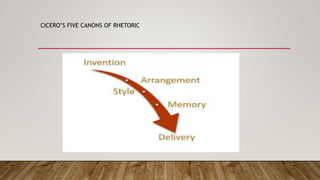
CICERO’S FIVE CANONS OF RHETORIC
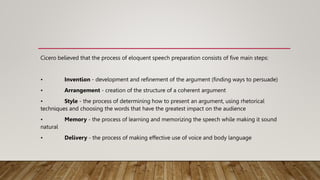
Cicero believed that the process of eloquent speech preparation consists of five main steps:
‱ Invention - development and refinement of the argument (finding ways to persuade)
‱ Arrangement - creation of the structure of a coherent argument
‱ Style - the process of determining how to present an argument, using rhetorical
techniques and choosing the words that have the greatest impact on the audience
‱ Memory - the process of learning and memorizing the speech while making it sound
natural
‱ Delivery - the process of making effective use of voice and body language
MODERN ELEMENTS OF PUBLIC SPEAKING
‱ The widespread accessibility of mass media and especially, the Internet, has made it easy for us to reach a vast audience
and let our voice be heard.
‱
‱ Public speaking has evolved from a skill reserved by a selected few to one of the most powerful marketing, educational
and brand promotion tools in any business.
‱
‱ It is safe to say that in the modern business world just about every well-paid position requires some form of public
speaking, be it giving a group sales presentation, presenting your ideas to the board of directors, speaking to a committee
or tellinga group of potential clients about your company during a corporate event.
‱
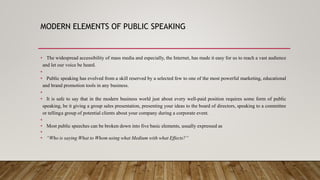
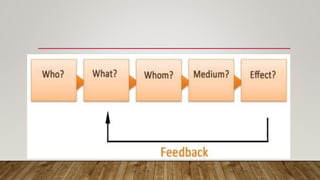
‱ Most public speeches can be broken down into five basic elements, usually expressed as
‱
‱ “Who is saying What to Whom using what Medium with what Effects?”
THREE STYLES OF SPEECH
WHAT ARE THEY?
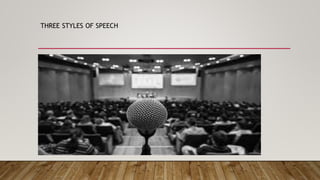
‱ The three most common styles of speeches that you encounter in today’s business and social world
are - impromptu, manuscript and extemporaneous. To become a great public speaker you will have to
learn and ace each one of them, as it will allow you to speak confidently and effectively in front of
any number of listeners and in any given situation.
‱
IMPROMPTU SPEECH
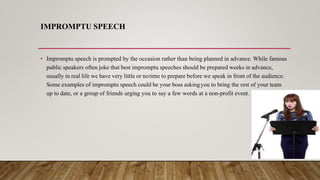
‱ Impromptu speech is prompted by the occasion rather than being planned in advance. While famous
public speakers often joke that best impromptu speeches should be prepared weeks in advance,
usually in real life we have very little or notime to prepare before we speak in front of the audience.
Some examples of impromptu speech could be your boss askingyou to bring the rest of your team
up to date, or a group of friends urging you to say a few words at a non-profit event.
MANUSCRIPT SPEECH
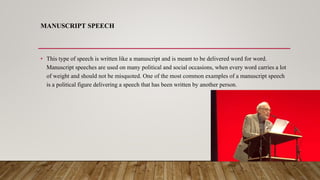
‱ This type of speech is written like a manuscript and is meant to be delivered word for word.
Manuscript speeches are used on many political and social occasions, when every word carries a lot
of weight and should not be misquoted. One of the most common examples of a manuscript speech
is a political figure delivering a speech that has been written by another person.
EXTEMPORANEOUS SPEECH
‱ Extemporaneous speech is the most commonly used type of speech that helps to establish
emotional connection with the audience. It is built around key points, but the material can be
presented freely, allowing the speaker to make changes in their speech based on the listeners’
reaction.
‱
‱ Later we will cover the preparation of all three speech styles, but before we do that, let us address
one of the major obstacles that most people face when it comes to speaking in front of a group of
people – Fear.
THE_ART_OF_PUBLIC_SPEAKING.pptx

THE_ART_OF_PUBLIC_SPEAKING.pptx

  • 1.
    THE ART OFPUBLIC SPEAKING BY EWEN NELSON
  • 2.
    INTRODUCTION ‱ Communications inits multiple forms pervades today’s business environment. With numerous job interviews, conferencecalls, meetings, product presentations, workshops, and public events, more and more leaders realize the importance of developing good interpersonal communication skills within their company. ‱ Whether your goal is to enhance your professional growth, take your business to the next level, or inspire, persuade and motivate other people to follow your lead, you will have to learn how to convey your ideas in front of a group of people in a clear, structured and captivating manner.
  • 3.
    BENEFITS OF DEVELOPINGYOUR COMMUNICATION SKILLS ‱ Opens up new opportunities for career advancement ‱ Positions you as an authority ‱ Sets you apart from your competition ‱ Attracts the right customers to your business ‱ Presents technical or business information effectively ‱ Produces a faster sales cycle ‱ Allows you to effectively market your business or promote your products to larger audiences ‱ Improves internal communication ‱ Helps you to easily assume leadership and train others ‱ Increases employees’productivity ‱ Prepares you for spontaneous speaking challenges (e.g. delivering a speech at short notice) ‱ Establishes greater credibility and helps your clients’loyalty
  • 4.
    PERSONAL BENEFITS ‱ Increasedself-confidence ‱ Improved communication skills ‱ Increased organizational skills ‱ Greater social influence ‱ Enhanced ability to listen ‱ Greater possibility of meeting new people ‱ Lesser anxiety and fear when speaking in front of others ‱ Improved memory ‱ Enhanced persuasion ability ‱ Greater control over emotions and body language
  • 5.
    EVOLUTION OF PUBLICSPEAKING ‱ Public speaking is a process, an act and an art of making a speech before an audience. ‱ It is not enough to talk in front of a group of people to be a brilliant public speaker. Your goal should not be limited with informing your audience or expressing your thoughts publically, but to changing emotions, actions, and attitudes, and toleaving your listeners moved by the words and touched by their meaning.
  • 6.
    THREE PARTS OFPERSUASION BY ARISTOTLE
  • 7.
    ‱ The artof speaking in public is not new. Its long tradition can be traced back to Classical Greece (approximately 490-322 BC). Any young men leaving at that time were expected to acquire and develop public speaking skills as part of their duties as citizens. ‱ ‱ The first rules of a public speech were elaborated on over 2000 years ago by the Greek philosopher and teacher of Alexanderthe Great – Aristotle.
  • 8.
    ‱ We knowthem as the Three Basic Parts of Persuasion: ‱ ‱ Ethos (credibility or the speaker) ‱ Logos (logic behind any conclusions drawn by a speaker) ‱ Pathos (emotional appeal or ability to create connection between the speaker and his audience)
  • 9.
    WHAT ARE THEY? ‱These key elements still lie at the base of any successful public speech. ‱ ‱ First, in order to be asked to share their thoughts, observations and ideas publically a speaker should possess a certainlevel of authority and knowledge about the chosen topic (ethos). ‱ ‱ To make sure that the message is received and understood correctly by the audience, it has to be conveyed in a clear,informative and logical manner (logos). ‱ ‱ And to capture and hold the audience’s attention the speaker must first establish an emotional connection with thelisteners. (pathos).
  • 10.
  • 11.
    Cicero believed thatthe process of eloquent speech preparation consists of five main steps: ‱ Invention - development and refinement of the argument (finding ways to persuade) ‱ Arrangement - creation of the structure of a coherent argument ‱ Style - the process of determining how to present an argument, using rhetorical techniques and choosing the words that have the greatest impact on the audience ‱ Memory - the process of learning and memorizing the speech while making it sound natural ‱ Delivery - the process of making effective use of voice and body language
  • 12.
    MODERN ELEMENTS OFPUBLIC SPEAKING ‱ The widespread accessibility of mass media and especially, the Internet, has made it easy for us to reach a vast audience and let our voice be heard. ‱ ‱ Public speaking has evolved from a skill reserved by a selected few to one of the most powerful marketing, educational and brand promotion tools in any business. ‱ ‱ It is safe to say that in the modern business world just about every well-paid position requires some form of public speaking, be it giving a group sales presentation, presenting your ideas to the board of directors, speaking to a committee or tellinga group of potential clients about your company during a corporate event. ‱ ‱ Most public speeches can be broken down into five basic elements, usually expressed as ‱ ‱ “Who is saying What to Whom using what Medium with what Effects?”
  • 14.
  • 15.
    WHAT ARE THEY? ‱The three most common styles of speeches that you encounter in today’s business and social world are - impromptu, manuscript and extemporaneous. To become a great public speaker you will have to learn and ace each one of them, as it will allow you to speak confidently and effectively in front of any number of listeners and in any given situation. ‱
  • 16.
    IMPROMPTU SPEECH ‱ Impromptuspeech is prompted by the occasion rather than being planned in advance. While famous public speakers often joke that best impromptu speeches should be prepared weeks in advance, usually in real life we have very little or notime to prepare before we speak in front of the audience. Some examples of impromptu speech could be your boss askingyou to bring the rest of your team up to date, or a group of friends urging you to say a few words at a non-profit event.
  • 17.
    MANUSCRIPT SPEECH ‱ Thistype of speech is written like a manuscript and is meant to be delivered word for word. Manuscript speeches are used on many political and social occasions, when every word carries a lot of weight and should not be misquoted. One of the most common examples of a manuscript speech is a political figure delivering a speech that has been written by another person.
  • 18.
    EXTEMPORANEOUS SPEECH ‱ Extemporaneousspeech is the most commonly used type of speech that helps to establish emotional connection with the audience. It is built around key points, but the material can be presented freely, allowing the speaker to make changes in their speech based on the listeners’ reaction. ‱ ‱ Later we will cover the preparation of all three speech styles, but before we do that, let us address one of the major obstacles that most people face when it comes to speaking in front of a group of people – Fear.