GROUP DISCUSSION
ACTIVITY #7
1.Why do you need information?
2.Where do you search for information?
3.How do you acquire and store information?
4.How will you determine the quality and accuracy of
the information that you have?
5.How do you use the information that you have?
6.How will you communicate information?
INFORMATION LITERACY
LESSON 3
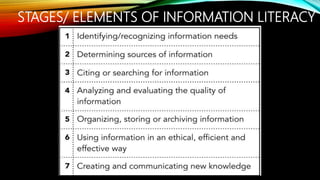
STAGES/ ELEMENTS OF INFORMATION LITERACY
INFORMATION LITERACY
A set of individual competencies needed to identify,
evaluate and use information in the most ethical, efficient
and effective way across all domains, occupations and
professions. It refers to the ability to recognize when
information is needed and to locate, evaluate, effectively
use and communicate information in its various formats
“KNOWLEDGE IS POWER”
How does information become knowledge?
COMMON KNOWLEDGE
Facts that can be found in numerous places and are likely to
be widely known.
INTERPRETATION
You must document facts that are not generally known, or
ideas that interpret facts.
PARAPHRASE
Using someone’s ideas, but rephrasing them in your own words.
Although you will use your own words to paraphrase, you must still
acknowledge and cite the source of the information.
QUOTATION
Using someone’s words directly. When you use a direct quote, place the
passage between quotation marks, and document the source according
to a standard documenting style
PLAGIARISM
Using other people’s words and ideas without clearly
acknowledging the source of the information
“There are times when you need to share information that
you have acquired from various sources written by different
authors. It is inevitable to directly quote their words in order
to preserve their meaning. However, quoting someone
else's words without giving credit to the author essentially
gives an impression that you are claiming ownership of the
words they have said.”
Plagiarism has legal implications. While ideas themselves are not
copyrightable, the artistic expression of an idea automatically falls
under copyright when it is created. Under fair use, small parts may
be copied without permission from the copyright holder. However,
even under fair use - in which you can use some parts of the
material for academic or non-profit purposes - you must attribute
the original source. What is considered fair use is rather subjective
and can vary from country to country.
STRATEGIES IN AVOIDING PLAGIARISM
• Submit your own work for publication. You need to cite even
your own work.
• Put quotation marks around everything that comes directly
from the text and cite the source.
• Paraphrase, but be sure that you are not simply rearranging
or replacing a few words and cite the source.
• Keep a source journal, a notepad, or note cards- annotated
bibliographies can be especially beneficial
• Use the style manual in properly citing sources
• Get help from the writing center or library
STRATEGIES IN AVOIDING PLAGIARISM
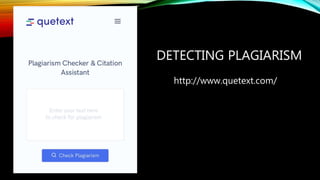
DETECTING PLAGIARISM
http://www.quetext.com/
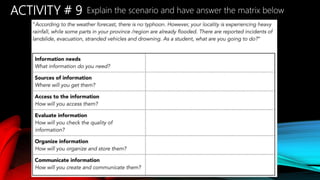
ACTIVITY # 9 Explain the scenario and have answer the matrix below

Information literacy

  • 2.
    GROUP DISCUSSION ACTIVITY #7 1.Whydo you need information? 2.Where do you search for information? 3.How do you acquire and store information? 4.How will you determine the quality and accuracy of the information that you have? 5.How do you use the information that you have? 6.How will you communicate information?
  • 3.
  • 4.
    STAGES/ ELEMENTS OFINFORMATION LITERACY
  • 5.
    INFORMATION LITERACY A setof individual competencies needed to identify, evaluate and use information in the most ethical, efficient and effective way across all domains, occupations and professions. It refers to the ability to recognize when information is needed and to locate, evaluate, effectively use and communicate information in its various formats
  • 6.
    “KNOWLEDGE IS POWER” Howdoes information become knowledge?
  • 7.
    COMMON KNOWLEDGE Facts thatcan be found in numerous places and are likely to be widely known. INTERPRETATION You must document facts that are not generally known, or ideas that interpret facts. PARAPHRASE Using someone’s ideas, but rephrasing them in your own words. Although you will use your own words to paraphrase, you must still acknowledge and cite the source of the information.
  • 8.
    QUOTATION Using someone’s wordsdirectly. When you use a direct quote, place the passage between quotation marks, and document the source according to a standard documenting style PLAGIARISM Using other people’s words and ideas without clearly acknowledging the source of the information
  • 9.
    “There are timeswhen you need to share information that you have acquired from various sources written by different authors. It is inevitable to directly quote their words in order to preserve their meaning. However, quoting someone else's words without giving credit to the author essentially gives an impression that you are claiming ownership of the words they have said.”
  • 10.
    Plagiarism has legalimplications. While ideas themselves are not copyrightable, the artistic expression of an idea automatically falls under copyright when it is created. Under fair use, small parts may be copied without permission from the copyright holder. However, even under fair use - in which you can use some parts of the material for academic or non-profit purposes - you must attribute the original source. What is considered fair use is rather subjective and can vary from country to country.
  • 11.
    STRATEGIES IN AVOIDINGPLAGIARISM • Submit your own work for publication. You need to cite even your own work. • Put quotation marks around everything that comes directly from the text and cite the source. • Paraphrase, but be sure that you are not simply rearranging or replacing a few words and cite the source.
  • 12.
    • Keep asource journal, a notepad, or note cards- annotated bibliographies can be especially beneficial • Use the style manual in properly citing sources • Get help from the writing center or library STRATEGIES IN AVOIDING PLAGIARISM
  • 13.
  • 14.
    ACTIVITY # 9Explain the scenario and have answer the matrix below