TYPES OF IMMUNITY
RAKESH SHARDA
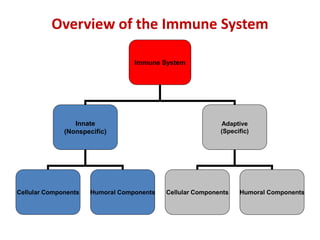
Overview of the Immune System
Immune System
Innate
(Nonspecific)
Adaptive
(Specific)
Cellular Components Humoral Components Cellular Components Humoral Components
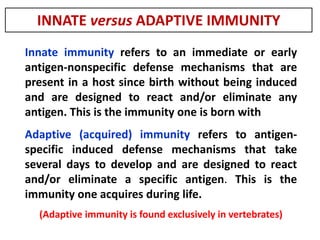
Innate immunity refers to an immediate or early
antigen-nonspecific defense mechanisms that are
present in a host since birth without being induced
and are designed to react and/or eliminate any
antigen. This is the immunity one is born with
Adaptive (acquired) immunity refers to antigen-
specific induced defense mechanisms that take
several days to develop and are designed to react
and/or eliminate a specific antigen. This is the
immunity one acquires during life.
(Adaptive immunity is found exclusively in vertebrates)
Components of the Immune Syste
INNATE versus ADAPTIVE IMMUNITY
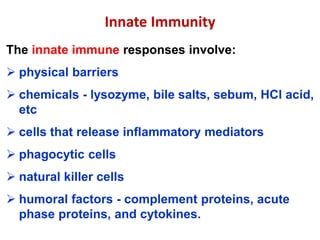
The innate immune responses involve:
 physical barriers
 chemicals - lysozyme, bile salts, sebum, HCl acid,
etc
 cells that release inflammatory mediators
 phagocytic cells
 natural killer cells
 humoral factors - complement proteins, acute
phase proteins, and cytokines.
Innate Immunity
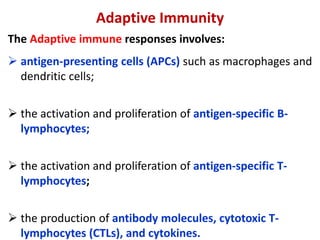
The Adaptive immune responses involves:
 antigen-presenting cells (APCs) such as macrophages and
dendritic cells;
 the activation and proliferation of antigen-specific B-
lymphocytes;
 the activation and proliferation of antigen-specific T-
lymphocytes;
 the production of antibody molecules, cytotoxic T-
lymphocytes (CTLs), and cytokines.
Adaptive Immunity
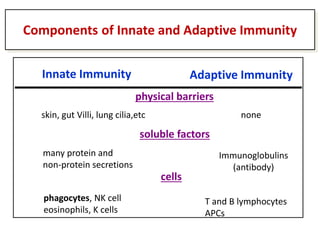
Innate Immunity Adaptive Immunity
Components of Innate and Adaptive Immunity
skin, gut Villi, lung cilia,etc
many protein and
non-protein secretions
phagocytes, NK cell
eosinophils, K cells
physical barriers
soluble factors
cells
none
Immunoglobulins
(antibody)
T and B lymphocytes
APCs
Skin GIT
Innate Immunity
Physical barrier
----- ----- ----- ----- ---- ----- ------- -------- ---- ---- ---- --- ----- -----
Chemical barrier
----- ----- ----- ----- ---- ----- ------- -------- ---- ---- ---- --- ----- -----
Sweat, Sebum, Tears
(body toxic fluids)
Antigen/ foreign material
+
Cellular barrier
Phagocytosing cells
II Line of defense
Acquired Immunity
I Line of defense
III Line of defense
B T
Antibody
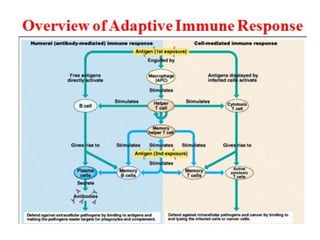
Antibody-mediated Immunity Cell Mediated Immunity
Y
Y
Y
Y Y Antigen elimination
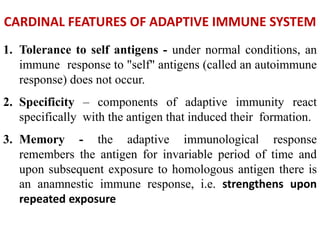
CARDINAL FEATURES OF ADAPTIVE IMMUNE SYSTEM
1. Tolerance to self antigens - under normal conditions, an
immune response to "self" antigens (called an autoimmune
response) does not occur.
2. Specificity – components of adaptive immunity react
specifically with the antigen that induced their formation.
3. Memory - the adaptive immunological response
remembers the antigen for invariable period of time and
upon subsequent exposure to homologous antigen there is
an anamnestic immune response, i.e. strengthens upon
repeated exposure
Innate Immunity Adaptive Immunity
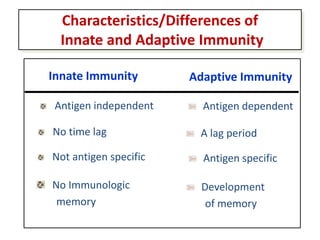
Characteristics/Differences of
Innate and Adaptive Immunity
No Immunologic
memory
Antigen independent
No time lag
Not antigen specific
Antigen dependent
A lag period
Antigen specific
Development
of memory
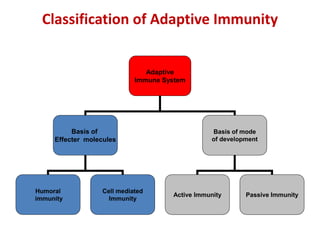
Classification of Adaptive Immunity
Adaptive
Immune System
Basis of
Effecter molecules
Basis of mode
of development
Humoral
immunity
Cell mediated
Immunity
Active Immunity Passive Immunity
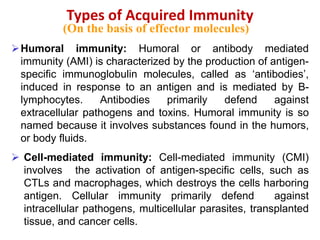
Types of Acquired Immunity
(On the basis of effector molecules)
Humoral immunity: Humoral or antibody mediated
immunity (AMI) is characterized by the production of antigen-
specific immunoglobulin molecules, called as ‘antibodies’,
induced in response to an antigen and is mediated by B-
lymphocytes. Antibodies primarily defend against
extracellular pathogens and toxins. Humoral immunity is so
named because it involves substances found in the humors,
or body fluids.
 Cell-mediated immunity: Cell-mediated immunity (CMI)
involves the activation of antigen-specific cells, such as
CTLs and macrophages, which destroys the cells harboring
antigen. Cellular immunity primarily defend against
intracellular pathogens, multicellular parasites, transplanted
tissue, and cancer cells.
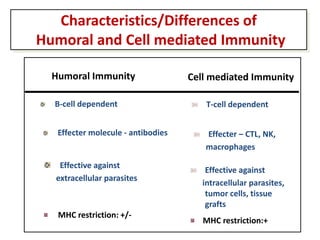
Humoral Immunity Cell mediated Immunity
Characteristics/Differences of
Humoral and Cell mediated Immunity
Effective against
extracellular parasites
B-cell dependent
Effecter molecule - antibodies
T-cell dependent
Effecter – CTL, NK,
macrophages
Effective against
intracellular parasites,
tumor cells, tissue
grafts
MHC restriction: +/-
MHC restriction:+
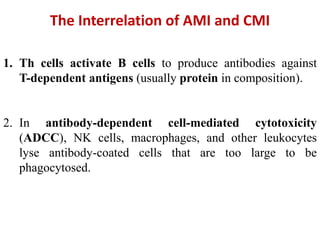
The Interrelation of AMI and CMI
1. Th cells activate B cells to produce antibodies against
T-dependent antigens (usually protein in composition).
2. In antibody-dependent cell-mediated cytotoxicity
(ADCC), NK cells, macrophages, and other leukocytes
lyse antibody-coated cells that are too large to be
phagocytosed.
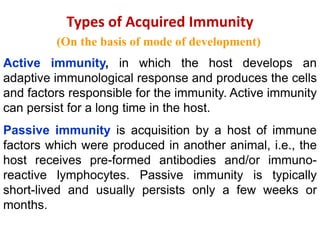
Types of Acquired Immunity
(On the basis of mode of development)
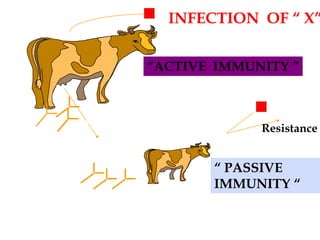
Active immunity, in which the host develops an
adaptive immunological response and produces the cells
and factors responsible for the immunity. Active immunity
can persist for a long time in the host.
Passive immunity is acquisition by a host of immune
factors which were produced in another animal, i.e., the
host receives pre-formed antibodies and/or immuno-
reactive lymphocytes. Passive immunity is typically
short-lived and usually persists only a few weeks or
months.
INFECTION OF “ X”
MILK
(COLOSTRUM)
“ACTIVE IMMUNITY ”
“ PASSIVE
IMMUNITY “
MOTHER
NEWBORN
ANTIBODIES TO “X”
ARE PRODUCED Resistance
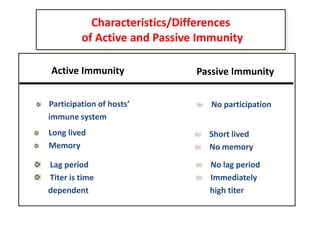
Active Immunity Passive Immunity
Characteristics/Differences
of Active and Passive Immunity
Lag period
Titer is time
dependent
Participation of hosts’
immune system
Long lived
Memory
No participation
Short lived
No memory
No lag period
Immediately
high titer
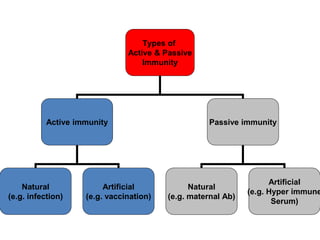
Types of
Active & Passive
Immunity
Active immunity Passive immunity
Natural
(e.g. infection)
Artificial
(e.g. vaccination)
Natural
(e.g. maternal Ab)
Artificial
(e.g. Hyper immune
Serum)
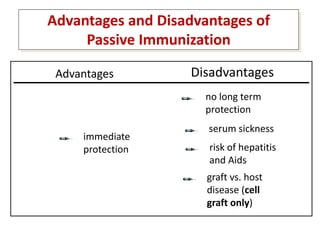
Advantages Disadvantages
serum sickness
immediate
protection
no long term
protection
graft vs. host
disease (cell
graft only)
risk of hepatitis
and Aids
Advantages and Disadvantages of
Passive Immunization

Types-of-Immunity.ppt

  • 1.
  • 2.
    Overview of theImmune System Immune System Innate (Nonspecific) Adaptive (Specific) Cellular Components Humoral Components Cellular Components Humoral Components
  • 3.
    Innate immunity refersto an immediate or early antigen-nonspecific defense mechanisms that are present in a host since birth without being induced and are designed to react and/or eliminate any antigen. This is the immunity one is born with Adaptive (acquired) immunity refers to antigen- specific induced defense mechanisms that take several days to develop and are designed to react and/or eliminate a specific antigen. This is the immunity one acquires during life. (Adaptive immunity is found exclusively in vertebrates) Components of the Immune Syste INNATE versus ADAPTIVE IMMUNITY
  • 4.
    The innate immuneresponses involve:  physical barriers  chemicals - lysozyme, bile salts, sebum, HCl acid, etc  cells that release inflammatory mediators  phagocytic cells  natural killer cells  humoral factors - complement proteins, acute phase proteins, and cytokines. Innate Immunity
  • 5.
    The Adaptive immuneresponses involves:  antigen-presenting cells (APCs) such as macrophages and dendritic cells;  the activation and proliferation of antigen-specific B- lymphocytes;  the activation and proliferation of antigen-specific T- lymphocytes;  the production of antibody molecules, cytotoxic T- lymphocytes (CTLs), and cytokines. Adaptive Immunity
  • 6.
    Innate Immunity AdaptiveImmunity Components of Innate and Adaptive Immunity skin, gut Villi, lung cilia,etc many protein and non-protein secretions phagocytes, NK cell eosinophils, K cells physical barriers soluble factors cells none Immunoglobulins (antibody) T and B lymphocytes APCs
  • 7.
    Skin GIT Innate Immunity Physicalbarrier ----- ----- ----- ----- ---- ----- ------- -------- ---- ---- ---- --- ----- ----- Chemical barrier ----- ----- ----- ----- ---- ----- ------- -------- ---- ---- ---- --- ----- ----- Sweat, Sebum, Tears (body toxic fluids) Antigen/ foreign material + Cellular barrier Phagocytosing cells II Line of defense Acquired Immunity I Line of defense III Line of defense B T Antibody Antibody-mediated Immunity Cell Mediated Immunity Y Y Y Y Y Antigen elimination
  • 8.
    CARDINAL FEATURES OFADAPTIVE IMMUNE SYSTEM 1. Tolerance to self antigens - under normal conditions, an immune response to "self" antigens (called an autoimmune response) does not occur. 2. Specificity – components of adaptive immunity react specifically with the antigen that induced their formation. 3. Memory - the adaptive immunological response remembers the antigen for invariable period of time and upon subsequent exposure to homologous antigen there is an anamnestic immune response, i.e. strengthens upon repeated exposure
  • 9.
    Innate Immunity AdaptiveImmunity Characteristics/Differences of Innate and Adaptive Immunity No Immunologic memory Antigen independent No time lag Not antigen specific Antigen dependent A lag period Antigen specific Development of memory
  • 11.
    Classification of AdaptiveImmunity Adaptive Immune System Basis of Effecter molecules Basis of mode of development Humoral immunity Cell mediated Immunity Active Immunity Passive Immunity
  • 12.
    Types of AcquiredImmunity (On the basis of effector molecules) Humoral immunity: Humoral or antibody mediated immunity (AMI) is characterized by the production of antigen- specific immunoglobulin molecules, called as ‘antibodies’, induced in response to an antigen and is mediated by B- lymphocytes. Antibodies primarily defend against extracellular pathogens and toxins. Humoral immunity is so named because it involves substances found in the humors, or body fluids.  Cell-mediated immunity: Cell-mediated immunity (CMI) involves the activation of antigen-specific cells, such as CTLs and macrophages, which destroys the cells harboring antigen. Cellular immunity primarily defend against intracellular pathogens, multicellular parasites, transplanted tissue, and cancer cells.
  • 13.
    Humoral Immunity Cellmediated Immunity Characteristics/Differences of Humoral and Cell mediated Immunity Effective against extracellular parasites B-cell dependent Effecter molecule - antibodies T-cell dependent Effecter – CTL, NK, macrophages Effective against intracellular parasites, tumor cells, tissue grafts MHC restriction: +/- MHC restriction:+
  • 15.
    The Interrelation ofAMI and CMI 1. Th cells activate B cells to produce antibodies against T-dependent antigens (usually protein in composition). 2. In antibody-dependent cell-mediated cytotoxicity (ADCC), NK cells, macrophages, and other leukocytes lyse antibody-coated cells that are too large to be phagocytosed.
  • 16.
    Types of AcquiredImmunity (On the basis of mode of development) Active immunity, in which the host develops an adaptive immunological response and produces the cells and factors responsible for the immunity. Active immunity can persist for a long time in the host. Passive immunity is acquisition by a host of immune factors which were produced in another animal, i.e., the host receives pre-formed antibodies and/or immuno- reactive lymphocytes. Passive immunity is typically short-lived and usually persists only a few weeks or months.
  • 17.
    INFECTION OF “X” MILK (COLOSTRUM) “ACTIVE IMMUNITY ” “ PASSIVE IMMUNITY “ MOTHER NEWBORN ANTIBODIES TO “X” ARE PRODUCED Resistance
  • 18.
    Active Immunity PassiveImmunity Characteristics/Differences of Active and Passive Immunity Lag period Titer is time dependent Participation of hosts’ immune system Long lived Memory No participation Short lived No memory No lag period Immediately high titer
  • 19.
    Types of Active &Passive Immunity Active immunity Passive immunity Natural (e.g. infection) Artificial (e.g. vaccination) Natural (e.g. maternal Ab) Artificial (e.g. Hyper immune Serum)
  • 21.
    Advantages Disadvantages serum sickness immediate protection nolong term protection graft vs. host disease (cell graft only) risk of hepatitis and Aids Advantages and Disadvantages of Passive Immunization